16339. National of North America (New York, NY)

Bank Information

Episode Type
Suspension → Closure
Bank Type
state
Start Date
February 1, 1908*
Location
New York, New York (40.714, -74.006)

Metadata

Model
gpt-5-mini
Short Digest
77aa48ab

Response Measures

None

Description

Articles (1912) recount testimony about the 1907 panic aftermath: the Clearing House committee in late Jan. 1908 called loan/clearing certificates of the National of North America (and other 'Morse' banks), which precipitated the bank's suspension and ultimate collapse. The coverage describes the bank being forced to suspend/close as a consequence of the Clearing House action; no explicit description of a depositor run prior to suspension is given in the provided excerpts. I therefore classify this as a suspension leading to permanent closure. Date for the Clearing House call is cited as late January 1908 with withdrawal required by Feb. 6, 1908; suspension/closure is placed in early Feb. 1908.

Events (3)

1. February 1, 1908* Other
Newspaper Excerpt
the National of North America ... went down to ruin with the Oriental. ... the collapse of what were known as the Morse banks-the National of North America, The New Amsterdam, and the Mechanics and Traders went down to ruin with the Oriental.
Source
newspapers
2. February 6, 1908 Suspension
Cause Details
Clearing House committee peremptorily called the bank's loan/clearing certificates (withdrawal of Clearing House support) in late January 1908, forcing the bank to suspend.
Newspaper Excerpt
requiring them to withdraw their Clearing House panic certificates by Feb. 6 following.
Source
newspapers
3. * Receivership
Newspaper Excerpt
the two Morse banks-the National of North America and the New Amsterdam-and the Mechanics and Traders went down to ruin with the Oriental.
Source
newspapers

Newspaper Articles (11)

Article from The Evening World, June 7, 1912

Click image to open full size in new tab

Article Text

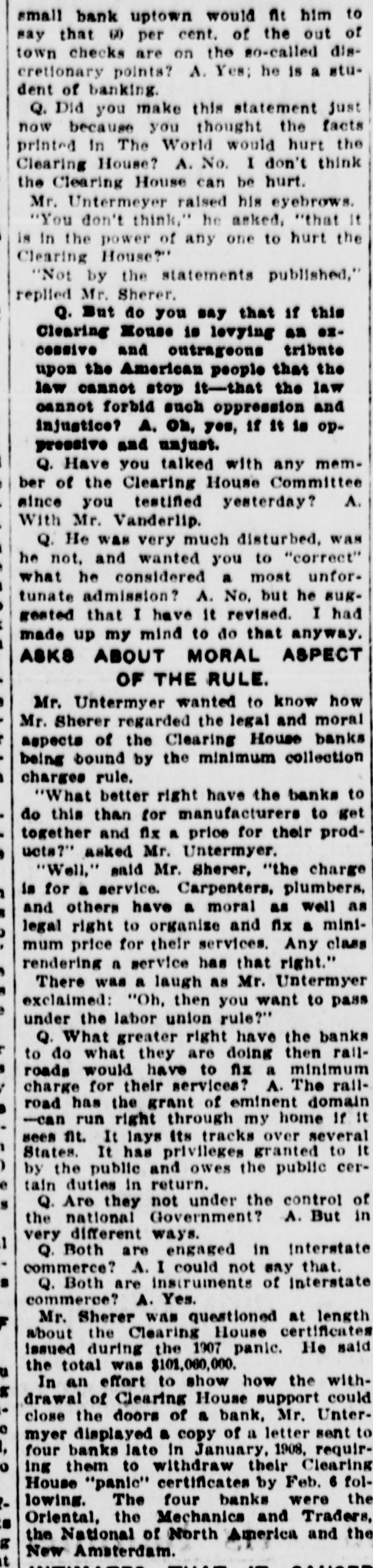
small bank uptown would fit him to say that 60 per cent. of the out of town checks are on the so-called discretionary points? A. Yes; he is a student of banking. Q. Did you make this statement just now because you thought the facts printed In The World would hurt the Clearing House? A. No. I don't think the Clearing House can be hurt. Mr. Untermeyer raised his eyebrows. "You don't think," he asked, "that It is in the power of any one to hurt the Clearing House?" "Not by the statements published," replied Mr. Sherer. Q. But do you say that if this Clearing Mouse is levying an excessive and outrageous tribute upon the American people that the law cannot stop it-that the law cannot forbid such oppression and injustice? A. on, yes, if it is oppressive and unjust. Q. Have you talked with any member of the Clearing House Committee since you testified yesterday? A. With Mr. Vanderlip. Q. He was very much disturbed, was he not, and wanted you to "correct" what he considered a most unfortunate admission? A. No. but he suggested that I have it revised. I had made up my mind to do that anyway. ASKS ABOUT MORAL ASPECT OF THE RULE. Mr. Untermyer wanted to know how Mr. Sherer regarded the legal and moral aspects of the Clearing House banks being bound by the minimum collection charges rule. "What better right have the banks to do this than for manufacturers to get together and fix a price for their products?" asked Mr. Untermyer. "Well," said Mr. Sherer, "the charge is for a service. Carpenters, plumbers, and others have a moral as well as legal right to organize and fix a minimum price for their services. Any class rendering a service has that right." There was a laugh as Mr. Untermyer exclaimed: "Oh, then you want to pass under the labor union rule?" Q. What greater right have the banks to do what they are doing then railroads would have to fix a minimum charge for their services? A. The railroad has the grant of eminent domain -can run right through my home If It sees fit. It lays Its tracks over several States. It has privileges granted to It by the public and owes the public certain duties in return. Q. Are they not under the control of the national Government? A. But in very different ways. 1 Q. Both are engaged in interstate commerce? A. I could not say that. Q. Both are instruments of Interstate commerce? A. Yes. Mr. Sherer was questioned at length about the Clearing House certificates issued during the 1907 panic. He said the total was $101,060,000. In an effort to show how the withdrawal of Clearing House support could close the doors of a bank, Mr. Untermyer displayed a copy of a letter sent to four banks late in January, 1908, requiring them to withdraw their Clearing House "panic" certificates by Feb. 6 following. The four banks were the Oriental, the Mechanics and Traders, the National of North America and the New Amsterdam.


Article from The Washington Herald, June 12, 1912

Click image to open full size in new tab

Article Text

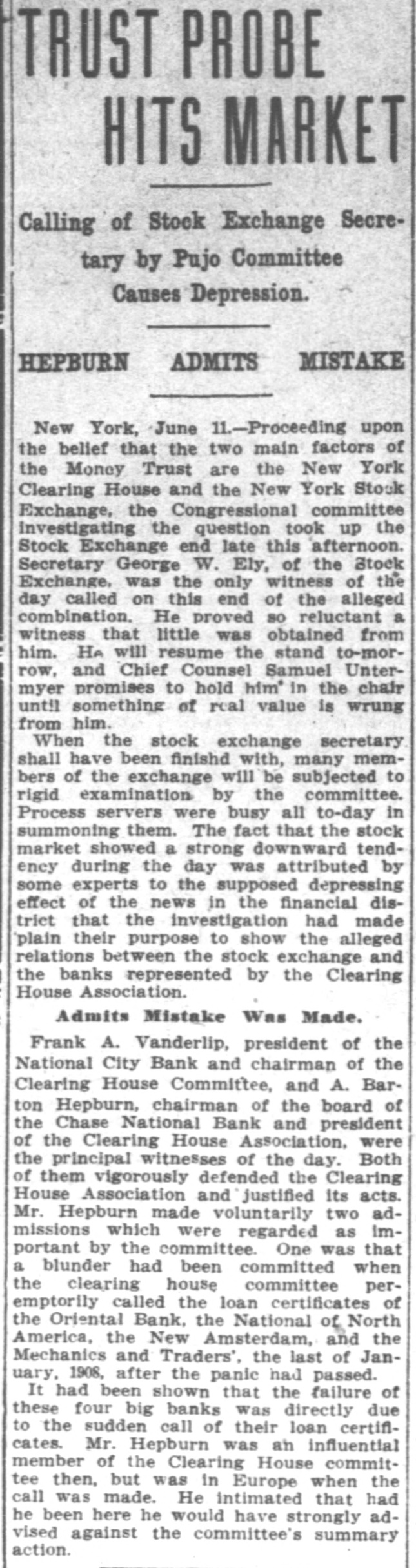
TRUST PROBE HITS MARKET Calling of Stock Exchange Secretary by Pujo Committee Causes Depression. HEPBURN ADMITS MISTAKE New York, June 11.-Proceeding upon the belief that the two main factors of the Money Trust are the New York Clearing House and the New York Stock Exchange, the Congressional committee investigating the question took up the Stock Exchange end late this afternoon. Secretary George W. Ely, of the Stock Exchange, was the only witness of the day called on this end of the alleged combination. He proved so reluctant a witness that little was obtained from him. HA will resume the stand to-morrow, and Chief Counsel Samuel Untermyer promises to hold him* in the chair until something of real value is wrung from him. When the stock exchange secretary shall have been finishd with, many members of the exchange will be subjected to rigid examination by the committee. Process servers were busy all to-day in summoning them. The fact that the stock market showed a strong downward tendency during the day was attributed by some experts to the supposed depressing effect of the news in the financial district that the investigation had made plain their purpose to show the alleged relations between the stock exchange and the banks represented by the Clearing House Association. Admits Mistake Was Made. Frank A. Vanderlip, president of the National City Bank and chairman of the Clearing House Committee, and A. Barton Hepburn, chairman of the board of the Chase National Bank and president of the Clearing House Association, were the principal witnesses of the day. Both of them vigorously defended the Clearing House Association and justified its acts. Mr. Hepburn made voluntarily two admissions which were regarded as Important by the committee. One was that a blunder had been committed when the clearing house committee peremptorily called the loan certificates of the Oriental Bank, the National of North America, the New Amsterdam, and the Mechanics and Traders', the last of January, 1908, after the panic had passed. It had been shown that the failure of these four big banks was directly due to the sudden call of their loan certificates. Mr. Hepburn was an influential member of the Clearing House committee then, but was in Europe when the call was made. He intimated that had he been here he would have strongly advised against the committee's summary action.


Article from The Manitowoc Pilot, June 13, 1912

Click image to open full size in new tab

Article Text

SOUND BANKS WERE FORCED TO CLOSE Clearing House Denied Help at Critical Times. RESULTED IN KELLY'S DEATH "Money Trust" Investigation Develops Tragedy of "High Finance" and Cause of Failure of Four Big Institutions. New York, June 10.-Testimony on Friday intended to show how the power of the New York clearing house committee was used to force a solvent bank to the wall during the aftermath of the panic of 1907, with the result that the "fair reputation" of its president was "blasted," was presented dramatically before the Pujo committee of the house of representatives which is investigating the so-called money trust. Witnesses told how Hugh Kelly, after being induced by members of the clearing house to assume the presidency of the Oriental bank, was denied help at a critical time, the bank being forced to suspend. This, it is declared by friends, was the direct cause of the death of Mr. Kelly eight months later. R. W. Jones, himself broken in health, produced a letter soon after he had been called to the witness stand by Samuel Untermyer, counsel to the committee. Mr. Jones was president of the Oriental bank when the financial cyclone of 1907 swept over New York. According to his testimony and that of Erskine Hewitt, son of the late Abraham Hewitt, and Charles K. Beekman, both of whom were directors of the ill-fated bank-Mr. Hewitt also being its counsel-the clearing house committee of the New York Clearing House association, prescribed conditions for the conduct of the Oriental bank which made it impossible for it to survive. And so It as driven to the wall, although as shown by its assets, it was perfectly solvent. Their statements indicate that as soon as President Jones met one requirement made by the clearing house committee that organization would prescribe a new one, until finally it issued its ultimatum that nothing would be done to aid the Oriental unless Jones resigned the presidency and was succeeded by Hugh Kelly. The Oriental was one of the oldest banks in New York and was a charter member of the clearing house. The two Morse banks-the National of North America and the New Amsterdam-and the Mechanics and Traders went down to ruin with the Oriental. The Brooklyn bank and the Borough bank of Brooklyn had closed previously when the Oriental was ordered to cease clearing for them. Mr. Kelly accepted the presidency under protest and only after he had been solemnly assured, according to


Article from The Salt Lake Tribune, September 19, 1912

Click image to open full size in new tab

Article Text

# MORSE ANXIOUS TO APPEAR AS WITNESS Expects to Give Money Trust Probers His Version of Crash in Roosevelt Administration. # MORGAN IS SUMMONED William G. Rockefeller, James Stillman, Thomas F. Ryan and Others to Testify. By International News Service. NEW YORK, Sept. 18.-J. Pierpont Morgan and Charles W. Morse will be among the first witnesses called in the money trust investigation to be re- sumed by the house committee on bank- ing and currency in this city about the middle of November. This was learned today from officials of the com- mittee. Deputy Sergeant-at-Arms White, of the house of representatives, is supposed to have served these two and several other financiers with sub- poenaes on his arrivel from Washing- ton. Mr. White could be located to- night. It is known, however, that he has subpoenaes for Messrs. Morgan and Morse and also for William Rockefeller, James Stillman, Thomas F. Ryan, George F. Baker, president of the First National bank; Otto T. Bannard, presi- dent of the New York Trust company; William A. Nash and Walter E. Frew, respectively chairman of the board and president of the Corn Exchange bank. The two latter are made subject to the jurisdiction of the committee by reason of their service on the clearing house committee Member of Committee. Mr. Walsh was a member of that all- powerful organization in 1907 when the committee took charge of the fi- nancial situation during the panic, and has been charged by witnesses hereto- fore examined in the money trust in- vestigation with participating in con- ferences that preceded the closing of the old Oriental National bank, and which so quickly was followed by the collapse of what were known as the Morse banks-the National of North America, The New Amsterdam, and the Mechanics and Traders. Mr. Frew is now a member of the clearing house committee. William Rockefeller could not be served with a subpoena when the com- mittee was holding its sessions last spring. At that time it was charged that he had suddenly gone to Canada to evade service. His health then was not good. It is reported that be has sufficiently recovered to be able to stand the ordeal of an examination by Samuel Untermyer, chief counsel of the congressional committee. J. P. Mor- gan went to Europe before he could be served with a subpoena and re- turned only a few weeks ago. # Will Assist Untermyer. Major E. H. Farrar, leader of the New Orleans bar and recently presi- dent of the American Bar association, is associated with Mr. Untermyer as counsel. Major Farrar has been in New York for the last two weeks colaborat- ing with Mr. Untermyer in the work of preparation for the resumption of the investigation after the election in No- vember. Charles W. Morse is expected to re- late a more sensational story regard- ing the operations of the alleged money trust than has yet been told by wit- nesses already examined as to the cause of the failure of the Oriental and Morse banks in spite of the absolute solvency of all those institutions. Morse has suffered a term in the penitentiary on an indictment charging him with crim- inally mismanaging his banks. While undergoing in the federal prison at Atlanta a term of fifteen years he stub- bornly maintained that silence which characterized his skyrocket career as a "high financier." But since his restor- ation to freedom and to health, it is stated by several of his friends that he is anxious to be placed on the witness stand before the congressional prob- ers in order that he may tell under oath, and in detail for the first time the full story of what he is convinced was a carefully laid plot of a powerful group of financiers to ruin him.


Article from Rock Island Argus, September 20, 1912

Click image to open full size in new tab

Article Text

MORSE WILL HAVE REVENGE ON J.P. New York Convict Banker Promises to Bare Plot to Ruin Him. New York, Sept. 20.-Charles W. Morse will go before the house committee on banking and currency which is investigating the money trust when its hearings are resumed here in the middle of November and tell for the first time the full story of what he is convinced was a carefully laid plot by a powerful group of financiers to ruin him. He is expected to take revenge on J. Pierpont Morgan. Deputy Sergeant-at-Arms White of the house of representatives is supposed to have served Morse and Morgan today with subpoenas to appear before the committee. The house officer is known to have come to New York with subpoenas for Morgan and Morse, William Rockefeller, James Stillman, Thomas F. Ryan, George F. Baker, president of the First National a bank; Otto T. Bannard, president of d the New York Trust company; William e A. Nash and Walter E. Frew, respec₫ tively, chairman of the board and president of the Corn Exchange bank. Morse is expected to relate a more a sensational story regarding the operad tions of the alleged money trust than has yet been told by witnesses directly examined as to the cause of the l failure of the Oriental and Morse banks in spite of the absolute solvency of all of those institutions. Morse has suffered a term in the penitentiary on d an indictment charging him with criminally mismanaging his banks. y While undergoing in the federal O prison at Atlanta a term of 15 years d he stubbornly maintained that silence which characterized his skyrocket caS. reer as a "high financier." But since S his restoration to freedom and to health it is stated by several of his friends that he is anxious to be placed e on the witness stand before the cond gressional probers to tell the story under oath and in detail, a William A. Nash and Walter A. y Frew. who are to be summoned, are subject to the jurisdiction of the comy mittee by reason of their service on the clearing house committee. Mr. Nash was a member of that all-powd erful organization in 1907 when the committee took charge of the financial situation during the panic and has ty been charged by witnesses heretofore examined in the money trust investirt gation with participating in confer10 ences that preceded the closing of the e old Oriental National bank, which so quickly was followed by the collapse ts of what was known as the Morse banks e --the National of North America, the ed New Amsterdam and the Mechanics' r& Traders'. Mr. Frew is now a member of the clearing house committee. William Rockefeller could not be served with a subpoena when the comds mittee was holding its sessions last he spring. At that time it was charged e that he had suddenly gone to Canada re to evade service. His health then was al not good. It is reported that he has es sufficiently recovered to be able to In stand the ordeal of an examination by re Samuel Untermyer, chief counsel of d. the congressional committee. J. P. Morgan went to Europe before he could be served with a subpoena and returned only a few weeks ago. 0 Major E. H. Farrar, leader of the OX, New Orleans bar and recently presite dent of the American Bar association a is associated with Mr. Untermyer as hicounsel. Major Farrar has been in atNew York for the last two weeks co! gn laborating with Mr. Untermyer in the th work of preparation for the resumption to of the investigation after the election in November


Article from The Cairo Bulletin, September 20, 1912

Click image to open full size in new tab

Article Text

MORSE TO HAVE REVENCE SOON ON P. MORGAN Convict Banker Will Bare Plat to Ruin Him in Panic CALLED IN HOUSE INQUIRY Expected to Take Witness Stand and Attaek Powerful Financiers New York, Sept. Charles W. Morse will go before the House Committee on Banking and Currency which is investigating the money trust when its hearings are resumed here in the middle of November and tell for the first time the full story of what lie is convinced was a carefully laid plot by a powerful group of financiers to ruin him. He is expected to take revenge on J. Pierpont Morgan Deputy Sergeant at Arms White, of the House of Representatives, is supposed to have served Morse and Morgan today with subpoenas to ap pear before the committee. The House officer is known to have come to New York with subpoenas for Morgan and Morse, William Rockefeller, Pames Stillman, Thomas F. Ryan, George F Baker, president of the First National Bank: Otto T. Bannard, president of the New York Trust Company; William A. Nash and Walter E. Frew. respectively chairman of the board and president of the Corn Exchange Bank. Expect Sensation From Morse. Morse is expected to relate a more sensational story regarding the operations of the alleged money trust than has yet been told by witnesses already examined as to the cause of the failure of the Oriental and Morse banks in spite of the absolute solvency of all of those institsutions. Morse has suffered a term in the penitentiary on an indictment charging him with criminally mis managing his banks. While undergoing in the federal prison at Atlanta a term of fifteen years he stubbornly maintained that silence which characterized his sky rocket career as a "high financier." But since his restoration to freedom and to health it is stated by several of his friends that he is anxious to be placed on the witness stand before the Congressional probers to tell the story under oath and in detail Took Charge During Panic. William A. Nash and Walter A Frew wh,o are to be summoned, are subject to the jurisdiction of the committee by reason of their service on the clearing house commit tee. Mr. Nash was a member of that all-powerful organization 1907 when the committee took charge of the financial situation during the panic and has been charged by witnesses heretofore examined in the money trust investigation with par ticipating in conferences that preceeded the closing of the old Criental National Bank, which so quickly was followed by the collapse of what were known as the Morse banksthe National of North America, the New Amsterdam and the Mechanics a and Traders' Mr. Frew is now member of the clearing house committee. Rockefeller Well Enough Now. William Rockefeller could not be served with a subpoena when the committee was holding its session last spring. At that time it was charged that he had suddenly gone to Canada to evade service. His health then was not good. It is reported that he has sufficiently recovered to be able to stand the ordeal of an examination by Samuel Unteymyer, chief counsel of the Congressional committee. J. P. Morgan went to Europe before he could be served with a subpoena and returned only a few weeks ago. Major E. H. Farrar, leader of the New Orleans bar and recently president of the American Bar Association, is associated with Mr. Untermyer as counsel. Major Farrar has for Unterweeks been in in collaborating New York with the Mr. last two myer the work of preparation for the resumption of the


Article from Manchester Democrat, September 25, 1912

Click image to open full size in new tab

Article Text

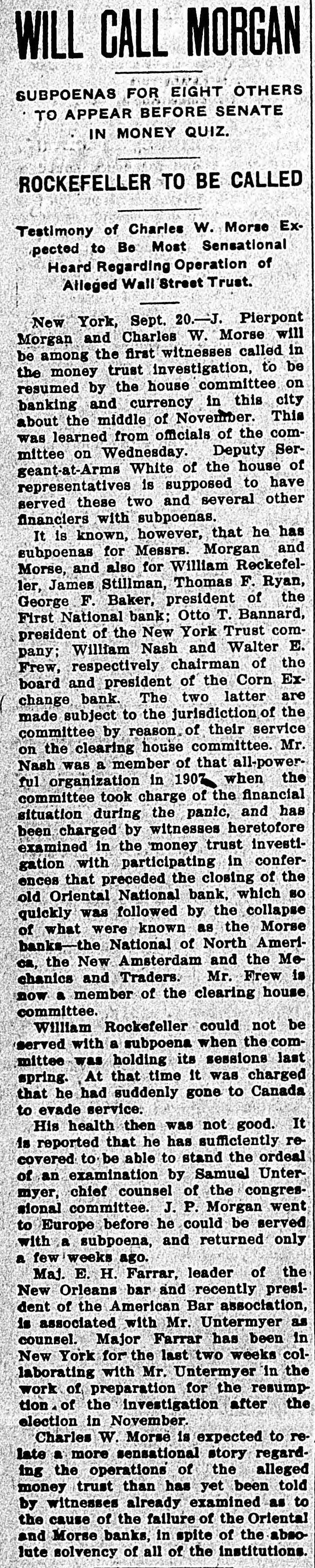
WILL CALL MORGAN SUBPOENAS FOR EIGHT OTHERS TO APPEAR BEFORE SENATE IN MONEY QUIZ. ROCKEFELLER TO BE CALLED Testimony of Charles W. Morse Expected to Be Most Sensational Heard Regarding Operation of Alleged Wall Street Trust. New York, Sept. 20.-J. Pierpont Morgan and Charles W. Morse will be among the first witnesses called in the money trust investigation, to be resumed by the house committee on banking and currency in this city about the middle of November. This was learned from officials of the committee on Wednesday. Deputy Sergeant-at-Arms White of the house of representatives is supposed to have served these two and several other financiers with subpoenas. It is known, however, that he has subpoenas for Messrs. Morgan and Morse, and also for William Reckefeller, James Stillman, Thomas F. Ryan, George F. Baker, president of the First National bank; Otto T. Bannard, president of the New York Trust company; William Nash and Walter E. Frew, respectively chairman of the board and president of the Corn Exchange bank. The two latter are made subject to the jurisdiction of the committee by reason of their service on the clearing house committee. Mr. Nash was a member of that all-powerful organization in 1907, when the committee took charge of the financial situation during the panic, and has been charged by witnesses heretofore examined in the money trust investigation with participating in conferences that preceded the closing of the old Oriental National bank, which so quickly was followed by the collapse of what were known as the Morse banks-the National of North America, the New Amsterdam and the Mechanics and Traders. Mr. Frew is now a member of the clearing house committee. William Rockefeller could not be served with a subpoena when the committee was holding its sessions last spring. At that time it was charged that he had suddenly gone to Canada to evade service. His health then was not good. It is reported that he has sufficiently recovered to be able to stand the ordeal of an examination by Samuel Untermyer, chief counsel of the congressional committee. J. P. Morgan went to Europe before he could be served with a subpoena, and returned only a few weeks ago. Maj. E. H. Farrar, leader of the New Orleans bar and recently president of the American Bar association, is associated with Mr. Untermyer as counsel. Major Farrar has been in New York for the last two weeks collaborating with Mr. Untermyer in the work of preparation for the resumption of the investigation after the election in November. Charles W. Morse is expected to relate a more sensational story regarding the operations of the alleged money trust than has yet been told by witnesses already examined as to the cause of the failure of the Oriental and Morse banks, in spite of the absolute solvency of all of the institutions.


Article from The Greenville Journal, September 26, 1912

Click image to open full size in new tab

Article Text

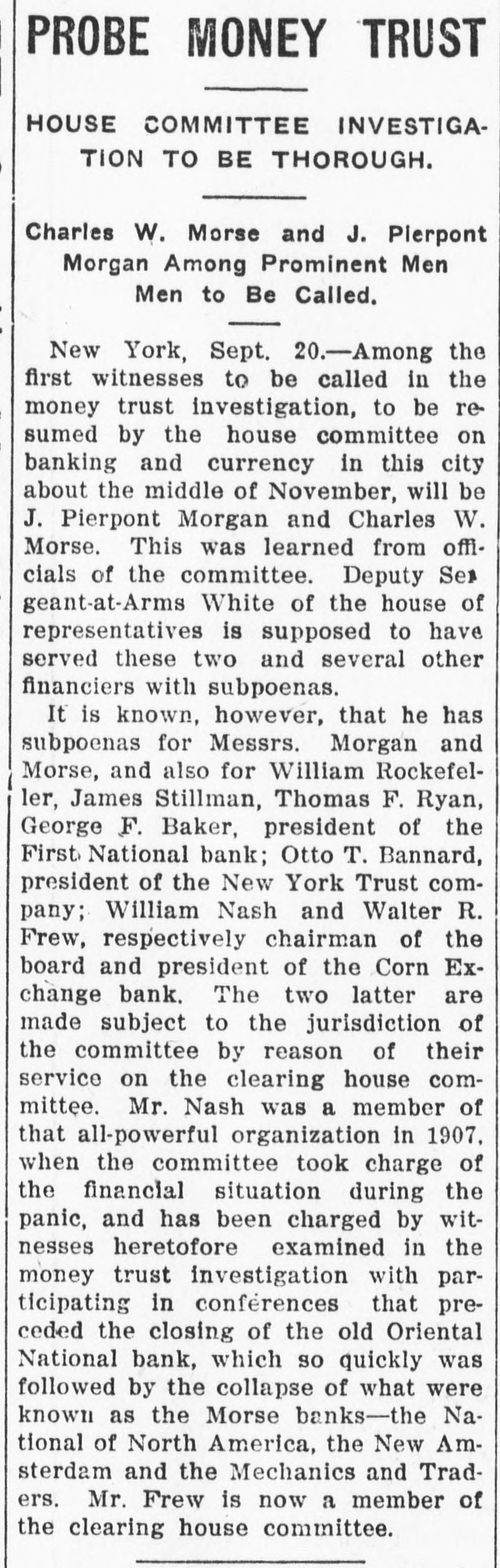
PROBE MONEY TRUST HOUSE COMMITTEE INVESTIGATION TO BE THOROUGH. Charles W. Morse and J. Pierpont Morgan Among Prominent Men Men to Be Called. New York, Sept. 20.-Among the first witnesses to be called in the money trust investigation, to be resumed by the house committee on banking and currency in this city about the middle of November, will be J. Pierpont Morgan and Charles W. Morse. This was learned from officials of the committee. Deputy Ser geant-at-Arms White of the house of representatives is supposed to have served these two and several other financiers with subpoenas. It is known, however, that he has subpoenas for Messrs. Morgan and Morse, and also for William Rockefeller, James Stillman, Thomas F. Ryan, George F. Baker, president of the First National bank; Otto T. Bannard, president of the New York Trust company; William Nash and Walter R. Frew, respectively chairman of the board and president of the Corn Exchange bank. The two latter are made subject to the jurisdiction of the committee by reason of their service on the clearing house committee. Mr. Nash was a member of that all-powerful organization in 1907, when the committee took charge of the financial situation during the panic, and has been charged by witnesses heretofore examined in the money trust investigation with participating in conférences that preceded the closing of the old Oriental National bank, which so quickly was followed by the collapse of what were known as the Morse banks-the National of North America, the New Amsterdam and the Mechanics and Traders. Mr. Frew is now a member of the clearing house committee.


Article from River Falls Journal, September 26, 1912

Click image to open full size in new tab

Article Text

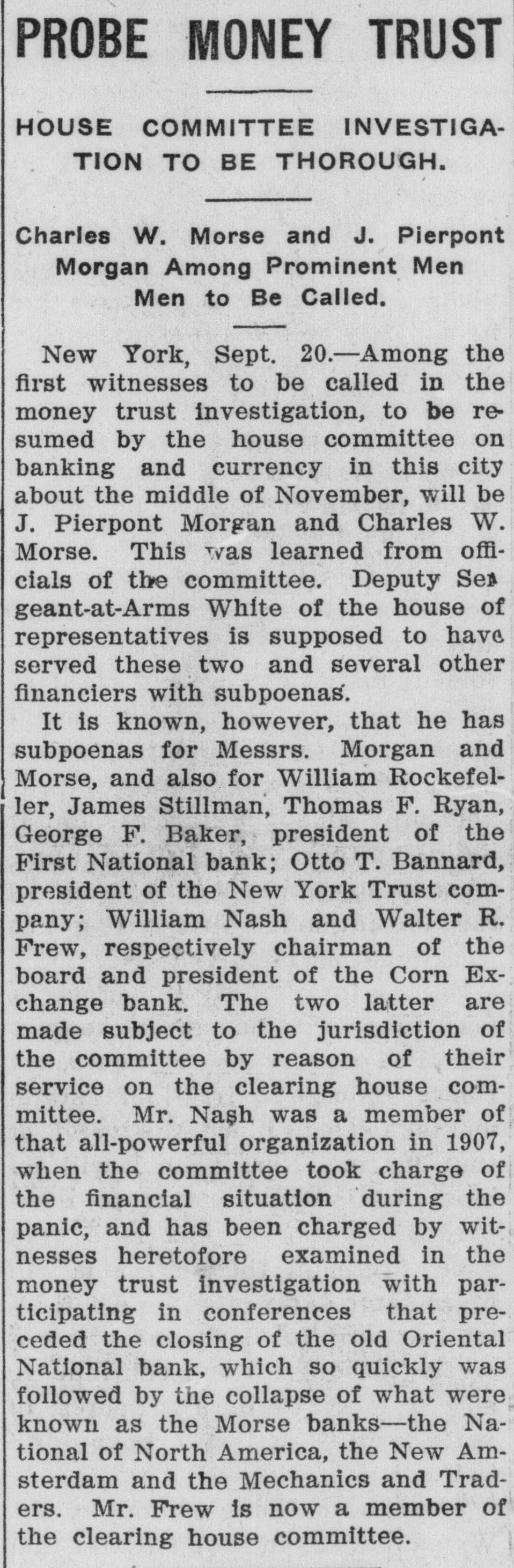
PROBE MONEY TRUST HOUSE COMMITTEE INVESTIGATION TO BE THOROUGH. Charles W. Morse and J. Pierpont Morgan Among Prominent Men Men to Be Called. New York, Sept. 20.-Among the first witnesses to be called in the money trust investigation, to be resumed by the house committee on banking and currency in this city about the middle of November, will be J. Pierpont Morgan and Charles W. Morse. This was learned from officials of the committee. Deputy Ser geant-at-Arms White of the house of representatives is supposed to have served these two and several other financiers with subpoenas. It is known, however, that he has subpoenas for Messrs. Morgan and Morse, and also for William Rockefeller, James Stillman, Thomas F. Ryan, George F. Baker, president of the First National bank; Otto T. Bannard, president of the New York Trust company; William Nash and Walter R. Frew, respectively chairman of the board and president of the Corn Exchange bank. The two latter are made subject to the jurisdiction of the committee by reason of their service on the clearing house committee. Mr. Nash was a member of that all-powerful organization in 1907, when the committee took charge of the financial situation during the panic, and has been charged by witnesses heretofore examined in the money trust investigation with participating in conferences that preceded the closing of the old Oriental National bank, which so quickly was followed by the collapse of what were known as the Morse banks-the National of North America, the New Amsterdam and the Mechanics and Traders. Mr. Frew is now a member of the clearing house committee.


Article from The Progressive West Virginian, September 26, 1912

Click image to open full size in new tab

Article Text

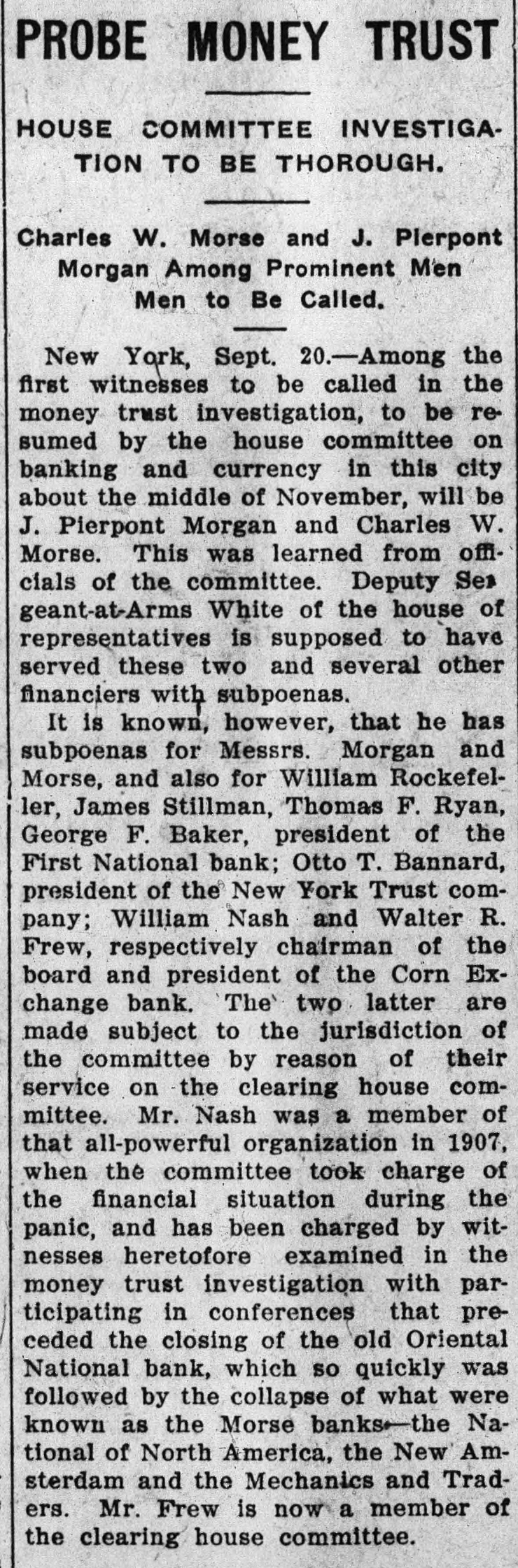
PROBE MONEY TRUST HOUSE COMMITTEE INVESTIGATION TO BE THOROUGH. Charles W. Morse and J. Pierpont Morgan Among Prominent Men Men to Be Called. New York, Sept. 20.-Among the first witnesses to be called in the money trust investigation, to be resumed by the house committee on banking and currency in this city about the middle of November, will be J. Pierpont Morgan and Charles W. Morse. This was learned from officials of the committee. Deputy Ser geant-at-Arms White of the house of representatives is supposed to have served these two and several other financiers with subpoenas. It is known, however, that he has subpoenas for Messrs. Morgan and Morse, and also for William Rockefeller, James Stillman, Thomas F. Ryan, George F. Baker, president of the First National bank; Otto T. Bannard, president of the New York Trust company; William Nash and Walter R. Frew, respectively chairman of the board and president of the Corn Exchange bank. The two latter are made subject to the jurisdiction of the committee by reason of their service on the clearing house committee. Mr. Nash was a member of that all-powerful organization in 1907, when the committee took charge of the financial situation during the panic, and has been charged by witnesses heretofore examined in the money trust investigation with participating in conferences that preceded the closing of the old Oriental National bank, which so quickly was followed by the collapse of what were known as the Morse banks-the National of North America, the New Amsterdam and the Mechanics and Traders. Mr. Frew is now a member of the clearing house committee.


Article from Dakota Farmers' Leader, September 27, 1912

Click image to open full size in new tab

Article Text

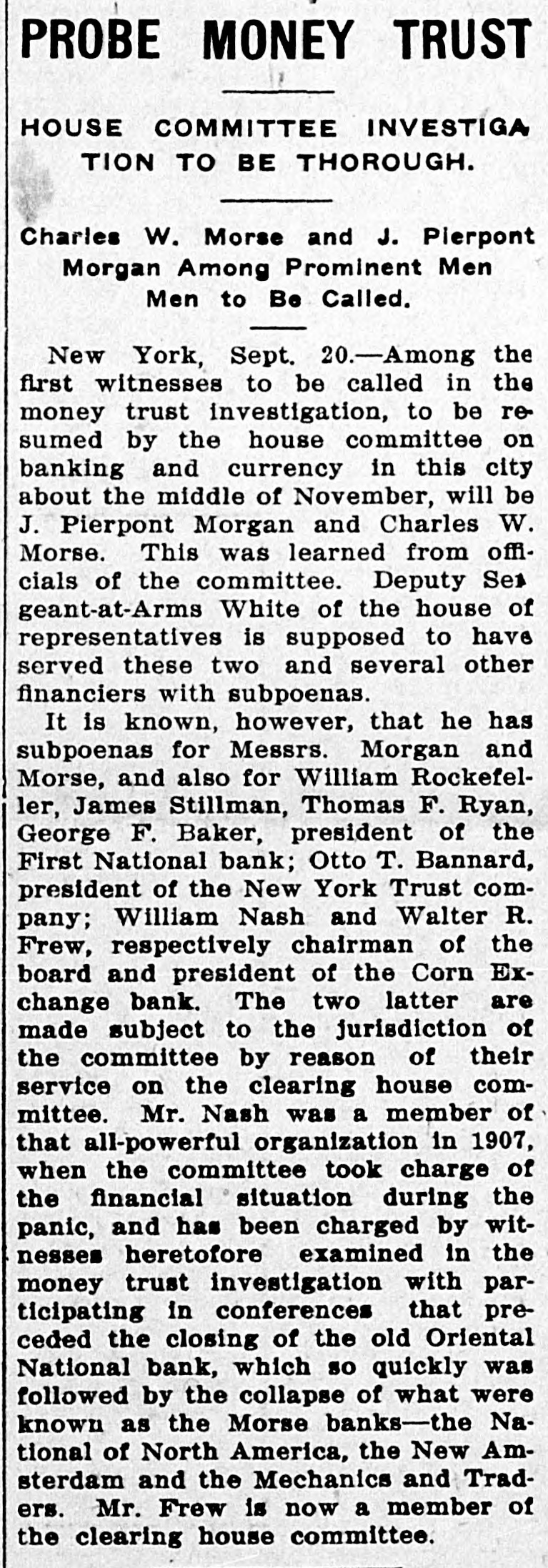
PROBE MONEY TRUST HOUSE COMMITTEE INVESTIGA TION TO BE THOROUGH. Charles W. Morse and J. Pierpont Morgan Among Prominent Men Men to Be Called. New York, Sept. 20.-Among the first witnesses to be called in the money trust investigation, to be resumed by the house committee on banking and currency in this city about the middle of November, will be J. Pierpont Morgan and Charles W. Morse. This was learned from officials of the committee. Deputy Set geant-at-Arms White of the house of representatives is supposed to have served these two and several other financiers with subpoenas. It is known, however, that he has subpoenas for Messrs. Morgan and Morse, and also for William Rockefeller, James Stillman, Thomas F. Ryan, George F. Baker, president of the First National bank; Otto T. Bannard, president of the New York Trust company; William Nash and Walter R. Frew, respectively chairman of the board and president of the Corn Exchange bank. The two latter are made subject to the jurisdiction of the committee by reason of their service on the clearing house committee. Mr. Nash was a member of that all-powerful organization in 1907, when the committee took charge of the financial situation during the panic, and has been charged by witnesses heretofore examined in the money trust investigation with participating in conferences that preceded the closing of the old Oriental National bank, which so quickly was followed by the collapse of what were known as the Morse banks-the National of North America, the New Amsterdam and the Mechanics and Traders. Mr. Frew is now a member of the clearing house committee.