16335. National Trust Company (New York, NY)

Bank Information

Episode Type
Run → Suspension → Reopening
Bank Type
trust company
Start Date
September 20, 1873
Location
New York, New York (40.714, -74.006)

Metadata

Model
gpt-5-mini
Short Digest
137aa844

Response Measures

Full suspension, Books examined

Other: Bank is a Trust Company; clearing-house issued loan certificates to support banks in crisis.

Description

During the Sept. 1873 panic the National Trust Company was unable to realize on securities and suspended in late Sept. It later resumed payment in early October (reports Oct 9–14). Suspension was driven by the wider financial panic sparked by Jay Cooke & Co. and the illiquidity of the market rather than a specific internal fraud.

Events (3)

1. September 20, 1873 Run
Cause
Macro News
Cause Details
Part of the broader Sept. 1873 financial panic (Jay Cooke failure, collapsing stock values) causing depositors to withdraw and inability to sell securities.
Measures
Directors called in loans and attempted to negotiate securities; trustees/executive committee examined affairs and sought to convert securities into money.
Newspaper Excerpt
Soon after the suspension of the Union Trust Company was reported the suspension of the National Trust Company was announced, and this served, if possible, to intensify the excitement.
Source
newspapers
2. September 20, 1873 Suspension
Cause
Macro News
Cause Details
Illiquidity of the market amid the wider panic prevented negotiation of government securities and realization of assets, forcing a temporary suspension of payments.
Newspaper Excerpt
The National Trust Company ... could not realize a dollar on them and wisely closed its doors until it could dispose of them.
Source
newspapers
3. October 9, 1873 Reopening
Newspaper Excerpt
The National Trust Company, at the corner of Broadway and Warren streets, resumed payment yesterday... We are able to pay every dollar deposited with us, and have neither sacrificed any stock nor sold any securities at a loss.
Source
newspapers

Newspaper Articles (24)

Article from The Daily Dispatch, September 21, 1873

Click image to open full size in new tab

Article Text

MEASURES FOR RELIEF. NEW YORK. # UNPRECEDENTED PANIC AT THE OPENING OF THE STOCK EXCHANGE-GREAT TUMBLE IN VALUES-GENERAL DISASTER IMMINENT-THE EXCHANGE CLOSED -A STARTLING DEFALCATION-BETTER FEELING IN THE EVENING. [Special telegram to the Dispatch.] NEW YORK, September 20.-To-day has witnessed one of the greatest panics that ever occurred on the Stock Exchange. At the opening there was an improvement of two to six per cent. in values, and great hopes were entertained that the end had been reached. But these hopes were soon destroyed when it was announced that the Union Trust Company had decided to stop until Monday. The suspension of the Trust Company was followed by that of the Bank of the Commonwealth, which closed its doors at an early hour. The excitement and panic which followed the suspension of these institutions were beyond description. The Stock Exchange RESEMBLED A MAD-HOUSE, and the streets were blocked with people, all laboring under great excitement and frenzy. Prices tumbled from two to sixteen per cent., and stocks were slaughtered without any apparent regard to values. Amid the surging of an excited crowd in the Stock Exchange and continued destruction of values there were some few cool and level heads. These men conceived the idea of imitating the Vienna plan of CLOSING THE EXCHANGE, and immediately the Governing Committee was convened to take action thereon. In a few moments the Board was called to order, and from the rostrum the announcement was made that the Exchange would be closed until further orders from the President. This was received with great joy, and the Exchange resounded with cheers. The gong was sounded, and in less time than it takes to record the fact the wild excitement was over, the surging crowd of frantic brokers disappeared, and the Stock Exchange was nothing but a deserted hall. All this happened in so short a time that it seems almost impossible, and only those on the spot can realize the remarkable change. All dealings on the street are strictly prohibited under penalty of expulsion, and therefore no business can be transacted. MORE SUSPENSIONS. Soon after the suspension of the Union Trust Company was reported the suspension of the National Trust Company was announced, and this served, if possible, to intensify the excitement. The failures of brokers then began to be announced, and in a short time the following names were read out: C. G. White & Co.; Ketchumn & Belknap; W. G. Broadhead & Co.; Saxton & Rogers; Williams & Bostwick; Miller & Walsh; E. Haight & Co.; Laurens & Joseph; P. M. Myers & Co.; Taussig, Fisher & Co.; Feasing & Bellinger; S. B. White. It is impossible to say where the list would have ended had not the Governing Committee of the Exchange decided to close the institution until the panic was over. About this time UGLY RUMORS BEGUN TO GAIN CURRENC. on the street of irregularities in the Union Trust Company, and it is found that Carleton, the secretary, son of Rev. Dr. Carleton, of the Methodist Book House, was a defaulter, some fixing the amount at $250,000, others at $500,000. It was not known that Carleton was a defaulter until some time yesterday afternoon, when his absence begun to give rise to suspicions. He remained at his desk until 12 o'clock yesterday, conversing freely but exhibiting signs of excitement and trepidation. He left the Trust Company saying he was too unwell to remain, and desired some rest. When it was necessary to consult him in regard to certain matters, he was not to be found, and then it was that the trustees began to SUSPECT HE WAS A DEFAULTER. Under a hurried examination into his affairs it soon became quite certain that he had

Article from The Cairo Bulletin, September 21, 1873

Click image to open full size in new tab

Article Text

ae Carlicton, 18 reported to be 8 defaulter. it is also said he has not been seen since yesterday afternoon THE NATIONAL TRUST COMPANY say they could have to. came on the street this day. They kept up payment morning with their securities but could find NO buyers, except at A DISCOUNT OF 30 TO 40 PER CENT. to sell at such N and for a better of them. suspended They refused protection sacrifice, selves and customers BONDS ACCEPTED Two millions four hundred and eighty three thousand dollars in bonds Were sc. cepted, at from 109 to 111-25 All offers of bonds under 111-27 are accepted by the government A BIG MISTAKE 20-3 Another NEW YORK, September p.m.story in connection with the sus. Trust is 80 unnerved that the pension the of excitement the Union yesterday company, secretary that instead of of dollars he made three millions calling a big mistake, and only called for three hunthus the without Ired thousand, funds, leaving company and causing its suspension. the they no The re positive friends of he has secretary participation say in any defalcation that may have occurred in the institution It is understood the company has called in two millions its numbers of of Co. visited the Man. loans. Union Trust Large paper holders of but as no to the credit of the been hattan deposited bank to-day, funds com- had pany, they were compelled to return with. out money. Mr. Haiburger cashier of the bank, could not positively say how much money had been paid out yesterday to those holding checks of the Trust Co., but be thought haf a million He considered largely exceeded the dollars. amount that the directors of the pany taken a sensible course pending had until by com- sus. Monday; and said they were making extraordinary efforts now to convert their securities into money, although he thought the difficulties of the Institution could be overcome when their securities were converted into greenbacks In the office of FISK & HATCH the following notice is by Kean & Co., "Drafts Cbicago, drawn Preston, posted f on Fisk & Hatch will be honred by Mesars. Stephens & Allen, No. 25 Pine street. HE COMMITTEE OF BANK PRESIDENTS. September 20. 4 committee NEW YORK, of p.m.-The bank presidente, appointed o a plan of relief in the condition perfect of present affairs, is composed of Fredrick D. Tappan, C. B. Levery, Geo. S. Cole and C.F. Henter RICHARDSON COMING. A special dispatch fror Washington 98 Washays Secretary Richards rk. A gton this evening onference will be he mora. what g at the sub-treasur ction he will take in of the Shortly before noon of the anic, the governing took Exchange determined to close the & Exchange. Immediately afterwards ommittee of associated banks met at the and it was association that ted ew York by the clearing house, they would sue certificates, pledging themselves for e to be issued the whole. These certificates, y manager of the clearing house, and I bank the or assets. The of onds, y associated securities against deposits, effect is action would enable all the to their sets rna in into community convert solvent conmoney temporarily, and withit any sacrifice to themselves. The 1 tock Exchange, ordinarily, is a t converting 8 edium sh. In for securities simply into the prevailing panic the arcity of money this I securities offer. ing accomplished, prevente 1 being from for sale at constantly decreasing prices ( thout finding buyers, unless to the enor1 ous loss of sellers. By the issue of the , nk certificate, any bank can realize I oney upon its assets, and will thus be d le to extend to its customers all b for which ( immodations n find the they acsecurity, without com. lling the sale or any sacrifice assets offered. The whole machinery T erefore of conversion is once set P is likely to run operation, all and smoothly more t d concerns which have will I no in them into a difficulty This converting assets, e oney. action of the banks at the r meeting, gave to a feelearing confidence house t : of on the street that no ad. ional failures are likely to occur, and C , impression obtained that the panic is over. 80 g LEADING FOREIGN EXCHANGE FIRMS, S: h as Brown & Brothers, August Bel. fo & Co., and do not give organ nt, Henry & Co., Clews any Drexel, sign of ling the pressure of the past three days


Article from Evening Star, September 22, 1873

Click image to open full size in new tab

Article Text

Lished action of the national banks ot New York to draw on their reserve if necessary and stand by each other in meeting any "run" that might be made on a particular bank, contributed to satisfy the public mind. # THE NORTHERN PACIFIC RAILROAD. General Nettleton, the agent of the Northern Pacific raiload, gives this information in regard to the condition of that company: "The rail- road company loses nothing by the suspension of the banking-house of Jay Cooke & Co., as it is largely indebted to the latter. The railroad company has no floating debt of any conse- quence aside from what it owes Jay Cooke & Co,, and has few liabilities falling due before January next, when a year's interest is to be met. As this is three months off it is expected that the stockholders of the company will by that time have completed other financial ar- rangements which will provide for future needs." # LIST OF SUSPENDED FIRMS. The following is a complete list of the names of firms that failed or suspended: New York Failures. Jay Cooke & Co., No. 5 Nassau street; Fisk & Hatch, White, Defreita & Rathborne. Beers & Edwards, Eugene J Jackson, Thomas Roed & Co., W. H. Warren. George Bolton, Alley & Co., Greenleaf, Norris & Co., Theodore Berdell, Amos M. Kidder, S. H. Smith & Seaver, Day Morse, Hay & War- ner, Vernam & Hoy, Fitch & Co., W. E. Con ner, Whittemore & Anderson, Jacob Little Co., E. D. Randolph & Co., C. G. White & Co., Ketchum & Belknap, W. G. Moorehead & Co., Saxton & Rogers, Williams & Bostwick, Miller & Walsh, E. Haight & Co., Lawrence Joseph, P. M. Myers & Co., Tansig, Fisher & Co., Fear- ing & Dunning, C. G. White, Marvin & Bros., Union Trust Company, National Trust Com pany, Bank of The Commonwealth, Bank of North America. Philadelphia Fatures.-E. W. Clarke & Co.. De Haven & Bro., Gelbongh, Bond & Bro.. George H. North, J. S. & H. E. Yerkes, Charles P. Bayard, John P. Loyd, Henry H. Douglase H. H. Bull, T. C. Knight, Henry L. Fell, Union Bank Company. Albany Failure. T. Squire & Co., bankers. Chicago Failure. Franklin Bank Company. Woburn, Mass., Failure.-Horace Conn, leather manufacturer. Toronto, Canada.-H. J. Morse & Co., bankers Williamsport, Pa.--Powell & Co., bankers. St. Louis. Taussig, Gemp & 00. # Causes and Effects of the Crisis, HOPEFUL VIEWS OF THE NEW YORK HERALD. In its money article of yesterday, the New York Herald says the panic started with the failure of one or two parties identified with incomplete railroads. "The stock market at the time was in a feverish condition, responsive to slight causes and tremulous in the extreme. Its strength consisted in two or three stocks, firmly upheld by great operators. They had come to be regarded as the key-note of the market. Even these, however, could not at last resist the pressure. They "broke," and in doing so naturally carried with them the entire list of speculative securities. Thus the weakness of a few railroads has extended through the entire network of our local finance. The pulling down of one or two great houses produced distrust Money, always timid, retreated into private re- cesses. Depositors commenced to run upon banks; the banks have been unable to afford their usual accommodations, have refused each other's checks, though certified, and at last, as a consequence of universal doubt, have been com- pelled in self defence to arrange with the clearing house for the issue by the latter of certain loan certificates based on acceptable assets, which are to be received in the settlement of all clear- ing house differences in the place of legal-ton- der notes. Practically this action means the expansion of the bank credits and the sens mixing of legal tenders. It aids the banks, but it is yet to be seen what facilities are thus ex- tended to depositors and business men. As re- gards the savings banks, there is no good rea- son why, if the officers of the same have rigidly done their duty, there should be any cause of alarm. Their investments are regulated by law, and they are not such as ordinarily fluctuate in value. Hence a run on them is both injudicious and unwarranted by events. The depositors should understand that thus far our financial troubles result only from local speculation. Crops are good; business is first-rate; our mer- chants have rarely done better than they are doing this season. They are not suffering from this temporary disturbance, and we can safely count on a large fall trade and handsome re- turns."


Article from New-York Tribune, September 22, 1873

Click image to open full size in new tab

Article Text

CULMINATION OF THE PANIC. THE DOOR SLAMMED IN THE FACE OF SPECULATION -THE EXCITEMENT CHECKED. The distrust which prevailed on Friday night was not general; in fact, the promised action of the Government had in a measure restored confidence to many; but early on Saturday the excitement was renewed by the discovery that the Union and the National Trust Companies had not opened their doors. The curiosity seekers had sought the street early in the day, and roved through Broad, Wall, and Nassan-sts. in great numbers as early as halfpast o'clock. By 10 the Sub-Treasury steps, from which a fair view of Pandemonium is obtainable, were crowded with listless observers, who seemed equally amused and amazed at what was happening below them. In front of the houses which had suspended on Friday like crowds gathered, SO quiet in their demeanor that it seemed & useless precaution to post policement at the doors. Idle,too, the heavy patrol which marched through the crowded streets, for the mob was too eager to observe the passing events it could not comprehend to contemplate mischief. Those who had not favorablepositions for sight-seeing roved through the streets, filling not only the sidewalks, but the whole space between, good-humored and curious-nothing more. The Stock Exchange had opened amid excitement in consequence of the further depression of stocks in sales before the call, and before half an hour had passed confusion reigned supreme, increasing as time passed and rumors of the suspensions of the banks became established facts. At no time during the session of Saturday was the bidding a measure of the value of stocks, for frequently the same stocks were sold at three several prices by brokers within a few feet of one another. The whole Board appeared to be helplessly confused, and at one time it seemed as if the bears were as much distressed as the bulls at the constant decline in values. The resort which was had soon after noon to the closing of the Exchange was, therefore, hailed by both sides as a relief which prevented the market from becoming hopelessly confused, and it concealed the fact that the Street was really broken. The proposition to suspend operations was made on Friday, but the broker who offered the resolution was hooted at and reviled. When on Saturday his wisdom of the previous day was acknowledged and acted on, the Board confirmed it by cheers which drowned the rude clangor of the gong which announced the closing of the Exchange until it should be reopened in the discretion of the President. The brokers are forbidden to deal outside the Exchange, or after or before its hours of opening and closing. Hence the closing of the Exchange>puts a stop to all speculation and gives time for settlements. At least, speculation must now be confined to brokers who are not members of the Board. A few of these dealt on the Street in the afternoon, and, as if still further to confirm the wisdom of the closing of the Exchange, the sales on the Street were at much better than the closing rates of the Board. Other measures of relief had meanwhile been taken to help the pressed banks. The Gold Exchange Bank returned many statements handed into it as a clearing-house for the Gold Exchange, and this prevented further exciting speculation, as it deferred previous settlements. The Bank Presidents met and resolved upon the issue of $10,000,000 temporary loan certificates, making a common fund for all the banks to draw upon, and resolved to stand by one another. The effect of this was highly reassuring, and before o'clock the Street had recovered much of its composure. When Trinity chimes marked the division of the afternoon, they had a cheerful sound, to the music of which many of the crowd marched homeward, a little less depressed if still sore at run or in doubt as to the future.


Article from New-York Tribune, September 22, 1873

Click image to open full size in new tab

Article Text

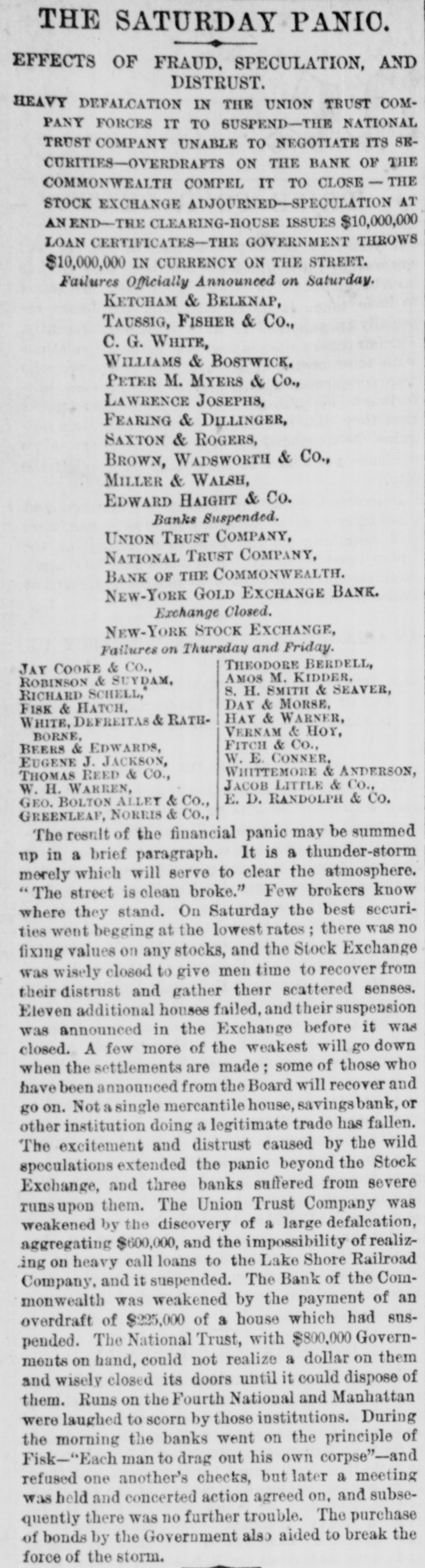
THE SATURDAY PANIC. EFFECTS OF FRAUD, SPECULATION, AND DISTRUST. HEAVY DEFALCATION IN THE UNION TRUST COMPANY FORCES IT TO SUSPEND-THE NATIONAL TRUST COMPANY UNABLE TO NEGOTIATE ITS SECURITIES-OVERDRAFTS ON THE BANK OF THE COMMONWEALTH COMPEL IT TO CLOSE - THE STOCK EXCHANGE ADJOURNED--SPECULATION AT ANEND-THE CLEARING-HOUSE ISSUES $10,000,000 LOAN CERTIFICATES-THE GOVERNMENT THROWS $10,000,000 IN CURRENCY ON THE STREET. Failures Officially Announced on Saturday. KETCHAM & BELKNAP, TAUSSIG, FISHER & Co., C.G. WHITE, WILLIAMS & BOSTWICK. PETER M. MYERS & Co., LAWRENCE JOSEPHS, FEARING & DILLINGER, SAXTON & ROGERS, BROWN, WADSWORTH & Co., MILLER & WALSH, EDWARD HAIGHT & Co. Banks Suspended. UNION TRUST COMPANY, NATIONAL TRUST COMPANY, BANK OF THE COMMONWEALTH. New-York GOLD EXCHANGE BANK. Exchange Closed. NEW-YORK STOCK EXCHANGE, Failures on Thursday and Friday. THEODORE BERDELL, JAY COOKE & Co., AMOS M. KIDDER. ROBINSON & SUYDAM, 8. H. SMITH & SEAVER, RICHARD SCHELL," DAY & MORSE. FISK & HATCH, HAY & WARNER, WHITE, DEFREITAS & RATHVERNAM & HOY, BORNE, FITCH & Co., BEERS & EDWARDS, W. E. CONNER, EUGENE J. JACKSON, WHITTEMORE & ANDERSON, THOMAS REED & Co., JACOB LITTLE & Co., W. H. WARREN, E. D. RANDOLPH & Co. GEO. BOLTON ALLEY & Co., GREENLEAF, NORRIS & Co., The result of the financial panic may be summed up in a brief paragraph. It is a thunder-storm morely which will serve to clear the atmosphere. "The street is clean broke." Few brokers know where they stand. On Saturday the best securities went begging at the lowest rates; there was no fixing values on any stocks, and the Stock Exchange was wisely closed to give men time to recover from their distrust and gather their scattered senses. Eleven additional houses failed, and their suspension was announced in the Exchange before it was closed. A few more of the weakest will go down when the settlements are made; some of those who have been announced from the Board will recover and o n. Not a single mercantile house, savingsba or other institution doing a legitimate trade has fallen. The excitement and distrust caused by the wild speculations extended the panic beyond the Stock Exchange, and three banks suffered from severe runsupon them. The Union Trust Company was weakened by the discovery of a large defalcation, aggregating $600,000, and the impossibility of realiz.ing on heavy call loans to the Lake Shore Railroad Company. and it suspended. The Bank of the Commonwealth was weakened by the payment of an overdraft of $225,000 of a house which had suspended. The National Trust, with $800,000 Governments on hand, could not realize a dollar on them and wisely closed its doors until it could dispose of them. Runs on the Fourth National and Manhattan were laughed to scorn by those institutions. During the morning the banks went on the principle of Fisk-"Each man to drag out his own corpse"-and refused one another's checks, but later a meeting was held and concerted action agreed on, and subsequently there was no further trouble. The purchase of bonds by the Government also aided to break the force of the storm.


Article from Delaware Republican, September 22, 1873

Click image to open full size in new tab

Article Text

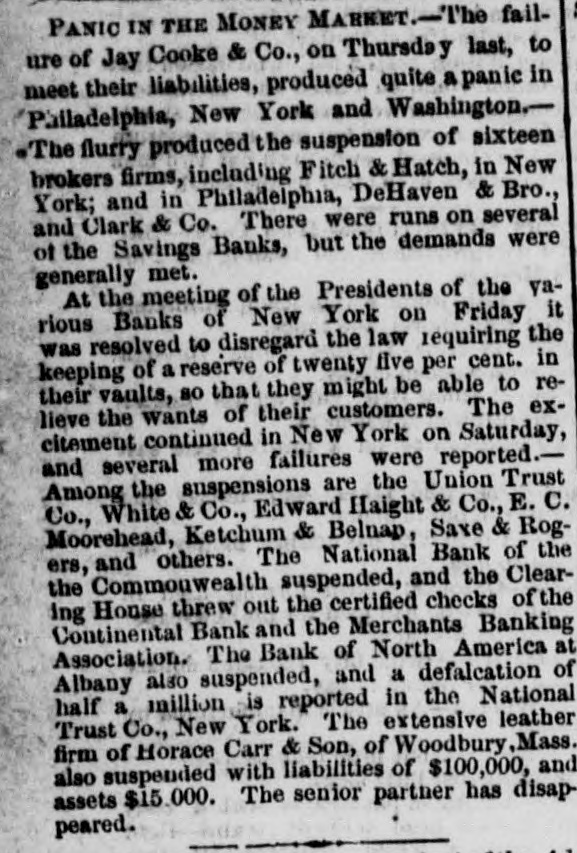
PANIC IN THE MONEY MARKET.-The failure of Jay Cooke & Co., on Thursday last, to meet their liabilities, produced quite a panic in Palladelphia, New York and Washington.The flurry produced the suspension of sixteen brokers firms, including Fitch & Hatch, in New York; and in Philadelphia, DeHaven & Bro., and Clark & Co. There were runs on several of the Savings Banks, but the demands were generally met. At the meeting of the Presidents of the yarious Banks of New York on Friday it was resolved to disregard the law requiring the keeping of a reserve of twenty five per cent. in their vaults, so that they might be able to relieve the wants of their customers. The excitement continued in New York on Saturday, and several more failures were reported.Among the suspensions are the Union Trust Co., White & Co., Edward Haight & Co., E.C. Moorehead, Ketchum & Belnap, Saxe & Rogers, and others. The National Bank of the the Commouwealth suspended, and the Clearing House threw out the certified checks of the Continental Bank and the Merchants Banking Association. The Bank of North America at Albany also suspended, and a defalcation of half a million is reported in the National Trust Co., New York. The extensive leather firm of Horace Carr & Son, of Woodbury, Mass. also suspended with liabilities of $100,000, and assets $15.000. The senior partner has disappeared.


Article from The Rutland Daily Globe, September 23, 1873

Click image to open full size in new tab

Article Text

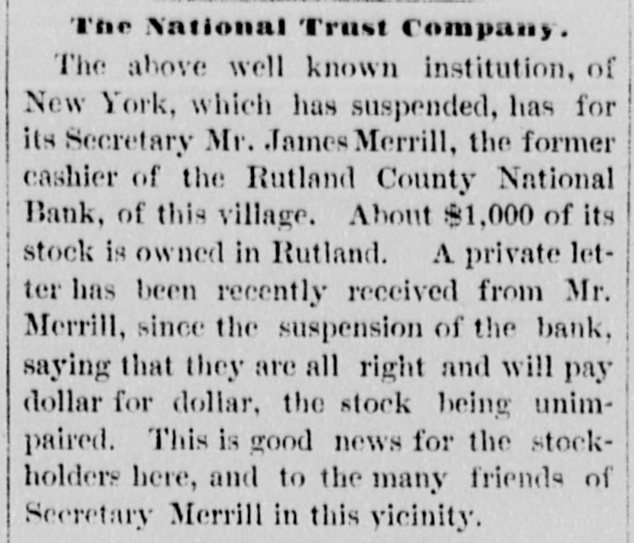
The National Trust Company. The above well known institution, of New York, which has suspended, has for its Secretary Mr. James Merrill, the former cashier of the Rutland County National Bank, of this village. About $1,000 of its stock is owned in Rutland. A private letter has been recently received from Mr. Merrill, since the suspension of the bank, saying that they are all right and will pay dollar for dollar, the stock being unimpaired. This is good news for the stockholders here, and to the many friends of Secretary Merrill in this vicinity.


Article from New-York Tribune, September 23, 1873

Click image to open full size in new tab

Article Text

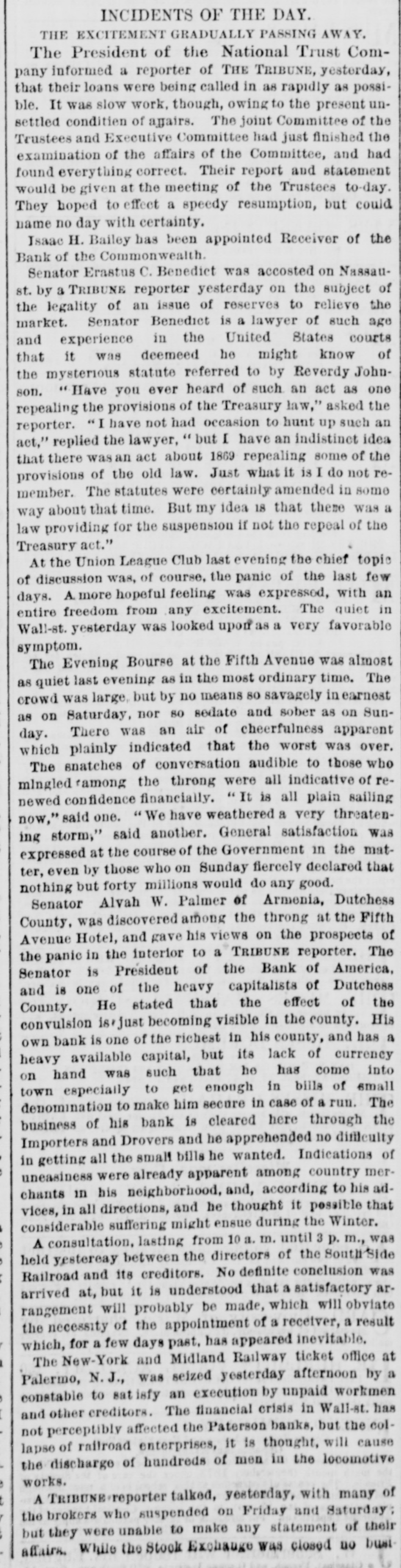
INCIDENTS OF THE DAY. THE EXCITEMENT GRADUALLY PASSING AWAY. The President of the National Trust Company informed a reporter of THE TRIBUNE, yesterday, that their loans were being called in as rapidly as possible. It was slow work, though, owing to the present unsettled conditien of agairs. The joint Committee of the Trustees and Executive Committee had just finished the examination of the affairs of the Committee, and had found everything correct. Their report and statement would be given at the meeting of the Trustees to-day. They hoped to effect a speedy resumption, but could name no day with certainty. Isaac H. Bailey has been appointed Receiver of the Bank of the Commonwealth Senator Erastus C. Benedict was accosted on Nassaust. by a TRIBUNE reporter yesterday on the subject of the legality of an issue of reserves to relieve the market. Senator Benedict is a lawyer of such age and experience in the United States courts that it was deemeed he might know of the mysterious statute referred to by Reverdy Johnson. "Have you ever heard of such an act as one repealing the provisions of the Treasury law," asked the reporter. "I have not had occasion to hunt up such an act," replied the lawyer, " but I have an indistinct idea that there was an act about 1869 repealing some of the provisions of the old law. Just what it is I do not remember. The statutes were certainly amended in some way about that time. But my idea 18 that theme was a law providing for the suspension if not the repeal of the Treasury act." At the Union League Club last evening the chief topic of discussion was, of course, the panic of the last few days. A. more hopeful feeling was expressed, with an entire freedom from any excitement. The quiet in Wall-st. yesterday was looked upon as a very favorable symptom. The Evening Bourse at the Fifth Avenue was almost as quiet last evening as in the most ordinary time. The crowd was large, but by no means 80 savagely in earnest as on Saturday, nor 80 sedate and sober as on Sunday. There was an air of cheerfulness apparent which plainly indicated that the worst was over. The snatches of conversation audible to those who mingled ramong the throng were all indicative of renewed confidence financially. It is all plain sailing now," said one. "We have weathered a very threatening storm," said another. General satisfaction was expressed at the course of the Government in the matter, even by those who on Sunday fiercely declared that nothing but forty millions would do any good. Senator Alvah W. Palmer of Armenia, Dutchess County. was discovered among the throng at the Fifth Avenue Hotel, and gave his views on the prospects of the panic in the interior to a TRIBUNE reporter. The Senator is President of the Bank of America, and is one of the heavy capitalists of Datehess County. He stated that the effect of the convulsion is just becoming visible in the county. His own bank is one of the richest in his county, and has a heavy available capital, but its lack of currency on hand was such that he has come into town especially to get enough in bills of small denomination to make him secure in case of a run. The business of his bank is cleared here through the Importers and Drovers and he apprehended no difficulty in getting all the small bills he wanted. Indications of uneasiness were already apparent among country merchants in his neighborhood, and, according to his advices, in all directions, and he thought it possible that considerable suffering might ensue during the Winter. A consultation, lasting from 10 a. m. until 3 p. m., was held yestereay between the directors of the South Side Railroad and its creditors. No definite conclusion was arrived at, but it is understood that a satisfactory arrangement will probably be made, which will obviate the necessity of the appointment of a receiver, a result which, for a few days past, has appeared inevitable. The New-York and Midland Railway ticket office at 1 Palermo, N.J., was seized yesterday afternoon by a constable to sat isfy an execution by unpaid workmen I and other creditors. The financial crisis in Wall-st. has not perceptibly affected the Paterson banks, but the collapse of railroad enterprises, it is thought, will cause the discharge of hundreds of men in the locomotive works. e A TRIBUNE-reporter talked, yesterday, with many of t the brokers who suspended on Friday and Saturday but they were unable to make any statement of their affairs. While the Stock Exchange was closed no busi


Article from The Toledo Chronicle, September 25, 1873

Click image to open full size in new tab

Article Text

Panic in Wall Street. The financial world was shocked last Thursday by the announcement that the heavy firm of Jay Cook & Co,, of New York, had suspended payment This firm, as is well known was one of the heaviest banking houses in the world, having advanced immense sums of money w the gov erument during the war when the national credit was gone, and being now one of the leading members o! the syndicate, besides having advance ed millions of dollars to Railroad companies. Th bank suffere a run on Thursday morning. an was com pelled quate early 1a the day to clust The phuosophy of this future, which led to many other suspensions, must be sought in the fact that, instead of attending to a. legitim t banking bu-mess, speculative enterprises were entered into. Immense loads of railroad bonds, in which capitalists are now slow to invest, were taken and the result we see in a financial crisis, whose extent will never 1, known, because of the heavy loss on tailed upon holders of railroad stock responded of at a she " after 1. panic occurred. Among the new vailures we notice the following: Fish & Hatch, N " Y ik; the Fax National Bank of Washington, the New Your Unen Trust Company; he National Bank of in Common wealth, N.W York the National Trust Company. New York; the Bank of America, Non York; the Union Banking Company. 01 Philadelphia. These froms," of them at least. were intimatey associated with Couke & Co 111 their business trans actions, and the financial distress will be more of less wile-spread in proportion to the permanency of the failures. If the alone soff l' ed from the panic, the financial dis turbance would excite little sympto thy, but as it entailed losses upon many who had their all invested in radroal securities, which they sold at he ay loss, the panic is J. plorable. The effect produced upon the floor 01 the Stock Exchange may be intere red from the fact that last Saturday the extreme factuations on some clocks were as follows: Harlem 30 per cam; Panama, 18; Rook Island 91; Western Union. 9; Hammbal & St. Joseph, 9, with other stocks flue tuating from 2 to 8 points. The government came to the relief of the money market by purchasing U. Bonds. By this meaus, togeth. er with the action of Bank Presi dems, through the Clearing House loan certificates, many millions of greerbacks were released, with III touching any portion of the $44,000. 000 reserve now In the National Treasury.


Article from New-York Tribune, September 25, 1873

Click image to open full size in new tab

Article Text

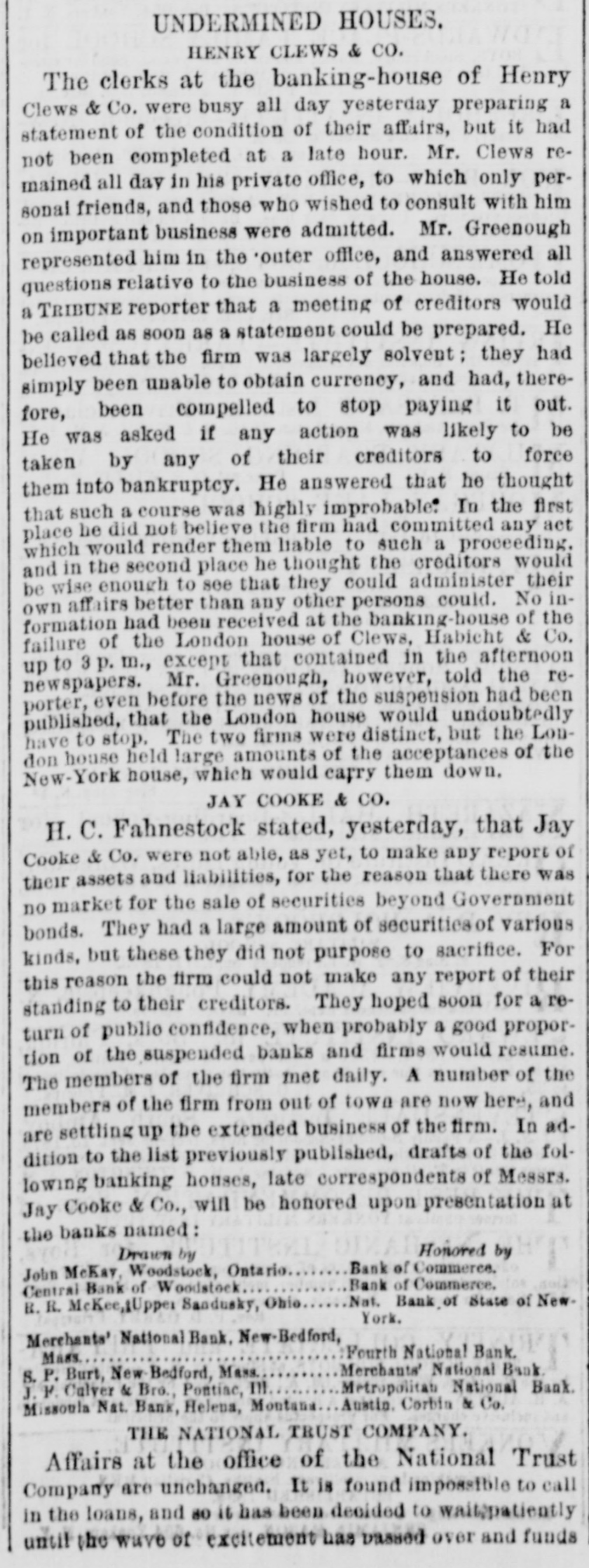
# UNDERMINED HOUSES. HENRY CLEWS & CO. The clerks at the banking-house of Henry Clews & Co. were busy all day yesterday preparing a statement of the condition of their affairs, but it had not been completed at a late hour. Mr. Clews re- mained all day in his private office, to which only per- sonal friends, and those who wished to consult with him on important business were admitted. Mr. Greenough represented him in the outer office, and answered all questions relative to the business of the house. He told a TRIBUNE reporter that a meeting of creditors would be called as soon as a statement could be prepared. He believed that the firm was largely solvent; they had simply been unable to obtain currency, and had, there- fore, been compelled to stop paying it out. He was asked if any action was likely to be taken by any of their creditors to force them into bankruptcy. He answered that he thought that such a course was highly improbable. In the first place he did not believe the firm had committed any act which would render them liable to such a proceeding, and in the second place he thought the creditors would be wise enough to see that they could administer their own affairs better than any other persons could. No in- formation had been received at the banking-house of the failure of the London house of Clews, Habicht & Co. up to 3 p. m., except that contained in the afternoon newspapers. Mr. Greenough, however, told the re- porter, even before the news of the suspension had been published, that the London house would undoubtedly have to stop. The two firms were distinct, but the Lon- don house held large amounts of the acceptances of the New-York house, which would carry them down. JAY COOKE & CO. H. C. Fahnestock stated, yesterday, that Jay Cooke & Co. were not able, as yet, to make any report of their assets and liabilities, for the reason that there was no market for the sale of securities beyond Government bonds. They had a large amount of securities of various kinds, but these they did not purpose to sacrifice. For this reason the firm could not make any report of their standing to their creditors. They hoped soon for a re- turn of public confidence, when probably a good propor- tion of the suspended banks and firms would resume. The members of the firm met daily. A number of the members of the firm from out of town are now here, and are settling up the extended business of the firm. In ad- dition to the list previously published, drafts of the fol- lowing banking houses, late correspondents of Messrs. Jay Cooke & Co., will be honored upon presentation at the banks named: Drawn by Honored by John McKay, Woodstock, Ontario. Bank of Commerce. Central Bank of Woodstock... Bank of Commerce. R. R. McKee, Upper Sandusky, Ohio...... Nat. Bank of State of New- York. Merchants' National Bank, New-Bedford, Mass... Fourth National Bank. S. P. Burt, New Bedford, Mass.. Merchants' National Bank. J. F. Calver & Bro., Pontiac, Ill. Metropolitan National Bank. Missoula Nat. Bank, Helena, Montana... Austin. Corbin & Co. THE NATIONAL TRUST COMPANY. Affairs at the office of the National Trust Company are unchanged. It is found impossible to call in the loans, and so it has been decided to wait patiently until the wave of excitement has passed over and funds


Article from Sunbury American, September 26, 1873

Click image to open full size in new tab

Article Text

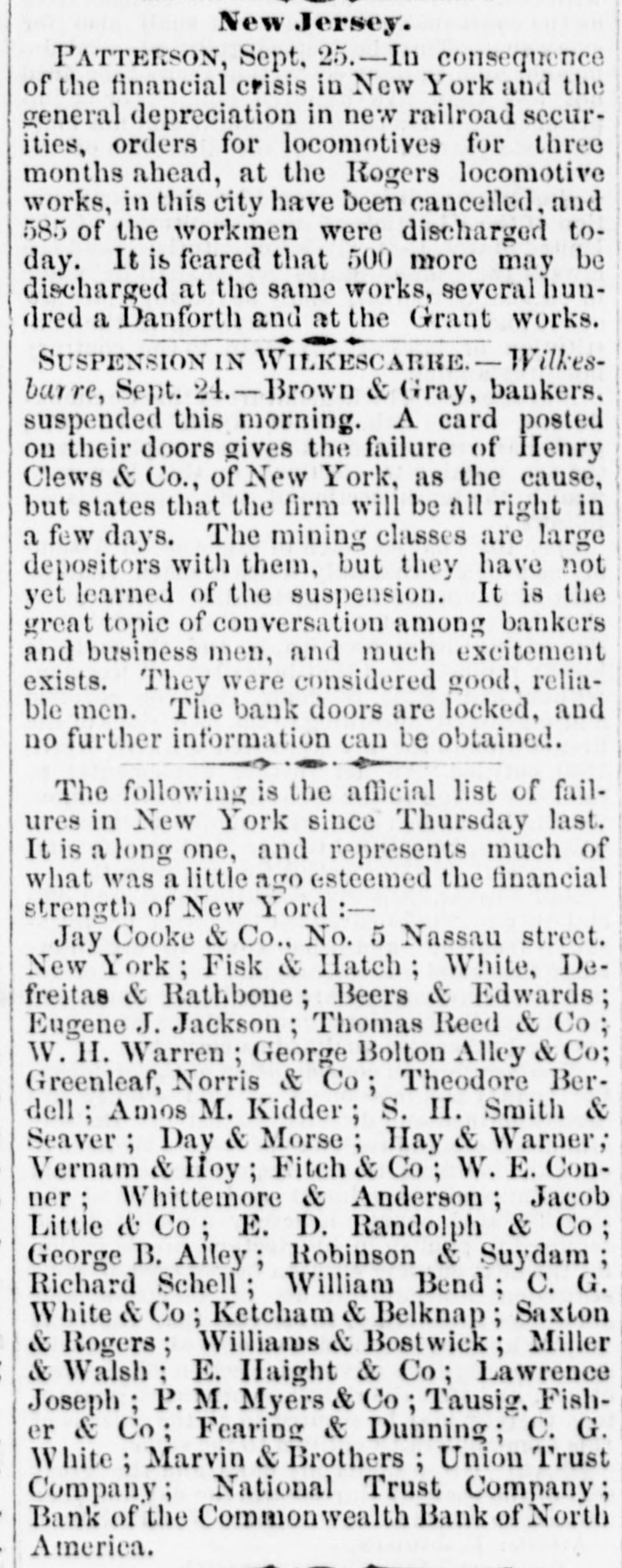
New Jersey. PATTERSON, Sept. 25.-In consequence of the financial crisis in New York and the general depreciation in new railroad securities, orders for locomotives for three months ahead, at the Rogers locomotive works, in this city have been cancelled, and 585 of the workmen were discharged today. It is feared that 500 more may be discharged at the same works, several hundred a Danforth and at the Grant works. SUSPENSION IN WILKESCARNE.- - Wilkesbarre, Sept. 24.-Brown & Gray, bankers. suspended this morning. A card posted on their doors gives the failure of Henry Clews & Co., of New York, as the cause, but states that the firm will be all right in a few days. The mining classes are large depositors with them, but they have not yet learned of the suspension. It is the great topic of conversation among bankers and business men, and much excitement exists. They were considered good, reliable men. The bank doors are locked, and no further information can be obtained. The following is the afficial list of failures in New York since Thursday last. It is a long one, and represents much of what was a little ago esteemed the financial strength of New Yord:Jay Cooke & Co., No. 5 Nassau street. New York; Fisk & Hatch; White, Defreitas & Rathbone; Beers & Edwards Eugene J. Jackson; Thomas Reed & Co W. H. Warren; George Bolton Alley & Co; Greenleaf, Norris & Co; Theodore Berdell ; Amos M. Kidder; S. II. Smith & Seaver; Day & Morse; Hay & Warner; Vernam & Hoy; Fitch & Co : W. E. Conner; Whittemore & Anderson; Jacob Little & Co E. D. Randolph & Co ; George B. Alley; Robinson & Suydam ; Richard Schell; William Bend ; C. G. White & Co; Ketcham & Belknap; Saxton & Rogers ; Williams & Bostwick; Miller & Walsh : ; E. Haight & Co; Lawrence Joseph P. M. Myers & Co ; Tausig. Fisher & Co; Fearing & Dunning; C. G. White; Marvin & Brothers ; Union Trust Company; National Trust Company; Bank of the Commonwealth Bank of North America.


Article from Burlington Weekly Free Press, September 26, 1873

Click image to open full size in new tab

Article Text

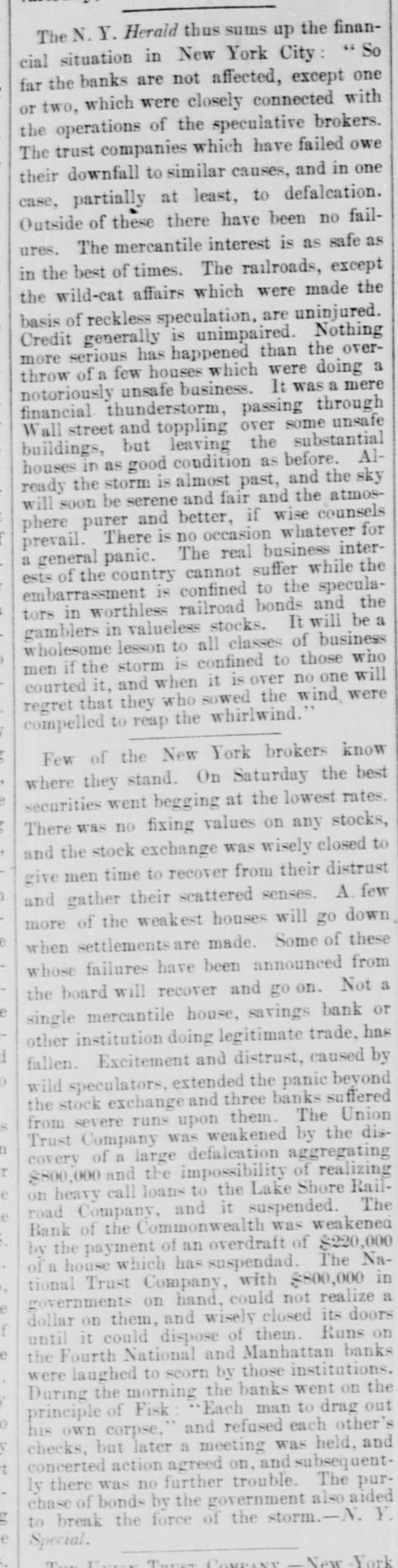
The N. Y. Herald thus sums up the financial situation in New York City : So far the banks are not affected, except one or two, which were closely connected with the operations of the speculative brokers. The trust companies which have failed owe their downfall to similar causes, and in one case, partially at least, to defalcation. Outside of these there have been no failures. The mercantile interest is as safe as in the best of times. The railroads, except the wild-cat affairs which were made the basis of reckless speculation. are uninjured. Credit generally is unimpaired. Nothing more serious has happened than the overthrow of a few houses which were doing a notoriously unsafe business. It was a mere financial thunderstorm, passing through Wall street and toppling over some unsafe buildings, but leaving the substantial houses in as good condition as before. Already the storm is almost past, and the sky will soon be serene and fair and the atmosphere purer and better, if wise counsels prevail. There is no occasion whatever for a general panic. The real business interests of the country cannot suffer while the embarrassment is confined to the speculators in worthless railroad bonds and the gamblers in valueless stocks. It will be a wholesome lesson to all classes of business men if the storm is confined to those who courted it, and when it is over no one will regret that they who sowed the wind were compelled to reap the whirlwind. Few of the New York brokers know where they stand. On Saturday the best securities went begging at the lowest rates. There was no fixing values on any stocks, and the stock exchange was wisely closed to give men time to recover from their distrust and gather their scattered senses. A. few more of the weakest houses will go down when settlements are made. Some of these whose failures have been announced from the board will recover and go on. Not a single mercantile house, savings bank or other institution doing legitimate trade, has fallen. Excitement and distrust, caused by wild speculators, extended the panic beyond the stock exchange and three banks suffered from severe runs upon them. The Union Trust Company was weakened by the discovery of a large defalcation aggregating $800,000 and the impossibility of realizing on heavy call loans to the Lake Shore Railroad Company, and it suspended. The Bank of the Commonwealth was weakened by the payment of an overdraft of $220,000 of a house which has suspendad. The National Trust Company, with $800,000 in governments on hand, could not realize a dollar on them, and wisely closed its doors until it could dispose of them. Runs on the Fourth National and Manhattan banks laughed to scorn by those institutions. the the went on During were morning banks the principle of Fisk "Each man to drag out his own corpse. and refused each other's checks, but later a meeting was held, and concerted action agreed on. and subsequentt ly there was no further trouble. The purchase of bonds by the government also aided to break the force of the storm.-N. Y. Special.


Article from Los Angeles Daily Herald, October 5, 1873

Click image to open full size in new tab

Article Text

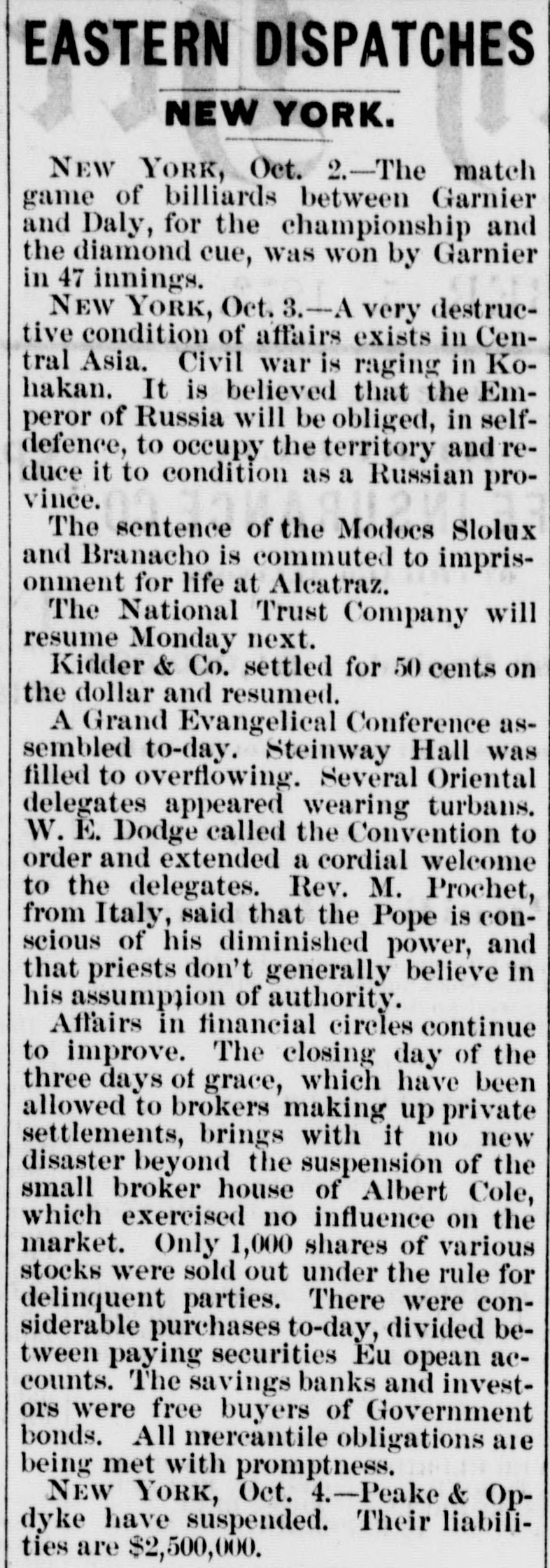
EASTERN DISPATCHES NEW YORK. NEW YORK, Oct. 2.-The match game of billiards between Garnier and Daly, for the championship and the diamond cue, was won by Garnier in 47 innings. NEW YORK, Oct. 3.-A very destructive condition of affairs exists in Central Asia. Civil war is raging in Kohakan. It is believed that the Emperor of Russia will be obliged, in selfdefence, to occupy the territory and reduce it to condition as a Russian province. The sentence of the Modoes Slolux and Branacho is commuted to imprisonment for life at Alcatraz. The National Trust Company will resume Monday next. Kidder & Co. settled for 50 cents on the dollar and resumed. A Grand Evangelical Conference assembled to-day. Steinway Hall was filled to overflowing. Several Oriental delegates appeared wearing turbans. W. E. Dodge called the Convention to order and extended a cordial welcome to the delegates. Rev. M. Prochet, from Italy, said that the Pope is conscious of his diminished power, and that priests don't generally believe in his assumption of authority. Affairs in financial circles continue to improve. The closing day of the three days of grace, which have been allowed to brokers making up private settlements, brings with it no new disaster beyond the suspensión of the small broker house of Albert Cole, which exercised no influence on the market. Only 1,000 shares of various stocks were sold out under the rule for delinquent parties. There were considerable purchases to-day, divided between paying securities Eu opean accounts. The savings banks and investors were free buyers of Government bonds. All mercantile obligations are being met with promptness. NEW YORK, Oct. 4.-Peake & Opdyke have suspended. Their liabilities are $2,500,000.


Article from Evening Star, October 9, 1873

Click image to open full size in new tab

Article Text

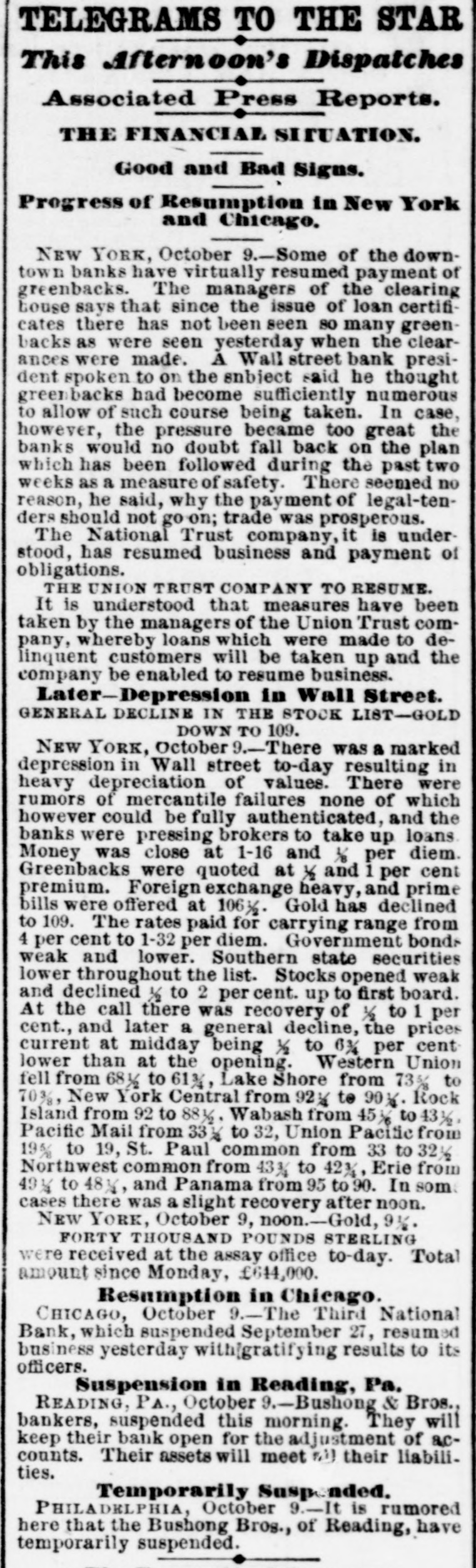
TELEGRAMS TO THE STAR This Afternoon's Dispatches Associated Press Reports. THE FINANCIAL SITUATION. Good and Bad Signs. Progress of Resumption in New York and Chicago. NEW YORK, October 9.-Some of the downtown banks have virtually resumed payment of greenbacks. The managers of the clearing house says that since the issue of loan certificates there has not been seen so many greenbacks as were seen yesterday when the clearances were made. A Wall street bank president spoken to on the subject said he thought green backs had become sufficiently numerous to allow of such course being taken. In case, however, the pressure became too great the banks would no doubt fall back on the plan which has been followed during the past two weeks as a measure of safety. There seemed no reason, he said, why the payment of legal-tenders should not go on; trade was prosperous. The National Trust company, it is understood, has resumed business and payment of obligations. THE UNION TRUST COMPANY TO RESUME. It is understood that measures have been taken by the managers of the Union Trust company, whereby loans which were made to delinquent customers will be taken up and the company be enabled to resume business. Later-Depression in Wall Street. GENERAL DECLINE IN THE STOCK LIST-GOLD DOWN TO 109. NEW YORK, October 9.-There was a marked depression in Wall street to-day resulting in heavy depreciation of values. There were rumors of mercantile failures none of which however could be fully authenticated, and the banks were pressing brokers to take up loans Money was close at 1-16 and % per diem. Greenbacks were quoted at 1/2 and 1 per cent premium. Foreign exchange heavy, and prime bills were offered at 106 1/2. Gold has declined to 109. The rates paid for carrying range from 4 per cent to 1-32 per diem. Government bonds weak and lower. Southern state securities lower throughout the list. Stocks opened weak and declined 1/2 to 2 per cent. up to first board. At the call there was recovery of 1/2 to 1 per cent., and later a general decline, the prices current at midday being 1/2 to 634 per cent lower than at the opening. Western Union fell from 68 1/2 to 61%, Lake Shore from 73 to 70%, New York Central from 92 /4 to 90 Rock Island from 92 to 88 1/2. Wabash from 45% to 43 1/2, Pacific Mail from 33 1/4 to 32, Union Pacific from 19% to 19, St. Paul common from 33 to 321/2 Northwest common from 43 1/4 to 42 Erie from 49 1/4 to 48 X/, and Panama from 95 to 90. In som cases there was a slight recovery after noon. NEW YORK, October 9, -Gold, 91/2. FORTY THOUSAND POUNDS STERLING were received at the assay office to-day. Total amount since Monday, £644,000. Resumption in Chicago. CHICAGO, October 9.-The Third National Bank, which suspended September 27, resumed business yesterday with/gratifying results to its officers. Suspension in Reading, Pa. READING, PA., October 9.-Bushong & Bros., bankers, suspended this morning. They will keep their bank open for the adjustment of accounts. Their assets will meet (ii) their liabilities. Temporarily Susp nded. PHILADELPHIA, October 9.-It is rumored here that the Bushong Brog., of Reading, have temporarily suspended.


Article from Alexandria Gazette, October 9, 1873

Click image to open full size in new tab

Article Text

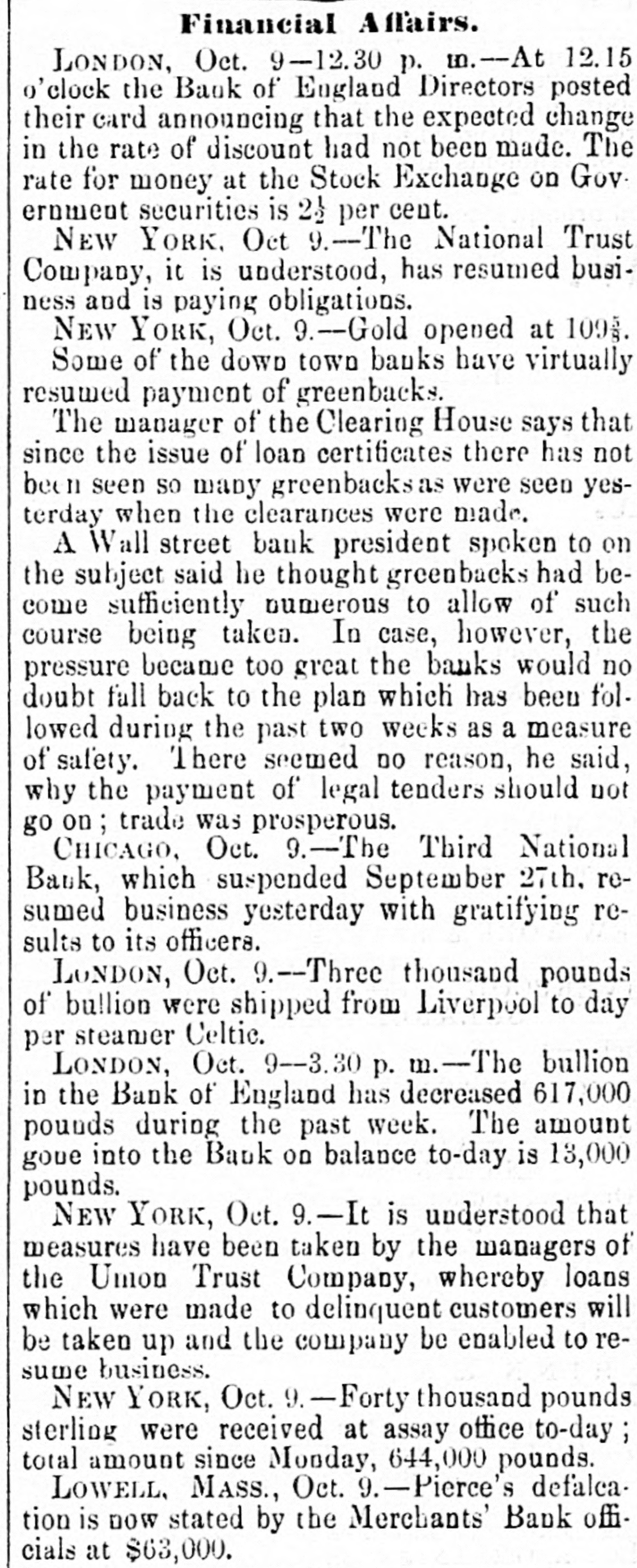
Financial Affairs. LONDON, Oct. 9-12.30 p. in.-At -- 12.15 o'clock the Bank of England Directors posted their card announcing that the expected change in the rate of discount had not been made. The rate for money at the Stock Exchange on Government securities is 24 per cent. NEW YORK, Oct --The National Trust Company, it is understood, has resumed business and is paying obligations. NEW YORK, Oct. .-Gold opened at 109. Some of the down town banks have virtually resumed payment of greenbacks. The manager of the Clearing House says that since the issue of loan certificates there has not bee 11 seen SO many greenbacksas were seen yesterday when the clearances were made. A Wall street bank president spoken to on the subject said he thought greenbacks had become sufficiently numerous to allow of such course being taken. In case, however, the pressure became too great the banks would no doubt fall back to the plan which has been followed during the past two weeks as a measure of safety. There seemed 00 reason, he said, why the payment of legal tenders should not go on; trade was prosperous. CHICAGO, Oct. 9.-The Third National Bauk, which suspended September 27th. resumed business yesterday with gratifying results to its officers. LONDON, Oct. 9.--Three thousand pounds of bullion were shipped from Liverpool to day per steamer Celtic. LONDON, Oct. 9--3.30 p. m. - -The bullion in the Bank of England has decreased 617,000 pounds during the past week. The amount gone into the Bank on balance to-day is 13,000 pounds. NEW YORK, Oct. 9.-It is understood that measures have been taken by the managers of the Umon Trust Company, whereby loans which were made to delinquent customers will be taken up and the company be enabled to resume business. NEW YORK, Oct. 9. - Forty thousand pounds sterling were received at assay office to-day total amount since Monday, 644,000 pounds. LOWELL, MASS., Oct. - -Pierce's defalcation is DOW stated by the Merchants' Bank officials at $63,000.


Article from Chicago Daily Tribune, October 9, 1873

Click image to open full size in new tab

Article Text

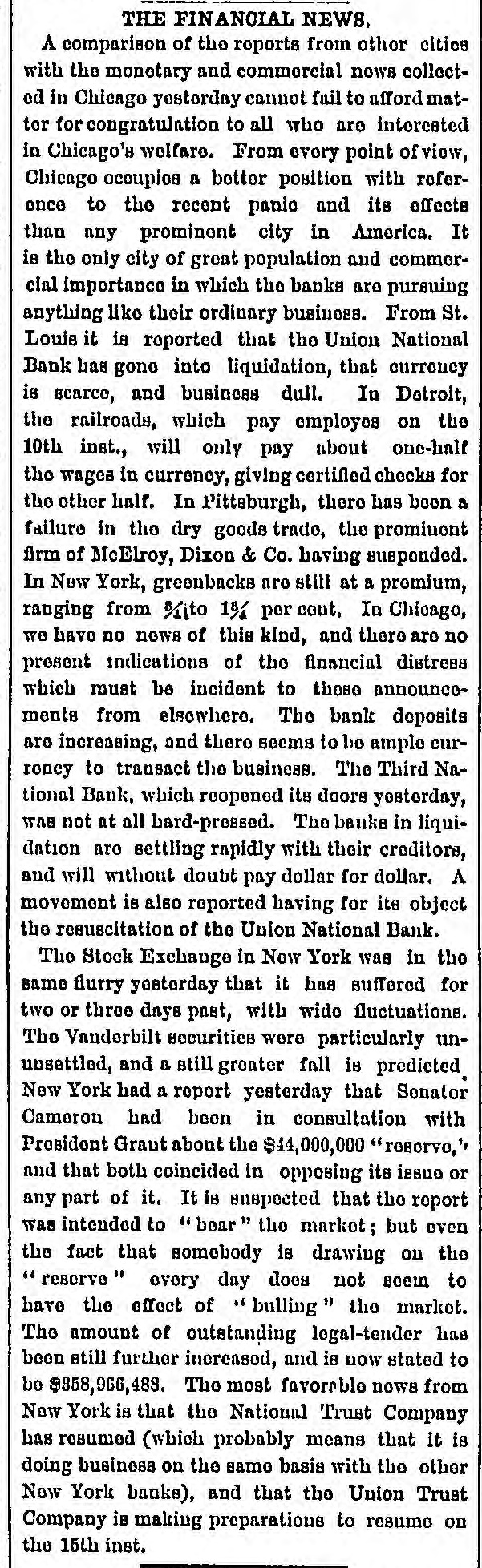
THE FINANCIAL NEWS. A comparison of the reports from other citics with the monotary and commercial nows collected in Chicago yestorday cannot fail to afford mattor for congratulation to all who are intorcated in Chicago's welfare. From every point of view, Chicago ocoupios a better position with referonce to the recont panic and its effects than any prominent city in America. It is the only city of great population and commercial importance in which the banks are pursuing anything like their ordinary business. From St. Louis it is reported that the Union National Bank has gone into liquidation, that currency is scarce, and business dull. In Detroit, the railroads, which pay employes on the 10th inst., will only pay about one-half the wages in currency, giving certified checks for the other half. In Pittsburgh, there has been a failure in the dry goods trade, the prominent firm of McElroy, Dixon & Co. having susponded. In New York, greenbacks are still at a promium, ranging from Mito 18/4 por cout, In Chicago, we have no nows of this kind, and there are no present indications of the financial distress which must be incident to those announcements from elsowhere. The bank deposits are increasing, and there seems to be ample currency to transact the business. The Third National Bank, which reopened its doors yesterday, was not at all bard-pressed. The banks in liquidation are settling rapidly with their creditore, and will without doubt pay dollar for dollar. A movement is also reported having for its object the resuscitation of the Union National Bank. The Stock Exchange in Now York was in the same flurry yesterday that it has suffered for two or three days past, with wide fluctuations. The Vanderbilt securities were particularly ununsettled, and a still greater fall is predicted New York had a report yesterday that Senator Camoron had been in consultation with President Graut about the $44,000,000 "reserve," and that both coincided in opposing its issue or any part of it. It is suspected that the report was intended to "bear" the market; but oven the fact that somebody is drawing on the "reserve" every day does not seem to have the effect of " bulling" the market. The amount of outstanding legal-tender has been still further increased, and is now stated to be $358,966,488. The most favorable nows from New York is that the National Trust Company has resumed (which probably means that it is doing business on the same basis with the other Now York banks), and that the Union Trust Company is making preparations to resumo on the 15th inst.


Article from The Portland Daily Press, October 10, 1873

Click image to open full size in new tab

Article Text

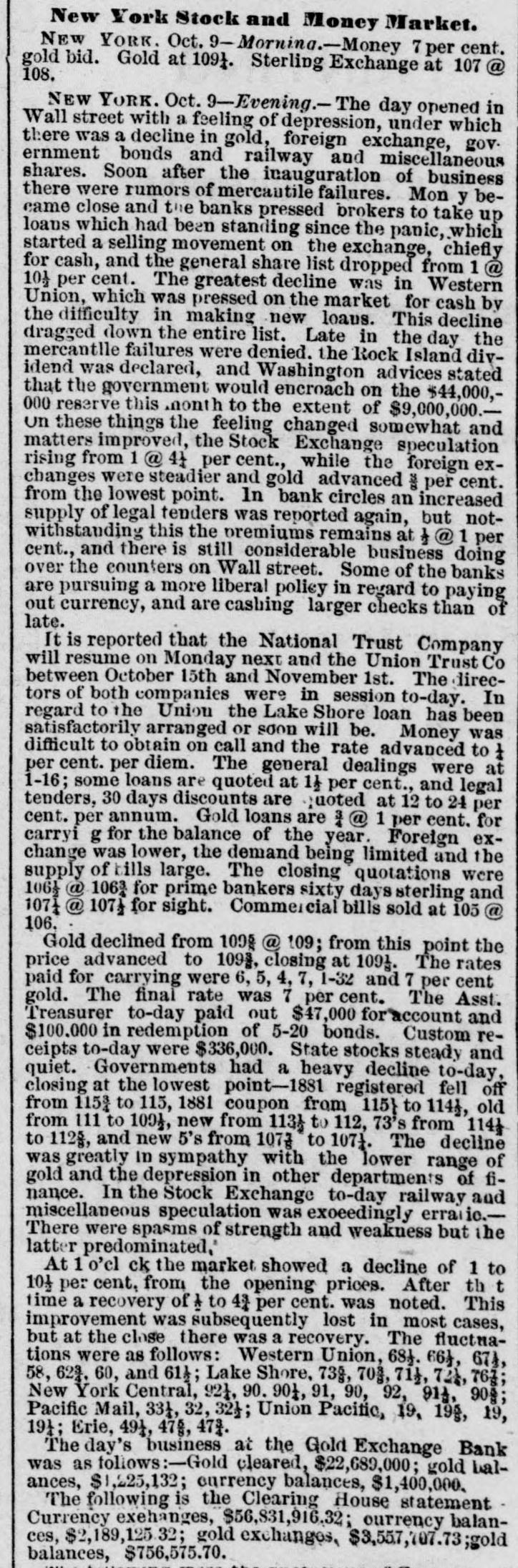
New York Stock and Money Market. NEW YORK. Oct. Morning.-Money 7 per cent. gold bid. Gold at 1091. Sterling Exchange at 107 @ 108. NEW YORK. Oct. 9-Evening.-The - day opened in Wall street with a feeling of depression, under which there was a decline in gold, foreign exchange, gov. ernment bonds and railway and miscellaneous shares. Soon after the inauguration of business there were rumors of mercautile failures. Mon y became close and the banks pressed brokers to take up loans which had been standing since the panic, which started a selling movement on the exchange, chiefly for cash, and the general share list dropped from 1 @ 10 per cent. The greatest decline was in Western Union, which was pressed on the market for cash by the difficulty in making new loaus. This decline dragged down the entire list. Late in the day the mercantile failures were denied. the Rock Island dividend was declared, and Washington advices stated that the government would encroach on the $44,000,000 reserve this month to the extent of $9,000,000.On these things the feeling changed somewhat and matters improved, the Stock Exchange speculation rising from @ 41 per cent., while the foreign exchanges were steadier and gold advanced cities per cent. from the lowest point. In bank circles an increased supply of legal tenders was reported again, but notwithstanding this the premiums remains at & @ per cent., and there is still considerable business doing over the counters on Wall street. Some of the banks are pursuing a more liberal policy in regard to paying out currency, and are cashing larger checks than of late. It is reported that the National Trust Company will resume on Monday next and the Union Trust Co between October 15th and November 1st. The directors of both companies were in session to-day. In regard to the Union the Lake Shore loan has been satisfactorily arranged or soon will be. Money was difficult to obtain on call and the rate advanced to 1 per cent. per diem. The general dealings were at 1-16; some loans are quoted at 1) per cent., and legal tenders, 30 days discounts are uoted at 12 to 24 per cent. per annum. Gold loans are 3/2 @ 1 per cent. for carryi g for the balance of the year. Foreign exchange was lower, the demand being limited and the supply of tills large. The closing quotations were 1064 @ 106 for prime bankers sixty days sterling and 1071 @ 107) for sight. Commercial bills sold at 105 @ 106. Gold declined from 1098 @ 109; from this point the price advanced to 109 closing at 1091. The rates paid for carrying were 6, 5, 4, 7, 1-32 and 7 per cent gold. The final rate was 7 per cent. The Asst. Treasurer to-day paid out $47,000 for account and $100.000 in redemption of 5-20 bonds. Custom receipts to-day were $336,000. State stocks steady and quiet. Governments had a heavy decline to-day, closing at the lowest point-1881 registered fell off from 115 to 115, 1881 coupon from 115} to 114}, old from 111 to 1091, new from 113} to 112, 73's from 1141 to 112g, and new 5's from 107g to 1071. The decline was greatly in sympathy with the lower range of gold and the depression in other departments of finance. In the Stock Exchange to-day railway and miscellaneous speculation was exoeedingly errario.There were spasms of strength and weakness but the latter predominated," At 10'cl ck the market showed a decline of 1 to 104 per cent, from the opening prices. After th t time a recovery of A to 42 per cent. was noted. This improvement was subsequently lost in most cases, but at the close there was a recovery. The fluctnations were as follows: Western Union, 68}. 66}, 671, 58, 62g. 60, and 61); Lake Shore, 73g, 70g, 71}, 72, 76g; New York Central, 921, 90. 901, 91, 90, 92, 914, 90g; Pacific Mail, 331, 32, 32}; Union Pacific, 19, 19g, 19, 191; Erie, 491, 47g, 47 The day's business at the Gold Exchange Bank was as follows:-Gold cleared, $22,689,000; gold balances, $1,225,132; currency balances, $1,400,000. The following is the Clearing House statement Currency exchanges, $56,831,916.32; currency balances, $2,189,125.32; gold exchanges, $3,557,707.73 ;gold balances, $756,575.70.


Article from Chicago Daily Tribune, October 10, 1873

Click image to open full size in new tab

Article Text

THE FINANCIAL NEWS. Decline of Stocks in New York Yesterday from 1 to 10 Cents. Failure of a Bank in New York and Another in Reading, Pa. Prospect of the Carly Resumption of Currency Payments in New York. Conflicting Statements in Regard to the $44,000,000 "Reserve" Further Information Concerning the Affairs of Jay Cooke & Co. The Monetary Situation Throughout the West Unchanged. NEW YORK. Special Dispatch to The Chicago Tribune. NEW YORK, Oct. 9.-Rumors of an unfavorablo character, reflecting upon the stability of several mercantile houses, were circulated at the opening of business in Wall street. Notwithstanding that they were proved false, they had a depressing effect upon the market. This depression was accelerated by the announcement that special banks had CALLED IN THEIR LOANS, and caused a heavy sacrifico of stocks by the operation. Among those whose stocks were said to have been forced to sale was Honry N Smith, who wont largely long of Western Union with a view to twisting Jay Gould, who was originally short, and thus revenging himself for his treatment in the Northwestern corner. Later in the day, the FAILURE OF GIBBON, CASANOVA & CO., bankers, No. 50 Exchange Place, who had became embarrassedby reason of the withdrawal of Western deposits and advances made to the Jacksonville, Northwestern & Southeastern Railway of Illinois. Another and small dealer, named S. B. Hard was announced to the Exchange as suspended. The stock market was very much depressed, declining from 1 to 10 per cont in the entire list. Western Union declined 101/4 per cent, the annual report being regarded as unfavorable. GREENBACKS are selling at from % to 1 1/4 por cent premium. It is in contemplation to hold a meeting of the Clearing-Houeo on Saturday, and, if possible, to resume the payment of legal-tenders, which action, it 18 thought, will restore matters to their normal condition. THE NATIONAL TRUST COMPANY will resume on Monday. [To the Associated Press.] GIBBON, CASANOVO & CO. NEW YORK, Oct. 9.-Gibson, Casanovo & Co., stock brokers, say their suspension 18 our of the results of the recent panic. The depositors drew out their funds, and securities became unavailable. People indebted to the house were unable to pay, and in some cases failed. Added to this, a large amount of capital was locked up in a new railroad. They express the bolief of their inability to pay in full. NEW YORK, Oct. 0.-A Washington special eays Owing to the small receipts from the revenue, Treasury officials say that it will be necessary to issue 88,000,000 or $9,000,000 of the $44,000,000 reserve, to meet the current expenses of the Government for the present month."


Article from The New York Herald, October 14, 1873

Click image to open full size in new tab

Article Text

AFTER THE STORM. The National Trust Company Resume Payment-Action of the Clearing House in Regard to the Bank of the Commonwealth-The Union Trust Company to Resume. The National Trust Company, at the corner of Broadway and Warren streets, resumed payment yesterday. The rush at ten o'clock, when the doors were opened, was very great, but when the depositors saw that all checks were promptly paid, many of them went away without drawing their money. During the day about $300,000 was paid out. Fifty deposits were also received. Mr. D. P. Mangen, the President of the company, said in conversation with a reporter of the HERALD, "We have paid out only comparatively small amounts, and not more than one-third of what we expected to pay out today. You see how many people there are outside waiting for their money, but you must remember that we have about 2,800 depositors, so that it is but a small line after all. Our company is as safe and as sound as when we first stopped. We are able to pay every dollar deposited with us, and have neither sacrificed any stock nor sold any securities at a loss. The majority of checks drawn have thus far been only for a portion of the accounts of the respective depositors. This is proof that we still have the confidence of the public." The Bank of Commonwealth, which is in the hands of a receiver-Mr. Isaac N. Barley-was expelled from the Clearing House Association yesterday. A meeting of the association was held at the Merchants' Bank, and the report of the Special Committee on the Bank of Commonwealth was read confirming the statement of the receiver and refuting the charges of Mr. Ellis, the former President, who had denounced the receiver's report as an ex parte statement. The report was adopted, so that the bank will go into liquidation. There was a rumor yeaterday that the Union Trust Company intended to resume business. The only foundation for this rumor was that the Examining Committee was to have held a meeting yesterday afternoon. The committee 18 composed of Augustus Schell, Freeman Clark, S. D. Fairchild, J. B. Johnston and J. M. McLane. There was no quorum, and nothing could therefore be done. Both Mr. Schell and Mr. McLane assured the reporter that the company would resume payment at an early day. Mr. McLane thought they would probably be able to resume before the 1st of December, as the affairs of the company were in a very good condition.


Article from The Wheeling Daily Intelligencer, October 14, 1873

Click image to open full size in new tab

Article Text

NEW YORK CITY. New YORK, Oct. -The trial of EdS. Stokes was resumed this morning, but up to noon no additional jurors had been obtained. Mrs. Charles Backus, formerly Kate Newton, a well known actress, died here yesterday. Her funeral will take place Wednesday. The Federal Council of the International Workingmen's Association had a meeting yesterday, when the Committee on Cheap Transportation recommended as the best meaus of facilitating transportation, the opening of a large water way under the control of the Government, at rates covering running charges and repairs. A committee was appointed to wait on Mayor Havemeyer, to see what could be done about modifying the contract system, so as to give 5,000 persons, who were last year depending on the Commissioners of Charities, some means of earning their own bread. The committee reported that he would do nothing, and that he said he did not care if one million of people were without a chance of earning a livelihood this winter. The steamship George W. Clyde, at Key West, October 8, from Galveston for New York, reports that during the severe hurricane of the 6th, Capt. Cole, the second officer, chief engineer and one 3eaman, were washed overboard and drown. ed. The failure of P. H. Stevens has been announced this morning at the Stock Exchange. A Washington special says that the German Minister has just received intelligence.from Berlin, stating authoritively that Mme. Von Bismarck is not only not dead, but is not sick. The story was probably invented by the Ultramontainists to coincide with the arrival of Victor Emanuel at Berlin, SO it will appear that Bismarck had suffered this affliction for the King of Italy. The National Trust Company resumed business to-day, paying the depositors in certified checks on the Central National Bank, their Clearing House Bank. The Union Trust Company has not yet begun to pay depositors. The Delegates of the Evangelical Alhance Conference left this morning for Philadelphia. A short stay will be made at Princeton where the delegates will be received by President McCosh and laculty of Princeton College, and distinguished residents of the place. Judge Blatchford to day modified an injunction sufficiently to permit Blaker Bro's. & Co., to sell securities held as collateral for money loaned to G. Bird, Grinnell & Co. This decision may throw on the market 10,000 registered Lake Shore & Michigan Southern registered sinking fund bonds. Nine jurors have been obtained in the Stokes case. The Grinnell injunction case was modified on condition that Blake, Bros. & Co. file a sworn. statement of sales in the Clerk's office of the U. S. District Court in Bankruptcy, to await such action as an assignee in bankruptcy may take, providing such assignee be appointed to collect and distribute the assets of Grinnell & Co. In the case of the colored men against Wallack, for the refusal of admission to the Orchestra circle of his theater, Jodge Barrett to-day allowed the defendant to put in an unverified answer. It is reported that ex Governor Hoffman will be nominated by the Democrats for Congress as a successor to James Brooks. The leading houses in the piano trade to-day deny any intention of reducing the wages. A few of the small houses have ceased operations for a short time, owing to their inability at present of making collections. Two thousand three hundred emigrants arrived to day.


Article from New-York Tribune, October 14, 1873

Click image to open full size in new tab

Article Text

FINANCIAL DEPRESSION. A DECLINE IN STOCKS. THE EXPECTED REACTION AGAIN DEFERRED-RUMORS OF SECRETARY RICHARDSON'S RESIGNATION-A SINGLE FAILURE. I Depression was the feature of business in ) Wall-st. yesterday. From the opening of the stock market , to the close there appeared to be a steady tendency downward. This excited considerable uneasiness, for it bad been generally hoped that the course of the market had been changed for the better, and that prices having reached their lowest point, would react and enable some of the sufferers who were carrying stocks at high prices to unload at something like saving figures. These hopes. however, appeared to be untimely, and apprehensions were felt that if the decline continued serious results would ensue. The failure of a small house (P. H. Stevens) was announced. Various theories were expressed in regard to the cause of the decline, but few seemed satisfied with them. It was believed that, Judge Blatchford having modified the Grinnell injunction 80 far as it related to Blake Bros., bankers, who had loaned money to Grinnell & Co. on Lake Shore, a large quantity of the stock had been thrown on the market and the price declining in consequence had brought down the rest of the list. It was further asserted that the Grinnell injunction, which temporarily kept out of the street so large a quantity of Western Union and Lake Shore, might be dissolved at any moment, and the result would be the throwing of stock upon the market. The bankruptcy proceedings instituted against Daniel Drew in the case of the failure of Kenyon Cox & Co., were also regarded with an apprehension which contributed to the depression. Again rumors were in circulation to the effect that Secretary Richardson had either resigned or been requested to do so, his successor being the Hon. Columbus Delano. These rumors were based upon the reports of an interview between an. agent of the Associated Pressand President Grant, In Washington, wherein the latter expressed VIOWS at variance with those of the Secretary. These rumors, however, were unfounded. Subjected to 80 many influences of a disturbing character. prices fluctuated as follows: Lake Shore declined from 691 to 65, rallied to 68, and closed at 65 Western Union advanced from 61 to 623, fell off to 592, recovered to 61h. and closed at 58. NewYork Central advanced from 90g to 91, and stopped at 881, the lowest price of the day. Harlem declined from 112 to 109; St. Paul Common, 31 to 29 North-West Common, 421 to 401 Wabash, 448 to 423; and Pacific Mail, 331 to 313. The remainder of the list declined about from to 1 per cent, the general market closing at the lowest quotations made. Money ruled as high as 3-16 per cent and interest, but the greater part of the business was transacted at from 1-16 to g. Greenbacks are still coming this way, although not as fast as could be desired, and the premium rules from 1/4 to 1 per cent. The rate of discount ranges between 12 and 24 per cent. Gold was active and strong, despite the reported shipments from abroad-the price opening at 1081, advancing to 108 and closing at 108 Among the more cheerful signs of the day was the resumption of business by the National Trust Company. The officers of the establishment reported a fair business, and were cheerful over the prospect. The committee of five appointed on behalf of the trustees of the Union Trust Company were to have held their first meeting yesterday, but did not do so, owing to the lack of a quorum, several of the members being out of town. The Committee consists of Augustus Schell, Chairman; Freeman Clark, S. E. Fairchild, J. B. Johnston, and J.M. McLean. Mr. McLean said that the Committee intend to make an investigation of the affairs of the Company, which are now regarded as in good condition, and to take steps for the resumption of business as soon as expedient. This movement was not at all in opposition to the receiver, Mr. Wesley, who is himself a trustee, and all of whose actions have received the approval of the Board. The Clearing-house Committee appointed on the application of President Ellis of the Bank of the Commonwealth to investigate the condition of that institution, with a view to refuting the statements of Receiver Bailey, reported yesterday to the Clearing-house, fully sustaining the charges of Mr. Bailey. The President of the Missouri, Kansas, and Texas Railway has notified to the Stock Exchange that the company has increased its stock $4,460,000 for a newly acquired road, The company DOW controls 785 miles of road. The total amount of stock is increased to $21,400,000, the amount of bonds being $17,900,000.


Article from The Fremont Weekly Journal, October 17, 1873

Click image to open full size in new tab

Article Text

NEWS ITEMS. Horses are scarce in Europe. The Canadian crops are reported good. The colored population of Washington is 8,532. The Azores Islands are styled a paradise in mid ocean. The estimate of the corn crop this year is 177,000,000 bushels. The prices of products will ad vance fifty per cent this fall. The tobacco crop of Ohio this year is estimated at 30,000 hogsheads. John Johnston considers the old worm fence the cheapest for the farmers. An Iowa preacher at a donation lately got beans enough to last him 30 years. Yellow fever of a very malignant type is still making fearful ravages at Memphis. New York sheep men are abandoning the Merinos for the Cots. wolds and Downs. One thousand emigrants settled in Georgia last year, but 20,000 of her citizens left the State. Complaints of a stagnation of business come from the lumbering regions of the far North-west. A "honeymoon car" is now run on the Pacific Railroad for the accommodation of bridal parties. In boring an artesian well at Rives, Mich., recently, a solid oak log was struck 146 feet below the surface. The difference in value between gold and greenbacks since the panic is less than at any time since the war. A Peoria man claims to have a stone that Washington threw at a wood-pecker on his father's cherry tree. The National Trust Company of New York has resumed business. The Union Trust Company will soon follow. Eight million feet of white birch lumber is annually cut in Maine and sold to manufacturers of spools and shoe pegs.


Article from The Donaldsonville Chief, October 18, 1873

Click image to open full size in new tab

Article Text

Saturday, the third day of the financial panie, was an intensely N exciting one in Wall street-so much SO that it was found necessary to close the Stock Exchange, and to pass a rule forbidding the members from making any transactions in stocks either on the street or elsewhere prior to the regular session of the Board on Monday. A large number of additional failures were reported, among them the Union Trust Company (the cashier of which was said to be a defaulter to 'the amount of $600,000), the National Trust Company, and the National Bank of the Commonwealth. The excitement and panic which followed the announcement in the Stock Exchange of the suspension of these institutions were beyond description. The Stock Exchange resembled a mad-house, and the streets were blocked with people, all laboring under great excitement and frenzy. Prices tumbled from two to sixteen per cent., and stocks were slaughtered without any apparent regard to values. President Grant and Seeretary Richardson proceeded to New York on Saturday night, and on Sunday a conference was held with some of the leading financiers at the Fifth Avenue Hotel, to endeavor to arrange some plan for governmental relief. A proposition was made that the President authorize the Secretary of the Treasury to place $30,000,000 of legal reserve in the city banks, and Commodore Vanderbilt offered to add $10,000,000 more. This proposition was declined, the President stating his belief that he had no constitutional power to afford the relief asked for in this manner. It was finally determined that the Assistant Treasurer be instructed to purchase all the government bonds offered for sale to any amount, and as the


Article from New-York Tribune, May 7, 1882

Click image to open full size in new tab

Article Text

District-Attorney Bergen and Police Captain Dobbs, of Plainfield, yesterday had a consultation with Superintendent Walling. The Superintendent detailed two detectives to assist the Captain in tracing the sus- pected man in this city, while Mr. Bergen went to Trenton, N. J., on an afternoon train. The detectives and Captain Dobbs were engaged yesterday in visiting dealers who sell perforated chair bottoms, in the hope of getting a trace of the supposed murderer. Eirsch's brother-in-law, Jacob Cohen, and his cousin went to Plainfield yesterday to identify the body. It is believed that Eirsch had about $30 in his pockets when he was murdered. # WAITING FOR COMPLAINTS. It was announced that the Senate committee which is inquiring into insurance receiverships, would hold a meeting at the office of Senator Koch, No. 320 Broadway, at 11 o'clock yesterday morning, for the purpose of hearing complaints. Senators Koch and Lord were present and waited for two hours for com- plaints to come in. Incidentally, while waiting, Senator Koch received a number of friends and transacted per- sonal business, but it was evidently a bad day for com- plaints. The only two cases brought to the attention of the Senators, in their capacity as committeemen, were those of the National Trust Company, of which William J. Best is receiver, and the Bowling Green Savings Bank, of which Shepherd Knapp is receiver. In connection with the former institution, which went into the hands of a receiver in 1873, the opinion was expressed that whereas there should be a large dividend, there had been none at all so far to the stockholders. The Bowling Green Savings Bank, which was put into the hands of a receiver in 1871, has only paid a dividend of 15 per cent, and it is alleged that this dividend was only paid to a part of those who were entitled to receive it.