A brief depositor run occurred on March 8, 1926 driven by rumors about the personal insolvency/financial troubles of M. R. Hoffman (president). Clearing house, state examiner, neighboring banks and $150,000 from the Federal Reserve (via Philadelphia) plus local cash and public assurances quickly checked the run. No suspension or closure is reported. Minor OCR errors in articles corrected (e.g., 'Hoffman ... taken over by his creditors') but conclusions drawn only from statements in the articles.
Events (1)
1.March 8, 1926Run
Cause
Rumor Or Misinformation
Cause Details
Rumors spread that M. R. Hoffman, president of the Union Trust Company, was insolvent/personal affairs taken over by creditors; gossip connected his personal problems with the bank.
Measures
Lancaster Clearing House pledged support; State Banking Examiner affirmed condition; $150,000 sent from Federal Reserve Bank in Philadelphia; Lancaster Trust offered $300,000; local firms and officials publicly vouched for bank; cash payouts (~$152,000) met withdrawals.
Newspaper Excerpt
Officials of the Union Trust company, on which depositors started run shortly after noon yesterday believed last night that the run had been checked
Source
newspapers
Newspaper Articles (10)
1.March 8, 1926Lancaster New EraLancaster, PA
Click image to open full size in new tab
Article Text
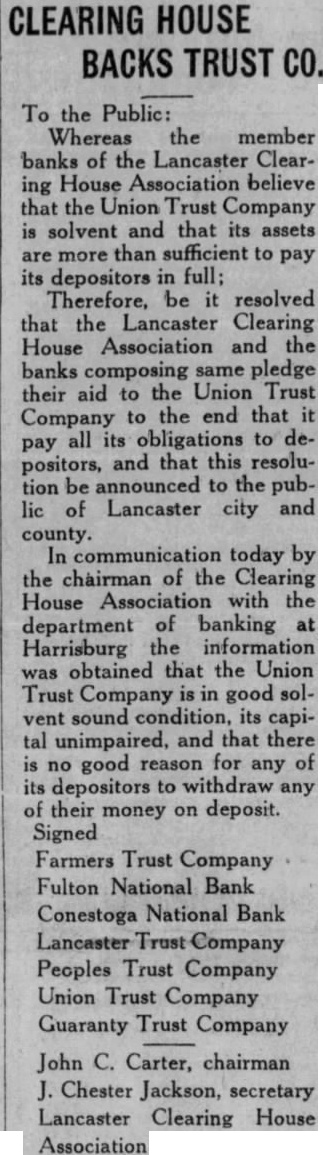
CLEARING HOUSE BACKS TRUST CO.
To the Public: Whereas the member banks of the Lancaster Clearing House Association believe that the Union Trust Company is solvent and that its assets are more than sufficient to pay its depositors in full; Therefore, be it resolved that the Lancaster Clearing House Association and the banks composing same pledge their aid to the Union Trust Company to the end that it pay all its obligations to depositors, and that this resolution be announced to the public of Lancaster city and county. In today by the chàirman of the Clearing House Association with the department banking at Harrisburg the information obtained that the Union Trust Company is in good solvent sound condition, its capital unimpaired, and that there is no good reason for any of its depositors to withdraw any of their money on deposit. Signed Farmers Trust Company Fulton National Bank Conestoga National Bank Company Peoples Trust Company Union Trust Company Guaranty Trust Company
John C. Carter, chairman Chester Jackson, secretary Lancaster Clearing House
Association
2.March 9, 1926The Kane RepublicanKane, PA
Click image to open full size in new tab
Article Text
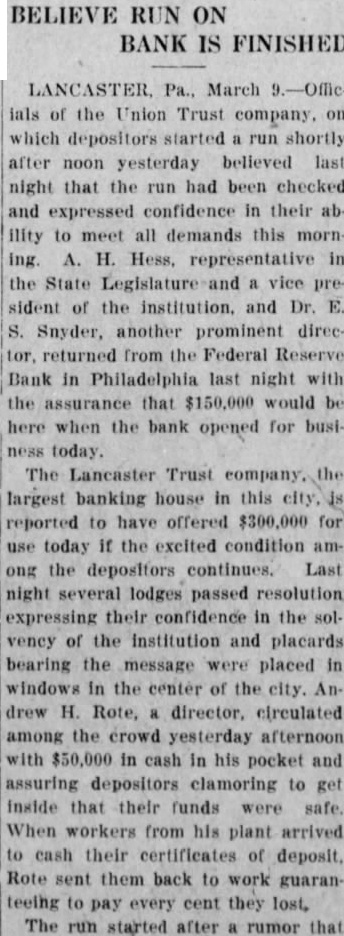
BELIEVE RUN ON BANK IS FINISHED
LANCASTER, Pa., March 9.-Officials of the Union Trust company, on which depositors started run shortly after noon yesterday believed last night that the run had been checked and expressed confidence in their ab ility to meet all demands this morn ing. A. H. Hess, representative in the State Legislature and a vice president of the institution. and Dr. E. S. Snyder, another prominent director, returned from the Federal Reserve Bank in Philadelphia last night with the assurance that $150,000 would be here when the bank opened for business today. The Lancaster Trust company. the largest banking house in this city, reported to have offered $300,000 for use today if the excited condition among the depositors continues. Last night several lodges passed resolution expressing their confidence in the solvency of the institution and placards bearing the message were placed in windows in the center of the city. Andrew H. Rote, a director, circulated among the crowd yesterday afternoon with $50,000 in cash in his pocket and assuring depositors clamoring to get inside that their funds were safe. When workers from his plant arrived to cash their certificates of deposit, Rote sent them back to work guaran teelhg to pay every cent they lost, The run started after a rumor that
3.March 9, 1926Standard-SpeakerHazleton, PA
Click image to open full size in new tab
Article Text
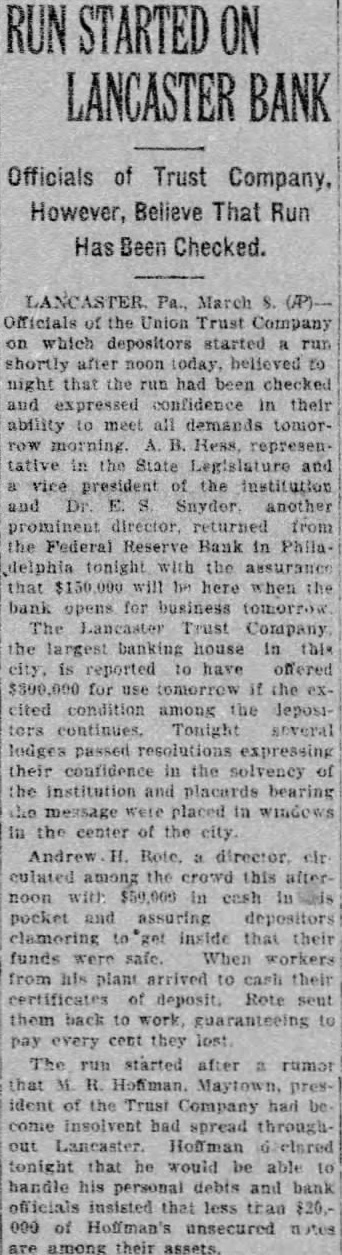
STARTED LANCASTER BANK
Officials of Trust However, Believe That Run Been Checked.
March Officials of the Union Trust Company which depositors started run shortly after noon today. believed to night that the run had been checked and expressed confidence in their ability to meet all demands tomortative in the State Legislature and president the institution and Dr another prominent director, returned from the Federal Reserve Bank in Philadelphia tonight with the assurance that will be here when the bank opens for business The Lancaster Trust Company the largest banking house in this city is reported have offered $300,000 for use tomorrow if cited condition among the Jepositors Tonight several lodges passed resolutions expressing their confidence in the solvency institution and placards bearing the message placed in windows in the center of the city culated among the crowd this afternoon with $59,000 cash pocket and assuring depositors clamoring inside that their funds were safe. When workers from his plant arrived to cash their certificates of deposit. Rote sent them back to work, guaranteeing pay every cent they lost. The run started after rumor that Hoffman. Maytown, ident of the Trust Company had come Insolvent had spread throughLancaster Hoffman tonight that would be able handle his personal debts and bank officials insisted that less than 000 of Hoffman's unsecured are among their assets.
4.March 9, 1926Lancaster Daily IntelligencerLancaster, PA
Click image to open full size in new tab
Article Text
RUN ON UNION TRUST COMPANY ENDS QUICKLY
When Everyone is Jovial, Clamor Subsides-Stacks of Cash Today
HOFFMAN MAY RETIRE
Lancaster's temporary bank run of yesterday diminished to the commonplace today. One hundred and fifty-two thousand dollars withdrawn in four hours from the Union Trust company yesterday afternoon by about 400 excited depositors insignificant today compared to $440,000 in green and gold notes stacked up high on table behind the cashier's window.
OFFICIAL STATEMENT ON UNION TRUST CO.
The run on the Union Trust is over. It was unjustified and without cause. The has ever since the opening day been more than able pay all the depositors in full. The loans to the directors are far below the amount allowed by law. The assets are clean. The last sale of stock was $230% per share, and that price was justified by the books. The par value is $100 per share There is no financial Institution in the that is in sounder financial The State Banking Examiner as late as midnight on March 8, stated that the was in first class condition. We are ready to meet all demands Our receipts on March were almost equal to our payments.
(Signed) JOHN M. GROFF, Attorney for Union Trust Co.
Combined with this reassuring paper which said to have the ability "talk" the depositors of the institution have the assurance of W. H. Soule, state bank examiner that conditions at the bank are "excellent." the situation Is the relterated action of the Lancuster Clearing House association last night that they endorse the solid condition of the Union Trust company and guarantee that said trust is perfectly solvent, The bank officials preparing today readjust their official organization through which the misunderstanding regarding the bank's status was begun. The run on the bank yesterday begun following or unsubrumors spread innocently by the "grapevine" which usually gossip fast. The rumors out of personal financial difficulties of M. R. Hoffman of Maytown, president of the Union Trust company. Mr. Hoffman's financial affairs have been mored for the past two weeks and on Friday he was takover by his creditors the gossips unfortunately connected his personal affairs with the affairs of the bank. (Continued on Page Seventeen)
5.March 9, 1926Lancaster New EraLancaster, PA
Click image to open full size in new tab
Article Text
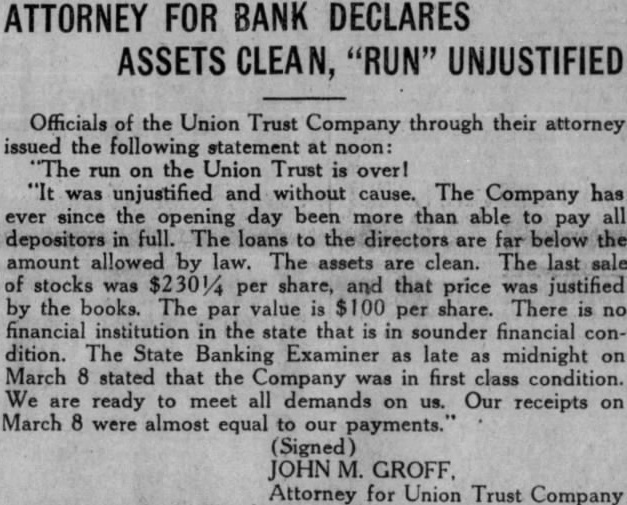
ATTORNEY FOR BANK DECLARES ASSETS CLEAN, "RUN" UNJUSTIFIED
Officials of the Union Trust Company through their attorney issued the following statement at noon: The run on the Union Trust is over! "It was unjustified and without cause. The Company has ever since the opening day been more than able to pay all depositors in full. The loans to the directors are far below the amount allowed by law. The assets are clean. The last sale of stocks was $2301/4 per share, and that price was justified by the books. The par value is $100 per share. There is no financial institution in the state that is in sounder financial condition. The State Banking Examiner as late as midnight on March 8 stated that the Company was in first class condition. We are ready to meet all demands on us. Our receipts on March 8 were almost equal to our payments. (Signed) JOHN GROFF. Attorney for Union Trust Company
6.March 9, 1926Lancaster New EraLancaster, PA
Click image to open full size in new tab
Article Text
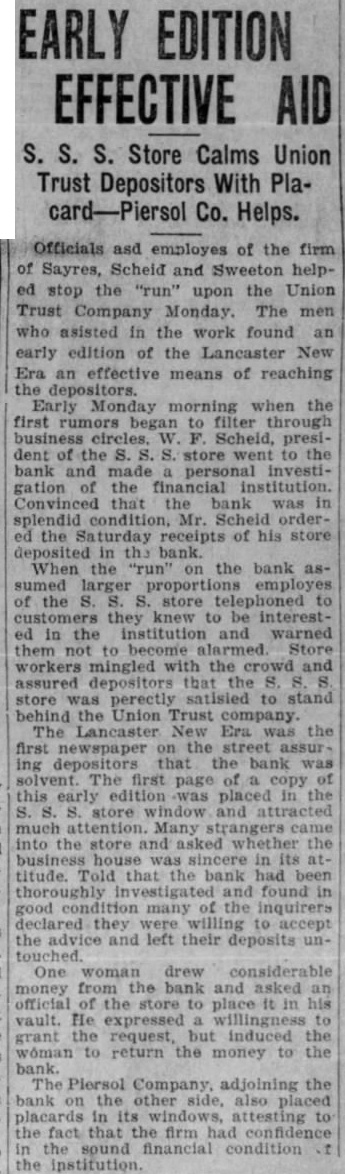
EARLY EDITION EFFECTIVE AID
S. S. S. Store Calms Union Trust Depositors With PlaCo. Helps.
Officials asd employes of the firm of Sayres, Scheld and Sweeton helped stop "run" upon the Union Trust Company Monday. The who asisted In the work found early edition of the Lancaster New Era an effective means of reaching the depositors. Early Monday morning when the first rumors began filter through business circles. president store went the and investigation the Convinced was splendid Mr. the receipts of his store in bank. the the bank assumed store they knew the institution warned become Store mingled with the crowd and assured depositors store perectly to behind Trust company The New the solvent. The page copy this edition was placed the store much Many the store the titude. the bank had found good many the declared they willing to the and left their deposits One woman money from and asked the store to place his vault. He expressed willingness grant request, but induced woman to return the money the Piersol Company, adjoining the the also to the fact that the firm had the sound financial condition the
7.March 9, 1926The News-JournalLancaster, PA
Click image to open full size in new tab
Article Text
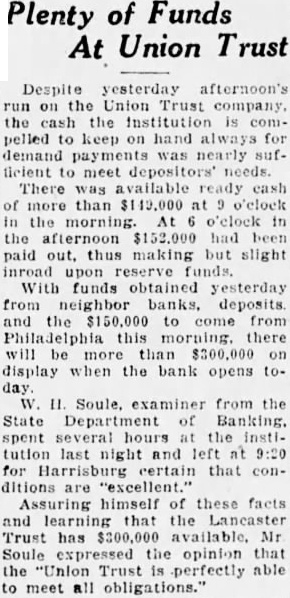
Plenty of Funds At Union Trust
Despite yesterday on the Union Trust company, the keep hand demand was sufmeet depositors' needs. There than the morning. the afternoon thus but slight inroad funds. With funds obtained from neighbor the $150,000 come from there display when the opens Soule, examiner from the State Department spent several the tution and left for Harrisburg certain that himself these and the Trust has opinion that the "Union Trust perfectly meet obligations."
8.March 9, 1926The News-JournalLancaster, PA
Click image to open full size in new tab
Article Text
During those four hours approximately $152,000 was paid out to overanxious depositors, but this amount offset largely deposits totaling nearly $100,000. Many of those drew their money from the bank re-deposited again within few minutes. Action of the Clearing House the official bank auditor that $1,000,000 more than bilities, and guarantees nipped the run before good Firms Aid Not single business firm the county its confimoney business house deposited its day's Nearly the and Christmas funds. least one fraternal organization night passed resolution pressing faith the Union Trust one painted display assur ing his sound. Officials of the bank other Clearing House tion busithe finance obtaining funds the Philadelphia Federal bank. This issued: Money Ask Union perfectly good shape We ready and their money only prepared after officials found that $150,000 hand: Federal Lancaster Trust be ready needed. When opened yesterday were expecting the about county difficulties President Hoffman. Starts Noon The rush not tion's street filled positors, their funds. tellers were rushed for About o'clock the planations big depositors have the business accountstarted regular audit yesterday his showing of persons the Ho the bank's statement examinathe time, showed Union Trust depositors $3,189,954 while assets
Crowds Mr. Maloney Officer turned confident state by pointing the doors would rule of the State found shut the doors depositors unable their state concluded gation. This fact alone
9.March 10, 1926The Anderson HeraldAnderson, IN
Click image to open full size in new tab
Article Text
BOYS ASSEMBLE FOR FIRESIDE
Enjoy Diamond Movies Other Activities of Boys at Y Tuesday. boys assembled at the Young Mens' Christian Association last, night to witness the Fireside Hour. Fifty slides on the gold and diamond mines Africa were shown. This proved of much interest to the boys. Conversation and refreshments formed the nucleus of the social hour. The boys' Work Committee met yesterday evening Regular business was discussed. The Junior A Bible, class convened with Mr. McHarry last night. The session was spent in regular Bible instructions. The attendance was fair. The Aquatis Club will meet this evening at 7:00 m. in the Mens' Assembly. Regular swimming praetice will be held Thursday even. ing from 7:00 m. until 8:00 o'clock.
PIRATES SCALP NDIJANS. The Pirates defeated the Indians in three well played volleyball games the gymnasium yesterday evening. As result of their victories the Pirates practically cinched the honors for first place. Line-up and scores as follows: Pirates. Indians. Grinnell Cookson Rodecap Steck Coffin Crunk Wilson Goldsmith Patterson Carson The scores are 15 to 10; 15 to and 15 to 11. The will play the Quak ers next Thursday evening.
RUN ON BANK Pa., March Union Trust Company of this city transacted as usual today, following slight run on the institution yesterday. Rumors that the institution was in unsound condition spread rapidly and many depositors withdrew their funds. statement by the Lancaster clearing house association that it would stand
10.March 12, 1926Shamokin News-DispatchShamokin, PA
Click image to open full size in new tab
Article Text
Lehigh Co. Was Second Normal in Shipments
The Mahanoy and Hazleton division of the Lehigh Valley railroad reported that Thursday was the second normal day in anthracite shipments since the resumption of operThe report shows that a total of 28,900 tons were prepared for shipment to the markets. This tonnage was carried in 628 coal cars and six box cars, the latter having been loaded for western shipments. With the resumption of the HazleBrook colliery next Monday, it is expected that new records in daily shipments will be attained. ton division, with the result that they detected two men named Snauffer and Gerhart, of Delano, in the act of removing coal from cars at an outof-the-way place. They were taken before a justice of the peace and heavily fined on larceny and trespassing charges.
CASH HALTS RUN
When depositors in the Union Trust company, at Lancaster, started run on the bank, word was telephoned to Philadelphia and banking houses there rushed $150,000 in currency to the bank by special messengers in fast cars. The arrival of the cash, piled up on the counters. quickly halted the run and calm was restored. Incidentally, confidence was also restored in the institution.