gpt-5-mini (chosen from majority vote of a three-model LLM ensemble)
Short Digest
648e52ebc26fe074
Response Measures
None
Receivership Details
Depositor recovery rate
86.0%
Date receivership started
1904-07-27
Date receivership terminated
1910-10-31
OCC cause of failure
Fraud
Share of assets assessed as good
51.6%
Share of assets assessed as doubtful
5.5%
Share of assets assessed as worthless
42.9%
Events (5)
1.January 15, 1866Chartered
Source
historical_nic
2.July 26, 1904Suspension
Cause
Bank Specific Adverse Info
Cause Details
Directors closed the bank after discovery of irregularities and the drowning of key officers, pending an examiner's investigation; later found extensive forgeries.
Newspaper Excerpt
The First National bank of Grinnell...has closed its doors pending an investigation by national bank examiners.
Source
newspapers
3.July 27, 1904Receivership
Source
historical_nic
4.July 27, 1904Receivership
Newspaper Excerpt
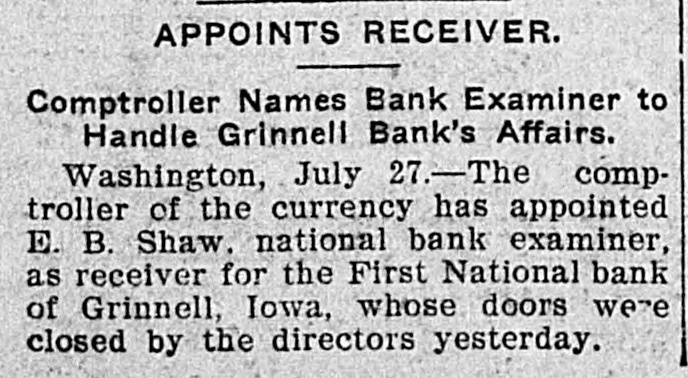
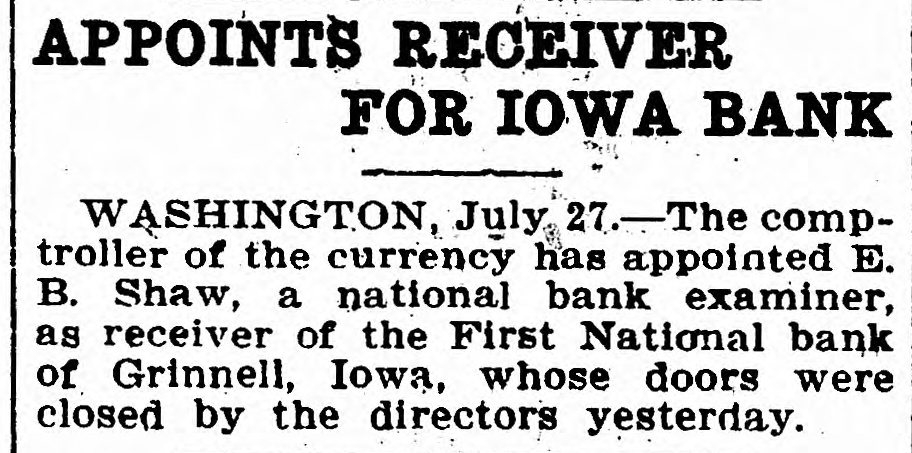
The comptroller of the currency has appointed E. B. Shaw, a national bank examiner, as receiver of the First National bank of Grinnell, Ia., whose doors were closed by the directors yesterday.
Source
newspapers
5.August 17, 1904Other
Newspaper Excerpt
Bank Examiner Shaw...found $207,000 of fraudulent notes in the First National bank's assets.
Source
newspapers
Newspaper Articles (24)
1.July 27, 1904The Topeka State JournalTopeka, KS
Click image to open full size in new tab
Article Text
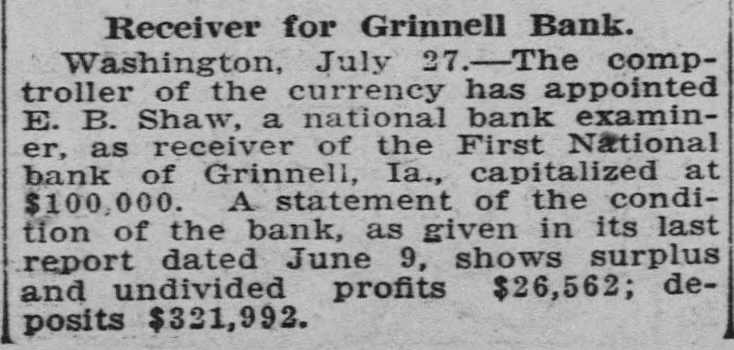
Receiver for Grinnell Bank. Washington, July 27.-The comptroller of the currency has appointed E. B. Shaw, a national bank examiner, as receiver of the First National bank of Grinnell, Ia., capitalized at $100,000. A statement of the condition of the bank, as given in its last report dated June 9, shows surplus and undivided profits $26,562; deposits $321,992.
2.July 27, 1904Evening Times-RepublicanMarshalltown, IA
Click image to open full size in new tab
Article Text
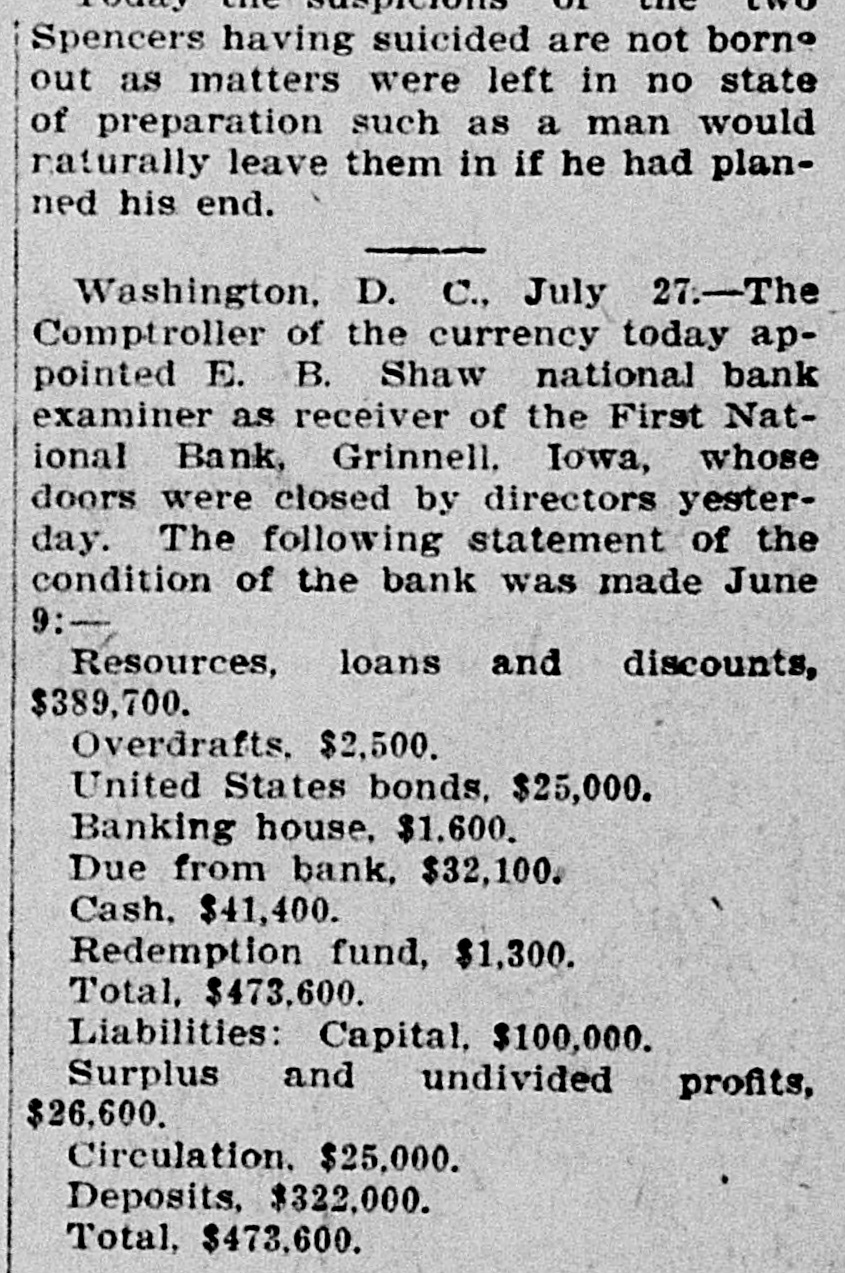
Spencers having suicided are not born out as matters were left in no state of preparation such as a man would naturally leave them in if he had planned his end. Washington, D. C., July 27.-The Comptroller of the currency today appointed E. B. Shaw national bank examiner as receiver of the First National Bank, Grinnell. Iowa, whose doors were closed by directors yesterday. The following statement of the condition of the bank was made June 9:Resources, loans and discounts, $389,700. Overdrafts, $2,500. United States bonds, $25,000. Banking house, $1.600. Due from bank, $32,100. Cash. $41,400. Redemption fund, $1,300. Total, $473.600. Liabilities: Capital, $100,000. and Surplus undivided profits, $26,600. Circulation. $25,000. Deposits, $322.000. Total, $473,600.
3.July 27, 1904Evening Times-RepublicanMarshalltown, IA
Click image to open full size in new tab
Article Text
FORGED PAPER FOUND AT GRINNELL Admitted by Directors of Grinnell Bank That Large Shortage Was Caused by Forged Notes Not Yet Known What the Amount Will Be-Examiner Shaw Appointed Receiver-Believed That Cash on Hand and Stockholders' Assessment Will Pay Out-Rumors Are Many and Large But Can Not Be Verified. Today the suspicions of the two Grinnell, July 27.-E. B. Shaw, of Spencers having suicided are not born West Union, Iowa, national bank exout as matters were left in no state aminer, was today placed in charge of of preparation such as a man would the First National bank as receiver. naturally leave them in if he had planned his end. Stories leaking from several of those who know now point very strongly to Washington, D. C., July 27.-The conditions much worse than was exComptroller of the currency today appected. It is told from mouth to mouth pointed E. B. Shaw national bank examiner as receiver of the First Natin Grinnell by business men who were ional Bank, Grinnell. Iowa, whose depositors at the bank that a large doors were closed by directors yesteramonut of forged paper has already day. The following statement of the been discovered, aggregating over condition of the bank was made June 9:$100,000. At least two directors have Resources, loans and discounts, admitted that they have been ruined $389,700. by the failure and it is almost certain Overdrafts, $2,500. that the loss of their stock investment United States bonds, $25,000. Banking house, $1.600. and a possible assessment will wipe out Due from bank, $32,100. all that some of them have in the Cash, $41,400. world. It is not yet known whether Redemption fund, $1,300. the depositors will suffer. The bank, Total, $473.600. on July 5. had $41,000 in cash on hand Liabilities: Capital, $100,000. and a deposit showing of $321,000. One Surplus and undivided profits, $26,600. depositor claims, however, that the Circulation. $25,000. deposit account has been stuffed very Deposits, $322.000. Total, $473,600. greatly for the purpose of making a good showing for the bank and if this In Marshalltown today information is true the forged paper could be acpassed over the telephone wires to counted for as a stuffed asset to offset other towns that the Grinnell shortage the factitious deposits with no real will reach $200,000. but this can not be verified at Grinnell in fact, the best inharm done to the bank. The examiner formation that can be gained by the is at work and refuses to make a stateT.-R.'s regular Grinnell correspondent ment. Directors themselves admit that is to the effect that the shortage will forged paper has been found in large be much less. amounts and this is all that is known.
4.July 27, 1904The Saint Paul GlobeSaint Paul, MN
Click image to open full size in new tab
Article Text
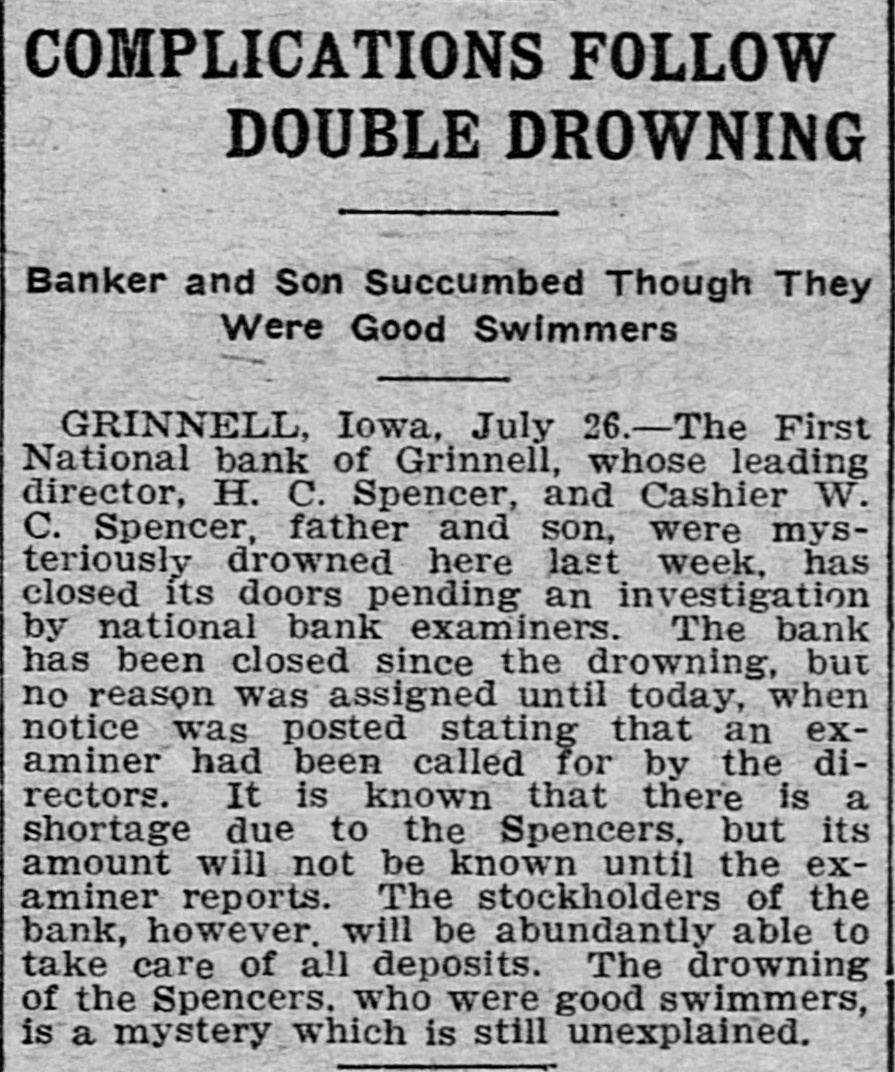
COMPLICATIONS FOLLOW DOUBLE DROWNING Banker and Son Succumbed Though They Were Good Swimmers GRINNELL, Iowa, July 26.-The First National bank of Grinnell, whose leading director, H. C. Spencer, and Cashier W. C. Spencer, father and son, were mysteriously drowned here last week, has closed its doors pending an investigation by national bank examiners. The bank has been closed since the drowning, but no reason was assigned until today, when notice was posted stating that an examiner had been called for by the directors. It is known that there is a shortage due to the Spencers, but its amount will not be known until the examiner reports. The stockholders of the bank, however. will be abundantly able to take care of all deposits. The drowning of the Spencers. who were good swimmers, is a mystery which is still unexplained.
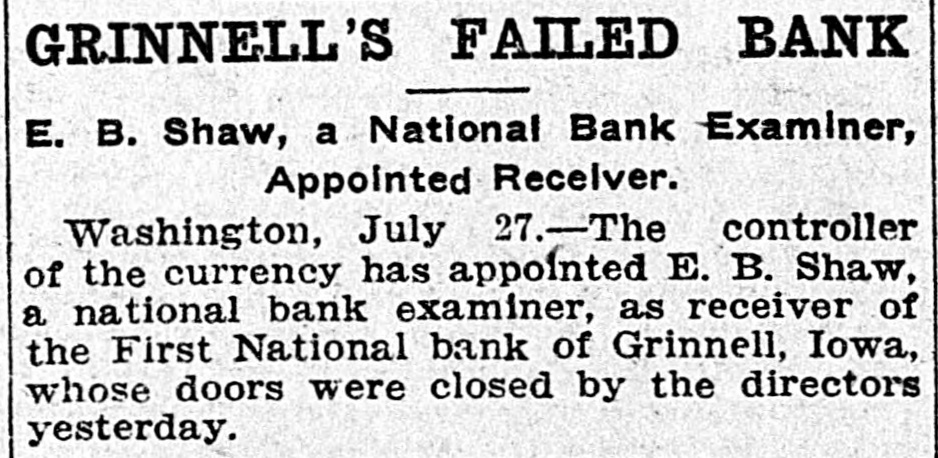
GRINNELL'S FAILED BANK E. B. Shaw, a National Bank Examiner, Appointed Receiver. Washington, July 27.-The controller of the currency has appointed E. B. Shaw, a national bank examiner, as receiver of the First National bank of Grinnell, Iowa, whose doors were closed by the directors yesterday.
6.July 28, 1904Ottumwa Tri-Weekly CourierOttumwa, IA
Click image to open full size in new tab
Article Text
APPOINTS RECEIVER. Comptroller Names Bank Examiner to Handle Grinnell Bank's Affairs. Washington, July 27.-The comptroller of the currency has appointed E. B. Shaw. national bank examiner, as receiver for the First National bank of Grinnell, Iowa, whose doors were closed by the directors yesterday.
7.July 28, 1904Missouri Valley TimesMissouri Valley, IA
Click image to open full size in new tab
Article Text
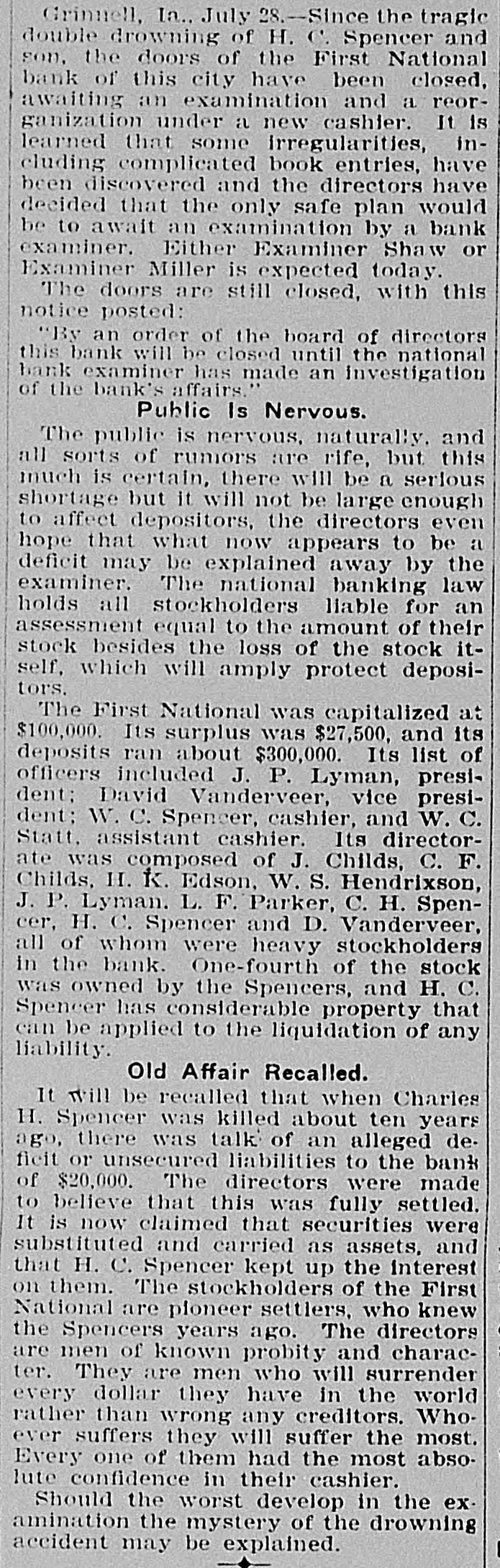
Grinnell, In. July 28.-Since the tragle double drowning of H. C'. Spencer and son. the doors of the First National bank of this city have been closed, awaiting an examination and a reorganization under a new cashier. It is learned that some Irregularities, including complicated book entries, have been discovered and the directors have decided that the only safe plan would be to await an examination by a bank examiner. Either Examiner Shaw or Examiner Miller is expected today. The doors are still closed, with this notice posted: "By an order of the board of directors this bank will be closed until the national bank examiner has made an investigation of the bank's affairs." Public Is Nervous. The public is nervous, naturally. and all sorts of runiors are rife, but this much is certain, there will be a serious shortage but it will not be large enough to affect depositors, the directors even hope that what now appears to be a deficit may be explained away by the examiner. The national banking law holds all stockholders liable for an assessment equal to the amount of their stock besides the loss of the stock itself, which will amply protect depositors. The First National was capitalized at $100,000. Its surplus was $27,500, and its deposits ran about $300,000. Its list of officers included J. P. Lyman, president; David Vanderveer, vice president: W. C. Spencer, cashier, and W. C. Statt. assistant cashier. Its directorate was composed of J. Childs, C. F. Childs, II. K. Edson, W. S. Hendrixson, J. P. Lyman. L. F. Parker, C. H. Spencer, H. C. Spencer and D. Vanderveer, all of whom were heavy stockholders in the bank. One-fourth of the stock was owned by the Spencers, and H. C. Spencer has considerable property that can be applied to the liquidation of any liability. Old Affair Recalled. It will be recalled that when Charles H. Spencer was killed about ten years ago, there was talk of an alleged deficit or unsecured liabilities to the bank of $20,000. The directors were made to believe that this was fully settled. It is now claimed that securities were substituted and carried as assets, and that H. C. Spencer kept up the interest on them. The stockholders of the First National are pioneer settlers, who knew the Spencers years ago. The directors are men of known probity and character. They are men who will surrender every dollar they have in the world rather than wrong any creditors. Whoever suffers they will suffer the most. Every one of them had the most absolute confidence in their cashier. Should the worst develop in the examination the mystery of the drowning accident may be explained.
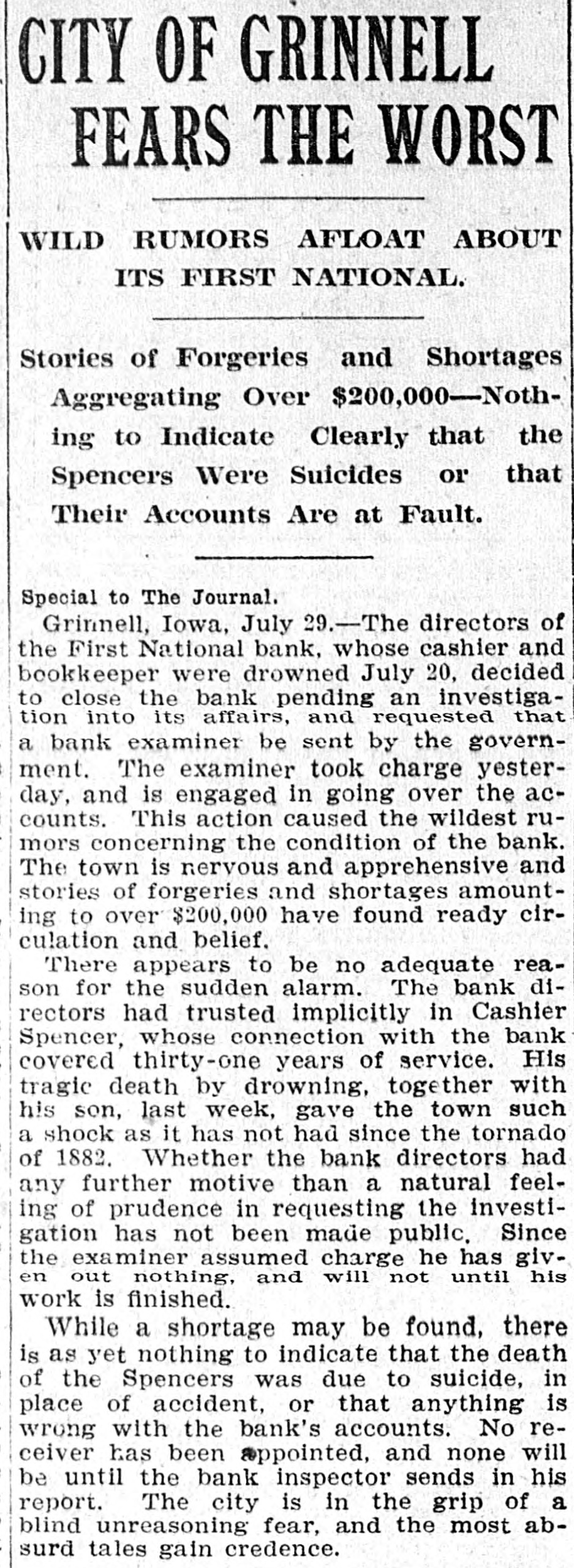
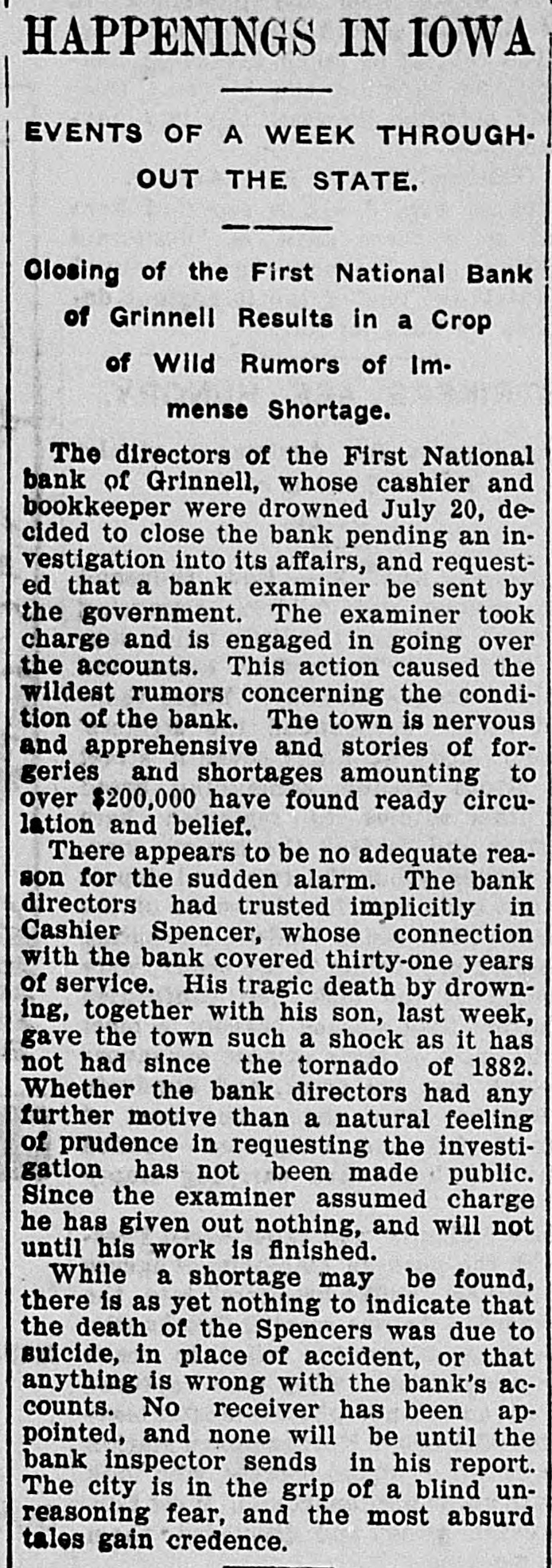
CITY OF GRINNELL FEARS THE WORST WILD RUMORS AFLOAT ABOUT ITS FIRST NATIONAL. Stories of Forgeries and Shortages Aggregating Over $200,000-Nothing to Indicate Clearly that the Spencers Were Suicides or that Their Accounts Are at Fault. Special to The Journal. Grinnell, Iowa, July 29.-The directors of the First National bank, whose cashier and bookkeeper were drowned July 20, decided to close the bank pending an investigation into its affairs, and requested that a bank examiner be sent by the government. The examiner took charge yesterday, and is engaged in going over the accounts. This action caused the wildest rumors concerning the condition of the bank. The town is nervous and apprehensive and stories of forgeries and shortages amounting to over $200,000 have found ready circulation and belief. There appears to be no adequate reason for the sudden alarm. The bank directors had trusted implicitly in Cashier Spencer, whose connection with the bank covered thirty-one years of service. His tragic death by drowning, together with his son, last week, gave the town such a shock as it has not had since the tornado of 1882. Whether the bank directors had any further motive than a natural feeling of prudence in requesting the investigation has not been made public. Since the examiner assumed charge he has given out nothing, and will not until his work is finished. While a shortage may be found, there is as yet nothing to indicate that the death of the Spencers was due to suicide, in place of accident, or that anything is wrong with the bank's accounts. No receiver has been appointed, and none will be until the bank inspector sends in his report. The city is in the grip of a blind unreasoning fear, and the most absurd tales gain credence.
9.July 29, 1904The Owosso TimesOwosso, MI
Click image to open full size in new tab
Article Text
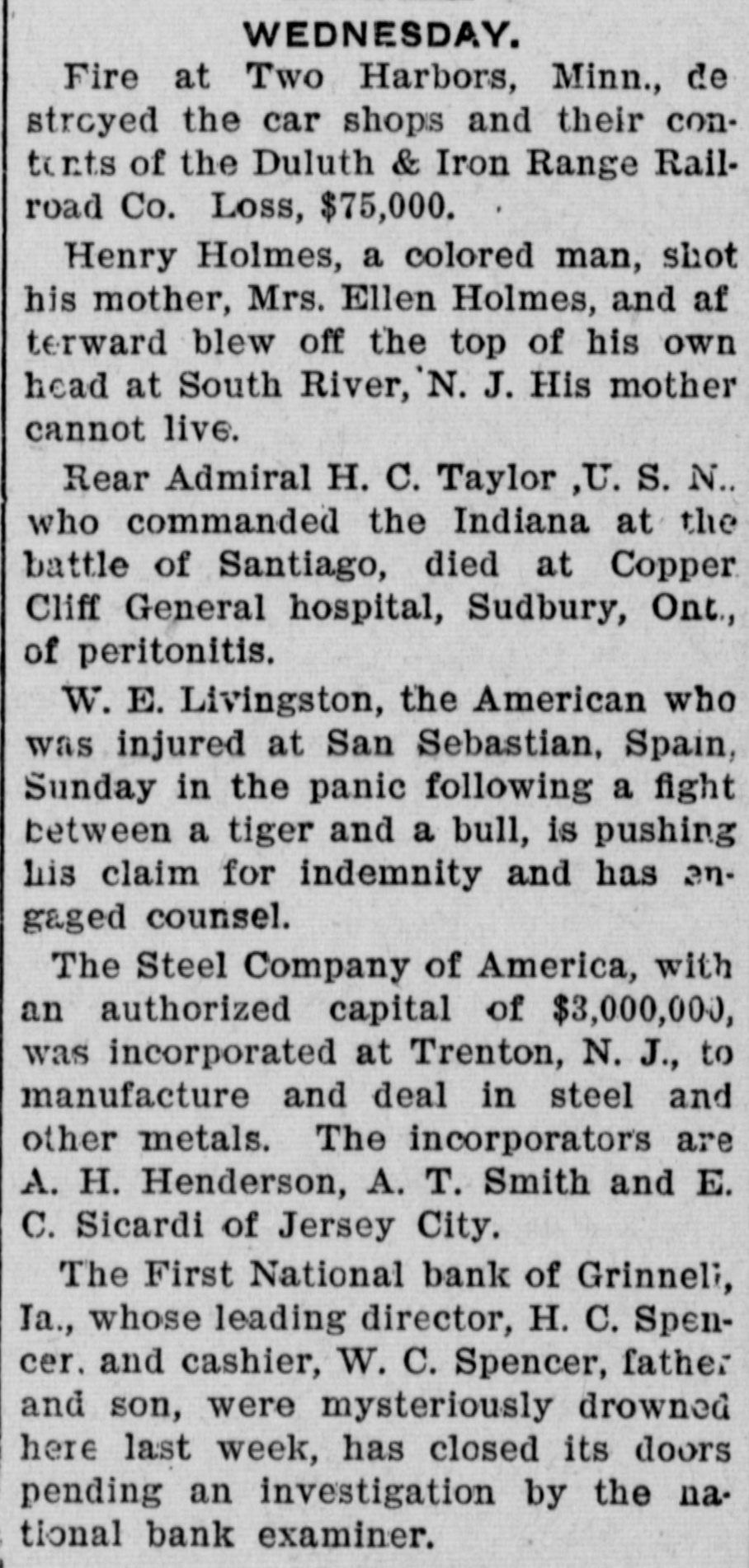
WEDNESDAY. Fire at Two Harbors, Minn., de strcyed the car shops and their contents of the Duluth & Iron Range Railroad Co. Loss, $75,000. Henry Holmes, a colored man, shot his mother, Mrs. Ellen Holmes, and af terward blew off the top of his own head at South River, 'N. J. His mother cannot live. Rear Admiral H. C. Taylor ,U. S. N.. who commanded the Indiana at the battle of Santiago, died at Copper Cliff General hospital, Sudbury, Ont., of peritonitis. W. E. Livingston, the American who was injured at San Sebastian, Spain, Sunday in the panic following a fight between a tiger and a bull, is pushing his claim for indemnity and has engaged counsel. The Steel Company of America, with an authorized capital of $3,000,000, was incorporated at Trenton, N. J., to manufacture and deal in steel and other metals. The incorporators are A. H. Henderson, A. T. Smith and E. C. Sicardi of Jersey City. The First National bank of Grinneli, Ia., whose leading director, H. C. Spencer. and cashier, W. C. Spencer, father and son, were mysteriously drowned here last week, has closed its doors pending an investigation by the national bank examiner.
10.August 2, 1904Rock Island ArgusRock Island, IL
Click image to open full size in new tab
Article Text
FRAUD SHOWN AFTER DEATH Bank Cashier, Mysteriously Drowned With His Son, Was a Forger. Grinnell, Iowa, Aug. 2.-H. C. Spencer, cashier of the defunct First National bank of this city, who was mysteriously drowned with his son two weeks ago, was not merely a defalter, but also a forger. Evidence of this fact came to light yesterday in the discovery of nine fradulent notes purporting to be signed by as many prominent farmers and business men of this section. The nine notes aggregate $7,479. The receiver of the bank sent notices to men whose names appeared on the notes and today they declared the signatures spurious. In each case there was a slight transposition of letters in spelling of names. How many more notes of the same character are extant is not yet known. The bank receiver is not yet ready to make a statement, the affairs of the institution being badly involved.
11.August 4, 1904The TomahawkWhite Earth, MN
Click image to open full size in new tab
Article Text
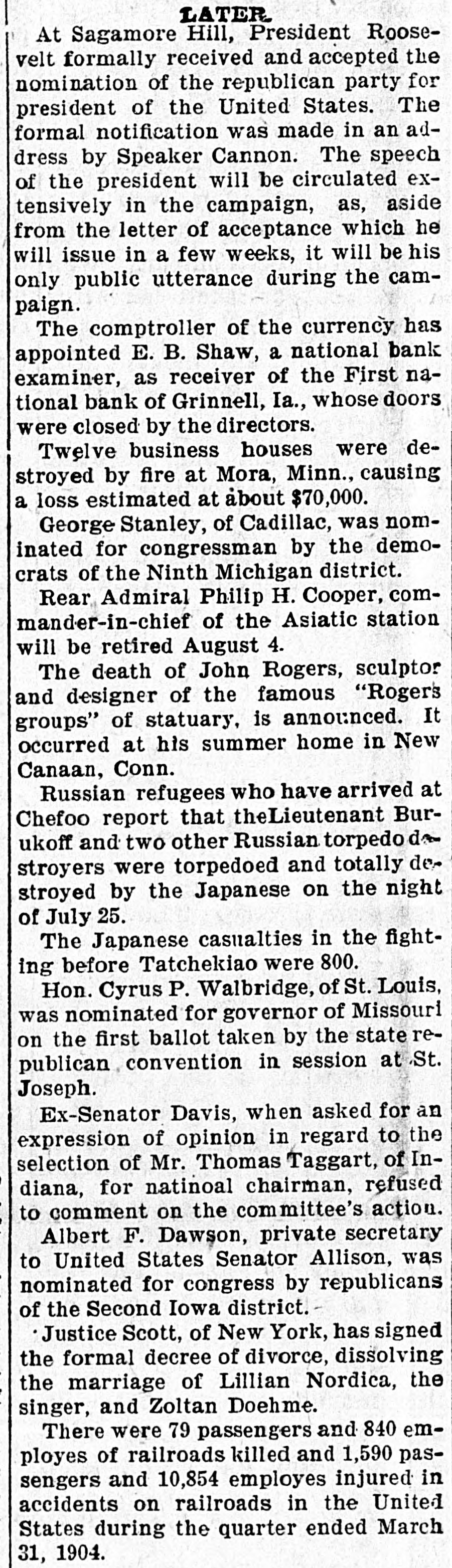
LATER. At Sagamore Hill, President Roosevelt formally received and accepted the nomination of the republican party for president of the United States. The formal notification was made in an address by Speaker Cannon. The speech of the president will be circulated extensively in the campaign, as, aside from the letter of acceptance which he will issue in a few weeks, it will be his only public utterance during the campaign. The comptroller of the currency has appointed E. B. Shaw, a national bank examiner, as receiver of the First national bank of Grinnell, Ia., whose doors were closed by the directors. Twelve business houses were destroyed by fire at Mora, Minn., causing a loss estimated at about $70,000. George Stanley, of Cadillac, was nominated for congressman by the democrats of the Ninth Michigan district. Rear Admiral Philip H. Cooper, commander-in-chief of the Asiatic station will be retired August 4. The death of John Rogers, sculptor and designer of the famous "Rogers groups" of statuary, is announced. It occurred at his summer home in New Canaan, Conn. Russian refugees who have arrived at Chefoo report that theLieutenant Burukoff and two other Russian torpedo destroyers were torpedoed and totally destroyed by the Japanese on the night of July 25. The Japanese casualties in the fighting before Tatchekiao were 800. Hon. Cyrus P. Walbridge, of St. Louis, was nominated for governor of Missouri on the first ballot taken by the state republican convention in session at St. Joseph. Ex-Senator Davis, when asked for an expression of opinion in regard to the selection of Mr. Thomas Taggart, of Indiana, for natinoal chairman, refused to comment on the committee's action. Albert F. Dawson, private secretary to United States Senator Allison, was nominated for congress by republicans of the Second Iowa district. Justice Scott, of New York, has signed the formal decree of divorce, dissolving the marriage of Lillian Nordica, the singer, and Zoltan Doehme. There were 79 passengers and 840 employes of railroads killed and 1,590 passengers and 10,854 employes injured in accidents on railroads in the United States during the quarter ended March 31, 1904.
12.August 6, 1904Evening Times-RepublicanMarshalltown, IA
Click image to open full size in new tab
Article Text
STOCKHOLDERS ARE ASSESSED Grinnell Bank Failure Grows Much Worse as Facts Develop IS SUICIDE NOW BELIEVED Forgeries Tremendous and Even Heartless Thievery of Petty Amounts Appear-Stockholders Assessed 100 Per Cent-Depositors May SufferHave Three Months to File Claims. Special to Times-Republican Grinnell, Aug. 6.-As time passes, and the facts come to light the failure of the First National Bank grows worse instead of better. Stockholders today received notices from the receiver to the effect that they would be assessed to the full amount of their stock. This means that the depositors must lose something for it is estimated that only one-half the stockholders are able to pay. Just what the shortage will be will not be known for three months as notice has been published by Comptroller of the currency Ridgely that claims can be filed within that time. Henry Spencer and his wife owned one-third of the bank stock. His stock cannot be depended upon for an assessment for the reason that his estate will all be taken before the assessment is used. About one-fourth of the other stockholders had their all invested in the bank stock and when this is gone they will not be able to pay an assessment besides. As incidents come to light the diabolical work of the cashier becomes more and more apalling. It was learned today that when C. L. Gaddis of Hickory township, a very poor and aged farmer. died some two months ago, he prepared for his end by locking up in his safety deposit box at the Spencer bank a certificate of deposit for $700, and entrusted the key to Mr. Spencer with instructions to deliver the contents to the widow. When the old lady called after the death she deposited $500, the proceeds of their farm sale and asked for the certificate of deposit. Spencer denied all knowledge of the same and investigation shows that the certificates are marked paid. The old lady never got a cent of it and her $500 is tied up in the deposits. So hot had become the volcano over which the Spencers were sitting that there is no longer any doubt in the minds of Grinnell people that both father and son committed suicide. It now transpires that in Spencer's private desk was found a list of the forged paper amounting to $204,000. Henry Spencer had been in the habit of personally keeping the note register. the certificate register and the discount register. which constitute about all the books of the bank. By keeping all hands off from these records he was compelled to work till midnight often and did about all of the bank work himself. but was able to perform almost any kind of a trick with the record.s The Grinnell Herald yesterday published a story to the effect that The bank would not be re-opened That there will be a material loss to depositors. That the report of the receiver is likely to show that the deposits were even greater than reported, and that the false entries were made to cause them to show less rather than greater as at first supposed. That new evidences of forgery constantly appear. The Times-Republican correspondent reported more than a week ago that there were evidences of forgery. and that the bank would never re-open; but for this the newspaper was censured for disturbing the Bradstreets rating of all Grinnell citizens in generh al. However, it is not yet certain that there will be a loss to depositors altho this is possible, and the facts will not be known for three months or uno til all claims are filed in the legal way. h It is not true that the receiver's report will show any new developments in ret gard to the deposits for the men in charge of the investigation have not t taken up the deposit accounts except t to verify the official statement of $321. n 000 with the books which was p be correct. enr will develop will tries found deposits to What not their be false claims. known fl depositors file tl mistake as la newspaper errors be all The until such Herald's all is excusable exercised should si but more care should be or Bradstreets ratings in Grinnell will be demoralized by so-called "yellow journalism."
13.August 10, 1904Evening Times-RepublicanMarshalltown, IA
Click image to open full size in new tab
Article Text
Examiner's Report Reaches Washington But ( ontents Are Kept Secret RIDGELY CALLS IT TOTAL WRECK Comptroller of Currency Says Spencers Would Have Been In Penitentiary Had They Lived - Grinnell Still Insists That Depositors Will be Paid, Few Stockholders Are Ruined. Washington, Aug. 10.-Examiner Shaw's report on the bank failure at Grinnell was received by the comptroller of the currency yesterday but there is a continued air of mystery about the affair yet and the officials refuse to make the report public. Comptroller Ridgeley says the bank is completely wrecked and that is all there is to it. "The report received today from Mr. Shaw," said Comptroller Ridgeley, "indicates that the affairs of the Grinnell bank are in an almost interminable tangle, and their unraveling may take many weeks. According to the report gross frauds have been committed, criminal in character. The report also shows that the Spencers, father and son, were the parties to the commission of the crimes, and they are dead. So far as I can ascertain there does not seem to be anyone left connected with the Grinnell bank who can in any way be held responsible for the fraudulent actions of the Spencers. It is a most remarkable case, and bids fair to be one of the most interesting that has been brought to the attention of the department for years." In this connection Comptroller Ridgeley said when he was appaised of the death of the Spencers, he went over to see Secretary Shaw, and in his office found Representative Hepburn. He explained that the Spencers had been drowned, but there was a suspicion of sucide due to certain elements of the affairs of the First National bank at Grinnell. Col. Hepburn. it is said, spoke up and assured Mr. Ridgeley that there could not be the slightest doubt as to the probity of the Spencers, as they were held in the highest esteem in the community in which they lived. "Subsequent events would seem to disprove Col. Hepburn's judgment," said Mr. Ridgeley, "as it appears quite evident that the Spencers' were entirely and alone responsible for the disasterous wrecking of the First National bank at Grinnell, and that thru methods, which, had they lived, would probably have landed them behind the bars. "This only proves," continued Mr. Ridgeley, "that a man having made a reputation for honesty and fair dealing in a community may do almost any fraudulent thing for years until some such catastrophe as overtook the Spencers bring home the fact that they have played upon the credulity of the public for dishonest purposes." Comptroller Ridgeley said that in all probability Bank Examiner Shaw would be held at Grinnell for some time to continue further his examination into the bank's affairs. As to the appointment of a receiver for the bank, Mr. Ridgeley said he could not under present conditions say whether such'an official would be appointed or not; he would await further advices from Mr. Shaw. The fact of the matter is the bank is completely wrecked and the wreckers are dead.
14.August 11, 1904Ottumwa Tri-Weekly CourierOttumwa, IA
Click image to open full size in new tab
Article Text
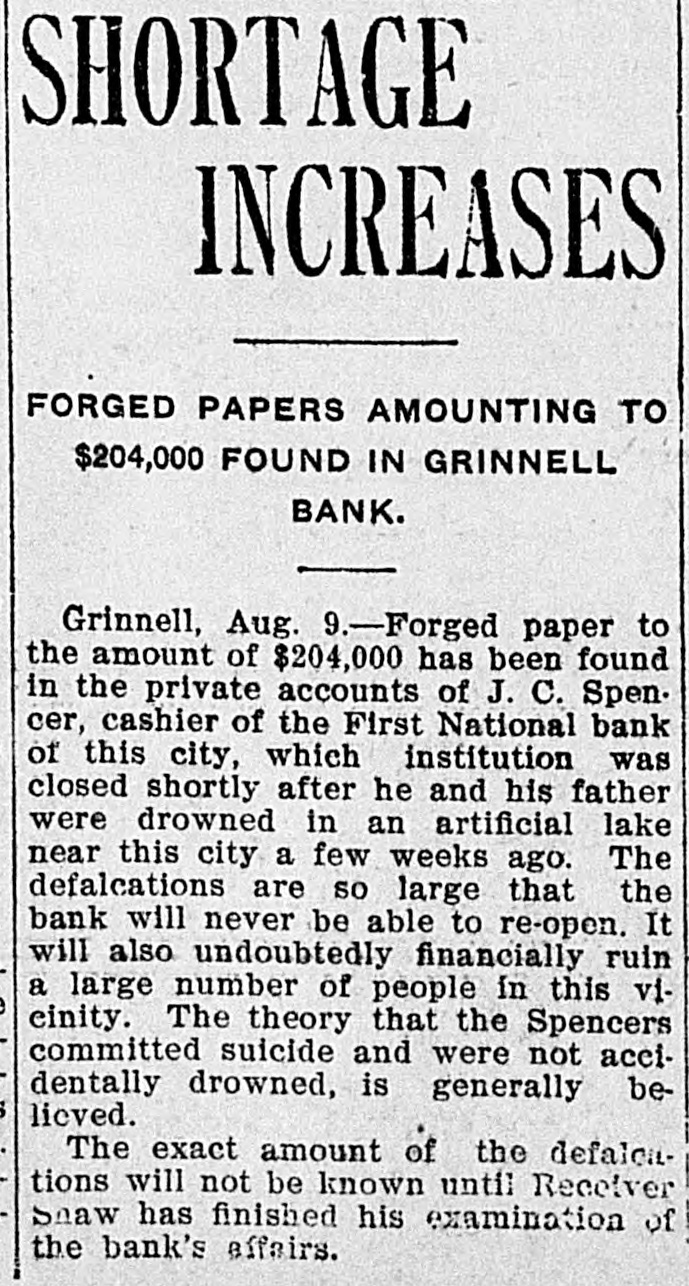
SHORTAGE INCREASES FORGED PAPERS AMOUNTING TO $204,000 FOUND IN GRINNELL BANK. Grinnell, Aug. 9.-Forged paper to the amount of $204,000 has been found in the private accounts of J. C. Spen. cer, cashier of the First National bank of this city, which institution was closed shortly after he and his father were drowned in an artificial lake near this city a few weeks ago. The defalcations are so large that the bank will never be able to re-open. It will also undoubtedly financially ruin a large number of people in this vicinity. The theory that the Spencers committed suicide and were not accidentally drowned, is generally believed. The exact amount of the defalontions will not be known until Receiver Snaw has finished his examination of the bank's effairs.
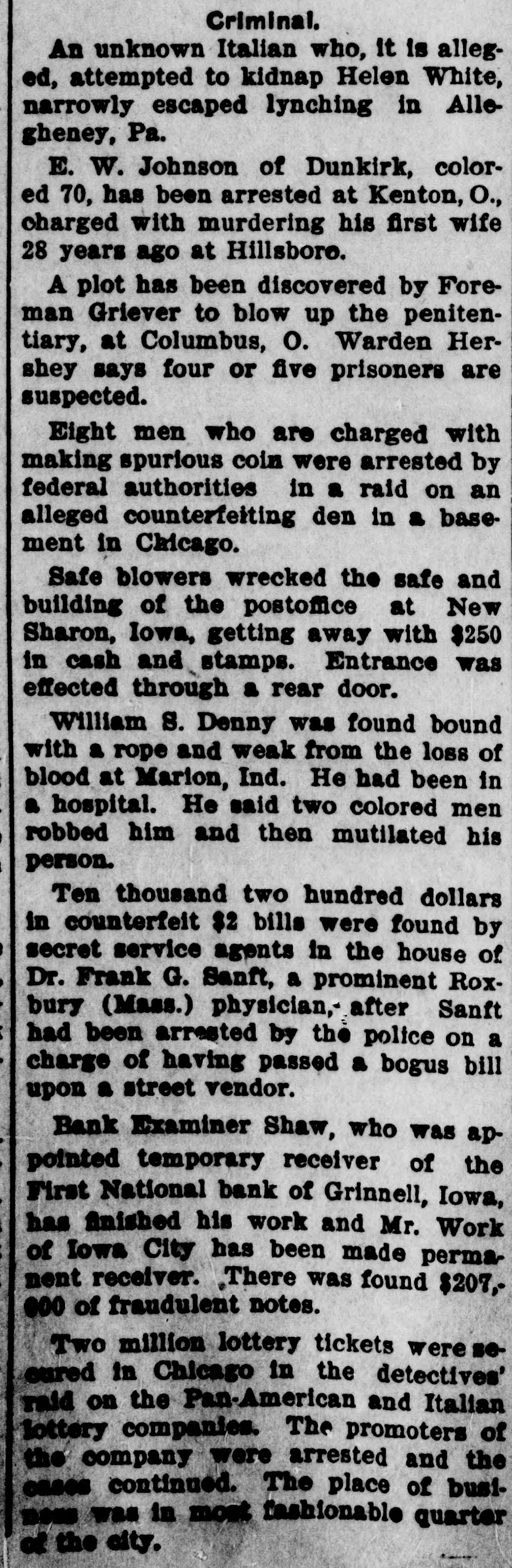
BAD NOTES FOR $207,000. Found by Bank Examiner in Grinnel! (la.) First National. Grinnell, Ia., Aug. 17.-Bank Examiner Shaw, who was appointed tem porary receiver of the First National bank, has finished his work and Mr. Work of Iowa City, Ia., has been made permanent receiver. There was found $207,000 of fraudulent notes. From all that can be learned, and that is little, there are enough or nearly enough assets to pay the depositors, but it is generally believed that if they get 75 cents on the dollar it will be all that will be realized.
16.August 31, 1904The Miller SunMiller, SD
Click image to open full size in new tab
Article Text
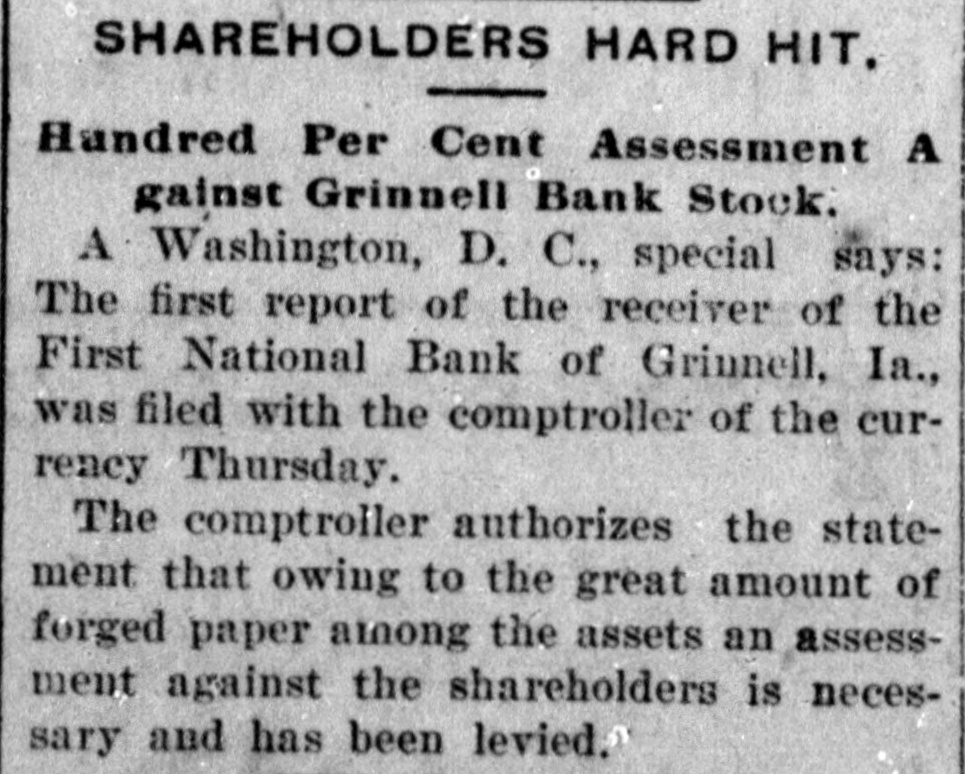
# SHAREHOLDERS HARD HIT.
Handred Per Cent Assessment Against Grinnell Bank Stock.
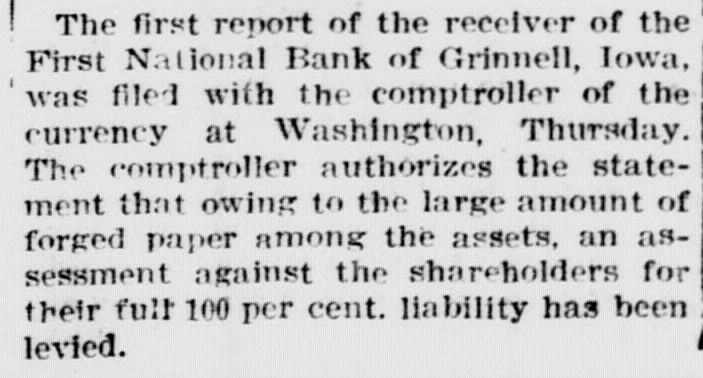
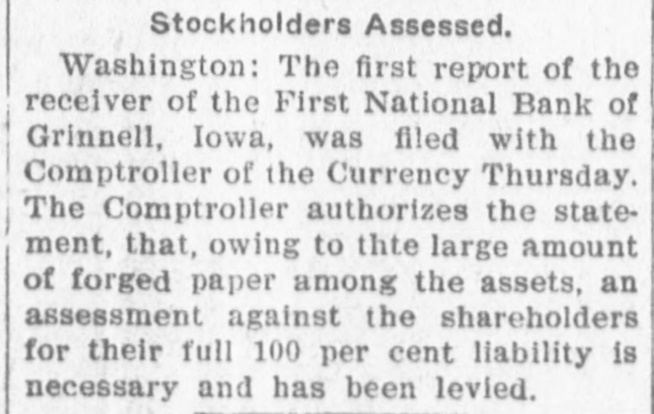
A Washington, D. C., special says: The first report of the receiver of the First National Bank of Grinnell, Ia., was filed with the comptroller of the currency Thursday.
The comptroller authorizes the statement that owing to the great amount of forged paper among the assets an assessment against the shareholders is necessary and has been levied.
17.September 7, 1904The Denison ReviewDenison, Dow City, IA
Click image to open full size in new tab
Article Text
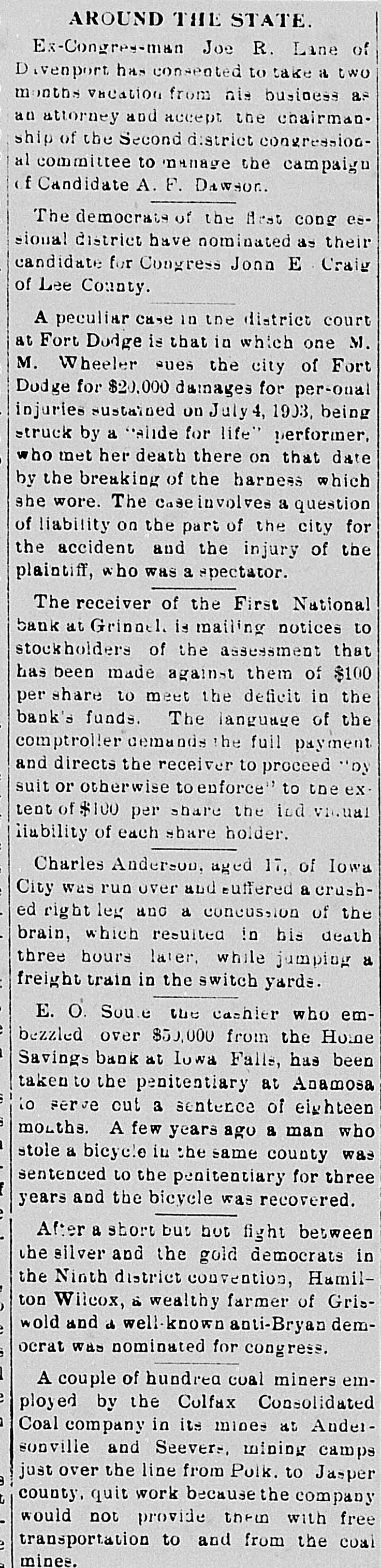
# AROUND THE STATE.
Ex-Congres-man Joe R. Lane of Davenport has consented to take a two months vacation from nis business as an attorney and accept the chairmanship of the Second district congressional committee to manage the campaign of Candidate A. F. Dawson.
The democrats of the first congressional district have nominated as their candidate for Congress Jonn E Craig of Lee County.
A peculiar case in the district court at Fort Dodge is that in which one M. M. Wheeler sues the city of Fort Dodge for $20,000 damages for personal injuries sustained on July 4, 1933, being struck by a "slide for life" performer, who met her death there on that date by the breaking of the harness which she wore. The case involves a question of liability on the part of the city for the accident and the injury of the plaintiff, who was a spectator.
The receiver of the First National bank at Grinnel, is mailing notices to stockholders of the assessment that has been made against them of $100 per share to meet the deficit in the bank's funds. The language of the comptroller demands the fuil payment and directs the receiver to proceed "Dy suit or otherwise to enforce" to the extent of $100 per share the ind voual liability of each share holder.
Charles Anderson, aged 17, of Iowa City was run over and suffered a crushed right leg and a concussion of the brain, which resulted in his death three hours later, while jumping a freight train in the switch yards.
E. O. Sou.e the cashier who embezzled over $50,000 from the Home Savings bank at Iowa Falls, has been taken to the penitentiary at Anamosa to serve cut a sentence of eighteen mouths. A few years ago a man who stole a bicycle in the same county was sentenced to the penitentiary for three years and the bicycle was recovered.
After a short but hot fight between the silver and the gold democrats in the Ninth district convention, Hamilton Wilcox, a wealthy farmer of Griswold and a well-known anti-Bryan democrat was nominated for congress.
A couple of hundred coal miners employed by the Colfax Consolidated Coal company in its mines at Andersonville and Seevere, mining camps just over the line from Polk. to Jasper county, quit work because the company would not provide them with free transportation to and from the coal mines.
18.October 6, 1904Evening Times-RepublicanMarshalltown, IA
Click image to open full size in new tab
Article Text
are wholly incompetent to unravel the mystery. The history of the appointment of the present receiver would throw some interesting side lights on the system of graft that Lincoln Steffens writes about in McClure's. It would reflect no credit on certain officials and some Iowa politicians would appear in a light not complimentary, and their admiring constituents would have to revise their opinions. Depositors are now paying three men very high salaries for doing what one ordinary business man could do without bringing about nervous prostration. Unfortunately when a national bank goes into liquidation, the receiver is not selected on the ground of fitness, of competency ,or of familiarity with the business. The only question is, how can certain politicians pay their most pressing political debts, and advance their own personal political fortunes. A certain prominent politician may sometime be called on to explain why he endorsed the application of a man thoroughly qualified, and pretended to support him, while all the time he was urging the selection of some one else. Voting for Cummins may be a heinous offense, but the people of Poweshlek county and the creditors of the First National bank of Grinnell have yet to learn that it disqualifies a man from performing the duties of receiver. The question now arises after reading this story why some one did not know or at least suspect what was going. on The answer is that while the elder Spencer lived those who had interests in the bank had ample warning, but to all suggestions they turned a deaf ear. When he met his death in 1893 the audacious manner in which H. C. Spencer juggled with the estate's assets ought to have suggested inquiries, but the very boldness of his methods silenced inquiry. There were men, quite a number of them, who knew something was wrong, but they didn't know what it was. As they could only surmise, they kept still. From time to time the bank's statements were examined with misgivings. The trouble was believed to be due to the presence of a large lot of bad securities, an inheritance of the Beatrice failure, but forgery was never suspected. For example, the last semi-annual statement of July, 1904, The Merchants' National showed a line of discounts of $470,000; the First National of $407,-
19.November 9, 1904Evening Times-RepublicanMarshalltown, IA
Click image to open full size in new tab
Article Text
Depositors In Defunct Grinnell Bank, Demand Appointment of John C. Manly INTERESTS ARE JEOPARDIZED Such is the Claim of Those Signing the Petition Which Will be Presented to Secretary Shaw on His Expected Arrival in Grinnell Wednesday-The Situation. Special to Times-Republican. Grinnell, Nov. 8.-Matters in regard to the failure of the First National bank are still interesting. A petition. addressed to Comptroller Ridgeley signed by numerous depositors and some business men, asking for the removal of the present receiver and the appointment of John C. Manly of this city, will be presented to Secretary Shaw on his promised arrival on Wednesday next. Failing In this, It is the intention of these dissatisfied depositors to secure the services of some able lawyer to protect their Interests, which they claim are jeopardized under the management of the present receiver. Legal steps are more than likely to be instituted, in the matter of one stockholder liable for $5,000, who was compromised with for $1,875. The basis of the suit will be the public statement in a public meeting that said stockholder would lose every cent he had on earth but that he would pay his assessment in full, and the bank depositors would lose nothing on his account. Whether this will stand law and the proceedings of the receiver in this case be annulled, is an open question but the dissatisfied depositors feel assured that If this case is brought to the attention of Shaw and Controller Ridgley it will produce results. In regard to the politics in the case Lacey has relieved himself of some embarrassment as to any direct action in the appointment of Receiver Swords but there is n. general feeling that politics did result in the appointment of a man outside of Poweshiek county, notwithstanding there were many men living in Montezuma, Malcom or Brooklyn who would have been acceptable both to depositors and stockholders. There is a surprising number of women's signatures on the list, asking for the removal of the present receiver, and to these the loss of even the small amount of money they had in the defunct bank is most serious. Hardly any of the business firms are Interested more than to hope for as speedy a settlement as possible, and this without making the appointment of any receiver "a plum," for political services rendered. There is no feeling because Lanphere was not appointed. Lanphere himself is no sore head, and the majority of republicans here feel that Lacey in trying to secure the services of Judge Lewis of Montezuma, was working along the line of the real Interests of both stockholders and depositors. Nevertheless so acute is the situation now that to claim that the continuance of the present receivership will not result in future political grief is a mistake. If political considerations forced the appointment greater ones demand the change.
20.December 21, 1904Evening Times-RepublicanMarshalltown, IA
Click image to open full size in new tab
Article Text
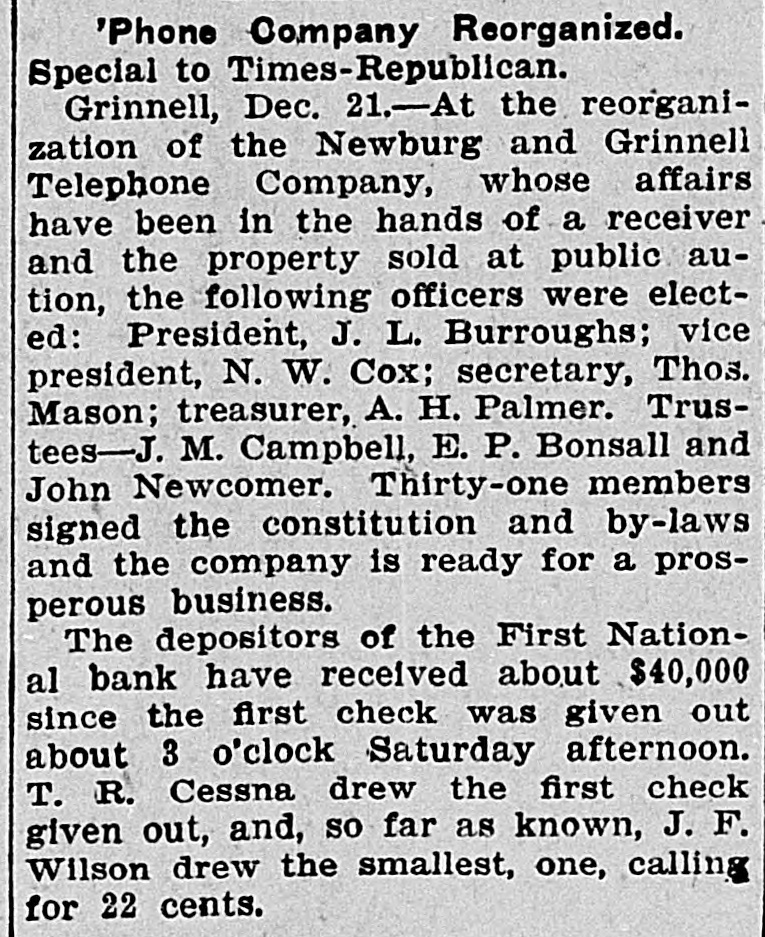
'Phone Company Reorganized. Special to Times-Republican. Grinnell, Dec. 21.-At the reorganization of the Newburg and Grinnell Telephone Company, whose affairs have been in the hands of a receiver and the property sold at public aution, the following officers were elected: President, J. L. Burroughs; vice president, N. W. Cox; secretary, Thos. Mason; treasurer, A. H. Palmer. Trustees-J. M. Campbell, E. P. Bonsall and John Newcomer. Thirty-one members signed the constitution and by-laws and the company is ready for a prosperous business. The depositors of the First National bank have received about $40,000 since the first check was given out about 3 o'clock Saturday afternoon. T. R. Cessna drew the first check given out, and, so far as known, J. F. Wilson drew the smallest, one, calling for 22 cents.
21.December 28, 1904The Washington TimesWashington, DC
Click image to open full size in new tab
Article Text
TEN BANKERS IN IOWA SELF-SLAIN Record Year of Disaster in That State. CATTLE BROUGHT DOWNFALL Faced by Ruin, Half a Score of Hawkeye Officials Committed Suicide. DES MOINES, Dec. 28.-An unprecedented record of disaster among Iowa banks will be disclosed by a report now being prepared at the State auditor's office for 1904. Culminating last week with the closing of the savings bank at Dedham, this is the year's startling record: Ten bank cashiers dead by suicide. Forty banks wrecked and their surplus squandered. Twelve millions of dollars lost to depositors. In two instances bank officers have absconded with funds, thus accounting for the failure, but the remarkable number of failures due to similar circumstances has aroused the curiosity of the whole State to ascertain the cause. These are the suicides of the year due to bank failures, so far as the State officials know: H. C. Spencer and his son, cashier and assistant cashier of the Grinnell National Bank. George D. Wood, cashier of the Bank of Colfax, Colfax, Iowa. Charles Wood, cashier of the Citizens' Bank of St. Charles. F. L. La Rue, cashier of the Corning State Bank. G. D. Utterback, cashier of the Sigourney Savings Bank. H. W. Main, cashier of the Linn Grove Bank. Cashier of the Lone Tree Bank. Two other suicides early in the year, whose names are not recalled by the attaches of the State auditor's office. Tragedy Follows Tragedy. It is only within the past few days that the State has become aware of the magnitude of the disasters and the tragedies attending them, many of the failures having been kept quiet. Not until the two suicides in quick succession at Lone Tree and Linn Grove, and the failure of the Sheldon State Bank, with losses amounting to many thousands, created a State-wide sensation was general attention attracted to the serious condition of affairs. The failure of the bank at Collfax, the National Bank at Storm Lake, and the bank at Sigourney, with the suicide of the cashier, added to the sensation. The suicide of Cashier Utterback, of the Sigourney Bank, was followed by the discovery of extensive forgeries which he had perpetrated to cover up a shortage which had been running for some time. His shortage, like those of the eight other cashier suicides, was apparently due to one of two causesspeculation on the Chicago board of trade and the juggling of prices by the meat trust. Meat Trust Blamed. The meat trust is blamed by thousands throughout Iowa for the year's tragedies. In almost every bank that failed large quantities of paper, based on higher prices for five stock, were found, the makers being unable to meet their loans owing to the cut in prices of live stock. In almost every case the cashier had trusted to the prices of cattle remaining high, and this, coupled with speculative plunges on the board of trade, accomplished their ruin. Back of this recklessness. State Bank Examiner Cox declares, is the lax banking law of the State, and as a result of the year's melancholy record efforts are already making to amend this law. The epidemic of banking suicides started with that of Cashier George D. Wood, of the Bank of Colfax He was regarded as one of the shrewdest and most trustworthy bankers of the State, and his suicks caused a great sensation. Investigation developed that he personally had been a large investor in live stock and had loaned extensively for cattle purchases. The drop in eattle prices brought him face to face with ruin, if not dishonor, and he took his life. Wood had been accounted the wealthiest and most public-spirited man in his county, and imputation of dishonesty is hotly resented by every man in his home city. The cause of his downfall is illustrated by the sale, after his suicide, of paper representing a par value of $175,000 for $640. State Bank Examiner Cox declares that such worthless paper would never have been admitted to the bank if the institution had been subject to State inspection. A Six-Figure Failure. The death of E. H. McCutchon, one of the best-known politicians in the State, precipitated the wreck of the bank at Holstein. Directly after his death it was discovered that the loss at this bank would run into the six
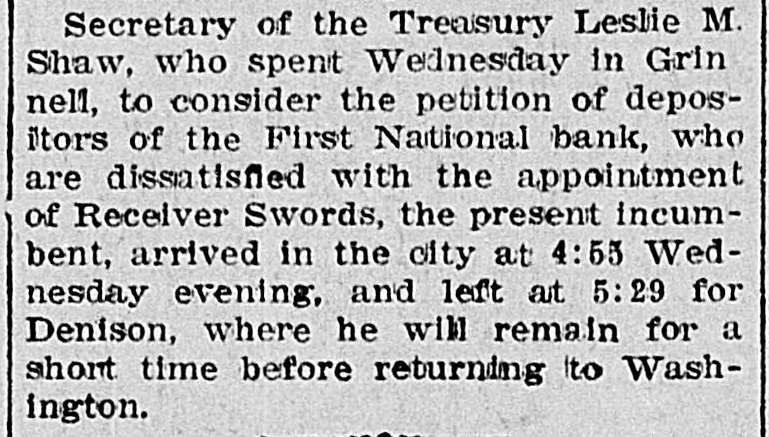
NOVEL STEP BY RECEIVER Grinnell Bank Official Asks Federal District Court to Approve His Acts. IOWA CITY, IOWA.-A novel step in disposing of the affairs of a defunct bank was taken today by George W. Swords of Iowa City, receiver of the First National bank of Grinnell, who asks the district court of the United States to approve his settlements and adjudication of many matters connected with the bank-in which he has handled something like $300,000 worth of cash. claims and collateral. He has declared, in all, 55 per cent in dividends, an unexpectedly large proportion. Receiver Swords calls particular attention to matters connected with the dower interest of Mrs. Spencer. widow of the president. who committed suicide a year ago; to disputed claims amounting to many thousands of dollars, legal actions brought to determine the rights of the bank under certain leases to which Josiah B. Grinnell, the father of the city, was party in his lifetime; the foreclosure of a mortgage in the courts of Colorado-one of the notable assets of the bank (amounting to $30,000), and some other matters connected with the real and personal property in the assets. The controller of currency has already approved Mr. Swords' acts, but the Iowa City official wished to take the matters higher. This is the first time that an Iowa receiver has construed the law SO as to place the business in his charge in the district court of the United States. Owing to the refusal of Byron Stillwell's paint and panerhanging establishment to sign a
23.September 30, 1905Evening Times-RepublicanMarshalltown, IA
Click image to open full size in new tab
Article Text
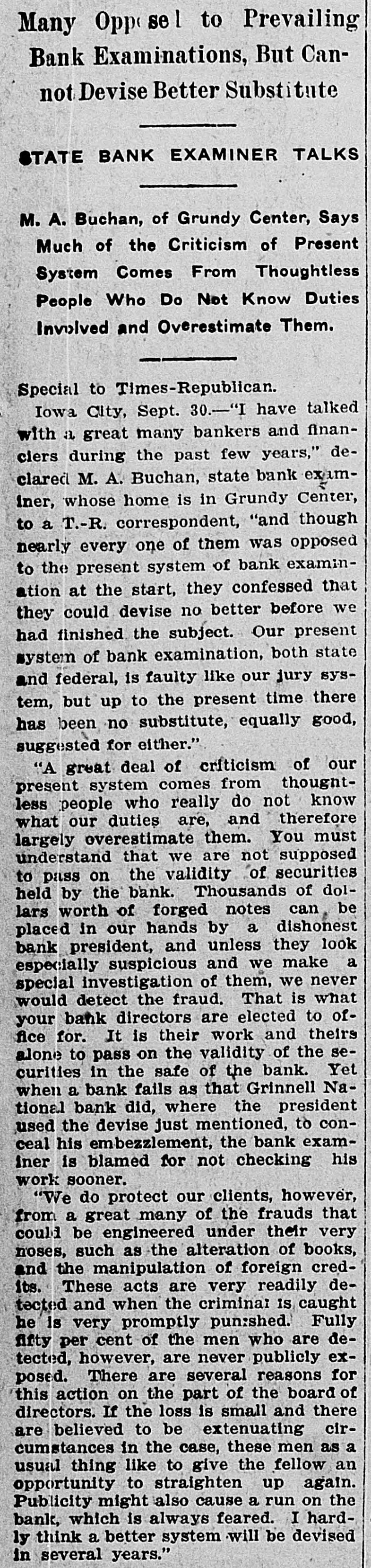
# Many Opposel to Prevailing Bank Examinations, But Cannot Devise Better Substitute
# STATE BANK EXAMINER TALKS
M. A. Buchan, of Grundy Center, Says Much of the Criticism of Present System Comes From Thoughtless People Who Do Not Know Duties Involved and Overestimate Them.
Special to Times-Republican.
Iowa City, Sept. 30.-"I have talked with a great many bankers and finan-
clers during the past few years," de-
clared M. A. Buchan, state bank exam-
iner, whose home is in Grundy Center,
to a T.-R. correspondent, "and though
nearly every one of them was opposed
to the present system of bank examin-
ation at the start, they confessed that
they could devise no better before we
had finished the subject. Our present
system of bank examination, both state
and federal, is faulty like our jury sys-
tem, but up to the present time there
has been no substitute, equally good,
suggested for either."
"A great deal of criticism of our
present system comes from thought-
less people who really do not know
what our duties are, and therefore
largely overestimate them. You must
understand that we are not supposed
to pass on the validity of securities
held by the bank. Thousands of dol-
lars worth of forged notes can be
placed in our hands by a dishonest
bank president, and unless they look
especially suspicious and we make a
special investigation of them, we never
would detect the fraud. That is what
your bank directors are elected to of-
fice for. It is their work and theirs
alone to pass on the validity of the se-
curities in the safe of the bank. Yet
when a bank fails as that Grinnell Na-
tional bank did, where the president
used the devise just mentioned, to con-
ceal his embezzlement, the bank exam-
iner is blamed for not checking his
work sooner.
"We do protect our clients, however,
from a great many of the frauds that
could be engineered under their very
noses, such as the alteration of books,
and the manipulation of foreign cred-
its. These acts are very readily de-
tected and when the criminal is caught
he is very promptly punished. Fully
fifty per cent of the men who are de-
tected, however, are never publicly ex-
posed. There are several reasons for
this action on the part of the board of
directors. If the loss is small and there
are believed to be extenuating cir-
cumstances in the case, these men as a
usual thing like to give the fellow an
opportunity to straighten up again.
Publicity might also cause a run on the
bank, which is always feared. I hard-
ly think a better system will be devised
in several years."
24.November 25, 1905Evening Times-RepublicanMarshalltown, IA
Click image to open full size in new tab
Article Text
PENA REFORMS Committee Appointed to Investigate Favors Indeter'minate Sentence Plan REPORT TO THE LEGISLATURE Large Number of the District Judges Are Said to Favor the Change in the w-Wisconsin and Towa Political Conditions Compared - Keokuk Doctors Critised. Special to Times-Republican. Des Moines, Nov. 25.--The indeterminate sentence law is to be recommended to the legislature by the legislative committee appointed at the last session to investigate the indeterminate sentence and the Elmira reformatory system. The committee, it is learned, has thus far not held any meeting to formulate its report to the legislature but it is learned that all three members of the committee are favorably disposed to the indeterminate sentence idea as a result of their investigations the past summer. As to the Elmira reformatory system there is some doubt with the chances that the committee will not be unanimously in favor of the system. The indeterminate sentence law has been recommended by the state board of control a number of times and was recommended at the last session and the recommendation is in the report soon to appear from the hands of the state printer. A large number of the district judges are said to favor the indeterminate sentence also. The state board of control is as anxious to have the penitentiary prisoners divided, the older ones sent to Fort Madison and the younger of whom there is some hopes of reformation sent to Anamosa as they are to have the Indeterminate sentence, one of their strongest arguments being that the reformatory and Indeterminate sentence go hand in hand in the matter of prison reform and further that the change could be made with practically no additional expense, the only thing being needed being a law authorizing the division of the prisoners and a small appropriation for hiring teachers for the reformatory There has been some disposition for some time to draw a parallel between conditions in Wisconsin and Iowa in the fights of LaFollette and Cummins for the interest of the people against the corporations and one of the contentions now by those who wish Governor' Cummins to take the field against Capt. J. A. T. Hull for the position in congress is based on this alleged parallel. It lis claimed that Governor LaFollette, if he goes to the senate now will go with somewhat less prestige and with less flying colors than he would have done had he gone to the senate before his last campaign. In the last campaign in Wisconsin, It will be remembered there was a desperate fight and the aid of the courts was invoked by LaFollette men to get the ballots straightened out. Making the comparison with Iowa conditions it is claimed that should Governor Cummins be a candidate for a third term and his majorities in the count of the vote be shown to be any less it would mean a loss of prestige for him and an election either to the senate or house at Washington following such an election would not counteract the effect. But to defeat Captain Hull would mean that he would step at once into greater national prominence. As a matter of fact there are Interests in the case that are more or less in conflict. Undoubtedly a great many of the governor's friends out through the state would like to have him governor for a third term as it will mean much to them and undoubtedly there are a great many anti-Hull men in Polk county and the Seventh district who would like to have the Governor defeat Hull for the reason that it would mean much to them. James Martin of Sac county was committed to the penitentiary at Anamosa and died before his record could be taken. The report is that he was committed Oct. 18 for breaking and entering and sentenced to two and a half years. He seems to have been taken giok and died the next day after he entered the penitentiary. An additional report from the school for the feeble minded at Glenwood is to the effect that one of the assistants wt the school has died from the diphtheria. There are still no new cases, however. There have now been two deaths. It is learned that George W. Swords of Iowa City has about completed all the work of winding up the affairs of the Grinnell National bank and has been notified by the comptroller of the currency of his appointment to take charge of a bank at Minot, N. D., as receiver, a national bank there having gone by the wall. Mr. Swords is a lawyer. According to Dr. J. F. Kennedy, secretary of the state board of health there is one city in the state for which the records show no births thus far during the year 1905. That city is Keokuk. Till within the last few days there were no reports of births or deaths from Dubuque. The seriousness of the ommission and failure to these things to the proper au-
Bank runs are almost always and everywhere a deterioration of bank fundamentals.
But not for you.
You are the measure-zero exception: great fundamentals, solid bank, and yet the Diamond Dybvig fairy spread its rumor. Depositors woke up. Your collateral was not prepositioned. The Clearinghouse had it for you.
Do not pass Go. Do not collect $200. Go directly to jail… or worse.