Louisiana National Bank (New Orleans, LA)

Episode Information

Episode UID
162600951
Episode Type
Run β†’ Suspension β†’ Reopening
Bank Type
national
Bank ID
16260 national
Charter Number
1626
Start Date
March 19, 1879
Location
New Orleans, Louisiana (29.955, -90.075)

Metadata

Model
gemini-3-flash-preview (chosen from majority vote of a three-model LLM ensemble)
Short Digest
89c6255feaf21343

Response Measures

Borrowed from banks or large institutions, Fed/other loan, Partial suspension

Other: The Clearing House banks collectively agreed to limit cash payments to $200 per depositor per day and use certified checks for larger transactions to preserve currency until shipments arrived from New York.

Clearinghouse involved: Yes (loan, examination, or other measures)

Description

The bank participated in a city-wide Clearing House agreement to limit payments to $200 per day following a general run on New Orleans banks.

Events (5)

1. December 30, 1865 Chartered
Source
historical_nic
2. March 19, 1879 Run
Cause
Local Banks
Cause Details
The failure of the Southern Bank and Mechanics' and Traders' Bank, following a savings bank failure, triggered a general panic and run on all banks.
Measures
The Clearing House adopted a resolution refusing to pay out more than $200 to any one depositor for ten days.
Newspaper Excerpt
The third day, yesterday, came a general rush, and the banks suspended currency payments in selfdefense.
Source
newspapers
3. March 20, 1879 Suspension
Cause
Local Banks
Cause Details
Partial suspension of currency payments (limited to $200/day) enacted by the Clearing House to stop a growing panic following local bank failures.
Newspaper Excerpt
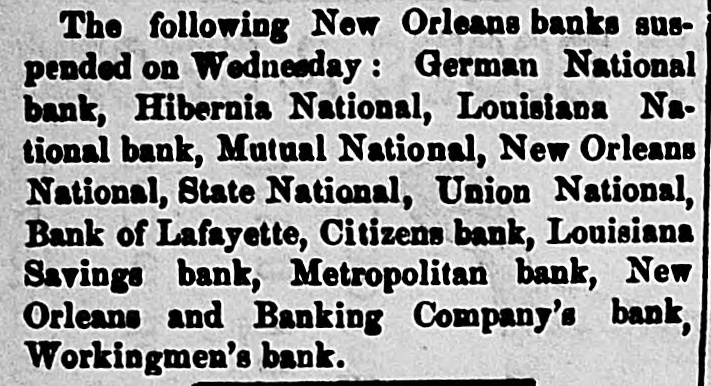
The followinglis a list of the banks that have temporarily suspended: ... Louisiana National Bank
Source
newspapers
4. March 25, 1879 Reopening
Newspaper Excerpt
The New Orleans banks after three days suspension have all resumed. ... resumed payment on the 25th inst. ... paying over the counter in the good old way all solid checks presented. Confidence in our banks has evidently been restored, for not the least sign of a rush could be seen on any of these institutions, and no anxiety appeared to be felt about the safety of any. Two of our leading banks, the Canal Bank and the Citizens' Bank, step up to the front and publish statements this morning, which can be found in the proper column of the DEMOCRAT. Both show undeniable strength. The Canal Bank's expose shows an amount in gold, United States Treasury notes. etc., immediately disposible, of $2,911,688 14, against an amount of deposits of $3,257,748 77, with loans on demand and mortgage loans realizable immediately upon any emergency. The Citizens' Bank shows a total amount subject to check of $778,426 77, to face which it has on hand $715,821 87, leaving only a difference of $62,604 90, which can be made up within the space of half an hour by calling in some of the loans on call, $100,000 of which, 80 we are informed, could be immediately realized. This is a splendid showing for these two banks; in fact, it demonstrates that it is the next thing to an impossibility to break them.
Source
newspapers
5. October 2, 1905 Voluntary Liquidation
Source
historical_nic

Newspaper Articles (24)

Article from New-York Tribune, March 21, 1879

Click image to open full size in new tab

Article Text

fused. A few days later the news of the bank's failure was received in this city. It is very evident that the people of New-Orleans became greatly alarmed over the suspension of the savings bank, and began to think that their money was not safe in any bank. This started a run on some of the institutions, and the Southern Bank, though strong in one senso of the word, could not stand a drain on its funds. Shortly after the suspension of the Southern Bank became known, it was followed by the suspension of the Mechanics' and Traders' Bank. Of course the suspension of these two banks, within a very short period, and following closely on the failure of the savings institution, turned the excitement into a regular panic. Those having money on deposit desired to draw it out, and a general run on all the bapks was the consequence. To allay the excitement the Clearing House at New-Orleans adopted a resolution refusing to pay out on checks more than $200 to any one depositor for ten days." " Probably," he added, " the suspension of the Southern Bank was the immediate cause of the run on the other banks. When the savings institution closed its doors, ail the banks promptly paid the depositors-at least I have heard no intelligence to the contrary, except in the case of the Southern Bank. This bank has a capital of $334,500. It holds a large number of the New-Orleans City consolidated bonds of 1852. They are the old issue of bonds, which were quoted favorably at one time, but have now fallen off to about 30. A suit in which this issue of the bonds was involved has just been decided against the Southern Bank. This left the bank a class of securities on which it could not realize except at a great discount. The bank also holds about $100,000 in the 7 per cent NewOrleans City bonds, which only sell for about 25. So when even a small run was made on the bank, and they could not obtain a loan, it had to close its doors. The report that the temporary suspension was caused by the nonpayment of loans made by the banks of New-Orleans to the Roman Catholic Archbishop there was probably started because the president of the Southern Bank is a staunch Roman Catholic. Toomas Layton, who has been president of the bank for over fifteen years, IS largely identified with the Catholle movements of New-Orleans, but the crippled condition of the bank is not due to loans to Catholics, but to the depreciated securities which it holds." Members of the Produce Exchange stated that the market here would not be affected by the bank excitement in New-Orleans, but presumed that St. Louis, Louisville and Cincinnati markets might possibly be disturbed. The cotton market was slightly disturbed on the opening yesterday, but shortly recovered when further information was received.
Article from The Sun, March 21, 1879

Click image to open full size in new tab

Article Text

PRICE TWO CENTS. CRESCENT CITY FINANCES. WHY THERE WAS A GENERAL SUSPENSION OF NEW ORLEANS BANKS. A Serious Pante Averted by Resorting to the Method Adopted by the New York Banks In 1873- The Effect there and In this City. NEW ORLEANS, March 20.-The Clearing House Association voted, this morning. that in order to to protect the business public from the calamity of any further suspensions of banks arising from what seems an entirely unneces. sary panic in the withdrawal of deposits from banks known to be solvent and sound, the Clearing House banks should not pay out on checks more than $200 to any one depositor on any one day. and that all other payments should be made by certification of checks, which should on by the the arrangement to tempoClearing be received House. deposit banks members be inst. of rary, and to expire on Saturday. the 29th The banks having accepted this proposal, a despatch was sent to New York by the President of one of the banks here. informing the New York banks that the banks here have suspended until currency arrives from New York. All Clearing House banks by resolution have refused to pay out on checks more than $200 to any one depositor in any one day until the 29th. Exchange in New York is entirely nominal. Correct quetations cannot be given. The followinglis a list of the banks that have temporarily suspended: Germania National, its New York correspondents being the Fourth National and Importers' and Traders' Banks: Hibernia of New Orleans, New York correspondent Importers' and Traders' Bank: Louisiana National Bank. New York correspondent Third National Bank: New Orleans Mutual, New York correspondents City and Mechanics' Banks: New Orleans National. New York correspondents American Exchange and Hanover banks: State National of New Orleans, New York correspondents Bank of New York and Park Bank: Union National of New Orleans, New York correspondent Park Bank: Bank of Lafayette of New Orleans, New York correspondent American Exchange Bank Citizens of New Orleans. New York correspondent MetroBank: Louisiana National, New politan York correspondent Fourth National Bank: New Mechanics' and Traders' of New Orleans, York correspondents M. Morgan's Sons: Metropolitan of New Orleans, New York correspondents Limburger & Taliman of New York: New New Orleans Canal and Banking Company. York correspondents M. Morgan & Sons of New York: People's of New Orleans, New York correspondent Merchants' Bank: Southern Bank New Orleans, New York correspondent of Chemical Bank: Workingmen's Bank of New Orleans. New York correspondent Park Bank. To stop a growing panic following the late Orsuspension of the Southern Bank of New and the Mechanics' and Traders' Bank two leans, savings banks. all the other banks, thirteen number, composing the Clearing House Association. in agreed to make certification of checks bedrawn against them on the basis of business tween themselves, and with depositors. howCollections for distant customers, will be remitted for, as heretofore. in ever. checks on New York. In effect this has action currency involves only local interests here. and checked the panic. the pretext for which will cur- be entirely removed in a day or two when rency arrives, which is already ordered about from New York. The banks held this morning $2,200,000 in legal tender notes, and $3,000,000 sight exchange on New York, exclusive of their portfolios, with which to meet about $10,000,000 due-depositors. Most of the banks to-day_recelved more currency from depositorsthat they paid out. MEMPHIS Tenn.. March 20.-The New bank- Orleans bank troubles have had no effect on ing or other business in this city. All of the banks included in the New Orleans this Clearing House have correspondents in of city: but, so far as could be learned. none them is affected by the temporary suspension. Manager Camp of the New York Clearing House said that the action taken by the New Orleans the banks was exactly similar to that taken by banks here during the panic of 1873. It was done to prevent depositors from getting their out and putting it in their pockets. money where it would do no one any good. and market. only increase the stringency of the money could betransneted as usual the use settlement of Business of certified checks. which that but is made little through the Clearing House, so banks. changes hands or leaves the money Nearly every correspondent of the New Orleans received despatches from there yesterday assuring banks them of their solvency and that all was well. Demands for money were also received. dol- As could be learned, n round million of far as was shipped to New Orleans yesterday. lars The shippers said that the money belonged here to the banks withdrawing it. it having lain trouble deposit. The exaggerated reports of on caused no perceptible effect on the stock OI


Article from Memphis Daily Appeal, March 21, 1879

Click image to open full size in new tab

Article Text

A FINANCIAL EARTHQUAKE. New Orleans Banks Imposing Restrictions that Indicate an Alarming Shakiness-The Effect in St. Louis and New York. NEW ORLEANS, March 20.-The clearinghouse banks decide not to pay out on checks more than two hundred dollars to one depositer in one day, all other payments to be made by the certification of checks, which shall be received on deposit by the banks of the clearing house. The arrangement will be temporary. Collections for distant customers will be re.nitted for as heretofore in currency checks on New York. In effect, this action involves only local interests here, and has checked the panic, the pretext for which will be entirely removed in a day or two, when the currency arrives which is already ordered from New York. The banks held this morning about two million Etwo hundred thousand legaltenders and three million sight exchange on New York, Exclusive of their portfolios, with which to meet about ten millions due depositors, most of the banks to-day received more currency from depositors than they paid out. THE EFFECT IN ST. LOUIS. ST. LOUIS, March 20.-The news of the suspension of the banks at New Orleans had comparatively little effect on 'change other than in the southern provision jobbing trade, which was somewhat depressed owing to the belief that monetary affairs at New Orleans and adjacent towns which do their business through the New Orleans banks would be at least temporarily disturbed. The general business of the city and banks here will not be affected to any appreciable extent. NEW YORK COMING TO THE RESCUE. NEW YORK, March 20.-The following is a list of the New Orleans banks whose temporary suspension is announced: Germania national bank, Hibernia national bank, Louisiana national bank, Mutual national bank. New Orleans national bank, State national bank, Union national bank, bank of Lafayette, Citizens bank of Louisiana, Citizens savings bank, Louisiana savings bank, Metropolitan bank, New Orleans canal and banking company, Peoples bank, and Workingmen's bank. Many orders for currency were received here to-day from New Orleans, and large amounts shipped. The order of suspension expires on the twenty-ninth instant, and before that time funds from this city will have reached the banks. The action taken was to avert a threatened panic. Over one million dollars were sent to the New Orleans banks to-day from this city. Mr. Hendricks's Position. Indianapolis Journal: "We are not authorized to speak for Governor Hendricks, nor is Montgomery Blair, and when he says that Mr. Hendricks is for the old ticket of Tilden and Hendricks he does not speak authoritatively. That may be Mr, Hendricks's second choice. It is not fair play, however, for eastern Democrats to assume to speak by authority and place Mr. Hendricks second on the ticket. Hailing from the only State north of Mason and Dixon's line carried by the Democrats last year, he is entitled to fair play in the canvass. Natal Railwav Accident


Article from The Wheeling Daily Intelligencer, March 21, 1879

Click image to open full size in new tab

Article Text

New Orleans Clearing House. NEW ORLEANS, March 20.-The Clearing House Banks have decided not to pay out on checks more than $200 to one depositor in one day, all other payments to be made by the certification of checks, which shall be received on deposit by the Banks of the Clearing House. The arrangement will be temporary. NEW ORLEANS, March 20.-The collectionsfor district customers will be remitted for as heretofore in currency checks on New York. In effect this action involves only the local interests here and has checked the panic, pretext for which will be entirely removed in a day or two when the currency arrives, which is already ordered from New York. The banks hold this morning about $2,200,000 legal tenders and $3,000,000 sight exchange on New York, exclusive of their portfolios with which to meet about $10,000,000 due depositors. The most of the banks to-day received more currency from depositors than they paid out.


Article from Memphis Daily Appeal, March 21, 1879

Click image to open full size in new tab

Article Text

FINA NCIAL. Our banks reported a quiet day in general business, a moderate amount of exchange coming in and money still In slight request. The most troublesome problem our banks have had to contend with is what to do with the heavy funds on hand, and even investments in four per cents has been resorted to, that some employment might be found for idle money. The great object of attention was the pante and suspension of currency payments by the banks of New Orleans. The general Idea among our merchants appeared to be that the difficulty originated In local circumstances and the trouble would spend itself where it began. The Southern bank WHS stopped from the city of New Orleans having gained a decision against it involving $86,000, and the Mechanics and Traders stopped the next day from weakness that the excitement caused by the Southern bank's fature was too much for. The third day, yesterday, came a general rush, and the banks suspended currency payments in selfdefense. The St. Louis Republican, of Wed says: "It was noted, something like two weel ago, that there had been some stiffening in the loa market, and this week there has been a still arther tendency that way. Yesterday, especially, there W&t a very active inquiry for call money on mark stab collaterals, and It is pretty well determine 1thr some local borrowers, who have been accommode in New York on call, have been required to pay, ⑉ direct result of which is a brisk hustling aroun here to get loans from local banks. The New York banks are evidently gathering In their resources as a conservative precaution against the first of April settlements, and the chances are that the money market will be decidedly stiffer for the next thirty days at least." In our I cal market exchange quoted: New York, 1/4 discount; all points in New England. with grace. 38 discount: New Orleans, 4 discount. and sell on all points at par. Money per ent. Shelby county scrip quoted 80@86 buying, 88 selling. Last sales were: Memphis gas stock, 80, now asking 821/2; Tennessee, new issue, 40841; Mississippi and Tennessee railway first-mortgage bonds, 115; second mortgage, 90; Memphis gas bonds, 91. ex-coupon; Hernando insurance stock, 117; Bluff City insurance, 71 50; Home insurance, 40. [BY TELEGRAPH.] PARIS, March 20.-Rentes, 114f. 71/2c. NEW ORLEANS. March 20.- Sight exchange on New York at par; sterling exchange, bankers' bills, 485. LONDON, March 20.-Consols-money, 97 1-16; Illinois Central. 83; Pennsylvania Central, 3534; Reading. 13; Erie, 2418; preferred, 44; 5-20s of 1867, 10334; 10-40s, 10834; new 5s, 10648; 41/28, 10718; 4s, 1011/4. NEW YORK, March 20.-Money market active at 407 per cent., closing sharp at 7 per cent. Prime mercantile paper, 4000 per cent. eterning exchangebankers' bills unsettled, 48614; sight exchange on New York, 489. Government bonds closed firm; coupons 1881, 10618; coupons 1867, 1021/s; coupons 1868, 1021/2; new 5s, 10414; new 41/23, 10 41/2; new 4s, 9958; 10-40s, registered, 10114; 10-40s coupons. 1018; curre ncy 6s, 1211/2 State bonds dull; Tennessee 6s, old, 83; Tennessee 6s. new, 2734; Virginia 6s, old. 32: Virginia 6s, new, 32; Missouri 6s, 10412. Railroad bonds active. Stocks were irregular in the early dealings, but during the afternoon an advance of 3180358 per cent was established, Northwestern common leading the upward movement. Erie declined in consequence of reports that the company Intended to Issue a new loan, but these being denied officially by President Jewets the stock recovered. Western Union was strong, though in the final dealings there was a reaction of 1/8/5/8 per cent. from the highest point. Coal stocks were strong. Transactions aggregated 139,000 shares. of which 18,000 were Erie. 8000 Lake Shore, 10,000 Wabash, 25,000 Northwestern common, 10,000 preferred, 15,000 St. Paul common, 13,000 Lackawanna, 6000 New Jersey Central, 6000 Michigan Central, 14,000 Western-Union, and 2000 St. Louis and San Francisco. The following were the closing quotations: Western Union Telegraph, Quicksilver, 1242; Quicksliver preferred, 35%: Pacific Mail, 1258; Mariposa, 3; Mariposa preferred,41/g: Adams express, 514; Wells & Fargo's express, 991/2; American ex press, 481/2; United States express, 471/2; New York Central, 114; Erie, 241/8; Erie preferred. 431/2: Hartem, 150; Michigan Cer tral, -; Panama. 128; Union Pacific stock. 7314; Lake Shore, 70%; Illinois Central, 8078; Cleveland and Pittsburg. 901/2; Northwestern, 3418; Northwestern preferred, 851/2; Cleveland, Columbus, Cincinnati and Indianapolis, 41; New Jersey Central, 374s; Rock Island, 1291/2; St. Paul,3844;St. Paul preferred, 821/4; Wabash, 191/8; Fort Wayne, 1051/2; Terre Haute, 234; Terre Haute preferred, 6; Chicago and Alton, 781/2; Chicago and Alton preferred, 108: Ohio and Mississippl, 101/2; Delaware, Lackawanna and Western, 46; Atlantic and Pacific telegraph, 3614, ex-div.; Missouri Pacific. 11/4; Chicago, Burlington and Quiney, 131 Hannibal


Article from New-York Tribune, March 21, 1879

Click image to open full size in new tab

Article Text

THE NEWS THIS MORNING. FOREIGN.-Prince Bismarck is certain of a large majority for the protective tariff. The French Tariff Committee has voted in favor of maintaining the treaties of commerce. A case supposed to be of the plague is reported at St. Petersburg. England has officially expressed regret at the new Canadian tariff. In London $26,000 has been subscribed for the Szegedin sufferers. DOMESTIC.- The Democrats of Rhode Island have nominated Thomas W. Segar, of Westerly, for Governor on a "fraud" platform. A caucus of the Democrats of the House of Representatives has taken action looking to a long session of Congress. General Walker has been nominated to be Superintendent of the Census. The Democrats of the United States Senate have nominated Confederates for most of the Senate offices. All the banks of New-Orleans have suspended currency payments except in small sums. The Assembly yesterday discussed a bill reducing the salary of Judges and State officials, and ordered it to a third reading. The Republicans of Rhode Island have renominated their present State officers. CONGRESS.-The Senate transacted no business yesterday, being in session only ten minutes. The House discussed the Ohio cases, and ordered an investigation of the means by which Butterworth and Young were elected, and then adjourned; the Republicans favored the investigation. CITY AND SUBURBAN.-The papers for the removal of Police Commissioners Erhardt, Nichols and Smith have been prepared; they will be presented to the Governor to-day. Criminal proceedings will probably be begun against County Clerk Thompson to-day. Albert Falk, clerk of William Ryle, a silk importer, is in Ludlow Street Jail for alleged misappropriations of goods worth $100,000. Mrs. J. Kennedy Smyth lectured on Percy Bysshe Shelley, and Parke Godwin on "Commercial Crises." Mrs. R. W. Peck, of Brooklyn, was charged with obtaining under false pretences $19,000 in diamonds. Gold value of the legal-tender silver dollar (412Β½ grains), 82.35. Stocks active and fluctuating, closing irregular and feverish. THE WEATHER.-TRIBUNE local observations indicate cloudy and warmer weather, with occasional rains, possibly followed by colder and clearing weather. Thermometer yesterday: Highest, 46Β°; lowest, 32Β°; average, 39ΒΌ.


Article from Chicago Daily Tribune, March 21, 1879

Click image to open full size in new tab

Article Text

All the New Orleans Banks Limit Their Payment on Checks. This Partial Suspension Belleved to be Only Temporary. Three Millions of Currency En Route for the Assistance of the Banks. No Other Money Centre in the Least Affected by the Occurence. An Idea as to How Commercial Business Is Transacted in New Orleans. NEW ORLEANS. NEW ORLEANS, March 20.-The Clearing House banks decided not to pay out on checks more than $200 to one depositor on one day. All other payments will be made by certification of checks, which shall be received on deposit by the banks of the Clearing-House. The arrange- ment is to be temporary. Collections for distant customers will be re- mitted, as heretofore, in currency checkson New York. The effect of this action involves only local in- terests here, and has checked the panic, the pre- text for which will be entirely removed in a day or two when the currency arrives which is al- ready ordered from New York. The banks held this morning about $2,200,000 legal-tenders and $3,000,000 sight exchange on New York, ex- clusive of their portfolios, with which to meet about $10,000,000 due depositors. Most of the banks to-day received more currency from de- positors than they paid out.


Article from Lexington Weekly Intelligencer, March 22, 1879

Click image to open full size in new tab

Article Text

All the New Orleans banks, twenty-one in number, have suspended payment for ten days-until the 29th.


Article from New-York Tribune, March 22, 1879

Click image to open full size in new tab

Article Text

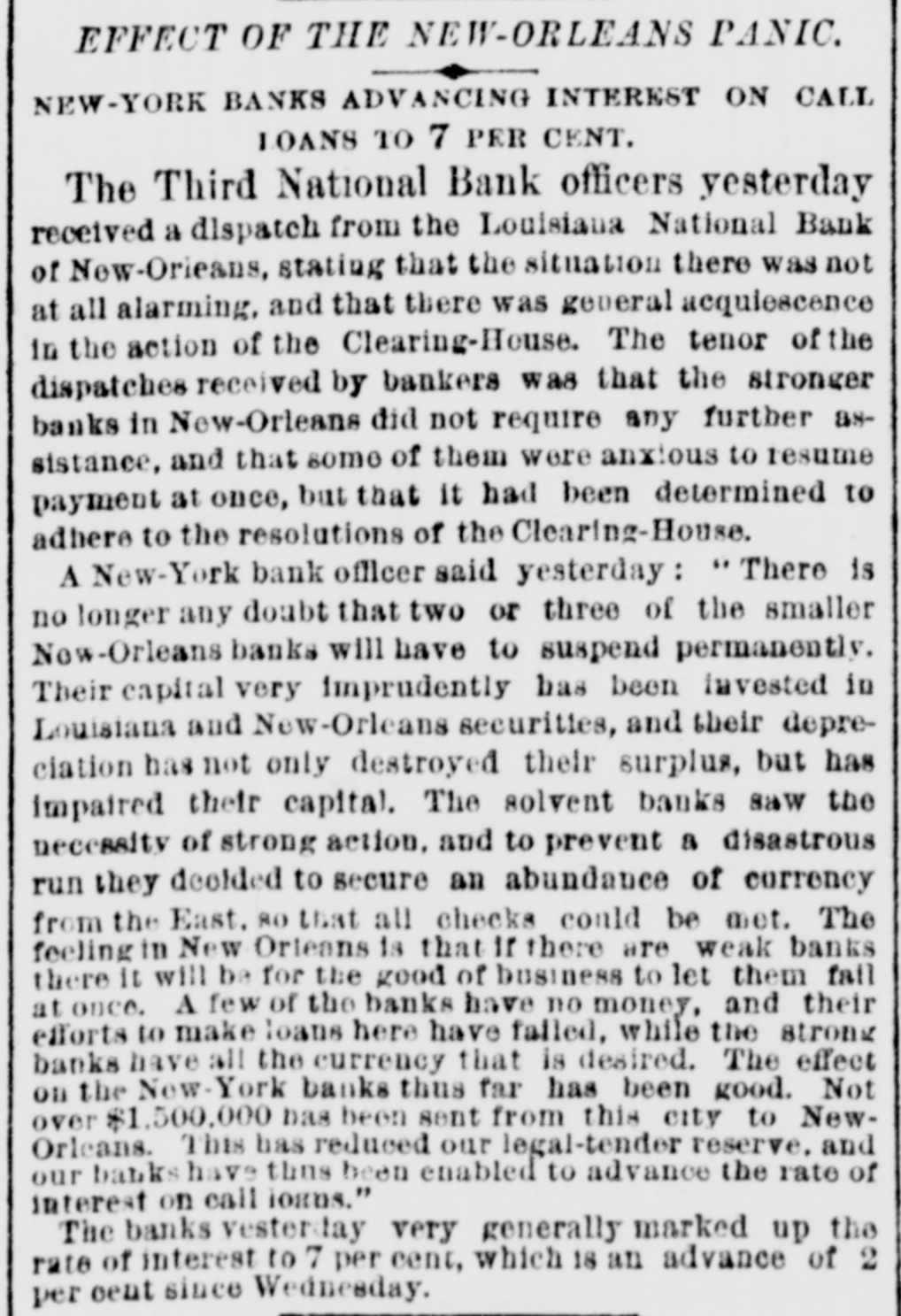
EFFECT OF THE NEW-ORLEANS PANIC. NEW-YORK BANKS ADVANCING INTEREST ON CALL LOANS TO 7 PER CENT. The Third National Bank officers yesterday received a dispatch from the Louisiana National Bank of New-Orieans, stating that the situation there was not at all alarming, and that there was general acquiescence in the action of the Clearing-House. The tenor of the dispatches received by bankers was that the stronger banks in New-Orleans did not require any further assistance, and that some of them were anxious to resume payment at once, but that it had been determined to adhere to the resolutions of the Clearing-House. A New-York bank officer said yesterday : "There is no longer any doubt that two or three of the smaller Now-Orleans banks will have to suspend permanently. Their capital very imprudently has been invested in Louisiana and New-Orleans securities, and their depreciation has not only destroyed their surplus, but has impaired their capital. The solvent banks saw the necessity of strong action. and to prevent a disastrous run they decided to secure an abundance of currency from the East. 80 that all checks could be met. The feeling in New Orteans is that If there are weak banks there it will be for the good of business to let them fail at once. A few of the banks have no money, and their efforts to make loans here have failed, while the strong banks have all the currency that is desired. The effect on the Now-York banks thus far has been good. Not over $1,500,000 has beon sent from this city to NewOrleans. This has reduced our legal-tender reserve, and our banks have thns been enabled to advance the rate of interest on call loans." The banks vesterday very generally marked up the rate of interest to 7 per cent, which 18 an advance of 2 per cent since Wednesday.


Article from New-York Tribune, March 22, 1879

Click image to open full size in new tab

Article Text

THIRD CALL--2:30 O'CLOCK P. M. FRIDAY, March 21-P. ΠΌ. The week ending to-day was one of feverish and uncertain expectation in financial circles. The comparatively low state of the bank reserves as shown by last week's statement--the surplus then having been only $3,844,975, against $16,100,825 at the same date of 1878; the steady hardening of rates for money, and the near approach to the time when the large settlements with the Treasury are to be made for subscriptions to the 4 per cents, added to the usual April shipments of currency to the interior-all contributed to this feeling, which found expression more in the inquiries heard on every side than in the expression of any decided opinions. The situation was simply aggravated by the unexpected suspension of the New-Orleans banks, on the effect of which it is almost impossible to obtain an intelligible opinion, and still more difficult to find two opinions alike. The greenbacks shipped to New-Orleans yesterday are now reported to have amounted to over $1,250,000, while the sum sent to-day cannot be definitely ascertained. But as the best estimates make the figures for the amount of New-Orleans deposits less rather than over $2,500,000, that sum may be accepted as the outside amount that can be shipped on account of preΓ«xisting credits. The telegraph, however, reported that the New-Orleans banks held about $5,000,000 sterling exchange. If this is so, it may be expected to furnish the means of still greater drafts for currency on the arrival of the mails. It is reported that the Secretary of the Treasury has ordered the payment of called bonds maturing on or before April 15, with rebate of interest, or their acceptance with full interest in exchange for subscribed bonds. This movement will fail to aid the money market to any material extent, as the general holders of the 6s are not of the class that loan money on call, and therefore, if they relinquished any portion of their interest, it would be for the purpose of making a permanent reinvestment, and not for accepting the chances of obtaining for a shorter or longer period a higher rate than 6 per cent on call loans. Nevertheless, despite the feverish state of financial matters, the speculation in stocks has continued in the even tenor of its way. It is true that in a majority of cases the prices of stocks at the close of the week are lower than at the opening, but not sufficiently so to justify any further comment than the usual one of a brokers' market. Prices have been both up and down several times during the week, and some of them were lower before the New-Orleans embarrassments were announced than they have been since. So there is no reason for ascribing to that event any effect for or against prices. The Northwest common stock was conspicuous in the speculation, having at one time sold as high as 58ΒΌ and later declined to 54β…›, finally closing at 55ΒΌ, against 55⅝ a week ago. But perhaps the most remarkable speculation was that in St. Paul common stock, which carried its price to 39⅝, and finally closed it at 38⅝, against 38 a week ago. This movement, it is understood, was based upon the expected good report of the company's business for 1878, which was printed in to-day's TRIBUNE. But in the minds of the public the earnings since January 1, the decline of which marks off one-half of last year's apparent surplus, seems to be regarded as of greater importance. Concerning the reported smaller amount of interest paid by the company for 1878 than for 1877, in the face of an acknowledged greater debt, which we alluded to, it is suggested that the explanation is that the bonds, although sold last April and May, were sold last April, ex July, 1878, coupon; therefore no interest on the increased debt was due until January 1, 1879. If this solution is correct, there cannot be two opinions as to the character of the company's statement issued yesterday, because the interest due on January 1, 1879, was due and payable from the earnings of 1878, and should be included in any statement upon which a dividend payable from the same earnings is declared to be paid on April 15 following. The preferred stocks of both Northwest and St. Paul have scarcely sympathized with the movements in the common stocks. As a rule the trunk line shares were dull; they all dragged on the market, and finally showed a decline on the week's operations, that of Michigan Central amounting to 3 per cent, although closing 1 per cent higher than its lowest. The coal stocks, after numerous fluctuations, show only moderate declines. As usual, rumor has had a virtual combination made several times, by which some one probably has turned an honest penny. The low-priced fancies generally are lower than a week ago, the transactions in them having been smaller and of less importance than for the preceding week. The total transactions for the week amounted to 831,937 shares, against 767,686 shares for the preceding week, and 1,183,168 for the week before that. WEEKLY RANGE OF PRICES.


Article from The Portland Daily Press, March 24, 1879

Click image to open full size in new tab

Article Text

THE people of Louisiana see now the business troubles that come through the failure of their credit as a people. The suspension of the banks of New Orleans may be described as a "Greenback Victory"-but a Cadmean victory it will prove.


Article from Public Ledger, March 24, 1879

Click image to open full size in new tab

Article Text

COMMERCIAL. PUBLIC LEDGER OFFICE, MEMPHIS, March 21, 1879. 1 The recent marked advance in cotton has imparted vigor and activity in all branches of business. Financial circles is made to feel its share of the improvement by an increased demand for exchange, a more cheerful tone to business generally, and an increase in the volume of currency. The latter is in ample supply, with little chance for its lucrative investment. It is estimated that nearly $2,000,000 are now lying idle in the vaults of our city banks and insurance companies. Solvent borrowers are scarce, and money can be readily obtained on prime mercantile paper or good collaterals at from 6 to 10 per cent. interest. The flurry of a few days ago caused by the temporary suspension of the New Orleans banks has subsided. The amount of cash on deposit to the credit of our banks in that city, and which is in jeopardy, will not exceed $20,000. It is believed all of the banks will resume again before the close of the present week, except perhaps the Bank of New Orleans and the Mechanics and Traders. Exchange is unaltered, banks buying bills on New York and Boston, without grace, at 1c, or $2.50 per $1000; for sight on Boston and vicinity $3.75 per thousand. Bills on New Orleans are taken at to discount. Checks on New Orleans are sold by the banks at par. The present quotable value of leading local securities are as follows: Memphis gas bonds, ex-April coupons, 91; gas stock, 821; county warrants, 82@88; Hernando Insurance stock, 117; Union and Planters' Bank stock, 105; Bluff City Insurance stock, 711; Bank of Tennessee notes, new issue, 35@41; Mississippi and Tennessee first mortgage eight per cents, 116, and second ditto, 90; Phoenix Insurance stock, 50; Memphis General Fire and Marine Insurance stock, 65.


Article from Daily Globe, March 25, 1879

Click image to open full size in new tab

Article Text

# ALL AROUND THE GLOBE. The New Orleans banks have resumed payment of currency on demand. The suspension of J. & A. Tyrrel, dealers in hides, Boston, was announced Monday. Liabilities, $60,000. A fire, Sunday, in Delwein, Iowa, near Independence, destroyed several stores. Loss $17,000; insurance $6,000. Henry C. Bennett, a well-known journalist, at one time United States pension agent, died suddenly at San Francisco Monday. Washington Butcher & Son's ham-curing house, North Front street, Philadelphia, was damaged $25,000 by fire Monday; insured.


Article from The Rock Island Argus, March 25, 1879

Click image to open full size in new tab

Article Text

Telegraphic Brevities. J. & A. Tyrrell, of Boston, dealers in hides, suspended. Liabilities $160,000. The New Orleans banks have resumed payment of currency on demand. LITTTLE Rock, March 24.-H. J. R. Webb, of Newport, convicted of an attempt to outrage a deaf mute girl, was committed to the penitentiary under a sentence of twenty one years. CHICAGO, March 24.-The Tribune's De Kalb, Ill., special says, George Alexander (colored) shot his wife here to-night with a shot gun, killing her instantly. They had lived in Sycamore lately, but this morning she left him, and he following on the evening train discovered her at the house of a friend. She was 19 years of age. he 26. The left side of her head was entirely blown off. A verdict was found accordingly.


Article from Chicago Daily Tribune, March 25, 1879

Click image to open full size in new tab

Article Text

# FINANCIAL. BOSTON, March 21.-J. & A, Tyrrell, dealers in hides, have suspended. Liabilities, $160,000. NEW ORLEANS, March 24.-The banks have resumed the payment of currency on demand.


Article from The New Orleans Daily Democrat, March 26, 1879

Click image to open full size in new tab

Article Text

RESUMPTION. Yesterday, after the opening of business hours, our mercantile community found Itself running again in the accustomed gear, the Clearing-House banks having opened wide their vaults, and paying over the counter in the good old way all solid checks presented. Contrary to the anticipations of wiseacres, and that class of men who always see the gloomy side of coming events, everything in our financial circles passed off briskly and at the same time quietly. Confidence in our banks has evidently been restored, for not the least sign of a rush could be seen on any of these institutions, and no anxiety appeared to be felt about the safety of any. Two of our leading banks, the Canal Bank and the Citizens' Bank, step up to the front and publish statements this morning, which can be found in the proper column of the DEMOCRAT. Both show undeniable strength. The Canal Bank's expose shows an amount in gold, United States Treasury notes. etc., immediately disposible, of $2,911,688 14, against an amount of deposits of $3,257,748 77, with loans on demand and mortgage loans realizable immediately upon any emergency. The Citizens' Bank shows a total amount subject to check of $778,426 77, to face which it has on hand $715,821 87, leaving only a difference of $62,604 90, which can be made up within the space of half an hour by calling in some of the loans on call, $100,000 of which, 80 we are informed, could be immediately realized. This is a splendid showing for these two banks; in fact, it demonstrates that it is the next thing to an impossibility to break them.


Article from The Jackson Standard, March 27, 1879

Click image to open full size in new tab

Article Text

-The New Orleans banks suspended payments last week. -Dr. Blackstone, a physician nearly 83 years of age, died suddenly at Athens last week.


Article from American Citizen, March 29, 1879

Click image to open full size in new tab

Article Text

THE New Orleans banks, on the 20th, by a preconcerted arrangement, temporarily suspended payment for all sums exceeding $200. This action was taken to avert a threatened panic, caused b


Article from The Lake Charles Echo, March 29, 1879

Click image to open full size in new tab

Article Text

# RESUMPTION. The panic is over, and the New Orleans Banks resumed payment on the 25th inst.


Article from The Weekly Elko Independent, March 30, 1879

Click image to open full size in new tab

Article Text

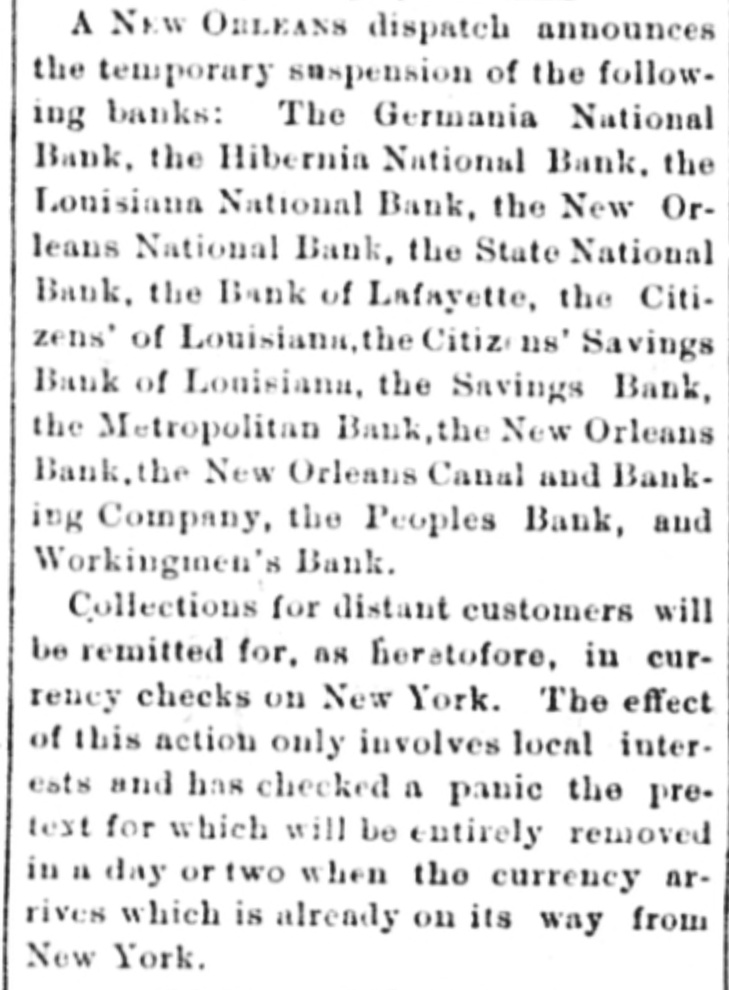
A NEW ORLEANS dispatch announces the temporary suspension of the following banks: The Germania National Bank, the Hibernia National Bank. the Louisiana National Bank, the New Orleans National Bank, the State National Bank, the Bank of Lafayette, the Citizens' of Louisiana, the Citiz ns' Savings Bank of Louisiana, the Savings Bank, the Metropolitan Bank, the New Orleans Bank. the New Orleans Canal and Banking Company, the Peoples Bank, and Workingmen's Bank. Collections for distant customers will be remitted for. as heretofore, in currency checks on New York. The effect of this action only involves local interests and has checked a panic the pretext for which will be entirely removed in 11 day or two when the currency arrives which is already on its way from New York.


Article from Watertown Republican, April 2, 1879

Click image to open full size in new tab

Article Text

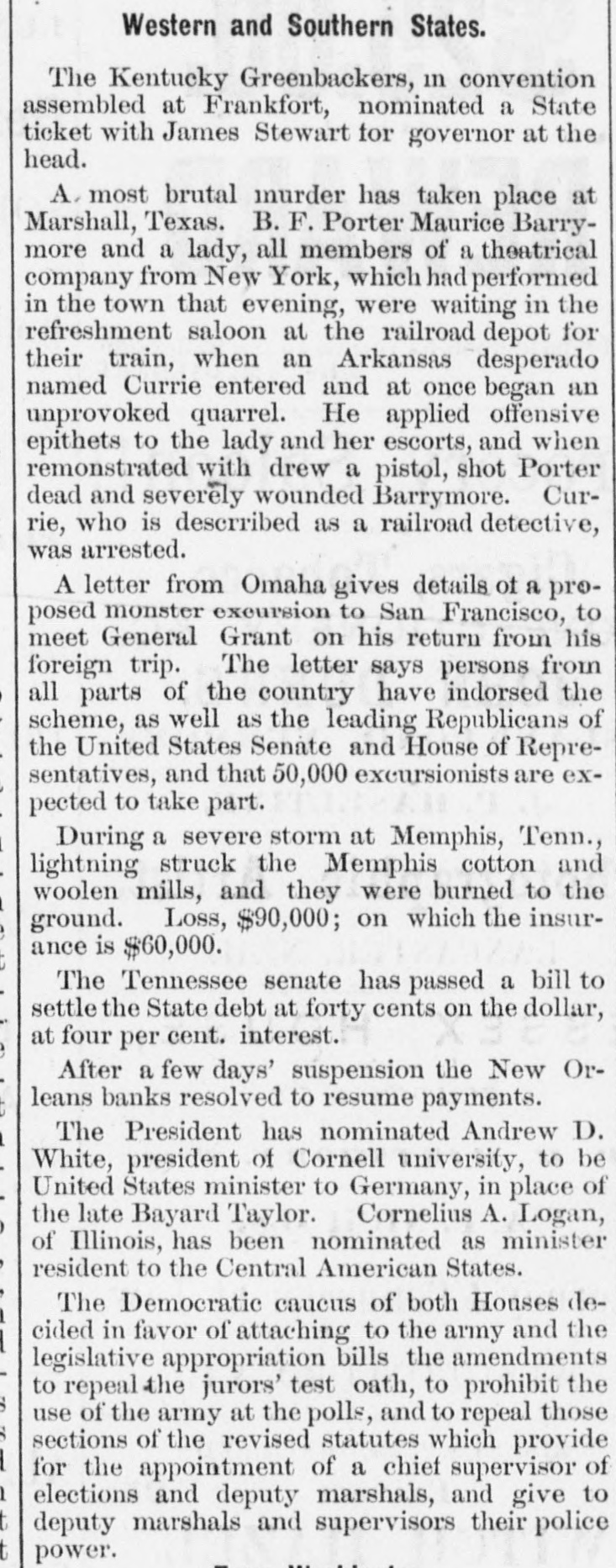
THE WORLD'S WORK. MISCELLANEOUS. THE revolution in Sonora, Mexico, has been squelched. THE negro exodus from the south to Kansas continues unabated. THE New Orleans banks after three days suspension have all resumed. NATHAN P. PRATT. treasurer of the Reading savings bank, Boston, is the latest bank defaulter. SEVERAL persons were injured by a collision on the New York elevated railroad March 25th. THE governor of Louisiana has signed the bill repealing the charter of the state lottery. COL. THOMAS A. SCOTT was re-elected president of the Pennsylvania railroad March 26th. ONE hundred and sixty families of Philadelphia are going to Kansas to settle on the public lands. THE Marquis of Lorne, governor of Canada, and his wife, are expected to visit New York city in May. A DISTRUCTIVE gale of wind swept over eastern Georgia on March 23rd. Milledgeville suffered a loss of $100,000. THE constitutional convention of Louisiana will stand as follows: 94 democrats, 33 republicans, and 7 fusionists and nationals. A SAN FRANCISCO dispatch of March 26th says: John W. Coughlan, ex-congressman for the third district of California, died to-day at his residence in Oakland. THE Virginia senate concurred in the house amendments to the senate bill providing for the settlement of the state debt, known as the "McCulloch compromise bill." THE national white lead association which closed its annual session in Chicago yesterday, decided not to raise the price of lead. It will remain at 71 cents per pound for large lots. AT Providence, R. I., on the 24th the legislature voted upon the question of woman suffrage. The vote stood, ayes, 25; noes, 21-not the necessary twothird vote for submiting it as an amendment to the constitution to the people. THE Michigan university laboratory suit has been a good one for the lawyers, the expenses of litigation footing up to not less than $80,000. Silas H. Douglass won the suit. SENOR ZAMACONA, Mexican minister, is doing a good work for his country in a commercial way. He is the best known foreign diplomat in the United States. He has just visited St. Louis and other cities. THE house of representatives of Rhode Island refused to pass the resolution submitting to the people an amendment granting the right of suffrage to women, although the vote stood ayes 25, noes 21. It required a twothirds vote. A LEXINGTON, Ky., dispatch says the centennial celebration of the first settlement of Lexington will take place OF Wednesday, April 2nd, when a vast assemblage from this and adjoining states is expected. Preparations are being made on the most extensive scale to make the occasion worthy of the ancient reputation of Lexington for hospitality THE socialists of Chicago gave a ball on Sunday March 23rd, which called together a monster concourse of people. A large number of men participated in a military drill, which showed great proficiency in the use of arms. Nodisturbance occurred. GENERAL C. B. Comstock, General G. Weitzel and Colonel D. C. Houston, United States engineers, are at Keokuk, Iowa, by direction of the secretary of war, to investigate and report as to the practicability of utilizing the waterpower of the Des Moines Rapids canal, as well as establishing dry-docks therein. THE Milwaukee News: Billy Holbert received such a handsome offer to play with the Syracuse Stars this season that he could not well refuse, and will leave Milwaukee Sunday afternoon for Syracuse, where he will go into training at once. The arrangements to keep Holbert in Milwaukee did not succeed. A SPECIAL from Leadville, Col., says that "considerable excitement has been produced in the camp by rumors of the "find" of a rich fissure vein of gold in California gulch. Two miners brought into the Leadville Bank specimens of quartz assaying $20,000 a ton, and claim


Article from The Iowa Plain Dealer, April 4, 1879

Click image to open full size in new tab

Article Text

DOMESTIC INTELLIGENOR. Came. The Rhode Ialand House of Reprecontatives last week voted on the question of note-not the two-thir majority necessary for submitting an amendment of the constitution to the people. J. J. Tyrrell, of Boston, dealers in hides, have suspended. Liabilities, $100,000. Stratton & Storms' tobacco factory, on Pearl street, New York, was burned last week. Lose, 975,000. The losson of other occupanta make the total over $100,000. The city of New York will have to come down with its proportion of the money needed to complete the great Brooklyn bridge, the State Court of Appeal having NO decided. Nellie, aged 18, the beautiful and mc. complished daughter of x Gov. Hubbard, of Connecticut, fell in love with the Governor's coachman, a young man of uncommonly good personal appearance and pleasing manners. All elopemout and marriage followed, whereat the social circles of Hartford are attirred to their very depths. Judge Edwards, a prominent lawyer of Albany, N.Y., and principal of the Albany Law School, recently committed suicide by dis emboweling himself with a large carving knife. He was temporarily insane. Pleuro-pneumonia has broken out among the New Jersey cattle. A shocking calamity in reported from Claremont, N. H. A Are broke out in the Tremont House, the leading hotel of the town, and spread so rapidly that five inmates, two board. era and three employee, were overtaken by the flames and burned to death. Month. The New Orien" banks have remimed the payment of currency on demand There was n double execution at New Kent Court House, Va, on March 25. The victime were Patrick Smith and Julius Chris tian, both negroes, convicted of the murder of John C. Lacy, 4 white man, in January last. Frankfort, the capital of Kentucky, has been the scene of A disbolical Ranammina tion. Col. Tom Buford, brother of Gen. Abe Buford, who in well known in Kentucky, upon hearing that a case in the Court of Appeals, in which he was interested, had been decided against him, loaded a double-berreled whot. gun with buckshot, took him position near the front door of the Capitol Hotel, and waited for the Judges of the court to come to dinner. Judge J. M. Elliott was the first to approach. An he reached the door Buford walked up to him and shot him dearl. Twelve buckshot entered his body, some of them passing through his heart. Judge Pryor made his appearance on the scene a moment later, when Buford leveled him gun to Kive him the contents of the other barrel, but, before he could got natinfactory aim, Judge Pryor run behind corner. A crowd collected, and the annamin was taken into custody. A wharf-boat burned nt Hickman. Ky., lane work, and four persons who were slooping on the boat were burned to death. Buford, the annansin of Judge Elliott, has been placed in the jail nt Louisville, Ky. Hon. H. Y. Riddle, n member of the last Congress from Tennensee, recently com mitted suicide ml Lebanon, Tenn, while labor ink under a temporary At of humanity, catised by protracted illness. West. William H. Vanderhilt win begin, about the lawe of April, the construction of n tunnel for the Canada Monthorn railway under w the Detroit river, at Grosse Ielo. The tunnel e will be 3,700 feet long, and, " in calculated, will s cost $1,500,000. e At Fort Scott, Kan., n few days ago, a nogro named Bill Howard, having been dee tected in a horrible crime, was taken from jail l and hanged to a lamp-post. After the body / had hung some alwen minutes the infuriated < mob took it down and dragged It to the equare, J in spite of the resistance and objection of the 3 more calm and peaceable portion of the crowd, e and literally roasted and burned the remaine / in n fire of dry goods boxes and coal-oil, music 3 demonetrations that rivaled 1, John Schroler, n prominent Western , Socialist agitator, was lately arrested ne his


Article from The Meridional, April 12, 1879

Click image to open full size in new tab

Article Text

The banks of New Orleans have resumed payments. The New Orleans Savings, the Southern, and the Mechanics and Traders, have failed and their assets have been placed in the hands of receivers.


Article from Chicago Daily Tribune, March 24, 1880

Click image to open full size in new tab

Article Text

NEW ORLEANS. A Heavy Suit Growing Out of Now Orleans Interest Coupon Bonds-A Receiver Appointed. Special Dispatch to The Chicago Tribune. NEW ORLEANS, March 23.-In the United States Court the past few days Judge Billings has been taking testimony and hearing arguments In the caso of H. Bior vs. The City of Now Orlenns. In his potition the plaintiff sets forth that he was the owner of certain interest coupons of the said city, past due and unpaid, making in the ng. gregato $45,000 of interest coupons. He alleges that the City of New Orlcans was authorized and required by the laws of Louisiana to levy and collect a tax to pay said interest coupons and to apply the moneys so collected to such payment, and this requirement constitutes a contract between the holders of said coupons and said city, the inviolability of which in protected by the Constitution of the United States, and for said city to withhold orapply any moneys BO collected to any other purpose whatover than the paymont of interest coupons constitutes a breach of trust and of said contracts. The tax has been lovied and collected and paid over up to June 30, 1876, since which time the city has not 80 applied such moneys. March 3, 1870, the city and $100,165.41 in the Louisiana National Bank to the credit of the Interest account. Since June 30, 1875, the authorities of said city have persistently refused to apply the moneys to the only purpose authorized by law. Soon after the date June 30, 1675, the said city authorities In their capacity of Commissioners of the consoltdated debt of the city drew out of said bank, from the moneys as aforesaid, the sum of $125,000 and purchased therowith on the market bonds of the City of New Orleans issued under not No. 01, of 1870, and known ns premium bonds, to the amount of $500,000. The funds used to purchase the $500,000 of premium bonds were trust funds, and the withholding of said funds and the Investment of said bonds, as aforesaid, constituted a breach of trust and nn unlawful conversion of said funds. He feared further conversion of this trust 0 fund, and prays the Court to have the city authorities make nnswer to interrogatories; to have an account taken of all the interest coupons outstanding and unpaid, and of all the moneys received: and that A Receiver he appointed under the direction of the Court, and that said Mayor and administrators be re0 strained from further proceedings with regard to canceling or disposing of in any way said promium bondsor applying the moneys received on the interest account otherwise than the Court shall direct. To this end an injunction was prayed for. To-day Judge Billings heard the argument and granted the petition of plaintiff, appointing Charles T. Howard owner of the LouIslana State Lottery Company, Receiver on a r bond of $50,000.