16231. Venango National Bank (Franklin, PA)

Bank Information

Episode Type
Suspension β†’ Closure
Bank Type
national
Bank ID
1176
Charter Number
1176
Start Date
March 28, 1866
Location
Franklin, Pennsylvania (41.383, -79.832)

Metadata

Model
gpt-5-mini
Short Digest
e1406746e27dbe34

Response Measures

None

Receivership Details

Depositor recovery rate
23.4%
Date receivership started
1866-05-01
OCC cause of failure
Losses
Share of assets assessed as good
8.7%
Share of assets assessed as doubtful
5.9%
Share of assets assessed as worthless
85.3%

Description

Contemporary articles report the Venango National Bank of Franklin, PA, as having failed on or about the 28th of March 1866 (NY Tribune) due to heavy exposure to the failure of Culver, Penn & Co.; later (June 1867) many newspapers list the Venango National Bank among national banks 'in the hands of receivers.' No article describes a depositor run precipitating the suspension; the failure is attributed to the correspondent/large debtor (Culver, Penn & Co.) and mismanagement. OCR errors in some lists give varying circulation amounts ($35,000 vs $85,000); I retain bank name and city as given.

Events (5)

1. May 20, 1865 Chartered
Source
historical_nic
2. March 28, 1866 Suspension
Cause
Correspondent
Cause Details
Failure of Culver, Penn & Co. (major debtor/correspondent) which held large advances and bonds of the bank, rendering the Venango National Bank insolvent.
Newspaper Excerpt
The only other loss of public money deposited in a national bank that has come to the knowledge of the Committee is in the case of the Venango National Bank of Franklin, Pennsylvania, which failed on or about the 28th of March.
Source
newspapers
3. April 18, 1866 Other
Newspaper Excerpt
The notes of the Venango Bank, Franklin; ... The notes of the Venango Bank, Franklin, are believed to be good. Thompson's New York Bank Note Reporter quotes them at 10 per cent discount.
Source
newspapers
4. May 1, 1866 Receivership
Source
historical_nic
5. June 1, 1867* Receivership
Newspaper Excerpt
The Venango National Bank of Franklin, Penn., is listed among national banks that have failed and are now in the hands of receivers.
Source
newspapers

Newspaper Articles (15)

Article from North Branch Democrat, April 18, 1866

Click image to open full size in new tab

Article Text

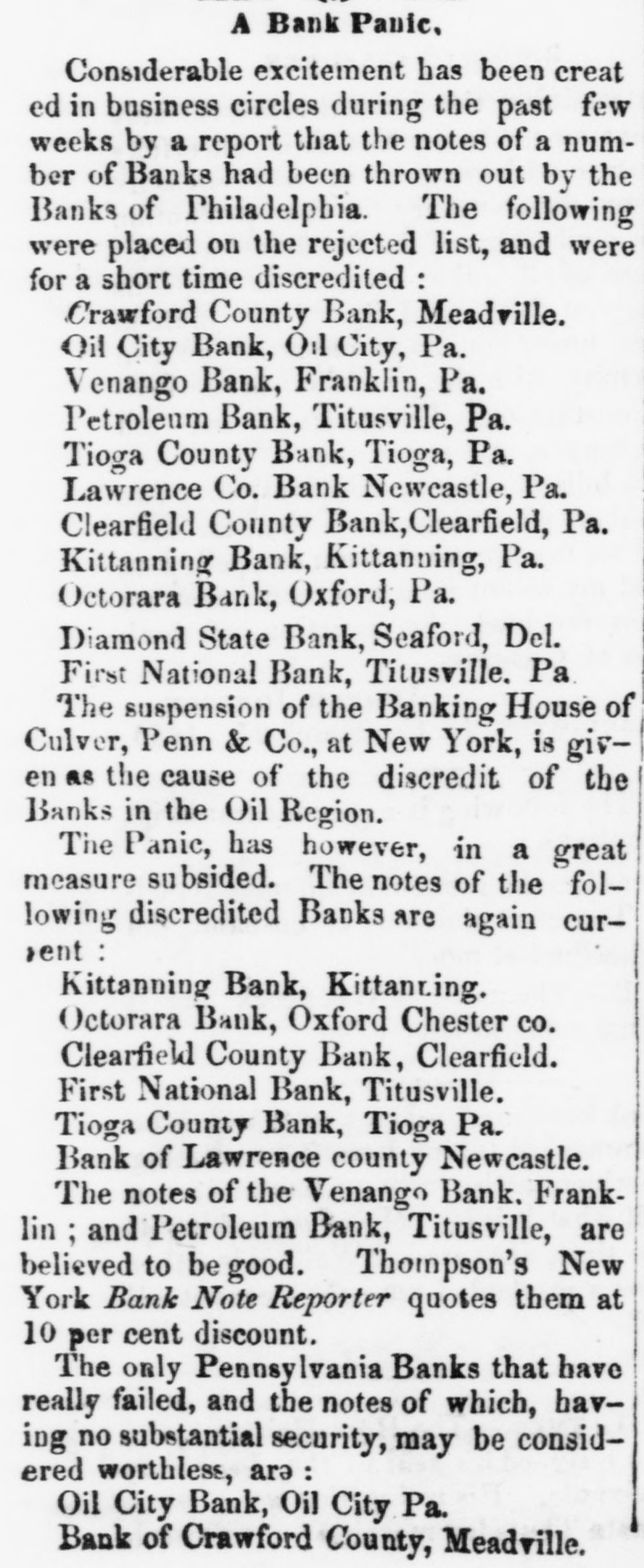
A Bank Panic, Considerable excitement has been creat ed in business circles during the past few weeks by a report that the notes of a number of Banks had been thrown out by the Banks of Philadelphia. The following were placed ou the rejected list, and were for a short time discredited : Crawford County Bank, Meadville. Oil City Bank, Oil City, Pa. Venango Bank, Franklin, Pa. Petroleum Bank, Titusville, Pa. Tioga County Bank, Tioga, Pa. Lawrence Co. Bank Newcastle, Pa. Clearfield County Bank,Clearfield, Pa. Kittanning Bank, Kittanning, Pa. Octorara Bank, Oxford, Pa. Diamond State Bank, Seaford, Del. First National Bank, Titusville. Pa The suspension of the Banking House of Culver, Penn & Co., at New York, is given as the cause of the discredit of the Banks in the Oil Region. The Panic, has however, in a great measure subsided. The notes of the following discredited Banks are again current : Kittanning Bank, Kittanting. Octorara Bank, Oxford Chester co. Clearfield County Bank, Clearfield. First National Bank, Titusville. Tioga County Bank, Tioga Pa. Bank of Lawrence county Newcastle. The notes of the Venango Bank. Franklin ; and Petroleum Bank, Titusville, are believed to be good. Thompson's New York Bank Note Reporter quotes them at 10 per cent discount. The only Pennsylvania Banks that have really failed, and the notes of which, having no substantial security, may be considered worthless, are : Oil City Bank, Oil City Pa. Bank of Crawford County, Meadville.


Article from New-York Tribune, July 17, 1866

Click image to open full size in new tab

Article Text

PRICE FOUR CENTS. sented that a number of 7.30 bonds sent to Bayne & Co. were still in possession of the bank, while in fact they were beyond its control. This was done to conceal the indebtedness of Bayne & Co. from the Comptroller of the Currency, who, at the time mentioned, owed to the bank $283,586 56, which was, reduced, in the returns, to $20,900, the difference being represented as bonds in the bank. President Hayek, it is suspected made these false statements, in the books of the bank, at night with the assistance of the bookkeeper. It appears by the testimony that a most pernicious system was adopted by the President of the bank, Mr. Huyok, in connection with Mr. Oscar King, one of the directors, and Mr. H. G. Fant, by which they undertook to procure deposits of public money by disbursing officers, for which Mr. Fant and Mr. King received compensation in the nature of interest upon the deposits of those officers, whom they claimed to have influenced to open accounts with the bank. Mr. King was the special friend and bondsman for Paymaster Paulding, Mr. L. P. Bayne, of the house of Bayne & Co., being the other surety on his bond-both of them directors of the bank. It does not appear by any testimony that the officers making the deposits had knowledge of this payment of interest on their accounts, or that they derived any benefit from it. On the contrary, the parties concerned expressly declare that they concealed all knowledge of that fact from the officers whose acts they thus made the source of profit to themselves. Other paymasters, beside Col. Paulding, deposited public moneys in this bank, but Col. Paulding made the deposits with the view of giving assistance to the First National Bank of Washington, which was known to be in trouble, while the other deposits were not made with the same knowledge or purpose. On the 20th of April, the bank was in great difficulty, on account of the impending failure of Bayne & Co., and it was requested by a Mr. Oscar King, that Col. Paulding should make a transfer of $150,000 from the First National Bank. Mr. Huntington, the cashier of this bank, was desired to recommend such transfer, but he declined having anything to do with it, more especially as he learned that Col. Paulding had already a deposit of several hundred thousand dollars in the Merchants National Bank. At the request of Col. Paulding, Mr. Huntington made inquiries respecting the condition of the Merchants' National Bank, and found their assets consisted chiefly of a debt of Bayne & Co.; and to satisfy him in regard to the responsibility of that firm. Mr. Lawrence Bayne was telegraphed by the President, Mr. Huyck, and came from Baltimore that evening to make a representation of the condition of his affairs. The statement of Mr. Bayne was verbal, but so satisfactory that at the close of the interview Mr. Huntington said he was inclined to recommend the transfer, if the statement of Bayne & Co.'s condition could be relied upon as true. On reflection, however, this was not satisfactory; so he consulted the president of his bank, Mr. Henry D. Cooke, who expressly charged him not to make any recommendation or to take any responsibility in the matter. He then said to Colonel Paulding if his checks were presented they would be paid; but he must act on his own responsibility. On that day Colonel Paulding's checks for $200,000 were presented at the First National Bank by Mr. Sherman, cashier of the Merchants' National Bank; and in accordance with Mr. Sherman's request, $50,000 was placed to the credit of Bayne & Co., with Seott, Capron, & Co., New York; $50,000 to the credit of Bayne & Co., with Hoyt, Anthony, Douglass, & Co., of New York; $50,000 in a check on New York, which was delivered afterwards by Mr. Sherman to Oscar King, for Bayne & Co.; the remaining $50,000 was paid in currency, of which $30,000 was used, according to the testimony of the cashier, to make good certain checks given the day previous by the Merchants' National Bank to Bayne & Co; thus making a total of $180,000 of the amount of Colonel Paulding's checks paid directly or indirectly for the benefit of Bayne & Co. The Board of Directors of the Merchants' National Bank were required by the by-laws to meet every Tuesday, but Mr. Sherman, the cashier, says there was no meeting of the Board from the time he went there until the 9th of January last. Mr. Boteler says that since January 1, 1866, when he was appointed Vice President of the bank, there have not been three meetings of the Board of Directors, and whenever a quorum happened to be present. Mr. Huyek told them there was nothing for them to do. A Finance Committee, composed of the President Mr. Huyck; the Vice-President, Mr. Boteler, and the cashier, Mr. Sherman, were authorized to transact all the duties of the Board of Directors, Mr. Boteler, finding that he was not consulted when money was loaned, or other important matters transacted, had a resolution passed by the Board of Directors forbidding money to be loaned except by unanimous consent of the Finance Committee. Notwithstanding this, Mr. Huyck continued to act as though the bank was his own, and neither informed Mr. Sherman nor Mr. Boteler of his transactions. When the bank was organized, the name of Mr. J. B. Stewart appeared as one of the original subscribers to the Merchants' National Bank, for $60,000. M. Stewart never subscribed a cent, in any shape or way. He was represented without his consent, at the organization of the bank, by Mr. Oscar A. Stephens, who also represented him before the Notary Public when the organization certificate was sworn to. As soon as the bank commenced business, Mr. Stewart opened an account at the bank, and made an arrangement to draw for money as he may require it, depositing 950 shares of the Washington, Alexandria and Georgetown Railroad Company as collateral security for any money he might owe the bank; also that he made a special deposit, for safe keeping in the bank, of $169,000 in bonds of the Union Pacific Railroad Company, which he held in trust. In March last he discovered that those bonds had been sent by Mr. Huyck, the President of the bank, to Messrs. Bayne & Co., and by them used as collateral security for loans obtained in various banks in Baltimore, without his knowledge or authority; that he did not know of their abstraction until he went to the Merchants' Bank for the bonds in March, when Mr. Huyck refused to deliver them, or to give him any information in regard to them. Mr. Stewart also testified that after the failure of the bank, and the appointment of a receiver, he was notified to pay his debt to the bank; when he offered to make the payment, and asked for the nine hundred shares of railroad stock he had deposited as collateral security, he found that they had likewise been abstracted, and had been disposed of in the same manner as the bonds. No institution could be safe in the hands of men so reckless and unscrupulous; and the failure of this bank, involving so considerable a loss of public money, must be attributed wholly to the dishonest and criminal conduct of the men who controlled it. The only other loss of public money deposited in a national bank that has come to the knowledge of the Committee is in the case of the Venango National Bank of Franklin, Pennsylvania, which failed on or about the 28th of March. It was a depository bank, with $50,000 in bonds and treasury notes as security for the deposits. The amount of public money in that bank is $223,883 72 to the credit of the Treasurer, and 2.-584 93 to the credit of Mr. McGough, the collector, There is also a draft of that bank on Culver, Penn & Co. for $65,000, which was sent on the 26th of January inst, to transfer that amount of public money from the Venango National Bank to the Sub-Treasury in New York. The draft has never been paid; the bank claims that it is relieved from any responsibility, as the draft was received at the Sub-Treasury in payment of that amount, and was not protested for non-payment. There is said to be sufficient security for this draft in the possession of the Government. The capital of the Venango Nationa' Bank was $300,000 It seems to have been managed for the benefit of Culver, Penn, & Co. of New York, who had nearly all of the funds of the bank, their debt to the bank being over $600,000. Under such circumstances the failure of Culver, Penn & Co. necessarily involved the failure of this bank. The law limiting the maximum of the aggregate loan of any party to 10 per centum of the capital of the bank was wholly disregarded in this case, as it was in the case of Bane & Co. by the Merchants' National Bank. This is excused in both cases by the specious pretence that these debts were not loans, but balances due from the parties. It should be stated that $400,000 of Culver, Penn & Co.'s debt was for Government bonds which, as appeared by the testimony before the Committee, the bank claims were deposited by them for safe-keeping, but were used by them without the authority of the bank. Many of the national banks which were converted from State banks do not make proper exertion to withdraw their old circulation, and in many instances pay it out and take measures to continue it in circulation, thereby receiving the benefit of the old circulation and of the national currency notes received from the Bureau of the Controller. It was stated to the Committee that there were instances of banks having reported to the Controller that the State circulation had been withdrawn again paying it out. In justice to the very large majority of national banks that are honestly conducted, it seems right to give in this report all the testimony the Committee had on this subject, though it is not so definite as they desired. The Committee have also inquired into the affairs of the national banks in Springfield, Mass.; some of the national banks in Providence, R. I.; the Chemung Canal Bank of Elmira, N. Y.; some of the national banks of New Jersey and New-York: the First National Bank of Fenton, Mich.; the National Bank of Michigan, at Marshall, and are of opinion that they are not conducted to the strict letter of the law. In conclusion, the Committee say they have performed the duty assigned to them in the resolution of the House, by an examination into the affairs of the national banks so far as any circumstances that came to their knowledge seemed to demand; they have examined and reported on the facts and circumstances connected with the recent failure of the Merchants' National Bank of Washington; the amount of public money deposited, and by whom, in that bank, and the cause of its failure. The bill to regulate the deposits of public officers, which has been reported and passed, and the amendments reported to the National Currency act, embrace the legislation which the Committee deem necessary, in regard to the national banks, to protect the public and the Government. In regard to the gross abuse of their trusts as a depository of public money by the Merchants' National Bank, the Committee are of opinion that legal proceedings should be had for the punishment of those of its managers who are responsible for that breach of trust; and also such proceedings as may be necessary to recover any portion of the money; and as it was mostly money intrusted to disbursing officers of the War Department, the duty of instituting and conducting these proceedings should be committed to the War Department. The Committee close this report by submitting the annexed resolution: Resolved, That the Secretary of War be directed to institute such

Article from The Ebensburg Alleghanian, February 21, 1867

Click image to open full size in new tab

Article Text

# The Culver Case---Interesting History. A correspondent of the New York Tribune, writing from Franklin, gives the following interesting statement of the causes which culminated in the failure of the firm of Culver, Penn & Co., and which led to the prosecution of Mr. Culver on charges of a criminal nature. We quote: The history of Mr. Culver in his connection with this region for the last six years, of his unparalleled success and of his failure, is the history of the rise, decline and fall of the empire of Petroleum. Suffice it to say that in 1861 Mr. Culver opened a banking office in this town on a small capital, and subsequently others at various points in this region, all of which, very soon, from the exigencies of business, became incorporate banks, under what was known as the Free Banking Law, he retaining the general financial management, and dispensing Presidencies and Directorships as Andrew II. dispenses Consulates and Collectorship of Customs, and probably with quite as large a sense of the "eternal fitness of things." Of these, the Venango bank at Franklin, and the Petroleum bank at Titusville, had a circulation, the former of $600,000, the latter of $900,000, secured by the deposit of a like amount of Government bonds with the Auditor General at Harrisburg. And when Congress passed an act forbidding a re-issue of the notes of State banks after July 1, 1866, these banks about to become National banks, it became necessary to retire their circulation, and to do this gradually was a measure of prudence. Mr. Culver accordingly made arrangements with a National bank at Pittsburg in May, 1865, for the redemption and cancellation of the notes, the funds required to be drawn from Culver, Penn & Co., (the New York branch), and the respective banks certified by drafts on them, which, when forwarded to. Culver, Penn & Co., were charged to those banks. The Government bonds released by the return of the cancelled circulation were to be sent to Culver, Penn & Co., and placed to the credit of the banks. In the meantime, in the year 1864 and 1865, the oil fever had reached its crisis; and speculation rushed on to the confines of madness. This state of things inevitably led to accommodation loans, from the various banking institutions under Mr. Culver's control, secured in the usual manner; and when, in March, 1865, the terrible flood destroyed property in the valleys of this region to the value of millions of dollars, followed immediately by the close of the war, and the consequent check of all speculation, by these combined causes the firm of Culver, Penn & Co., lost very heavily. Shortly prior to this time, the firm became largely interested in an enterprise called the Reno Oil and Land Company, with the object of making Reno the depot for the oil-producing districts; and when the oil business had somewhat recuperated, a railroad was built to carry the purpose into effect, in the face of a determined opposition from rival interests, which made it necessary, at a heavy expense, to choose a circuitous route, and overcome serious engineering difficulties. By the energy and tact of Mr. Culver, however, two rival railroad companies were consolidated with this, under his control, in the winter of 1865-6; and nothing was required but a final meeting, which was appointed for March 29, 1866, to approve the consolidation. In a few days, as he alleges, he would be entitled to receive a large sum, sufficient to meet all his immediate liabilities, in the form of the first mortgage bonds of the consolidated road; but he claims that unscrupulous men, opposed to this project, created a run upon the New York house at this critical period by malicious rumors that it had failed, or was about to fail; and burdened beyond their capacity to bear, on the 27th of March they failed with liabilities estimated at $5,000,000. The consequence was, of course, the failure of the consolidation, and therefore, of the Reno enterprise, to which all Mr. Culver's energies had been lent, and that with which we are more immediately interested-the closing of all the banks which had been controlled by Mr. Culver-among them the Venango National Bank, whose capital, as I have shown above, had passed into his hands during the progress of the retirement of its circulation. Mr. Culver was soon after arrested at the instance of Mr. Hoge, Vice President and Director of the Venango Bank (a member of the Pennsylvania Senate), on a charge of conspiracy to defraud Messrs. Myers and Kinear, the latter the President and both Directors of the bank joining in the charge-all three having made private loans to Mr. Culver to further his railroad enterprise. This arrest was followed by others, on the same charge, but bail to a very large amount was obtained and he was discharged. He was also arrested on a charge of obtaining the bonds deposited at Harrisburg under false pretences; and after giving the required bail was immediately re-arrested upon the


Article from The New York Herald, June 11, 1867

Click image to open full size in new tab

Article Text

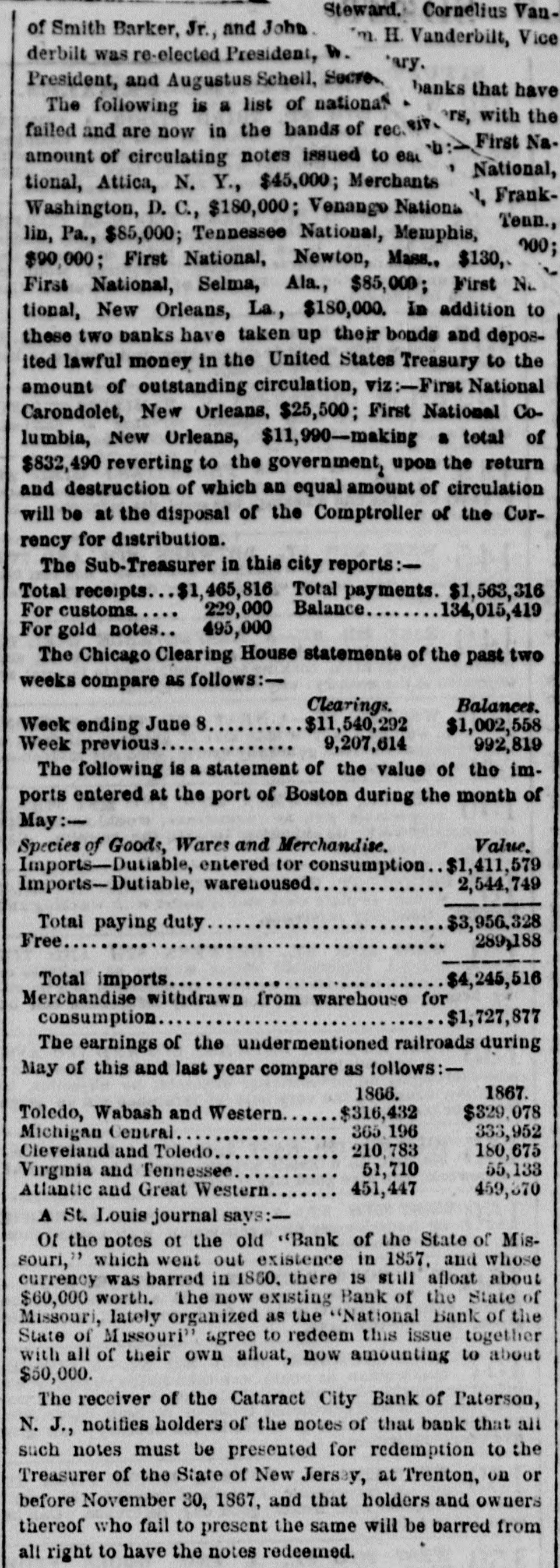
Steward. Cornelius Vanof Smith Barker, Jr., and John H. Vanderbilt, Vice derbilt was re-elected President, W. ary. President, and Augustus Scheil, Secre banks that have The following is a list of national rs, with the Bive failed and are now in the bands of rec. First Na. amount of circulating notes issued to eac National, tional, Attica, N. Y., $45,000; Merchants FrankWashington, D. C., $180,000; Venango Nationa Tenn., lin, Pa., $85,000; Tennessee National, Memphis, 200; $90,000; First National, Newton, Mass., $130, First National, Selma, Ala., $85,000; First N tional, New Orleans, La, $180,000. In addition to these two banks have taken up their bonds and deposited lawful money in the United States Treasury to the amount of outstanding circulation, viz:-First National Carondolet, New Orleans, $25,500; First National Columbia, New Orleans, $11,990-making a total of $832,490 reverting to the government, upon the return and destruction of which an equal amount of circulation will be at the disposal of the Comptroller of the Currency for distribution. The Sub-Treasurer in this city reports:Total receipts $1,465,816 Total payments. $1,563,316 For customs. 229,000 Balance 134,015,419 495,000 For gold notes The Chicago Clearing House statements of the past two weeks compare as follows:Balances. Clearings. $11,540,292 Week ending June 8 $1,002,558 9,207,614 Week previous 992,819 The following is a statement of the value of the imports entered at the port of Boston during the month of May:Value. Species of Goods, Wares and Merchandise. Imports-Dutiable, entered tor consumption $1,411,579 2,544,749 Imports-Dutiable, warehoused $3,956,328 Total paying duty Free 289,188 Total imports $4,245,516 Merchandise withdrawn from warehouse for $1,727,877 consumption The earnings of the undermentioned railroads during May of this and last year compare as follows:1867. 1866. $329,078 $316,432 Toledo, Wabash and Western 365,196 333,952 Michigan Central Cleveland and Toledo 210,783 180,675 51,710 55,133 Virginia and Tennessee Atlantic and Great Western 451,447 459,370 A St. Louis journal says:or the notes of the old "Bank of the State of Missouri, " which went out existence in 1857, and whose currency was barred in 1860, there 18 still afloat about $60,000 worth. The now existing Bank of the State of Missouri, lately organized as the "National Bank of the State of Missouri" agree to redeem this issue together with all of their own afloat, now amounting to about $50,000. The receiver of the Cataract City Bank of Paterson, N. J., notifies holders of the notes of that bank that all such notes must be presented for redemption to the Treasurer of the State of New Jersey, at Trenton, on or before November 30, 1867, and that holders and owners thereof who fail to present the same will be barred from all right to have the notes redeemed.


Article from The Daily Dispatch, June 12, 1867

Click image to open full size in new tab

Article Text

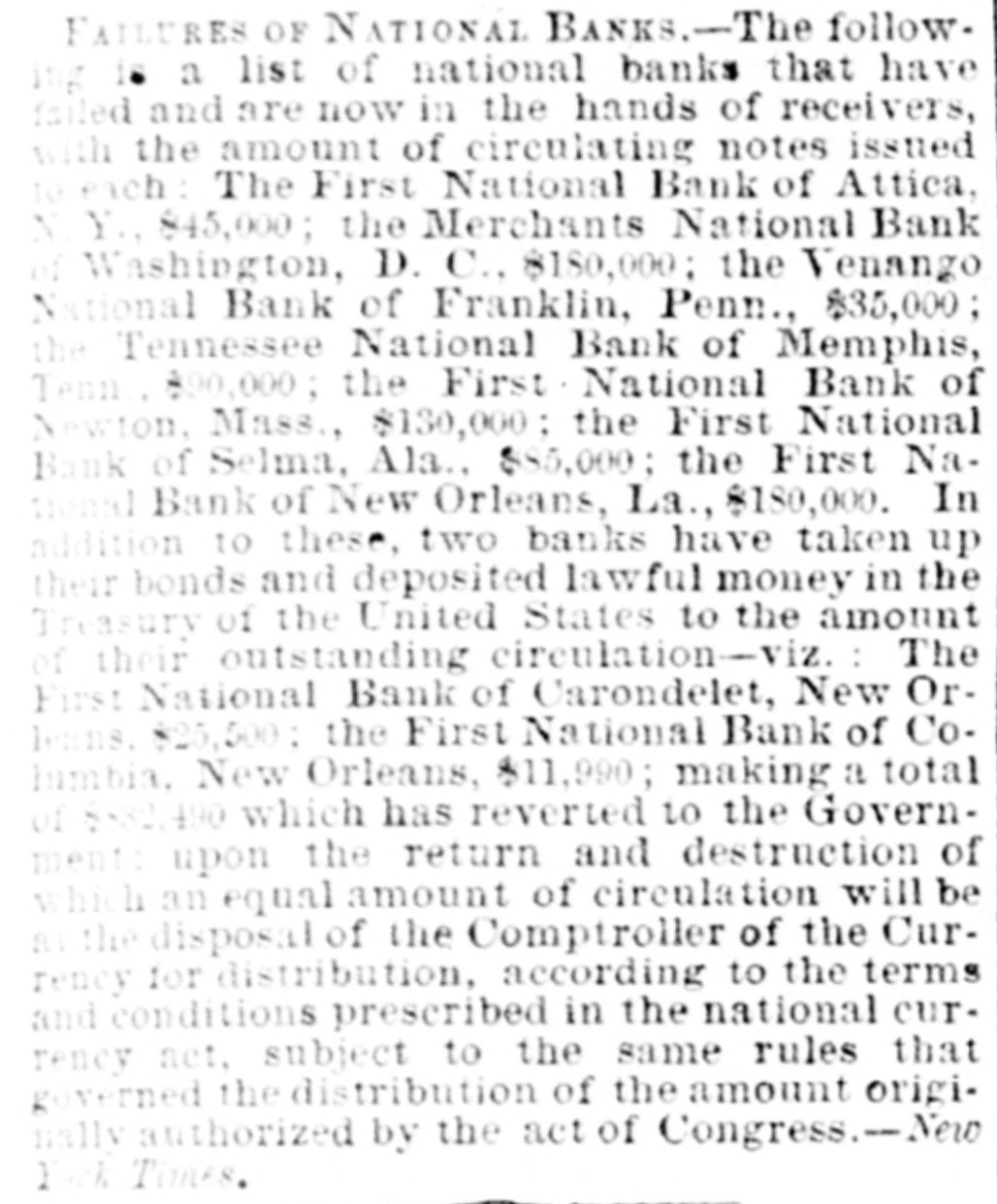
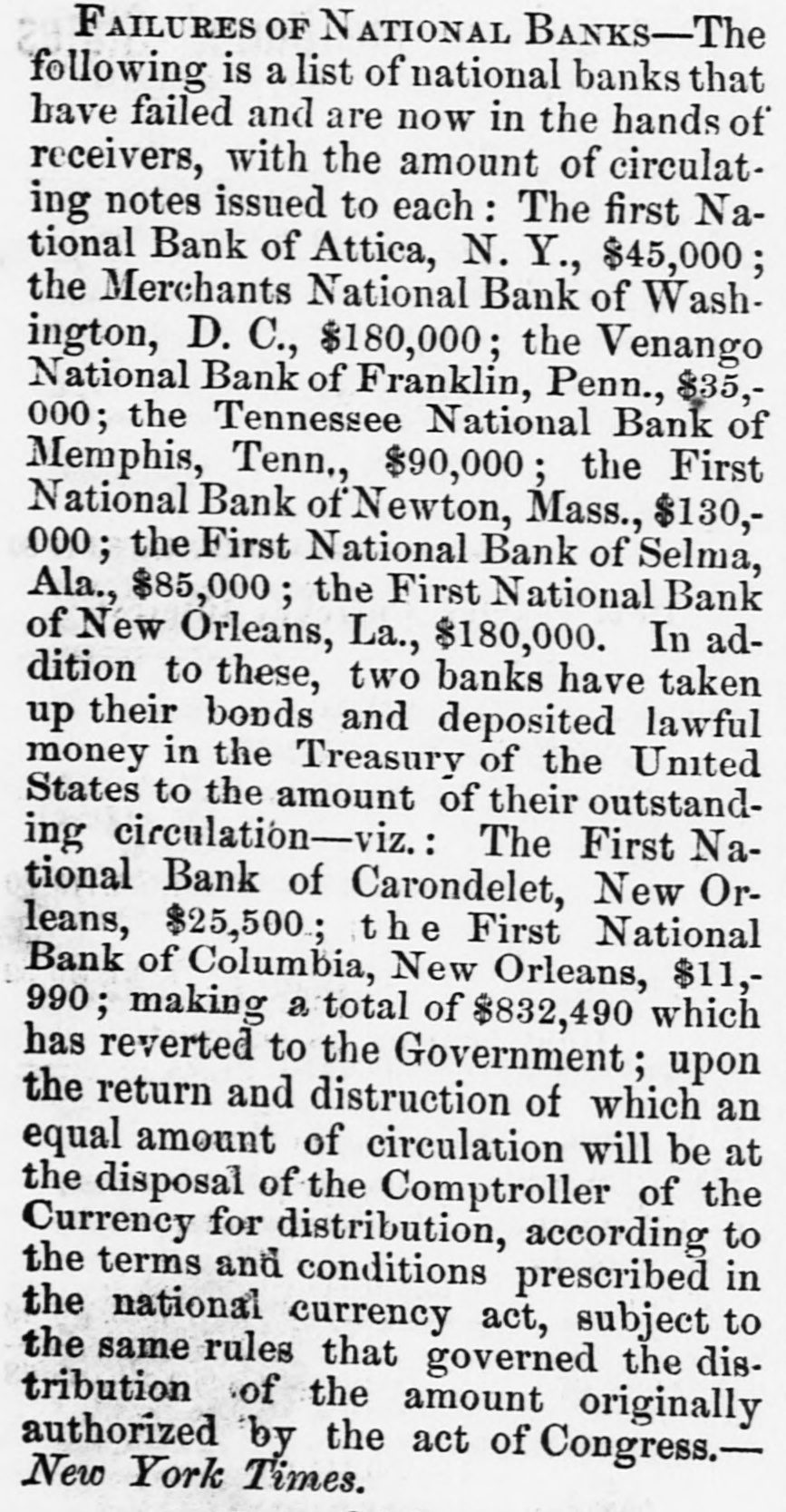
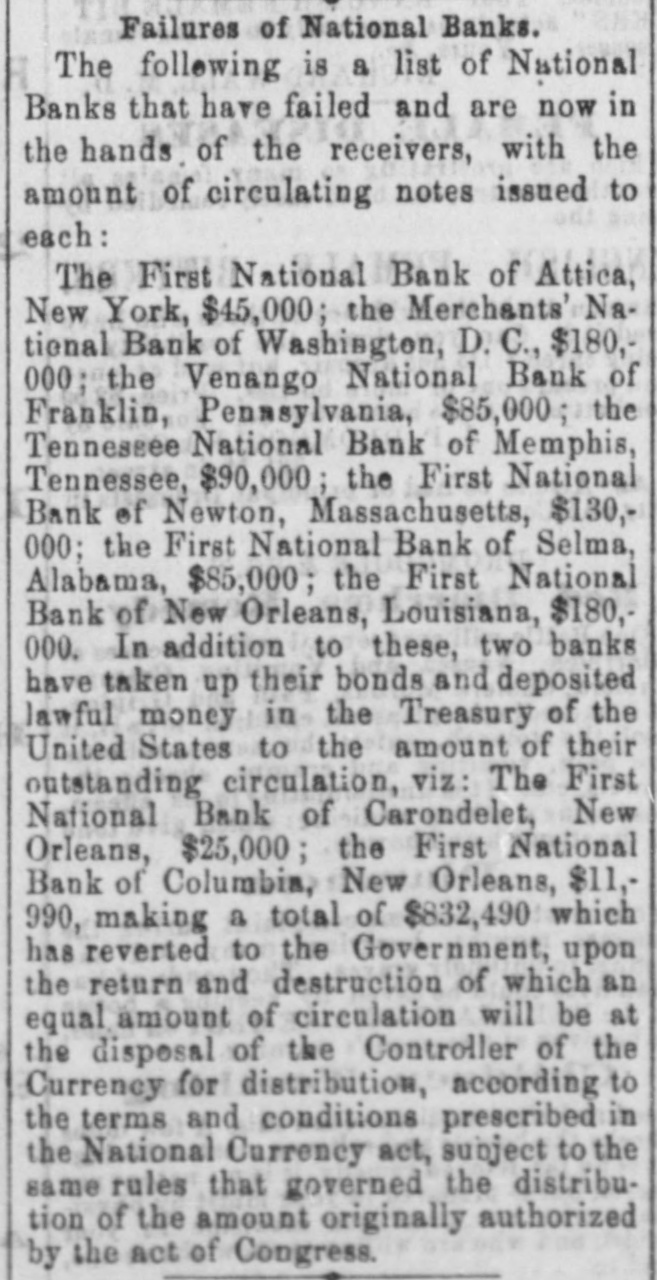
FAILURES OF NATIONAL BANKS.-The followis a list of national banks that have and are now in the hands of receivers, the amount of circulating notes issued each The First National Bank of Attica, Y., 845,000; the Merchants National Bank Washington, D. C. $180,000; the Venango National Bank of Franklin, Penn., $35,000; Tennessee National Bank of Memphis, Tenn $90,000; the First National Bank of Newton Mass., $130,000; the First National of Selma, Ala. $85,000; the First NaBank tional Bank of New Orleans, La., $180,000. In addition to these, two banks have taken up their bonds and deposited lawful money in the Treasury 01 the United States to the amount of their outstanding circulation-viz. : The First National Bank of Carondelet, New Orleans. $25,500 the First National Bank of Co. lumbia. New Orleans, $11,990; making a total $582,490 which has reverted to the Governupon the return and destruction of equal amount of circulation will be althe disposal of the Comptroller of the Currency for distribution, according to the terms and conditions prescribed in the national currency net. subject to the same rules that governed the distribution of the amount origimally authorized by the act of Congress.-New 1 to


Article from The Tri-Weekly Standard, June 15, 1867

Click image to open full size in new tab

Article Text

FAILURES OF NATIONAL BANKS-The following is a list of national banks that have failed and are now in the hands of receivers, with the amount of circulating notes issued to each : The first National Bank of Attica, N. Y., $45,000; the Merchants National Bank of Washington, D. C., $180,000; the Venango National Bank of Franklin, Penn., $35,000; the Tennessee National Bank of Memphis, Tenn., $90,000; the First National Bank of Newton, Mass., $130,000; the First National Bank of Selma, Ala., $85,000; the First National Bank of New Orleans, La., $180,000. In addition to these, two banks have taken up their bonds and deposited lawful money in the Treasury of the United States to the amount of their outstanding circulation-viz.: The First National Bank of Carondelet, New Orleans, $25,500; the First National Bank of Columbia, New Orleans, $11,990; making a total of $832,490 which has reverted to the Government; upon the return and distruction of which an equal amount of circulation will be at the disposal of the Comptroller of the Currency for distribution, according to the terms and conditions prescribed in the national currency act, subject to the same rules that governed the distribution of the amount originally authorized by the act of Congress.New York Times.


Article from Public Ledger, June 19, 1867

Click image to open full size in new tab

Article Text

Failures of National Banks. The following is a list of National Banks that have failed and are now in the hands of the receivers, with the amount of circulating notes issued to each: The First National Bank of Attica, New York, $45,000; the Merchants' National Bank of Washington, D. C., $180,000: the Venango National Bank of Franklin, Penasylvania, $85,000; the Tennessee National Bank of Memphis, Tennessee, $90,000; the First National Bank of Newton, Massachusetts, $130,000; the First National Bank of Selma, Alabama, $85,000; the First National Bank of New Orleans, Louisiana, $180,000. In addition to these, two banks have taken up their bonds and deposited lawful money in the Treasury of the United States to the amount of their outstanding circulation, viz: The First National Bank of Carondelet, New Orleans, $25,000; the First National Bank of Columbia, New Orleans, $11,990, making a total of $832,490 which has reverted to the Government, upon the return and destruction of which an equal amount of circulation will be at the disposal of the Controller of the Currency for distribution, according to the terms and conditions prescribed in the National Currency act, subject to the same rules that governed the distribution of the amount originally authorized by the act of Congress.


Article from The Weekly North-Carolina Standard, June 19, 1867

Click image to open full size in new tab

Article Text

FAILURES OF NATIONAL BANKS- The following is a list of national banks that have failed and are now in the hands of receivers, with the amount of circulating notes issued to each : The first National Bank of Attica, N. Y., $45,000; the Merchants National Bank of Wash ington, D. C., $180,000; the Venango National Bank of Franklin, Penn., $35,000; the Tennessee National Bank of Memphis, Tenn., $90,000; the First National Bank of Newton, Mass., $130,000; the First National Bank of Selma, Ala., $85,000; the First National Bank of New Orleans, La., $180,000. In addition to these, two banks have taken up their bonds and deposited lawful money in the Treasury of the United States to the amount of their outstanding circulation-viz.: The First National Bank of Carondelet, New Orleans, $25,500; the First National Bank of Columbia, New Orleans, $11,990; making a total of $832,490 which has reverted to the Government; upon the return and distruction of which an equal amount of circulation will be at the disposal of the Comptroller of the Currency for distribution, according to the terms and conditions prescribed in the national currency act, subject to the same rules that governed the distribution of the amount originally authorized by the act of Congress.New York Times.


Article from Baton Rouge Tri-Weekly Gazette & Comet, June 20, 1867

Click image to open full size in new tab

Article Text

LIST OF SUSPENDED NATIONAL BANKS.-The following is a list of national banks that have failed are now in the hands of the receiver, with amount of circulating notes is sued to each : First National Bank, Attica, New York, circulation $45,000; Merchants' National Bank Washington, D. C., $150,000; Venango National Bank Franklin, Pa., $85, 000; Teonessee National Bank, Memphis, $90,000; First National Bank, Newton, Mass., $130,000; First National Bank, New Orleans, $180,000. In addition to these, the First Na. tional of Carondelet, Missouri, with a circulation of $25,000, and First National of Columbia, with a circulation of $11,990, have taken up their bonds and deposited lawful money in the United State Treasury to the amount of their outstanding circula tion. Here is an aggregate of $832,490 which has reverted to the Government, upon the return and destruction of which an equal amount of circulation will be at the disposal of the currency for the currency for distribution according to the terms and conditions prescribed in the National Currency act, subject to the same rules as governed the distribution of the amount originally authorized by Congress. Banks Without Circulation.-Quite a number of national banks have been organized, to which the Controller has not yet given any circulation because the amount provided for by law is already out, and there are many others that have received only part of the amount to which they would, un der other circumstances, be entitled. There is a pressing demand for more currency west of the Mississippi, and more particularly in Kansas, which he is anxious to meet, and he will do 80 as soon as a sufficient amount of these broken banks have been restored.


Article from Dallas Herald, July 13, 1867

Click image to open full size in new tab

Article Text

FAILURES OF NATIONAL BANKS.The following is a list of National Banks that have failed and are now in the hands of the receivers, with the amount of circulating notes issued to each: The First National Bank of Atticit, New York, $45.000; the Mer. chants' National Bank of Washington, D. C., $180,000; the Venango National Bank of Franklin, Pennsylvania, $85,000; the Tennessee National Bank of Memphis, Tennessee, $90,000; the First National Bank of Newton, Massachusetts, $130,000; the First National Bank of Selma, Alabama, $85,000; the First National Bank of New Orleans, Louisiana, $180,000. In addition to those, two banks have taken up their bonds and deposited lawful money in the Treasury of the United States to the amount of their outstanding circulation, viz: The First National Bank of Carondelet, New Orleans, $25,000; the First National Bank of Columbia, New Orleans, $11,990, making a total of $832,490 which has reverted to the Government, upon the return and destruction of which an equal amount of circulation will be at the disposal of the Comptroller of the Currency for distribution. according to the terms and conditions prescribed in the National Currency Act, subject to the same rules that governed the distribution of the amount originally authorized by the act of Congress.


Article from The Jasper Weekly Courier, July 19, 1867

Click image to open full size in new tab

Article Text

NO. 23. The following is a list of Na. tional Banks that have failed, and are DOW in the hands of receivers, with the amount of circulating notes issued to each:-First National, Atica. New York, $45,000; Merchants' National, Washington, D. C., $180,000; Venango National; Franklin, Pa., $85,000; Tennessee National, Memphis, Tenn., $90,000; First National, Newton, Mass., $130,000; First National Selma, Ala., $85,000; First National New Orleans, La., $180,000. In ad dition to these, two banks have taken up their bonds, and deposited lawful money in the United States Treasury to the amount of outstanding circulation, viz: Firat National, Columbia, $11,990-making a total of $832. 490 reverting to the Government, upon the return and destruction of which an equal amount of circulation will be at the disposal of the Comptroller of the Currency for distribution.


Article from Clearfield Republican, October 10, 1867

Click image to open full size in new tab

Article Text

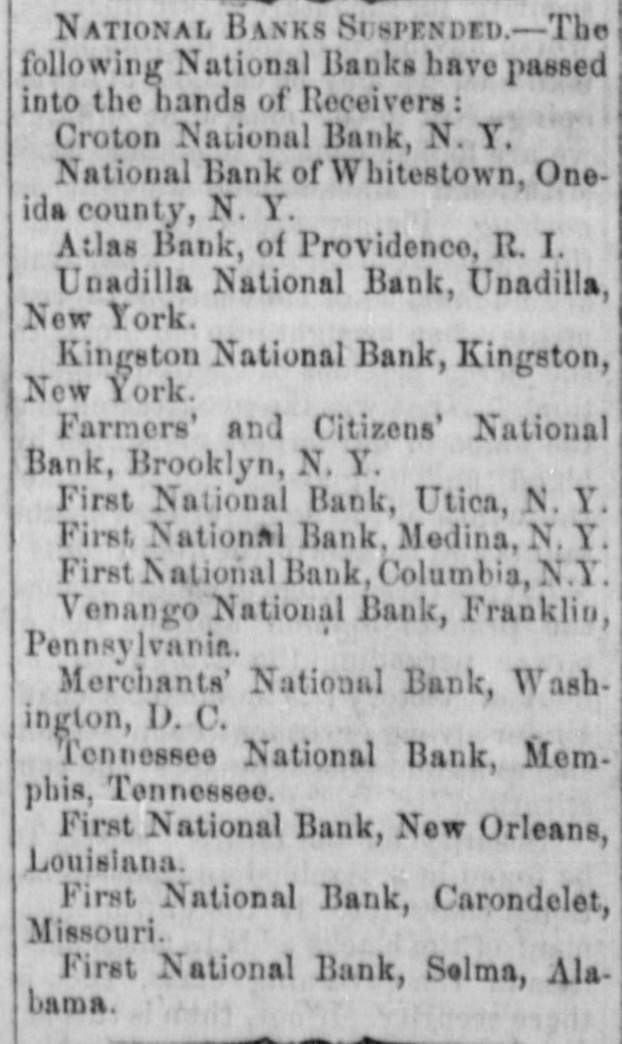
NATIONAL BANKS SUSPENDED.-The following National Banks have passed into the hands of Receivers: Croton National Bank, N. Y. National Bank of W bitestown, Oneida county, N. Y. Atlas Bank, of Providence, R. I. Unadilla National Bank, Unadilla, New York. Kingston National Bank, Kingston, New York. Farmers' and Citizens' National Bank, Brooklyn, N. Y. First National Bank, Utica, N. Y. First National Bank, Medina, N.Y. First National Bank, Columbia, N.Y. Venango National Bank, Franklin, Pennsylvania. Merchants' National Bank, Washington, D. C. Tennessee National Bank, Memphis, Tennessee. First National Bank, New Orleans, Louisiana. First National Bank, Carondelet, Missouri. First National Bank, Selma, Alabama.


Article from The Jeffersonian, October 24, 1867

Click image to open full size in new tab

Article Text

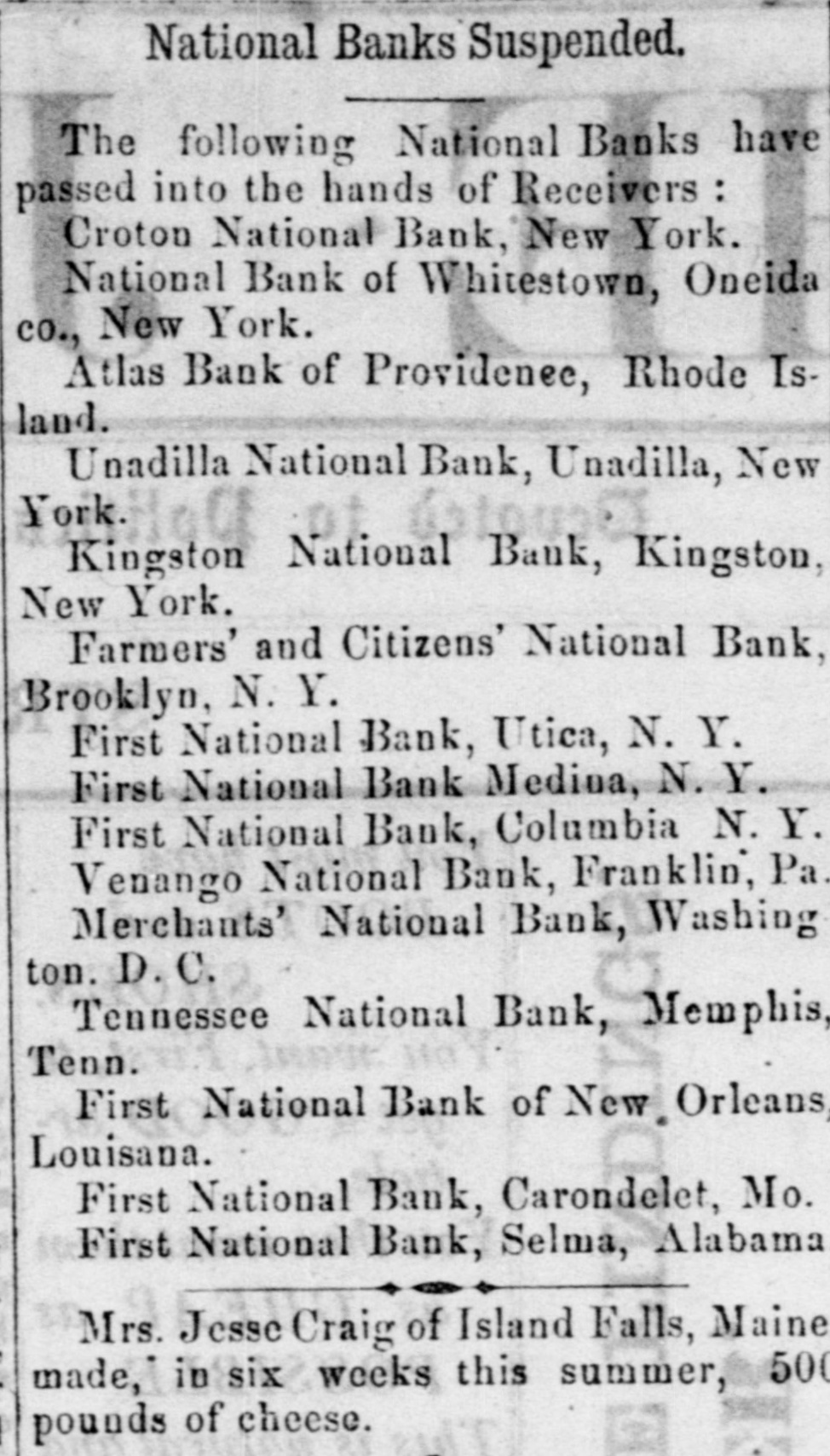
National Banks Suspended. The following National Banks have passed into the hands of Receivers : Croton National Bank, New York. National Bank of Whitestown, Oneida co., New York. Atlas Bank of Providence, Rhode Island. Unadilla National Bank, Unadilla, New York. Kingston National Bank, Kingston, New York. Farmers' and Citizens' National Bank, Brooklyn, N. Y. First National Bank, Utica, N. Y. First National Bank Medina, N. Y. First National Bank, Columbia N. Y. Venango National Bank, Franklin, Pa Merchants' National Bank, Washing ton. D. C. Tennessee National Bank, Memphis, Tenn. First National Bank of New Orleans Louisana. First National Bank, Carondelet, Mo. First National Bank, Selma, Alabama Mrs. Jesse Craig of Island Falls, Maine made, in six weeks this summer, 50 pounds of cheese.


Article from Indiana American, November 22, 1867

Click image to open full size in new tab

Article Text

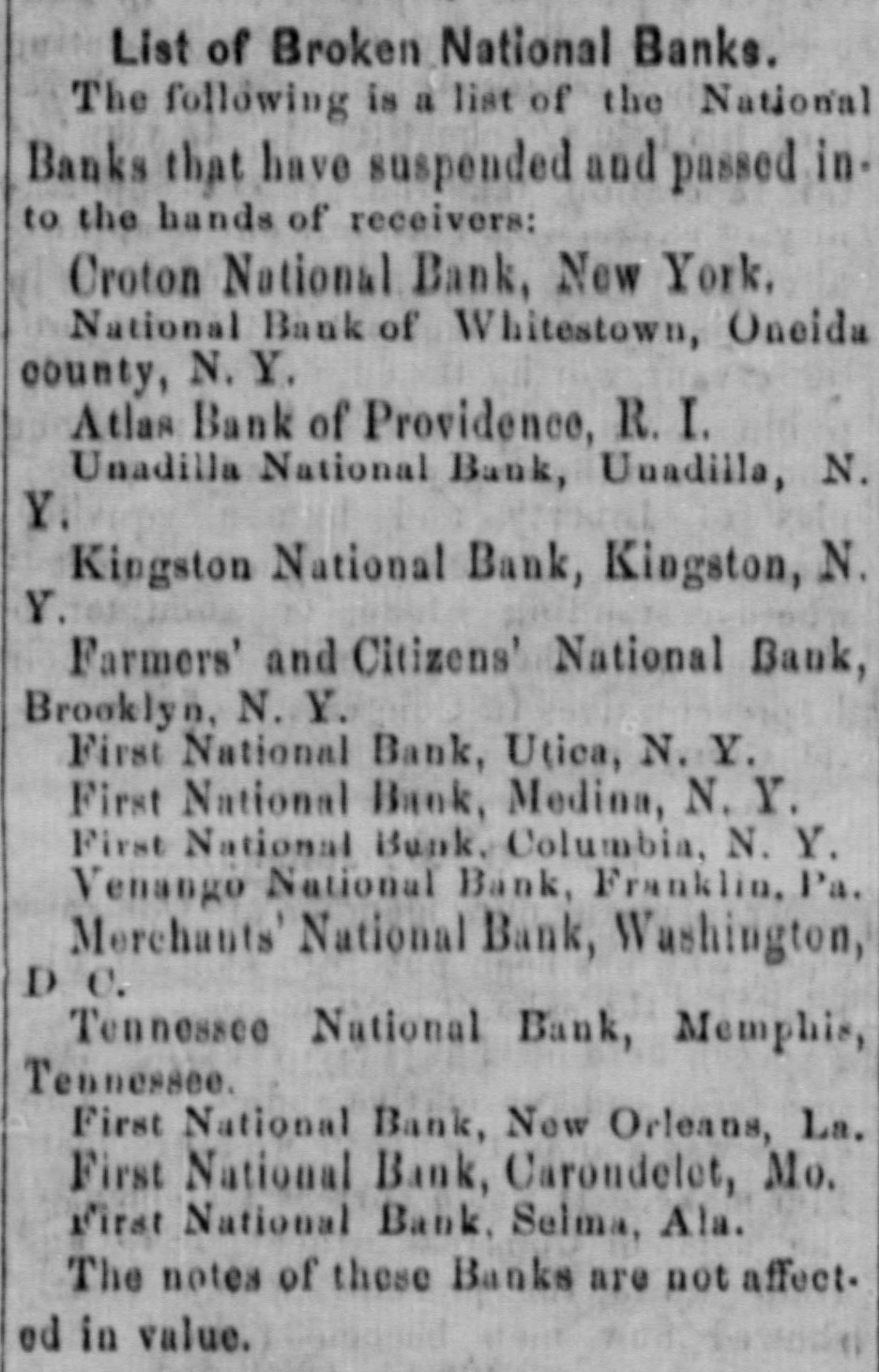
List of Broken National Banks. The following is a list of the National Banks that have suspended and passed in. to the hands of receivers: Croton National Bank, New York, National Bank of Whitestown, Oneida county, N. Y. Atlas Bank of Providence, R. I. Unadilla National Bank, Uuadilla, N. Y. Kingston National Bank, Kingston, N. Y. Farmers' and Citizens' National Bank, Brooklyn, N. Y. First National Bank, Utica, N. Y. First National Bank, Medina, N. Y. First National Bunk, Columbia, N. Y. Venango National Bank, Franklin, Pa. Merchants' National Bank, Washington, D C. Tennessee National Bank, Memphis, Tennessee. First National Bank, New Orleans, La. First National Bank, Carondelet, Mo. First National Bank, Selma, Ala. The notes of these Banks are not affect. ed in value.


Article from New-York Tribune, December 2, 1872

Click image to open full size in new tab

Article Text

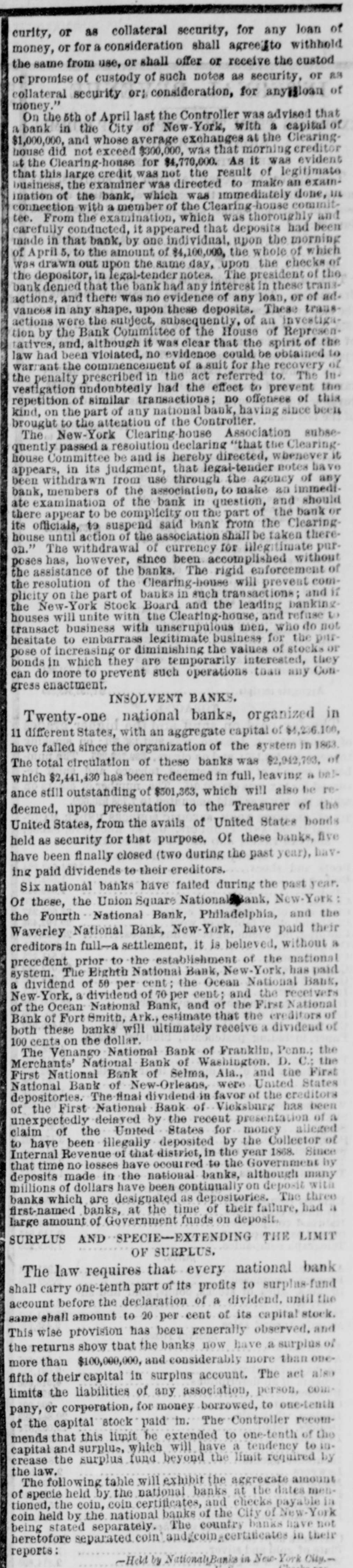
curity, or as collateral security, for any loan of money, or for a consideration shall agreeAto withhold the same from use, or shall offer or receive the custod or promise of custody of such notes as security, or as collateral security or consideration, for any lloan of money." 5th of April last the Controller was advised that bank On the in the City of New-York, with a capital of $1,000,000, a and whose average exchanges at the Clearinghouse did not exceed $300,000, was that morning creditor at the Clearing-house for $4,770,000. A8 it was evident that this large credit was not the result of legitimate business, the examiner was directed to make an exam ination of the bank, which was immediately done, 114 connection with a member of the Clearing-house committee. From the examination, which was thoroughly and carefully conducted, it appeared that deposits had been made in that bank, by one individual, upon the morning of April 5 to the amount of $4,100,000, the whole of which was drawn out upon the same day, upon the checks of the depositor, in legal-tender notes. The president of the bank denied that the bank had any interest in these trans actions, and there was no evidence of any loan, or of ad. vances in any shape. upon these deposits. These traus actions were the subject, subsequently, of an investiga tion by the Bank Committee of the House of Represent tarives, and, although it was clear that the spirit of the law had been violated, no evidence could be obtained to warrant the commencement of a suit for the recovery of the penalty prescribed in the act referred to. The in vestigation undoubtedly had the effect to prevent the repetition of similar transactions; no offenses of this been kind, on the part of any national bank, having since brought to the attention of the Controller. The New-York Clearing house Association subse quently passed a resolution declaring "that the Clearinghouse Committee be and is hereby directed, whenever it appears, in its judgment, that legal-tender notes have been withdrawn from use through the agency of any bank, members of the association, to make an immediate examination of the bank in question, and should there appear to be complicity on the part of the bank or its officials, to suspend said bank from the Clearing house until action of the association shall be taken there on." The withdrawal of currency for illegitimate purposes has, however, since been accomplished without the assistance of the banks. The rigid enforcement of the resolution of the Clearing-house will prevent complicity on the part of banks in such transactions; and it the New-York Stock Board and the leading banking houses will unite with the Clearing-house, and refuse to transact business with unserupulous men. who do not hesitate to embarrass legitimate business for the parpose of increasing or diminishing the values of stocks or bonds in which they are temporarily interested, they can do more to prevent such operations team any Congress enactment. INSOLVENT BANKS. Twenty-one national banks, organized in 11 different States, with an aggregate capital of $1,236,100, have failed since the organization of the system in 1863 The total circulation of these banks was $2,942,793. of which $2,441,430 has been redeemed in full, leaving a belance still outstanding of $501,363, which will also be redeemed, upon presentation to the Treasurer of the United States, from the avails of United States bonds held as security for that purpose. Of these banks, five have been finally closed (two during the past year), baying paid dividends to their ereditors. Six national banks have fatted during the past year. New-York: Of these, the Union Square National Bank, the Fourth National Bank, Philadelphia, and the Waverley National Bank, New-York, have paid their creditors in full-a settlement, it is believed, without a precedent prior to the establishment of the national system. The Eighth National Bank, New-York, has paid dividend of 50 per cent; the Ocean National Bank, New-York, a dividend of 70 per cent; and the receiver of the Ocean National Bank, and of the First National Bank of Fort Smith, Ark., estimate that the creditors of both these banks will ΓΊltimately receive a dividend of 100 cents on the dollar. The Venango National Bank of Franklin, Penn.: the Merchants' National Bank of Washington. D. C. the First National Bank of Selma, Ala., and the First National Bank of New-Orleans, were United States depositories. e-final dividend in favor of the creditors of the First National Bank of Vicksburg has been unexpectedly delayed by the recent presentation of a claim of the United States for money alleged to have been illegally deposited by the Collector of Internal Revenue of that district, in the year 1868. Since that time no lesses have occurred to the Government by deposits made in the national banks, although many millions of dollars have been continually on deposit with banks which are designated as depositories. The three a first-named banks, at the time of their failure, had large amount of Government funds on deposit. SURPLUS AND SPECIE-EXTENDING THE LIMIT OF SURPLUS. The law requires that every national bank shall carry one-tenth part of its profits to surplus-fund account before the declaration of a dividend, until the same shall amount to 20 per cent of its capital stock. This wise provision has been generally observed. and the returns show that the banks now have a surplus of more than $100,000,000, and considerably more than onefifth of their capital in surplus account. The act also limits the liabilities of any association, person, com pany, or corporation, for money borrowed, to one-tenth of the capital stock paid in. The Controller recommends that this limit be extended to one-tenth of the capital and surplu. which will have a tendency to 10. crease the surplus fund beyond the limit required by the law. The following table will exhibit the aggregate amount of specie held by the national banks at the dates mentioned, the coin, coin certificates, and checks payable coin held by the national banks of the City of New York being stated separately. The country banks have not heretofore separated coin in their reports: -Held NationalsBanks in New- City.-