16204. Bank of Commerce (Erie, PA)

Bank Information

Episode Type
Suspension โ†’ Closure
Bank Type
state
Start Date
November 21, 1860
Location
Erie, Pennsylvania (42.129, -80.085)

Metadata

Model
gpt-5-mini
Short Digest
e920394916885958

Response Measures

None

Description

Contemporary newspapers (Nov 1860) report the Bank of Commerce at Erie was suspended amid a wider currency panic and brokers refusing its notes. Later 1878 state reports refer to it as one of the 'broken' banks and mention affairs being wound up by an assignee, indicating permanent failure/closure. No clear article describes a depositor run on this specific bank prior to suspension; causation is contagion from other banks and general currency panic.

Events (3)

1. November 21, 1860 Suspension
Cause
Local Banks
Cause Details
Suspended amid a wider currency panic and the recent suspensions/failures of other banks (Southern and Western banks); brokers were refusing to take its notes in some cities.
Newspaper Excerpt
The Bank of Commerce at Erie ... are thrown out at Philadelphia.
Source
newspapers
2. August 9, 1878 Other
Newspaper Excerpt
the Bank of Commerce, Erie, that suspended during the term of Hon. Eli Slifer ... and the Venango National Bank, Franklin, that suspended during the term of Hon. W. H. Kemble ... both gentlemen claim they were authorized depositaries of the State and that the moneys lost in them were deposited by the County Treasurers under authority of law. As soon as the affairs of the bank are wound up by the assignee Mr. Rawle will pay the balance into the treasury. (discussing the bank as one of six 'broken banks')
Source
newspapers
3. August 14, 1878 Receivership
Newspaper Excerpt
As soon as the affairs of the bank are wound up by the assignee Mr. Rawle will pay the balance into the treasury. The other five broken banks were marked upon the books of the Treasury ... 'certified to the Attorney General' for collection, ... no responsibility for their collection or settlement belongs to the Treasurer.
Source
newspapers

Newspaper Articles (7)

Article from Cincinnati Daily Press, November 22, 1860

Click image to open full size in new tab

Article Text

MONETARY AND COMMERCIAL. Financial Affairs. Yesterday was, financially, the most unsettled day yet experienced in Third-street, and Money closer than it had been before this season. The Discount-houses were unwilling to accommodate any but their customers, and they threw out considerable of the Paper offered. The uncertain and troubled feeling affects all branches of trade, and though the city and country-this portion of it, at leastare rich in means and.crops, there is no disposition to operate to any extent until the political difficulties in the South are over. Monetary matters, during the week ending last evening, grew much closer than they had been during any week previous, and the stock of Currency held by the Bankers was much reduced. Rates of interest became higher, and though 10@12 remain the figures of the leading Discount-houses, the best names often go at 18@24 per cent., while long Paper is with difficulty negotiated at any price. Every one hopes for a speedy delivery from the existing condition of affairs, and if confidence were restored, the city would be rejoicing in an excellent and a prosperous trade. There is no reason, as every one knows, for the present commercial disarrangement, but still it has the most unfavorable effects. Eastern Exchange became firmer during the week, and at the close of yesterday rates were stiff at our quotations. The rates here are very low-more so than they should beand would doubtless advance if Money were easy. New Orleans Exchange is very quiet, and rates almost nominal. Gold during the week was in good retail demand, and is still, with some sales to the country Banks. The supply is moderate; dealers supplying themselves by assorting Paper and returning it home for Coin. In Time-bills hardly any thing is doing, though prime Drafts are nominal at 12 per cent. per annum. Uncurrent Money, during the week, underwent various fluctuations and was much unsettled yesterday; the rates, though not reliable, being given as follows, at the close of Bank-hours: Indiana Stock ยฝ; Pennsylvania (interior),%; Virginia (except Wheeling City and branches), 5@10; Missouri, 5; Iowa 5; Wisconsin, 10; Illinois, 10; Maryland (interior), 3/4; Tennessee 1@2; Michigan and Canada 2 discount; Alabama, Georgia and the Carolinas, 10@20 discount. The failure of the Farmers' Bank of Virginia has caused persons to distrust much of the Southern Paper, as the suspension of the Bank of Commerce at Erie has affected the country Pennsylvania Notes. Some twenty-three of the Illinois Banks have been discredited, and they are purchased in. some quarters at 25 discount; while some of the Brokers purchase them as they do the other institutions, at 10 discount. By reference to our New York dispatches it will be seen that a great panic was experienced yesterday, in Wall-street, respecting Uncurrent Money. A plan is proposed in that city to relieve the Banks by issuing Scrip based on undoubted securities. The present rates of Exchange and Coin are:
Article from New-York Daily Tribune, November 22, 1860

Click image to open full size in new tab

Article Text

266'601$ Increase $3,542,680 $658,360 $1,685,055 Decrease The suspensions of banks at the South and West, announced within a day or two, brought about almost a panic in uncurrent money, and the brokers' offices were crowded to-day with sellers. The rates rapidly advanced, partly from the inability of buyers to meet the rush, and partly from the uncertainty in regard to the future. At the latest, Messrs. Thompson Brothers quote New-York State and Eastern P cent discount; IIdiscount; Ohio, Indiana, and Kentucky, 5 cent linois, Missouri, Wisconsin, and Iowa, 15 โ‚ฝ cent disdiscent count; Maryland and Pennsylvania, 1@2 P count; Virginia, North Carolina, South Carolina, cent discount. Land Georgia, and Alabama, 25 Warrants are unsettled, and nominally 60c. P acre. The rush to sell uncurrent money has been 80 great that the brokers have had no time to assort it. Mobile and New-Orleans, if assorted, could be sold at 10 cent. Telegraph dispatches announce the suspension of all the Richmond Banks, and that at Baltimore uncurrent money cannot be sold. The Bank of Commerce at Erie, and the Pittston Bank, are thrown out at Philadelphia, and the weak banks all over the country are shaking in the wind. State and Eastern currency is coming in very freely at the Metropolitan Bank, and that institution, we understand, now requires the guarantee of brokers depositing uncurrent funds. A scheme was incubated yesterday, to seal up these notes of State and Eastern banks, instead of sending them home for redemption, and issue certificates upon them, as in 1857, to be used between the banks in settlement of balances at the Clearing-House. This scheme, however, was superseded by the action of the banks this afternoon. The Exchange Committee of the Banks have bought about ยฃ30,000 at about 102, and have negotiations under way for a much larger amount. The offerings of bills to-day were quite moderate. The difficulty of finding the right description of bills, hampers the operations of the Committee, and they will probably be obliged to resort to the bankers to fill up the amount authorized. The true policy of the Committee would be to buy commercial bills of the bankers, with their indorsement, paying a fair advance for the risk thus assumed by the bankers. The object of the movement, we apprehend, is not to make money for the banks on the import of specie, but to relieve the stagnation in the Exchange market. The bankers know the standing of commercial drawers, while the Committee have to make nun erous inquiries, which cause delay, when in mediate relief is needed. To-morrow is the day of payment for the Government loan awarded last week. The speculative lots will not probably be paid for. In the mean time, Treasury notes are going in rapidly for redemption, and we shall not be surprised to see the Treasury bankrupt by Jan. 15, 1861, unless Congress intervenes to save it. There was little or no relief in the money market today, but a rather easier feeling in anticipation of some relief by a more liberal course on the part of the banks. First-class names go at 12@15 cent, and good at 18@24 cent. There is no currency, even at these rates. Demand loans are 7 P cent, and the supply of money is moderate. The managers of our banks this morning became thoroughly awake to the precarious character of their condition, and held a meeting to consider measures for the relief of the mercantile classes, and to prevent a general suspension of specie payment by themselves. A scheme was proposed and adopted, subject to the approval of an adjourned meeting, to be held in the afternoon. This plan contemplates a general and liberal expansion of loans to meet the full wants of the worldcommercial Committee of five to be appointed, to whom any bank which should be drained of its gold could apply, and by the deposit of bills receivable, stocks, &c., in trust, Clearing-House certificates to the extent of 75 cent of the deposits would be issued, which certificates are to be receivable at the Clearing-House in payment of balances. This practically establishes a community of all the specie in the bank vaults, and no single bank can bebroken 80 long as it has good assets. In the present state of our foreign trade, there being no shipping demand for gold, we can see no danger in this expansion of loans contemplated, and if the step had been taken two weeks ago, much suffering would have been averted. The want of a leading spirit in the banking circle has been painfully evident, and the banks, each one for it self, have gone on scrambling for coin until the merchants and banks have together been brought to the brink of bankruptcy. We trust the action of this afternoon has averted the danger, and that the relief to be afforded will be sufficient to infuse new vitality into all the avenues of trade and commerce. No better proof of the thorough fright and earnestness of the bank officers is needed than the fact, that for the


Article from Sioux City Register, December 1, 1860

Click image to open full size in new tab

Article Text

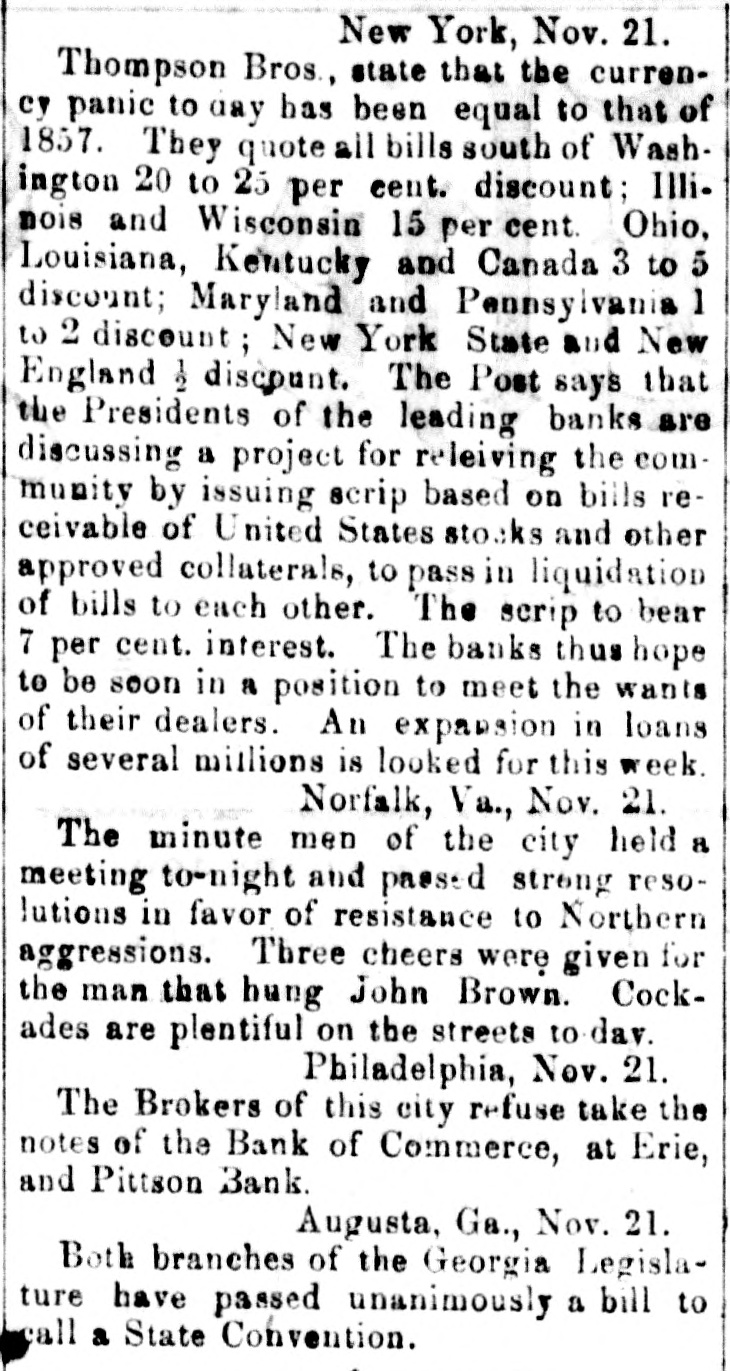
New York, Nov. 21. Thompson Bros, state that the currency panic to day has been equal to that of 1857. They quote all bills south of Washington 20 to 25 per cent. discount; Illinois and Wisconsin 15 per cent. Ohio, Louisiana, Kentucky and Canada 3 to 5 discount; Maryland and Pennsylvania 1 to 2 discount; New York State and New England 1 discount. The Post says that the Presidents of the leading banks are discussing a project for releiving the community by issuing scrip based on bills receivable of United States stocks and other approved collaterals, to pass in liquidation of bills to each other. The scrip to bear 7 per cent. interest. The banks thus hope to be soon in a position to meet the wants of their dealers. An expansion in loans of several millions is looked for this week. Norfalk, Va., Nov. 21. The minute men of the city held a meeting to-night and passed strong resolutions in favor of resistance to Northern aggressions. Three cheers were given for the man that hung John Brown. Cockades are plentiful on the streets to dav. Philadelphia, Nov. 21. The Brokers of this city refuse take the notes of the Bank of Commerce, at Erie, and Pittson Bank. Augusta, Ga., Nov. 21. Both branches of the Georgia Legislature have passed unanimously a bill to call a State Convention.


Article from The Cambria Freeman, August 9, 1878

Click image to open full size in new tab

Article Text

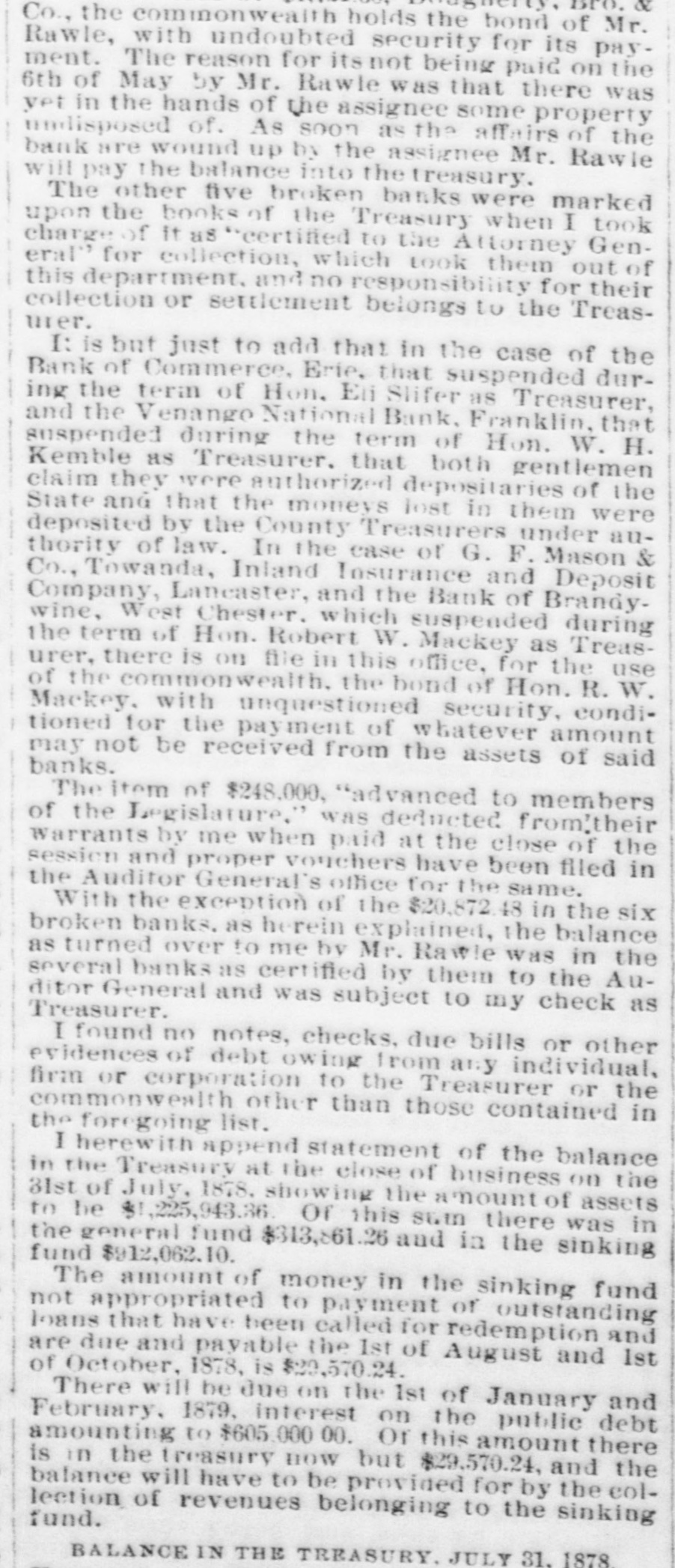
Co., the commonwealth holds the bond of Mr. & Rawle, with undoubted security for its payment. The reason for its not being paid on the 6th of May by Mr. Rawle was that there was yet in the hands of the assignee some property undisposed of. As soon as the affairs of the bank are wound up by the assignee Mr. Rawle will pay the balance into the treasury. The other five broken banks were marked upon the books of the Treasury when I took charge of it us "certified to the Attorney General" for collection, which took them out of this department, and no responsibility for their collection or settlement belongs to the Treasurer. I: is but just to add that in the case of the Bank of Commerce. Erie, that suspended during the term of Hon. En Slifer as Treasurer, and the Venango National Bank, Franklin, that suspended during the term of Hon. W. H. Kemble as Treasurer. that both gentlemen claim they were authorized depositaries of the State and that the moneys lost in them were deposited by the County Treasurers under authority of law. In the case of G. F. Mason & Co., Towanda, Inland Insurance and Deposit Company, Laneaster, and the Bank of Brandywine, West Chester. which suspended during the term of Hon. Robert W. Mackey as Treasurer, there is on file in this office, for the use of the commonwealth. the bond of Hon. R. W. Mackey, with unquestioned security, conditioned for the payment of whatever amount banks. may not be received from the assets of said The item of $248,000, "advanced to members of the Legislature," WAS deducted from!their Warrants by me when paid at the close of the session and proper vouchers have been filed in the Auditor General's office for the same. With the exception of the $20,872.48 in the six broken banks. as herein explained, the balance as turned over to me by Mr. Rawle was in the several banks as certified by them to the Auditor Treasurer. General and was subject to my check as I found no notes, checks, due bills or other evidences of debt owing from any individual, firm or corporation to the Treasurer or the commonwewlth other than those contained in the foregoing list. I herewith append statement of the balance in the Treasury at the close of business on the 31st of July, 1878. showing the amount of assets to be $1,225,943.36. Of this st.m there was in the general fund $313,861.26 and in the sinking fund $912,062.10. The amount of money in the sinking fund not appropriated to payment of outstanding loans that have been called for redemption and are due and payable the 1st of August and Ist of October, 1878, is $20,570.24. There will be due on the 1st of January and February, 1879, interest on the public debt amounting to $605,000 00. Or this amount there is in the treasury now but $29,570.24, and the balance will have to be provided for by the colfund. lection of revenues belonging to the sinking BALANCE IN THE TREASURY. JULY 31. 1878


Article from Clearfield Republican, August 14, 1878

Click image to open full size in new tab

Article Text

Total $20,872 All of which institutions had failed. For the item of $1,721.60, DougherS, ty Bro. & Co., the Commonwealth holds the bond of Mr. Rawle, with undoubted security for its payment. The reason for its not being paid on the 6th d a of May by Mr. Rawle was that there was yet in the hands of the assignee some property undisposed of. As soon r as the affairs of the bank are wound up by the assignee Mr. Rawle will pay the balance into the Treasury. The other five broken banks were marked upon the books of the Treas. ury when I took charge of it as "cer) tified to the Attorney General" for collection, which took them out of the department, and no responsibility for their collection or settlement belongs to the Treasurer. e It is but just to add that in the case of the Bank of Commerce, Erie, that suspended during the term of Hon. Eli Slifer as Treasurer, and the Venango National Bank, Franklin that suspended during the term of Hon. W. H. Kemble as Treasurer, that both gentlemen claim that they were authorized depositaries of the State and that the moneys lost in them were deposited by the County Treasurers under authority of law. In the case of G. F. Mason & Co., Towanda, Inland Insurance and Deposit Company, Lan. caster, and the Bank of Brandywine, : West Chester, that suspended during the term of Hon. Robert W. Mackey 0 as Treasurer, there is on file in this 0 office, for the use of the Common0 wealth, the bond of Hon. Robert W. 0 Mackey, with unquestioned security 0 conditioned for the payment of what0 ever amount may not be received from a the assets of said banks. n The item of $248,000, "advanced to a members of the legislature" was deducted from their warrants by me when paid at the close of the session and proper vouchers have been filed in the Auditor General's office for the same. With the exception of the $20,872.48 in the six broken banks as herein explained, balance as turned over to me , by Mr. Rawle, was in the several banks as certified by them to the Anditor General and was subject to my check as Treasurer. I found no notes, checks, due bills or other evidences of debt owing from any individual firm or corporation to the Treasurer or the Commonwealth 1. other than those contained in the fore. at going list. e, or I herewith append statement of the balance in the Treasury at the close of d business on the 31st of July, 1878, showing the amount of assets to be 0 $1,225,943.36. Of this sum there was in the general fund $313,861.26 and in the sinking fund $912,032.10. The amount of money in the sink-


Article from The Somerset Herald, August 14, 1878

Click image to open full size in new tab

Article Text

Total. . . . . . . . . . . . . . . . . . . . . . . . . . . . . . . . . . . . . . . . . . . . . . . . . . . . . . . . . . . . . . . . . . . . . . . . . . . . . . . . . . . . . . . . . . . . . . . . . . . . . . . . . . . . . . . . . . . . . . . . . . . . . . . . . . . . . . . . . . . . . . . . . . . . . . . . . . . . . . . . . . . . . . . . . . . . . . . . . . . . . . . . . . . . . . . . . . . . . . . . . . . . . . . . . . . . . . . . . . . . . . . . . . . . . . . . . . . . . . . . . . . . . . . . . . . . . . . . . . . . . . . . . . . . . . . . . . . . . . . . . . . . . . . . . . . . . . . . . . . . . . . . . . . . . . . . . . . . . . . . . . . . . . . . . . . . . . . . . . . . . . . . . . . . . . . . . . . . . . . . . . . . . . . . . . . . . . . . . . . . . . . . . . . . . . . . . . . . . . . . . . . . . . . . . . . . . . . . . . . . . . . . . . . . . . . . . . . . . . . . . . . . . . . . . . . . . . . . . . . . . . . . . . . . . . . . . . . . . . . . . . . . . . . . . . . . . . . . . . . . . . . . . . . . . . . . . . . . . . . . . . . . . . . . . . . . . . . . . . . . . . . . . . . . . . . . . . . . . . . . . . . . . . . . . . . . . . . . . . . . . . . . . . . . . . . . . . . . . . . . . . . . . . . . . . . . . . . . . . . . . . . . . . . . . . . . . . . . . . . . . . . . . . . . . . . . . . . . . . . . . . . . . . . . . . . . . . . . . . . . . . . . . . . . . . . . . . . . . . . . . . . . . . . . . . . . . . . . . . . . . . . . . . . . . . . . . . . . . . . . . . . . . . . . . . . . . . . . . . . . . . . . . . . . . . . . . . . . . . . . . . . . . . . . . . . . . . . . . . . . . . . . . . . . . . . . . . . . . . . . . . . . . . . . . . . . . . . . . . . . . . . . . . . . . . . . . . . . . . . . . . . . . . . . . . . . . . . . . . . . . . . . . . . . . . . . . . . . . . . . . . . . . . . . . . . . . . . . . . . . . . . . . . . . . . . . . . . . . . . . . . . . . . . . . . . . . . . . . . . . . . . . . . . . . . . . . . . . . . . . . . . . . . . . . . . . . . . . . . . . . . . . . . . . . . . . . . . . . . . . . . . . . . . . . . . . . . . . . . . . . . . . . . . . . . . . . . . . . . . . . . . . . . . . . . . . . . . . . . . . . . . . . . . . . . . . . . . . . . . . . . . . . . . . . . . . . . . . . . . . . . . . . . . . . . . . . . . . . . . . . . . . . . . . . . . . . . . . . . . . . . . . . . . . . . . . . . . . . . . . . . . . . . . . . . . . . . . . . . . . . . . . . . . . . . . . . . . . . . . . . . . . . . . . . . . . . . . . . . . . . . . . . . . . . . . . . . . . . . . . . . . . . . . . . . . . . . . . . . . . . . . . . . . . . . . . . . . . . . . . . . . . . . . . . . . . . . . . . . . . . . . . . . . . . . . . . . . . . . . . . . . . . . . . . . . . . . . . . . . . . . . . . . . . . . . . . . . . . . . . . . . . . . . . . . . . . . . . . . . . . . . . . . . . . . . . . . . . . . . . . . . . . . . . . . . . . . . . . . . . . . . . . . . . . . . . . . . . . . . . . . . . . . . . . . . . . . . . . . . . . . . . . . . . . . . . . . . . . . . . . . . . . . . . . . . . . . . . . . . . . . . . . . . . . . . . . . . . . . . . . . . . . . . . . . . . . . . . . . . . . . . . . . . . . . . . . . . . . . . . . . . . . . . . . . . . . . . . . . . . . . . . . . . . . . . . . . . . . . . . . . . . . . . . . . . . . . . . . . . . . . . . . . . . . . . . . . . . . . . . . . . . . . . . . . . . . . . . . . . . . . . . . . . . . . . . . . . . . . . . . . . . . . . . . . . . . . . . . . . . . . . . . . . . . . . . . . . . . . . . . . . . . . . . . . . . . . . . . . . . . . . . . . . . . . . . . . . . . . . . . . . . . . . . . . . . . . . . . . . . . . . . . . . . . . . . . . . . . . . . . . . . . . . . . . . . . . . . . . . . . . . . . . . . . . . . . . . . . . . . . . . . . . . . . . . . . . . . . . . . . . . . . . . . . . . . . . . . . . . . . . . . . . . . . . . . . . . . . . . . . . . . . . . . . . . . . . . . . . . . . . . . . . . . . . . . . . . . . . . . . . . . . . . . . . . . . . . . . . . . . . . . . . . . . . . . . . . . . . . . . . . . . . . . . . . . . . . . . . . . . . . . . . . . . . . . . . . . . . . . . . . . . . . . . . . . . . . . . . . . . . . . . . . . . . . . . . . . . . . . . . . . . . . . . . . . . . . . . . . . . . . . . . . . . . . . . . . . . . . . . . . . . . . . . . . . . . . . . . . . . . . . . . . . . . . . . . . . . . . . . . . . . . . . . . . . . . . . . . . . . . . . . . . . . . . . . . . . . . . . . . . . . . . . . . . . . . . . . . . . . . . . . . . . . . . . . . . . . . . . . . . . . . . . . . . . . . . . . . . . . . . . . . . . . . . . . . . . . . . . . . . . . . . . . . . . . . . . . . . . . . . . . . . . . . . . . . . . . . . . . . . . . . . . . . . . . . . . . . . . . . . . . . . . . . . . . . . . . . . . . . . . . . . . . . . . . . . . . . . . . . . . . . . . . . . . . . . . . . . . . . . . . . . . . . . . . . . . . . . . . . . . . . . . . . . . . . . . . . . . . . . . . . . . . . . . . . . . . . . . . . . . . . . . . . . . . . . . . . . . . . . . . . . . . . . . . . . . . . . . . . . . . . . . . . . . . . . . . . . . . . . . . . . . . . . . . . . . . . . . . . . . . . . . . . . . . . . . . . . . . . . . . . . . . . . . . . . . . . . . . . . . . . . . . . . . . . . . . . . . . . . . . . . . . . . . . . . . . . . . . . . . . . . . . . . . . . . . . . . . . . . . . . . . . . . . . . . . . . . . . . . . . . . . . . . . . . . . . . . . . . . . . . . . . . . . . . . . . . . . . . . . . . . . . . . . . . . . . . . . . . . . . . . . . . . . . . . . . . . . . . . . . . . . . . . . . . . . . . . . . . . . . . . . . . . . . . . . . . . . . . . . . . . . . . . . . . . . . . . . . . . . . . . . . . . . . . . . . . . . . . . . . . . . . . . . . . . . . . . . . . . . . . . . . . . . . . . . . . . . . . . . . . . . . . . . . . . . . . . . . . . . . . . . . . . . . . . . . . . . . . . . . . . . . . . . . . . . . . . . . . . . . . . . . . . . . . . . . . . . . . . . . . . . . . . . . . . . . . . . . . . . . . . . . . . . . . . . . . . . . . . . . . . . . . . . . . . . . . . . . . . . . . . . . . . . . . . . . . . . . . . . . . . . . . . . . . . . . . . . . . . . . . . . . . . . . . . . . . . . . . . . . . . . . . . . . . . . . . . . . . . . . . . . . . . . . . . . . . . . . . . . . . . . . . . . . . . . . . . . . . . . . . . . . . . . . . . . . . . . . . . . . . . . . . . . . . . . . . . . . . . . . . . . . . . . . . . . . . . . . . . . . . . . . . . . . . . . . . . . . . . . . . . . . . . . . . . . . . . . . . . . . . . . . . . . . . . . . . . . . . . . . . . . . . . . . . . . . . . . . . . . . . . . . . . . . . . . . . . . . . . . . . . . . . . . . . . . . . . . . . . . . . . . . . . . . . . . . . . . . . . . . . . . . . . . . . . . . . . . . . . . . . . . . . . . . . . . . . . . . . . . . . . . . . . . . . . . . . . . . . . . . . . . . . . . . . . . . . . . . . . . . . . . . . . . . . . . . . . . . . . . . . . . . . . . . . . . . . . . . . . . . . . . . . . . . . . . . . . . . . . . . . . . . . . . . . . . . . . . . . . . . . . . . . . . . . . . . . . . . . . . . . . . . . . . . . . . . . . . . . . . . . . . . . . . . . . . . . . . . . . . . . . . . . . . . . . . . . . . . . . . . . . . . . . . . . . . . . . . . . . . . . . . . . . . . . . . . . . . . . . . . . . . . . . . . . . . . . . . . . . . . . . . . . . . . . . . . . . . . . . . All of which institutions had failed. For the item of $1,721 60, Daugherty, Bro. & Co., the commonwealth holds the bond of Mr. Rawle, with undoubted security for its payment. The reason for its not being paid on the 6th of May by Mr. Rawle, was that there was yet in the hands of the assignee some property undisposed of. As soon as the affairs of the bank are wound up by the assignee Mr. Rawle will pay the balance into the treasury. The other five broken banks were marked upon the books of the Treasury when I took charge of it as "eertified to the Attorney General" for collection, which took them out of this department, and no responsibility for their collection or settlement belongs to the Treasurer. It is but just to add that in the case of the Bank of Commerce, Erie, that suspended during the term of Hon. Eli Stifer as Treasurer, and the Venango National Bank, Franklin, that suspended during the term of Hon. W. H. Kemble as Treasurer, that both gentlemen claim they were authorized depositaries of the State and that the moneys lost in them were deposited by the County Treasurers under authority of law. In the case of G. F. Mason & Co., Towanda, Inland Insurance and Deposit Company, Lancaster, and the Bank of Brandywine, West Chester, which suspended during the term of Hon. Robert W. Mackey as Treasurer, there is on file in this office, for the use of the commonwealth, the bond of Hon. R. W. Mackey, with unquestioned security, conditioned for the payment of whatever amount may not be received from the assets of said banks. The item of $248,000, "advanced to members of the Legislature," was deducted from their warrants by me when paid at the close of the session and proper vouchers have been filed in the Auditor General's office for the same. With the exception of the $20,872 48, in the six broken banks, as herein explained, the balance as turned over to me by Mr. Rawle was in the several banks as certified by them to the Auditor General and was subject to my check as Treasurer.


Article from The Middleburgh Post, October 28, 1897

Click image to open full size in new tab

Article Text

nants on the state treasurer in cer- tain matters. It is the duty of the state treasurer to receive and pay with- out delay all warrants presented to him # ANNUAL REVENUES ACCOUNTED FOR. Fourth. There was paid into the state treasury from all sources during the fiscal year 1896, $12,635,127.59. Of this amount there was transferred to the sinking fund, as provided by law, $369,371.50. There was returned to the counties three-fourths of the state tax on personal property received, amounting to $2,038,936.04, thus leaving a balance for general appropriation purposes of $10,226,820.05. According to the testimony of the state treasurer the appropriation exceeded the revenues of the last fiscal year about $2,500,000. Although a large amount of money has been received and paid out by the present treasurer, there has not been any loss to the state. The Chester County Guarantee, Trust and Safe Deposit company at the time it went into the hands of a receiver had a deposit of state funds amounting to $60,000, but the persons who had given a bond for the security of this fund paid into the state treasury the full amount of money held by said trust company, and thus relieved the treasurer of any further responsibility in connection therewith. So far as your committee is advised this is the only banking institution having a deposit of state funds that has become financially embarrassed during the incumbency of the present treasurer. According to the testimony of the state treasurer there was in the general fund on Jan. 29 last, in the 61 depositories named by him, $2,984,104.65. A list of the banks and amounts deposited with each will be found in the notes of testimony, which is made a part of this report. This statement does not include the sinking fund. # IN FIFTY-SIX YEARS ENTIRE LOSS TO STATE FROM ALL SOURCES 23 10-1000 OF 1 PER CENTUM. Fifth. At the request of the committee the state treasurer submitted a statement showing the annual receipts and expenditures of the commonwealth from 1840 to 1896, inclusive. In this period, 56 years, the state has received from all sources $410,974,961.73. During the same period it paid out $407,131,131.68. The loss to the state in this time has been very small. So far as the committee was able to ascertain no loss has ever occurred by reason of the default of a state treasurer or his bondsmen. Several years ago an item of $9,432.61, which had been carried along in the sinking fund account, was dropped in pursuance of a resolution of the board of sinking fund commissioners. This was done on the opinion of the attorney general, who reported the item uncollectable. This loss was the result of the old system which allowed county officers to deposit fees belonging to the state in such home banks as were designated by the state treasurer. Prior to 1880 the Bank of Commerce, of Erie, was designated as such a depository. The county officers deposited to the credit of the state certain fees of office. The bank failed, and the state treasurer took the position that inasmuch as the depository was fixed under authority of law he was relieved of personal responsibility by reason of any loss that might occur. The claim was submitted to the court of common pleas of Dauphin county, No. 309, August term, 1881, and it was decided that the treasurer was not personally responsible, yet the fact remained that the state lost the sum of $9,432.61, but this is the only loss of any kind the state has suffered since 1840. Prior to that time the committee could not obtain records giving the exact data in reference to our finances. The loss expressed in a fraction is about 23 10-1000 of 1 per centum of the amount received. It is very doubtful if any banking institution in this or any other country can show so small a percentage of loss in the handling of money, and it will be seen that the records made by the commonwealth and her state treasurers, beginning with Almon H. Reed in 1840, and continuing down to and including the term of B. J. Haywood in 1896, is one in which every Pennsylvanian may feel a just degree of pride. # NO INTEREST PAID TO THE STATE TREASURER FOR USE OF FUNDS. Sixth. Under the law neither the commonwealth nor the state treasurer are authorized to receive interest on deposits. Inasmuch as it has been alleged that interest has been paid on these deposits, the committee deemed it advisable to investigate this question. The state treasurer, cashier, assistant cashier and corporation clerk all testified that no interest had been paid to them or any of them on account of state moneys deposited in any banking institution. The testimony of these officers refutes the charges that state money had been loaned for political or campaign purposes; that money had been paid out of the treasury to persons who did not render service to the state, and that persons were required to receipt for a larger sum than they were entitled to receive. All these questions were directly asked by the committee, and the answers were positive and unequivocal denials of the several allegations. In order to keep down expenses the committee deemed it inexpedient to subpoena officers of banking institutions to appear in person. but required each banking insti-