16149. Market Bank (New York, NY)

Bank Information

Episode Type
Run → Suspension → Closure
Bank Type
state
Start Date
January 20, 1872
Location
New York, New York (40.714, -74.006)

Metadata

Model
gpt-5-mini
Short Digest
c23c9736

Response Measures

Full suspension

Other: Receiver/assignee appointed; criminal prosecutions of officers mentioned.

Description

Contemporary articles describe crowds and threats around the suspended Market bank (Jan 20, 1872), an official suspension and appointment of a receiver (James Dennis, Jan 20, 1872), and later reporting that the institution went under with receivership and bankruptcy actions. Officers (secretary Conklin) absconded and misappropriation is described; the bank did not reopen.

Events (4)

1. January 20, 1872 Receivership
Newspaper Excerpt
Mr. James Dennis was appointed receiver January 20, 1872, by Judge Barnard, but the appointment... resulted in the rejection of Dennis and the throwing of the bank into bankruptcy.
Source
newspapers
2. January 20, 1872 Run
Cause
Bank Specific Adverse Info
Cause Details
Reports of misappropriation by officers (secretary Conklin) and discovery of improper charged loans; allegation of officers' misconduct led depositors to agitate.
Measures
Noted as 'suspended' same day; depositors met and receiver later appointed.
Newspaper Excerpt
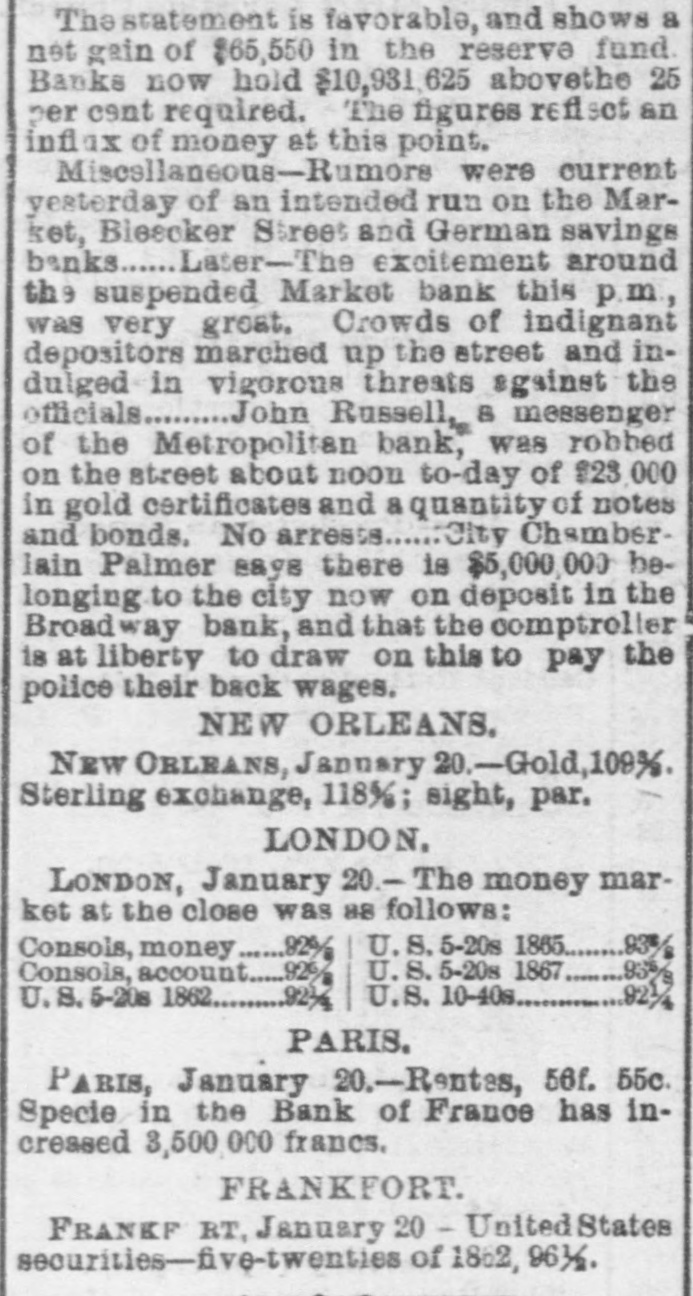
Later—The excitement around the suspended Market bank this p.m., was very great. Crowds of indignant depositors marched up the street and indulged in vigorous threats against the officials.
Source
newspapers
3. January 20, 1872 Suspension
Cause
Bank Specific Adverse Info
Cause Details
Bank suspended amid revelations of large liabilities, misappropriated call loans and officer misconduct (Conklin alleged defaulter).
Newspaper Excerpt
The Market Bank, of New York City, has been obliged to suspend.
Source
newspapers
4. January 31, 1872 Other
Newspaper Excerpt
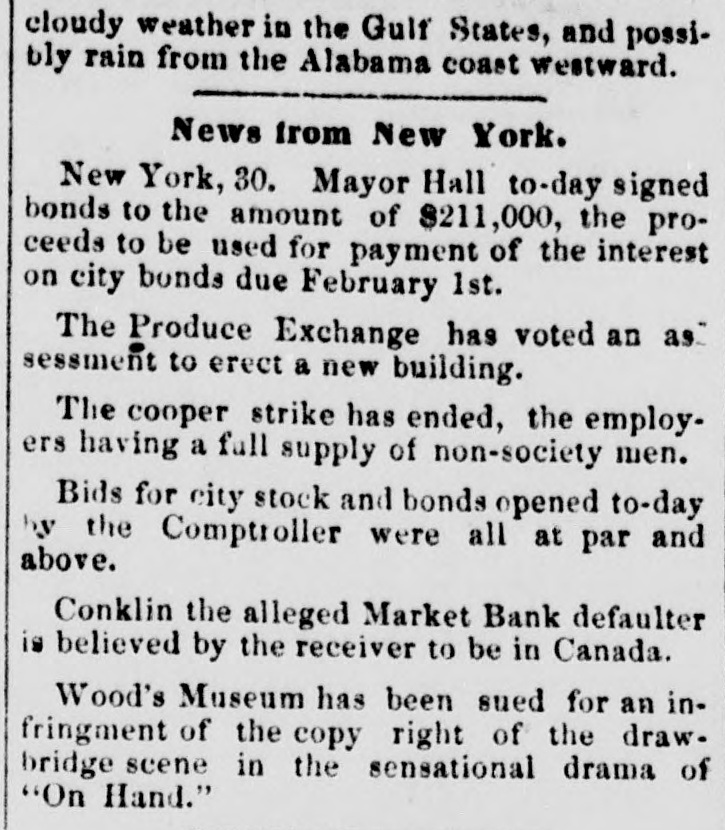
Conklin the alleged Market Bank defaulter is believed by the receiver to be in Canada.
Source
newspapers

Newspaper Articles (5)

Article from Memphis Daily Appeal, January 21, 1872

Click image to open full size in new tab

Article Text

The statement is favorable, and shows a net gain of $65,550 in the reserve fund. Banks now hold $10,931,625 abovethe 25 per cent required. The figures reflect an influx of money at this point. Miscellaneous—Rumors were current yesterday of an intended run on the Market, Bleecker Street and German savings banks...... Later—The excitement around the suspended Market bank this p.m., was very great. Crowds of indignant depositors marched up the street and indulged in vigorous threats against the officials........ John Russell, a messenger of the Metropolitan bank, was robbed on the street about noon to-day of $23,000 in gold certificates and a quantity of notes and bonds. No arrests...... City Chamberlain Palmer says there is $5,000,000 belonging to the city now on deposit in the Broadway bank, and that the comptroller is at liberty to draw on this to pay the police their back wages. NEW ORLEANS. NEW ORLEANS, January 20.—Gold, 109%. Sterling exchange, 118%; sight, par. LONDON. LONDON, January 20.— The money market at the close was as follows: Consols, money 92% | U. S. 5-20s 1865.......93% Consols, account..... 92% U. S. 5-20s 1867.......93% U. S. 5-20s 1862.......92% U. S. 10-40s 92% PARIS. PARIS, January 20.—Rentes, 56f. 55c. Specie in the Bank of France has increased 3,500,000 francs. FRANKFORT. FRANKF RT, January 20 - United States securities-five-twenties of 1862, 96%.


Article from The Fremont Weekly Journal, January 26, 1872

Click image to open full size in new tab

Article Text

The Market Bank, of New York City, has been obliged to suspend. Wm. B. Allison has been elected U. S. Senator from Iowa in place of Senator Harlan. Senator Morton is urging his bill fixing the adjournment of Congress for the second week in May next. The chess players of Cleveland had a meeting lately to arrange for a Northern Ohio Chess Tournament. A bank messenger was robbed of $23,000 in gold certificates besides notes and bonds, in New York, on Saturday last. The pews of Henry Ward Beecher's Church rent, this year, for $50,000, "And the poor have the gospel preached to them." Tweed, the Tammany thief, went west last week. How far he goes, or whether he returns, are questions difficult to answer. The Union Pipe Foundry of Dennis, Long & Co., of Louisville, was destroyed by fire on Sunday morning last. Loss $175,000. Insured for only $10,000. An insane man at Louisville, named Thome, shot four persons on Sunday last, two of whom will die. He then tried to kill himself but succeeded only in dangerously injuring himself. Rev. Osman A. Lyman, pastor of the Euclid Avenue Presbyterian Church, was struck with paralysis at noon on the 17th, and died at his residence on Friday evening the 19th. He was aged 46 years. Nearly one hundred chickens were used in making a pie for a fair at Bridgeport, Conn., a few days since. It was the biggest chicken pie ever built and baked in the Nutmeg State, and required four men to move it. Alexis has been enjoying a big hunt with the Indians under the general direction of Sheridan and Custar. He killed a buffalo cow, and a bull calf, on the 15th. The head of the cow was to be sent home to Russia as a trophy. At Massillon, on the night of the 20th, a row occurred, and stones were thrown by the rowdies. One of them struck an innocent looker on, named George Hofaker, and his death resulted. Two men were arrested for the murder. The next Ohio State Fair will be held from the 2d to the 6th of September, inclusive. The place for holding the same is not yet determined, and will depend, among other considerations upon the amount of subscription obtained from towns competing. A lady near St. Louis has become fascinated with Alexis, and is bound to become his Grand Duchess. She followed him from St. Louis to Omaha, bound to go on the big hunt with him, but she was left behind. At last report she was still after him. The ex-Empress Eugenia has disposed of her jewels. They were purchased by English jewelers for £80,000 or about $400,000. As there are no evidences of poverty existing at Chiselhurst, it is supposed the amount realized is designed for furthering intrigues at the Court of France. Representative Cox having introduced a resolution condemning the Secretary of the Treasury for the manner in which he placed the new five per cent loan on the market, the resolution was referred to the Ways and Means Committee, who reported a resolution exhonorating the Secretary from all charges. Two clerks in the Cleveland Post Office, were arrested on Wednesday, the 17th, on suspicion of being concerned in the opening of letters and appropriating the valuable contents. One of them was discharged, after hearing, and the other bound over till next term of court, in order to afford time for further examination. There was a grand race on the Hudson a few days ago. An ice-boat was matched against a railway train. The locomotive was powerful and and its load light, but though the wind was unsteady, the boat flew.


Article from Daily Kennebec Journal, January 31, 1872

Click image to open full size in new tab

Article Text

cloudy weather in the Gulf States, and possibly rain from the Alabama coast westward. News from New York. New York, 30. Mayor Hall to-day signed bonds to the amount of $211,000, the proceeds to be used for payment of the interest on city bonds due February 1st. The Produce Exchange has voted an as." sessment to erect a new building. The cooper strike has ended, the employers having a full supply of non-society men. Bids for city stock and bonds opened to-day by the Comptroller were all at par and above. Conklin the alleged Market Bank defaulter is believed by the receiver to be in Canada. Wood's Museum has been sued for an infringment of the copy right of the draw. bridge scene in the sensational drama of "On Hand."


Article from Daily Kennebec Journal, February 6, 1872

Click image to open full size in new tab

Article Text

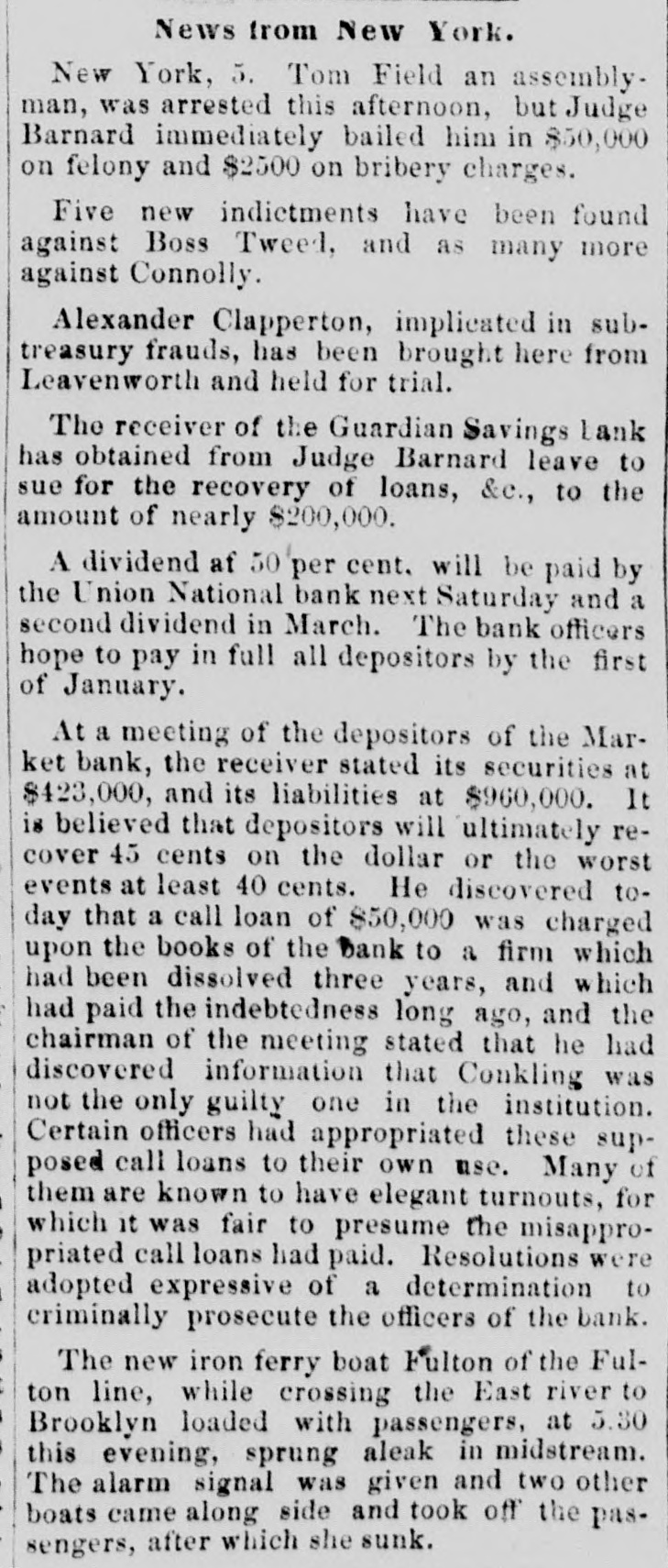
News from New York. New York, 5. Tom Field an assemblyman, was arrested this afternoon, but Judge Barnard immediately bailed him in $50,000 on felony and $2500 on bribery charges. Five new indictments have been found against Boss Tweed, and as many more against Connolly. Alexander Clapperton, implicated in subtreasury frauds, has been brought here from Leavenworth and held for trial. The receiver of the Guardian Savings lank has obtained from Judge Barnard leave to sue for the recovery of loans, &c., to the amount of nearly $200,000. A dividend af 50 per cent. will be paid by the Union National bank next Saturday and a second dividend in March. The bank officers hope to pay in full all depositors by the first of January. At a meeting of the depositors of the Market bank, the receiver stated its securities at $423,000, and its liabilities at $960,000. It is believed that depositors will ultimately recover 45 cents on the dollar or the worst events at least 40 cents. He discovered today that a call loan of $50,000 was charged upon the books of the Bank to a firm which had been dissolved three years, and which had paid the indebtedness long ago, and the chairman of the meeting stated that he had discovered information that Conkling was not the only guilty one in the institution. Certain officers had appropriated these supposed call loans to their own use. Many of them are known to have elegant turnouts, for which it was fair to presume the misappropriated call loans had paid. Resolutions were adopted expressive of a determination to criminally prosecute the officers of the bank. The new iron ferry boat Fulton of the Fulton line, while crossing the East river to Brooklyn loaded with passengers, at 5.30 this evening, sprung aleak in midstream. The alarm signal was given and two other boats came along side and took off the passengers, after which she sunk.


Article from The New York Herald, April 21, 1878

Click image to open full size in new tab

Article Text

amount of $0 building was so heavily mortgaged that the rent only defrayed the interest on the mortgage. Suits, how. ever, are pending against the president and trustees, and may yet result in yielding something. Clinton Baok collapsed July 5, 1877, with a roll of 1,300 depositors, calling for $88,000. Mr. Edward L. Paris was appointed receiver by Judge Landon July 17. 1877. The panie of 1873 caused such a shrinkage in the securities of this bank that It was reduced to 118 last legs, and was only kept alive by the personal sacrifices of 118 trustees, Who struggled on, making up the deficiency from year 10 year until they grew tired. From the sale of real estate owned by the bank and available assets the depositors may yet realize a dividend of thirty-five per cent, out toey must have patience. Clairmont Bank closed September, 1877, on 1,000 Repositors, representi $100,000. Judge Westbrook appointed General Henry V. Smalley receiver. but though the available assets are rated at sixty cents no dividend bus yet been declared, and the late recelver is enjoying himself in Canada. His successor as receiver is Mr. Clark Brooks, no is expected to do thing possible for the depositors GERMAN UPTOWN BANK. This institution closed on December 6, 1875, with a roll of 4,399 depositors, claiming $229,436. Mr. Herman Uni was appointed receiver by Judge Davis, and the depositors received eighty cents on the dollar, the last dividend being declared September 4, 1876, while another is expected about this time of teu per cent. The trouble with this bank was that its assistant Secretary, Schwartz, who is now in Sing Sing, stole liberally of its lunds, and a consi erable amount of its securities were in depreciat Southern bonds. The German Bank, of Morrisauia, failed March, 1877, having 2,200 depositors, 10 whom 11 owed $230,000. Mr. William J. Best was made receiver by Judge Landon, and he expects when all the available assets are realized and the trustees made to pay on account of illegal investments that the depositors will be reimbursed to the extent of seventy five cents on the dollar, but they have had nething yet. Mr. Best says that when he took possession of the bank last July its cash amounted to only $351 95 and it owed $54 000 to sundry secured creditors. including two of its own trustees The sum named had been borrowed at different times by the officers LO meet current disbursements, its payment being guaranteed by the pledge of 10wn bonds and bonds and mortgages. Mr. Best says he holds railroad bonds and other securities to the amount of $167,000, and this amount he shall endeavor to recover from those trustees who voted in favor of the purchase of the bonds and of making the loan on railroad securities, both acts being in direct violation of the charter of the bank and of the laws in relation to savings banks. If he only succeeds in this it will be a well taught lesson to all trustees in future. GUARDIAN BANK. This bank had 1,000 depositors, to whom it owed $560,000 on the day it closed, November 17, 1871# Among its directors were well known members of the Ring. Its first receiver was Mr. Jeremiah Quinlan, appointed by Judge Barnard November 17, 1871. Mr. Mr. Walter S. Roche, one of the directors, who held himself responsible for the failure of the bank. turned over to Quinlan his entire property, to make good the losses. This property realized enough to pay the depositors in full and leave a surplus of about $150,000; but Roche WMS cheated of his last dollar. Quintan resigned and Peter J. O'Donohue was ap. pointed his successor by Judge Donohue; but no Was removed by Judge Lawrence and Mr. John T. McGowan, a lawyer of good repute, WILL substituted in his place. Suits against Quiolan for the recovery of the moneys were promptly started by Mr. McGowan, but nothing has come of them yet. The depositors, however, ought to be thankful to get so much as ninety live cents OD the dollar, though it Was secured by the beggary of Roche. MECHANICS AND TRADERS' BANK. This closed June 10, 1876, having 3, 300 depositors, to whom it owed $1,454,000. On July 13 Mr. William J. Best was appointed receiver by Judge Osborne. The depositors were paid seventy one cents on the dollar, the last dividend having been declared December, 1877, and one more of ten or filteen per cent 18 expected to be declared within a few months. Snrinkage of values, along with culpable mismanagement, brought about the tate of the Mechanics and Traders'. MUTUAL BENEFIT BANK. This yielded up the ghost November 27. 1875, after being seven years in existence. It bad 4,000 depositors, to whom It owed $450,000. Judge Donohue appointed William F. Addried receiver. The depositors were paid fifty cents on the dollar up to May, 1876. Another dividend of ten per cent, and though a (orther one of ten 18 hoped for there 18 not much faith in its being realized. Fall in real estate and stupid management brought this concern to its inglorious end. MARKET BANK. This institution went under in January, 1872. through the rasculities of ring composed of its officers and one or two outsiders. The number of its depositors was 1,900, to whom $1,000,000 were due. Mr. James Dennis was appointed receiver January 20, 1872, by Judge Barnard, but the appointment, owing to the character of the Judge, excited the suspicion of the depositors, which culminated 12A such action being taken as resulted in the rejection 01 Dennis and the throwing of the bank into bankruptcy. Mr. Francis W. Worth, who died the following year, was elected assignee by the creditors, and about the same time the secretary of the bank, Conklin, departed for Canada with as much of the funds as he could conveniently lay hold OI. On Worth's death, in September, 1873, John S. Platt was appointed his successor by Judge Blatchford, but he succeeded to little more than a legacy of barassing litigation about real estate and squabbles with lawyers about fees. The bank paid thirty-eight cents on the dollar up to March 12. 1873, and another dividend is hoped for some day in the future. NEW AMSTERDAM BANK. This concern expired September 27, 1876, with a roll of 2,100 depositors, representing $510,000. It had been in existence eight years and was lodged in a large and most expensive building, that proved a fatal drag upon its resources. Mr. Richard M. Bent was appointed receiver December, 1876, by Judge Landon, and up to October 1877, bad paid the depositors sixty-five cents our the dollar. with a promised forthcoming dividend of twelve per cent. NATIONAL BANK This was a savings institution of no great consequence, and was more or less identified with the Ring, along with which It collapsed. "Hank" Smith was president. The trustees made up the deficiency and the depositors, to whom $190,000 were due, were paid in falls The receiver was appointed by Judge Barnard, but as be neid the office only ball a day, was offered $6,000 for his services, which he indignantly declined and felt ashamed o: the whole business, his name never transpired. PROPLE'S BANK. This was rather a weak institution and collapsed immediately when the hard times set in November 26, 1875. It had 1,296 depositors, to whom it owed $195,000. Isaac V. French Was appointed receiver by Judge Landon and succeeded in paying 33 1-3 cents on the dollar to the depositors up to April 4, 1876. Within the past SIX months 10 per cent additional has been paid, making 10 all 431-3 cents on the dollar, an amount which the depositors when the crash OCcurred hardly ever expected to get. SECURITY BANK. This bank failed November 26, 1875, after an existonce of seven years, which appears to be about the average longevity of a New York savings bank. It had 2,600 depositors, entitled to the gross sum of $390,000. Mr. William M. Banks was appointed receiver January 28, 1876, by Judge Landon, and up to May 1877, paid the depositors ty-seven and a half cents on the dollar. A delalcation on the part of the secretary, John L. Sen, who was subsequently sent to the Pemtentiary, and also the tall 10 the value of real estate, were the causes of the collepse. Mr. Banks expects within two months more to pay an additional live per cent THIRD AVENUE BANK. This bank closed with a deep. resounding crash September 30, 1875, and produced more w despread distress than hall the other banks put together. It bad the immense roll of 8,000 depositors, to whom was due $1,400,000. Mr. William S. Carman was first appointed receiver by Judge Osborne October, 1875, but was subsequently removed and Mr. Samuel H. Hurd, the present receiver, appointed in bis place by Judge Westbrook. Everybody has heard the history of this bank and its disgraceful and. corrupt management A loop in the law permited the escape of the president and trustees. Fifteen cents on the dollar, what they have got already is nearly all the depositors are ever likely LO see. The management of this concern was illustrated in the matter of the trustees bond suit, ID which " was shown that when the bank ran behind 80 that it could not pay a dividend the trusiees held a meeting and drew up a bond by which they became individually liable to the amount of