16134. Manufacturers Trust Company (New York, NY)

Bank Information

Episode Type
Run Only
Bank Type
trust company
Start Date
December 11, 1930
Location
New York, New York (40.714, -74.006)

Metadata

Model
gpt-5-mini
Short Digest
e7c49ec1

Response Measures

Accommodated withdrawals, Public signal of financial health, Books examined

Other: Bank admitted to the Clearing House Association on Dec 11; coordinated with Federal Reserve and other banks.

Description

Multiple articles describe a run on Manufacturers Trust branches on Dec 11, 1930 triggered by a misunderstood stock warning and fallout from the failed merger/Bank of United States collapse. The bank did not suspend payments; it was admitted to the Clearing House same day and later continued operations and mergers.

Events (1)

1. December 11, 1930 Run
Cause
Rumor Or Misinformation
Cause Details
A neighborhood merchant's desire to sell stock was misinterpreted as advice to withdraw deposits; rumors spread after the failed proposed merger and Bank of United States collapse.
Random Run
Yes
Random Run Snippet
Small merchant's stock warning misunderstood as withdraw money; police traced report
Measures
Armored trucks delivered $3,000,000 in cash to branches; police and mounted units cleared crowds; bank worked with Federal Reserve and Clearing House to reassure depositors.
Newspaper Excerpt
With nothing more substantial than this, police say, the small merchant advised his patrons and friends to get rid of their stock, but they interpreted this to mean to draw their money... As soon as the lines began to appear at the branch bank... $3,000,000 was rushed out to the office in armored trucks.
Source
newspapers

Newspaper Articles (6)

Article from Daily News, December 11, 1930

Click image to open full size in new tab

Article Text

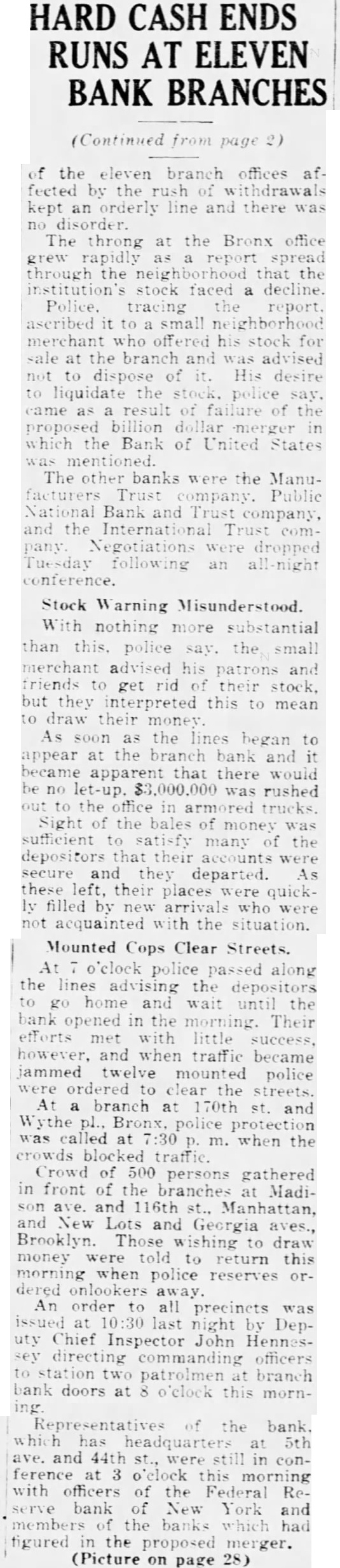
HARD CASH ENDS RUNS AT ELEVEN BANK BRANCHES (Continued from page 2) of the eleven branch offices affected by the rush of withdrawals kept an orderly line and there was no disorder. The throng at the Bronx office grew rapidly as a report spread through the neighborhood that the institution's stock faced a decline. Police. tracing the report. ascribed it to a small neighborhood merchant who offered his stock for sale at the branch and was advised not to dispose of it. His desire to liquidate the stock, police say, came as a result of failure of the proposed billion dollar merger in which the Bank of United States was mentioned. The other banks were the Manufacturers Trust company. Public National Bank and Trust company, and the International Trust company. Negotiations were dropped Tuesday following an all-night conference. Stock Warning Misunderstood. With nothing more substantial than this, police say. the small merchant advised his patrons and friends to get rid of their stock, but they interpreted this to mean to draw their money As soon as the lines began to appear at the branch bank and it became apparent that there would be no let-up, $3,000,000 was rushed out to the office in armored trucks. Sight of the bales of money was sufficient to satisfy many of the depositors that their accounts were secure and they departed. As these left, their places were quickly filled by new arrivals who were not acquainted with the situation. Mounted Cops Clear Streets. At 7 o'clock police passed along the lines advising the depositors to go home and wait until the bank opened in the morning. Their efforts met with little success, however, and when traffic became jammed twelve mounted police were ordered to clear the streets. At a branch at 170th st. and Wythe pl., Bronx, police protection was called at 7:30 p. m. when the crowds blocked traffic. Crowd of 500 persons gathered in front of the branches at Madison ave. and 116th st., Manhattan, and New Lots and Georgia aves., Brooklyn. Those wishing to draw money were told to return this morning when police reserves ordered onlookers away. An order to all precinets was issued at 10:30 last night by Deputy Chief Inspector John Hennessey directing commanding officers to station two patrolmen at branch bank doors at 8 o'clock this morning. Representatives of the bank. which has headquarters at 5th ave. and 44th st., were still in conference at 3 o'clock this morning with officers of the Federal Reserve bank of New York and members of the banks which had figured in the proposed merger. (Picture on page 28)


Article from The Brooklyn Daily Times, January 5, 1931

Click image to open full size in new tab

Article Text

TRUST CO. ELECTS GIBSON New York Trust Co. Chairman Leads Group Acquiring Controlling Interest. Harvey D. Gibson. chairman the New York Trust Co. executive today elected president of Manufacturers' Trust Co. Controlling interest in the bank, organized than years ago Brooklyn neighborhood bank by Nathan 8. and Ralph Jonas, had been acquired by group headed by Mr. Gibson. Later in week. other mem. pers of the syndicate headed by Mr. Gibson be elected direcand there are some changes in the directing person. nel. The Jonas brothers, the management the institution since its organization in and responsible large for its growth from neighborhood bank into an institution with 45 branches, will the manageas will Henry C. Von has been president. Ralph Jonas will remain rector and Nathan Jonas as chairman of the board. joint issued by Na. than Jonas and Mr. Gibson discloses there no of merging the Manufacturers Trust with any other banking institution in the city, but plans are under way expand into an ever greater banking house separate organization. The bank has resources of Gibson to Quit Other Bank As an indication that there is between the Manufacturers Trust and the New York Trust, Gibson is resigning his position in the latter institution. The syndicate he heads bought the stock interests the Manufacturers Trust, which was held by the Goldman Sachs Trading Corp.: and. other thus becomes the largest stockholder group in the bank. number of shares ac. quired by syndicate and the amount has not been dis. closed. It estimated, about 30 per of the stock 000 shares. On the basis of Saturday's closing bid price, this amount of stock would have value of $11.number of shares bought and the price paid, Mr. Gib. son would be anlater in the week. "My Mr. Gibson said, "will by all odds the largest stockholders the bank. The chase was made an investment for the future, with the hope of developing the bank still greatinstitution. Despite the fact that the New York Trust is of the Morgan interests. both Gibson Nathan Jonas emphasizes that the acquisition of working control of the bank by the syndicate did not mean the exit of himself or his brother. There was suggestion the Rockefeller might be associated the transaction by the presence of Ivy Lee, press representative of the Rockefellers, newspaper men when the anmade. was announced later that there was no foundation for the suggestion. Praise for Nathan Jonas In making public the acquisition of stock. Mr. Gibson paid high tribute to Nathan Jonas, who present the conference. and also to soundness of the institution weathering what looked for time as the start of run about the time the Bank of United States collapsed. Withdrawals at that time were heavy. On Dec. 11. however. the day the Bank of United States was taken over, the Manufacturers Trust was admitted to the Clearing House Association. The run the Bank of United States started after plans fell through for merging with the Manufacturers Trust two other institutions The state of conditions of the Manufacturers Trust, as of Jan. follows: Resources hand Federal other liability 14,006,937.11 banks Total Liabilities Capital undivided profits acceptances other Reserve Total Enlargement Planned in his formal stateMr. Gibson. ment, disclosed that contemplated adding to the size of the institution His statement read: have agreed to become president the Trust Co. Mr. Jonas and his associates have built bank with an of New York clientele every part Its unit offices, serving an City. number of clients unusually large various services make through its uniquely popular bank and constitute nucleus for further developvery large scale. is and my believe so firmly in the tunities for the


Article from The Brooklyn Daily Times, January 5, 1931

Click image to open full size in new tab

Article Text

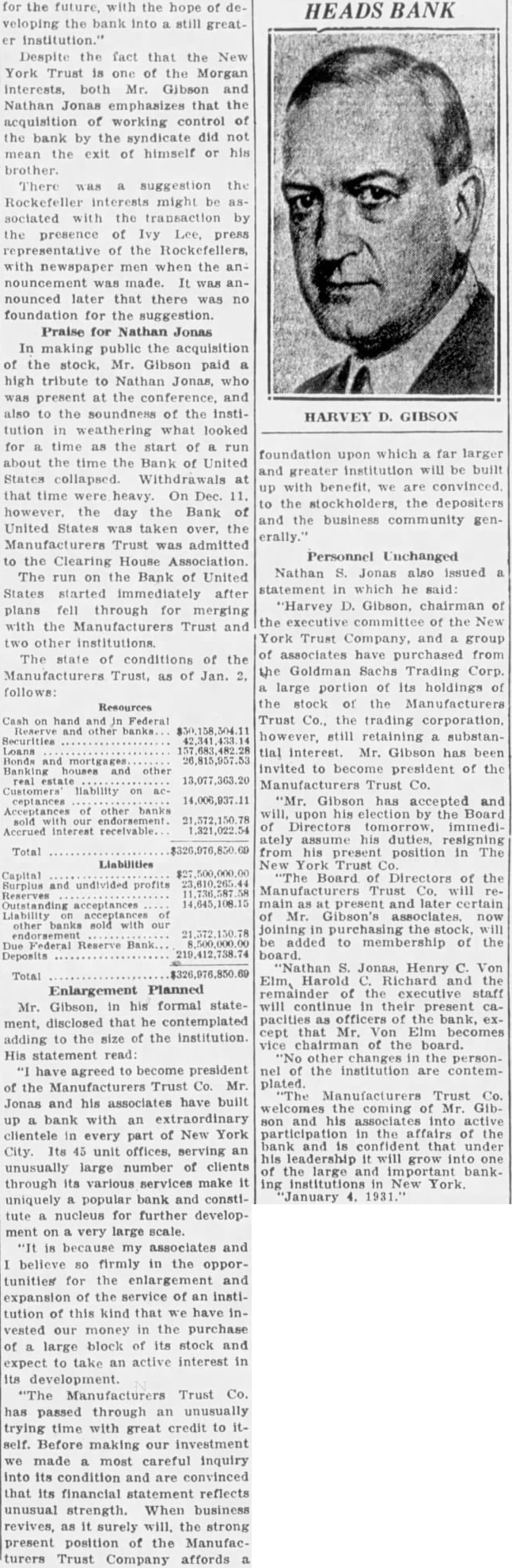
for the future, with the hope of developing the bank into still greater institution." Despite the fact that the New York Trust is one of the Morgan interests, both Mr. Gibson and Nathan Jonas emphasizes that the acquisition of working control of the bank by the syndicate did not mean the exit of himself or his brother. There was suggestion the Rockefeller interests might be associated with the transaction by the presence of Ivy Lee, press representative of the Rockefellers, with newspaper men when the announcement made. It was announced later that there was no foundation for the suggestion. Praise for Nathan Jonas In making public the acquisition of the stock, Mr. Gibson paid a high tribute to Nathan Jonas, who was present at the conference, and also to the soundness of the institution in weathering what looked for a time as the start of a run about the time the Bank of United States collapsed. Withdrawals at that time were heavy. On Dec. 11. however, the day the Bank of United States was taken over, the Manufacturers Trust was admitted to the Clearing House Association. The run on the Bank of United States started immediately after plans fell through for merging with the Manufacturers Trust and two other institutions. The state of conditions of the Manufacturers Trust, as of Jan. 2, follows: Resources Cash on hand Federal and other Securities Loans and mortgages 26,815,957.53 Banking houses and other real 13,077,363.20 Customers liability on acceptances 14,006,937.11 of other banks sold our endorsement. Accrued interest receivable. 1,321,022.54 Total $326,976,850.69 Liabilities Capital $27,500,000.00 Surplus and undivided profits Reserves Outstanding acceptances 14,645,108.15 Liability of other banks sold with endorsement Due Federal Reserve Bank.. Deposits Total $326,976,850.69 Enlargement Planned Mr. Gibson, in his formal statement, disclosed that he contemplated adding to the size of the institution His statement read: "I have agreed to become president of the Manufacturers Trust Co. Mr. Jonas and his associates have built up a bank with an extraordinary clientele in every part of New York City. Its 45 unit offices, serving an unusually large number of clients through its various services make it uniquely a popular bank and constitute a nucleus for further development on very large scale. "It is because my associates and I believe so firmly in the opportunities for the enlargement and expansion of the service of an institution of this kind that we have invested our money in the purchase of a large block of its stock and expect to take an active interest in its development. "The Manufacturers Trust Co. has passed through an unusually trying time with great credit to itself. Before making our investment we made a most careful inquiry into its condition and are convinced that its financial statement reflects unusual strength. When business revives, as it surely will. the strong present position of the Manufacturers Trust Company affords a HEADS BANK foundation upon which a far larger and greater institution will be built up with benefit, we are convinced. to the stockholders, the depositers and the business community generally." Personnel Unchanged Nathan S. Jonas also issued a statement in which he said: "Harvey D. Gibson, chairman of the executive committee of the New York Trust Company, and a group of associates have purchased from the Goldman Sachs Trading Corp. a large portion of its holdings of the stock of the Manufacturers Trust Co., the trading corporation. however, still retaining a substantial interest. Mr. Gibson has been invited to become president of the Manufacturers Trust Co. "Mr. Gibson has accepted and will, upon his election by the Board of Directors tomorrow, immediately assume his duties, resigning from his present position in The New York Trust Co. "The Board of Directors of the Manufacturers Trust Co. will remain as at present and later certain of Mr. Gibson's now joining purchasing the stock, will be added to membership of the board. "Nathan S. Jonas, Henry C. Von Elm, Harold C. Richard and the remainder of the executive staff will continue in their present capacities as the bank, except that Mr. Von Elm becomes vice chairman of the board. "No other changes in the person. nel of the institution are contemplated. "The Manufacturers Trust Co. welcomes the coming Mr. Gibson and his associates into active participation in the affairs of the bank and is confident that under his leadership It will grow into one of the large and important banking institutions in New York January 4.


Article from Brooklyn Eagle, January 5, 1931

Click image to open full size in new tab

Article Text

Morgan Aides Hinted in Deal M'frs Trust H. D. Gibson Heads Group Wresting Control From the Jonases Continued From Page 1 of commanding influence throughout Greater New York. The brothers established branches throughout the with an imposing bank lower Manhattan. They openly challenged most successful and daring bankers of the big city. Nothing seemed to stop the Jonas brothers they expanded their field of operations. Bank after bank was gathered into their fold and branch after branch was established. The capital ran to the present figure of from $500,000. Since the formation the original company, in 1905, the bank has participated 15 mergers. The brothers became the subject of conversation gossip in Wall Street circles and there was much speculation as to how far they would go. Many Followed Pair Subsidiaries formed and for a period they experienced brilliant careers. Followers of the brothers in many cases made small fortunes. Stocks were bought left and right throughout Brooklyn by those who had been attracted by the spectacular the Jonas brothers. Stocks, like the Financial & Industrial Corporation, starting at 28 and to 156, created stories heavy killings by the fortunate insiders. market crash the fall of 1929 naturally affected the fortunes. The Manufacturers in the past year mentioned in connection with several great all of which failed of fruition. The news today that the House of Morgan would assume control Manufacturers new touch to the bank's unusually spectacular history. Jonases Set Back The first serious difficulty encountered by the Jonas brothers in acquiring Manhattan banks came back in 1924, in connection with control of the Bank America. It suddenly appeared that the Jonas group had obtained large amount Bank America stock, and a battle for control ensued. It was said the time that the Morgan interests were giving close attention rising financial giants the Eastern District. The fight for control resulted in litigation that lasted several years, and even special legislation bearing on the struggle. The Jonas brothers scored a victory over the group control. Eventually. in February, 1928, they sold control of the Bank of to Giannini, head of the Bancitaly Corporation. The Jonas group reputed profit of $7,000,000 to $10,000,000 the transaction. The struggle for control. however, had feeling in high and influential banking zircles. Merger is Denied Acquisition of controlling interest in the Manufacturers Trust Company is preliminary step toward absorption of the bank by larger institution, the formal announcement emphasized. Instead of merger with larger bank the plans of new interests are to use Manufacturers Trust "a foundation which far larger and greater institution will be built up," the announcement said. Nevertheless, the belie persisted today in Wall Street circles that ultimately merger involving Manufacturers will be accomplished. Manufacturers Trust Company has 45 branches throughout city and resources $327,000,000. Sixteen the branches are in Brooklyn. Announcement of the deal was made jointly by Mr. Gibson and Nathan Jonas. While Mr. Gibson would not say what portion of the Goldman Sachs Trading Corporation's interest in the bank he and his group have acquired, he stated the corporation would retain part of its holdings. The corporation originally held 32 percent interest. "My group will be, by all odds, the largest in the bank," Mr. Gibson said. He added that the group's was made as "an investment for the future,' with the hope developing the bank "into a still greater institution." Jonas Brothers Stay The Jonas brothers will continue active in the management, Nathan S. Jonas as of the board and Ralph Jonas as Harold Richard will remain as chairman of the committee and HenC. Von Elm. who been president since 1929, will become vice chairman of the board. No other changes in the are at present it was said. Price Not Revealed While the number of shares the Gibson group has acquired and their price were not formally disclosed, it was reported in financial circles that the group had bought about 30 percent of the 1,100,000 Manufacturers Trust shares outstanding, or approximately 330,000 shares. On the basis of Saturday's closing bid price of 34½, this amount of stock had market value of $11,385,000. Made public with the announcement of the deal was statement of the bank's condition as of In are reflected the withdrawals to which the Trust was subjected few weeks ago directly after the closing of the Bank of United States. Before this closing transaction had been under way looking toward merger of Manufacturers Trust. Public National Bank and Trust Company, International Trust and Bank of United States. The deal was dropped and began on the Bank of United States immediately thereafter, which extended


Article from Brooklyn Eagle, January 5, 1931

Click image to open full size in new tab

Article Text

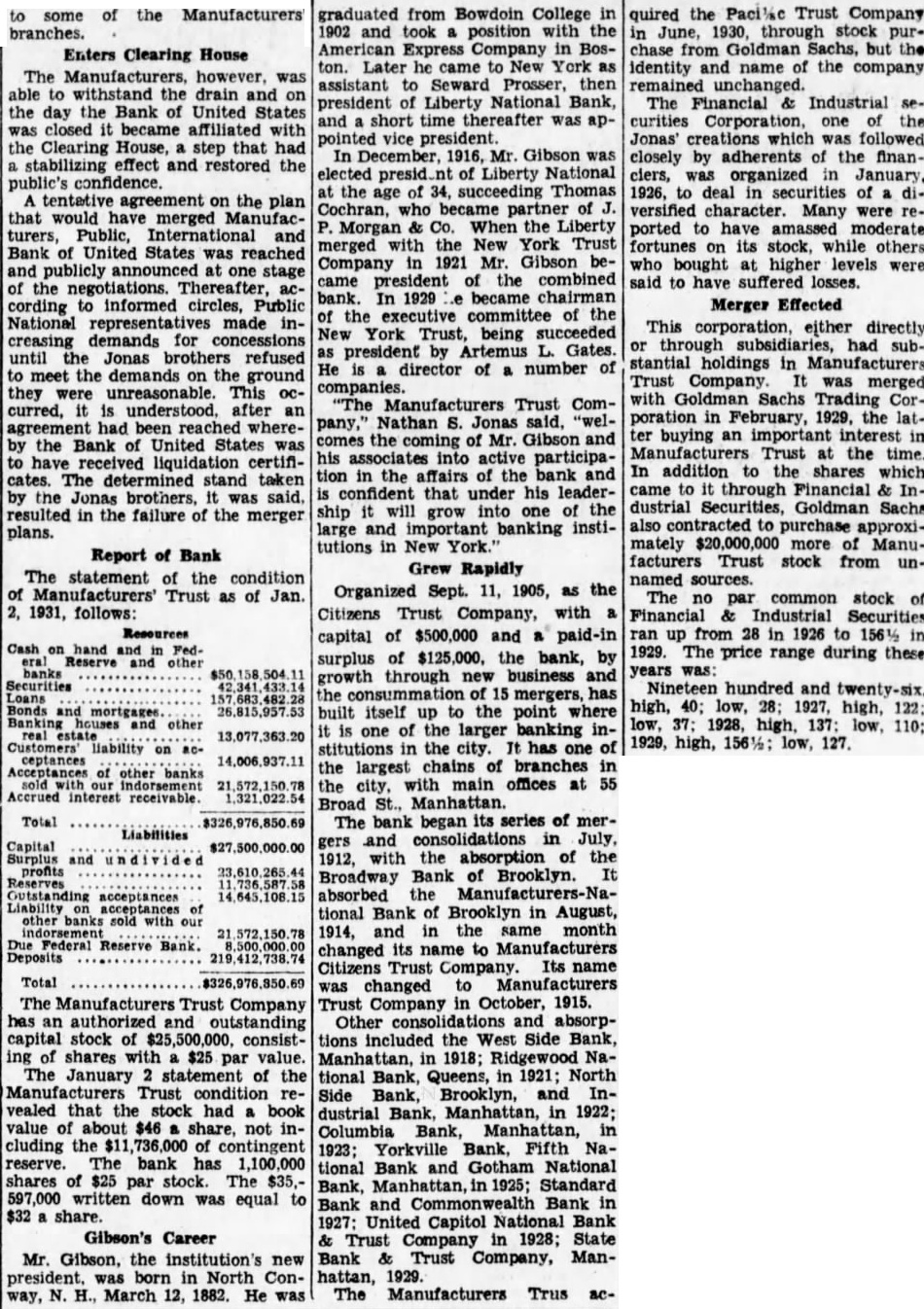
to some of the branches. Enters Clearing House The Manufacturers, was able to withstand the drain and on the day the Bank of United States was closed it became affiliated with the Clearing House, step that had stabilizing effect and restored the public's tentative agreement the plan that would have merged turers, Public, International and Bank of United States was reached and publicly one stage of the negotiations. Thereafter, according informed circles, Public National representatives made increasing demands concessions until Jonas brothers refused to meet the demands on the ground they unreasonable. This occurred, it is understood. after an agreement had been reached whereby the Bank United States was to have received liquidation certificates. The determined stand taken by the Jonas brothers, it said, resulted in the failure of the merger plans. Report of Bank The statement of the condition of Manufacturers' Trust as of Jan. 2, 1931, follows: on hand Reserve Securities and mortgages. and other estate 13,077,363.20 Customers' liability on ceptances of other banks our indorsement Accrued interest receivable 1,321,022.54 Total $326,976,850.69 Liabilities Capital $27,500,000.00 Surplus and Outstanding acceptances Liability indorsement banks sold with Due Federal Reserve Bank. Total The Manufacturers Trust Company has an authorized outstanding capital stock of $25,500,000. consisting of shares with $25 par value. The January statement of the Manufacturers Trust condition revealed that the stock had book value of about $46 share, not including the $11,736,000 of contingent reserve. bank has 1,100,000 shares of $25 par stock. The $35,597,000 written down was equal to $32 share. Gibson's Career Mr. Gibson, the institution's new president, born in North Conway, N. H., March 12, 1882. He was graduated from Bowdoin College in 1902 and took position with the American Express Company in Boston. Later came to New York as assistant to Seward Prosser, then president of Liberty National Bank, and short time thereafter was appointed vice president. In December, 1916, Mr. Gibson was elected presid. of Liberty National at the of 34, succeeding Thomas Cochran, who became partner of J. P. Morgan Co. When the Liberty merged with the New York Trust Company in Mr. Gibson became president the combined bank. In 1929 became chairman of the executive committee of the New York Trust, being succeeded as president Artemus Gates He is director of a number of companies. "The Manufacturers Trust Company," Nathan S. Jonas said, "welcomes the coming of Mr. Gibson and his into active participation in the affairs of the bank and is that under his leadership will grow into one of the large and important banking institutions New York.' Grew Rapidly Organized Sept. 11, 1905, as the Citizens Trust Company, with capital of $500,000 and paid-in surplus of $125,000, the bank, by growth through business and the consummation of mergers, built itself up to the point where of the larger banking institutions the city. has one the largest chains of branches in the city, main offices at Broad St., Manhattan. The bank began its series of merand consolidations in July, with the absorption of the Broadway Bank Brooklyn. absorbed the Manufacturers-National Bank of Brooklyn in August, 1914, the same month changed its name Manufacturers Citizens Trust Company. Its name changed to Manufacturers Trust Company in October, 1915. Other consolidations absorpincluded the West Side Bank, Manhattan, 1918; Ridgewood National Bank, Queens, in 1921; North Bank, Brooklyn, and dustrial Bank, Manhattan, in 1922; Columbia Bank, Manhattan, 1923; Yorkville Bank, Fifth National Bank and Gotham National Bank, Manhattan, in 1925; Standard Bank and Commonwealth Bank in 1927: United Capitol National Bank Trust Company in 1928; State Bank & Trust Company, Manhattan, 1929. The Manufacturers Trus ac- quired the Paci Trust Company in June, 1930, through stock purchase from Goldman Sachs, but the identity and name of the company remained unchanged. The Financial & Industrial securities Corporation, one the Jonas' creations which was followed closely by adherents of the financiers, was organized January, 1926, to deal in securities of diversified character. Many were reported to have amassed moderate fortunes its stock, while others who bought higher levels were said to have suffered losses. Merger Effected This corporation, either directly or subsidiaries, had substantial holdings in Trust Company. was merged with Goldman Sachs Trading Corporation in February, 1929, the latter buying an important interest in Trust at the time. In addition to the shares which came to through Financial Industrial Securities, Goldman Sachs also contracted to purchase approximately $20,000,000 more of Manufacturers Trust stock from unnamed The no par common stock of Financial Industrial Securities ran up from 28 in 1926 to 156 1/2 in 1929. The price range during these years was: Nineteen hundred and twenty-six. high, 40; low, 28; 1927, high, 122: low, 37; 1928, high, 137: low, 110; 1929, high, 1561/2; low, 127.


Article from Brooklyn Eagle, March 13, 1932

Click image to open full size in new tab

Article Text

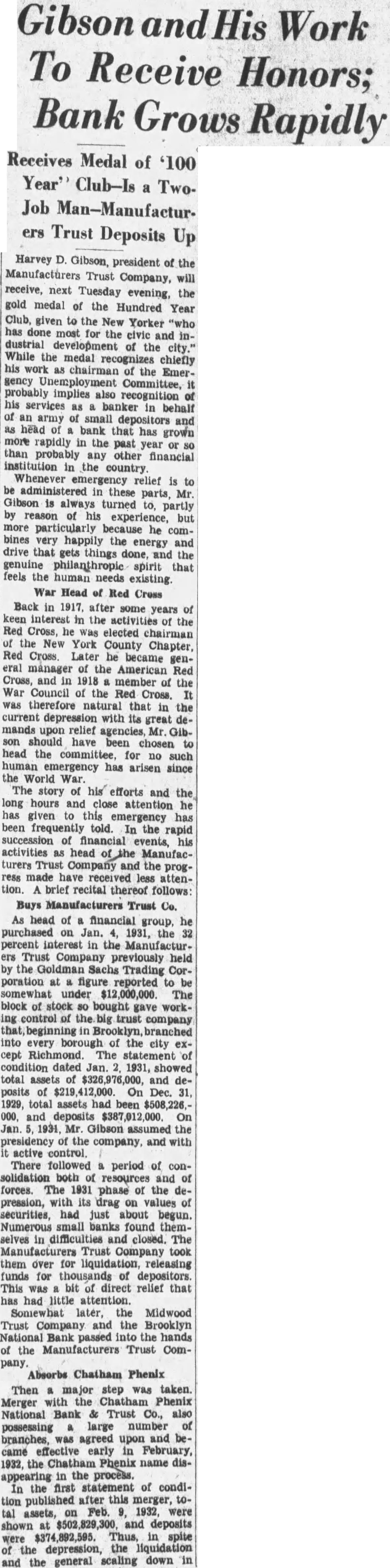
Gibson Work To Receive Honors; Bank Grows Rapidly Receives Medal of '100 Year' Club-Is TwoJob Man-Manufacturers Trust Deposits Up Harvey D. Gibson, president of the Manufacturers Trust Company, will next Tuesday evening, the gold medal of the Hundred Year Club, given the New Yorker "who has most civic and industrial the While the medal recognizes chiefly his chairman the Emergency Committee, probably implies services banker behalf of an army small depositors and head bank that has more rapidly the past than probably any other financial institution the country Whenever relief administered these parts, Mr Gibson always turned to, partly by reason of his experience, but more particularly because he combines very happily energy and drive that things done, and the genuine philanthropic spirit that the human needs existing War Head of Red Cross Back in 1917, years in the activities of the Red Cross, elected the New York County Chapter, Red Cross. Later became eral manager American Red Cross, and member of the War Council the Red Cross. was that in the current with its mands upon relief agencies, son should have head the committee, for no human emergency has arisen since the World The story of his efforts and the long hours he has given this been frequently told. In the rapid succession his activities head Manufacturers Trust Company and the progreceived attention brief recital thereof follows: Buys Manufacturers Trust Co. As head of financial he group, purchased 1931, the percent interest in the Manufacturers Trust Company previously by the Sachs Trading Corporation at figure reported be $12,000,000 block of bought gave workcontrol the trust company into every borough of the city cept statement dated Jan. 1931, showed total and of On 1929, total assets 000, and $387,012,000. On presidency the and with active control. There followed period of consolidation resources and forces. The 1931 of the pression, with drag on values securities, about begun. Numerous small banks found selves difficulties and closed. The Trust took them over for releasing for of This was bit of direct relief that has had little attention. later, the Midwood Trust Company the Brooklyn National into the the Manufacturers Trust Company. Absorbs Chatham Phenix Then step was taken Merger with Chatham Phenix National Bank Trust Co., also possessing large number branches, was agreed upon came effective early in February, 1932, the Chatham Phenix name appearing process. In the statement of condition published after this merger, tal assets, Feb. 1932, were shown and deposits $374,892,595. Thus, in were the depression, the liquidation scaling down and the general