16121. Manhattan Savings Institution (New York, NY)

Bank Information

Episode Type
Run Only
Bank Type
savings bank
Start Date
August 1, 1893
Location
New York, New York (40.714, -74.006)

Metadata

Model
gpt-5-mini
Short Digest
0fe4c96e

Response Measures

Accommodated withdrawals

Description

Multiple New-York Tribune articles (Aug 1–3, 1893) describe a run on several NYC savings banks including the Manhattan Savings Institution. The Manhattan paid depositors in full and remained open; no suspension or receivership is reported. The withdrawals are described in the context of broader financial difficulties (panic of 1893), so cause is coded as macro_news.

Events (1)

1. August 1, 1893 Run
Cause
Macro News
Cause Details
Part of a broader August 1893 run on New York savings banks amid general financial distress; withdrawals across many institutions rather than bank-specific scandal.
Measures
Paid depositors in full on demand; no invocation of the time clause at the Manhattan Savings Institution (while other banks later enforced 30/60 day rules).
Newspaper Excerpt
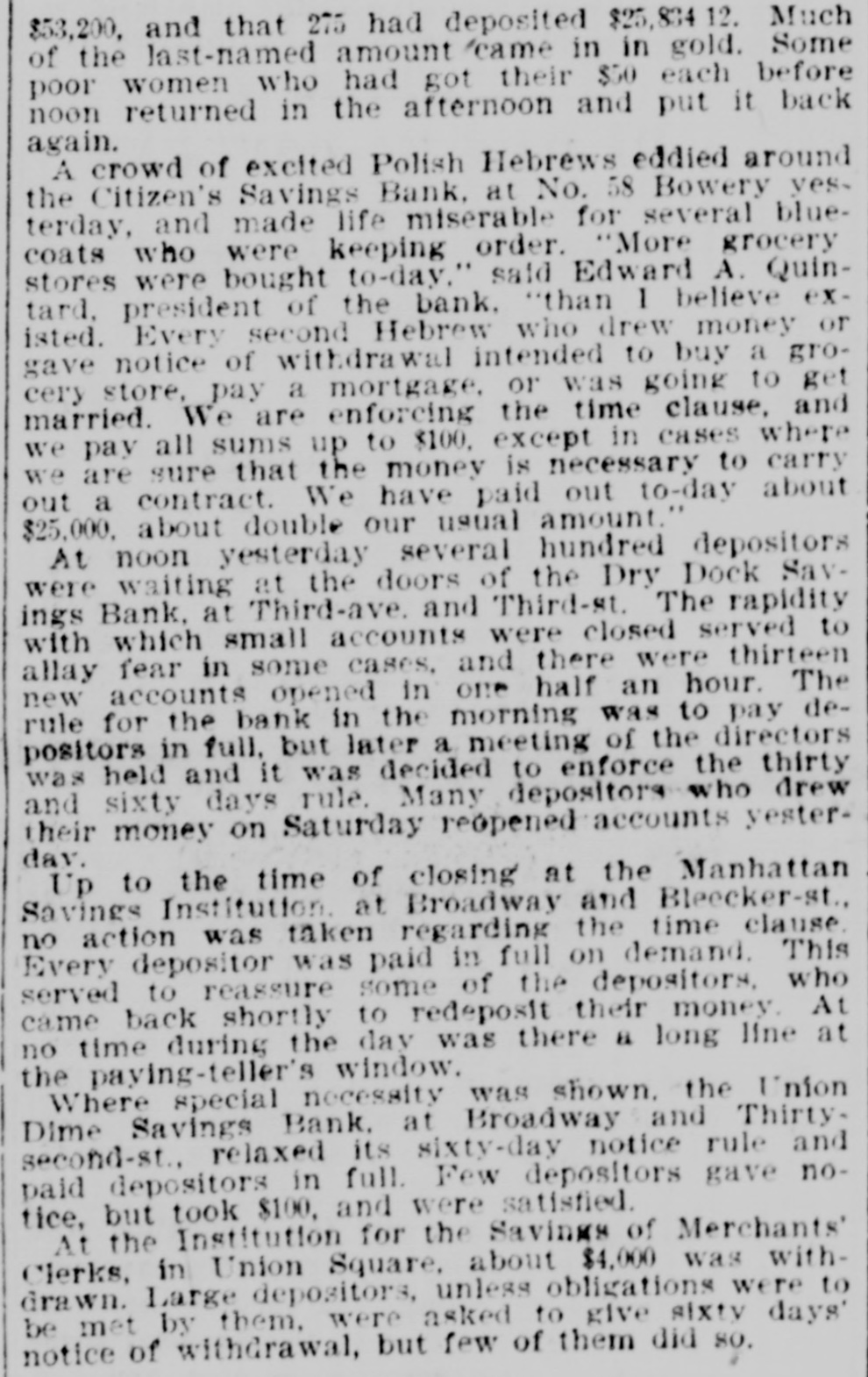
Up to the time of closing at the Manhattan Savings Institution, at Broadway and Bleecker-st., no action was taken regarding the time clause. Every depositor was paid in full on demand.
Source
newspapers

Newspaper Articles (3)

Article from New-York Tribune, August 1, 1893

Click image to open full size in new tab

Article Text

$53,200, and that 275 had deposited $25,834.12. Much of the last-named amount came in in gold. Some poor women who had got their $50 each before noon returned in the afternoon and put it back again. A crowd of excited Polish Hebrews eddied around the Citizen's Savings Bank, at No. 58 Bowery yesterday, and made life miserable for several bluecoats who were keeping order. "More grocery stores were bought to-day," said Edward A. Quintard, president of the bank. "than 1 believe existed. Every second Hebrew who drew money or gave notice of withdrawal intended to buy a grocery store, pay a mortgage, or was going to get married. We are enforcing the time clause, and we pay all sums up to $100, except in cases where we are sure that the money is necessary to carry out a contract. We have paid out to-day about $25,000. about double our usual amount." At noon yesterday several hundred depositors were waiting at the doors of the Dry Dock Savings Bank, at Third-ave. and Third-st. The rapidity with which small accounts were closed served to allay fear in some cases, and there were thirteen new accounts opened in one half an hour. The rule for the bank in the morning was to pay depositors in full, but later a meeting of the directors was held and it was decided to enforce the thirty and sixty days rule. Many depositors who drew their money on Saturday reopened accounts yesterday. Up to the time of closing at the Manhattan Savings Institution. at Broadway and Bleecker-st., no action was taken regarding the time clause. Every depositor was paid in full on demand. This served to reassure some of the depositors, who came back shortly to redeposit their money. At no time during the day was there a long line at the paying-teller's window. Where special necessity was shown. the Union Dime Savings Bank. at Broadway and Thirtysecond-st., relaxed its sixty-day notice rule and paid depositors in full. Few depositors gave notice, but took $100, and were satisfied. At the Institution for the Savings of Merchants' Clerks, in Union Square, about $4,000 was withdrawn. Large depositors, unless obligations were to be met by them. were asked to give sixty days' notice of withdrawal, but few of them did so.
Article from New-York Tribune, August 2, 1893

Click image to open full size in new tab

Article Text

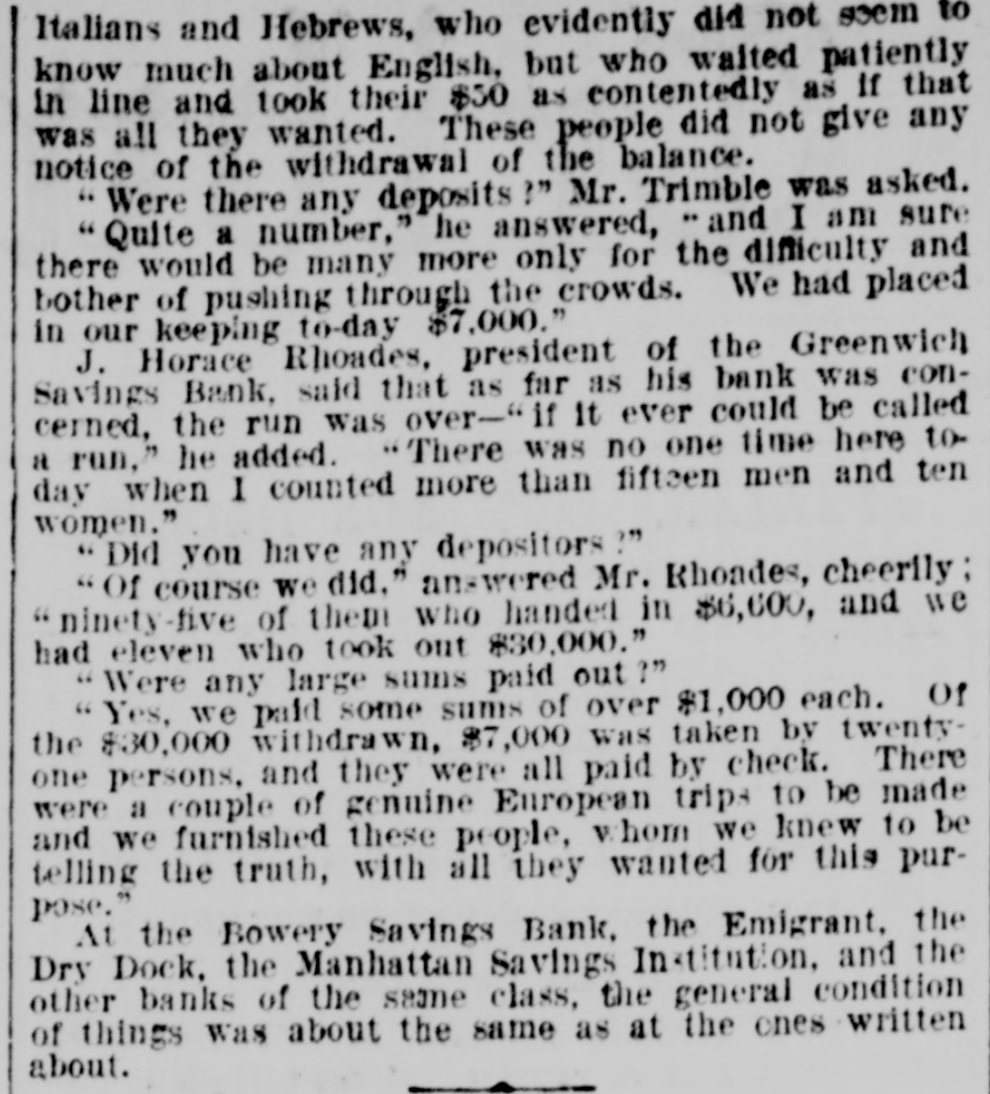
Italians and Hebrews, who evidently did not seem to know much about English, but who walted patiently in line and took their $50 as contentedly as If that was all they wanted. These people did not give any notice of the withdrawal of the balance. " Were there any deposits " Mr. Trimble was asked. "Quite a number," he answered, and I am sure there would be many more only for the difficulty and bother of pushing through the crowds. We had placed in our keeping to-day $7,000." J. Horace Rhoades, president of the Greenwich Savings Bank, said that as far as his bank was concerned, the run was over-"i if It ever could be called a run," he added. "There was no one time here today when I counted more than fifteen men and ten women." Did you have any depositors Of course we did," answered Mr. Rhoades, cheerily; "ninety-five of them who handed in $6,600, and we had eleven who took out $30,000." "Were any large sums paid out ?" "Yes, we paid some sums of over $1,000 each. Of the $30,000 withdrawn, $7,000 was taken by twentyone persons, and they were all paid by check. There were a couple of genuine European trips to be made and we furnished these people, whom we knew to be telling the truth, with all they wanted for this purpose." At the Bowery Savings Bank, the Emigrant, the Dry Dock, the Manhattan Savings Institution, and the other banks of the same class, the general condition of things was about the same as at the ones written about.


Article from New-York Tribune, August 3, 1893

Click image to open full size in new tab

Article Text

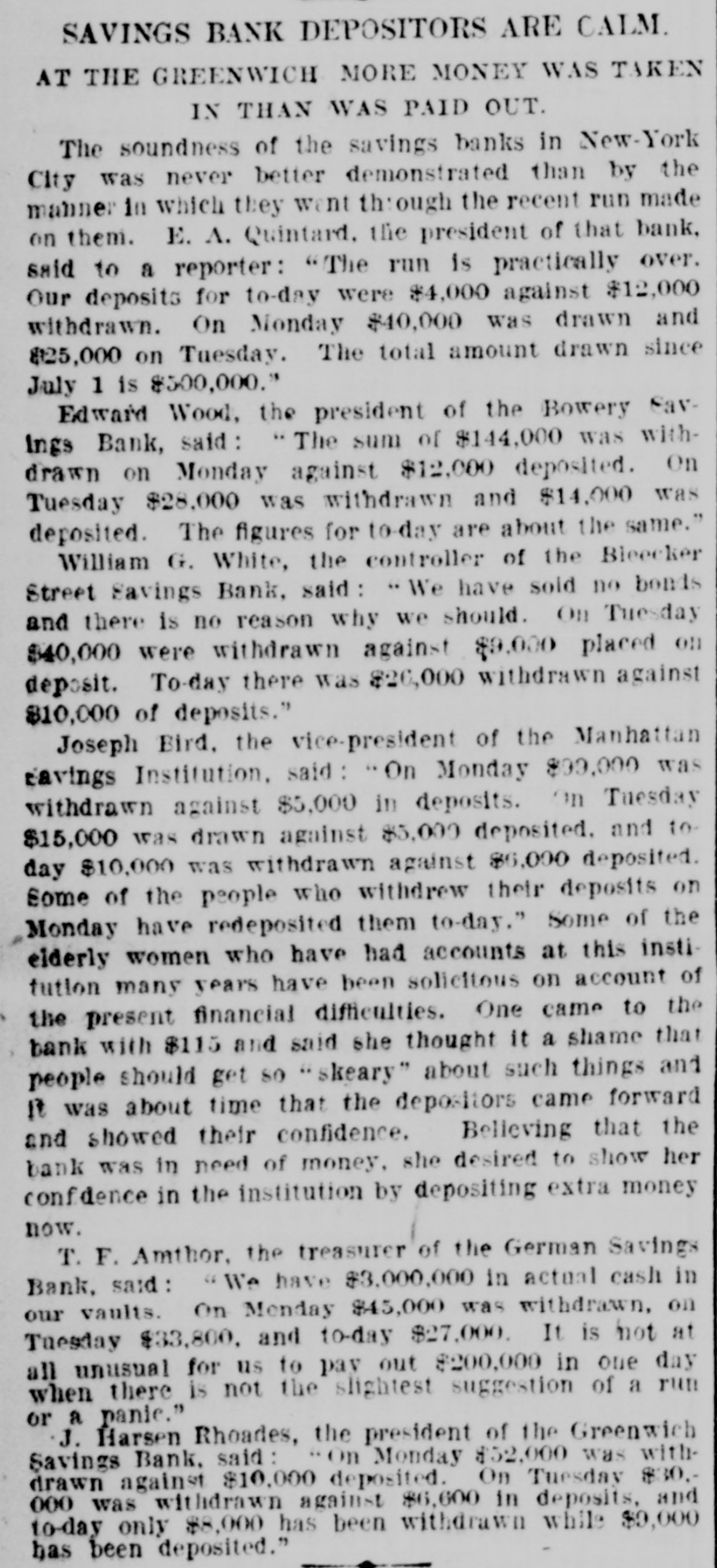
SAVINGS BANK DEPOSITORS ARE CALM. AT THE GREENWICH MORE MONEY WAS TAKEN IN THAN WAS PAID OUT. The soundness of the savings banks in New-York City was never better demonstrated than by the manner 10 which they went th:ough the recent run made on them. E. A. Quintard, the president of that bank, said to a reporter: "The run is practically over. Our deposits for to-day were $4,000 against $12,000 withdrawn. On Monday $40,000 was drawn and $25,000 on Tuesday. The total amount drawn since July 1 is $500,000." Edward Wood, the president of the Bowery SavIngs Bank, said: The sum of $144,000 was withdrawn on Monday against $12,000 deposited. On Tuesday $28,000 was withdrawn and $14,000 was deposited. The figures for to-day are about the same." William G. White, the controller of the Bleecker Street Savings Bank, said: "We have sold no bonds and there is no reason why we should. On Tuesday $40,000 were withdrawn against $9,000 placed on deposit. To-day there was $26,000 withdrawn against $10,000 of deposits." Joseph Bird, the vice-president of the Manhattan davings Institution, said : "On Monday $99,000 was withdrawn against $5,000 in deposits. On Tuesday $15,000 was drawn against $5,000 deposited. and today $10,000 was withdrawn against $6,000 deposited. Some of the people who withdrew their deposits on Monday have redeposited them to-day." Some of the elderly women who have had accounts at this institution many years have been solicitous on account of the present financial difficulties. One came to the bank with $115 and said she thought it a shame that people should get so "skeary" about such things and It was about time that the depositors came forward and showed their confidence. Believing that the bank was in need of money, she desired to show her confidence in the institution by depositing extra money now. T. F. Amthor, the treasurer of the German Savings Bank, said: "We have $3,000,000 in actual cash in our vaults. On Monday $45,000 was withdrawn, on Tuesday $33,800. and to-day $27,000. It is not at all unusual for us to pay out $200,000 in one day when there is not the slightest suggestion of a run or a panic." J. Harsen Rhoades, the president of the Greenwich Savings Bank. said: "On Monday $52,000 was withdrawn against $10,000 deposited. On Tuesday $30,000 was withdrawn against $6,600 in deposits, and to-day only $8,000 has been withdrawn while $9,000 has been deposited."