Article Text
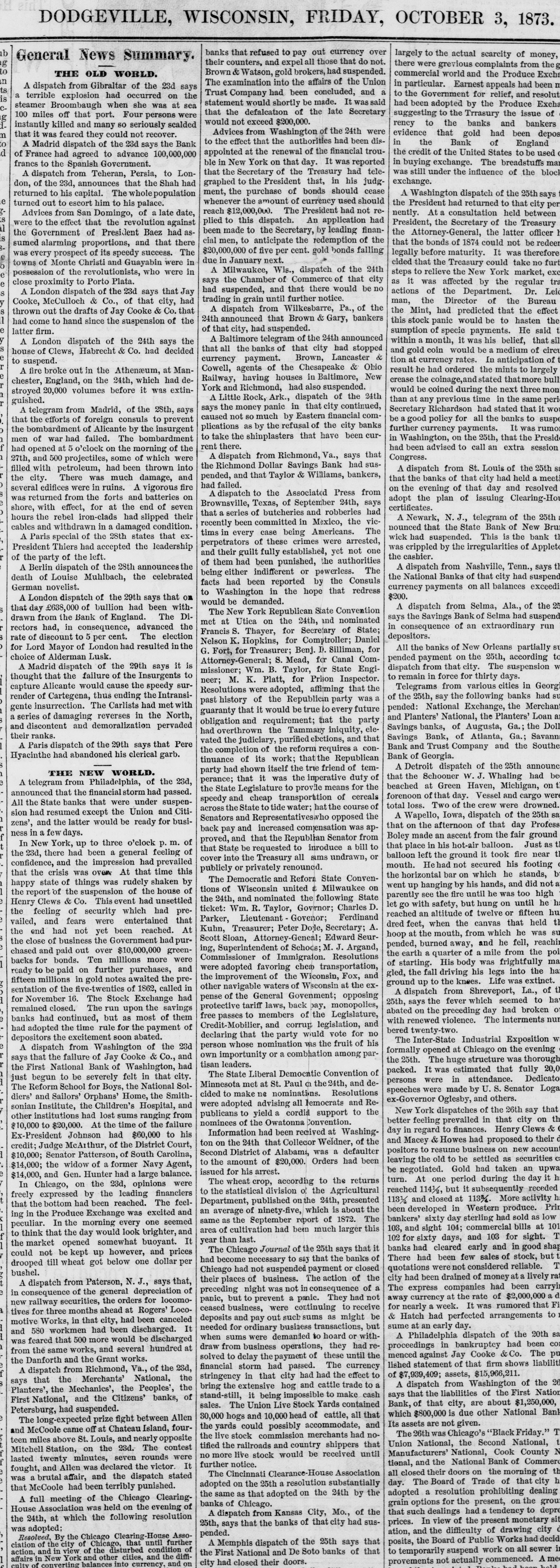
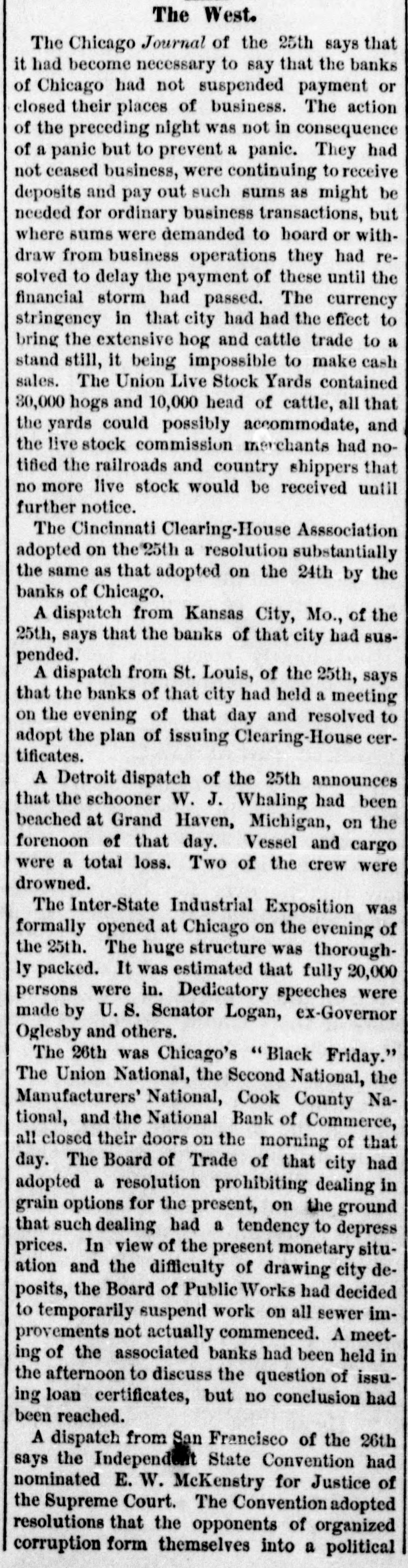
1873. DODGEVILLE, WISCONSIN, FRIDAY, OCTOBER 3, 1b banks that refused to pay out currency over largely to the actual scarcity of money General News Summary. their counters, and expels those that do not. there were grevious complaints from the to Brown & Watson, gold brokers, had suspended. THE OLD WORLD. commercial world and the Produce Exch in The examination into the affairs of the Union in particular. Earnest appeals had been A dispatch from Gibraltar of the 23d says its Trust Company had been concluded, and to the Government for relief, and resolu a terrible explosion had occurred on the is statement would shortly be made. It was said had been adopted by the Produce Exch steamer Broombaugh when she was at sea that the defalcation of the late Secretary suggesting to the Trrasury the issue of 100 miles off that port. Four persons were would not exceed $200,000. rency to the banks and bankers instantly killed and many so seriously scalded Advices from Washington of the 24th were that it was feared they could not recover. evidence that gold had been depo to the effect that the authorities had been disin the Bank of England A Madrid dispatch of the 23d says the Bank appointed at the renewal of the financial trouthe credit of the United States to be used of France had agreed to advance 100,000,000 in buying exchange. The breadstuffs m ble in New York on that day. It was reported francs to the Spanish Government. was still under the influence of the bloc that the Secretary of the Treasury had teleA dispatch from Teheran, Persia, to Lonexchange. graphed to the President that, in his judgdon, of the 23d, announces that the Shah had ment, the purchase of bonds should cease returned to his capital. whole population A Washington dispatch of the 25th says le whenever the amount of currency used should turned out to escort him to his palace. the President had returned to that city pe reach $12,000,000. The President had not reAdvices from San Domingo, of late date, nently. At consultation held between plied to this dispatch. An application had were to the effect that the revolution against President, the Secretary of the Treasury been made to the Secretary, by leading finanthe Government of President Baez had asthe Attorney-General, the latter officer cial men, to anticipate the redemption of the that the bonds of 1874 could not be redee sumed alarming proportions, and that there $20,000,000 of five per cent. gold bonds falling legally before maturity. It was therefor was every prospect of its speedy success. The due in January next. cided that the Treasury could take fur towns of Monte Christi and Guayabin were in A Milwaukee, Wis., dispatch of the 24th possession of the revolutionists, who were in steps to relieve the New York market, ex says the Chamber of Commerce of that city as it was affected by the regular tr close proximity to Porto Plata. had suspended, and that there would be no actions of the Department. Dr. Le A London dispatch of the 23d says that Jay trading in grain until further notice. man, the Director of the Bureau Cooke, McCulloch & Co., of that city, had A dispatch from Wilkesbarre, Pa., of the the Mint, had predicted that the effect thrown out the drafts of Jay Cooke & Co. that 24th announced that Brown & Gary, bankers this stock panic would be to hasten th had come to hand since the suspension of the of that city, had suspended. latter firm. sumption of specie payments. He said A Baltimore telegram of the 24th announced si within a month, it was his belief, that A London dispatch of the 24th says the that all the banks of that city had stopped and gold coin would be medium of circ house of Clews, Habrecht & Co. had decided currency payment. Brown, Lancaster & tion at currency rates. In anticipation of to suspend. Cowell, agents of the Chesapeake & Ohio A fire broke out in the Athenium, at Manresult he had ordered the mints to largely Railway, having houses in Baltimore, New crease the coinage,and stated bui chester, England, on the 24th, which had deYork and Richmond, had also suspended. would be coined during the next three mo stroyed 20,000 volumes before it was extinA Little Rock, Ark., dispatch of the 24th than at any previous time in the same per guished. says the money panic in that city continued, Secretary Richardson had stated that we A telegram from Madrid, of the 2Sth, says caused not so much by Eastern financial combe good policy for all the banks to susp that the efforts of foreign consuls to prevent plications as by the refusal of the city banks further currency payments. It was rum the bombardment of Alicante by the insurgent to take the shinplasters that have been curin Washington, on the 25th, that the Presi men of war had failed. The bombardment rent there. had been advised to call an extra session had opened at o'clock on the morning of the A dispatch from Richmond, Va., says that Congress. 27th, and 500 projectiles, some of which were the Richmond Dollar Savings Bank had susfilled with petroleum, had been thrown into A dispatch from St. Louis of the 25th pended, and that Taylor & Williams, bankers, that the banks of that city had held a mee the city. There was much damage, and had failed. several edifices were in ruins. A vigorous fire on the evening of that day and resolved dispatch to the Associated Press from was returned from the forts and batteries on adopt the plan of issuing Clearing-Ho Brownsville, Texas, of September 24th, says certificates. shore, with effect, for at the end of seven that a series of butcheries and robberies had A Newark, N. J., telegram of the 25th hours the rebel iron-clads had slipped their recently been committed in Mexico, the vicnounced that the State Bank of New Bru cables and withdrawn in damaged condition. tims in every case being Americans. The A Paris special of the 28th states that exwick had suspended. This is the bank perpetrators of these crimes arrested, President Thiers had accepted the leadership was crippled by the irregularities of Apple and their guilt fully established, yet not one the cashier. of the party of the left. of them had been punished, the authorities A dispatch from Nashville, Tenn., says A Berlin dispatch of the 28th announces the being either indifferent or powerless. The death of Louise Muhlbach, the celebrated the National Banks of that city had suspen facts had been reported by the Consuls German novelist. currency payments on all balances exceed to Washington in the hope that redress $200. A London dispatch of the 29th says that OR would be demanded. A dispatch from Selma, Ala., of the 2 that day £638,000 of bullion had been withThe New York Republican State Convention says the Savings Bank of Selma had suspen drawn from the Bank of England. The Dimet at Utica on the 24th, and nominated in consequence of an extraordinary run rectors had, in consequence, advanced the Francis S. Thayer, for Secretary of State: depositors. rate of discount to 5 per cent. The election Nelson K. Hopkins, for Comptroller; Daniel for Lord Mayor of London had resulted in the All the banks of New Orleans partially G. Fort, for Treasurer; Benj. I). Silliman, for choice of Alderman Lusk. pended payment on the 25th, according Attorney-General; S. Mead, for Canal ComA Madrid dispatch of the 29th says it is dispatch from that city. The suspension missioner; Wm. B. Taylor, for State Engithought that the failure of the Insurgents to to remain in force for thirty days. neer; M. K. Platt, for Prison Inspector. capture Alicante would cause the speedy surTelegrams from various cities in Georg Resolutions were adopted, affirming that the render of Cartegena, thus ending the Intransiof the 25th, say the following banks had s past history of the Republicin party was gente insurrection. The Carlists had met with pended: National Exchange, the Merchant guaranty that it would be true to every future series of damaging reverses in the North, and Planters' National, the Planters' Loan obligation and requirement; that the party and discontent and demoralization pervaded Savings banks, of Augusta, Ga.; the Do had overthrown the Tammary iniquity, eletheir ranks. Savings Bank, of Atlanta, Ga.; Savann vated the judiciary, purified elections, and that A Paris dispatch of the 29th says that Pere Bank and Trust Company and the South the completion of the reform requires a conHyacinthe had abandoned his clerical garb. Bank of Georgia. tinuance of its work; that the Republican A Detroit dispatch of the 25th announ party had shown itself the true friend of temTHE NEW WORLD. that the Schooner W. J. Whaling had b perance; that it was the inperative duty of A telegram from Philadelphia, of the 23d, beached at Green Haven, Michigan, on the State Legislature to provile means for the announced that the financial storm had passed. forenoon of that day. Vessel and cargo we speedy and cheap transporttion of cereals All the State banks that were under suspentotal loss. Two of the crew were drowned across the State to tide water; hat the course of sion had resumed except the Union and CitiA Wapello, Iowa, dispatch of the 25th Senators and Representativeswho opposed the zens', and the latter would be ready for busithat on the afternoon of that day Profes back pay and increased compensation was apness in few days. Boley made an ascent from the fair ground proved, and that the Republican Senator from In New York, up to three o'clock p. m. of that place in his hot-air balloon. Just as that State be requested to inroduce a bill to the 23d, there had been a general feeling of balloon left the ground took fire near cover into the Treasury all sims undrawn, or confidence, and the impression had prevailed mouth. Hehad not secured his footing publicly or privately renouned. that the crisis was over At that time this the horizontal bar on which he stands, The Democratic and Reform State Convenhappy state of things was rudely shaken by went up hanging by his hands, and did not tions of Wisconsin united & Milwaukee on the report of the suspension of the house of parently see the fire until he was too high the 24th, and nominated the following State Henry Clews & Co. This event had unsettled I let go with safety, but hung on until he ticket: Wm. R. Taylor, Govrnor; Charles D. the feeling of security which had prereached an altitude of twelve or fifteen h Parker, Lieutenant Govenor; Ferdinand vailed, and fears were entertained that dred feet, when the canvas that held t Kuhn, Treasurer; Peter Dole, Secretary; A. the end had not yet been reached. At hoop at the mouth, from which he was s Scott Sloan, Attorney-Genenl; Edward Seurthe close of business the Government had purpended, burned away, and he fell, reach ing, Superintendent of Schoos; M. J. Argand, chased and paid out over $10,000,000 greenthe earth a quarter of mile from the pc Commissioner of Immigraton. Resolutions backs for bonds. Ten millions more were of starting. His body was frightfully m were adopted favoring chea transportation, ready to be paid on further purchases, and gled, the fall driving his legs into the h the improvement of the Wiconsin, Fox, and fifteen millions in gold notes awaited the preground up to the knees. Life was extinct. other navigable waters of Wsconsin at the sentation of the five-twenties of 1862, called in A dispatch from Shreveport, La., of pense of the General Government; opposing for November 16. The Stock Exchange had 25th, says the fever which seemed to ha protective tariff laws, back pay, monopolies, remained closed. The run upon the savings e abated on the preceding day had broken free passes to members of the Legislature, banks had continued, but as most of them with renewed violence. The interments nu Credit-Mobilier, and corrup legislation, and had adopted the time rule for the payment of bered twenty-two. declaring that the party wiuld vote for no depositors the excitement soon abated. y The Inter-State Industrial Exposition person whose nomination was the fruit of his A dispatch from Washington of the 23d formally opened at Chicago on the evening own importunity or a combiation among parsays that the failure of Jay Cooke & Co., and the 25th. The huge structure was thoroug tisan leaders. the First National Bank of Washington, had packed. It was estimated that fully 20, The State Liberal Democntic Convention of just begun to be severely felt in that city. persons were in attendance. Dedicat Minnesota met at St. Paul a the 24th, and deThe Reform School for Boys, the National Solspeeches were made by U. S. Senator Log cided to make ne nominations. Resolutions diers' and Sailors' Orphans' Home, the Smithex-Governor Oglesby, and others. adopted advising all lemocrats and Resonian Institute, the Children's Hospital, and New York dispatches of the 26th say that publicans to yield a cordid support to the other institutions had lost sums ranging from better feeling prevailed in that city on t nominees of the Owatonna Convention. $10,000 to $20,000. At the time of the failure day in regard to finances. Henry Clews & Information had been received at WashingEx-President Johnson had $60,000 to his and Macey & Howes had proposed to their ton on the 24th that Collecor Weidner, of the credit; Judge McArthur, of the District Court, positors to resume business on new accour Second District of Alabami, was a defaulter $10,000; Senator Patterson, of South Carolina, leaving the old to be settled as securities to the amount of $20,000. Orders had been $14,000; the widow of a former Navy Agent, be negotiated. Gold had taken an upw issued for his arrest. $14,000, and Gen. Hunter had a large balance. turn. At one period during the day it The wheat crop, according to the returns In Chicago, on the 23d, opinions were reached 1141/2, but it subsequently receded to the statistical division of the Agricultural freely expressed by the leading financiers 1131/4 and closed at 113%. More activity Department, published on the 24th, presented that the bottom had been reached. The feelbeen developed in Western produce. Pr an average of ninety-five, which is about the ing in the Produce Exchange was excited and bankers' sixty day sterling had sold as low same as the September report of 1872. The peculiar. In the morning every one seemed 103, and sight 104; commercial bills at 10 area of cultivation had been much larger this to think that the day would look brighter, and 102 for sixty days, and 103 for sight. year than last. the market opened somewhat buoyant. It banks had cleared early and in good sha The Chicago Journal of the 25th says that it could not be kept up however, and prices There had been few sales of stock, but had become necessary to say that the banks of drooped till wheat got below one dollar per : quotations were not considered reliable. Chicago had not suspended payment or closed bushel. city had been drained of money a lively r their places of business. The action of the A dispatch from Paterson, N. J., says that, The express companies had been carry preceding night was not in consequence of a in consequence of the general depreciation of away currency at the rate of $2,000,000 a panic, but to prevent a panic. They had not new railway securities, the orders for locomofor nearly a week. It was rumored that F ceased business, were continuing to receive tives for three months ahead at Rogers' Loco& Hatch had perfected arrangements to deposits and pay out such sums as might be motive Works, in that city, had been canceled sume at an early day. needed for ordinary business transactions, but and 580 workmen had been discharged. It A Philadelphia dispatch of the 20th when sums were demanded to hoard or withwas feared that 500 more would be discharged proceedings in bankruptcy had been c draw from business operations, they had refrom the same works, and several hundred at menced against Jay Cooke & Co. The p solved to delay the payment of these until the the Danforth and the Grant works. lished statement of that firm shows liabili financial storm had passed. The currency A dispatch from Richmond, Va., of the 23d, of $7,939,409; assets, $15,966,211. stringency in that city had had the effect to says that the Merchants' National, the A dispatch from Washington of the 2 bring the extensive hog and cattle trade to a Planters', the Mechanics', the Peoples', the says that the liabilities of the First Natio stand-still, it being impossible to make cash First National, and the Citizens' banks, of Bank, of that city, are about $1,250,000, sales. The Union Live Stock Yards contained Petersburg, had suspended. which $800,000 is due other National Ban 30,000 hogs and 10,000 head of cattle, all that The long-expected prize fight between Allen Its assets are not given. the yards could possibly accommodate, and and McCoole came off at Chateau Island, fourChicago's Friday. the live stock commission merchants had noteen miles above St. Louis, and nearly opposite Union National, the Second National, tified the railroads and country shippers that Mitchell Station, on the 23d. The contest Manufacturers' National, Cook County no more live stock would be received until lasted twenty minutes, seven rounds were tional, and the National Bank of Comme further notice. fought, and Allen was declared the victor. It t all closed their doors on the morning of The Cincinnati Clearance-House Association was brutal affair, and the dispatch stated day. The Board of Trade of that city adopted on the 25th a resolution substantially that McCoole had been terribly punished. adopted a resolution prohibiting dealing the same as that adopted on the 24th by the A full meeting of the Chicago Clearinggrain options for the present, on the gro banks of Chicago. House Association was held on the evening of that such dealings had a tendency to depr A dispatch from Kansas City, Mo., of the the 24th, at which the following resolution prices. In view of the present monetary 25th, says that the banks of that city had suswas adopted; ation, and the difficulty of drawing city pended. Resolved, By the Chicago Assoposits, the Board of Public Works had deci A Memphis dispatch of the 25th says that ciation the city of Chicago, that until further action, and view of the disturbed condition to temporarily suspend work on all sewer the First National and De Soto banks of that affairs in New York and other cities, and provements not actually commenced. m city had closed their doors. culty of converting balances into currency. and