Newspapers (early Oct 1903) report a persistent three-week run driven by a rumor the bank was unsafe; directors closed doors and the Comptroller appointed a receiver (John B. Cunningham) Oct 1, 1903. The sequence is run → suspension/closure with receiver.
Events (7)
1.February 24, 1902Chartered
Source
historical_nic
2.September 10, 1903Run
Cause
Rumor Or Misinformation
Cause Details
Persistent withdrawals over about three weeks triggered by circulation of a rumor that the bank was unsafe.
Measures
Directors met and decided to close the bank's doors; president telegraphed comptroller that bank was insolvent.
Newspaper Excerpt
a quiet but persistent run on the institution, which began some three weeks ago with the circulation of a rumor that it was unsafe.
Source
newspapers
3.October 1, 1903Receivership
Source
historical_nic
4.October 1, 1903Receivership
Newspaper Excerpt
The comptroller of the currency has appointed receivers for the Bolivar National bank at Bolivar, Pa. ... Bank Examiner John B. Cunningham has been appointed receiver.
Source
newspapers
5.October 1, 1903Suspension
Cause
Rumor Or Misinformation
Cause Details
Closure followed a persistent run caused by rumors of insolvency; directors closed doors and bank suspended payments/operations.
Newspaper Excerpt
The president of this bank telegraphed the Controller that his bank was insolvent, and he had closed its doors.
Source
newspapers
6.October 15, 1906Restored To Solvency
Source
historical_nic
7.February 1, 1939Voluntary Liquidation
Source
historical_nic
Newspaper Articles (11)
1.October 1, 1903The Butte Inter MountainButte, MT
Click image to open full size in new tab
Article Text
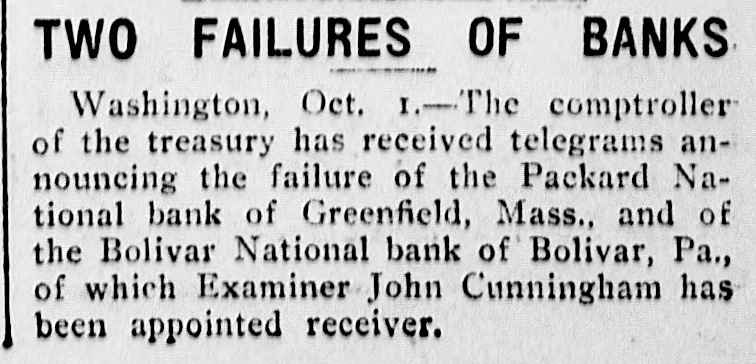
TWO FAILURES OF BANKS Washington, Oct. I.-The comptroller of the treasury has received telegrams announcing the failure of the Packard National bank of Greenfield, Mass., and of the Bolivar National bank of Bolivar, Pa., of which Examiner John Cunningham has been appointed receiver.
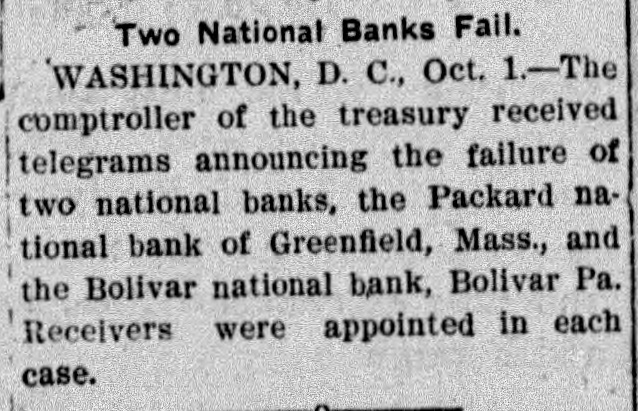
Two National Banks Fail. WASHINGTON, D. C., Oct. 1.-The comptroller of the treasury received telegrams announcing the failure of two national banks, the Packard national bank of Greenfield, Mass., and the Bolivar national bank, Bolivar Pa. Receivers were appointed in each case.
3.October 1, 1903The Spokane PressSpokane, WA
Click image to open full size in new tab
Article Text
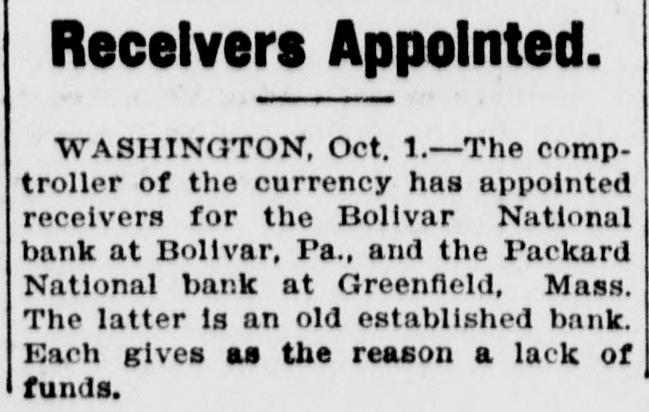
Receivers Appointed. WASHINGTON, Oct. 1.-The comptroller of the currency has appointed receivers for the Bolivar National bank at Bolivar, Pa., and the Packard National bank at Greenfield, Mass. The latter is an old established bank. Each gives as the reason a lack of funds.
4.October 1, 1903Evening Times-RepublicanMarshalltown, IA
Click image to open full size in new tab
Article Text
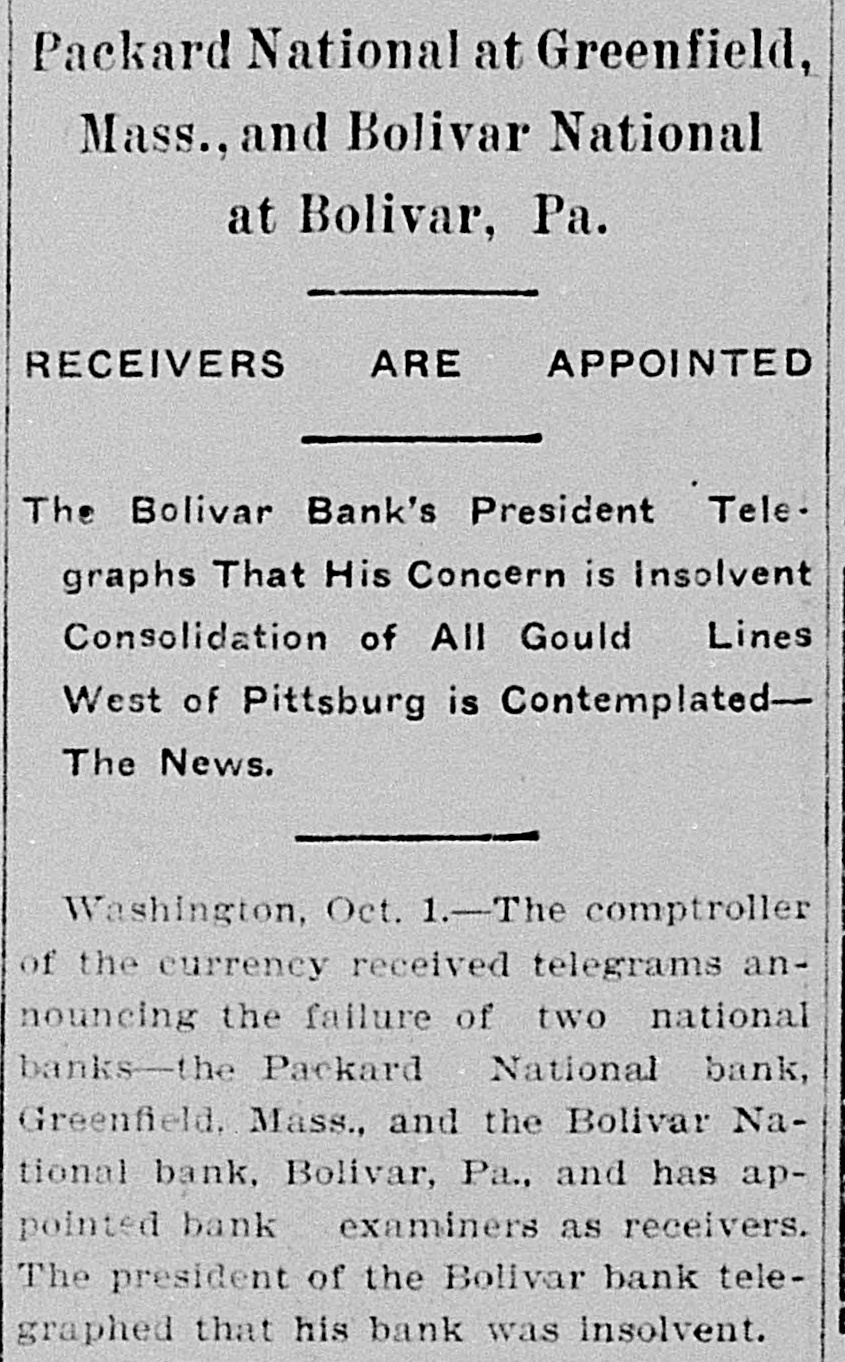
Packard National at Greenfield, Mass., and Bolivar National at Bolivar, Pa. RECEIVERS ARE APPOINTED The Bolivar Bank's President Telegraphs That His Concern is Insolvent Consolidation of All Gould Lines West of Pittsburg is ContemplatedThe News. Washington, Oct. 1.-The comptroller of the currency received telegrams announcing the failure of two national banks-the Packard National bank, Greenfield, Mass., and the Bolivar National bank, Bolivar, Pa., and has appointed bank examiners as receivers. The president of the Bolivar bank telegraphed that his bank was insolvent.
5.October 2, 1903New-York TribuneNew York, NY
Click image to open full size in new tab
Article Text
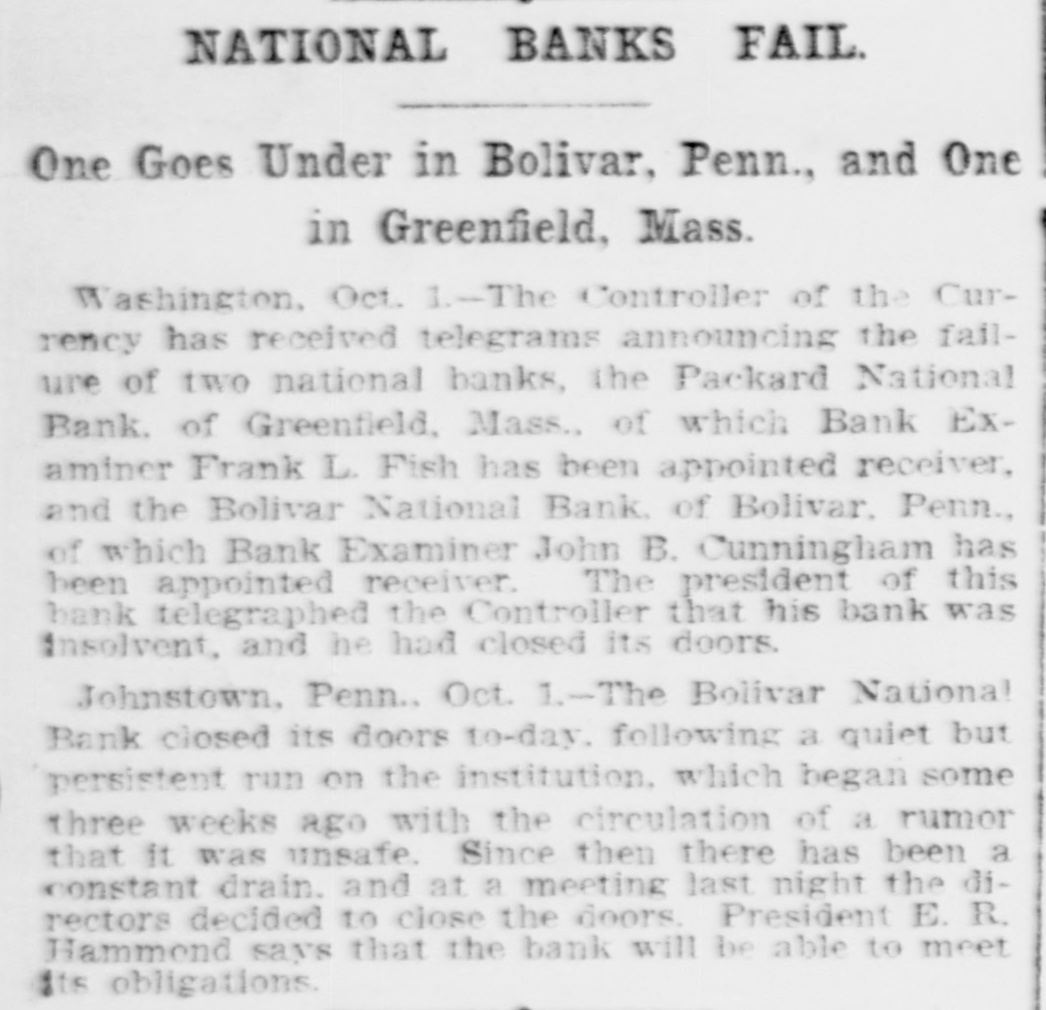
NATIONAL BANKS FAIL. One Goes Under in Bolivar, Penn., and One in Greenfield, Mass. Washington, Oct. 1.-The Controller of the Currency has received telegrams announcing the failure of two national banks, the Packard National Bank. of Greenfield, Mass., of which Bank Examiner Frank L. Fish has been appointed receiver, and the Bolivar National Bank. of Bolivar, Penn., of which Bank Examiner John B. Cunningham has been appointed receiver. The president of this hank telegraphed the Controller that his bank was Insolvent, and he had closed its doors. Johnstown, Penn.. Oct. 1.-The Bolivar National Bank closed its doors to-day. following a quiet but persistent run on the institution. which began some three weeks ago with the circulation of a rumor that it was unsafe. Since then there has been a constant drain. and at a meeting last night the directors decided to close the doors. President E. R. Hammond says that the bank will be able to meet Its obligations.
6.October 2, 1903The Washington TimesWashington, DC
Click image to open full size in new tab
Article Text
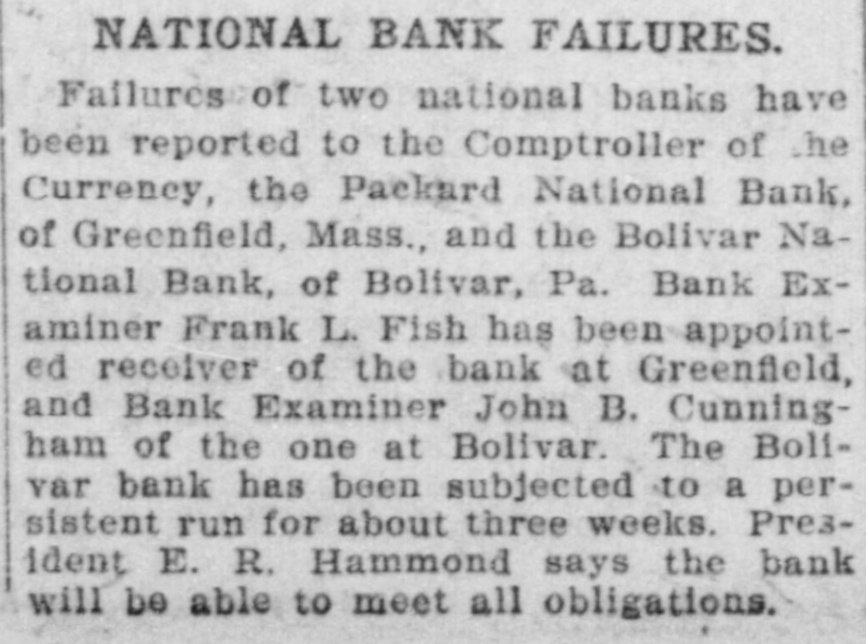
NATIONAL BANK FAILURES. Failures of two national banks have been reported to the Comptroller of he Currency, the Packard National Bank, of Greenfield, Mass., and the Bolivar National Bank, of Bolivar, Pa. Bank Examiner Frank L. Fish has been appointed receiver of the bank at Greenfield, and Bank Examiner John B. Cunningham of the one at Bolivar. The Bolivar bank has been subjected to a persistent run for about three weeks. President E. R. Hammond says the bank will be able to meet all obligations.
7.October 2, 1903The Savannah Morning NewsSavannah, GA
Click image to open full size in new tab
Article Text
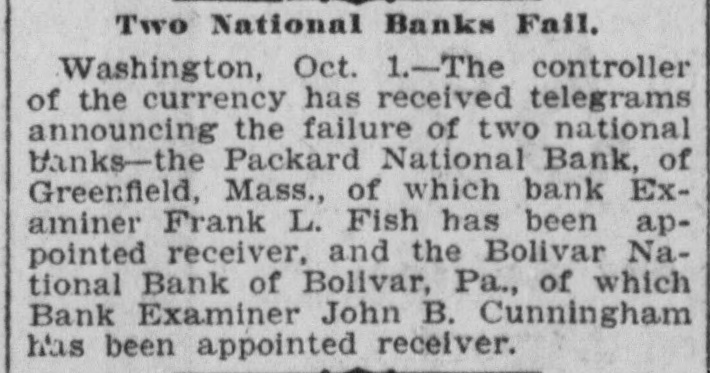
Two National Banks Fail. Washington, Oct. 1.-The controller of the currency has received telegrams announcing the failure of two national banks-the Packard National Bank, of Greenfield, Mass., of which bank Examiner Frank L. Fish has been appointed receiver, and the Bolivar National Bank of Bolivar, Pa., of which Bank Examiner John B. Cunningham has been appointed receiver.
8.October 2, 1903The Barre Daily TimesBarre, VT
Click image to open full size in new tab
Article Text
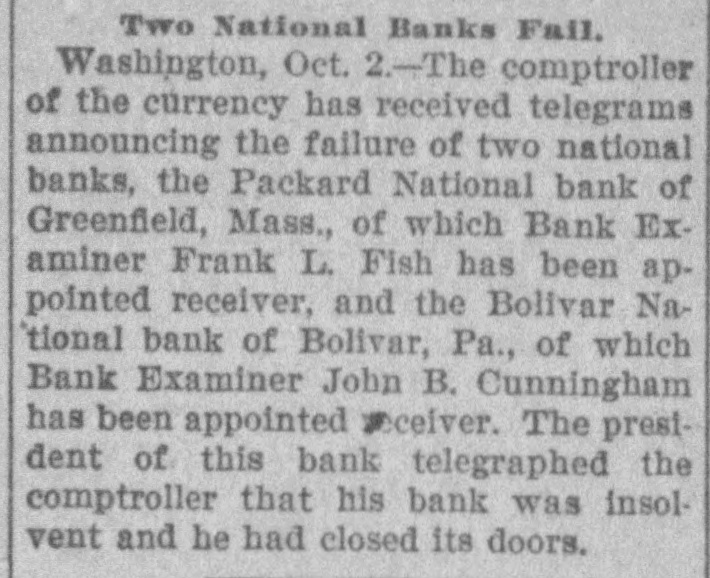
Two National Banks Fail. Washington, Oct. 2.-The comptroller of the currency has received telegrams announcing the failure of two national banks, the Packard National bank of Greenfield, Mass., of which Bank Examiner Frank L. Fish has been appointed receiver, and the Bolivar National bank of Bolivar, Pa., of which Bank Examiner John B. Cunningham has been appointed receiver. The president of this bank telegraphed the comptroller that his bank was insolvent and he had closed its doors.
9.October 7, 1903The Fulton County NewsMcConnellsburg, PA
Click image to open full size in new tab
Article Text
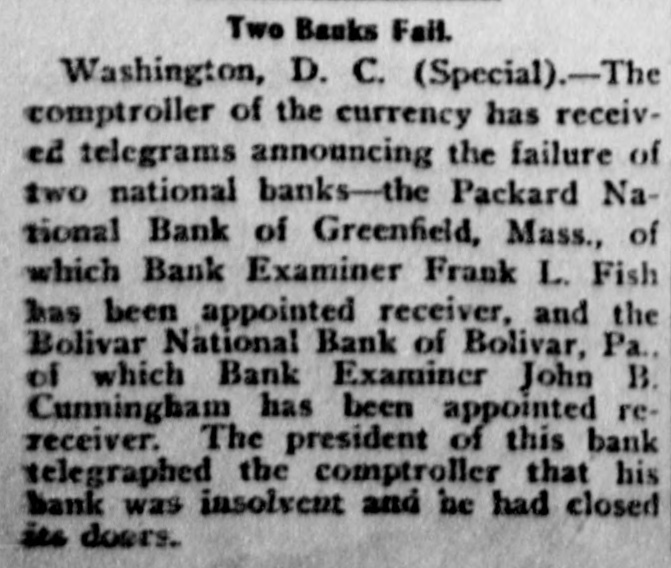
Two Banks Fail. Washington, D. C. (Special).-The comptroller of the currency has received telegrams announcing the failure of two national banks-the Packard National Bank of Greenfield, Mass., of which Bank Examiner Frank L. Fish has been appointed receiver, and the Bolivar National Bank of Bolivar, Pa., of which Bank Examiner John B. Cunningham has been appointed rereceiver. The president of this bank telegraphed the comptroller that his bank was insolvent and be had closed its doors.
10.October 8, 1903Audubon RepublicanAudubon, IA
Click image to open full size in new tab
Article Text
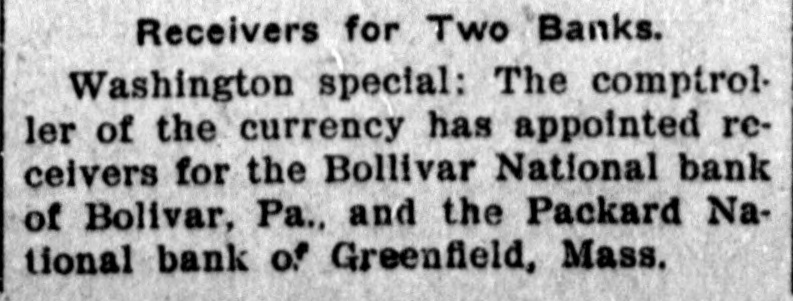
Receivers for Two Banks. Washington special: The comptrol. ler of the currency has appointed receivers for the Bollivar National bank of Bolivar, Pa., and the Packard National bank of Greenfield, Mass.
11.October 10, 1903Democratic MessengerSnow Hill, MD
Click image to open full size in new tab
Article Text
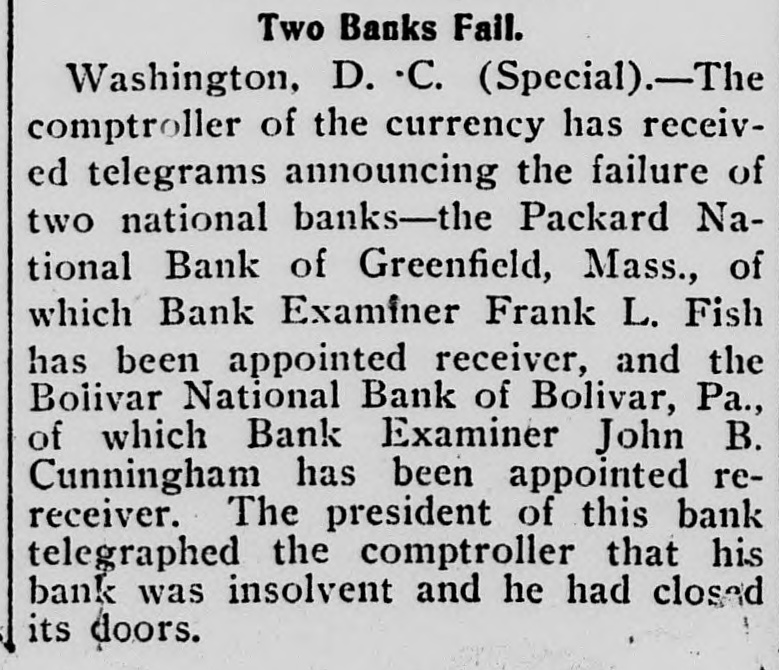
Two Banks Fail. Washington, D. C. (Special).-The comptroller of the currency has received telegrams announcing the failure of two national banks-the Packard National Bank of Greenfield, Mass., of which Bank Examiner Frank L. Fish has been appointed receiver, and the Bolivar National Bank of Bolivar, Pa., of which Bank Examiner John B. Cunningham has been appointed rereceiver. The president of this bank telegraphed the comptroller that his bank was insolvent and he had closed its doors.