1597. Hartford County Bank (Hartford, CT)

Bank Information

Episode Type
Run → Suspension → Reopening
Bank Type
state
Start Date
September 24, 1857
Location
Hartford, Connecticut (41.764, -72.685)

Metadata

Model
gpt-5-mini
Short Digest
e7152bb0

Response Measures

Full suspension, Books examined

Other: Receivers were appointed and an injunction obtained; bank later allowed to resume with reduced capital.

Description

Multiple articles (Sept–Dec 1857) report the Hartford County Bank being 'thrown out' by receiving banks, enjoined by the Bank Commissioners, receivers appointed, and later actions by directors and receivers to reduce capital and prepare to resume. Sequence: panic/withdrawals and discrediting (run/being thrown out) → injunction/receivership and suspension → arrangements to reduce capital and resume business (resumption by early Jan 1858). Classified as run leading to suspension with later reopening.

Events (4)

1. September 24, 1857 Run
Cause
Correspondent
Cause Details
Receiving/clearing banks 'threw out' the Hartford County Bank's bills; its notes were discredited and large amounts of circulation were returning for redemption amid wider panic and western remittances.
Measures
Bank Commissioners obtained injunction; receiving banks refused to take its notes; heavy scrutiny and receivership proceedings followed.
Newspaper Excerpt
The Hartford County Bank was thrown out by the receiving banks to-day. It has been enjoined by the Bank Commissioners.
Source
newspapers
2. September 30, 1857 Suspension
Cause
Bank Specific Adverse Info
Cause Details
Examination disclosed mismanagement, concealed large claims and bad loans; inability to redeem outstanding circulation forced injunction and suspension by the Bank Commissioners.
Newspaper Excerpt
The Hartford County Bank, which has just failed, had a capital of $500,000... The Hartford County Bank, as early as September, was unable to provide for an outstanding circulation ... the commissioners obtained an injunction and had receivers appointed.
Source
newspapers
3. October 10, 1857 Receivership
Newspaper Excerpt
The Directors of the Hartford County Bank, after a long consultation with the Receivers, on Tuesday afternoon, passed a vote conforming to the views of the Commissioners... the Receivers have already had $16,000 returned to them ... Receivers appointed and bank affairs taken in hand by commissioners/receivership was in place earlier in October 1857.) (paraphrase from multiple articles).
Source
newspapers
4. January 1, 1858 Reopening
Newspaper Excerpt
The Directors of the Hartford County Bank, after a long consultation with the Receivers, on Tuesday afternoon, passed a vote conforming to the views of the Commissioners... reduces the capital to $300,000... The Bank Commissioners ... have consented to a further extension of sixty days — during which it is expected that arrangements may be made for the resumption of business.
Source
newspapers

Newspaper Articles (14)

Article from Weekly Indiana State Sentinel, December 25, 1856

Click image to open full size in new tab

Article Text

Monetary. The following communication, upon the recent Bank excitement, has been handed to us by a friend, for publication. Of the justice and appropriateness of the points made, each reader must judge for himself. Rumors have been afloat for several days prejudicial to the Warren County Bank, Penn; Erie City Bank, Penn.; Bank of Newcastle, Penn.; Rhode Island Central Bank the Exchange Bank at Bangor, Maine; Hartford County and Hartford Banks; and on Monday the Banks of this city threw out the issues of those institutions. The result was a panic among the holders of those bills, and the Bank of the Capital relieved them of their alarm at five per cent. shave. We were unable to trace these rumors" to any reliable source, and our Eastern exchanges contained nothing which wouldjurelly the suspicions set afloat. Under these circumstances we thought it unwise, by a publication of mere rumors, to discredit the character of Banks whose paper was in circulation in this section to a considerable amount. It could have no good effect certainly, and the result of the publication of these rumors by other papers was, to give a sort of authority. to them which created unnecessary alarm. It induced the laboring man, the mechanic, the trader, and all parties to part with this currency at a shave and our Bankers laughed in their sleeves at the rich harvest it was bringing them. We have no sympathy for Banks, but we cannot see the propriety of newspapers discrediting their issues unjustly and unnecessarily, to the disadvantage of the public. Private speculation may be the motive, we can conceive of no other. We should like to see the Constitutional Currency, gold and silver, displace all the small bank notes in circulation, but this era we do not expect to witness until some general commercial revulsion bursts the paper bubble and forces it upon the country. The N. Y. Tribune of Saturday last, states that the Exchange Bank of Bangor, Maine, had been thrown out by the Suffolk Bank, of Boston and it was rumored that some parties at the West had purchased it. The Suffolk is the redeeming agent of all the' New England Banks and its being thrown out is unfavorable to the credit of the Exchange Bank, although no evidence of its failure. [For the Sentinel.] THE CRUSADE AGAINST THE BANKS.Some extremely wise financier has the following in the commercial column of the Journal this morning as a communication INDIANAPOLIS, Dec. 22. EDITORS JOURNAL I notice in your monetary column that some interested party speaks of rumor being afoat in relation to Hartford County Bank and Hartford Bank. Any person with a thimble full of brains would not suspect the Harrford Banks; and to classify them with such concerns as the Rhode Island Central and Erie City, is ridiculous in the extreme. Has this community forgot the losses on the "Valley Bank" at Hagerstown, Maryland? A friend to good Banks is quite adroit in placing Rhode Island Central and Erie City in such good company. The ear-marks of the above are unmistakable. Its author is one of a few that are left of the wonderful genius's of a fast reced. ing generation. He has more than a "thimble full of brains," no doubt-an ceertainly more than a bucket full of impudence. But there is none wise as he,and he thinks no one other than himself has any right to have any opinion of money, Banks or business. He comes down on those'concerns', the Erie City and R. I. Central, with his fiat of doom. He has probably forgot a certain "concern nearer home, that, a few years ago, suspended specie payments, and drove its creditors to rely on its promises a year or two, or get nothing. There is "snobbism" in Banks, as well as other places, it seems.


Article from New-York Daily Tribune, September 24, 1857

Click image to open full size in new tab

Article Text

WEDNESDAY, Sept. 23-P. M. There was an increased amount of business at the morning Board to-day, and an improved feeling was manifeeted in most of the active descriptions. There was a larger time business than has been noticed of late, principally, however, confined to New-York Central, Reading and Toledo, and largely on three and five day operations. There is still a feeling in the bear circles that prices will go lower, but in other quarters there is a more honeful feeling, and buyers' options were taken more freely. The improvement in Reading was 2 ¼ cent, Central 2 ¼ cent, Erie ¼ cent, Michigan Central ½ cent, Michigan Southern 1¼ cent, Illinois Central 1 ¼ cent, Toledo 1 ¼ cent, Rock Island 3 ¼ cent, Galena ½ ¼ cent, Milwaukee and Mississippi ½ ¼ cent, &c. The transactions in State stocks were to considerable extent at better rates, and operators for the rise took some ventures. Missouris sold at 69¾@70, Virginias 86½, Tennessee 6s 75, North Carolina 6s 92, &c. Sales of 4,600 Illinois Central Bords were made at 83½ regular, and 84 buyer thirty. At the Second Board there was a reaction and prices fell back, although not to the low points of yesterday. After the Second Board the market was inactive and heavy. Erie closed at 17@17¼, Reading 43¼@43½, Central 67¼@67½, Michigan Southern 19@19¼. Pennsylvania Coal 65½ @66. The market for Excharge continues irregular and heavy. Sterling is nominally 607¼ cent. Francs 5.30@5.20. Freights are a shade easier, but not very active, though more so than yesterday. To Liverpool, the engagements are 48,000 bush. Grain at 4¾@ 5d. in bulk, and 5½@ 6d. in bags; 800 bales Cotton at 5 3223 16d; 50 hhds. Tallow at 16s.; 500 boxes Cheese at 20c. To London, 200 boxes Spermaceti at 15s.; 500 bbls. Oil Cake at 2s.; 1,000 bbls. Crude Turpentine at 2s. 9d. To Glasgow, 12 000 bush. Grain per steamer on private terms. The ship Rose Standish, with Lumber to Valparaiso, from thence to Iquique, and thence for Cronstadt, on private terms. The business of the Sub-Treasury was: Receipts, $129,116 15; payments, $195,965 33; balance, $10,016,611 47. The Chicago, St. Paul and Fond du Lac Railroad Concern have failed for $1,400,000 to-day, and made an assignment to Mesers. Moses Taylor & Co. We regret to announce the suspension of the important paper house of Perase & Brooks. They have assigned to Mr. Forrest, of Frost & Forrest. The liabilities are stated at $100,000. Messre. Platner & Smith, paper makers, Lee, Mass., have also superded. This is one of the largest paper concerns in the country, and shows a nominal surplus of $100,000, mostly in real estate. We hear of one or two other email failures. The telegraph from Philadelphia announces the suspension of Caleb Cape & Co., one of the oldest and most respectable houses in that city. The Hartford County Bank was thrown out by the receiving banks to-day. It has been enjoined by the Bank Commissioners. Capital $300,000. It has been, we hear, lending its circulation to Western railroads. A meeting of the stockholders and bondholders of the Delaware, Lackawanna and Western Road to consult upon the condition and prospects of the Company was called for to-day at the office of the Company. The meeting was a large one. A statement of the affairs of the Company was submitted, and a proposition was made for funding the floating debt. After a full discussion, a Committee was appointed, consisting of Messrs. Jas. Brown, S. B. Chittenden, M. K. Jesup, C. R. Robert, Wm. M. Vermilye, and Wm. H. Smith, to report at an adjourned meeting, to be held next Monday, at 12 o'clock, some scheme for the funding of the floating debt, and relieving the Company from its embarrassments. The amount of floating debt to be provided for is in round numbers $1,400,000. The Company has suspended payment on its floating debt, and has taken the legal measures necessary as a foreign corporation to protect its property from attachment by full assignment to John J. Blair of Belvidere, Ruius R. Graves and Wm. E. Warren. The parties interested feel very confident that a plan will be offered at the adjourned meeting which will relieve the Company at once, and enable them to resume operations at an early day. The plan will probably be ar issue of it come borde at par. It is not apprehended that any interruption wi'l take place in the ranning and transportation businees of the Company. The business of the Road has been quite favorable. The transportation earnings for the month of August amounted to$146.921 21 For sane morth in 1806...


Article from New-York Daily Tribune, September 26, 1857

Click image to open full size in new tab

Article Text

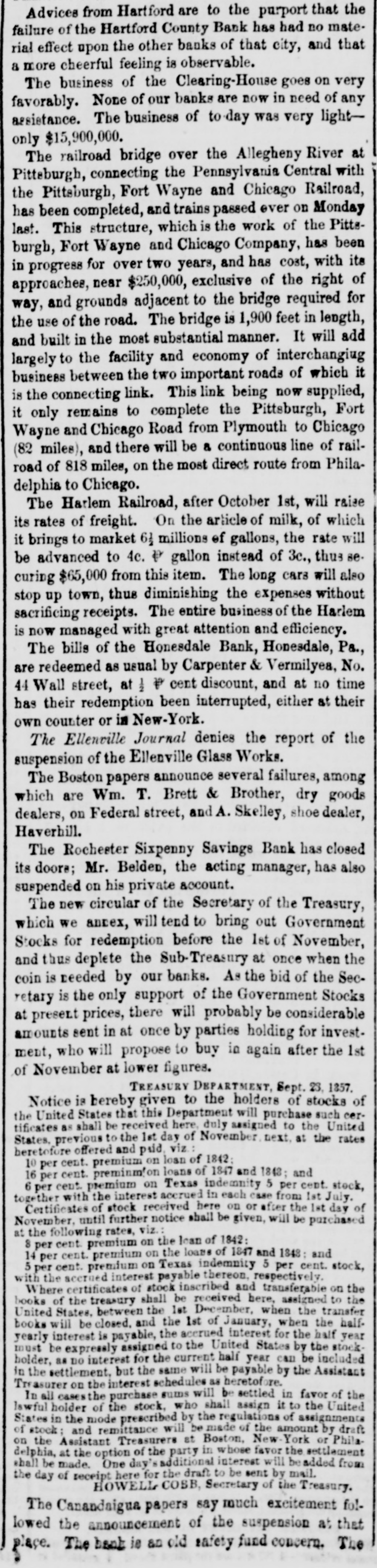
Advices from Hartford are to the purport that e failure of the Hartford County Bank has had no material effect upon the other banks of that city, and that a more cheerful feeling is observable. The business of the Clearing-House goes on very favorably. None of our banks are now in need of any assistance. The business of to day was very lightonly $15,900,000. The railroad bridge over the Allegheny River at connecting the Pennsylvania Central with Fort Wayne and has and trains ever on Pitteburgh, the been Pittsburgh, completed, passed Chicago Railroad, Monday last. This structure, which is the work of the PittsFort and Chicago Company, has been in for over two years, and near $250,000, exclusive burgh, approaches, progress Wayne has of cost, the right with for its of way, and grounds adjacent to the bridge required the use of the road. The bridge is 1,900 feet in length, and built in the most substantial manner. It will add largely to the facility and economy of interchanging business between the two important roads of which it is the connecting link. This link being now supplied, it only remains to complete the Pittsburgh, Fort Wayne and Chicago Road from Plymouth to Chicago (82 miles), and there will be & continuous line of railroad of 818 miles, on the most direct route from Philadelphia to Chicago. The Harlem Railroad, after October 1st, will raise its rates of freight. On the article of milk, of which it brings to market 61 millions of gallons, the rate will be to 4c. P se. from this cars curing advanced $65,000 gallon item. instead The the long of 3c., will thus without also stop up town, thus diminishing expenses sacrificing receipts. The entire business of the Harlem is now managed with great attention and efficiency. The bills of the Honesdale Bank, Honesdale, Pa., are redeemed as usual by Carpenter & Vermilyea, No. 44 Wall street, at 1/2 ₽ cent discount, and at no time has their redemption been interrupted, either at their own counter or in New-York. The Ellenville Journal denies the report of the suspension of the Ellenville Glass Works. The Boston papers announce several failures, among which are Wm. T. Brett & Brother, dry goods dealers, on Federal street, and A. Skelley, shoe dealer, Haverhill. The Rochester Sixpenny Savings Bank has closed its doore; Mr. Belder, the acting manager, has also suspended on his private account. The new circular of the Secretary of the Treasury, which we annex, will tend to bring out Government Stocks for redemption before the 1st of November, and thus deplete the Sub-Treasury at once when the coin is needed by our banks. As the bid of the Secretary is the only support of the Government Stocks at present prices, there will probably be considerable amounts sent in at once by parties holding for investment, who will propose to buy in again after the 1st of November at lower figures. TREASURY DEPARTMENT Sept. 23. 1857. Notice is hereby given to the holders of stocks of the United States that this Department will purchase such certificates as shall be received here. duly assigned to the United States. previous to the 1st day of November next. at the rates heretofore offered and paid, viz. 10 per cent. premium on loan of 1842: 16 per cent. preminmon loans of 1847 and 1848: and per cent. premium on Texas indemnity 5 per cent. stock, together with the interest accrued in each case from 1st July. Certificates of stock received here on or after the 1st day of November, until further notice shall be given, will be purchased at the following rates, viz. 8 per cent premium on the loan of 1842: 14 per cent. premium on the loans of 1847 and 1848 and 5 per cent. premium on Texas indemnity 5 per cent. stock, with the accrued interest payable thereon. respectively. Where certificates of stock inscribed and transferable on the books of the treasury shall be received here, assigned to the United States. between the 1st December, when the transfer books will be closed. and the 1st of January, when the half. yearly interest is payable, the accrued interest for the half year must be expressly assigned to the United States by the stock. holder, as DO interest for the current half year can be included in the settlement, but the same will be payable by the Assistant Treasurer on the interest schedules as heretofore. In all casesthe purchase sums will be settled in favor of the lawful holder of the stock, who shall assign it to the United States in the mode prescribed by the regulations of assignments of stock: and remittance will be made of the amount by draft on the Assistant Treasurers at Boston, New-York or Phila. delphia, at the option of the party in whose favor the settlement shall be made. One day's additional interest will be added from the day of receipt here for the draft to be sent by mail. HOWELL COBB, Secretary of the Treasury. The Canandaigua papers say much excitement fo!lowed the announcement of the suspension at that place. The bent is &D old safety fund concern. The


Article from The New York Herald, September 28, 1857

Click image to open full size in new tab

Article Text

brossed in value by the addition of large amounts of and silver. A suspension of specie payment Pennsyl vaals will not, therefore, be such a serious matter as many anticipate in Maryland, a similar law in relation to small bills ex se, so that State the benefits of a specie ga-reboy created to anpply the place of small notes, will cow be realized. The difficulty will, in a measure, in tais way be moderated, and a resumpidou be a matter for more deliberate consideration. A general bank suspension in New England would be of much grenier importance, and attended with more disastrous results. There the paper currency is principally smail bilis, and specie is comparatively sosroo ole suspension in New England is not si all willy, but in the contrary bigaty probable. In Rhode Island And Conneckout it appears to us inevitabis. The banks of to see States are fairly loaded down with breds of Western ra oads. Their circulation has been enor-mor way exterιded to mas loans to Western railroad companies and is is scattered ali sver the Westora country. In Hartford sad Providence Western railroad Busaciors found picuty at morey at high rates of interest. The currency given ta exchange for these bonds is now coming back in large la to, and the probability is that the banke 02 these cities with to down by the run. The Hariford County Bank, wisiad has just failed, had a capital of $500,000, and was no more likely to break up to the last moment than any otites bank in Hartford or Naw England. The circulation of all these New England banke is very large, not a dollay, of which is secured. Most of them hold less than $15 118 Decie for every $100 of their petes in circulation. The whole banking system of the Eastern States is nothing morser less than credit and con-idense. The billholders must a ve faith, and so long as that faith lasts as long may dien om be mostained. The West is sending home this currency and it must be redeemed. In the absence of exchange at the West Exit-ern banka bliis are remitted, and fun her than this, die-trust has taken hoid of tast secilen, at the bankers are buying it up for vederspilon. It will be a long time before we got at the bottom of our financial difficuistes. So far as the deprima tion of stook securities goes, the dessent thus far horhees pretty rapid, but the most important question is, at what point shall we stop. It is utterly imporsible to realize on the mery best deferiptions of property. Many of the largeret faliure which have occurred, have susponded olm0001% of the total luability of realizing on their assets. The case of Garser & Co, given yesterony, is an instrate, and we shall have hundreds more. Such is the etse of vebio confidence and private orodit. All this must end an overwhelming revulsion, which must be fortowed by months and months of prostration. Nothing can stay the whiriwind, and all must do the best and wenther it if ponible. is te the general impression that the banks o this city will go through safely and come out strong iste to be hoped they will, for there must be some bergen 10 carry us through the surrounding darkness. The solid wealth of this city is now clearly to be seen. We have no musurcom banking system here, that topples over at the Örst blast, but a strong, sound, substantial system tesi retains its position in public confidencs under any and all ciroumstances, and meeta all the demands and require-ments of she community. The banking system of this olty and State is as perfect as human foresight and skill can make it, and it will stand while all others around it hare passed away. The most implicit confilience in our banks will not be misplaced. The exports of specie from this port for the week end-ing this day, and for the year 1857, thus far, were as follows:- Brig Mary Pierce, Pars, specie.. $321 00 Brig Correo, Ciudad, Bolivar, American gold.. 10,000 00 Total for the week $10.321 00 Previously reported.. 82,874,840 80 Toial, 1857.. $32,884,861 89 ### THE MEOBANICA' BANK HAS ISSUED THE FOLLOWING CIRGALER IN RELATION TO COLLECTIONS ON PHILADELPHIA:- MICHANIOS BANK, N. F. Sept. 26, 1857. CIRCULAR. In consequence of the suspension of specie payments by the Polladelphia banks, notice is hereby given that all col-lections for scoount of the dealers with this bank, maturing out of the asy of New York will, at the aption of the deale (Immediately expressed) be either recslied or if paid be subject to drafts of this bank, payable in fanda current at the point of said payment. G. DE ANGELUS, Onshier. [This is the general form adopted by all the backe] Mr. A. H. Nicolay's regular semi-weekly suction sala of stocks and bonds will take place on Monday next, the 29th Instant, at 12% o'clock, at the Merchants' Exchange. An unusual variety of securistes will be offered, among whion will be found State, city and railroad bonds; bank stocks, such as Buichers' and Drovers', Leather Manafacturers', City, Union, People's, Importers' and Traders', &o, &c. Also, a variety of Insurance stocks. The Pittsburg, Fort Wayne and Chicago Ralirond Company give notice of the payment at their office, 37 William street, on and after the ls. October, of the interest, a nount-ing to ove $100,000, due on that day, on Ohio and Penn-sylvania Railroad Company income bonds, Ohio and In-diana Railrond Company sesond mortgage bonds, and Fort Wayne and Chiorgo Railroad Oompany resi esate mort-gage bonds. The annared statement exhibits the value of foreign im-porte inio abis port during the week and since January ) in each of the past three years COMMERCE OF THE PORT OF Naw Yous-VALUR OF IMPORTS. For the wesk. 1865 1856.. 1851 Dry goods.. $1,421.104 $1,886.678 $1,308,201 Gen'i sperca'ze.. 1.08,480 2,095,032 2,258,546 Total for week. $2,719,594 $3.483.708 $3,595,747 Previously reo'd. 109 388.422 168.915.577 182 431 602


Article from The Perrysburg Journal, October 1, 1857

Click image to open full size in new tab

Article Text

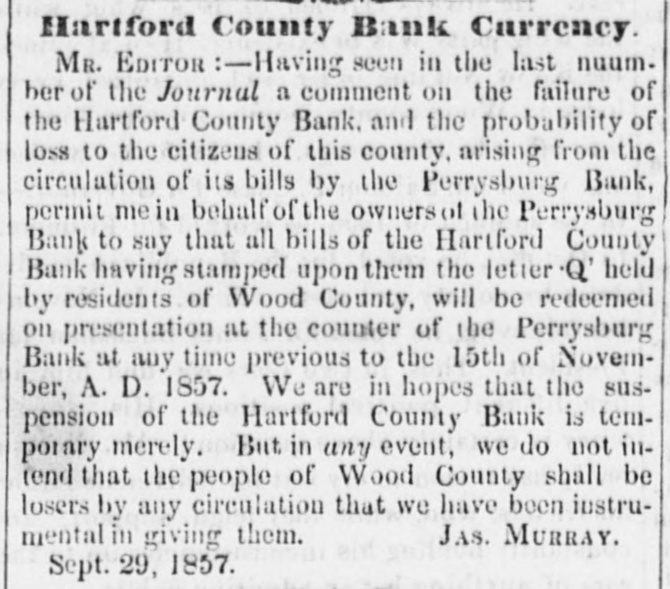
# Hartford County Bank Currency. MR. EDITOR: - Having seen in the last nuum-ber of the Journal a comment on the failure of the Hartford County Bank, and the probability of loss to the citizens of this county, arising from the circulation of its bills by the Perrysburg Bank, permit me in behalf of the owners of the Perrysburg Bank to say that all bills of the Hartford County Bank having stamped upon them the letter 'Q' held by residents of Wood County, will be redeemed on presentation at the counter of the Perrysburg Bank at any time previous to the 15th of November, A. D. 1857. We are in hopes that the suspension of the Hartford County Bank is temporary merely. But in any event, we do not intend that the people of Wood County shall be losers by any circulation that we have been instru-mental in giving them. JAS. MURRAY. Sept. 29, 1857.


Article from The New York Herald, October 4, 1857

Click image to open full size in new tab

Article Text

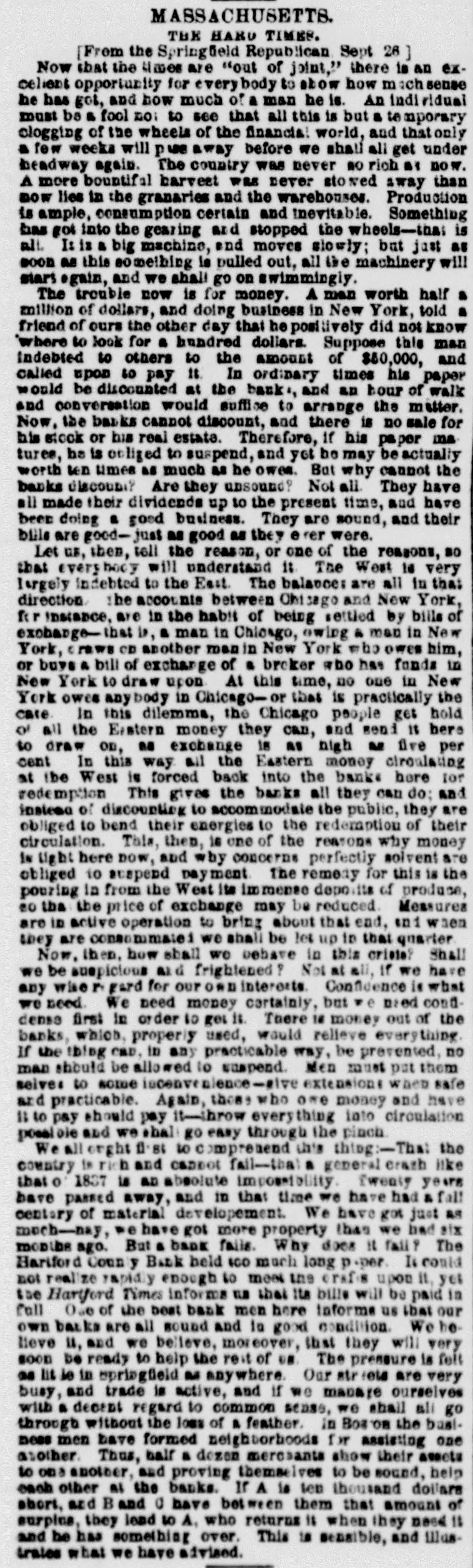
MASSACHUSETTS. THE HARD TIMES. [From the Springfield Republican Sept 26] Now that the times are "out of joint," there is an excelient opportunity for to skow how machsense be has got, and how much of a man he is. An individual must be a fool no: to see that all this is but a temporary clogging of the wheels of the financial world, and thatonly a few weeks will puse away before we shall all get under headway again. The country was never no rich B1 now. A more bountiful harvest was never stowed away than now lies in the granaries and the warehouses. Production is ample, consumption certain and inevitable. Something has got into the gearing and stopped the wheels-that is all. I: is a big machine, and moves slowly; but just as soon as this something is pulled out, all the machinery will start egain, and we shall go on swimmingiy. The trouble now is for money. A man worth half a million of dollars, and doing business in New York, told a friend of ours the other day that he positively did not know 'where to look for a hundred dollars. Suppose this man Indebted to others to the amount of $50,000, and called upon 10 pay it. In ordinary times his paper would be discounted at the banks, and an hour of walk and conversation would suffice to arrange the matter. Now, the banks cannot discount, and there is no sale for his stock or his real estate. Therefore, If his paper ma tures, be is obliged to suspend, and yet be may be actually worth ten times as much as he owes. Bat why cannot the banks discount? Are they unsound? Not all. They have all made their dividends up to the present time, and have been doing a good business. They are sound, and their bills are good-just as good as they e rer were. Let us, then, tell the reason, or one of the reasons, so that everybooy will understand it The West 16 very largely indebted to the East. The balance: are all in that direction :he accounts between Obisago and New York, for instance, are in the habit of being settled by bills of exchange-that 19, a man in Chicago, owing a man in New York, raws CD another manin New York who owes him, or buys a bill of exchange of a broker who has funds in New York to draw upon At this time, no one in New York owes anybody in Chicago-or that is practically the care In this dilemma, the Chicago people get hold of all the Eastern money they can, and send it here to draw on, as exchange is as high M five per cent In this way all the Eastern money circulating at the West is forced back into the banks here for redemption This gives the banks all they can do; and instead of discounting to accommodate the public, they are obliged to bend their energies to the redemption of their circulation. This, then, is one of the reasons why money is light here now, and why concerns perfectly solvent are obliged 10 suspend payment the remeny for this is the pouring in from the West its immense deposits of produce, 80 tha the price of exchange may be reduced. Measures are in active operation to bring about that end, tn1 when they are consommatei we shall be let up in that quarter Now, then, how shall we behave in this crisis? Shall we be suspicious at d frightened? Not at all, If we have any who r. gard for our own interests. Confidence is what we need. We need money certainly, but we n:ed conddense first in order 10 get it. There 16 money out of the banks, which, properly used, would relieve everything. If the Iblog CAD, in any practicable way, be prevented, no man should be allowed to suspend. Men must put them selve: to some iscenvenlence-give extensions when safe and practicable. Again, those who one money and have 11 to pay should pay it-throw everything into circulation possible and we shal go easy through the pinch. We all orght first to imprehend this thing:-That the country is rich and cannot fail-thai general crash like that o 1837 is an absolute impossibility. Twenty years have passed away, and in that time we have had & fall centery of material developement. We have got just as much-nay, we have got more property than we bad six months ago. But a bank fails. Why does it fail? The Hariford Coun y Bank held 400 much long p.per. It could not realize rapidly enough to meet the crafs upon it, yes the Hartford Times informs us that Its bills will be paid in full Oae of the best bank men here informs us that our own backs are all sound and to good condition. We helieve 11, and we believe, moreover, that they will very soon be ready to help the rest of us. The pressure is felt as 112 le in springfield M anywhere. Our str rets are very busy, and trade is active, and if we manage ourselves with a decent regard to common sense, we shall all go through without the loss of a feather. in Boson the business men have formed neightorhoods for assisting one another. Thus, half a dezen merchants show their assets to one another, and proving themselves to be sound, help each other at the banks. If A is ten thousand dollars short, and B and 0 have between them that amount of surpins, they lead to A, who returns It when they need 11 and be has something over. This is sensible, and illustrates what we have advised.


Article from The Weekly Minnesotian, October 10, 1857

Click image to open full size in new tab

Article Text

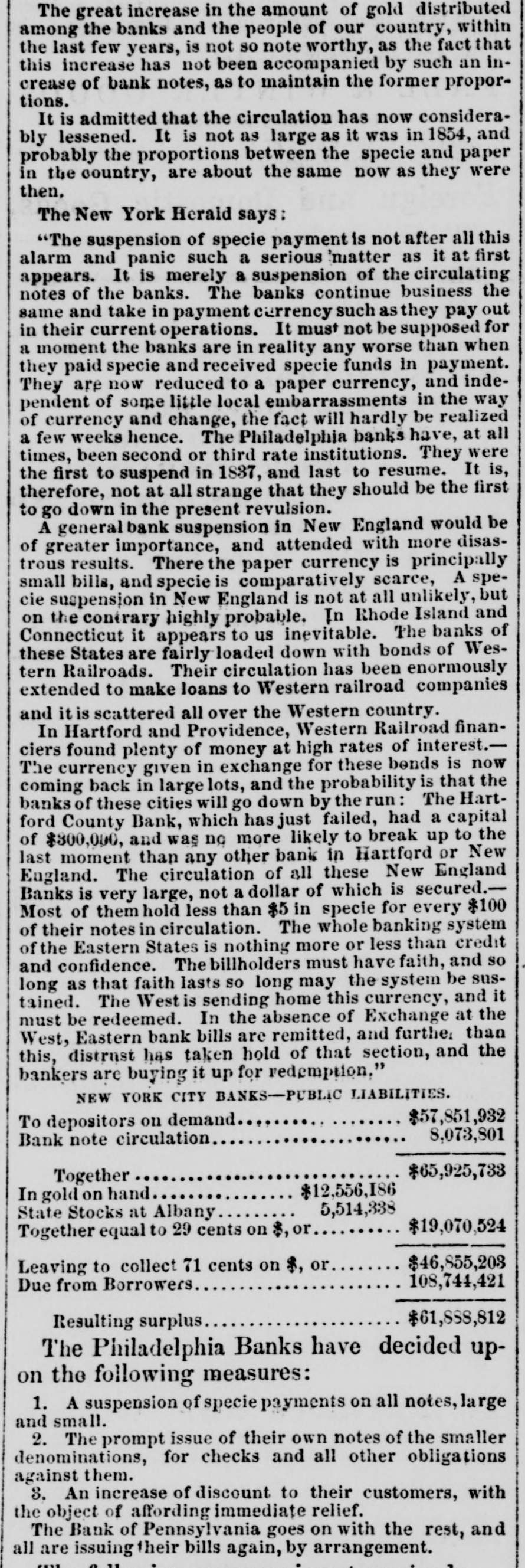
The great increase in the amount of gold distributed among the banks and the people of our country, within the last few years, is not so note worthy, as the fact that this increase has not been accompanied by such an increase of bank notes, as to maintain the former proportions. It is admitted that the circulation has now considerably lessened. It is not as large as it was in 1854, and probably the proportions between the specie and paper in the country, are about the same now as they were then, The New York Herald says: "The suspension of specie payment is not after all this alarm and panic such a serious matter as it at first appears. It is merely a suspension of the circulating notes of the banks. The banks continue business the same and take in payment currency such as they pay out in their current operations. It must not be supposed for a moment the banks are in reality any worse than when they paid specie and received specie funds in payment. They are now reduced to a paper currency, and independent of some little local embarrassments in the way of currency and change, the fact will hardly be realized a few weeks hence. The Philadelphia banks have, at all times, been second or third rate institutions. They were the first to suspend in 1837, and last to resume. It is, therefore, not at all strange that they should be the first to go down in the present revulsion. A general bank suspension in New England would be of greater importance, and attended with more disastrous results. There the paper currency is principally small bills, and specie is comparatively scarce, A specie suspension in New England is not at all unlikely, but on the contrary highly probable. In Rhode Island and Connecticut it appears to us inevitable. The banks of these States are fairly loaded down with bonds of Western Railroads. Their circulation has been enormously extended to make loans to Western railroad companies and it is scattered all over the Western country. In Hartford and Providence, Western Railroad financiers found plenty of money at high rates of interest.The currency given in exchange for these bends is now coming back in large lots, and the probability is that the banks of these cities will go down by the run: The Hartford County Bank, which has just failed, had a capital of $800,000, and was no more likely to break up to the last moment than any other bank in Hartford or New England. The circulation of all these New England Banks is very large, not a dollar of which is secured.Most of them hold less than $5 in specie for every $100 of their notes in circulation. The whole banking system of the Eastern States is nothing more or less than credit and confidence. The billholders must have faith, and SO long as that faith lasts SO long may the system be sustained. The West is sending home this currency, and it must be redeemed. In the absence of Exchange at the West, Eastern bank bills are remitted, and further than this, distrust has taken hold of that section, and the bankers are buying it up for redemption." NEW YORK CITY BANKS-PUBLIC LIABILITIES. $57,851,932 To depositors on demand 8,073,801 Bank note circulation $65,925,733 Together $12,556,186 In gold on hand 5,514,338 State Stocks at Albany $19,070,524 Together equal to 29 cents on $, or $46,855,203 Leaving to collect 71 cents on $, or 108,744,421 Due from Borrowers $61,888,812 Resulting surplus The Philadelphia Banks have decided upon the following measures: 1. A suspension of specie payments on all notes, large and small. 2. The prompt issue of their own notes of the smaller denominations, for checks and all other obligations against them. 3. An increase of discount to their customers, with the object of affording immediate relief. The Bank of Pennsylvania goes on with the rest, and all are issuing their bills again, by arrangement.


Article from New-York Daily Tribune, October 10, 1857

Click image to open full size in new tab

Article Text

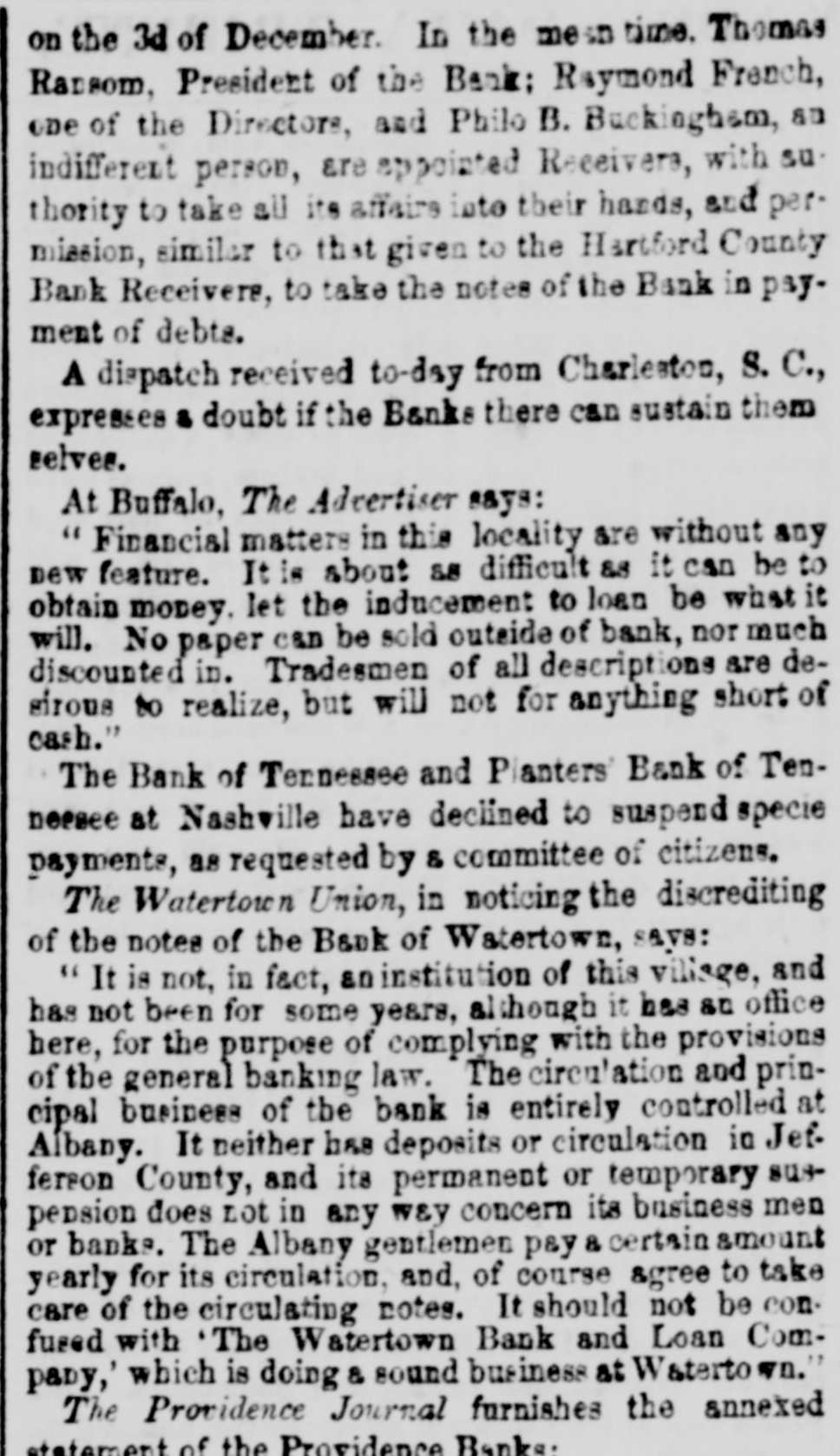
on the 3d of December. In the mean time. Thomas Ransom, President of the Bank; Raymond French, one of the Directors, and Philo B. Buckingham, an indifferent person, are appointed Receivers, with authority to take all its affairs into their hands, and permission, similar to that given to the Hartford County Bank Receivers, to take the notes of the Bank in payment of debts. A dispatch received to-day from Charleston, S. C., expresses a doubt if the Banks there can sustain themselves. At Buffalo, The Advertiser says: "Financial matters in this locality are without any new feature. It is about as difficult as it can be to obtain money. let the inducement to loan be what it will. No paper can be sold outside of bank, nor much discounted in. Tradesmen of all descriptions are desirous to realize, but will not for anything short of cash." The Bank of Tennessee and Planters' Bank of Tennessee at Nashville have declined to suspend specie payments, as requested by a committee of citizens. The Watertown Union, in noticing the discrediting of the notes of the Bank of Watertown, says: "It is not, in fact, an institution of this village, and has not been for some years, although it has an office here, for the purpose of complying with the provisions of the general banking law. The circulation and principal business of the bank is entirely controlled at Albany. It neither has deposits or circulation in Jefferson County, and its permanent or temporary suspension does not in any way concern its business men or banks. The Albany gentlemen pay a certain amount yearly for its circulation, and, of course agree to take care of the circulating notes. It should not be confused with 'The Watertown Bank and Loan Company,' which is doing a sound business at Watertown." The Providence Journal furnishes the annexed statement of the Providence Banks:


Article from Vermont Phœnix, October 31, 1857

Click image to open full size in new tab

Article Text

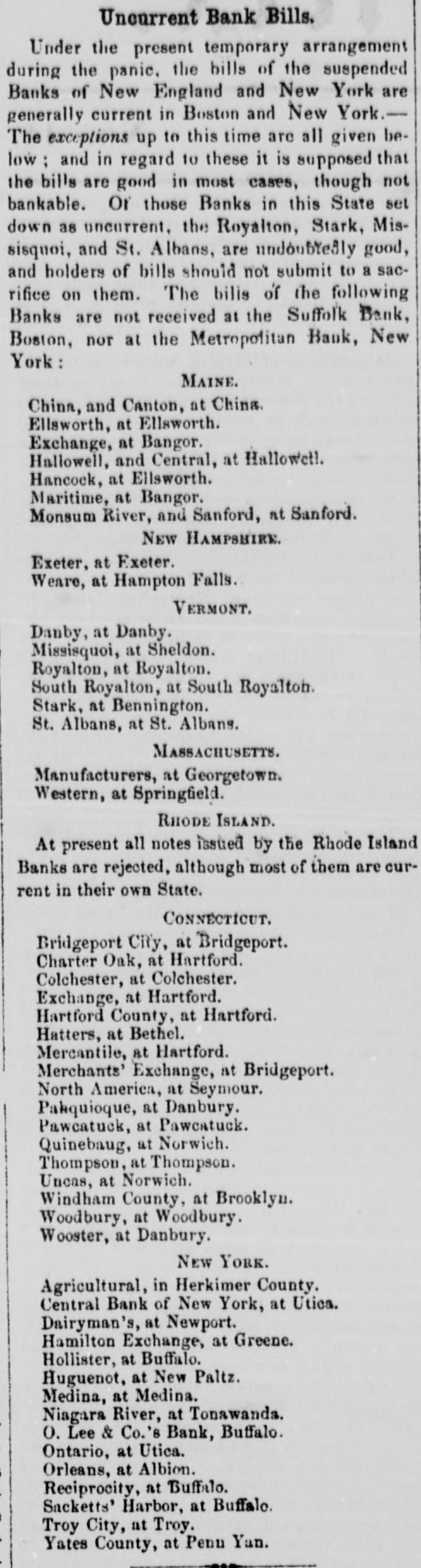
Uncurrent Bank Bills. Under the present temporary arrangement during the panic, the bills of the suspended Banks of New England and New York are generally current in Boston and New York.The exceptions up to this time are all given below ; and in regard to these it is supposed that the bills are good in most cases, though not bankable. Or those Banks in this State set down as uncurrent, the Royalton, Stark, Missisquoi, and St. Albans, are undoubtedly good, and holders of bills should not submit to a sacrifice on them. The bilis of the following Banks are not received at the Suffolk Bank, Boston, nor at the Metropolitan Bank, New York : MAINE. China, and Canton, at China. Ellsworth, at Ellsworth. Exchange, at Bangor. Hallowell, and Central, at Hallowell. Hancock, at Ellsworth. Maritime, at Bangor. Monsum River, and Sanford, at Sanford. NEW HAMPSHIRE. Exeter, at Exeter. Weare, at Hampton Falls. VERMONT. Danby, at Danby. Missisquoi, at Sheldon. Royalton, at Royalton. South Royalton, at South Royalton. Stark, at Bennington. St. Albans, at St. Albans. MASSACHUSETTS. Manufacturers, at Georgetown. Western, at Springfield. RHODE ISLAND. At present all notes issued by the Rhode Island Banks are rejected, although most of them are current in their own State. CONNECTICUT. Bridgeport City, at Bridgeport. Charter Oak, at Hartford. Colchester, at Colchester. Exchange, at Hartford. Hartford County, at Hartford. Hatters, at Bethel. Mercantile, at Hartford. Merchants' Exchange, at Bridgeport. North America, at Seymour. Palaquioque, at Danbury. Pawcatuck, at Pawcatuck. Quinebaug, at Norwich. Thompson, at Thompson. Uncas, at Norwich. Windham County, at Brooklyn. Woodbury, at Woodbury. Wooster, at Danbury. NEW YORK. Agricultural, in Herkimer County. Central Bank of New York, at Utica. Dairyman's, at Newport. Hamilton Exchange, at Greene. Hollister, at Buffalo. Huguenot, at New Paltz. Medina, at Medina. Niagara River, at Tonawanda. O. Lee & Co.'s Bank, Buffalo. Ontario, at Utica. Orleans, at Albion. Reciprocity, at Buffalo. Sacketts' Harbor, at Buffalo. Troy City, at Troy. Yates County, at Penn Yan.


Article from Litchfield Enquirer, December 3, 1857

Click image to open full size in new tab

Article Text

Business Items. Since our last issue, we have three days lafer news from Europe by the Vanderbilt. The accounts are of the aggravation of the panic in Great Britain to a frightful degree, followed by a sudden lull, produced by the putting forth of a Treasury letter. The following is the dispatch to the New York papers: The despondent condition of monetary matters on the departure of the steamship Atlantic on the afternoon of the 11th inst., resulted in the following day in a fearful panic throughout the whole country. All the banks utterly refused to discount to their patrons, which naturally added to the wild excitement, until the afternoon of Thursday when a Treasury letter appeared in London, and was instantly transmitted by telegraph to all the chief cities and towns, suspending the Bank Charter Act, and authorizing the issue of notes to any amount on app.oved securities. The effect at every point was instantaneous, and the panic ceased as if by magic. At Liverpool, Manchester, Glasgow, and other important cities, the news were received with the most important demonstrations of joy. There seems to be general apprehension both in Ehrope and America, of a deep depression in the cotton trade and manufacture. We clip the following from the close of an editorial in the Tribune. The Manchester Guardian concluded, months ago that a fair balancing up of accounts for 1856 would show the manufacturers that they had been working from December to December, not merely without profit but at a positive loss and as to the present year, when we come to add to the enhanced price of cotton and the low price of goods, all the losses to result from the non-payment of American debts, it is plain that the British cotton manufacturers will find themselves staggering under a heavy burden. From the way the thing has worked in New England. and the rest of our cotton manufacturing districts, we can well understand the real nature of the trouble in Glasgow, which is one of the great seats of the cotton manufacture. Of course a very decided decline must follow in the price of cotton, it being impossible that the mill owners should go on any longer, not merely manufacturing for the exclusive benefit of the cotton growers, but sinking their own capital in the operation. Whatever may be the case with other branches of commerce, it is but too evident that the whole business of the growth and manufacture of cotton has stood for some time past on a very unsound basis. We appiehend that many of our Southern friends who have invested in slaves at the late enormous prices, may find themselves before long in almost as discouraging a position as the mill-owners. LATER. The steamer Fulton, which arrived off Cape Race on the 28th, brings advices four days later. Among other pleasant items, she brings $230,000 in specie. She also has 71 passengers, with a large and very valuable cargo of French merchandise. The Fulton's dates are four days later than those brought by the Vanderbuilt, already telegraphed from this point. The Cunard steamer Europa, from Boston via Halitax, Nov 4th, arrived at Liverpool on the 16th. The financial advices brought by the Fulton. although not so exciting as those of the Vanderbuilt, are nevertheless of absorbing Interest The good effects of the suspension of the bank charter act were still showing themselves everywhere throughout Great Britain. The money market was firmer than at last advices. and the demand for discounts at the Bank are less pressing. Consols had also been advaning. The Bank of France, as was anticipated at ast advices had announced its determination to immediately extend its issues. The rate of interest at Hamburgh, had receded, the last quotations being at 9 1-2 Notwithstanding the improvement in the English money market, there had been several heavy failures in branches of business in Great Britain. The steamship Daniel Webster, from Havana on the 25th inst. arrived at New Orleans on the 20th. She brings half a million in specie The steamship Northern Light, left Havana on the same day as the Webster with California dates to the 5th instant, and nearly two millions in specie' The tales of Mormon ontrage upon Californians and emigrants are more than confirmed. The Hatters' Bank, Bethel. has stopped redeeming at the banks of New York and Boston, and now redeem at the office of B. P. Manierre. at one cent discount. The capital of this bank is $100,000, with a surplus of $3,000. The entire circulation is less than $28,000. A dairyman in Litchfield county. a few days since sold his cheese fot eight cents per lb., the same lot for which a few weeks since he refused eleven cents. CURIOUS BANK DEVELOPMENTS.-The Hartford Press makes a curious exposure in regard to the management of the Hartford County Bank, one of the offsprings of the Free Banking law. It appears that when the institution got rid of the general law. and set up under a special charter, it gave bonds for the redemption of its Free Banking law bills then in circulation, which according to the number registered in the State Department should have been only $11,000. But instead of $11,000, the Receivers have already had $16,000 returned to them, and may yet have more! Of these, there is no amount either on the books of the bank. in the State, Department


Article from New-York Daily Tribune, January 1, 1858

Click image to open full size in new tab

Article Text

NEW-YORK DAILY TRIBUNE, FRIDAY, JANUARY 1, 1858. Refu Refi 1858. 12,000 COMPARATIVE PRICES IN NEW-YORK, 1857, JANUARY 1, Foreign Bullione 1856. Other 26 W28 11,000 31 @311 U. 8. Bullion (contained in Gold) - v2 schooner of 150 tuns, from an Eastern port to Jameica, 4,000 25 @25 NewSheathing (suits) -@% U. S. Bullion (eld Coins) Yellow Metal 234724 24 &25 -025 at $8 out and $5 s tun home. Pig, Chili T - aso - as2 $1,560,000 -@35 Total Deposits payable in Bare Belts F @@3 The business of the Sub-Treasury was: Total Re1,700,000 140,000 - @63 --@35 Total Deposits payable in Coins Braziers Other 194@20 29420 27@28 American Ingot, cash ceipts, $151,753 47; from Customs, $31,168 15; Pay17 @171 $2,375,213 9 Gold Bars Stamped Sheathing, old, cash 854,904 19 ments, $325,852; Balance, $3,274,953 11. Transmitted to U. Mint, Phila., for Coinage FLOUR AND MEAL-The 24@26 inquiry for 23/@25 Western Canal Flouri The Park Bank has declared a semi-annual dividend more active, at d the market is firmer under the steamer's news. There is no material change to be noted in money The mand is in part for export. The stock, se carefully made Clea of 3 P cent, payable January 4; the Mechanics and matters. Paper of the best quality is negotiated withup by us, and which we think may be depended upon, shows de- a Mes Traders' Bank of Jersey City, 5 P cent, payable larger aggregate than we expected, but with a good export Thin out difficulty at rates varying from 7@10 P cent, acmand will soon disappear. The sales are 9,000 bble. at $4 20@ Prin January 5; the Bank of the Metropolis, Washington $1 25 for common to good State, $1 45@$4 60 for extra do, cording to its classification. Prime single names pass Flan $1 20@$4 25 for superfine Indiana and Michigan, $4 45@$5 20 Prin at from 12 15. On call, the supply is large at from 5 City, cent, payable January 1; the Tradesmen's for extra do., $4 55@$5 20 for common to good extra Ohio: Run Bank of New-Haven, 4 P cent; the Western Bank of 07 P cent. The banks take nearlyall of the offerings $5 50 for good to extra do., $5 25@$7 25 for St. Louis Refu brands, and $525@$7 for extra Genesee. Canadian Flour is Refu Baltimore, 4 P cent; and the Merchant's Bank of same of good, substantial names. held firmly the stock is very small, and the arrivals are light: Other sales of 300 bbls. at $4 25@$4 30 for superfine, and $5@$6 50 city, 41, P cent. Unin The Philadelphia Ledger says: for extra. Southern Flour very dull and heavy, the arrivals light The semi-annual interest on the convertible bonds of The Philadelphia banks have been strengthening and the stock liberal the sales are 450 bble. at $4 50@$5 for themselves daily for the last two or three weeks. the Panama Railroad, due on the 1st of January, will mixed to good brands Baltimore, &e., and 10@$6 50 for the To Their coin now averages considerably more than that better grades, the latter unsettled. Rye Flour is steady: sales of Prin be paid on presentation of the coupons at the office of 200 bbls. at $S@$4. Corn Meal is inactive; $3 10@$3 20 for Mest required by law. They will continue to strengthen Jersey, and $3 50@$3 60 for Brandywine, and $17 for punthe Company after Saturday next. 4,712 themselves and be ready for resumption at the earliest cheons. Buckwheat Flour is in fair demand, and is better; sales To A semi-annual dividend of 5 P cent has been depracticable period. If the country banks want longer at this time than the act allows, they must battle the quesCOMPARATIVE STOCK OF FLOUR IN NEW.YORK CITY, JAN. 1. 3,787 clared by the Cleveland, Columbus and Cincinnati 1855. 1856. 1857. 1858. tion with the Legislature themselves, the Philadelphia Mes Railroad Company, payable the Phenix Bank, in this -; banks being determined to assert their independence Western Canal Flour, bbls. 120,000 439,600 27,300 255,000 18,600 176,900 7,800 20,700 Canadian Flour, bbls Run city, or and after February 1. of these concerns hereafter. 48,000 180,100 119,500 118,450 Southern Flour, bbls last Interest on the State bonds of Ohio and Illinois will COMPARATIVE PRICES IN NEW-YORK, JAN. The money market is quiet, and for unquestioned 192: Western. State. Years. 758r paper the rates are easy, ruling at 8@ 10 per cent, for $450@462 be promptly paid as usual. $437@4.50 1852 tals, 5 65@5 75 short dates, and at 1@2 per cent a month for second 5 56 @5 62 The Ulster County Bank has declared a semi-annual 1858 7 56 @7 78 class bills. 7 50 @7 62 1854 950@987 dividend of 5 cent, and the State of New-York Bank 9 184 9 621 1855 We annex 8 comparative statement of the Imports 8 31@8 68 831 @8 43 1856 & semi-annual dividend of 3 P cent. 6 25 @6 55 of Foreign Dry Goods at New-York for the week and 1857 4 25@4.50 Rep The City of Troy has to pay to-morrow $20,400 420 @4.60 since Januaryl: Do. 1858 FISH-The market is quiet, but prices are well sustained both interest on the bonds loaned by the city to the Union Rail COMPARATIVE STATEMENT of the Imports of Foreign Dry for Dry Cod and Mackerel: 2,000 of Marblehead Cod remain Goods at New York for the week and since Jan. 1. Refu Railroad Company; that company being without the afloat unsold, being held above the views of buyers. Herring are FOR THE WEEK. Other dull, but prices are nominally the same: cargo of Pickled are on 1857. 1856. 1855. means whereby to raise the money. Unin the market unsold, being held at $3 75, which is above the views $289,396 1,209,737 $3,727,472 Unin Entered at the port The Panama Railroad Company will pay on the of buyers. Box Herring are inactive. 3,024,251 218,656 1,152,864 Thrown on market COMPARATIVE PRICES OF FISH IN NEW-YORK, JAN. 1. SINCE JANUARY 2d of January the interest on its convertible bonds. 1858. 1857. 1857. 1856. 1855. $300@3.50 $400@4.25 The books for the transfer of stock are also closed $90,534,129 $93,362,893 Dry Cod,7 cwt $68,701,584 Entered at the port 175@225 225@250 Dry Scale 81,522,830 91,247,806 69,251,004 Thrown on market until January 16. 3 25@ 3 75 --@400 Pickled Cod RECAPITULATION. --a21 00 28 00 The New-York City 5 P eent stock of 1858, about Mackerel, No. 1, Mass., large ENTERED FOR CONSUMPTION. 925@950 City i--@17.00 Mackerel.: No. 1, Mass., small Value. Pkgs. Value. -----Pkgs. Manuf. of CARD $3,000,000, comes due on and after January 1. 15 00 216 00 Manuf. of Mackerel, No. 1, Halifax 47 Miscellaneous. $13,844 $23,787 Do. 54 825@860 Wool 18 50@The interest on the Wabash and Erie Canal 6 P Mackerel, No. 2, Halifax large Rail 28,890 127 --0-Cotton 7257775 Mackerel, No. 2, small and med 327 Total Refu $106,305 19,139 29 ---Silk cent stock will be paid January 2 at the office of the 750@800 Mackerel, No. large Refu 21,095 70 --a-5 00@ 5 25 Flax Mackerel, No. 3. medium Trustees, No. 12 Wall street. WITHDRAWALS Other --Q-425@475 Mackerel No. S, Halitax Value. Pkgs. Value. Tea. Manuf. of Pkgs. 19 00 20 00 --2150 The Hanover Fire Insurance Company have deManuf. of Salmon, Pickled, No. Miscellaneous. 70 19,150 72 $23,523 Cour Wool --28 00 Salmon, Pickled, tee clared a semi-annual dividend of 6 P cent, payable on 21,526 129 Cour --1025 Cotton --1025 Shad, Conn., half-bbl 465 Total 26 31,929 $112,351 Unis Silk --@925 demand. Shad, Conn., No. 2. 168 Unit 16,223 3 25@ $ 75 375@475 Flax Herring, Pickled WAREHOUSED. - 30@-35 The coupons due January 1, 1858, on bonds of the 371 Herring, Scaled, P box Value. Value. Manuf. of Pkgs. -17@-20 25@Manuf. of Pkgs. Herring, No. City of Hartford, payable in New-York, will be paid Miscellaneous 80 107 $32,830 $32,429 Wool 137150 1 37t@ To Herring, Dutch, P keg. 364 69,455 Cotton on presentation at the office of Ketchum, Howe & Co., mon GRAIN-There is little doing in Wheat, and the market is 645 Total 39,449 55 $183,091 Silk mon No. 45 William street, on and after Saturday, Jan. 2. heavy. The sales are bush. Southern Red at $108 $110, and 39 9,728 Flax 2.44 500 bush. good White Southern $125. Rye is quiet at 72@73c for The interest due on the first of January on the mort223 Northern: sales of 1,000 bush. Jersey at 70c. Oats are firmer, and The Legislature of Tennessee has passed a bill delast in moderate request at 25@30c for Southern, 33@40c for Jersey, 42 gage bonds of the Lackawanna and Bloomsburg Railmon @41 for State, and 45@46 for Western. Corn is in better demand, claring that the banks of that State shall resume spe67; road Company will be paid at the Mercantile Bank of in part for export, and if dry would sell freely at about 60c for shipcie payments on the 1st of January, 1859, at which 1.73 ment-the local demand is moderate--sales of 19,000 bush. at 56 this city. Notwithstanding the hard times, the work 2,76 @62c for new Southern and Jersey Yellow 611 for inferior old time they are to issue no notes below $10. 590 on this road has steadily progressed to completion, and White, and 64 nominally for Western mixed. Barley is in large The Directors of the Hartford County Bank, after a 3,04' stock, and prices are nominal at 65@78c. regular trains commenced running its entire length (57 mon COMPARATIVE STOCK OF GRAIN IN NEW-YORK-JAN. 1. long consultation with the Receivers, on Tuesday aftermon 1855. 1856. 1857. 1858. miles) on the 21st of Dec., connecting at Scranton, Pa., 389,000 531,650 789,796 74,000 R noon, passed a vote conforming to the views of the Wheat, bush with the Delaware, Lackawanna and Western Rail97,000 1,967,500 645,962 500,000 at S Corn, bush Commissioners, in regard to their capital stock. This, 1857 COMPARATIVE PRICE IN NEW-YORK-JAN. 1. road, and at Rupert with the Catawissa, Williamsport Corn, new & old. Rye. when carried into effect, reduces the capital to Red and White Wheat. is 3, Years. 56 W60c. and Erie Railroad. $00000.77 1852 $100 â1 15 68 a/73c. $300,000, and fixes the par value at $50 P share. 0.00@0.93 1 25@1 30 1853 Messrs. Duncan, Sherman & Co. pay interest on 77@83c. 1 22@1 23 1 90@2 05 1854 The Bank Commissioners, in consequence of this ac97@104c. 160@1.62 2 20@2 40 1856 1855 the following securities, at their banking-rooms: Al78@98c. tion, have consented to a further extension of sixty 1 30@1 31 1857 1 90@2 20 1856 bany City, Buffalo City, Cleveland City Water, Chica68@75c. 0907092 SI 1 40@1 78 1857 days-during which it is expected that arrangements 56@65c. 0 69 00 72 0 82@1 30 sale 1858 go City, Buffalo and State Line Railroad Co., Mobile 7e., HEMP-The demand for Foreigh is limited andthe stock of Mamay be made for the resumption of business. and Ohio Railroad Co.'s Income Bonds, Buffalo and nila has been augmented by recent arrivale, being now some 15,000 for The London papers in noticing the resumption of bales. Domestic is in moderate request, particularly Dressed, Niagara Falls Railroad Co., New-York State 51 stock the Messrs. Babcock, refer to the cause of the temwithout, however, leading to business transactions. issued to aid the construction of Auburn and Rochester Cub STOCK OF HEMP ON HAND JAN. 1, 1857 AND 1858. 1858. porary suspension, and erroneously ascribe it to the 1857. Port Railroad. 576 232 New lack of remittances from this side of the water. This American Dressed, bales 607 111 The Controller is now arranging for its payment. St. American Undressed, bales we understand to be entirely incorrect-the house of *15,000 13,626 Manila, bales A portion will, no doubt, be exchanged for a new issue Babcock & Brothers, which is the New-York branch, Box of six per cent stock running thirty years. Some par1858. Estimated. COMPARATIVE PRICES IN NEW-YORK 1857. JAN. 1. Bag having remitted promptly, as usual, in sixty-day bills, 50 ties have already made this exchange, and othershave Mel which, however, the English house could not nego1000110 00 American Dressed, tun. $250 @ 280 1856. $285@250 200@210 $185@147 American Undres'd, P tun. 170@180 signified their intention to do so. The Columbia and 110@115.00 120@125 20@ 95 Year tiate, at the time of the suspension of the Bank CharJute, tun Xenia Railroad Company has declared 8 dividend of @101c. Twite. gagge. 1852 Manila, P 16 ter Act, ON account of the general distrust which pre1858 WIDES The market is quiet to-day; the sales are confined to five per cent payable in five years, hands of the commediate wants. The stock is 385,000. 1854 vailed. pany bearing seven per cent interest. COMPARATIVE PRICES IN NEW-YORK, JAN. 1. 1855 Angostura. Buenos Ayres. 1856 Mr. Albert H. Nicolay's regular daily auction sale of 11#@18c. @lle. 1852 Family Marketing. 1857 Stocks and Bonds will take place on Saturday next, - @14c. 1853. 154@16c. 1858 The following table gives the retail price of the prin22 @23c. 1854 21f@22c. W Jan. 2d, at 12} o'clock at the Merchants' Exchange. - @17c. 1855 19j@194c. You cipal articles of Farm Produce in the City of New-York a24 aThe following sales of stocks and bonds were made 1856 St 31 a 291aon Thursday, Dec. 31: 1857 45h at auction to-day by Albert H. Nicolay: MEAT. 20 @17@1858 Totaldad in lado |Pineapple Ch., each 184@ -


Article from New-York Daily Tribune, January 1, 1858

Click image to open full size in new tab

Article Text

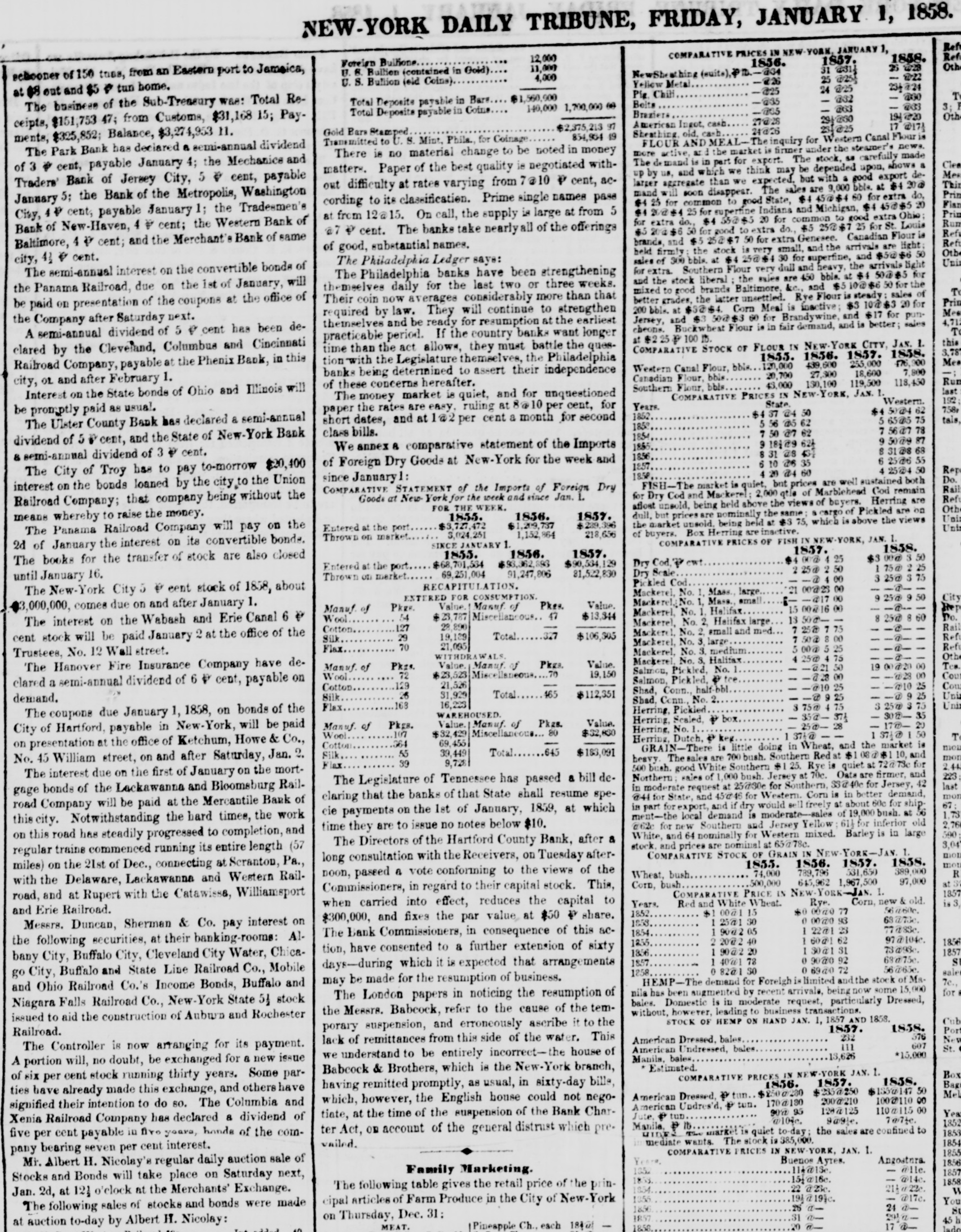
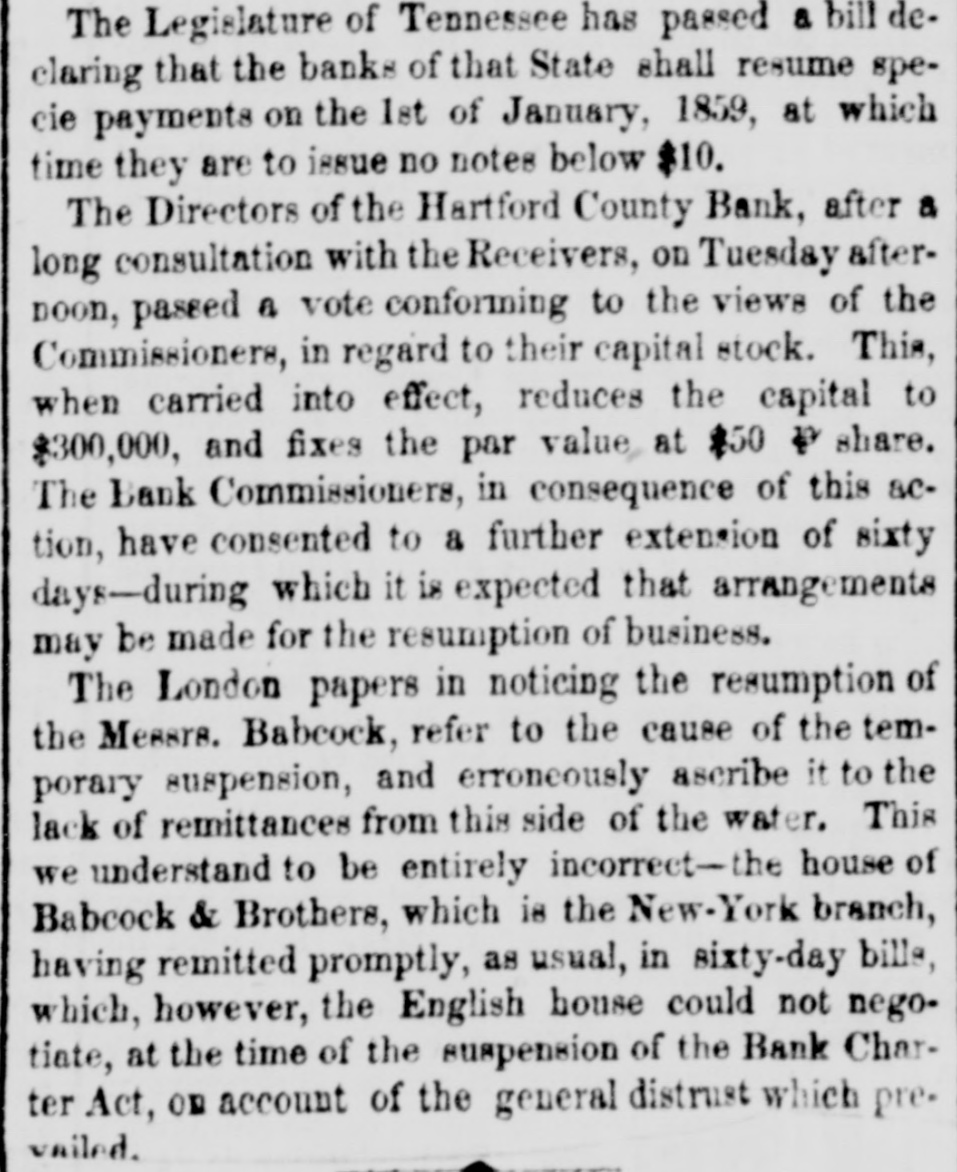
The Legislature of Tennessee has passed a bill de- claring that the banks of that State shall resume spe- cie payments on the 1st of January, 1859, at which time they are to issue no notes below $10. The Directors of the Hartford County Bank, after a long consultation with the Receivers, on Tuesday after- noon, passed a vote conforming to the views of the Commissioners, in regard to their capital stock. This, when carried into effect, reduces the capital to $300,000, and fixes the par value at $50 share. The Bank Commissioners, in consequence of this ac- tion, have consented to a further extension of sixty days-during which it is expected that arrangements may be made for the resumption of business. The London papers in noticing the resumption of the Messrs. Babcock, refer to the cause of the tem- porary suspension, and erroneously ascribe it to the lack of remittances from this side of the water. This we understand to be entirely incorrect-the house of Babcock & Brothers, which is the New-York branch, having remitted promptly, as usual, in sixty-day bills, which, however, the English house could not nego- tiate, at the time of the suspension of the Bank Char- ter Act, on account of the general distrust which pre- vailed.


Article from The New York Herald, February 18, 1858

Click image to open full size in new tab

Article Text

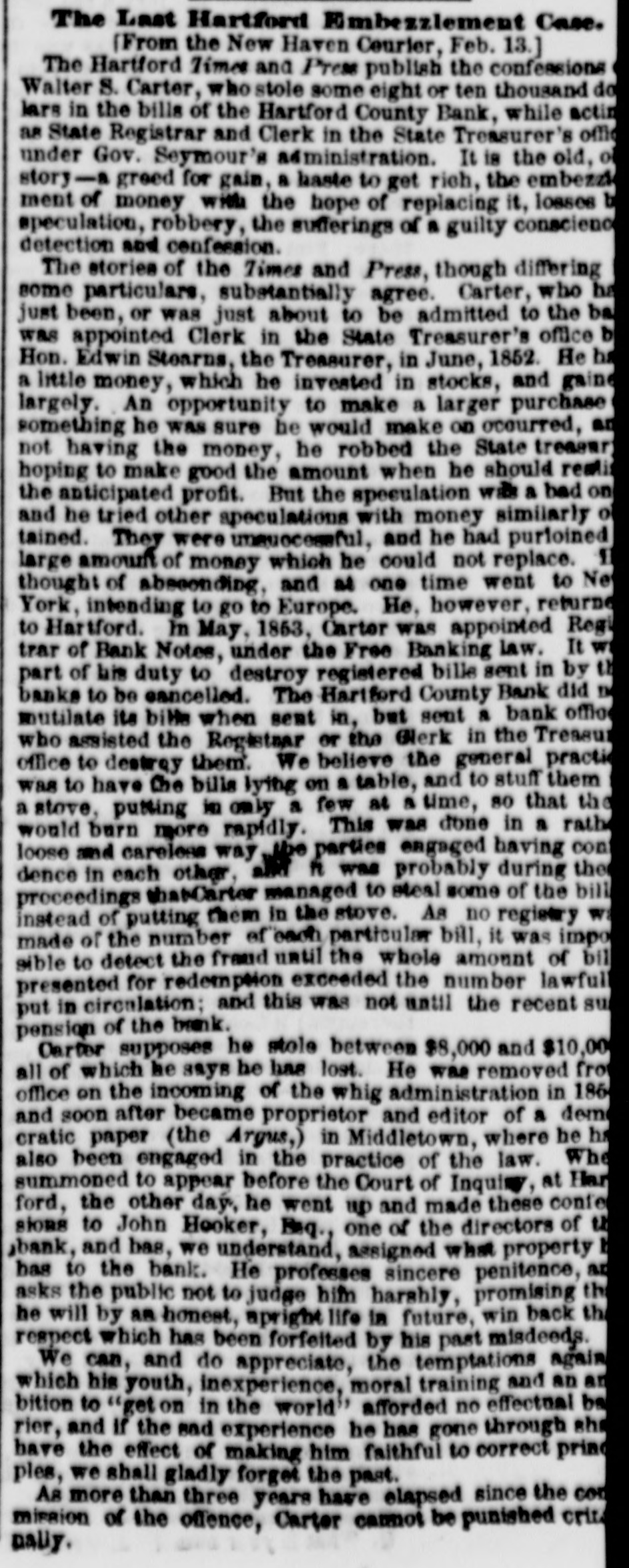
The Last Hartford Embezzlement Case. [From the New Haven Ceurier, Feb. 13.] The Hartford Times and Press publish the confessions << Walter S. Carter, who stole some eight or ten thousand dos lars in the bills of the Hartford County Bank, while actima as State Registrar and Clerk in the State Treasurer's office under Gov. Seymour's administration. It is the old, of story-a greed for gain, a haste to get rich, the embezzio ment of money with the hope of replacing it, losses be speculation, robbery, the sufferings of a guilty conscience detection and cenfession. The stories of the Times and Press, though differing some particulars, substantially agree. Carter, who ha just been, or was just about to be admitted to the ba was appointed Clerk in the State Treasurer's office be Hon. Edwin Stearns, the Treasurer, in June, 1852. He ha a little money, which he invested in stocks, and gaine largely. An opportunity to make a larger purchase something he was sure he would make on occurred, an not having the money, he robbed the State treasur hoping to make good the amount when he should realis the anticipated profit. But the speculation wills a bad on and he tried other speculations with money similarly of tained. They were unsuocessful, and he had purioined large amount of money which he could not replace. 11 thought of absconding, and at one time went to Net York, intending to go to Europe. He, however, returne to Hartford. In May, 1863, Carter was appointed Regi trar of Bank Notes, under the Free Banking law. It we part of his duty to destroy registered bills sent in by th banks to be eancelled. The Hartford County Bank did IN mutilate its bills when sent in, but sent a bank office who assisted the Registear or the Clerk in the Treasur office to destroy them. We believe the general practic was to have the bills lying on a table, and to stuff them ( a stove, putting in only a few at a time, 80 that the would burn more rapidly. This was done in a rathe loose and careless way the parties engaged having cont dence in each other, and n was probably during the proceedings thatCarter managed to steal some of the bill instead of putting them in the stove. As no registry wa made of the number of each particular bill, it was impo sible to detect the fraud until the whole amount of bill presented for redemption exceeded the number lawfull put in circulation; and this was not until the recent sui pension of the bank. Carter supposes he stole between $8,000 and $10,00 all of which he says he has lost. He was removed fro office on the incoming of the whig administration in 186 and soon after became proprietor and editor of a demo cratic paper (the Argus,) in Middletown, where he ha also been engaged in the practice of the law. When summoned to appear before the Court of Inquiry, at Har ford, the other day, he went up and made these confe sions to John Hooker, Beq., one of the directors of th bank, and has, we understand, assigned what property be has to the bank. He professes sincere penitence, and asks the public not to judge him harshly, promising the he will by an honest, apright life in future, win back the respect which has been forfeited by his past misdeeds. We can, and do appreciate, the temptations agains which his youth, inexperience, moral training and an an bition to "geton in the world" afforded no effectual bai rier, and If the sad experience he has gone through she have the effect of making him faithful to correct prino ples, we shall gladly forget the past. As more than three years have elapsed since the come mission of the offence, Carter cannot be punished crits nally.


Article from The New York Herald, May 24, 1858

Click image to open full size in new tab

Article Text

# THE WAY BANKS ARE MANAGED IN CONNECTICUT. [From the New Haven Courier, May 28.] We are obliged to Mr. Commissioner Noyce for copy of the Bank Commissioners' Report for the yearjst expired. The commissioners refer in the first place to the financial panis, at the commencement of which our banks had he outstanding circulation of $10,000,000; the sudden withdrawal of public confidence caused a sudden contraction of currency, which proved a source of great temporary embarrassment. On the first day of July the circulation of the banks of this State was $10,411,000; on the first of January it was reduced to $4,130,266, a contraction of over $6,000,000, and most of which took place between the first of August and the first of November. The ability of the banks to sustain themselves, without breaking down their customers, under a contraction so unprecedented, exhibited a degree of soundness and stability which must place them high in the confidence of the public of this and other States. With but few exceptions, they continued to redeem their notes in Boston and New York, and to pay specie at their banking house until the general suspension of the banks in New York and Boston, which took place on the 14th of October. On the 15th most of the banks of this State suspended specie payment, but in a majority of cases continued their redemption in Boston or New York, thus keeping the currency of this State from depreciation, and enabling all parts of the country possessing it to go forward in the liquidation of their debts, without suffering loss from the currency of Connecticut. Of the nine banks chartered by the last Legislature only the Etna, Merchants' and Manufacturers' of Hartford, and Bank of Norwalk, have gone into operation. Prior to the general suspension several banks became embarrassed The Harford County Bank, as early as September, was unable to provide for an outstanding circulation of $440.000, and an examination showed great mismanagement and duplicity on the part of the directors. Large claims, amounting in one instance to over $80,000, had been entirely concealed by being placed in the names of responsible parties, under an agreement that they should be held harmless. In other instances large amounts of debts, the character of which the commissioners could know nothing about without investigations out of the bank, were represented by the directors to be good and available, when in fact it was evident to them that they were either worthless or nearly so. Notwithstanding this the directors declared a dividend last July, whereupon the commissioners obtained an injunction and had receivers appointed. By good management the bank has been relieved, with the loss of half its capital, and has been allowed to resume its business with $300,000 stock. It is a question of some importance to determine who shall pay the $6,000 or $7,000, in notes of this bank, stolen by W. S. Carter, a clerk in the treasury department The Bank of North America, at Seymour, which had been the subject of remark in the previous report of the commissioners, was found in September last to have loaned large sums out of the State, on unavailable security, leaving the bank without the means to redeem its circulation. Its general management was bad, suspended debt increased, and capital stock impaired. Its immediate liabilities were over $70.000, and they had on hand only $1,072 in specie. An injunction was issued. On the 10th of April the case was called up, and it was found the receivers had reduced the liabilities of the bank for circulation, deposits and balances, down to $48,541. The assets of the bank now amount to $169,000. The commissioners say that the Exchange Bank of Hartford had carried a heavy amount of protested paper of a doubtful character for a series of years. It is their opinion that the bank should have ceased to make dividends more than two years ago. A dividend was passed in January, 1857, but in July of that year a dividend of 4 per cent was declared and paid. As this dividend impaired the capital the commissioners consider it to have been injudicious and illegal. A further examination developed a defalcation of about $25,000 in the accounts of the Cashier. This developement indicated great carelessness on the part of the officers and directors of the bank, for the defalcation had extended through several years, and might have been exposed, had the monthly statements been examined and tested with their own books. At the time the bank was enjoined its liabilities amounted to $250,000, and their specie funds were reduced down to $2,939. When the bank resumed specie payments its liabilities were reduced to $141,811, and their available funds amounted to $67,000. It was largely secured against ultimate loss by collaterals. It has from the beginning indulged in the illegal and dangerous practice of buying paper in New York, and in February last it declared a dividend, though it had on hand over $200,000 of protested paper. The Mercantile Bank, at first embarrassed by the failure of its correspondent in New York, will not sustain losses sufficient to seriously impair its capital. As to the Colchester Bank, the commissioners, after the changes in its administration, by direction of the last legislature, were still unsatisfied with its condition. In September it ceased its redemptions in Boston and was discredited in New York. Its general circulation at that time, by its books, was $14,000, of which $6,000 had been redeemed by New York banks; but this was evidently not the real condition of affairs. On the 3d of December an examination was made again, and it was found that Cashier F. S. Jones had caused to be printed from the original plates, by a firm of lithographers in Hartford, bills amounting to $101,108, a fact of which the president, cashier and directors must have been fully aware. The commissioners looked upon this transaction as fraudulent, applied for an injunction, and had Jones arrested in New York; but he was released before the proper papers could be procured from the Governor. J. H. Buell, the former President, testified that he had signed a quantity of notes without keeping any record of the amount or number, and that Jones had taken them away, promising to deliver them up, but had never done so. The amount of the irregular issue is supposed to be over $100,000, but as only $3,000 of it has been presented for redemption, it has probably not been put extensively into circulation. The assets of the bank will be sufficient to protect its creditors, but the stockholders will suffer largely. It is now being wound up by receivers. The Granite Bank swindle was one of the most deliberate frauds ever undertaken in this State. The first 10 per cent of the capital paid in was paid back by the directors, and the payment of the 40 per cent. was "a mere pretence," the money used being the bills of broken banks and worthless checks on banks out of the State, and the real managers who furnished the means of payment to the nominal stockholders in Voluntown resided out of the State. The bank pretended that it had issued no bills, but it was found that $23,000 had been signed and could not be produced. Outside parties were distributing these bills the headquarters of the concern were in a drinking saloon in New York, kept under the name of Prescott & Co. Samuel Wagner, of Ohio, Alexander Miller, of Buffalo, and Roswell C. Peck, of Hartford, are held on bail for trial before the Superior Court of Windham county as parties connected with the Granite Bank. An injunction was granted on the 10th of last November; its circulation is reduced to $3,000, and the assets and unpaid stock will enable the receivers to protect the public from loss. The Litchfield Bank started irregularly, without a bona fide capital. The commissioners checked its operations, and caused a change in its officers, and the payment of a bona fide cash capital of $50,000, with which it is now doing a legitimate business. One of the most flagrant violations of the banking laws of the State is in the case of the Quinnebaug Bank, of Norwich, which uniformly keeps a less amount of specie on hand than the law requires. It also loans too great an amount to individuals and to parties out of the State, and last December it had $225,000 under protest, on which its losses will be large. The Shetucket, Norwich, Uncas, Iron, Norfolk, Winsted. Saugaluck, Farmers' (Bridgeport), Danbury, Pabquioke, Manufacturers' (Derby), Windham, Waterbury, Middlesex County, Middletown, State, Merchants' and Manufacturers' (Hartford), Home, Meriden, Clinton, City (Bridgeport), Whaling, Commerce, Mystic River, Jewett City, Rockville, Connecticut River, and Stafford Banks are also reported as having, more or less, frequently violated some provision or provisions of the law, generally by loaning too much to directors or parties out of the State, keeping too little specie and buying brokers' paper at large discounts. The Phoenix Bank of Hartford has a suspended debt of $347,224, growing out of loans to Henry Dwight and the Chicago and Mississippi Railroad, from which must result a large loss, and which, in the opinion of the commissioners, made the payment of a dividend last March of doubtful expediency, if not illegal. Of the banks in New Haven, the commissioners say: The condition of the New Haven County Bank has not materially improved since it was first reported to the Legislature in 1856. Some portion of the debts due the bank have been adjusted by taking therefor a direct interest in the real estate, located in Brooklyn, N. Y. This arrangement covered $137,135 of the Dwight debt, and to protect this interest the bank is obliged to pay its proportion of the interest upon the first mortgages upon the property; also, its share of taxes and assessments for improvements. These items increase rapidly, and last year amounted to $16,000, which included, however, a small payment to the first mortgagees. The directors have been careful at all times to keep at command available means sufficient to protect the bill holders and depositors. But it is not in harmony with the uniform policy of the State to allow a bank so greatly depreciated to represent so large a capital stock. In the opinion of the commissioners the capital of the bank should be reduced to a proper level or its affairs placed