
15933. Greenwich Savings Bank (New York, NY)

Bank Information

Episode Type
Run Only
Bank Type
savings bank
Start Date
September 22, 1873
Location
New York, New York (40.714, -74.006)

Metadata

Model
gpt-5-mini
Short Digest
3b9b276e

Response Measures

Accommodated withdrawals

Description

Articles (Sept–Oct 1873) describe a slight run on Greenwich Savings Bank during the Panic of 1873 that was promptly met. The bank continued paying demands (did not invoke notice) and remained open; therefore classified as run_only. Bank is a savings bank (state-chartered) — inferred as 'state'.

Events (1)

1. September 22, 1873 Run
Cause
Macro News
Cause Details
Run occurred during the financial embarrassment/panic of 1873 (wider market distress) leading depositors to withdraw; articles report runs across many NYC savings banks.
Measures
Met all demands promptly; did not exact notice from depositors; paid out larger amounts to meet actual necessities.
Newspaper Excerpt
The Greenwich Savings bank has had a slight run, which was promptly met.
Source
newspapers

Newspaper Articles (3)

Article from Knoxville Weekly Chronicle, September 24, 1873

Click image to open full size in new tab

Article Text

WASHINGTON. Sent. 22.-In the course of the morning the President called at the Treasury Department and had a conference with Secretary Richardson. The result of it may be inferred from the fact thatsubsequently the Secretary stated to the agent of the New York Associated Press that the President will o anything within the law but will in no particular go beyond his clear legal authority. He will maintain the safety of the Treasury Department and protect the credit of the United States from the influences of the present financial embarrassment. Jay Cooke re-asserts the solvency of the London house. A private dispatch from Shreveport is discouraging. Pastor Hutter, of St. Mathew's Lutheran Church of Philadelphia is dead, aged 61 years. An American steamer at Newfoundland reports collision with a fisherman, three out of fifteen were saved. Bettingist and three to one on Brown for to-morrow's boat raco at Halifax. The Treasury Department denies that the navy account fund had been transferred from Jay Cooke, McCulloch & Co. Judge Richardson, says he will look out that the Government does its duty within the law, and he knows exactly where to get all the funds that are necessary, but does not intimate a word about the much talked of legal tender reserve, furnishing a part of the money to go to the Assistant Treasurer at New York. No meeting of the creditors will be held until full statements have been received from the various branch offices throughout the country. These are being prepared with the utmost dispatch. The firm can not at present say anything in regard to the duration of their suspension. The Clearing House statement is out to-day and shows that all the banks made their clearing satisfactorily, including the two heretofore reported in doubt. The following are the street quotations, showing a falling off New York Central, 91 Harlem, 106: Erie, 51; Rock Island, 87 Panama, 88. At present the excitement has complete. ly subsided. At the Broadway Sayings Bank, No. 4 Park Place, business was being transacted as usual, little or no exeitement prevailing. The amount paid up to two o'clock did not exceed $10,000, while the proportionate amount had been received. The bank officials do not anticipate a run. Shortly after the Bowery Savings Bank opened its doors, this morning, a large number of depositors began arriving and it soon became evident that there was going to be a run. The trustees met and decided to pay. all demands, as they did not believe that the run would last. One of the trustees stated that nearly all of the depositors drawing out their money were those having small accounts. The trustees say that they have et $2,000,000 government bonds, $1,000,000 in New York and $1,000,000 in Brooklyn, which could be drawn on immediately. However, if the run lasts, they will take advantage of every notice clause in their by-laws, but will even then pay out sums deup to $200 or $300, SO as to save their positors from any inconvenience. The Union Dime"Savings Bank, Canal street, is besieged by a vast throng. About two hundred are inside. The doors are closed, and a placard in the window announces that as many persons are in as can be paid to-day. The bank is amply able to meet the run, having on hand $1,500,000ir cash. They will sell to-day $500,000 in bonds, the proceeds going to reinforce their cash for to-morrow's run. They are not exacting the sixty days privilege accorded by its (by-laws. There are ninety thousand depositors with the institution. The New York Savings bank of Sixth Avenue, has had a run of $100,000, all checks being promptly cashed. The Greenwich Savings bank has had a slight run, which was promptly met. The Blecker street Bank is paying all checks upon presentation. A large line is in attendance. The Atlantic bank is paying all checks of one hundred dollars and less upon presentation. Checks of a greater amount are required to abide by sixty days by-law. Currency for the Purchase ef Ronds Fortheoming, WASHINGTON, Sept. 22.-Richard Harrington was appointed Secretary of State, of this District, vice E. L. Stanton, Esq., resigned. There will be a sufficient amount of currency in New York to-morrow, belonging to the Government to buy all the bonds that may be offered. The Secretary of the Treasury bas all that is necessary. and will lookout that there is enough in the hands of the Assistant Treasurer to buy everything in the shape of Government bonds that are presented for sale. Run on Savings Banks. The run on the Washington sayings banks to-day was comparatively very slight. Secretary Richardson received the following dispatch, dated at New York, today: Mercantile business progresses as usual. Wall street is already itself. The people join in congratulations to the President and Secretary Richardson for their stability. The Stock Exchange will be opened Wednesday Notice from Southern Banks. NEW YORK, Sept. 92 The holders of e drafts drawn by the undersigned, who are of Jay ree ferred honor to the banks correspondents for Cooke & and Co., bankers are Drafts set opposite their respective names.

Article from New-York Tribune, October 18, 1873

Click image to open full size in new tab

Article Text

SAVINGS BANKS UNSHAKEN. BUSINESS FLOWING BACK INTO ITS ORDINARY CHANNEL-PAYMENTS MADE TO DEPOSITORS IN ALL CASES OF NECESSITY-WITHDRAWAL MADE FOR PERMANENT INVESTMENT. " Business with us is easy," said President Brown of the Bowery Savings Bank yesterday, when questioned in this particular by a TRIBUNE reporter. easy as it has ever been." He further said that they had virtually resumed the payment of all demands, only draft requiring the legal notice, when the proposed a seemed unnecessary to the depositor. Only few of these notices were now given, on an average one or two daily. Taken altogether, notices had been received covering about $280,000; if the bank had settled all these book accounts at the time the respective notices were given. it would not have proved much more than the usual day's business. More money was being paid out than during the month previous to the panic, no doubt partly occasioned by the investments in real estate. He said the number of small drafts -of $5, $10, and was unusually large, which would seem to indicate that a large number of the laboring class were out of employment. Deposits, as was usually the case during the month of October, had been Finall. Deposits made after the 1st did not draw interest until the fullowing January. Compared with the corresponding month of last year, there was a very marked decrease, but taken altogether, everything connected with the banking business seemed most satisfactory at present. In the course of his remarks, Mr. Brown spoke of the statement made through the press to the effect that the savings banks were hoarding greenbacks-were ac cumulating in their vaults an "unusually large amount of bills. This," said he, " 80 far as the Bowerv Bank 18 I concerned, is untrue. On the Monday of the run, drew $500,000 from the Sub-Treasury, and the same day paid out $399,000. Anticipating a similar run on Tuesday, I that day drew another $500,000 from the Sub Treasury but the course then taken prevented run and this latter sum was left intact. I have now in the vaults $580,000 in greenbacks, against a liability of $27,000,000. and with notices covering $280.00 maturing within a few days. This amount is not as large by at least one third as the cash kept in the bank during the months of July and August last." When questioned as to the probable effect on their business of the enforcement of the law requiring notice. he said it did not appear hurtful to him. The depositors must in time acknowledge that they alone were benefited by such a course. Especially was this the case at this bank. The Bowery Savings Bank was in reality a charitable institution. and if the depositors could find more profitable investment for their savings, then its only aim was accomplished. There were no sinecures in the institution, none of the officers drew salaries except those actually engaged in the business of the bank. As to deposits, it would cause no disappointment if not another dollar was received. Secretary T.S. Armour reported a similar encouraging condition of affairs at the Union Ditne Savings Bank present they were paying sums of $500 upon demand, and even larger amounts when satisfied that they were required for legitimate business purposes. Notices covering about $57,000 had been received, and scarcely a day passed without many withdrawals were made. The drafts were mostly in small amounts. The receipts of the month were in excess of the payments, and, considering the circumstances, compared very favorably with the business of last year for the same month. the difference amounting to about $83,000. At present. business was not quite as heavy as ordinarily During the three days' run about $175,000 had been paid out-the largest amount in one day being $129,000. This was not equal to the usual payments for January and July, when dividends were declared. At these times as high as $150,000 or $200,000 was distributed in a single day. Of those w ho had helped to cause the run upon the bank, the majority were of the poorest and most illiterate their customers-it was safe to say seven out of ten could neither read nor write. At the Emigrant Industrial Savings Bank the Con troller said that they held notices of the withdrawal of deposits amount ing to $203,000. and in amounts varying from $50 to $2,000. He believed that little of this would be called for. Few notices were now coming in. only two or three a day. The receipts during the month were about one-third less than those of the corresponding month last year; the drafts were somewhat in excess. Much of the money was drawn for more profitable investment and not from any fear as to the security of the deposits. They still required the notice from those having no actual and immediate requirement for their moneys, but were paying all demands necessary for business purposes. At the Greenwich Savings Bank they have not exacted any notice from their depositors, meeting all demands promptly. Secretary Boyce stated that they were still paying out a larger amount of money than usual, but. as it seemed. chiefly to meet actual necessities. Few If any accounts were being closed, and no evidences of alarm could be seen among those making drafts. This ratber unusual drain upon the deposits he believed was occasioned partly by the large number of men out of employment at present, partly by the tightness of the money market, and partly by the investment of considerable sums in real estate. The drafts of this month were much larger than for the same period last year. He thought that the savings banks that had enforced the rule requiring notice from depositors would in the end suffer from it, and that those that had continued in the payment of all demands would be correspondingly benefited. Controller Craig, at the Bank for Savings of the City of New-York. said: Money is still coming in and going out. We are still paying out considerable more than our average previous to the panic, but among those drawing their deposits there are no evidences of fear as to their security. People seem to be very generally investing in good securities, and in real estate, and being unable to draw their deposits from other banks, are necessarily compelled to take what they have with us. Many are idle, and must have money to meet the actual requirements of life. Some of our country depositors have just heard that there has been some frouble in New-York, and are coming in to look after their deposits. Some take them. but more leave them. Very few accounts are being closed indeed a very fair percentage of money drawn during the excitement has been returned. To be brief, business is in most satisfactory condition. The secretary of the East River Savings Bank stated that the receipts for the week ending last Wednesday were $10,000 in excess of the amount for the corresponding week last year. The payments were somewhat heavier, and had been all along. Visits to numerous other savings banks-the German. Merchants' Clerks', Freedman's, Manhattan, Mechanics' and Traders', and Citizens'-substantiated the above reports. With all, business has resumed its ordinary channel, and the future appears most promising. THE DELTA KAPPA EPSILON FRATERNITY. EASTON. Pa.. Oct. 17.-The closing entertain-


Article from The Wheeling Daily Intelligencer, October 20, 1873

Click image to open full size in new tab

Article Text

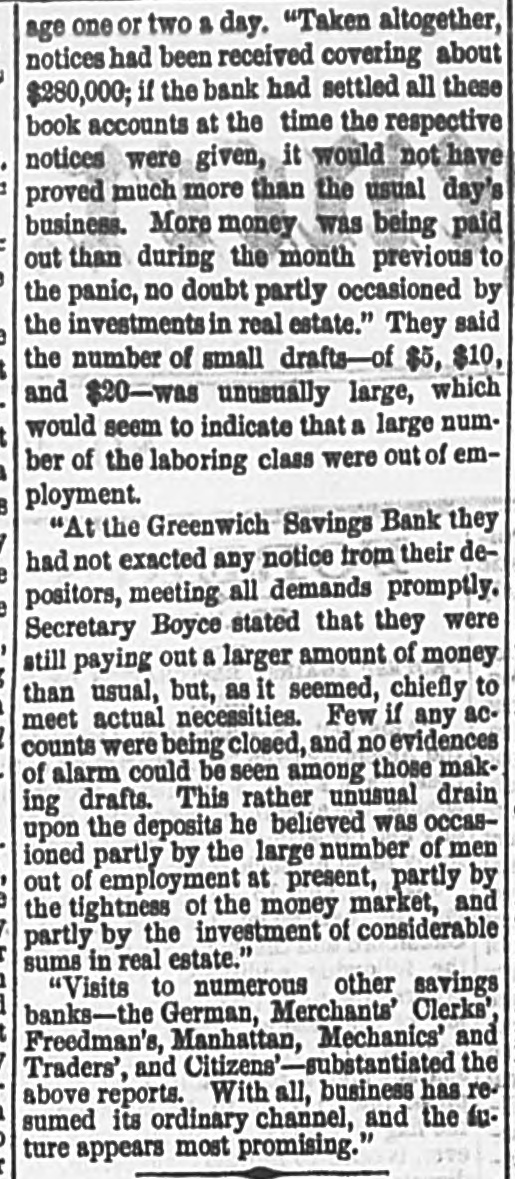
age one or two a day. "Taken altogether, notices had been received covering about $280,000; if the bank had settled all these book accounts at the time the respective notices were given, it would not have proved much more than the usual day's business. More money was being paid out than during the month previous to the panic, no doubt partly occasioned by the investments in real estate." They said the number of small drafts-of $5, $10, and $20-was unusually large, which would seem to indicate that a large number of the laboring class were out of employment. "At the Greenwich Savings Bank they had not exacted any notice from their depositors, meeting all demands promptly. Secretary Boyce stated that they were still paying out a larger amount of money than usual, but, as it seemed, chiefly to meet actual necessities. Few if any accounts were being closed, and no evidences of alarm could be seen among those making drafts. This rather unusual drain upon the deposits he believed was occasioned partly by the large number of men out of employment at present, partly by the tightness of the money market, and partly by the investment of considerable sums in real estate." "Visits to numerous other savings banks-the German, Merchants' Clerks', Freedman's, Manhattan, Mechanics' and Traders', and Citizens'-substantiated the above reports. With all, business has resumed its ordinary channel, and the fu. ture appears most promising."