15929. Farmers & Traders National Bank (La Grande, OR)

Bank Information

Episode Type
Run β†’ Suspension β†’ Closure
Bank Type
national
Bank ID
4452
Charter Number
4452
Start Date
October 10, 1908
Location
La Grande, Oregon (45.325, -118.088)

Metadata

Model
gpt-5-mini
Short Digest
3cc92839dd50c667

Response Measures

Full suspension, Books examined

Other: Receiver was appointed later (receivership) after defalcation discovered; stockholders were assessed to cover losses, but these were post-failure measures rather than immediate anti-run responses.

Receivership Details

Depositor recovery rate
65.0%
Date receivership started
1908-10-13
Date receivership terminated
1917-10-31
OCC cause of failure
Fraud
Share of assets assessed as good
67.2%
Share of assets assessed as doubtful
23.3%
Share of assets assessed as worthless
9.5%

Description

Articles report suspicion of forgery by cashier J. W. Scriber that prompted withdrawals (a run) and led the bank to refuse to open (suspension) on Oct 12, 1908. A receiver (Walter Neidner/Nieder) was later appointed and the bank remained defunct; large defalcations (~$120,000) discovered. Dates drawn from article publication dates and internal chronology.

Events (5)

1. October 29, 1890 Chartered
Source
historical_nic
2. October 10, 1908 Run
Cause
Bank Specific Adverse Info
Cause Details
News that a $2,000 note payable to the bank was forged/unauthorized and suspicion arose around cashier J. W. Scriber, prompting withdrawals
Measures
Partial withdrawals by depositors; bank officials chose to close the bank to avoid a larger run
Newspaper Excerpt
Some deposits were withdrawn Saturday, but not enough to affect the bank seriously. However, it was feared a run would occur today
Source
newspapers
3. October 12, 1908 Suspension
Cause
Bank Specific Adverse Info
Cause Details
Bank refused to open because of fears of a run after suspicions of forgery/defalcation by the cashier became public
Newspaper Excerpt
This morning the Farmers' & Traders' National bank of this city failed to open its doors ... The refusal of the bank to open its doors this morning was due to the fear of a run caused by a general suspicion that has been aroused as to the honesty of the bank's cashier, J. W. Scriber.
Source
newspapers
4. October 13, 1908 Receivership
Source
historical_nic
5. October 27, 1908 Receivership
Newspaper Excerpt
It is reported now that the depositors can not get more than 20 cents on the dollar. Receiver Nieder, recently appointed, will take charge immediately. ... the total defalcations of J. W. Scriber ... will reach approximately $120,000.
Source
newspapers

Newspaper Articles (21)

Article from East Oregonian : E.O, October 12, 1908

Click image to open full size in new tab

Article Text

La Grande, Ore., Oct. 12.-(Special.)-This morning the Farmers' & Traders' National bank of this city failed to open its doors and a bank examiner will be here tomorrow to inquire into the condition of its affairs. The refusal of the bank to open its doors this morning was due to the fear of a run caused by a general suspicion that has been aroused as to the honesty of the bank's cashier, J. W. Scriber. Forgery Is Suspected. Last Friday N. K. West, a prominent merchant of this city, received notice from the First National bank at Elgin informing him that they held a note "signed by him for $2000 and in favor of the Farmers' & Traders' national. Knowing he had never issued such a note, Mr. West called upon Scriber to explain. He was then informed by Scriber that the affair would be attended to and for him, West, to think no more about it. Auto Race to Elgin. However, Mr. West was not satisfied and securing an auto started for Elgin to investigate. At the same time Scriber also started out by auto for Elgin in hopes of beating West to that place. On the way to Elgin West's auto collided with a buggy and as a result Scriber beat him to Elgin by half an hour. Reaching the bank Scriber secured the note and the Elgin bankers are now non-committal regarding the matter. Suspicion Causes Run. Saturday the news of West's experience became known in La Grande and suspicion became aroused as to the safety of Scriber's bank. Some deposits were withdrawn Saturday, but not enough to affect the bank seriously. However, it was feared a run would occur today and in consequence Scriber ordered the bank closed today. Today Scriber is reported to be suffering from nervous prostration and is ill at his home. However, in an interview with the La Grande Observer, he declared he would use all his private means to protect the bank's depositors and furthermore declared that the bank has ample means to pay off every depositor at full face. Bank Is Solvent. The last statement issued by the bank September 23, showed the bank to be solvent. At that time the deposits amounted to $190,000 and the notes and securities to $161,000. Cash amounting to $50,000 was then on hand or available. It is the general opinion in La Grande that a reciver will be appointed to take charge of the bank's V affairs. However, it is not believed the depositors will suffer at all undess further irregularities are discovered. La Grande's other banks, of which there are two, are in stronger condiG tions than at any time in the past. No fears whatever are entertained d for their safety. h

Article from East Oregonian : E.O, October 12, 1908

Click image to open full size in new tab

Article Text

LA GRANDE BANK FAILS TO OPEN Suspicion as to Honesty of Bank's Cashier Causes Run and Doors Are Closed. SENSATIONAL AUTO RACE FIGURES IN TRANSACTIO J. W. Scriber, Cashier of Farmers' and Traders' Bank, Suspected of Forging a Large Note-Race to Elgin for Possession of Note Results in Smashup-News of Peculiar Transaction Leaks Out and Run Ensues.


Article from The Morning Astorian, October 13, 1908

Click image to open full size in new tab

Article Text

City and County Funds Are Deposited In Bank; Also School Funds CASHIER IS UNSTRUNG MAN Action of Bank Officials Not Unexpected as Rumors of Trouble Had Been Afloat Since Saturday-Bank Examiner Expected Today. I LA GRANDE, Or., Oct. 12.Closed until the bank examiner arrives" was the sign that greeted a would-be rush on the Farmers and Traders National Bank this morning. The action of the bank officials was not unexpected; rumors of trouble had been afloat since Saturday. Aside from the rumors of financial troubles are others of a more serious nature, but the alleged facts behind them have not yet assumed public form, and those interested are not saying anything. It is impossible to say now how the finances of the institution stand, but judging from the recently published sworn statement there should be no great shortage. The bank is incorporated for $60,000 and thus far has been conducting an apparently lucrative business. The suspension came as a decided shock to La Grande. La Grande itself has a large amount of money deposited and school and county funds are also in the bank's vaults. Before banking hours this morning depositors were in line to start a rush should the door open, but it failed to do so, The Bank Examiner is expected here tomorrow morning. Individual deposits and certificates of deposit two weeks ago were $190,000 and the liabilities at that time were $279,000. How much the bank's resources have deteriorated since that time will only be known after the Examiner gets here. Cashier Scriber is in the midst of a nervous breakdown and refused to be interviewed.


Article from Heppner Gazette, October 15, 1908

Click image to open full size in new tab

Article Text

NO. 1429 LA GRAND BANK IN TROUBLE f Suspicion as to Honesty of Cashier. -Monday morning the Farmers' & Traders' National bank of La t Grande, failed to open its doors. The refusal of the bank to open its doors was due to the fear of a run caused by & general euspicion that has been aroused as to the honesty of the bank's cashier, J. W. Scriber. Last Friday N. K. West, a prominent merchant of La Grande, received notice from the First National bank of Elgin informing him that they held a note signed by him for $2000 and in favor of the Farmers' and Traders' national. Knowing he had never issued such a note, Mr. West called upon Scriber to explain. He was then informed by Scriber that the affair would be attended to and for him. West, to think no more about it. However, Mr. West was not satisfied and securing an auto started for Elgin to investigate. At the same time Scriber also started out by auto for Elgin in hopes of beating West to that place. On the way to Elgin West's auto collided with a buggy and as a result Scriber beat him to Elgin by half an hour. Reaching the bank Scriber secured the note and the Elgin bankers now non-committal regarding the matter. Saturday the news of West's exexperience became known in La Grande and suspicion became aroused as to the safety of Scriber's bank. Some deposits were withdrawn Saturday, but not enough to affect the bank seriously. Scriber is reported to be suffering from nervous prostration and is ill at bis home. However, in an interview with the La Grande Observer, he declared he weuld use all his private means to protect the bank's depositors and furthermore declared that the bank has ample means to pay off every depositor full face. The last statement issued by the bank September 23. showed the bank to be solvent. It is the general opinion in La Grande that a receiver will be appointed to take charge of the bank's affairs. However, it is not believed the depositors will suffer at all unless further irregularities are discovered. La Grande's other banks, of which there aretwo, are in stronger conditions than at any time in the past. No fears whatever are entertained for their safety.


Article from East Oregonian : E.O, October 17, 1908

Click image to open full size in new tab

Article Text

A PRACTICAL ARGUMENT. From La Grande comes a powerful argument in favor of the democratic calling for a national law providing for the guaranteeing of bank deposits. Be cause of the Scriber bank failure many people find their savings jeopardized and business in La Grande is more or less disrupted. Had the Farmers & Traders bank been operating under the deposit guaranty system there would be none of this. In the first place there would have been no occasion for closing the bank because the deposits would have been secure and the people would have made no run. Scriber could have been prosecuted and the business of the bank continued as usual. Being safe from onslaughts upon its cash reserve the bank could probably have paid out without drawing upon the guaranty fund. Guaranteeing bank deposits is simply applying the principle of insurance to banking, the only difference being that the cost of insurance would be much lower than for other risks. A careful business man will not carry a stock of goods without insurance. Nor will farmers and woolgrowers store their products in warehouses without guarding against loss from fire. Even growing grain crops are insured. Why should bank deposits be unprotected? Why should people have to depend upon the personal honesty of bankers for the safety of their money? The average man has no way of knowing whether or not a banker is honest or whether or not he is following safe banking methods. Objection has been raised to the deposit guaranty plan because it will cost something. But It has been shown that the cost will be so infinitesimately small that it is scarcely to be considered. Depositors will gladly pay the cost if necessary for them to do so. Then the insurance is not for the depositors alone. Banks would be protected also. Under the present system when one bank goes down other banks, wholly innocent, become endangered. There could not be a money panic for there would then be no occasion for fright and panics are caused by the people becoming frightened. Since these things are true, how can there be any valid objection to a national law requiring the guaranteeing of deposits? Just now the republican papers and orators are assailing the scheme. But they are doing it because it is democratic doctrine, not from economic reasons. Regardless of how the present election goes some form of a deposit guaranty plan is going to be adopted. Four years from now the republican platform will probably call for precisely the same thing that the democrats now demand. But what Is the use of waiting? Why not vote for Bryan and thereby show that his efforts in behalf of better conditions are appreciated.


Article from The News=record, October 22, 1908

Click image to open full size in new tab

Article Text

With guaranteed bank deposits, the Farmers and Traders bank at La Grande would not have closed its loors, there would have been no run on the bank as the depositors would have had no fear of receiving their noney. The expenses of a receiver ship would have been avoided and very expensive litigation of various kinds. And above all, there would iave been an inspection that inspected, and the stealing of Scriber would have been stopped years ago.


Article from The Evening Statesman, October 27, 1908

Click image to open full size in new tab

Article Text

Scriber Made a Good Haul LA GRANDE, Oct. 27.-The fact has just become known that the total defalcations of J. W. Scriber, cashier of the suspended Farmers and Traders' National bank will reach approximately $125,000. It was thought at first they would not exceed one-third that amount. It is reported now that the depositors can not get more than 20 cents on the dollar. Receiver Nieder, recently appointed, will take charge immediately. It is reported today. that the night before the first exposure Scriber burned $70,000 in notes which he believed were bad. In his haste in covering his tracks, he also burned good notes valued at $20,000. it is said.


Article from The Spokane Press, October 27, 1908

Click image to open full size in new tab

Article Text

$120,000 SHORTAGE Scriber's Defalcation Has Reached Enormous Figures. LA GRANDE, Ore., Oct. 27.-The fact has just become known that the total defalcations of J. W. Scriber, cashier of the suspended Farmers & Traders' National bank, will reach approximately $120,000. It was thought at first that his shortage would not exceed a third of that amount. Now depositors will not get more than 20 cents on the dollar. Receiver Neider reported today that the night before the first exposure Scriber burned $70,000 in notes which he believed bad. In his haste to cover his tracks he also burned good notes valued at $20,000; it is said.


Article from Coeur D'alene Evening Press, October 27, 1908

Click image to open full size in new tab

Article Text

SCRIBER SHORTAGE $120,000 No Bank Guarantee Law to Protect Depositors. LA GRANDE, Ore., Oct. 27.-The fact was just made known here today that the shortage of J. W. Scriber, cashier of the suspended Farmers' & Traders' bank will reach approximately $120,000. It was thought at first that the amount would not exceed a third of that sum, but since Receiver Neider took charge of the defunct institution he ascertained that the night before Scriber's fraudulent manipulation of the bank's money was exposed, that he had burned $70,000 worth of notes, believing them to be the products of his forgery, and that among them were notes amounting to $20,000 which were good. It is presumed that Scriber in his haste to cover up his tracks overlooked the good notes. According to a statement made by the receiver this morning the depositors of the bank will not receive in excess of 20 cents on the dollar.


Article from The Spokane Press, October 28, 1908

Click image to open full size in new tab

Article Text

SCRIBER ARRESTED AGAIN LA GRANDE, Ore., Oct. 28.-J. W. Scriber the defaulting cashier of the suspended Farmers & Traders' National bank was arrested again yesterday on another charge placed against him by O. F. Coolidge one of Scriber's bondsmen. He was immediately arraigned and was allowed further time to plead. He gave additional bonds of $5,000 for his release.


Article from The Evening Statesman, October 31, 1908

Click image to open full size in new tab

Article Text

espionage, and the Farmers and Traders would have conducted a safe and sane banking business or been put out of business long ago. With its surrender of its charter, there would have been, just as in Oklahoma, immediate payment in full of all depositors, and no man would have lost one cent. But our banking system has no guarantee. For the safety of the depositors' money there is absolutely no provision beyond the personal integrity and business capacity of the bankers. Of these there are thousands, but there are also weaker ones, and it is these that make the panics. It was Morse and Heinze and the others with their bank looting that last year precipitated the panic of which the country is still the victim. It is such bankers all over the nation that dissipate the money of helpless depositors and are a constant menace to prosperity. It is a weak system that permits operations by bank pirates and looters of deposits, and it ought to be remedied. What aggravates the menace is that there is another spot in the system that is perilously weak. It is the fact that confidence is the chief asset in banking, and confidence is a fitful the fearsome reliance. Thus, the deposits in Oregon banks on the 23rd of September were $75,600,000. The actual cash in the bank vaults, as shown by the official statements, was but $12,700,000. That is to say, but one-sixth of the money was actually in the banks, and the balance, aggregating $62,900,000 was loaned out on time notes running from one day to six months. Yet the whole sum of $75,600,000, in effect borrowed by the banks was subject to call at any moment, and that with but one-sixth of the money on hand to buy it. The same is true of the nation, in which at all times the aggregate of the deposits is five or six times as great as the available money. The whole banking system thus rests on a theoretical confidence between the banker and the depositor which in theory causes the banker to have confidence that the depositor will not call for his money, and gives the depositor confidence that when he does call for his money he will get it. Thus the whole financial fabric is a huge inverted pyramid, resting on its apex, and capable of being blown over by the slightest summer breeze. The Morse crowd blew it over last year, and three months with every bank in the country actually suspended was the consequence. Confidence, as it always does, vanished at the first signal of danger. Depositors hurriedly called for their deposits, as they always do when there is menace, and the bank holidays alone saved the country from a financial crash that would have shaken the foundations of the earth. And along with this weakness, there are Morses. The shameful revelations in a criminal court in New York tell daily the rottenness of Morse and his deposit looters. The lost deposits, the crippled businesses, the impoverished depositors and the other tragedies of life recounted in the news from La Grande tell the tale of the Farmers and Traders National. A guarantee of deposits, provided for by a slight tax on the banks would eliminate the dishonest banker menace. With them eliminated fear of banks would be gone, and with the certainty that all deposits would be paid, there would be no bank runs, and the country would see the end of bank panics. Such is the plan of Mr. Bryan, and it makes his election desirable, because it would end panics. It is opposed by Mr. Taft, whose election means a continuation


Article from The Athena Press, November 13, 1908

Click image to open full size in new tab

Article Text

Scriber Gives Bonds. J. W. Scriber, formerly cashier of the wrecked Farmers' and Traders' bank of La Grande, Ore., was released from custody on bonds amounting to $40,000 provided by friends and relatives. In connection with bis release it has been given out upon what is regarded as reliable authority that several conferences have been held by Scriber's relatives and friends in view of making good the entire indebtedness of the ex-banker. It is also rumored that be will plead guilty when arraigned.


Article from The Spokane Press, November 26, 1908

Click image to open full size in new tab

Article Text

OWNERS OF DEFUNCT TO BE ASSESSED LA GRANDE, Ore., Nov. 26.Receiver Walter Neidner of the defunct Farmers' & Traders' National bank, will notify stockholders of the suspended institution during the next week that an assessment of 100 per cent will be levied on all stock. The $60,000 capital stock will be used to defray exxpenses of the receivership and apply on the repayment of the depositors. Only Scriber, the bankrupt cashier of the defunct bank, cannot meet the assessments.


Article from East Oregonian : E.O, January 15, 1909

Click image to open full size in new tab

Article Text

# SENATOR OLIVER # HATES TO PAY LA GRANDE LEGISLATOR OBJECTS TO ASSESSMENT Government Will Have to Bring Suit to Collect Liability of Politician Shortly After Legislature Closes Sessionβ€”Oliver Says He Tried to Change Management. La Grande, Jan. 14.β€”State Senator Turner Oliver balks at meeting the as- sessment levied on him by the comp- troller of the currency as a stockhold- er in the defunct Farmers' & Traders National bank, and government pro- ceedings will be instituted at a nearby date. The actual date of commenc- ing the prosecution, which can only be averted by Oliver meeting the as- sessments due to date, will be deter- mined by the government, but it can- not be until 15 days after the legis- ture adjourns, as any solon is ex- empt by statute that many days after legislature adjourns. Oliver's Ground.s Turner Oliver has presented his grounds for refusing to meet the as- sessment levied on his 40 shares, amounting to $4000, in a lengthy let- ter to Receiver Niedner. In it he af- firms that he repeatedly attempted to have the directorate and official slate of the now defunct bank reorganized. As a stockholder he desired a change, and affirms that had the change been made when asked for, the bank would not have failed. The allegations made and the exceptions taken, are now in the hands of the comptroller, as the receiver forwarded the entire letter to the government. His Claim's Validity. It will be a matter for the courts to decide whether or not Oliver's al- legations and exceptions are valid. To termine this, as stated before, pre- sumably early in March,


Article from The Hood River Glacier, January 28, 1909

Click image to open full size in new tab

Article Text

Bank to Pay 40 Per Cent. La Grande - There is money enough now on hand in the receiver's charge to pay 40 per cent dividend to depositors in the suspended Farmers' & Traders Bank, of this eley. This dividend will be paid early in March. City Treasurer Wright has received a communication from Washington saying his claim as treasurer for the city is no better than individual deposits. In all, there were $3382 of city fund in the bank. Mr. Wright states that he will make full payment to the city when the first dividend is paid. The county treasurer, sheriff and city treasurer have a total of $15,000 to repay because of the bank failure. This requirement will leave County Treasurer John Frawley practically penniless.


Article from East Oregonian : E.O, February 22, 1909

Click image to open full size in new tab

Article Text

Reads Like Fiction. The history of the $6000 which Receiver Walter Niender is seeking to recover from Asa B. Thomson, reads like a bit of fiction. At the time the note was issued Thomson was receiver of the land office at La Grande. There was an alleged conspiracy among a number of prominent business men of Heppner to obtain a large tract of government land, but just as the crowd was about to consummate the deal the Heppner flood came and several of the ringleaders of the alleged conspiracy perished in the flood. For a time, it is said, the deal was postponed, but when it was revived, Thomson and J. W. Scriber, ex-cashier of the Farmers & Traders' National bank, who is now awaiting indictment before the Federal grand jury, and several others were taken into the deal. At this time Thomson was using Scriber's bank as a depository for the government funds, and, according to the story that Scriber has told since the bank was wrecked, Thomson barrowed the $6000 in order to enter the timber deal with the Heppner crowd. The $6000 was borrowed from the Farmers' & Traders' National bank by Thomson, with only his (Thomson's) signature for security, according to Scriber.


Article from East Oregonian : E.O, March 29, 1910

Click image to open full size in new tab

Article Text

FIRST SESSION OF U. S. COURT IN PENDLETON NEXT TUESDAY For the first time the United States La Grande versus F. C. Bramwell; Bausman & Keller and W. M. Ramsey circuit court will convene in Pendleattorneys for the plaintiff; J. D. Slaton for a jury session next Tuesday ter, for the defendant, morning, April 5. Judge R. S. Bean In addition to trying out these two will be upon the bench and at least cases arguments will also De made in two cases will be tried out. As shown some of the Indian allotment cases by the docket now in the possession that are pending. All told there are of Mrs. Johnson, clerk of the court, 14 of these cases though some of them the cases are as follows: Minnie are not at issue at present. The testiJoshua versus the Northern Pacific mony in these cases was taken some R. R. company; McCourt & Phelps attime ago before a referee and the rectorneys for the plaintiff; Carr & Kerr ords are now in the local office of the for the defendant. federal court and are open to the inWalter Neidner, receiver for the spection of the attorneys interested in Farmers & Traders national bank of the cases.


Article from The Athena Press, April 1, 1910

Click image to open full size in new tab

Article Text

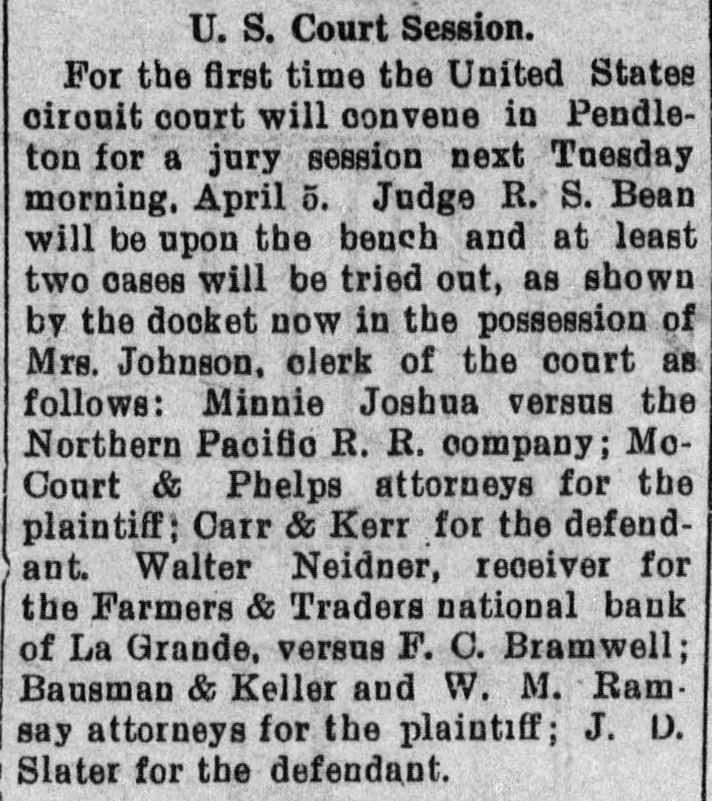
# U. S. Court Session. For the first time the United States circuit court will convene in Pendleton for a jury session next Tuesday morning, April 5. Judge R. S. Bean will be upon the bench and at least two cases will be tried out, as shown by the docket now in the possession of Mrs. Johnson, clerk of the court as follows: Minnie Joshua versus the Northern Pacific R. R. company; McCourt & Phelps attorneys for the plaintiff; Carr & Kerr for the defendant. Walter Neidner, receiver for the Farmers & Traders national bank of La Grande, versus F. C. Bramwell; Bausman & Keller and W. M. Ramsay attorneys for the plaintiff; J. D. Slater for the defendant.


Article from East Oregonian : E.O, April 5, 1910

Click image to open full size in new tab

Article Text

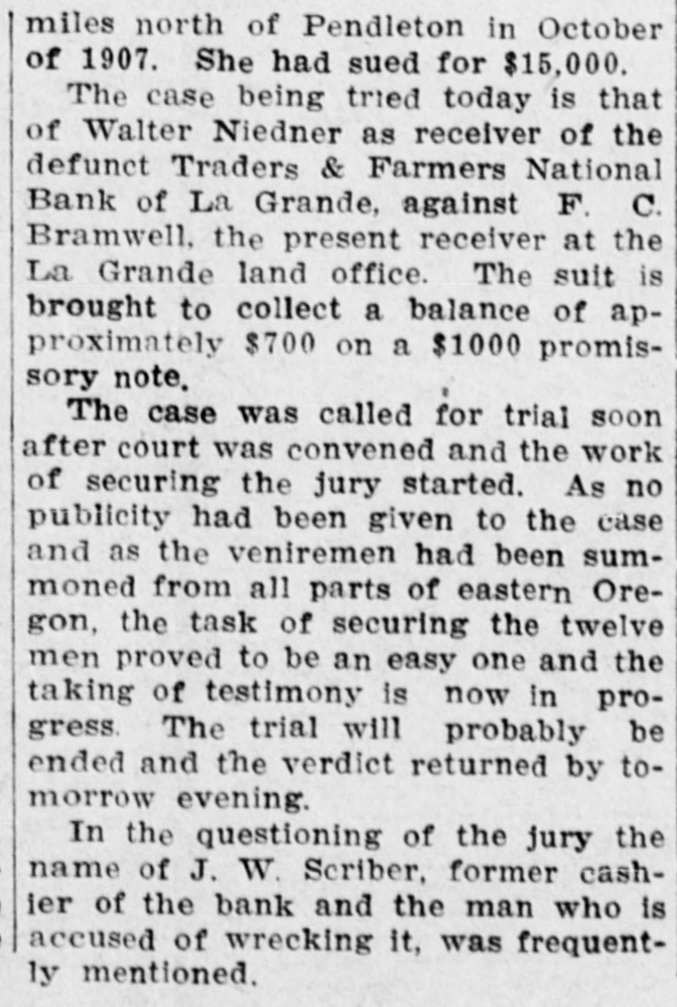
miles north of Pendleton in October of 1907. She had sued for $15,000. The case being tried today is that of Walter Niedner as receiver of the defunct Traders & Farmers National Bank of La Grande, against F. C. Bramwell, the present receiver at the La Grande land office. The suit is brought to collect a balance of approximately $700 on a $1000 promissory note. The case was called for trial soon after court was convened and the work of securing the jury started. As no publicity had been given to the case and as the venirement had been summoned from all parts of eastern Oregon, the task of securing the twelve men proved to be an easy one and the taking of testimony is now in progress The trial will probably be ended and the verdict returned by tomorrow evening. In the questioning of the jury the name of J. W. Scriber, former cashier of the bank and the man who is accused of wrecking it, was frequently mentioned.


Article from East Oregonian : E.O, April 6, 1910

Click image to open full size in new tab

Article Text

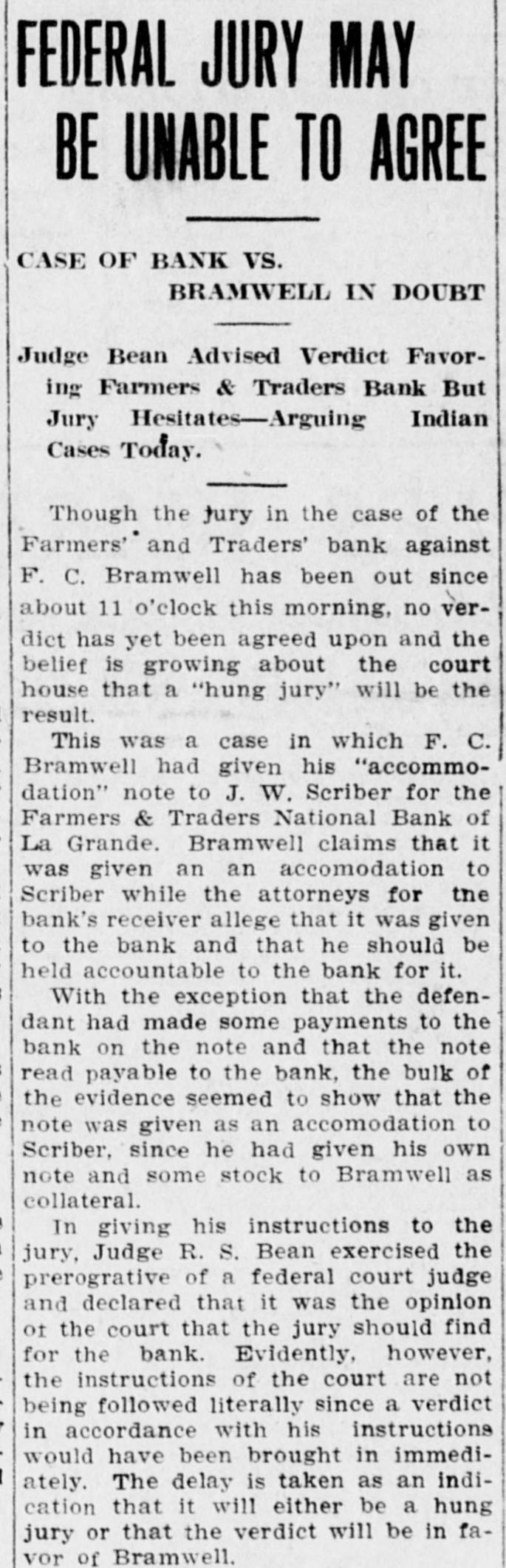
# FEDERAL JURY MAY # BE UNABLE TO AGREE CASE OF BANK VS. BRAMWELL IN DOUBT Judge Bean Advised Verdict Favor- ing Farmers & Traders Bank But Jury Hesitates-Arguing Indian Cases Today. Though the jury in the case of the Farmers' and Traders' bank against F. C. Bramwell has been out since about 11 o'clock this morning, no verdict has yet been agreed upon and the belief is growing about the court house that a "hung jury" will be the result. This was a case in which F. C. Bramwell had given his "accommodation" note to J. W. Scriber for the Farmers & Traders National Bank of La Grande. Bramwell claims that it was given an an accomodation to Scriber while the attorneys for the bank's receiver allege that it was given to the bank and that he should be held accountable to the bank for it. With the exception that the defendant had made some payments to the bank on the note and that the note read payable to the bank, the bulk of the evidence seemed to show that the note was given as an accomodation to Scriber, since he had given his own note and some stock to Bramwell as collateral. In giving his instructions to the jury, Judge R. S. Bean exercised the prerogrative of a federal court judge and declared that it was the opinion of the court that the jury should find for the bank. Evidently, however, the instructions of the court are not being followed literally since a verdict in accordance with his instructions would have been brought in immediately. The delay is taken as an indication that it will either be a hung jury or that the verdict will be in favor of Bramwell.


Article from East Oregonian : E.O, July 28, 1910

Click image to open full size in new tab

Article Text

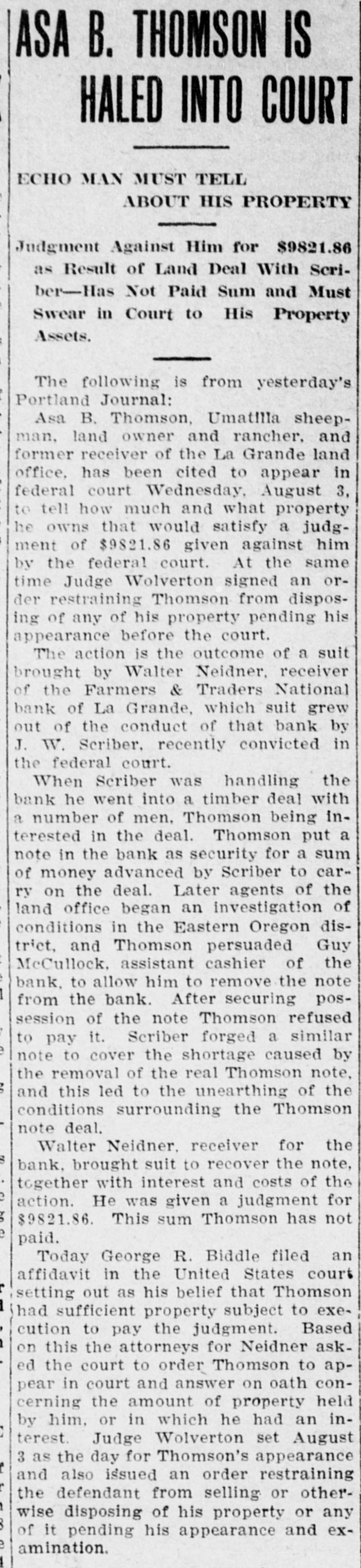
# ASA B. THOMSON IS HALED INTO COURT ECHO MAN MUST TELL ABOUT HIS PROPERTY Judgment Against Him for $9821.86 as Result of Land Deal With Scriber-Has Not Paid Sum and Must Swear in Court to His Property Assets. The following is from yesterday's Portland Journal: Asa B. Thomson, Umatilla sheepman, land owner and rancher, and former receiver of the La Grande land office, has been cited to appear in federal court Wednesday, August 3, to tell how much and what property he owns that would satisfy a judgment of $9821.86 given against him by the federal court. At the same time Judge Wolverton signed an order restraining Thomson from disposing of any of his property pending his appearance before the court. The action is the outcome of a suit brought by Walter Neidner, receiver of the Farmers & Traders National bank of La Grande, which suit grew out of the conduct of that bank by J. W. Scriber, recently convicted in the federal court. When Scriber was handling the bank he went into a timber deal with a number of men, Thomson being interested in the deal. Thomson put a note in the bank as security for a sum of money advanced by Scriber to carry on the deal. Later agents of the land office began an investigation of conditions in the Eastern Oregon district, and Thomson persuaded Guy McCullock, assistant cashier of the bank, to allow him to remove the note from the bank. After securing possession of the note Thomson refused to pay it. Scriber forged a similar note to cover the shortage caused by the removal of the real Thomson note, and this led to the unearthing of the conditions surrounding the Thomson note deal. Walter Neidner, receiver for the bank, brought suit to recover the note, together with interest and costs of the action. He was given a judgment for $9821.86. This sum Thomson has not paid. Today George R. Biddle filed an affidavit in the United States court setting out as his belief that Thomson had sufficient property subject to execution to pay the judgment. Based on this the attorneys for Neidner asked the court to order Thomson to appear in court and answer on oath concerning the amount of property held by him, or in which he had an interest. Judge Wolverton set August 3 as the day for Thomson's appearance and also issued an order restraining the defendant from selling or otherwise disposing of his property or any of it pending his appearance and examination.