Click image to open full size in new tab
Article Text
# VERY ANGRY DEPOSITORS.
Bad Management of Morrisania's Crippled
Bank-One Suspicious Incident.
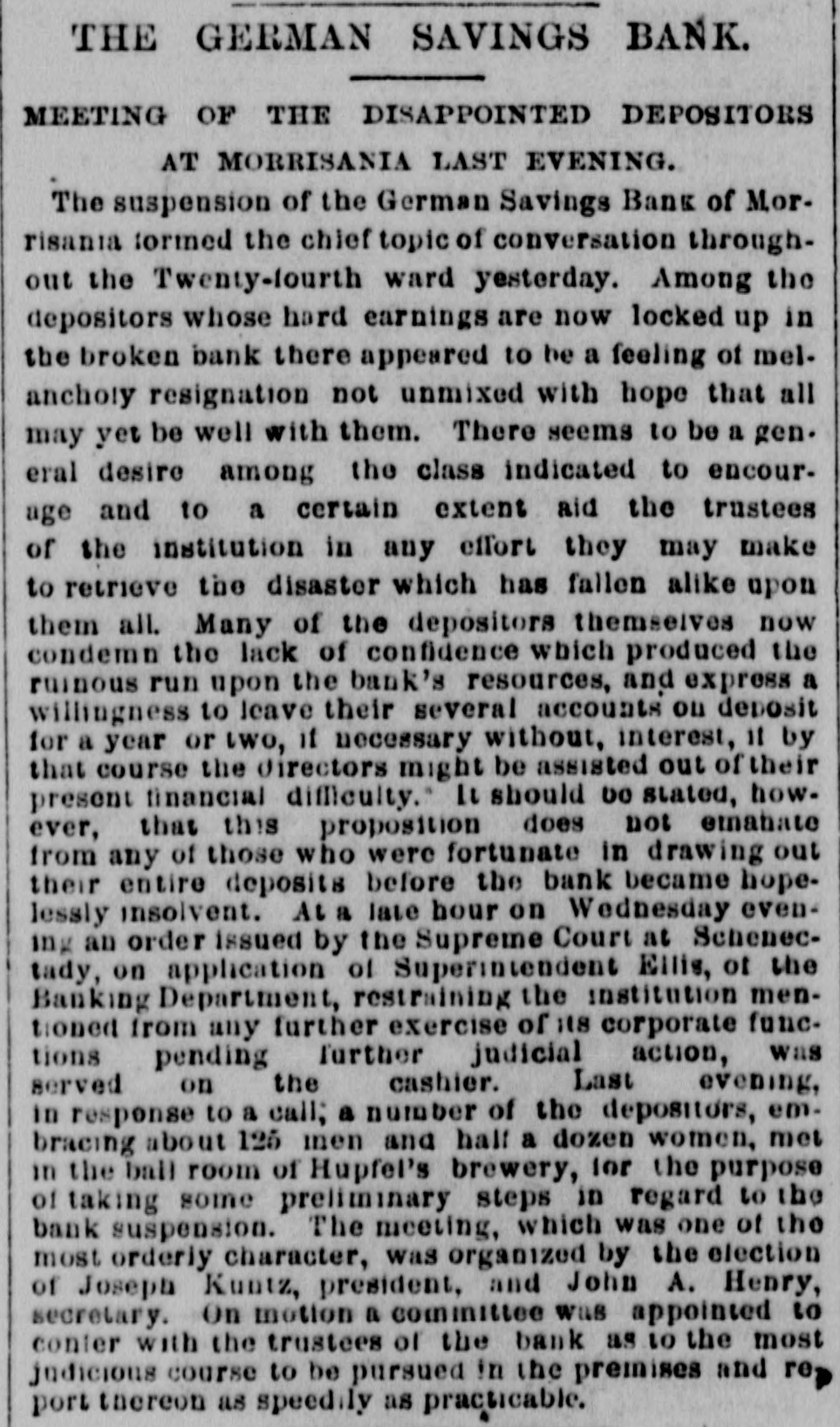
Among the German residents of Morris-
ania the feeling of indignation against the offi-
cers and trustees of the defunct German Sav-
ings Bank of that place is growing daily in in-
tensity. The depositors are chiefly of the poor
industrial classes, German mechanics, working
women, and laborers, and the rigid economy
they have practised to make their savings is
shown in their deposit books, where entries of
$1, and even of 50 cents, are not uncommon. As
these persons begin to understand the manner
in which their money was lost, they become ex-
cited. Stories reflecting severely on the man-
agement of the bank are freely circulated. It is
openly charged that, knowing the day of failure
was near at hand, the officers and trustees not
only drew out what money they had deposited
in the bank, but also informed their favorites
that they also might save themselves before the
crash came, a warning they were not slow to
take advantage of, to the cost of the other de-
positors. It is also asserted that the secretary,
who had six open accounts with the bank, closed
them all, and withdrew his last dollar the very
day before the bank closed.
The cases of individual suffering are many,
One poor, hardworking, old Irishman, named
McMahan, over 60 years of age, after many years
of toil, managed to secure a little home and plot
of ground, on which the bank hold a mortgage
of $2,000. By skimping and doing without
many comforts, he accumulated nearly $900,
which he took to the bank, and asked to have it
applied to the part payment of his mortgage.
The bank officers induced him to deposit it that
it might draw interest. Now he fears that he
may lose it all, and his mortgage remain as
large as at first. The janitress of the bank, a
German woman of about 65 years of age, had
on deposit $2.000.
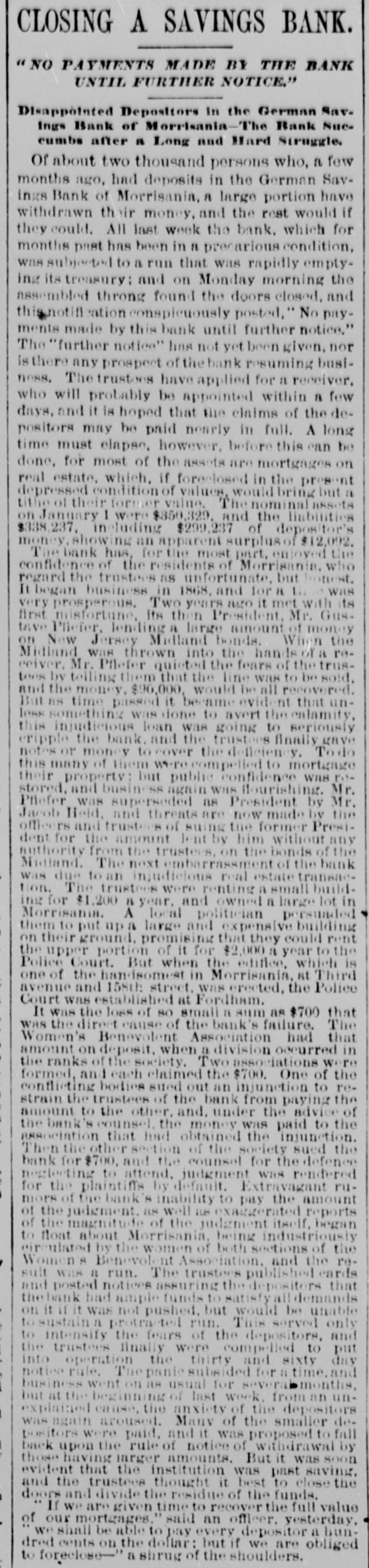
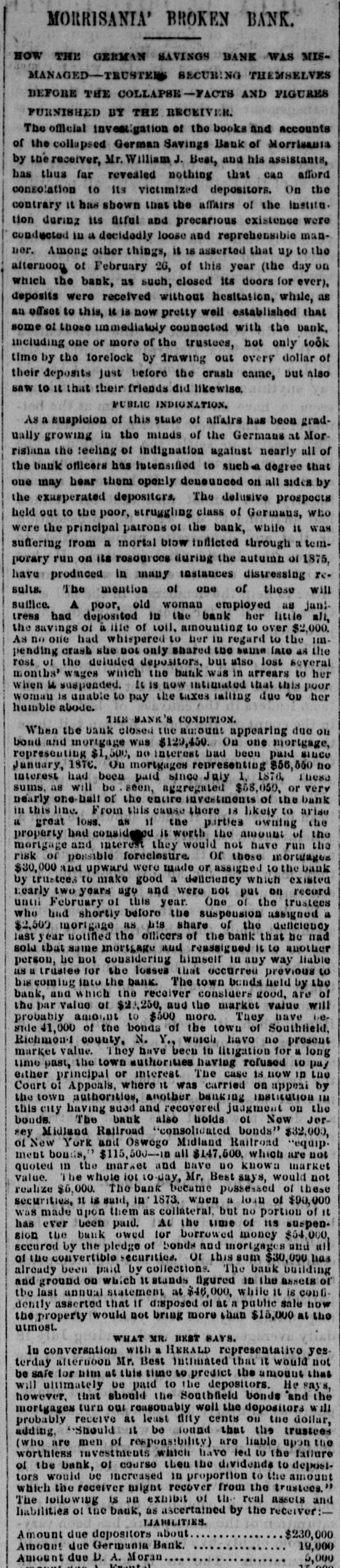
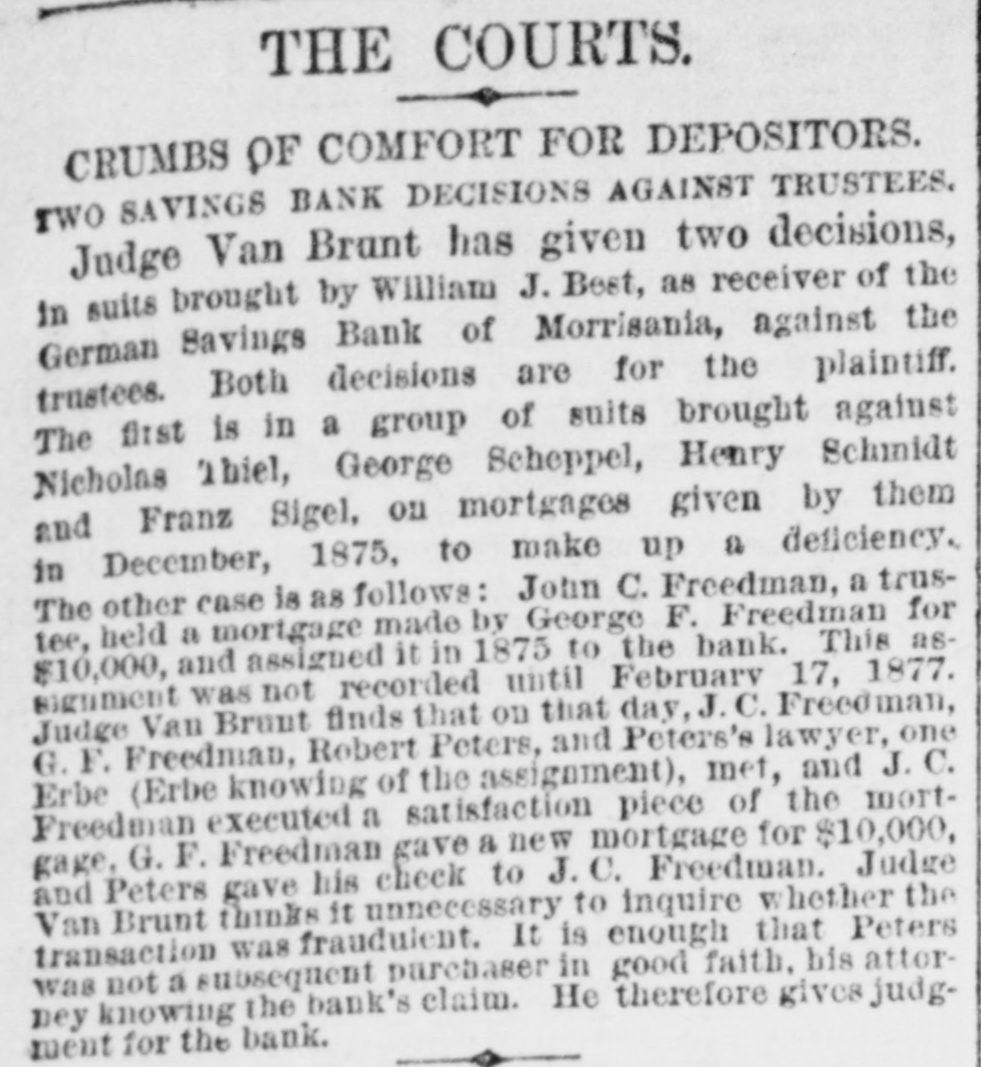
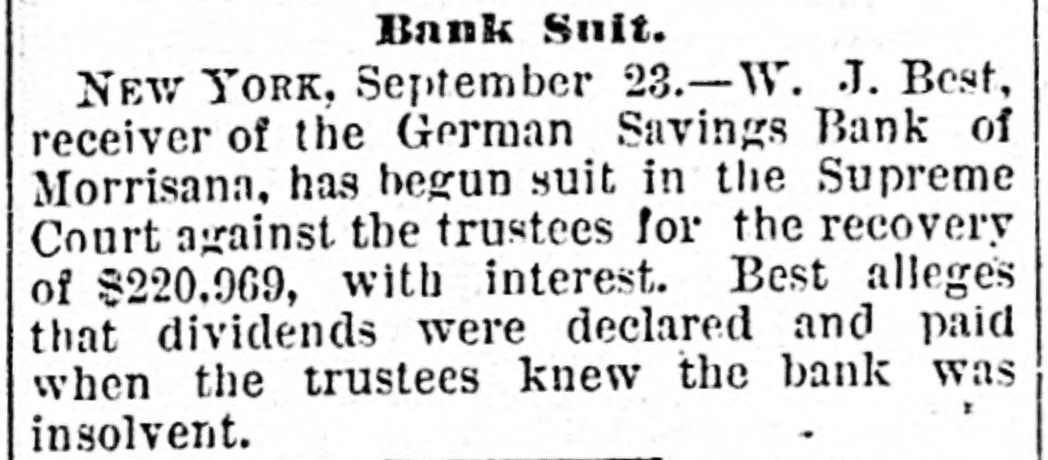
Receiver William J. Best has just finished a
statement of the condition of the bank. In it he
says that when the bank suspended, on Feb.
26, the available cash amounted to less than
$350. The bank owed different parties, for
money borrowed to carry it along, over $54.000,
and all the available, marketable securities had
been hypothecated to secure these debts, The
bank owes depositors about $230,000, The re-
ceiver gives the amount in this qualified way
because the books have not been balanced by
the officers for months, and he requires a little
time to straighten them out. The aggregate lia-
bilities, not including salaries and some other
little items amount to $284,000. There are
about 2,200 depositors, and though the amounts
are usually small, they range in a few instances
as high as $3,000, $4,000, and even $5,000.
Among the assets, as against these liabilities,
are $129.450 of bonds and mortgages, but on
nearly $60,000 of these no interest has been paid
for over a year, and about $30,000 of this amount
is in the form of indemnity bonds and mort-
gages, given by the officers and trustees nearly
two years ago to cover up a deficiency much
larger, which then existed. Some, but not all
of these officials, threaten to contest these bonds
because there was no consideration given and
on various other grounds. There are also $26,-
250 of town bonds, which are worth at least par,
and may realize a small premium. There are
$32,000 of consolidated bonds of the New Jersey
Midland Railroad. They are a third lien and
have no market value. There are $115.500 of
the New York and Oswego Midland Railroad
equipment bonds, which have no market value
and are considered worthless. There are $11,-
000 in bonds of the town of Southfield, Richmond
county, Staten Island. These bonds have been
in litigation for years, and the town refuses to
pay them. The authorities were sued and a
judgment obtained, but the case was carried to
the Court of Appeals, where it now rests. The
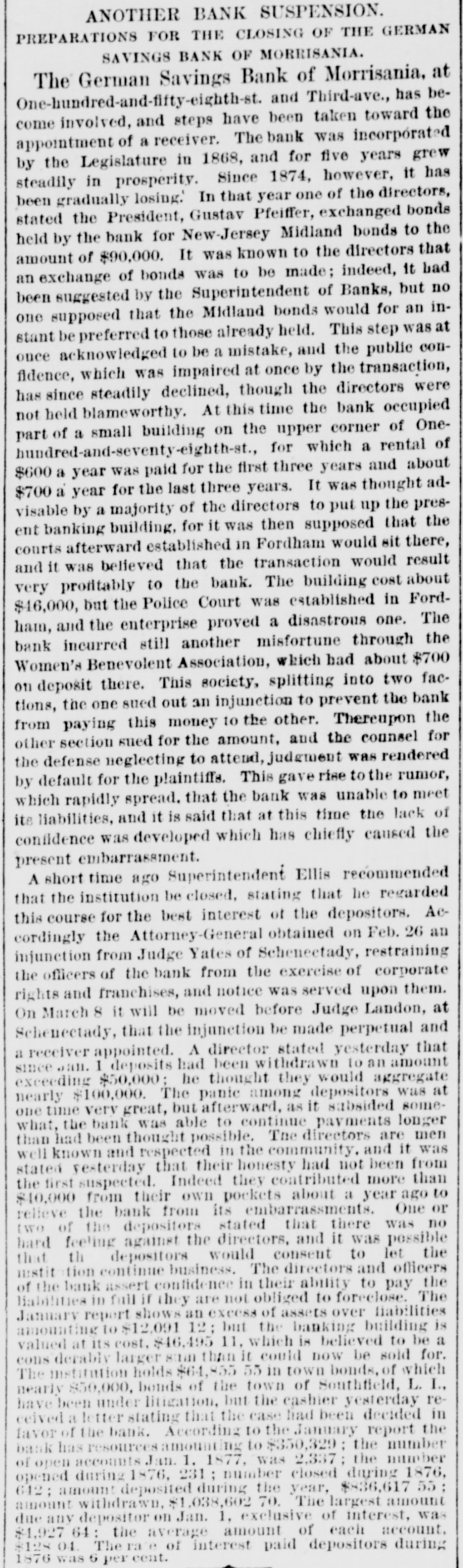
bonds have no market value. The banking
house, which is a very cheaply built structure,
is appraised at from $12.000 to $15,000. The
Secretary a few weeks ago admitted that it was
not worth over $15,000, yet in the sworn state-
ment made in January last it was valued at
$46,500. The bank also owns three small houses
and lots, which were bought in under foreclos-
ure, and are estimated to be worth $6,500. They
cost $8,900.
Out of these assets must first be paid the
$54,000 due preferred creditors to redeem the
good securities, considerably in excess of that
amount, which they hold as security for
amounts loaned; then what is left will be di-
vided among the policy holders. Mr. Best says
that if the Southfield bonds are ultimately de-
cided valid, and the mortgages bring their face
value or near it, he hopes to give the depositors
a dividend of from flity to sixty cents on the
dollar.
As a little incident, to show how thoroughly
the suspicions of the depositors have been
aaroused, it is said that one very dark and
stormy night, shortly before the failure of the
bank, the Secretary, on whose movements a
sharp watch had been kept, was seen to enter
the banking room between 9 and 10 o'clock.
When he came out he could give no satisfactory
explanation of his untimely visit. Something
wrong was then suspected, but nothing could
be proved. He was taken to the police station,
but as no one could make a direct charge, he
was discharged. The reason for that visit is
now a matter of much conjecture among the
unfortunates.