Article Text
PROCEEDINGS OF COUNTY COURT
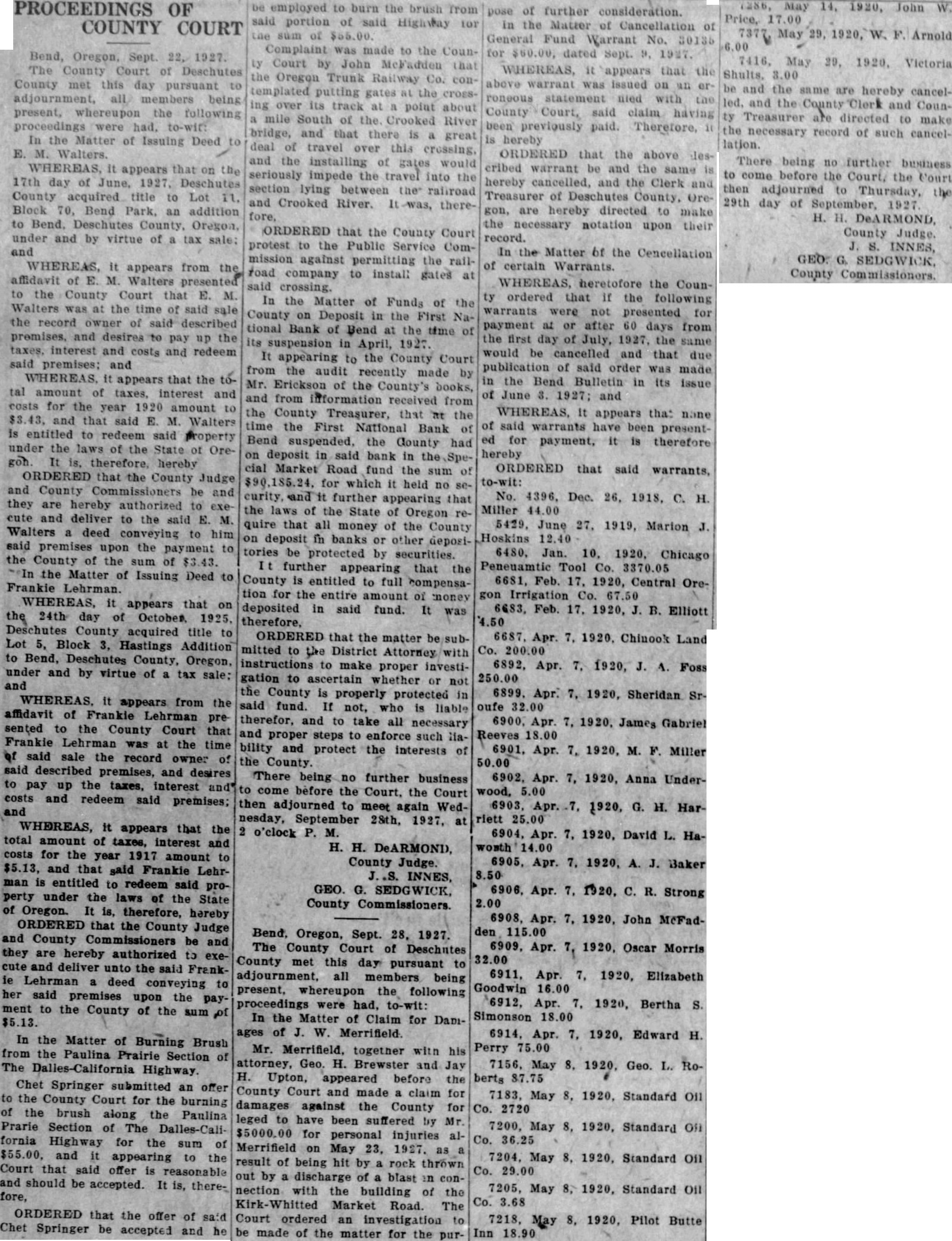
Bend, Oregon, Sept. 22, 1927. The County Court of Deschutes County met this day pursuant to adjournment, all members being present, whereupon the following proceedings were had, to-wit: In the Matter of Issuing Deed to E. M. Walters. WHEREAS, it appears that on the 17th day of June, 1927, Deschutes County acquired title to Lot 11, Block 70, Bend Park, an addition to Bend. Deschutes County, Oregon, under and by virtue of a tax sale: and
WHEREAS, it appears from the affidavit of E. M. Walters presented to the County Court that E. M. Walters was at the time of said sale the record owner of said described premises, and desires to pay up the taxes, interest and costs and redeem said premises; and WHEREAS, it appears that the total amount of taxes, interest and costs for the year 1920 amount to $3.43, and that said E. M. Walters is entitled to redeem said property under the laws of the State of Oregon. It is, therefore, hereby ORDERED that the County Judge and County Commissioners be and they are hereby authorized to execute and deliver to the said E. M. Walters a deed conveying to him said premises upon the payment to the County of the sum of $3.43. In the Matter of Issuing Deed to Frankie Lehrman. WHEREAS, it appears that on the 24th day of October. 1925, Deschutes County acquired title to Lot 5, Block 3. Hastings Addition to Bend, Deschutes County, Oregon. under and by virtue of a tax sale: and WHEREAS. It appears from the affidavit of Frankie Lehrman presented to the County Court that Frankie Lehrman was at the time of said sale the record owner of said described premises, and desires to pay up the taxes, interest and costs and redeem said premises; and WHEREAS, it appears that the total amount of taxes, interest and costs for the year 1917 amount to $5.13, and that said Frankie Lehrman is entitled to redeem said property under the laws of the State of Oregon. It is, therefore, hereby ORDERED that the County Judge and County Commissioners be and they are hereby authorized to execute and deliver unto the said Frankie Lehrman a deed conveying to her said premises upon the payment to the County of the sum of $5.13.
In the Matter of Burning Brush from the Paulina Prairie Section of The Dalles-California Highway. Chet Springer submitted an offer to the County Court for the burning of the brush along the Paulina Prarie Section of The Dalles-California Highway for the sum of $55.00, and it appearing to the Court that said offer is reasonable and should be accepted. It is, therefore,
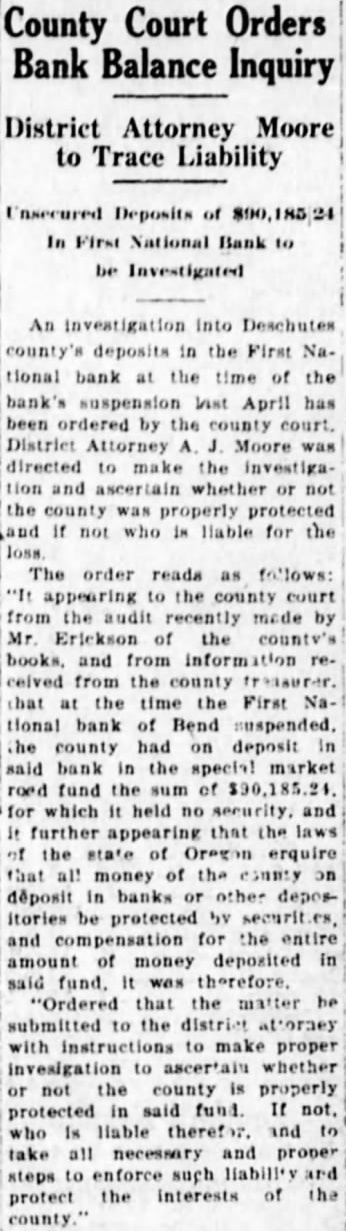
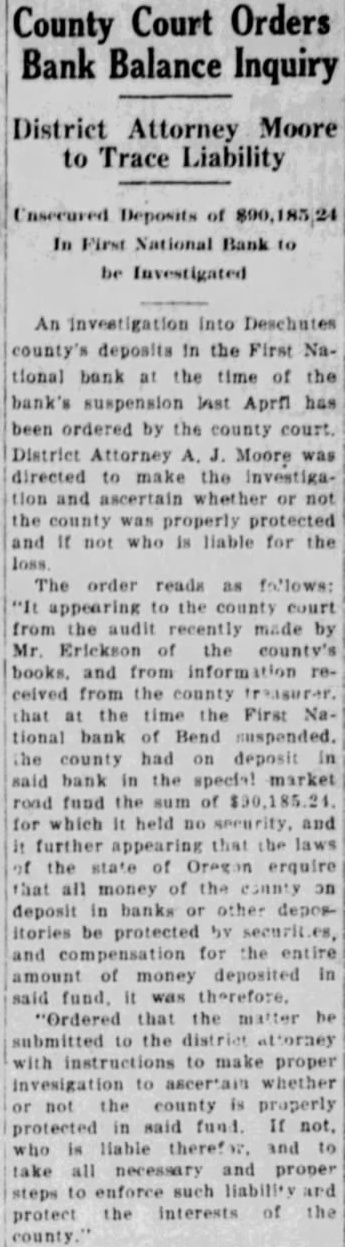
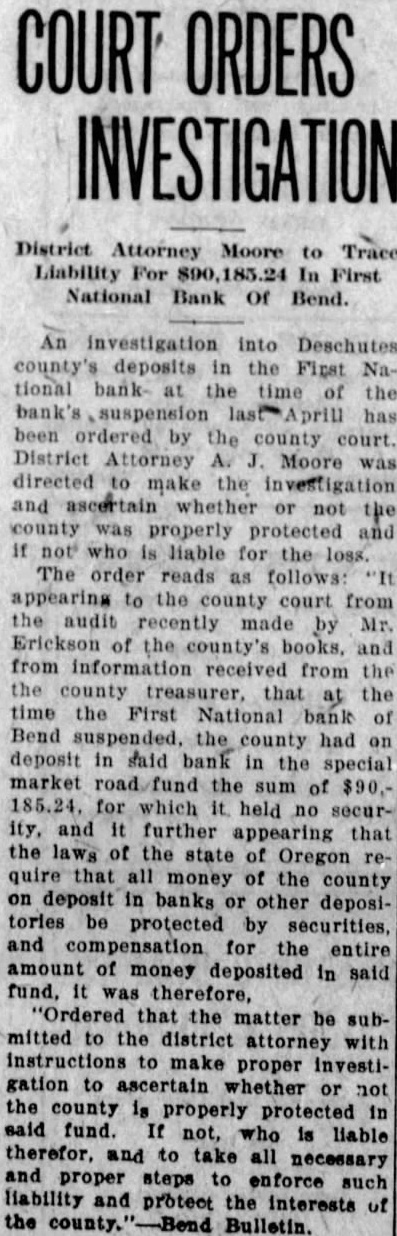
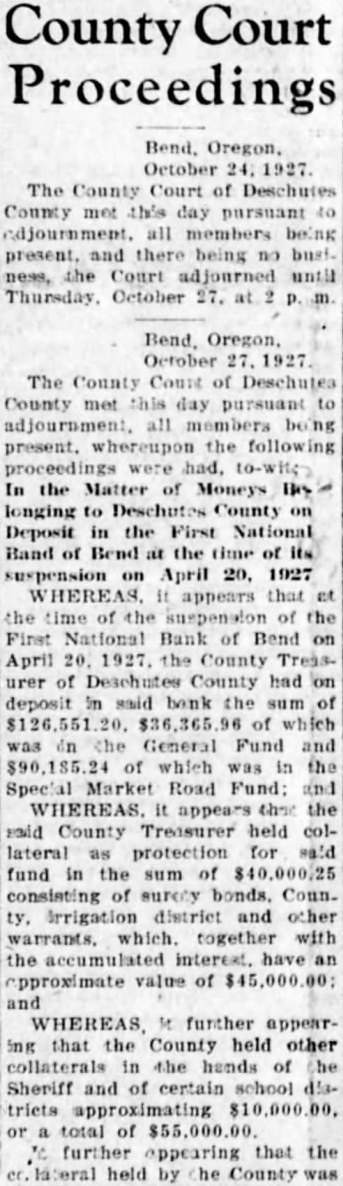
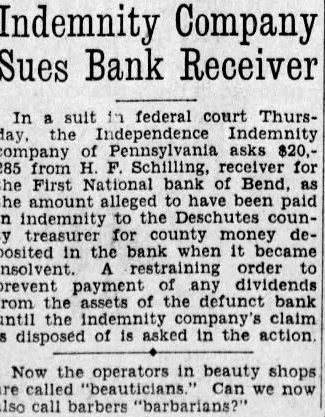
ORDERED that the offer of said Chet Springer be accepted and he be employed to burn the brush from said portion of said Highway for the sum of $55.00. Complaint was made to the County Court by John McFadden that the Oregon Trunk Railway Co. contemplated putting gates at the crossing over its track at a point about a mile South of the Crooked River bridge, and that there is a great deal of travel over this crossing, and the installing of gates would seriously impede the travel into the section lying between the railroad and Crooked River. It was, therefore, ORDERED that the County Court protest to the Public Service Commission against permitting the railroad company to install gates at said crossing. In the Matter of Funds of the County on Deposit in the First National Bank of Bend at the time of its suspension in April, 1927. It appearing to the County Court from the audit recently made by Mr. Erickson of the County's books, and from information received from the County Treasurer, that at the time the First National Bank of Bend suspended, the County had on deposit in said bank in the,Special Market Road fund the sum of 185.24, for which it held no security, and it further appearing that the laws of the State of Oregon require that all money of the County on deposit in banks or other depositories be protected by securities. It further appearing that the County is entitled to full compensation for the entire amount of money deposited in said fund. It was ORDERED that the matter be submitted to the District Attorney with instructions to make proper investigation to ascertain whether or not the County is properly protected in said fund. If not, who is liable therefor, and to take all necessary and proper steps to enforce such liability and protect the interests of the County. There being no further business to come bèfore the Court, the Court then adjourned to meet again Wednesday, September 28th, 1927, at 2 o'clock P. M.
H. H. DeARMOND. County Judge. J..S. INNES, GEO. G. SEDGWICK, County Commissioners.
Bend. Oregon, Sept. 28, 1927. The County Court of Deschutes County met this day pursuant to adjournment, all members being present, whereupon the following proceedings were had, to-wit: In the Matter of Claim for Daniages of J. W. Merrifield. Mr. Merrifield. together with his attorney, Geo. H. Brewster and Jay H. Upton, appeared before the County Court and made a claim for damages against the County for leged to have been suffered by Mr. $5000.00 for personal injuries alMerrifield on May 23, 1927. as result of being hit by a rock thrown out by a discharge of a blast in connection with the building of the Kirk-Whitted Market Road. The Court ordered an investigation to be made of the matter for the pur- pose of further consideration. in the Matter of Cancellation of General Fund Warrant No. 30135 for $60.00, dated Sept. 9, 1927. WHEREAS, it appears that the above warrant was issued on an or roneous statement nied with the County Court, said claim having been previously paid. Therefore, it is hereby ORDERED that the above lescribed warrant be and the same is hereby cancelled, and the Clerk and Treasurer of Deschutes County, Oregon, are hereby directed to make the necessary notation upon their record. In the Matter bf the Cencellation of certain Warrants. WHEREAS, heretofore the County ordered that if the following warrants were not presented for payment at or after 60 days from the first day of July, 1927, the same would be cancelled and that due publication of said order was made in the Bend Bulletin in Its issue of June 3. 1927; and WHEREAS, It appears that none of said warrants have been presented for payment, it is therefore hereby ORDERED that said warrants, to-wit: No. 4396, Dec. 26, 1918, C. H. Miller 44.00 5429, June 27, 1919, Marion J. Hoskins 12.40 6480, Jan. 10, 1920, Chicago Peneuamtic Tool Co. 3370.05 6681, Feb. 17, 1920, Central Oregon Irrigation Co. 67.50 6683, Feb. 17, 1920, J. B. Elliott 4.50
6687, Apr. 7. 1920, Chinook Land Co. 200.00 6892, Apr. 7. 1920, J. 4. Foss 250.00 6899. Apr. 7, 1920, Sheridan Sroufe 32.00 6900, Apr. 7, 1920, James Gabriel Reeves 18.00 6901, Apr. 7. 1920, M. F. Miller 50.00 6902. Apr. 7, 1920, Anna Underwood, 5.00 6903, Apr. 7, 1920, G. H. Harriett 25.00 6904, Apr. 7. 1920, David L. Haworth 14.00 6905, Apr. 7. 1920, A. J. Baker 8.50 6906, Apr. 7, 1920, C. R. Strong 2.00 6908, Apr. 7, 1920, John McFadden 115.00 6909. Apr. 7, 1920, Oscar Morris 32.00 6911, Apr. 7, 1920, Elizabeth Goodwin 16.00 6912, Apr. 7. 1920, Bertha S. Simonson 18.00 6914, Apr. 7, 1920, Edward H. Perry 75.00 7156, May 8, 1920. Geo. L. Roberts 87.75 7183, May 8, 1920, Standard Oil Co. 2720 7200, May 8, 1920, Standard on Co. 36.25 7204, May 8, 1920, Standard Oil Co. 29.00 7205, May 8, 1920, Standard Oil Co. 3.68 7218, May 8, 1920, Pilot Butte Inn 18.90
1286, May 14, 1920, John W, Price, 17.00 7377, May 29, 1920, W. F. Arnold 6.00 7416, May 39, 1920. Victoria Shults, 3.00 be and the same are hereby cancelled, and the County Clerk and County Treasurer are directed to make the necessary record of such cancellation.
There being no further business to come before the Court, the Court then adjourned to Thursday, the 29th day of September, 1927. H. H. DeARMOND, County Judge. J. S. INNES, GEO. G. SEDGWICK, County Commissioners.