15872. Franklin Bank (New York, NY)

Bank Information

Episode Type
Suspension → Closure
Bank Type
state
Start Date
May 26, 1828
Location
New York, New York (40.714, -74.006)

Metadata

Model
gpt-5-mini
Short Digest
864ceb15

Response Measures

None

Description

Multiple contemporary articles (May–June 1828) report Franklin Bank of New York suspended payment after an injunction was granted restraining the bank from paying out funds. The court appointed James Kent as receiver and the bank's affairs were wound up with dividends declared later. No bank run is described in the articles; suspension appears to lead to permanent closure/receivership and asset distribution.

Events (4)

1. May 26, 1828 Suspension
Cause
Government Action
Cause Details
Chancellor granted an injunction restraining the bank from paying out funds (injunction served on cashier), forcing immediate suspension.
Newspaper Excerpt
His honour the Chancellor having granted an injunction restraining the President, Directors and Company of the Franklin Bank... and for other purposes, I was under the necessity of suspending the operations of the Bank immediately. - JOHN H. HILL, Cashier
Source
newspapers
2. May 31, 1828 Other
Newspaper Excerpt
The FRANKLIN BANK, New-York, has suspended payment, as will be seen by a reference to the Steam Boat head. The Cashier ... requests a suspension of public opinion for a few days.
Source
newspapers
3. June 3, 1828 Receivership
Newspaper Excerpt
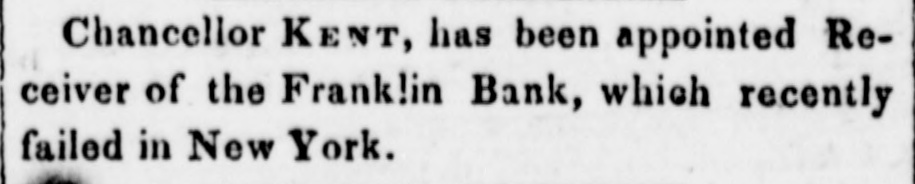
Chancellor KENT, has been appointed Receiver of the Franklin Bank, which recently failed in New York. / The Court then declared James Kent, Esq. to be the person appointed receiver of the debts of the Franklin Bank...
Source
newspapers
4. November 12, 1828 Other
Newspaper Excerpt
The Receiver says ... the creditors, either as note holders or depositors, will only receive fifty cents on the dollar ... The Receiver has made an official report of its affairs to the Chancery Court.
Source
newspapers

Newspaper Articles (18)

Article from Literary Cadet and Rhode-Island Statesman, May 31, 1828

Click image to open full size in new tab

Article Text

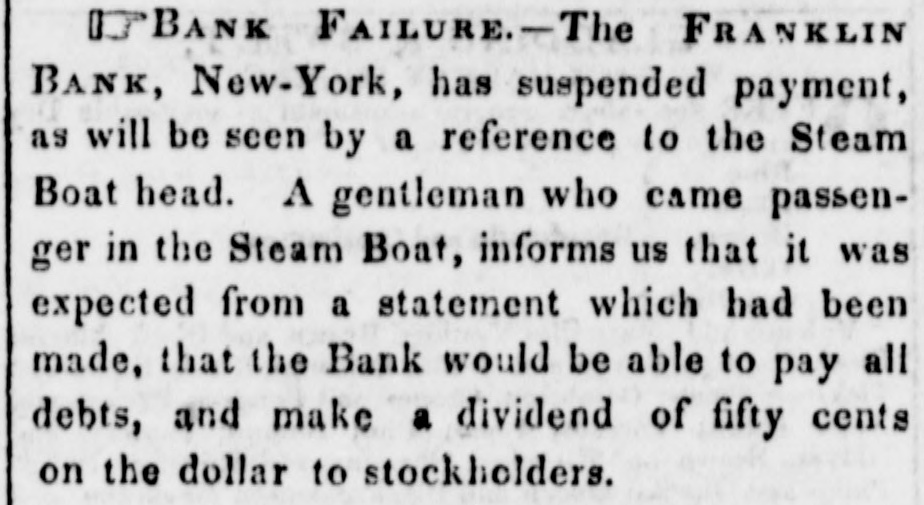
ID BANK FAILURE.-The FRANKLIN BANK, New-York, has suspended payment, as will be seen by a reference to the Steam Boat head. A gentleman who came passenger in the Steam Boat, informs us that it was expected from a statement which had been made, that the Bank would be able to pay all debts, and make a dividend of fifty cents on the dollar to stockholders.


Article from Literary Cadet and Rhode-Island Statesman, May 31, 1828

Click image to open full size in new tab

Article Text

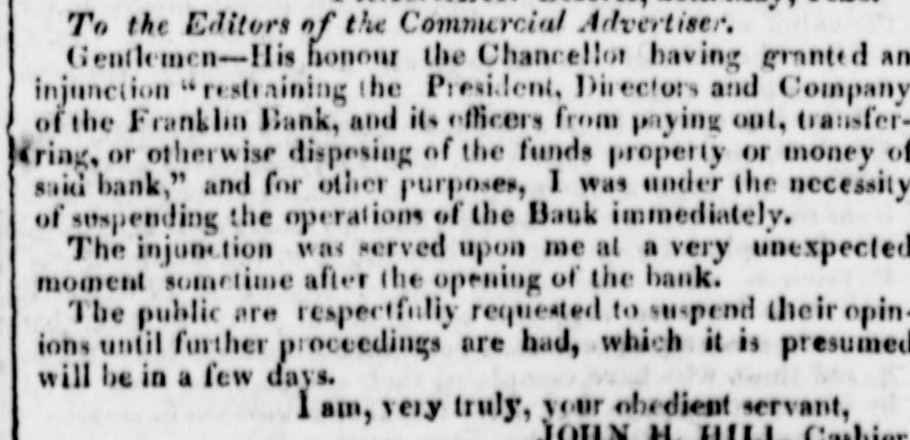
To the Editors of the Commercial Advertiser. Gentlemen-His honour the Chancellor having granted an injunction "restraining the President, Directors and Company of the Franklin Bank, and its officers from paying out, transfer-ring, or otherwise disposing of the funds property or money of said bank," and for other purposes, I was under the necessity of suspending the operations of the Bank immediately. The injunction was served upon me at a very unexpected moment sometime after the opening of the bank. The public are respectfully requested to suspend their opinions until further proceedings are had, which it is presumed will be in a few days. I am, very truly, your obedient servant, JOHN H. HILL, Cashier


Article from Phenix Gazette, June 2, 1828

Click image to open full size in new tab

Article Text

3:8ths per cent lower for me for money. [From the London World, of April 30th.] It is now confidently stated here, that the Greek Treaty has been resumed by the three Allied Powers, and that even Austria and Prussia have beccome.in some measure accessary to Rnssia, it is said, has given up the idea of on her own separate confines the of it. invading quarrel,and Turkey compensation ground which she intends to claim from Turkey to indemnities for injuries to the Rossian commerce, without any thought of territorial aggrandizement; and lastly, she will give instructions to her adthe Mediterrancan, to act in concert admirals of England miral with the in and France, the United according to such arrangements as Powers shall deem expedient. According to Russia is to the Principalities, as a occupy these arrangements, immediately pledge for three the indemnities to her commerce, while the combined fleets blockade the Morea and Alexandria. LONDON, APRIL 30th.-The - transactions of the consol market have been of very little moment to day. The price for the account has wavered between 85 7 and 8618, and closed at 86, buyers. The imports of Great Britain, in 1826, were the 50 in 1827, 43 millions, exports 61 imports 36 millions, exports millions, millions. From the fact that two English vessels had been permitted 10 leave Constantinople for the Archipelago, it was concluded that the feelings of the Porte were pacific towards Great Britain From the Austrian Observer of the 18th of April, is extracted a letter from Napoli di Ro. mani of the 10th of March, which gives an account of the arrival there from Poros on the Capo d'Istria, on board the WarHe was received with great spite. 2d of Count the enthusiasm, command and his first act was to transfer of the port of Palamides 10 Col. Hoidegger. the Greek in the channel of aulis, On appeared the 15th April, Scio Admiral with Mi- the Hellas, two Greek brigantines, and a few smaller vessels, and, it was supposed, he would throw considerable difficulty in the way of any communication between the Turkish garrison and their countrymen on the Asiatic coast. A second letter from John Harris the son, to to the murderer of his father will be found in our paper this morning. The feeling displayed in this letter is very natural, and ought to excuse the apparent warmth of language which is observed. The several Fire Insurance Offices of N. Y. have offered a reward of one thousand dollars for the apprehension of any incendiary of pro* perty in that city. The Franklin Bank of New York has suspended payment. The Cashier requests a suspension of public opinion for a few days. ISAAC VAN WART, say, the Albany Daily Adv. one of the captors of Major Andre, died on Fri day, 23d inst. at Greensburgh, near Tarrytown, Westchester county. A short time before his decease, in a conversation with his physician, he said, having reference to the Paulding Mon ument, that he wished no monument to be erected to him, after his death. The only one of the captors now living, is Williams, who res I sides, we believe, in Schoharie co. ) A splendid new theatre about to be comt menced on the site of the Bowery,and completed during the summer, is intended to present a beautiful model of pure Grecian order. The colonade in front is to be of the primitive Do. t ric, with fluted columns, in imitation of the ) Temple of Theseus. , OFFICIAL.


Article from Phenix Gazette, June 2, 1828

Click image to open full size in new tab

Article Text

The Franklin Bank of New York has suspended payment. The Cashier requests a suspension of public opinion for a few days.


Article from The Massachusetts Spy, and Worcester County Advertiser, June 4, 1828

Click image to open full size in new tab

Article Text

WORCESTER WEDNESDAY, JUNE 4, 1828. CONGRESS. After a session of nearly six months, the two houses of Congress adjourned on the 26th ult. The business of most importancé transacted after the accounts given in our last, were the rejecting by the Senate of the bill to abolish the office of Major General, and the passage of a bill making a donation in land to the State of Ohio to aid in the construction of the Miami Canal. Previous to the adjournment, a motion was made to pass a vote of thanks to the Speaker, for his able and laudable course during the session. This was opposed on the ground that it was without precedent to pass such a vote at the close of the first session. The motion, however, was sustained by a party vote, and, on the final passage, the votes were ayes 111, noes 28; a great number of the members having retired to the lobbies, and declined voting. The whole number of ayes was less than the number of Jackson men in the house. FOREIGN. Accounts from England and France are to May 1. Nothing new of importance has transpired. Preparations for a vigorous prosecution of the war between Russia and Turkey were continued. The Russian army lately engaged against Persia was advancing upon Asiatic Turkey towards the shorea of the Black Sea, while the grand army would direct its course to the Danube, and thus distract the attention and divide the force of the Turks. The utmost harmony in relation to the Turkish affairs is said to subsist between the cabinet of Russia and those of Prussia and Austria. In England, the bill for the repeal of the Test and Corporation Acts, was finally passed in the House of Lords on the 29th of April. BANK FAILURE. The Franklin Bank in New York city has stopped payment, and the property of the Corporation has been transferred to receivers, for the benefit of the creditors. In a letter to the Editor of the Evening Post, the late President of the Bank gives it as the opinion of the Directors and himself, that eventualally every creditor will receive his money in full. The Governor's Speech, which was not received till our columns were mostly occupied, affords us a good opportunity of substituting something more interesting, in the space usually occupied by editorial matter. 13 Although the writer of the following notice, forgot to accompany it with the usual fee for publishing marriages, (a slice of wedding cake) yet we are willing to gratify him by a publication of it, which we do in his own words. "May 2, 1928. COPARTNERSHIP. Mr. John Lenard of Oakham,hereby gives notice to his numerous friends that, on Wednesday of last week, he entered into copartnership, " for better or for worse," for life, with Miss Mary Burr of New B----e. Printers in this State, and throughout the Union; will confer a favor upon me and my friends by publishing the above in their respective papers." SALE OF PEWS. The sale of Pows in the South Meeting House in this town, on Thursday, furnishes some evidence of the increasing prosperity of the place. The average price of the best Pews, heretofore, has never exceeded $140. By an alteration of the Meeting House, a large additional number of Pews have been made, a portion of which were sold at Public Auction on Thursday. Seventeen, on the lower floor, principally wall Pews, some of them in a part of the house the most remote from the Pulpit, sold for an aggregate of $2510. The ,highest sum given was $221. Six Pews in the Gallery, brought $450-averaging $75. Yeoman.


Article from The Rhode-Island Republican, June 5, 1828

Click image to open full size in new tab

Article Text

The following is an accurate account of the amount of insurance and loss on the Theatre. Insurance on the building, $50, 000, Scenery and Wardrobe, $12,000. The private wardrobes of the actors, worth from 15 to 20,000 dollars were not insured. The largest sufferer is mr. Barrett, whose wardrobe was of greatvalue. The amount of property, not covered by insurance, 19 estimated at from 30 to 40,000 dellars. Appointments by the President of the Unit at States by and with the advice and COIL sent of live Senute. James Barbour, of Virginia, to be Envoy Extraordinary and Minister Piempotenuary to Great Britain. William H. Harrison, of Ohio, to be Enroy Extraordinary and Minister Piempotenuary to the Kepuolic or Colombia. Peter is Porter 01 New-York, be Se. cretary of War. Daniel M. Chistie, of New Hampshire, to be Attorney of the United States for the District of New-Hampshire. William G. Merril, of New York, to be Consul of the United States at Cape de Veralslands, 111 the place of Samuel Hodg es, deceased. Alexander Macomb, to be Major Gene rai in the Army of the United Diates. By the President. Samuel Brents, of Kentucky, to be Law Agent for the settlement and confirmation of the Private Land Claims in Florida. A duel, ,has been fought by two soldiers of the U.S. Army, which proved fatal 10 both of the combatants. [N. Orl. Mer. Adv. There will be exhibited this day, at Ma sonic Hall, by mr. James Smith, the inventor, the model of a Flying Machine, which be has been for a long time endeavoring perfect. [N. Y. Mer. Adv. Steam Boat Disaster.--At the Canadian Reach,about six hundred miles below Louisville, sometime last week, the boiler of the steam boat Car of Commerce bursted, and FIFTY SEVEN PERSONS WERE KILLED AND WOUNDED.--Wheeting pa. The Boat was on the way from New Or leans. [A gentleman has arrived in town by way of who on the 9th in the steam which May, Ohio, left boat N. survivors Orleans Amazon, of assisted in relieving the the of steam boat dreadful Car of Commerce, her. at The the time the accident to persons killed and were passenwere Sixteen were gers--none injured. wounded of the cabin instantly passengers all deck killed-three more had since died, and seven others were not expected to survive.--.V. Mer. Adv.] A constable with a posse, lately pursued a with a house on L. N. cer an Yankee offender, Island, of Y. white While attack, hat the white into offikulking out a ensued; but the fugitive was Along chase hat was seen was considering and of then back door. at overtaken ; to be man! In the cul. another length meantime and safely proved the prit had gone off fleisurely It is with lively satisfaction that we state that of the virthe in has of the the Secretary authority reposed Treasury, shares him. of in Stock subscribed for tenthousand in and Company to one million and the amounting Chesapeake installment Ohio of Canal thereon. dollars, has paid the first National Journal. The Steamer Atlas arrived at New Or leans the 5th inst. on having accident burst her the boiler which enwas so severely his gineer at the Balize, by scalded that life is despaired of. of the Witt Clinton, took on The sale place furniture Wednesday. of De Most of sold. The vaces as yet The was to have been it was offered. library have not been sold on Thursday. On Saturday last, a heavy shower of hail fell it was ed thunder and with in Cambridge, Md. lightning. accompani- which struck two houses. killed one negro man [Balt. pa. and wounded another. It is said that at the late annual meeting of at N. the Religious Society of Friends. the UnitariYork, a division took place on an question, which is said to be favored by the majority. -The National Intelligencer saya the Chesapeake and Ohio Canal will be. emp. phatically, the GRAND CANAL-being by far, the grandest undertaking in the world. Franklin Bank, at New York, has under an suspended The payment, injunction, on of the late President mr. a creditor. apgranted Leggett. application The ed, and Cashier asks pears to have been surpri. for temporary suspension of the public opinion on the affair. E. Young, of Albanv. sinvented a new Stage Coach, the seats are placed outside the in front and rear, so it will one persons. a ve. carriage. carry twenty It of is that work ry elegant and substantial piece


Article from Literary Cadet and Rhode-Island Statesman, June 7, 1828

Click image to open full size in new tab

Article Text

Chancellor KENT, has been appointed Receiver of the Franklin Bank, which recently failed in New York.


Article from The Virginian, June 9, 1828

Click image to open full size in new tab

Article Text

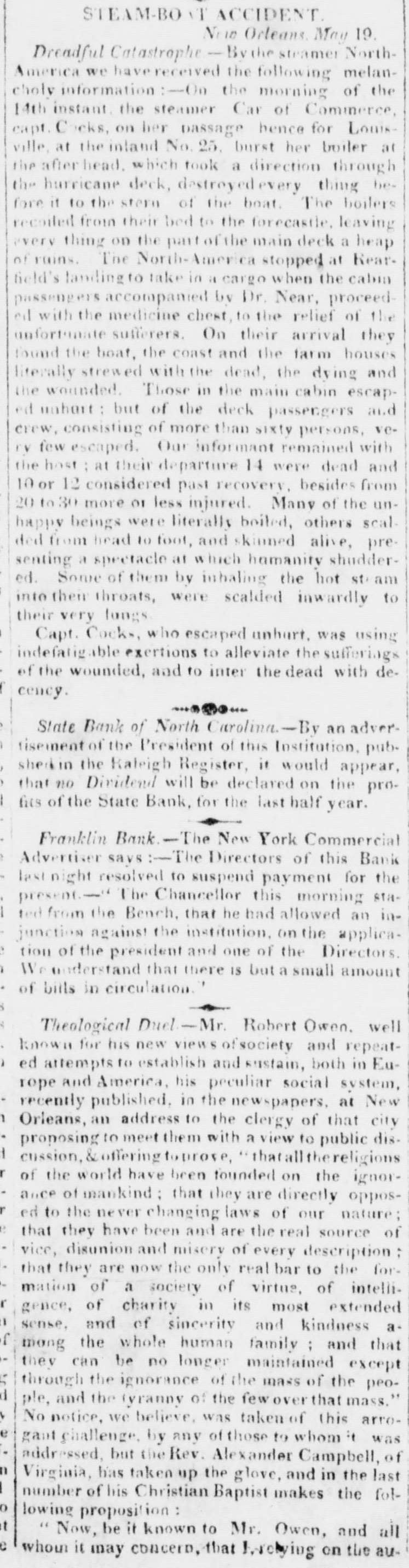
NEW Orleans May 19. Dreadful Catastrophe -Bythe steamer NorthAmerica we have received the following melancholy information :-On the morning of the 14th instant the steamer Car of Commerce capt. Cocks, on her passage hence for Louisville, at the inland No. 25. burst her builer at the afterhead. which took a direction through the hurricane deck, destroyed every thing before it to the stern of the boat. The boilers recoiled from their bed to the forecastle, leaving every thing on the part of the main deck a heap of rains. The North-America stopped at Rearfield's landing to take in a cargo when the cabin passengers accompanied by Dr. Near, proceed eil with the medicine chest, to the relief of the unfortunate sufferers. On their arrival they found the boat, the coast and the farm houses literally strewed with the dead, the dying and the wounded Those in the main cabin escaped unhart but of the deck passengers and crew, consisting of more than sixty persons, veOur at their departure were by the few host escaped. informant 14 remained dead with and 10 or 12 considered past recovery, besides from 20 to 30 more or less injured. Many of the unhappy beings were literally boiled, others scal. ded from head to foot, and skinned alive, presenting a spectacle at which hamanity shuddered. Some of them by inhaling the hot steam into their throats, were scalded inwardly to their very longs Capt. Cocks, who escaped unhart. was using indefatigable exertions to alleviate the sufferings of the wounded, and to inter the dead with decency. State Bank of North Carolina.-By an adverrisement of the President of this Institution. pubshedin the Raleigh Register, it would appear, that no Dividend will be declared on the profits of the State Bank, for the last half year. Franklin Bank -The New York Commercial Advertiser says :-The Directors of this Bank lastnight resolved to suspend payment for the present.- The Chancellor this morning staed from the Bench, that he had allowed an injunction against the institution on the application of the president and one of the Directors. We understand that there IS but a small amount of bills in circulation." Theological Duel-I Robert Owen. well known for his new views of society and repeated attempts to establish and sustain, both in Europe and America, his peculiar social system, recently published, in the newspapers. at New 1 Orleans, an address to the clergy of that city proposing to meet them with a view to public discussion, &offering to prove, 'thatallthereligions of the world have been founded on the ignorance of mankind that they are directly opposed to the never changing laws of our nature; that they have been and are the real source of vice, disunion and misery of every description that they are now the only real bar to the formation of a society of virtus, of intellir I gence, of charity in its most extended sense, and of sincerity and kindness af mong the whole human family ; and that they can be no longer maintained except : the of the mass of the peod and the of the w ple, through ignorance tyranny taken few overthat of this mass." arroNo notice, we believe. was e gant challenge. by any of those to whom it was addressed, but the Rev. Alexander Campbell, of n Virginia, has taken up the glove, and in the last I number of his Christian Baptist makes the foto lowing proposition t " Now, be it known to Mr. Owen, and all e whour it may concern, that Herefying on the au-


Article from Richmond Enquirer, June 10, 1828

Click image to open full size in new tab

Article Text

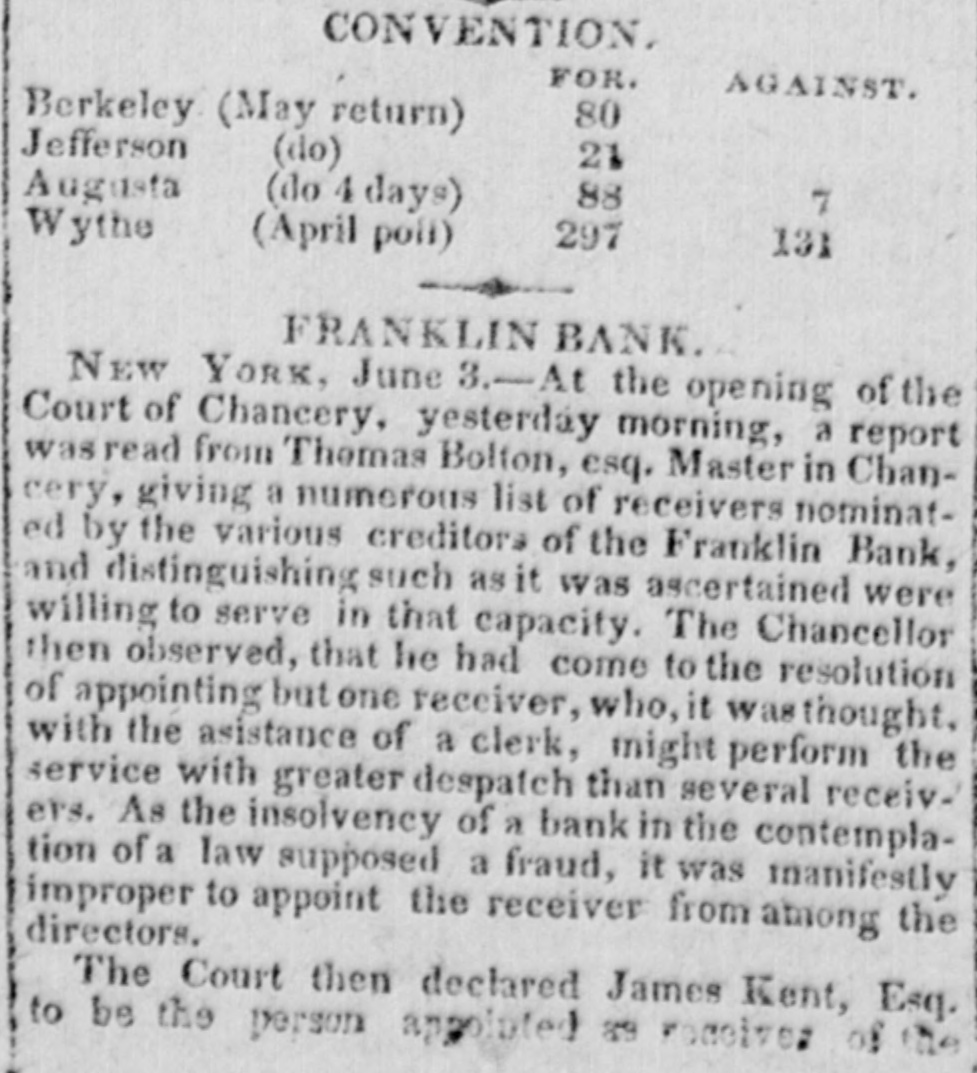
CONVENTION. FOR. AGAINST. 80 Berkeley (May return) Jefferson 21 (do) Augusta 88 (do 4 days) 7 Wythe 297 (April poli) 131 FRANKLIN BANK. NEW YORK, June 3.-At the opening of the Court of Chancery, yesterday morning, a report wasread from Thomas Bolton, esq. Master in Chancery, giving a numerous list of receivers nominated by the various creditors of the Franklin Bank, and distinguishing such as it was ascertained were willing to serve in that capacity. The Chancellor then observed, that he had come to the resolution of appointing but one receiver, who, it wasthought, with the asistance of a clerk, might perform the service with greater despatch than several receivet's. As the insolvency of a bank in the contemplation of a law supposed a fraud, it was manifestly improper to appoint the receiver from among the directors. The Court then declared James Kent, Esq. to be the person appolated 89 receiver of the


Article from Richmond Enquirer, June 10, 1828

Click image to open full size in new tab

Article Text

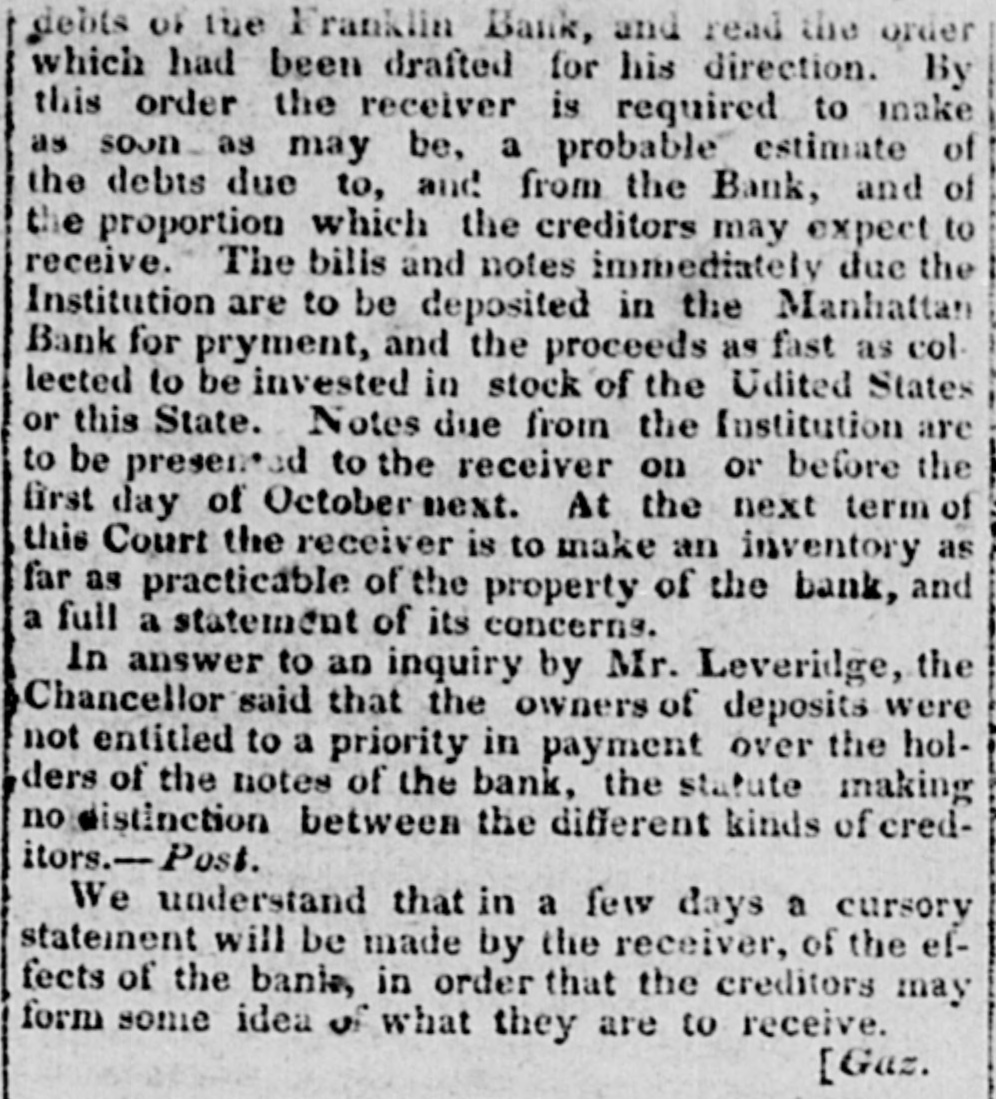
debts of the Franklin Bank, and read the order which had been drafted for his direction. By this order the receiver is required to make as soon as may be, a probable estimate of the debts due to, and from the Bank, and of the proportion which the creditors may expect to receive. The bills and notes immediately due the Institution are to be deposited in the Manhattan Bank for pryment, and the proceeds as fast as collected to be invested in stock of the Udited States or this State. Notes due from the Institution are to be presented to the receiver on or before the first day of October next. At the next term of this Court the receiver is to make an inventory as far as practicable of the property of the bank, and a full a statement of its concerns. In answer to an inquiry by Mr. Leveridge, the Chancellor said that the owners of deposits were not entitled to a priority in payment over the holders of the notes of the bank, the statute making no distinction between the different kinds of creditors.-Post. We understand that in a few days a cursory statement will be made by the receiver, of the effects of the bank, in order that the creditors may form some idea of what they are to receive. [Gaz.


Article from Constitutional Whig, June 14, 1828

Click image to open full size in new tab

Article Text

In the case of the Franklin Bank of the city of New York, which suspended payment a few days since, the Chancellor has decided that deposites are not to have any preference in payment, over banic notes. in the last New York Post, one of the depositors has protested against this decision, in the following terms: From the peculiar hardship attending the case of the subscriber with the Franklin Bank, he thinks himself justified in making the following expose and protest On the second of February last, he commenced making deposites in the aforesaid bank. and up to the 26th day of May. three days before it closed its doors. had depos sited two thousand and fifty nine dollars. He had not from the time of the first deposit to this date, drawn a check upon the bank for a single dollar, or asked it for a favor. The money so deposited was not given as a credit to the bank, but money lodged there to meet the claims of his honest creditors, and he cannot refrain expressing his disappointment and surprise when upon application he was informed by the clerks and cashier, that he could not obtain that which was placed by him in their hands as a sacred deposit, as the means of speculation or interest. If he tBSS disappointed and surprised at the refusal of the officers of the bank to make good monies lodged in their hands as a matter of trust, he is still more surprised at the arrangements made to wind up the concerns of the bank. He ohserves that by an order of the Court of Chancery, the officers of the bank are required to make a statement of the debts, credits and effects. and that James Kent, Esq. is appointed Receiver, with power to sue, &c and as often as the Receiver is in possession of $5000 over and above certain funds to meet contingencies and current expenses, he is authorised and directed to invest the same in Government Stock, in the name of the Register of the Court of Chancery. and in due time to dispose of the property and stock of the bank at action--against this the subscriber most solemnly protests, and hopes that the other depositors of the bank will also protest on the following grounds:1st. Deposites made for safe keeping are not the property of the bank. and should be restored without delay, in full to the right owners. 2d. That the receiver will be entitled to a commis sion ou the purchase of Government Stock. 3d. That he is entitled to 2 commission on the sale of Government Stock. 4th. The chance of speculation and loss on the Government Stock. 5th. That it was never the intention of the subscriber to hazard his money in speculation. And lastly the unnecessary expense attendant on this mode sattlement PHIT IP BRIGGS,


Article from The Virginian, June 19, 1828

Click image to open full size in new tab

Article Text

it is to be apprehended that the great buik e: deposites may be made in the former, to the prejudice of the latter In the last New York Post, one of the depositors has protested against this decision, in the following terins :From the peculiar hardship attending the case of the subscriber with the Franklin Bank, he thinks himself justified in making the following expose and protest. Oa the second of Feblaury last, he commenced making deposites in the aforesaid bank and up to the 26th day of May, three days before closed its doors. had deposited two thousand and filly time dollars. He had not, from the first deposite to this date, drawn a check upon the bank for a single dollar, or asked it for a favor. The money so deposited was not given as a credit to the bank, but money lodged there to meet the claims of his honest creditors. and he cannot retrain expressing his disappointment and surprise when upon application he was informed by the clerks and cashier. that he could not obtain that which was placed by him in their hands as a sacred deposite If --not as n means of speculation or interest was disappointed add surprised at the refusal of the officers of the bank to make good monies lodged in Hieir hand as a matt of trust, he is still more surprised at the arrangements made wind up the concerns of the bank. He oh. serves that by an order of the Courtof Chancery, the officers of the bank are required to make statement of the debts, credits, and effects, and that James Kent, Esq is appointed Receiver with power to sue, see nd as often as the Re. Criver is in possession of 5000 dollars over and above certain funds to meet contingencies and current expenses, he is authorised and directed invest the same in Government Stock, in the name of the Register of the Court of Chancery ant in due time 10 dispose of the property and stock of the bank at auct on-against this the subscriber most solemnly protests, and hopes that the other depositors of the bank will also protes on the following grounds: 1st Deposites made for sake keeping are not the property of the bank, and should be res. tored without d-day. infall the rightful owners 2d. That the receiver will be entitled to commission on the purchase of Government Stock 3d. That he is entitled to commission on the sale of Gover ment Stock 4th. The chance of speculation and loss on the Gov roment Stock 5th That it was never the intention of the subscriber to hazard the money in speculation. And lastly the nuncessary expense attendant on this mode of settlement PHILIP BRIGGS. The following gen lemen have been invited by the Secretary of War, to attend the examiination of the Cadets at the Military Acade my West Point. which commenced on Monday the 2d mst. Commed re John Rodgers United States' Navy General illiam Carroll, of Tennessee. ColonelHugh Mercer of Virginia. James Kent Esq. of New York. Dr. H sack do Honorable D. D Barnard do Honorable John H Bryan of North Carolina on Totten United Sals Army. do Genera Brady, P.I. Nicotin, Esq. Pennsylvania. Colonel G W. Kitter do Professor Vetbake, Dickanson College, do Colonel Breck of Keutucky Captain Larrabee of Contracticut Henry A Ballard Esq of Louisiana Colonel Isabe Audress New Jersey William J. Astiley Esq. of Kentucky Colonel Thomas Emory, Maruland. John Pitman, Esq Rhode Island. Morgan up the Missouri This noted vic. tim to the sacred order of Masonry, who, in the space of 12 months has undergone more transmigtationstham ever Indar did-who has beend ad and again alive-who has been buried in bellow strumps. and afterwards found lying most incomfortably on the banks of Lake Eni -who has been the noble with his coronel and again the humble seller of drains--W ho has travelled over every clime with more expedition than ever did Baron Muschausen-will has al. ternately excited the curiosity, sympathy. and astonishment of the world, has at last, much a gainst his will, been identified residing among the gagaga tribe of Indians, about 220 miles up the Missouri This information is derived fr in one of the returning emigrating half breed Insians, who gained its information while in Arkansas from a person who had been travellingupthat river upon a for nting exped t and who was well acquainted with Morgan from his boyboad The hunter of furs states, that M organis a principal chief in the tribe, has in rried the daughter of old King Gegagaga. all the Kings bearing that name and is known among them as Homenechleco, or the White Warrier Every endeavor was used to induce his return and every art resort d to, to induce a disclosure, by what means he had arrived at this then abode: but he resisted both art and intraitly and no satisfaction could he gained re pecting the CAUSE of his sudden mysterious disappearance. Olster (N ¥. Republican little Rock (Ark) May 7 Indians on our Southwestern Barder --Col. RECTOR returned o this place ou Monday last, from Miller Countv. where he was sent some weeks since, by the Governor, with orders to remove certain Indians who have been collecting in that C unly for some tune past : and we are happy to learn. that he has fully succeeded in the objects of his Journey first the Indians showed a disposition to be refractory. and refused to remove from the country, agreeably to he orders of the Governor n which Col. Rector applied to Captain HYDE, Commanding Officer at Cantonment Towson. for assistance but was informed v him, that he had no troops to space. and d.d. not fornish any. Failing toget assistance from the garrison, Col. R next applied to the eitizens,and biscali was promptly answered Sixtv three armed men imme intely turned out. and placed themselves under his orders. With this little band, he proceeded, without delay, towards the principal village of the Indians, with


Article from The Delaware Register, Or, Farmers', Manufacturers' & Mechanics' Advocate, November 15, 1828

Click image to open full size in new tab

Article Text

CS ADVOCATE. Some of the carronades and howitzers are said to be equal to any the British ever possessed ; they were captured on the memorable 11th September, 1814.With the glorious events of that day our readers are familiar, but a view of these relies is well calculated to inspire a feeling of gratitude to the God of Battles" for our happy deliverance. A Caution.-A lady, a few days ago, in passing rapidly round the base of the sky-light on the dome of the grand rotunda of the Capitol, suddenly fell upon the glass frame, broke through one of the panes, and was fortunately stopped in her descent by the narrowness of the aperture, and the extension of her arms. She remained suspended in that position for several minutes, 130 feet above a floor paved with stone, till one of the attendants came to her assistance, her companions being too much petrified to give her any aid. We trust this will be a warning to those whose curiosity may lead them to that splendid but dangerous nex.-Washington Chron. Franklin Bank of New York. - The Hon. James Kent, receiver of the Franklin Bank of New York, has made an official report of its affairs to the Chancery Court, from which it appears that its concerns have been most grossly mismanaged, to apply the mildest term. It is declared that the stockholders lose every thing; and, in the best result, the creditors, either as note holders or depositors, will only receive fifty cents on the dollar-and probably not so much The Receiver says, that, during severol years, the minutes of the Board of Directors were kept in so slovenly and disorderly a manner, that the history of the transactions of the Bank is left in great confusion.No entry appears, even of the names of the persons who were elected Directors for the years 1322, or for the year 1826." New York, Nov. 12. FRANKLIN BANK.-A question of much interest was argued on Monday, before Chancellor Wallworth, in relation to the distribution of the Assets of this Bank. The Depositors claim that the amount due them should be first paid, and that the holders of bills should afterwards come in for what (if any thing) may be left. Samuel A. Foot, Esq. on behalf of the holders of bills, opposed the claim, which was advocated by D. 3 B. Ogden, Esq. for the Depositors. The question being one of much importance, both as regards the principle to be established and the amount of property, Chanceller Wallworth has taken time to consider it, and will give his decision early in the ensuing week. An Honest Advertiser.-' following notice (says the Rochester Observer) is from the Yates Republican, and we would recommend it to the careful and prayerful consideration of all, especially professors of religion, who are engaged in furnishing the means of self-destruction to our citizens. "I have discontinued the distilling business, and have on hand, for sale, very low for ready pay or approved credit, a full set of distilling apparatus, consisting of two Worms, a copper Boiler, and iron Cylinder. The Cylinder is large, and uncommonly powerful. I have no doubt that with skilful management, the whole establishment would produce daily-a sufficient quantity of whiskey to kill fifty men, W. BABCOCK." Mr Cobbett's Beau-Ideal of a Laborer.-The following characteristic advertisement appears in Cobbett's Register:e I want three or four laboring men for the winter, at three t shillings per week, boarded and lodged in my farm-house.


Article from The Delaware Register, Or, Farmers', Manufacturers' & Mechanics' Advocate, November 22, 1828

Click image to open full size in new tab

Article Text

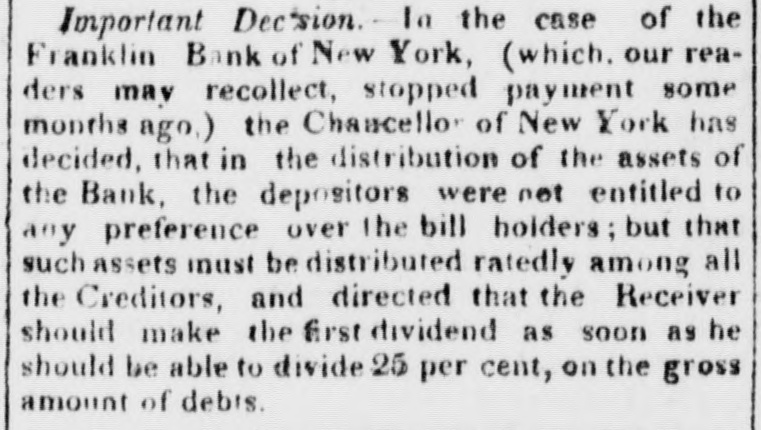
Important to those concerned. - In the case of the Frank- lin Bank of New York, the Chancellor has decided, that in the distribution of the assets of the Bank, the depositors were not entitled to any preference over the bill holders; but that such assets must be distributed ratedly among all the Credi- tors, and directed that the Receiver should make the first dividend as soon as he should be able to divide 25 per cent. on the gross amount of debts. Mexico. - Letters from Vera Cruz, of the 29th of September, are received in New York. They an- nounce the fact of the election of Pedrasa, as Presi- dent of the Republic, and that the Government had succeeded in obtaining a loan of 500,000 dollars as soon as the result of the election was known. Gene- ral Rincon is Governor of Vera Cruz. St. Ana re- mained in possession of Perote, but an ample force was on the march to subdue him. According to these advices, every thing was favorable to the speedy resto- ration of tranquility. At the last session of the Legislature of Pennsylvania, a law was passed which prohibits the circulation in that State, after the first of January next, of all bank notes of a less de- nomination than five dollars, and lays a fine of five dollars for every violation of the said Law. Dr Isaac Osgood, of Bluehill, Me. recently counted the grains of mustard on one branch of a stalk. There were 1175 pods, averaging four seeds each—4700 seeds. Worcester Coal. - The bed of Anthracite Coal, recently discovered in the vicinity of the village of Worcester, Massa- chusetts, has been opened to the extent of sixty feet. It is found to equal the anthracite coal of Pennsylvania, and the people are preparing to use it extensively. A rail road from the village to the mine, is in contemplation. Wrapping paper, and Paste-board, from Oat straw, are made at the paper mill of Mr Shyrock, of Cham- bersburg, Pa., which are represented to be very supe- rior in quality. Baptism by immersion, (says a New York paper) was lately performed in the established church, in Leicester, Eng- land. The rite was administered by the Rev. C. Vaughan, under the direction of the bishop of Lincoln. Such a case had not occurred before in that church, it is stated, for two centuries. The rate of interest, in the year 1255, the fortieth year of Henry the Third, was fifty per cent. per an- num, which was the highest rate ever known in Eng- land. The first act of Parliament for regulating the interest of money lent in this kingdom, was passed in the year 1545, the thirty-seventh of Henry the Eighth, by which it was fixed at 10 per cent. Baltimore Firemen, &c. - A communication in the Balti- more Gazette, contains the following statement: There are in our city, 14 engine and hose companies, em- ploying 27 engines of the following sizes, viz. 1 of 9¼ inch chambers, 1 of 3¼ inch, 2 of 8 inch, 4 of 7½ inch, 4 of 7 inch, 12 of 6 inch and 3 of 5 inch—there are in the possession of these companies, 18,000 feet of hose, prepared for instant operation, and 1,300 active and efficient members. The Philadelphia Aurora of the 13th, says - Anoth- er of the noted "Tea Cases," is now in the course of investigation before the Circuit Court of the United States. On Tuesday Edward Thomson was produced as a witness. When the officer, in affirming him, came to the words, "the whole truth," he said, "No, I will not tell that," and sat down. He refused to take the qualification, and for this contempt of Court was com- mitted to the custody of the Marshal. Thomas Hinds has been elected a Representative to Con- gress, from the State of Mississippi, to fill the vacancy occa- sioned by the resignation of Mr Haile John A. Quitman has been appointed by the Governor to be Chancellor of the State of Mississippi, vice J. G. Clark, deceased. Late London papers state that the great desidera- tum of a steam boat adapted for canals, without do-


Article from Constitutional Whig, November 26, 1828

Click image to open full size in new tab

Article Text

Important Decision,-In the case of the Franklin Bank of New York (which, our readers may recollect, stopped payment some months ago) the Chancellor of New York has decided, that in the distribution of the assets of the Bank, the depositers were not entitled to any preference over the bill holders; but that such assets must be distributed ratedly among all the Creditors, and directed that the Receiver should make the first dividend as soon as he should be able to divide 25 per cent on the gross amount of debts. William and Mary College.-More than two weeks ago, "the number of matriculated students in the College was upwards of 45, and a considerable accession was expected in the course of the week."


Article from The Virginian, December 1, 1828

Click image to open full size in new tab

Article Text

Important Decision. - In the case of the Franklin Bank of New York, (which. our readers may recollect, stopped payment some months ago.) the Chaucello of New York has decided, that in the distribution of the assets of the Bank, the depositors were not entitled to any preference over the bill holders : but that such assets must be distributed ratedly among all the Creditors, and directed that the Receiver should make the first dividend as soon as he should be able to divide 25 per cent, on the gross amount of debts.


Article from Litchfield Enquirer, March 26, 1829

Click image to open full size in new tab

Article Text

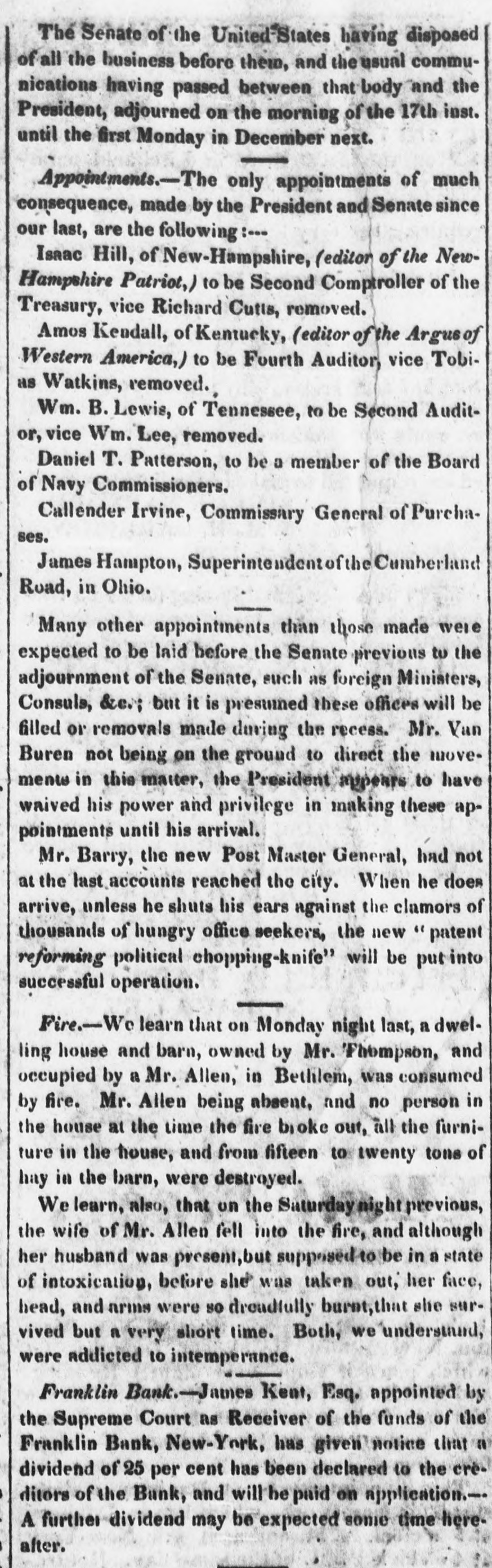
The Senate of the United States having disposed of all the business before them, and the usual communications having passed between that body and the President, adjourned on the morning of the 17th inst. until the first Monday in December next. Appointments.-The only appointments of much consequence, made by the President and Senate since our last, are the following: Isaac Hill, of New-Hampshire, (editor of the NewHampshire Patriot,) to be Second Comptroller of the Treasury, vice Richard Cutis, removed. Amos Kendall, of Kemueky, (editor of the Argus of Western America,) to be Fourth Auditor vice Tobias Watkins, removed. Wm. B. Lewis, of Tennessee, to be Second Auditor, vice Wm. Lee, removed. Daniel T. Patterson, to be a member of the Board of Navy Commissioners. Callender Irvine, Commissary General of Purchases. James Hampton, Superintendent of the Cumberland Road, in Ohio. Many other appointments than those made were expected to be laid before the Senate previous to the adjournment of the Senate, such as foreign Ministers, Consuls, &c., but it is presumed these offices will be filled or removals made during the recess. Mr. Van Buren not being on the ground to direct the movemenu in this matter, the President supports to have waived his power and privilege in making these appointments until his arrival. Mr. Barry, the new Post Master General, had not at the last accounts reached the city. When he does arrive, unless he shuts his ears against the clamors of thousands of hungry office seekers, the new "patent reforming political chopping-knife" will be put into successful operation. Fire.-We learn that on Monday night last, a dwel. ling house and barn, owned by Mr. 'Fhompson, and occupied by a Mr. Allen, in Bethiem, was consumed by fire. Mr. Allen being absent, and no person in the house at the time the fire bloke our, all the furniture in the house, and from fifteen to twenty tone of hay in the barn, were destroyed. We learn, also, that on the Saturday night previous, the wife of Mr. Allen fell into the fire, and although her husband was present, but supposed to be in a state of intoxication, before she was taken out, her face, head, and arms were so dreadfully burnt, that she survived but a very short time. Both, we understand, were addicted to intemperance. Franklin Bank.-James Kent, Esq. appointed by the Supreme Court as Receiver of the funds of the Franklin Bank, New-York, has given notice that dividend of 25 per cent has been declared to the crè. ditors of the Bank, and will he paid on application.A further dividend may be expected some time here. after.


Article from Daily Richmond Whig, August 19, 1829

Click image to open full size in new tab

Article Text

cannot envy them their feelings; nor will I complain if the traits which they exhibit shall be the passport to prefermeut, a claim to your confidence and esteem. I have the honor to be. Sir, your fellow citizen, ANDREW COYLE, Late Chief Clerk Post Office Department. [From the New York Morning Herald.] ### WHAT IS THE CAUSE OF THE DISTRESS AND HARD TIMES IN THIS COUNTRY? This question has been asked in a thousand shapes, and answered in as many. Adam Smith compares a nation to a family, and tells us that what would render a well regulated family prospe- rous, extended, would render a nation so; and of course what wou'd derange a family, would, if ap- plied to a nation, produce a siusilar effect. Now if a family that had been in the habit of buying 500 or 1000 dollars of goods per annum, it being just a- bout the ainount they could conveniently pay for, should be induced to buy double that quantity and become embarrassed, even though they obtained them cheaper than usual, would it not be strange if the members of the family should be found running about, and wondering why they were embarrassed. asking the cause, and attributuig it to every kind of thing imaginable but the true one, that is the buying of too many goods? Great Britain to a great extent is the merchant for the United States. She has or- dinarily sold us about 30,000,000 of dollars worth of goods, as much as we could well pay for. In 1828 Mr. Peel tells us, she sent to this country more than double that quantity. After they were brought here they were sold no doubt, and the money paid for them is gane out of this country to Great Britain. Is it strange then that we are einbarrassed? Would it not be strange if we were not embarrassed? It re- quires no necromancy to understand this. It is us piain as Dr. Franklin's mode of emptying the meal tub, which was done simply by taking out, and put- ting nothing in. But why has Great Britain of late sent us so many more goods than usual? The na- tions of the earth being pretty much at peace, and finding it better to make goods themselves than to buy them of Great Britain as they have been wont to do, she having a larger surplus on hand than usual. and wanting money more than goods, the ports of the United States being open to receive them, it would be passing strange if she did not ship them. It may be said that, although there has been a gen- eral pressure through the country, it has been felt more severely by the American manufacturers than any other class of citizens. This is perhaps true- the imported English goods being sold cheap to the customers of the manufacturers, would of course a- bridge their sales, this together with the general pressure and hue and cry through the country, tha the manufacturers were all about to fail, has brought a great portion of the calamity directly upon their de- voted heads. No class of manufacturers have suffer- ed more than those engaged in making coarse cot- tons. This had for years been a very profitable bu- siness-and vast amounts of capital and credit were employed. The prostration of credit operated like the besom of destruction. It was unparalled. The Journals in our mercantile cities who were instru- mental in destroying this confidence, have ascribed the embrassment to every cause but the true one. It is chiefly charged to the tariff of 1823. The ta- riff of 1328? What an absurdity! Every body knows. that knows any thing on the subject, that the tariff of 1828 had no effect on coarse cottons. The reply of all the cotton manufacturers, who were examin- ed by the Committee of the House of Representatives in 1823, was uniform that they wanted no further protection that they had under the existing laws ex- cluded foreign coarse cottons, and that all competi- tion, but home competition had ceased. The trou- bles in Rhode Island might as well be ascribed to the revocation of the edict of Nautz, as to the last tariff, and those who have produced this impression have done it from ignorance, or the most wanton decep- tion. Let it not be said by those who have been instru- mental in prostrating the manufacturing credit, that they had pushed the business too far that they ought not to have gone beyond their capita. If the same conduct had been pursued towards the Banks of this City at a particular juncture, when one of our City Banks failed, where would they now have been? If a general rush were now to be made upon us, is there any one so credulous as to believe they would meet all the demands. Suppose at the time of the failure of the Franklin Bank, very paper in the country had come out with the declaration that the New York Banks were all on the eve of a failure, how many would have withstood the shock? What would have been the situation of their customers, if they had re- fused to discount and undertaken to redeem all the paper they had emitted, by selling the goods, ships, &c. of their customers under the hammer, for what they would bring? Would not the calamity have been much greater? Mercantile credit is more ex- tended than manufacturing credit now is, or probably ever will be. CLARENDON. In the admirable article, in the last Edinburgh Re- view, on the Catholic Question, to which we have more than once already alluded, we find the follow- ing passage, illustrating the fallacy of the confidence that superiority of resources can make up for the in- justice of the cause in which they are emploved. N. Y. Am. "Mere strength and courage are not securities enough for victory; or America would still be ours. Let those who will regard nothing in a contest but its issue, look back to that fatal war, also with a kindred nation. It began with every thing in our favor but justice. Such was the unanimity, that the minority ranged from five to ten in the house of Lords. Lord Rockingham's party, when joined by Fox was always under fifty in the House of Commons. For mere law, the lawyers were always clear on the le- gislative authority of this country. The people at home so positive, that they would have stoned the man who had proposed to surrender it, without one dissentient vocie. The soldiers thought the Yankees were a sort of negroes escaped from Newgate, and sailed, delighting in the expedition. The Americane themselves were divided. None dreamt of Independ- ence. The hottest wou'd have been satisfied with some slight concessions. They were scattered over a vast country, unprepared, and shrinking from the idea of a battle. Yet the principle of Freedom, sad the sympathy of Europe, were stronger than the bay- onet of England; and we were shortly seen closing a disgraceful war, where two armies had laid down their arms, with a peace that not even left us our bonor. With this example yet botning in the memory