15793. Equitable National Bank (New York, NY)

Bank Information

Episode Type
Suspension → Closure
Bank Type
national
Bank ID
6284
Charter Number
6284
Start Date
February 9, 1904
Location
New York, New York (40.714, -74.006)

Metadata

Model
gpt-5-mini
Short Digest
64798bc3

Response Measures

None

Receivership Details

Depositor recovery rate
100.0%
Date receivership started
1904-02-10
Date receivership terminated
1904-11-25
OCC cause of failure
Losses
Share of assets assessed as good
38.9%
Share of assets assessed as doubtful
45.2%
Share of assets assessed as worthless
15.9%

Description

The Comptroller ordered the Equitable National Bank closed and appointed a receiver (Feb 10, 1904). Newspapers report a small run when news of the possible closing leaked, but the primary event is the suspension/closure by government action and appointment of a receiver. Depositors were reported to be paid in full; later criminal charges against the ex-cashier are reported.

Events (4)

1. June 2, 1902 Chartered
Source
historical_nic
2. February 9, 1904 Other
Newspaper Excerpt
There was a small run on the bank yesterday when the fact that it might close became known. Depositors who appeared before the regular closing time were paid off promptly ...
Source
newspapers
3. February 10, 1904 Receivership
Source
historical_nic
4. February 10, 1904 Suspension
Cause
Government Action
Cause Details
Closed by order of the Comptroller of the Currency; receiver Edward Ridgely appointed due to bad loans and injudicious management.
Newspaper Excerpt
The Equitable National bank of New York city was closed today by direction of the comptroller of the currency and National Bank Examiner Edward Ridgley has been appointed receiver.
Source
newspapers

Newspaper Articles (18)

Article from The Topeka State Journal, February 10, 1904

Click image to open full size in new tab

Article Text

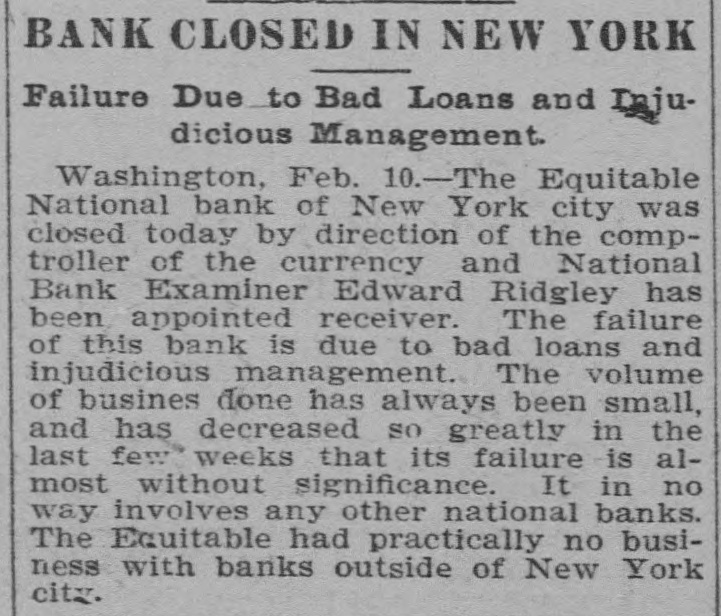
BANK CLOSED IN NEW YORK Failure Due to Bad Loans and Injudicious Management. Washington, Feb. 10.-The Equitable National bank of New York city was closed today by direction of the comptroller of the currency and National Bank Examiner Edward Ridgley has been appointed receiver. The failure of this bank is due to bad loans and injudicious management. The volume of busines done has always been small, and has decreased so greatly in the last few weeks that its failure is almost without significance. It in no way involves any other national banks. The Equitable had practically no business with banks outside of New York city.


Article from The Evening World, February 10, 1904

Click image to open full size in new tab

Article Text

EQUITABLE BANK ORDERED CLOSED Institution Organized by Postmaster Van Cott and Political Associates Put Out of Business by Comptroller Ridgely. The Equitable National Bank of the City of New York, at No. 803 Broadway. was closed to-day by order of Comptroller of the Currency Ridgely. This action followed a meeting of the officers and directors of the bank yesterday. at which it was decided that the bank was not even self-supporting and that with the handicap of having to carry $42,000 of worthless paper, a heritage from the old management, there was no use in keeping up the struggle any longer. It was, therefore decided to ask the Comptroller of the Currency to appoint a receiver, and a message to this effect was sent to Washington yesterday. Comptroller Ridgely acted promptly, appointing his. own brother. National Bank Examiner Edward Ridgely, receiver. There was a small run on the bank yesterday when the fact that it might close became known. Depositors who appeared before the regular closing time were paid off promptly and it was said at the bank to-day that others would be paid by the receiver as fast as they presented their claims. Postmaster Van Cott and a number of his associates in his political district organized the Equitable National Bank in May. 1902, and it opened for business the following month. Mr. Van Cott was President of the bank. which never did very much business. The present management and the bank examiners have denounced the old management repeatedly. especially because of the injudicious loans that it made. The methods of the Van Cott management certainly got the bank into difficulties. and last August It was decided to reorganize. Carl Randolph Schultz. son of the soda-water man, and a boy of twenty-seven, was made President. Much was published at the time about the young man, who was said to be the youngest bank president in the world. Julius Hammerslough was elected First Vice-President, E. G. Gilmore Second Vice-President and Owen T. Reeves. ir., cashier. The new officers made a desperate fight to save the bank. but could not. They ware too heavily bandicapped by the weight of worthless paper. At the meeting yesterday Mr. Van Cott and a number of others were present and after going thoroughly over the situation they agreed that there was nothing to do but liquidate. A statement was issued that all depositors would be paid in full and. then the Comptroller was asked by wire to act. The Equitable National Bank is capitalized at $200,000. It has 322 depositors, to whom $185,000 is due. The assets are said to be $385,000, not including $42,000 in bad paper. President Schultz when seen to-day at his residence, No. US West Ninth street, made this statement of the trouble: "It is simply a case of getting out. We decided yesterday that we would have to do it.' The appointment of Mr. "Zidgely as receiver is only temporary 250 will n/: act until the depositors have been paid off. and then we expect the appointment of Mr. Reeves, our cashier. as permanent receiver. , "At least we have petitioned for his appointment. Mr. Reeves was once a National bank examiner and fully competent for the task. I think we have paid off about a half of our depositors and the others are well covered by our assets. No one will lose anything so no one need get in the least excited." "How about this talk of bad paper and bad management?" asked an Evening World reporter. "The so-called bad paper," answered Mr. Schultz. "is an heirloom from the old management. You see, we have only been in since Sept. 1, and we found " this paper here when we came. amounts to $42,000. and we have instigated suits for the recovery of a large


Article from The Fargo Forum and Daily Republican, February 10, 1904

Click image to open full size in new tab

Article Text

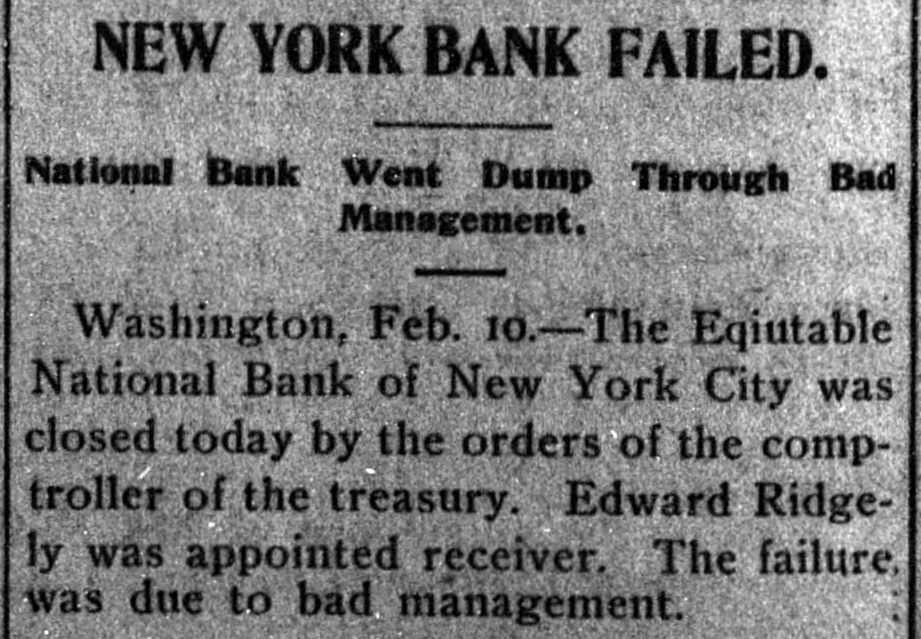
NEW YORK BANK FAILED. National Bank Went Dump Through Bad Management. / Washington, Feb. 10.-The Equitable National Bank of New York City was closed today by the orders of the comptroller of the treasury. Edward Ridgely was appointed receiver. The failure. was due to bad management.


Article from Las Vegas Daily Optic, February 10, 1904

Click image to open full size in new tab

Article Text

THE BANK FAILURE IN NEW YORK CITY. WASHINGTON, D.C., Feb. 10.The Equitable National bank, New York City, closed today by the order of the comptroller of the currency, and National Bank Examiner Edward Ridgeley was appointed receiver. The failure is due to bad loans and injudicious management.


Article from Evening Star, February 10, 1904

Click image to open full size in new tab

Article Text

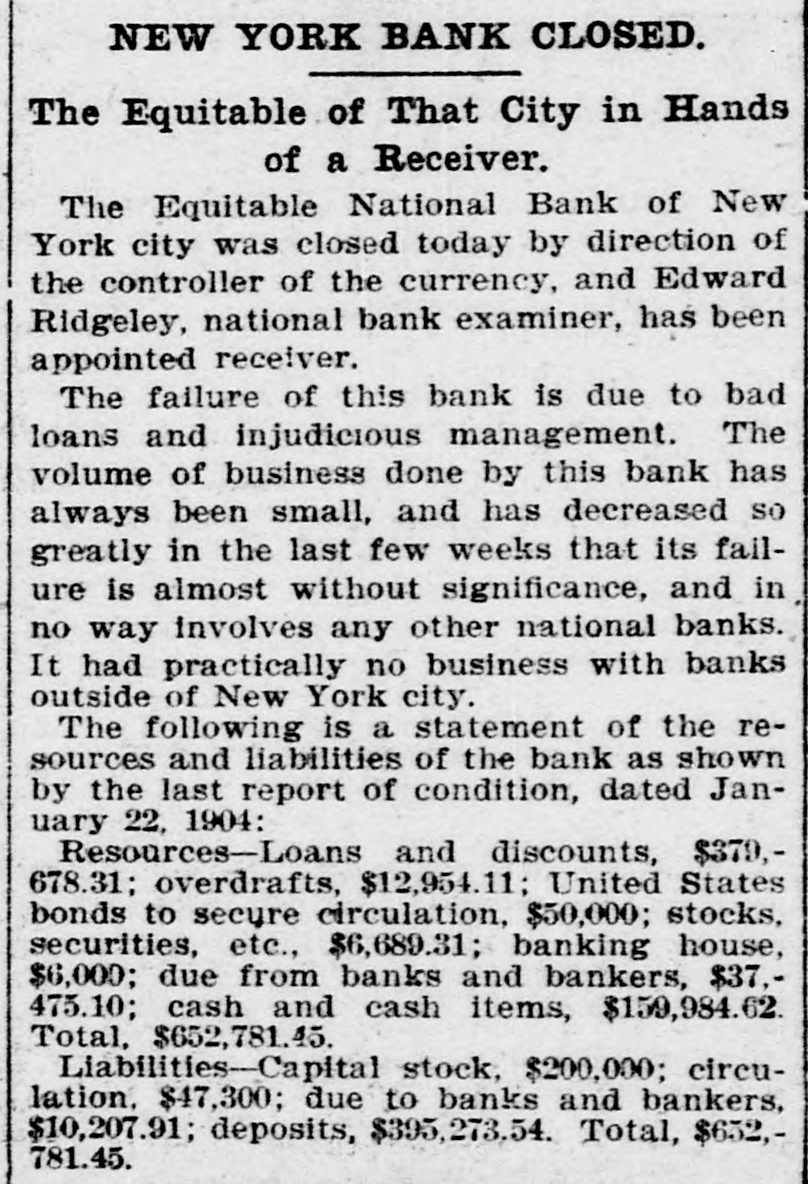
NEW YORK BANK CLOSED. The Equitable of That City in Hands of a Receiver. The Equitable National Bank of New York city was closed today by direction of the controller of the currency, and Edward Ridgeley, national bank examiner, has been appointed receiver. The failure of this bank is due to bad loans and injudicious management. The volume of business done by this bank has always been small, and has decreased SO greatly in the last few weeks that its failure is almost without significance, and in no way involves any other national banks. It had practically no business with banks outside of New York city. The following is a statement of the resources and liabilities of the bank as shown by the last report of condition, dated January 22, 1904: Resources-Loans and discounts, $379,678.31; overdrafts, $12,954.11; United States bonds to secure circulation, $50,000; stocks, securities, etc., $6,689.31; banking house, $6,000; due from banks and bankers, $37,475.10; cash and cash items, $159,984.62. Total, $652,781.45. Liabilities-Capital stock, $200,000; circulation. $47,300; due to banks and bankers, $10,207.91; deposits, $395,273.54. Total, $652,781.45.


Article from The Providence News, February 10, 1904

Click image to open full size in new tab

Article Text

NATIONAL BANK IS CLOSED BY ORDER OF COMPTROLLER. Washington Feb. 10.-The Equitable National bank of New York was closed today by direction of the comptroller of the currency and national bank examiner Edward Ridgeley has been appointed recelver. The failure of this bank is due to bad loans and injudicious management. The volume of business done by this bank has always been small and has decreased so greatly in the last few weeks that its failure is almost without significance and in no way involves any other national banks. It had practically no business with banks outside of New York city.


Article from Daily Kennebec Journal, February 11, 1904

Click image to open full size in new tab

Article Text

ASK FOR A RECEIVER. Directors of National Equitable Bank of New York. New York, Feb. 10.-By unanimous vote the directors of the Equitable National Bank have decided to ask the controller of the currency for the appointment of a receiver. The depositors according to the officials of. the institution will not lose a cent but the stockholders may lose more than 30 cents on the dollar on an aggregate amount of between $30,000 and $40,000. The bank, situated in the dry goods district at Broadway and 11th street was organized only two years ago. Many changes have occurred in its official rooster, and a few months ago C. R. Schultz was chosen president. He is the youngest head of a national bank in the country. "The earning capacity will not meet the running expenses of the bank in its present condition and will not warrant further continuance" said one of the directors. "We have taken this action to avoid further loss. The depositors will be paid in full." The bank is capitalized at $200,000, with claimed assets of $175,000 in excess of depositors. Washington, Feb. 10.-The Equitable National Bank of New York city, was closed. today, by direction of the comptroller of the currency and Notional Bank Examiner Edward Ridge. ley has been appointed the receiver. The failure of this bank is due to bad loans and injudicious management. The volume of business done by this bank has always been small and has decreased so greatly in the last few weeks that its failure is almost without significance and in no way involves any other national bank. It has practically no business with banks outside of New York city, A statement of the resources and liabilities of the bank was shown by the last report of condition, dated Jan. 22, 1904, showed total liabilities of $652,781 of which $395,273 was due depositors.


Article from The Indianapolis Journal, February 11, 1904

Click image to open full size in new tab

Article Text

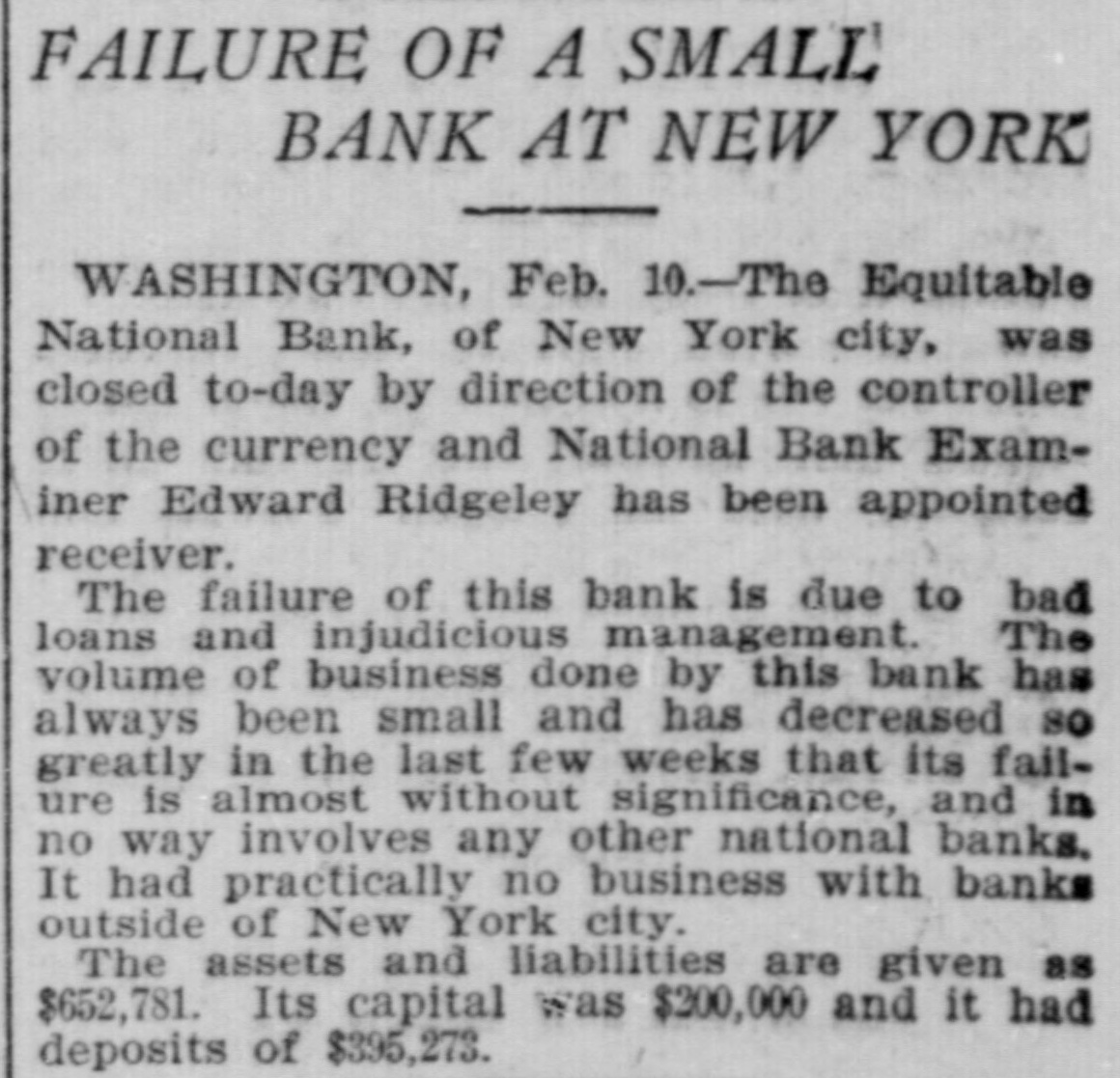
FAILURE OF A SMALL BANK AT NEW YORK WASHINGTON, Feb. 10.-The Equitable National Bank, of New York city, was closed to-day by direction of the controller of the currency and National Bank Examiner Edward Ridgeley has been appointed receiver. The failure of this bank is due to bad loans and injudicious management. The volume of business done by this bank has always been small and has decreased 80 greatly in the last few weeks that its failure is almost without significance, and in no way involves any other national banks. It had practically no business with banks outside of New York city. The assets and liabilities are given as $652,781. Its capital was $200,000 and it had deposits of $395,273.


Article from The Saint Paul Globe, February 11, 1904

Click image to open full size in new tab

Article Text

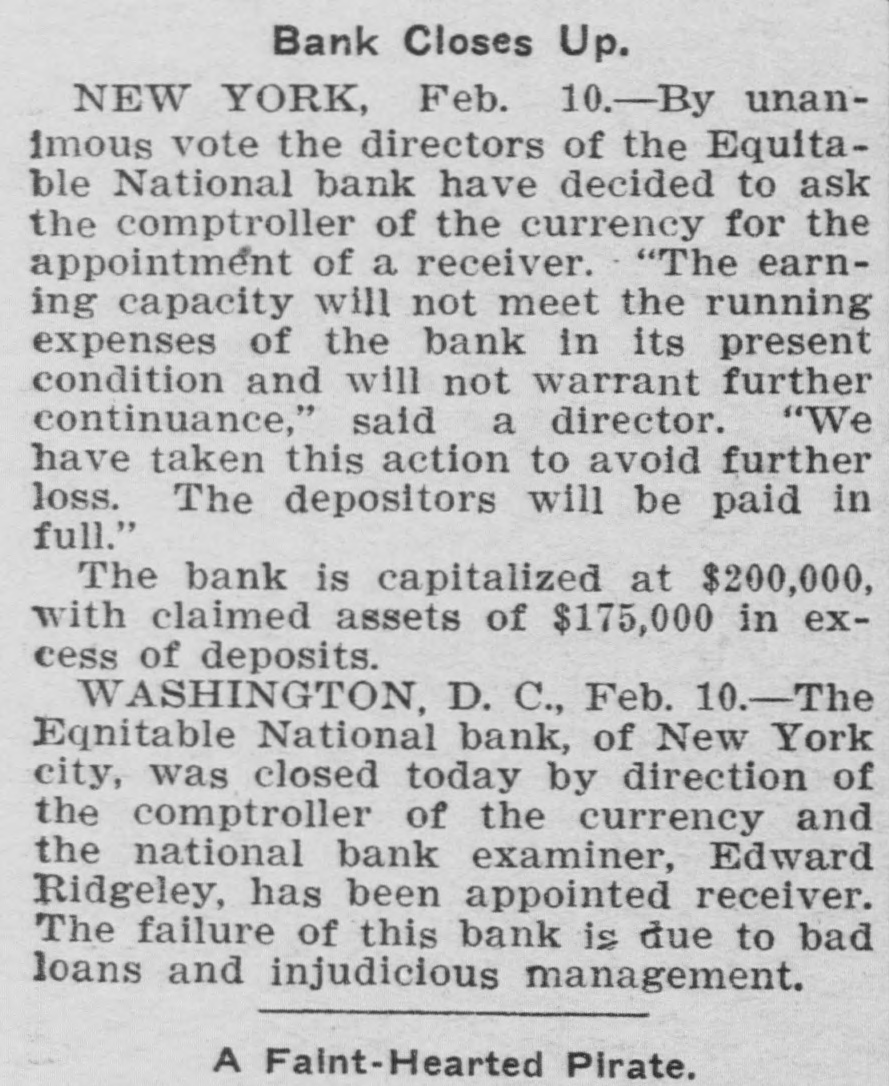
Bank Closes Up. NEW YORK, Feb. 10.-By unanimous vote the directors of the Equitable National bank have decided to ask the comptroller of the currency for the appointment of a receiver. "The earning capacity will not meet the running expenses of the bank in its present condition and will not warrant further continuance," said a director. "We have taken this action to avoid further loss. The depositors will be paid in full." The bank is capitalized at $200,000, with claimed assets of $175,000 in excess of deposits. WASHINGTON, D. C., Feb. 10.-The Eqnitable National bank, of New York city, was closed today by direction of the comptroller of the currency and the national bank examiner, Edward Ridgeley, has been appointed receiver. The failure of this bank is due to bad loans and injudicious management. A Faint-Hearted Pirate.


Article from The News & Observer, February 12, 1904

Click image to open full size in new tab

Article Text

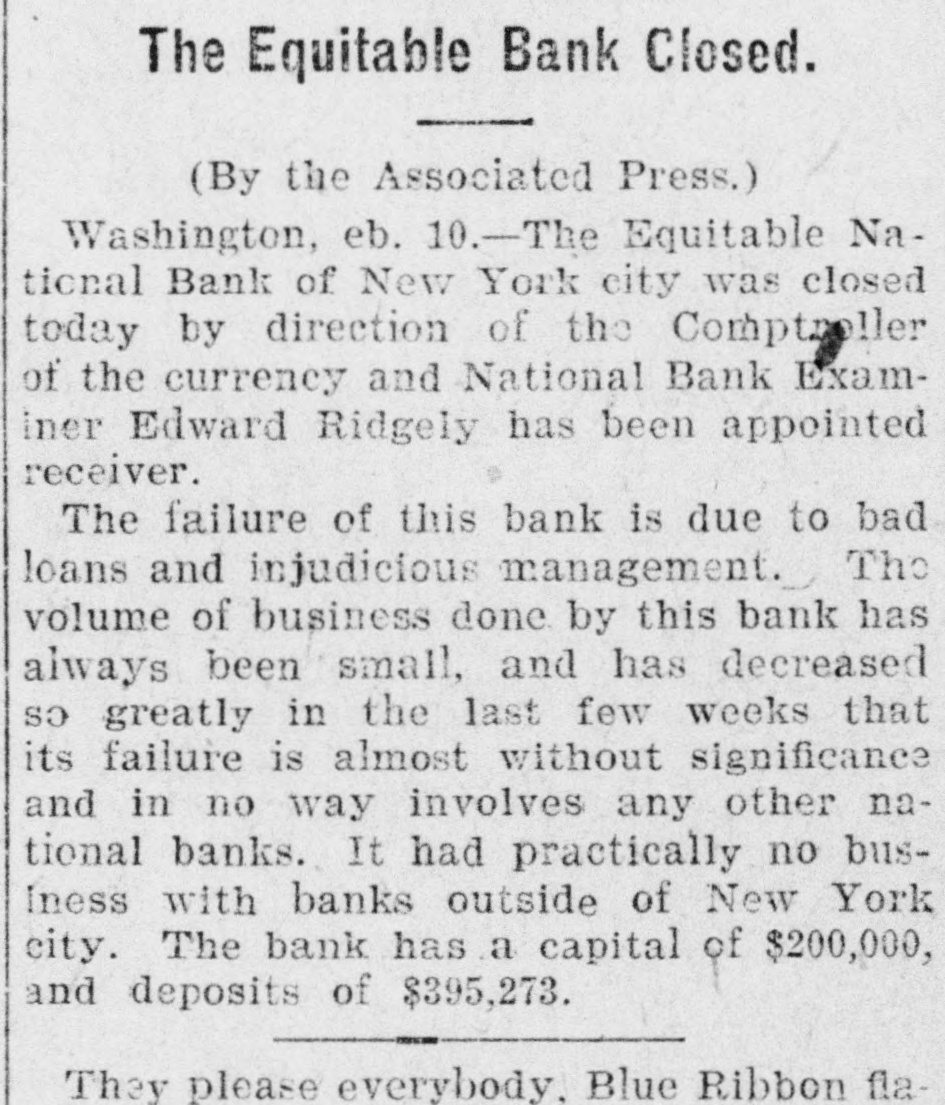
The Equitable Bank Closed. (By the Associated Press.) Washington, eb. 10.-The Equitable National Bank of New York city was closed today by direction of the Comptroller of the currency and National Bank Examiner Edward Ridgely has been appointed receiver. The failure of this bank is due to bad loans and injudicious management. The volume of business done by this bank has always been small, and has decreased SO greatly in the last few weeks that its failure is almost without significance and in no way involves any other national banks. It had practically no busIness with banks outside of New York city. The bank has a capital of $200,000, and deposits of $395,273. They please everybody. Blue Ribbon fla-


Article from The Cooperstown Courier, February 18, 1904

Click image to open full size in new tab

Article Text

THE NEWS IN BRIEF. For the Week Ending Feb. 18. Bandits dynamited the safe of a bank at Ravia, I. T., and secured $1,700. Burglars wrecked the interior of the Millerstown (Pa.) bank and got $500. After a run of ten days the Bank of Dunn, N. C., a state institution, closed its doors. Paul Misik, convicted of the murder of Charles O'Brien, was hanged at Hartford, Conn. The Equitable national bank of New York city closed its doors, with deposits of $395,273. The Citizens' national bank, of McGruder, Tex., closed its doors with liabilities of $134,603. A national boxing association has been organized at Detroit to control professional boxing. Henry W. Oliver, of Pittsburg, capitalist, steel master and politician, died at the age of 64 years. Erastus Wiman, once a famous promoter, died poor on Staten Island, N. Y., at the age of 70 years. The 20,000 rural free delivery mail carriers in the United States will have a holiday February 22. Rev. Mr. Soden, a Baptist minister, a Miss Clinton and a child were killed in a tornado at Union, Ark. Four men were crushed to death at Steubenville, 0., by the caving in of a pile of iron ore at a mine. Fourteen persons were killed and more than a score injured in a railway collision near Sand Point, Ont. John A. Roche, mayor of Chicago from 1887 to 1898, died suddenly of heart disease, aged 60 years. Ice gorges in the Susquehanna river were causing great damage at Wilkesbarre, Pa., and other places. The new customs duties announced by Cuba practically prohibit American competition in many articles. Mayor Johnson formally opened the national bowling tournament at Cleveland by rolling the first ball. Andre Matteson, for 20 years editor of the Chicago Times, died at his home in Highland Park, Ill., aged 75 years. George Bearskin, principal chief of the Seneca Indians, was found frozen to death by the roadside near Cayuga, I.T. The Iowa convention to select delegates to the national democratic convention will be held in Des Moines on May 4. Four men were shot to death and three wounded at Coal Creek, Tenn., in a fight between union and nonunion miners. James McDonald, a teamster, was arrested at Bedford, Ind., on suspicion of being the murderer of Miss Sarah C. Schafer. Rev. G. Campbell Morgan, former London preacher, has been called to the Second Presbyterian church in Chicago as pastor. Two twin baby sisters named Black were so badly bitten by rats at the Logan county children's home in Ohio that they died. Owing to a shortage of $57,500 in the cashier's accounts the savings department of the Wolfboro (N. H.) Loan bank closed. Twenty persons leaped from the thirdstory windows of a burning factory building in Brooklyn, N. Y., and five were fatally injured. August W. Machen, the central figure in the postal trial in Washington, took the witness stand and denied all the charges preferred against him. Rev. James Warden, who for 60 years was an active Methodist minister, has at the age of 102 years been admitted to the Baltimore (Md.) almshouse. Two of the three great buildings of the Corn Products company were destroyed by fire at Oswego, N. Y., causing a loss exceeding $1,000,000. A banquet 40 feet under Jackson boulevard, in the Illinois Telephone company's tunnel, was given by the latter to 1,200 guests in Chicago. Secretary Taft told the house committee on insular affairs that slavery had been abolished in the Philippines by legislative action taken there. Advices say that the powers of the world are indorsing Secretary Hay's plan and that the integrity of China is assured no matter how the Russo- Jan-

Article from The Sauk Centre Herald, February 18, 1904

Click image to open full size in new tab

Article Text

THE NEWS IN BRIEF. For the Week Ending Feb. 13. Bandits dynamited the safe of a bank at Ravia, I. T., and secured $1,700. Burglars wrecked the interior of the Millerstown (Pa.) bank and got $500. After a run of ten days the Bank of Dunn, N. C., a state institution, closed its doors. Paul Misik, convicted of the murder of Charles O'Brien, was hanged at Hartford, Conn. The Equitable national bank of New York city closed its doors, with deposits of $395,273. The Citizens' national bank, of McGruder, Tex., closed its doors with liabilities of $134,603. A national boxing association has been organized at Detroit to control professional boxing. Henry W. Oliver, of Pittsburg. capitalist, steel master and politician, died at the age of 64 years. Erastus Wiman, once a famous promoter, died poor on Staten Island, N. Y., at the age of 70 years. The 20,000 rural free delivery mail carriers in the United States will have a holiday February 22. Rev. Mr. Soden, a Baptist minister, a Miss Clinton and a child were killed in a tornado at Union, Ark. Four men were crushed to death at Steubenville, O., by the caving in of a pile of iron ore at a mine. Fourteen persons were killed and more than a score injured in a railway collision near Sand Point, Ont. John A. Roche, mayor of Chicago from 1887 to 1898, died suddenly of heart disease, aged 60 years. Ice gorges in the Susquehanna river were causing great damage at Wilkes. barre, Pa., and other places. The new customs duties announced by Cuba practically prohibit American competition in many articles. Mayor Johnson formally opened the national bowling tournament at Cleveland by rolling the first ball. Andre Matteson, for 20 years editor of the Chicago Times, died at his home in Highland Park, Ill., aged 75 years. George Bearskin, principal chief of the Seneca Indians; was found frozen to death by the roadside near Cayuga, I. T. The Iowa convention to select delegates to the national democratic convention will. be held in Des Moines on May 4. Four men were shot to death and three wounded at Coal Creek, Tenn., in a fight between union and nonunion miners. James McDonald, a teamster, was arrested at Bedford, Ind., on suspicion of being the murderer of Miss Sarah C. Schafer. Rev. G. Campbell Morgan, former London preacher, has been called to the Second Presbyterian church in Chicago as pastor. Two twin baby sisters named Black were so badly bitten by rats at the Logan county children's home in Ohio that they died. Owing to a shortage of $57,500 in the cashier's accounts the savings department of the Wolfboro (N. HI) Loan bank closed. Twenty persons leaped from the thirdstory windows of a/ burning factory building in Brooklyn, N. Y., and five were fatally injured. August W. Machen, the central figure in the postal trial in Washington, took the witness stand and denied all the charges preferred against him. Rev. James Warden, who for 60 years was an active Methodist minister, has at the age of 102 years been admitted to the Baltimore (Md.) almshouse. Two of the three great buildings of the Corn Products. company were destroyed by fire at Oswego, N. Y., causing a loss exceeding $1,000,000. A banquet 40 feet under Jackson boulevard, in the Illinois Telephone company's tunnel, was' given by the latter to 1,200 guests in Chicago. Secretary Taft told the house committee on insular affairs that slavery had been abolished in the Philippines by legislative action taken there. Advices say that the powers of the


Article from The Ely Miner, February 19, 1904

Click image to open full size in new tab

Article Text

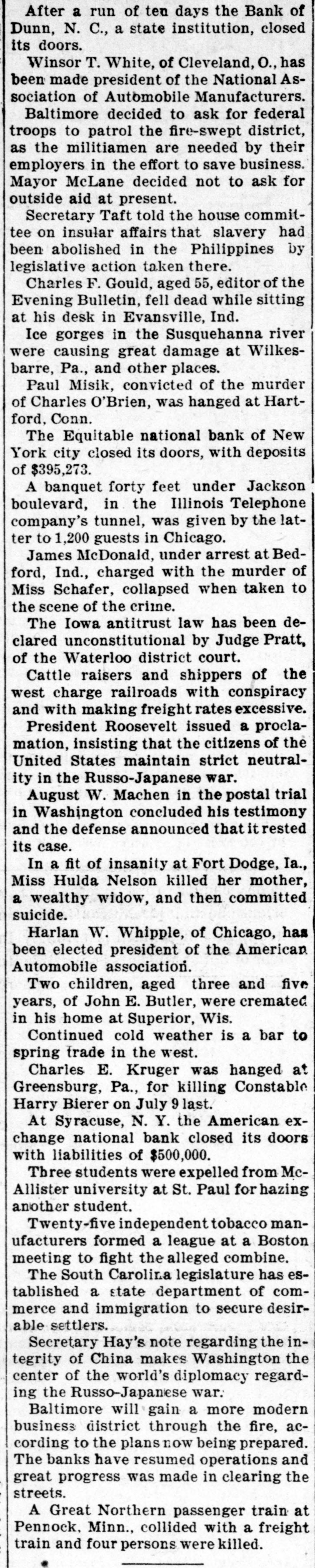
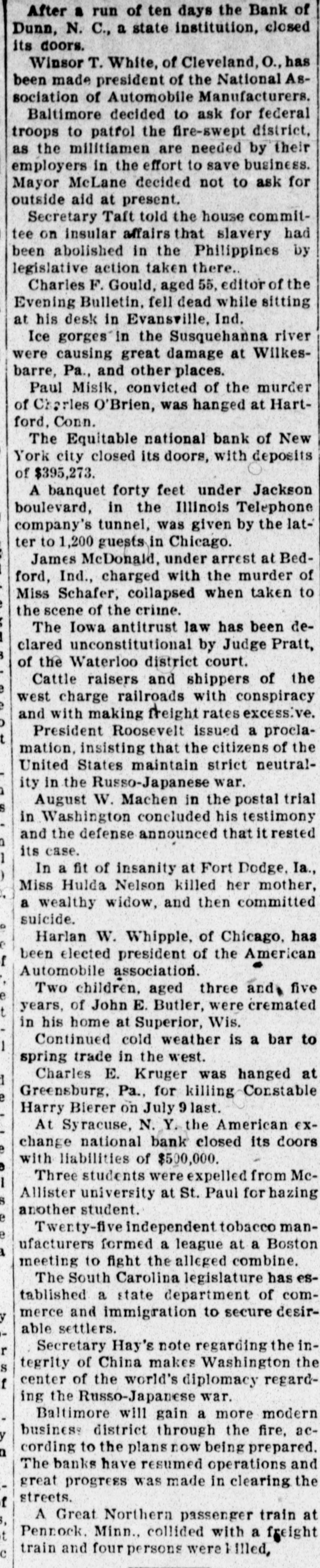
After a run of ten days the Bank of Dunn, N. C., a state institution, closed its doors. Winsor T. White, of Cleveland, O., has been made president of the National Association of Automobile Manufacturers. Baltimore decided to ask for federal troops to patrol the fire-swept district, as the militiamen are needed by their employers in the effort to save business. Mayor McLane decided not to ask for outside aid at present. Secretary Taft told the house committee on insular affairs that slavery had been abolished in the Philippines by legislative action taken there. Charles F. Gould, aged 55, editor of the Evening Bulletin, fell dead while sitting at his desk in Evansville, Ind. Ice gorges in the Susquehanna river were causing great damage at Wilkesbarre, Pa., and other places. Paul Misik, convicted of the murder of Charles O'Brien, was hanged at Hartford, Conn. The Equitable national bank of New York city closed its doors, with deposits of $395,273. A banquet forty feet under Jackson boulevard, in the Illinois Telephone company's tunnel, was given by the latter to 1,200 guests in Chicago. James McDonald, under arrest at Bedford, Ind., charged with the murder of Miss Schafer, collapsed when taken to the scene of the crime. The Iowa antitrust law has been declared unconstitutional by Judge Pratt, of the Waterloo district court. Cattle raisers and shippers of the west charge railroads with conspiracy and with making freight rates excessive. President Roosevelt issued a proclamation, insisting that the citizens of the United States maintain strict neutrality in the Russo-Japanese war. August W. Machen in the postal trial in Washington concluded his testimony and the defense announced that it rested its case. In a fit of insanity at Fort Dodge, Ia., Miss Hulda Nelson killed her mother, a wealthy widow, and then committed suicide. Harlan W. Whipple, of Chicago, has been elected president of the American Automobile association. Two children, aged three and five years, of John E. Butler, were cremated in his home at Superior, Wis. Continued cold weather is a bar to spring trade in the west. Charles E. Kruger was hanged at Greensburg, Pa., for killing Constable Harry Bierer on July 9 last. At Syracuse, N. Y. the American exchange national bank closed its doors with liabilities of $500,000. Three students were expelled from McAllister university at St. Paul for hazing another student. Twenty-five independent tobacco manufacturers formed a league at a Boston meeting to fight the alleged combine. The South Carolina legislature has established a state department of commerce and immigration to secure desirable settlers. Secretary Hay's note regarding the integrity of China makes Washington the center of the world's diplomacy regarding the Russo-Japanese war. Baltimore will gain a more modern business district through the fire, according to the plans now being prepared. The banks have resumed operations and great progress was made in clearing the streets. A Great Northern passenger train at Pennock. Minn., collided with a freight train and four persons were killed.


Article from The L'anse Sentinel, February 20, 1904

Click image to open full size in new tab

Article Text

Dunn, N. C., a state institution, closed its doors. Winsor T. White, of Cleveland, O., has been made president of the National Association of Automobile Manufacturers. Baltimore decided to ask for federal troops to patrol the fire-swept district, as the militiamen are needed by their employers in the effort to save business. Mayor McLane decided not to ask for outside aid at present. Secretary Taft told the house committee on insular affairs that slavery had been abolished in the Philippines by legislative action taken there. Charles F. Gould, aged 55, editor of the Evening Bulletin, fell dead while sitting at his desk in Evansville, Ind. Ice gorges in the Susquehanna river were causing great damage at Wilkesbarre, Pa., and other places. Paul Misik, convicted of the murder of Charles O'Brien, was hanged at Hartford, Conn. The Equitable national bank of New York city closed its doors, with deposits of $395,273. A banquet forty feet under Jackson boulevard, in the Illinois Telephone company's tunnel, was given by the latter to 1,200 guests in Chicago. James McDonald, under arrest at Bedford, Ind., charged with the murder of Miss Schafer, collapsed when taken to the scene of the crime. The Iowa antitrust law has been declared unconstitutional by Judge Pratt, of the Waterloo district court. Cattle raisers and shippers of the west charge railroads with conspiracy and with making freight rates excessive. President Roosevelt issued a proclamation, insisting that the citizens of the United States maintain strict neutrality in the Russo-Japanese war. August W. Machen in the postal trial in Washington concluded his testimony and the defense announced that it rested its case. In a fit of insanity at Fort Dodge, Ia., Miss Hulda Nelson killed her mother, a wealthy widow, and then committed suicide. Harlan W. Whipple, of Chicago, has been elected president of the American Automobile association. Two children, aged three and, five years, of John E. Butler, were cremated in his home at Superior, Wis. Continued cold weather is a bar to spring trade in the west. Charles E. Kruger was hanged at Greensburg, Pa., for killing-Constable Harry Bierer on July 9 last. At Syracuse, N. Y. the American exchange national bank closed its doors with liabilities of $500,000. Three students were expelled from McAllister university at St. Paul for hazing another student. Twenty-five independent tobacco manufacturers formed a league at a Boston meeting to fight the alleged combine. The South Carolina legislature has established a state department of commerce and immigration to secure desirable settlers. Secretary Hay's note regarding the integrity of China makes Washington the center of the world's diplomacy regarding the Russo-Japanese war. Baltimore will gain a more modern business district through the fire, according to the plans now being prepared. The banks have resumed operations and great progress was made in clearing the streets. A Great Northern passenger train at Pennock. Minn., collided with a freight train and four persons were Filled,


Article from New-York Tribune, February 21, 1904

Click image to open full size in new tab

Article Text

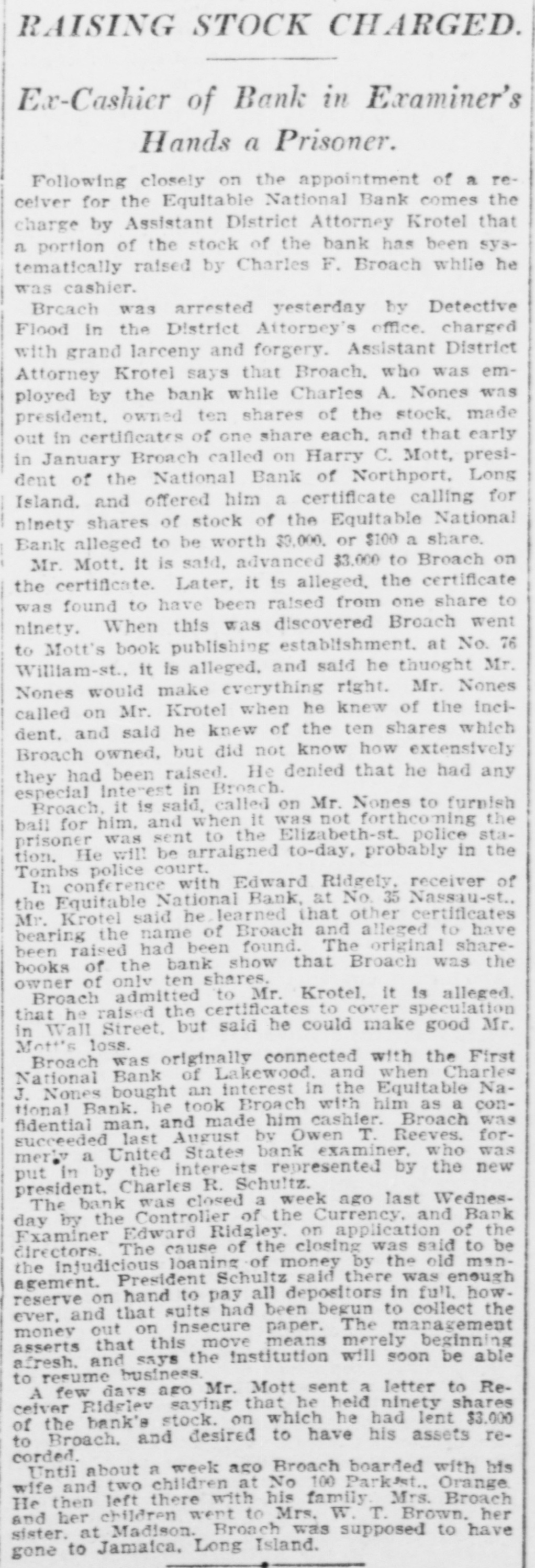
RAISING STOCK CHARGED. Ex-Cashier of Bank in Examiner's Hands a Prisoner. Following closely on the appointment of a receiver for the Equitable National Bank comes the charge by Assistant District Attorney Krotel that a portion of the stock of the bank has been systematically raised by Charles F. Broach while he was cashier. Breach was arrested yesterday by Detective Flood in the District Attorney's office. charged with grand larceny and forgery. Assistant District Attorney Krotel says that Broach. who was employed by the bank while Charles A. Nones was president. owned ten shares of the stock. made out in certificates of one share each. and that early in January Broach called on Harry C. Mott, president of the National Bank of Northport, Long Island. and offered him a certificate calling for ninety shares of stock of the Equitable National Bank alleged to be worth $3,000. or $100 a share. Mr. Mott. it is said, advanced $3,000 to Broach on the certificate. Later, it is alleged, the certificate was found to have been raised from one share to ninety. When this was discovered Broach went to Mott's book publishing establishment. at No. 76 William-st., it is alleged. and said he thuoght Mr. Nones would make everything right. Mr. Nones called on Mr. Krotel when he knew of the incident. and sald he knew of the ten shares which Broach owned, but did not know how extensively they had been raised. He denied that he had any especial Interest in Broach. Broach, it is said, called on Mr. Nones to furnish bail for him, and when It was not forthcoming the prisoner was sent to the Elizabeth-st. police station. He will be arraigned to-day, probably in the Tombs police court. In conference with Edward Ridgely, receiver of the Equitable National Bank, at No. 35 Nassau-st.. Mr. Krotel said he learned that other certificates bearing the name of Broach and alleged to have been raised had been found. The original sharebooks of the bank show that Broach was the owner of only ten shares. Broach admitted to Mr. Krotel, It is alleged. that he raised the certificates to cover speculation in Wall Street, but said he could make good Mr. Mott's loss. Broach was originally connected with the First National Bank of Lakewood. and when Charles J. Nones bought an interest in the Equitable National Bank. he took Broach with him as a confidential man, and made him cashier. Broach was succeeded last August by Owen T. Reeves. former'y a United States bank examiner. who was put in by the interests represented by the new president. Charles R. Schultz. The bank was closed a week ago last Wednesday by the Controller of the Currency. and Bank Examiner Edward Ridgley. on application of the directors. The cause of the closing was said to be the injudicious loaning of money by the old management. President Schultz said there was enough reserve on hand to pay all depositors in full. however, and that suits had been begun to collect the money out on insecure paper. The management asserts that this move means merely beginning afresh. and says the institution will soon be able to resume business. A few days ago Mr. Mott sent a letter to Receiver Ridglev saying that he held ninety shares of the bank's stock. on which he had lent $3.000 to Broach. and desired to have his assets recorded. Until about a week ago Broach boarded with his wife and two children at No 100 Park'st., Orange He then left there with his family Mrs. Broach and her children went to Mrs. W. T. Brown. her sister. at Madison. Broach was supposed to have gone to Jamaica. Long Island.


Article from Daily Kennebec Journal, February 22, 1904

Click image to open full size in new tab

Article Text

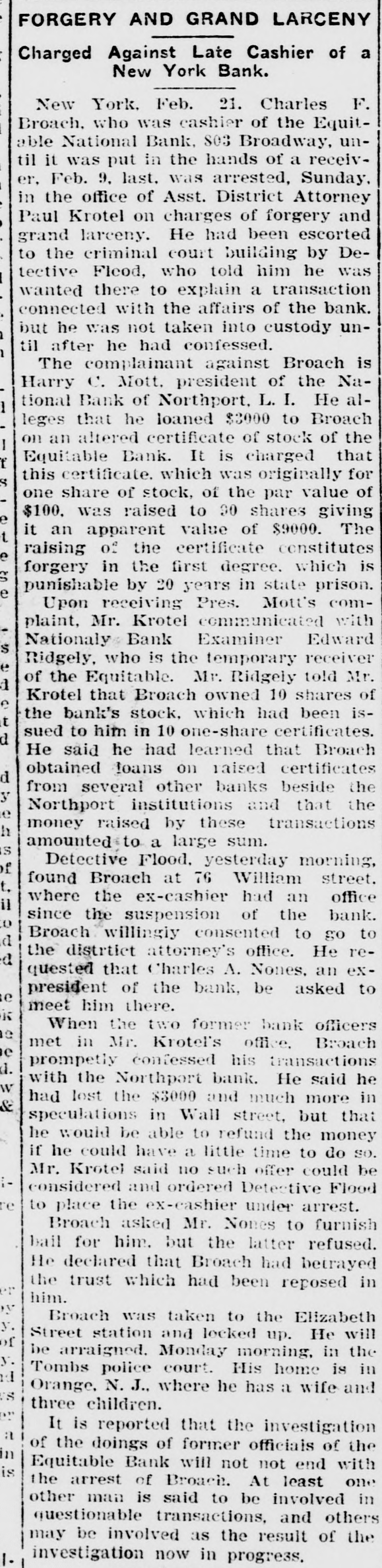
FORGERY AND GRAND LARCENY Charged Against Late Cashier of a New York Bank. New York. Feb. 21. Charles F. Broach. who was cashier of the Equitable National Bank, S03 Broadway, until it was put in the hands of a receiver, Feb. 9, last. was arrested, Sunday. in the office of Asst. District Attorney Paul Krotel on charges of forgery and grand larceny. He had been escorted to the criminal court building by Detective Flood, who told him he was wanted there to explain a transaction connected with the affairs of the bank. but he was not taken into custody until after he had confessed. The complainant against Broach is Harry C. Mott. president of the National Bank of Northport, L. I. He alleges that he loaned $3000 to Broach on an altered certificate of stock of the Equitable Bank. It is charged that this certificate. which was originally for one share of stock, of the par value of $100. was raised to 90 shares giving it an apparent value of $9000. The raising of the certificate constitutes forgery in the first degree. which is punishable by 20 years in state prison. Upon receiving Pres. Mott's complaint, Mr. Krotel communicated with Nationaly Bank Examiner Edward Ridgely, who is the temporary receiver of the Equitable. Mr. Ridgely told Mr. Krotel that Broach owned 10 shares of the bank's stock, which had been issued to him in 10 one-share certificates. He said he had learned that Broach obtained loans on raised certificates from several other banks beside the Northport institutions and that the money raised by these transactions amounted to a large sum. Detective Flood. yesterday morning, found Broach at 76 William street, where the ex-cashier had an office since the suspension of the bank Broach willingly consented to go to the district attorney's office. He requested that Charles A. Nones. an expresident of the bank, be asked to meet him there. When the two former bank officers met in Mr. Krotel's office. Broach prompetly confessed his transactions with the Northport bank. He said he had lost the $3000 and much more in speculations in Wall street, but that he would be able to refund the money if he could have a little time to do so Mr. Krotel said no such offer could be considered and ordered Detective Flood to place the ex-cashier under arrest. Broach asked Mr. Nones to furnish bail for him. but the latter refused. He declared that Broach had betrayed the trust which had been reposed in him. Broach was taken to the Elizabeth Street station and locked up. He will be igued M


Article from Iron County Register, January 5, 1905

Click image to open full size in new tab

Article Text

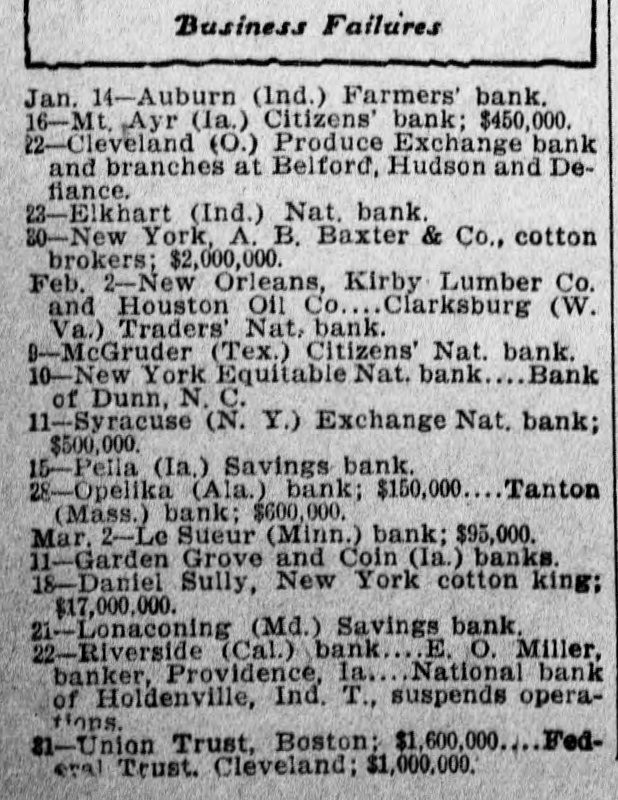
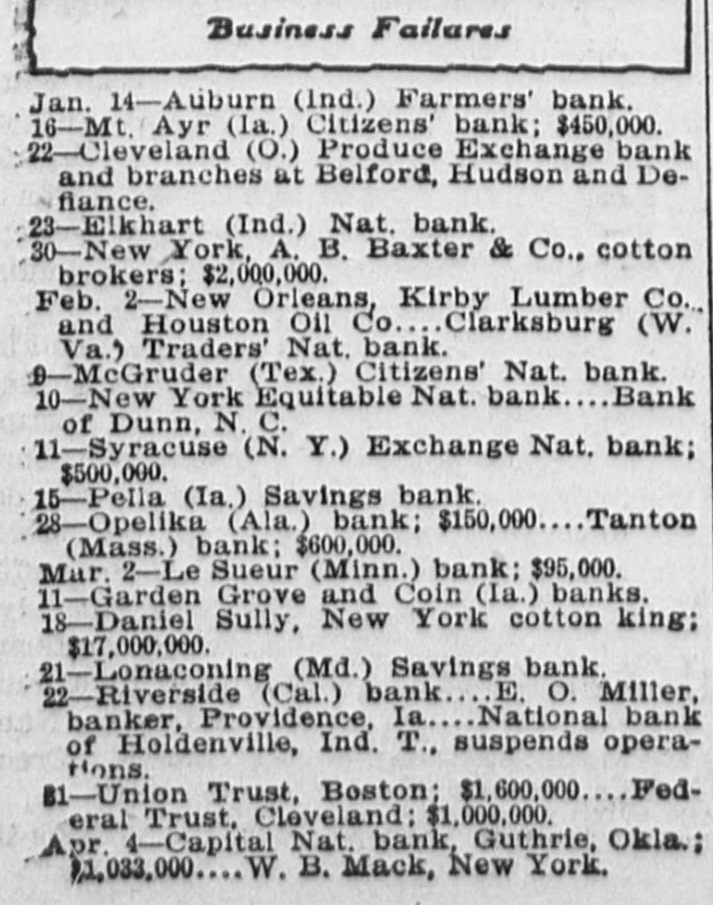
Business Failures Jan. 14-Auburn (Ind.) Farmers' bank. 16-Mt. Ayr (la.) Citizens' bank; $450,000. 22-Cleveland (0.) Produce Exchange bank and branches at Belford, Hudson and Defiance. 23-Elkhart (Ind.) Nat. bank. 80-New York, A. B. Baxter & Co., cotton brokers; $2,000,000. Feb. 2-New Orleans, Kirby Lumber Co. and Houston Oil Co. Clarksburg (W. Va.) Traders' Nat, bank. 9--McGruder (Tex.) Citizens' Nat. bank. 10-New York Equitable Nat. bank Bank of Dunn, N. C. 11-Syracuse (N. Y.) Exchange Nat. bank; $500,000. 15-Pella (Ia.) Savings bank. 28-Opelika (Ala.) bank; $150,000 Tanton (Mass.) bank; $600,000. Mar. 2-Le Sueur (Minn.) bank; $95,000. 11-Garden Grove and Coin (Ia.) banks. 18-Daniel Sully, New York cotton king; $17,000,000. 2i-Lonaconing (Md.) Savings bank. 22-Riverside (Cal.) bank....E. O. Miller, banker, Providence, la National bank of Holdenville, Ind. T., suspends operations. 81-Union Trust, Boston: $1,600,000...Federal Trust. Cleveland; $1,000,000.


Article from Perrysburg Journal, January 6, 1905

Click image to open full size in new tab

Article Text

Business Failures Jan. 14-Auburn (Ind.) Farmers' bank. 16-Mt. Ayr (la.) Citizens' bank; $450,000. 22-Cleveland (0.) Produce Exchange bank and branches at Belford, Hudson and Defiance. 23-Elkhart (Ind.) Nat. bank. 30-New York, A. B. Baxter & Co., cotton brokers; $2,000,000. Feb. 2-New Orleans, Kirby Lumber Co. and Houston Oil Co. Clarksburg (W. Va.) Traders' Nat. bank. 9-McGruder (Tex.) Citizens' Nat. bank. 10-New York Equitable Nat. bank Bank of Dunn, N. C. 11-Syracuse (N. Y.) Exchange Nat. bank; $500,000. 15-Pella (Ia.) Savings bank. 28-Opelika (Ala.) bank; $150,000 Tanton (Mass.) bank; $600,000. Mar. 2-Le Sueur (Minn.) bank; $95,000. 11-Garden Grove and Coin (Ia.) banks. 18-Daniel Sully, New York cotton king; $17,000,000. 21-Lonaconing (Md.) Savings bank. 22-Riverside (Cal.) bank....E. O. Miller, banker, Providence, Ia National bank of Holdenville, Ind. T., suspends operaHons. B1-Union Trust, Boston; $1,600,000. Federal Trust, Cleveland; $1,000,000. Apr. 4-Capital Nat. bank, Guthrie, Okla.; $1,033,000.... W. B. Mack, New York.