Article Text
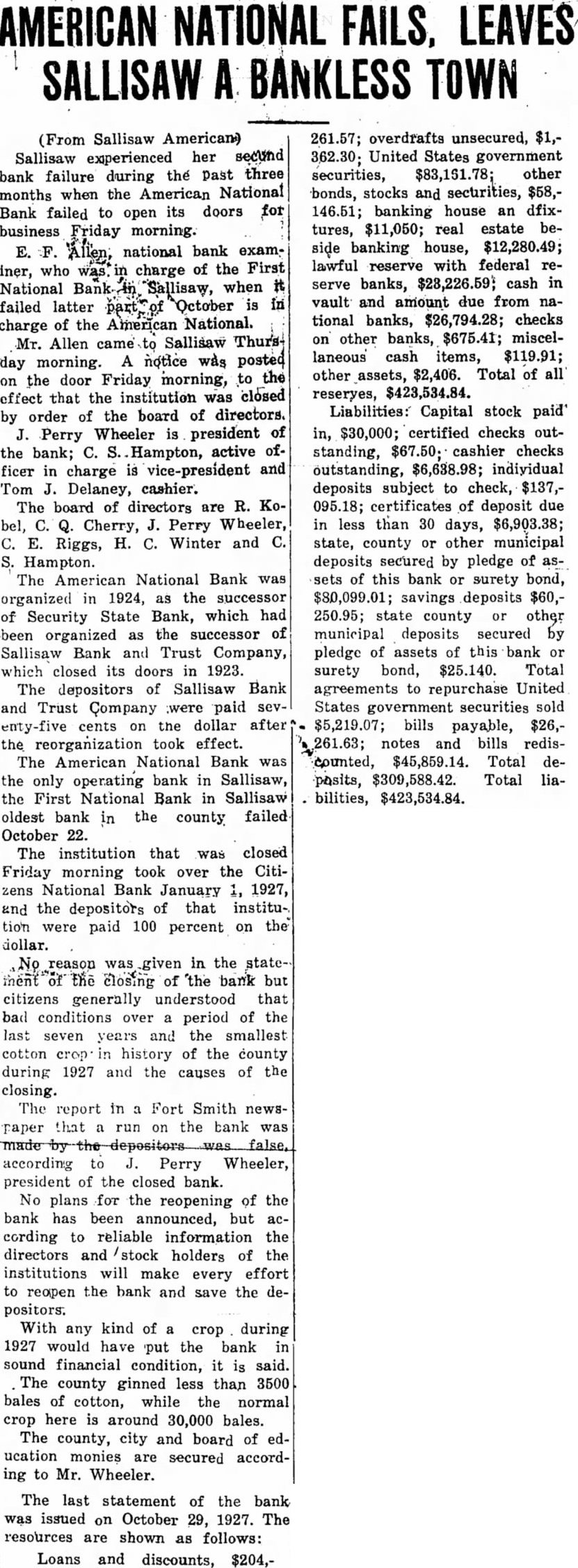
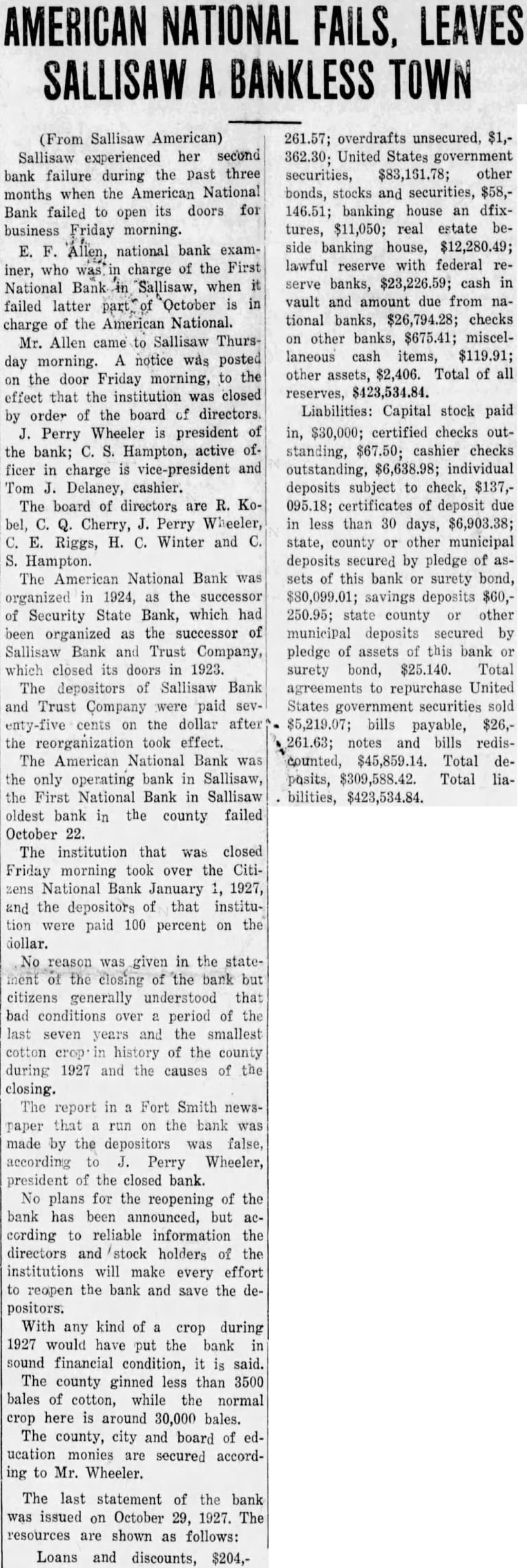
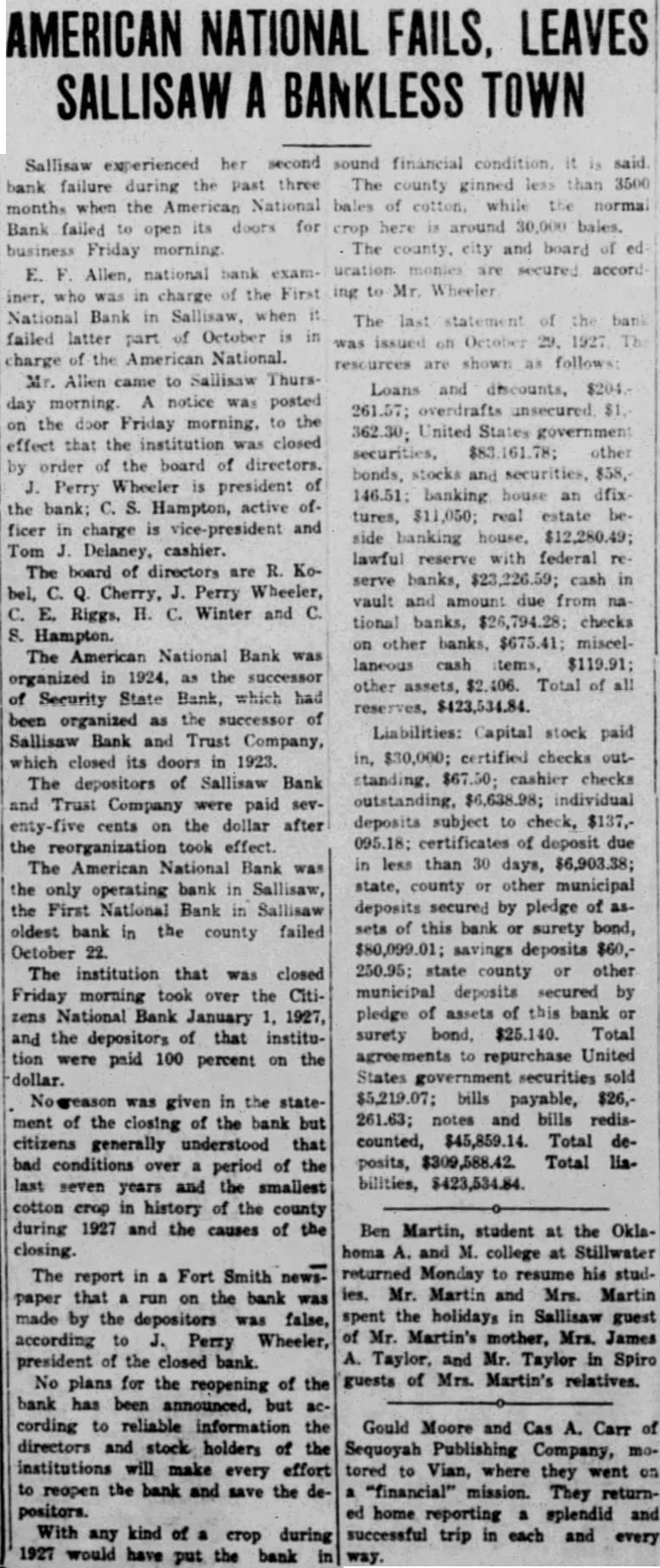
AMERICAN NATIONAL FAILS, LEAVES SALLISAW A BANKLESS TOWN bank failure during the past three months when the American National Bank failed to open its doors for business Friday morning E. F. Allen, national bank examiner, who was in charge of the First National Bank in Sallisaw, when it failed latter part of October is in charge of the American National. Mr. Allen came to Sallisaw Thursday morning. A notice was posted on the door Friday morning. to the effect that the institution was closed by order of the board of directors. J. Perry Wheeler is president of the bank; C. S. Hampton, active officer in charge is vice-president and Tom J. Delaney, cashier. The board of directors are R. Kobel, C. Q. Cherry, J. Perry Wheeler, C. E. Riggs, H. C. Winter and C. S. Hampton. The American National Bank was organized in 1924. as the successor of Security State Bank, which had been organized as the successor of Sallisaw Bank and Trust Company, which closed its doors in 1923. The depositors of Sallisaw Bank and Trust Company were paid seventy-five cents on the dollar after the reorganization took effect. The American National Bank was the only operating bank in Sallisaw, the First National Bank in Sallisaw oldest bank in the county failed October 22. The institution that was closed Friday morning took over the Citizens National Bank January 1, 1927, and the depositors of that institution were paid 100 percent on the dollar. No reason was given in the statement of the closing of the bank but citizens generally understood that bad conditions over a period of the last seven years and the smallest cotton crop in history of the county during 1927 and the causes of the closing. The report in a Fort Smith newspaper that a run on the bank was made by the depositors was false, according to J. Perry Wheeler, president of the closed bank. No plans for the reopening of the bank has been announced, but according to reliable information the directors and stock holders of the institutions will make every effort to reopen the bank and save the depositors. With any kind of a crop during 1927 would have put the bank in The county ginned less than 3500 bales of while the normal crop here is around 30,000 bales. The county, city and board of ed ucation monies are secured accord ing to Mr. Wheeler The last statement of the bank was issued on October 29. 1927 The resources are shown as follows: Loans and discounts. $204.261.57; overdrafts unsecured $1. 362.30: United States government securities, $83,161.78; other bonds, stocks and securities, $58,146.51: banking house an dfixtures. $11,050; real estate beside banking house, $12,280.49; lawful reserve with federal reserve banks, $23,226.59; cash in vault and amount due from national banks, $26,794.28; checks on other banks, $675.41; miscellaneous cash items, $119.91; other assets, $2,406. Total of all Liabilities: Capital stock paid in, $30,000; certified checks outoutstanding, $6,638.98; individual deposits subject to check, $137,095.18: certificates of deposit due in less than 30 days, $6,903.38; state, county or other municipal deposits secured by pledge of assets of this bank or surety bond, $80,099.01; savings deposits $60,250.95; state county or other municipal deposits secured by pledge of assets of this bank or surety bond, $25.140. Total agreements to repurchase United States government securities sold $5,219.07; bills payable, $26,261.63; notes and bills rediscounted, $45,859.14. Total deposits, $309,588.42. Total liabilities, $423,534.84. Ben Martin, student at the Oklahoma A. and M. college at Stillwater returned Monday to resume his studies. Mr. Martin and Mrs. Martin spent the holidays in Sallisaw guest of Mr. Martin's mother, Mrs. James A. Taylor, and Mr. Taylor in Spiro guests of Mrs. Martin's relatives. Gould Moore and Cas A. Carr of Sequoyah Publishing Company, motored to Vian, where they went on a "financial" mission. They returned home reporting a splendid and successful trip in each and every way.