Article Text
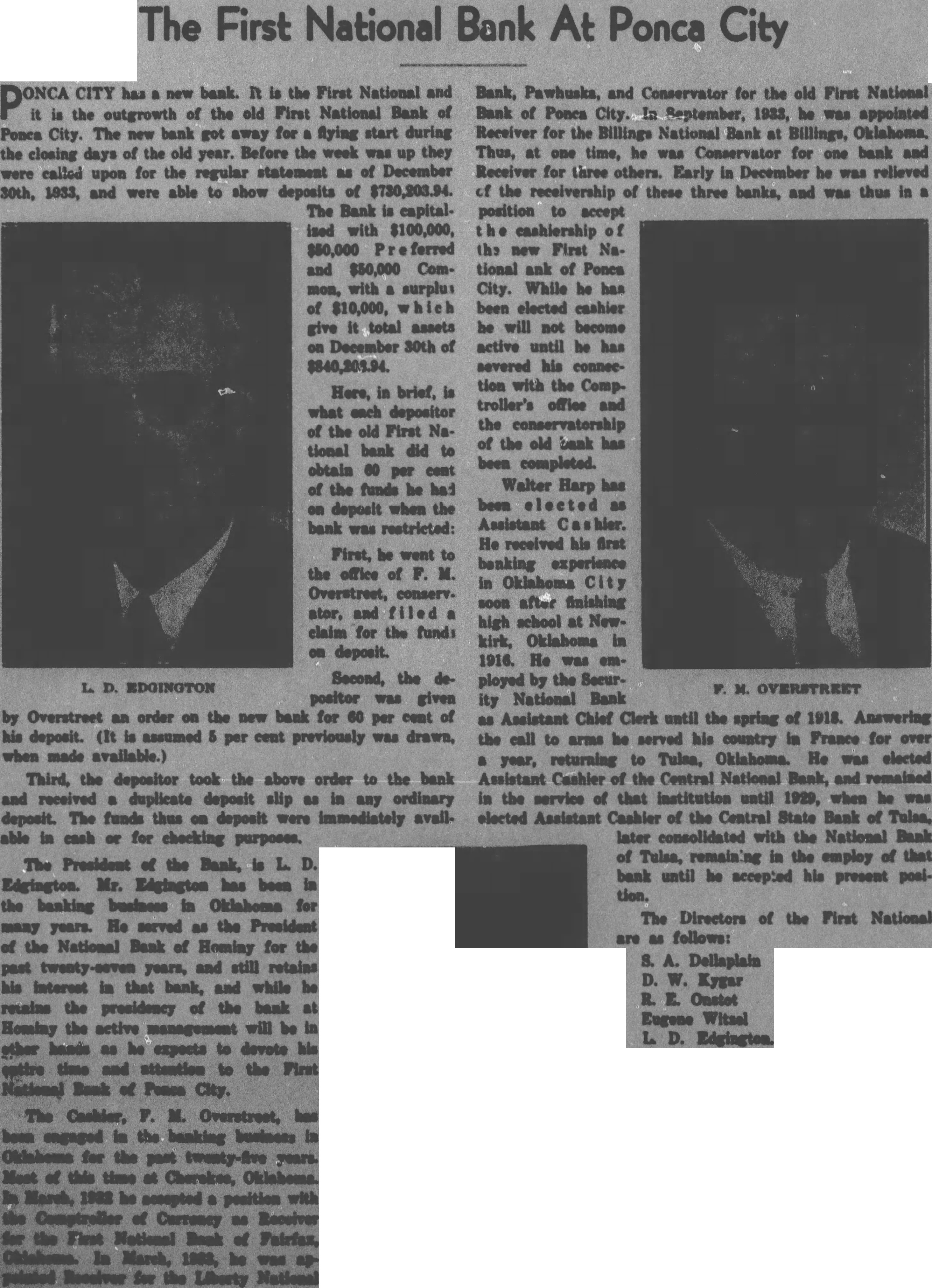
The First National Bank At Ponca City ONCA CITY has a new bank. it is the First National and P it is the outgrowth of the old First National Bank of Ponca City. The new bank got away for a flying start during the closing days of the old year. Before the week was up they were called upon for the regular statement as of December 30th, 1933, and were able to show deposits of $730,203.94. The Bank is capitalised with $100,000, $50,000 Preferred and $50,000 Common, with a surplus of $10,000, which give it total assets on December 30th of $840,203.94. Here, in brief, is what each depositor of the old First National bank did to obtain 60 per cent of the funds he had on deposit when the bank was restricted: First, be went to the office of F. M. Overstreet, conservator, and filed a claim for the funds on deposit. Second, the deL D. EDGINGTON positor was given by Overstreet an order on the new bank for 60 per cent of his deposit. (It is assumed 5 per cent previously was drawn, when made available.) Third, the depositor took the above order to the bank and received a duplicate deposit slip as in any ordinary deposit. The funds thus on deposit were immediately available in cash or for checking purposes. Bank, Pawhuska, and Conservator for the old First National Bank of Ponca City. In September, 1933, he was appointed Receiver for the Billings National Bank at Billings, Oklahoma. Thus, at one time, he was Conservator for one bank and Receiver for three others. Early in December he was relieved of the receivership of these three banks, and was thus in a position to accept the cashiership of the new First National ank of Pones City. While he has been elected cashier he will not become active until he has severed his connection with the Comptroller's office and the conservatorship of the old bank has been completed. Walter Harp has been elected as Assistant Cashier. He received his first banking experience in Oklahoma City soon after finishing high school at Newkirk, Oklahoma in 1916. He was employed by the Security National Bank as Assistant Chief Clerk until the spring of 1918. Answering the call to arms he served his country in France for over a year, returning to Tulsa, Oklahoma. He was elected Assistant Cashier of the Central National Bank, and remained in the service of that institution until 1929, when he was elected Assistant Cashier of the Central State Bank of Tulsa, later consolidated with the National Bank of Tulsa, remaining in the employ of that bank until he accepted his present position. The President of the Bank, is L. D. Edgington. Mr. Edgington has been in the banking business in Oklahoma for many years. He served as the President of the National Bank of Hominy for the past twenty-seven years, and still retains his interest in that bank, and while he retains the presidency of the bank at Hominy the active management will be in other hands as he expects to devote his entire time and attention to the First National Bank of Ponca City. The Cashier, F. M. Overstreet, has been engaged in the banking business in Oklahoma for the past twenty-five years. Meet of this time at Cherokee, Oklahoma. in March, 1932 he accepted a position with the Comptroller of Currency as Receiver for the First National Bank of Fairfax, Oklahoma. In March, 1983, be was appolated Receiver for the Liberty National The Directors of the First National are as follows: S. A. Dellaplain D. W. Kygar R. E. Onstot Eugene Witsel L D. Edgington. 0