15735. Columbia Bank & Trust Company (Oklahoma City, OK)

Bank Information

Episode Type
Suspension β†’ Run β†’ Closure
Bank Type
trust
Start Date
September 29, 1909
Location
Oklahoma City, Oklahoma (35.468, -97.516)

Metadata

Model
gpt-5-mini
Short Digest
0c8a0d7e31d2cdaa

Response Measures

None

Description

State banking board took charge and suspended the Columbia Bank & Trust Co. (declared insolvent around Sept 29, 1909). While the state commissioner paid depositors from the guaranty fund, depositors withdrew funds (a run/steady withdrawals). Attempts were made in early October to reorganize/turn the bank back to private control and resume business, but litigation seeking a receiver and later statements of insolvency indicate permanent failure/closure. Cause of suspension centered on poor quality oil operator paper and insolvency (bank-specific adverse information). I classify sequence as suspension leading to depositor agitation and eventual failure/receivership (suspension_run_closure). Dates are taken from the articles' reported dates; OCR issues corrected (e.g., Columbia Bank & Trust company spelled variably).

Events (5)

1. September 29, 1909 Suspension
Cause
Bank Specific Adverse Info
Cause Details
State banking board took charge and declared the bank insolvent due to large amount of questionable notes/paper (oil operator loans) making assets appear bad.
Newspaper Excerpt
The Columbia Bank & Trust company was declared insolvent by the state banking board shortly after midnight on the 29th of September.
Source
newspapers
2. September 30, 1909 Run
Cause
Bank Specific Adverse Info
Cause Details
Depositors withdrew funds and closed accounts after the bank was declared insolvent and taken over by state authorities; rumors circulated but the proximate trigger was the suspension/insolvency.
Measures
State Bank Commissioner A. M. Young paid depositors from the state guaranty fund and cash on hand while the state banking board held the bank.
Newspaper Excerpt
At noon today a steady stream of depositors was making its way to the paying tellers' windows of the suspended Columbia Bank and Trust Company, withdrawing savings and closing accounts.
Source
newspapers
3. October 2, 1909 Other
Newspaper Excerpt
A temporary injunction restraining the officers of the Columbia Bank and Trust company ... from paying out any funds of the bank was granted by Federal Judge Cotterel here today as the result of a suit ... asking that a receiver for the bank be appointed.
Source
newspapers
4. October 4, 1909 Other
Newspaper Excerpt
Plans were consummated ... by which the bank will be turned over to President Norton and his associates. Bank Commissioner Young continued to pay off the depositors today, with the guarantee funds.
Source
newspapers
5. November 1, 1909 Receivership
Newspaper Excerpt
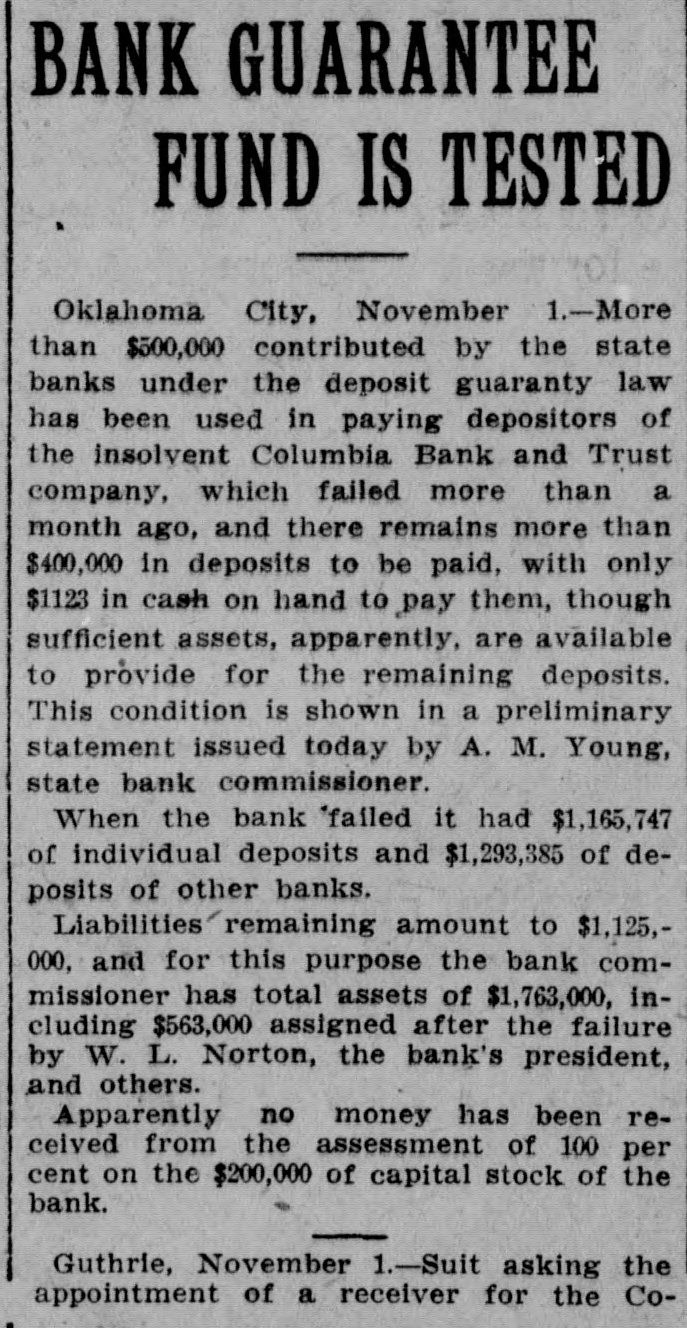
More than $500,000 contributed by the state banks under the deposit guaranty law has been used in paying depositors of the insolvent Columbia Bank and Trust company, which failed more than a month ago ... liabilities remaining amount to $1,125,000 ... Guthrie, November 1.-Suit asking the appointment of a receiver for the Co-
Source
newspapers

Newspaper Articles (23)

Article from The Guthrie Daily Leader, September 30, 1909

Click image to open full size in new tab

Article Text

special to Daily Leader. Oklahoma City, Okla., Sept. 30.Payment of depositors in the suspended Columbia Bank and Trust company was resumed promptly at 9 o'clock this morning and the feeling is general here that the "scare" has practically subsided. with the banking situation in Oklahoma stronger today than before the suspension of the bank. The state banking board and state bankers generally consider that the guaranty bank law has proved its stability in practice, and that the next few days will fully establish the soundness of its principle. After finishing a busy day at the bank in conducting the routine of a business strange to them. the state officers were well satisfied with de velopments, and last evening Gov ernor Haskell dietated the following statement in behalf of the state bank ing board: "The same persistent criticisms that embarrassed the management for ten days before the state took charge seems to have worked on the deposit ors all day. It is not fair to complain of all national bankers for this as sault; indeed. the vast majority are cour'eous and fair with their state bank neighbors and only a few national bankers can be blamed for this per sistent fight. "The people on every hand are ex pressing satisfaction with the peace ful, orderly way in which the state law of Oklahoma settles these diffi culties without loss 10 the people. We find the Columbia Bank and Trust company conditions stronger efter a day's active investigation than appear ed to us the night before we took charge "The owners of the bank have made good progress today in conver ing private assets into cash prepara tory to adding new capital to repair any losses and warrant the state of ficials in returning the control of the bank to them. w ich here seems CV ery reason to believe may occur within the coming week. Thus strengthen ed this bank will stand as a great benefit to the city and the state, "Four Oklahoma City s'ate banks have tendered their friendly wishes to be of service and created a feeling of much benefit. "We have to warn the people of the state against fake and malicious news items as the enemies of the state law circulate. he latest of which is an alleged special from Guthrie to the et's fect that state bankers have agreed to resist payment of an emergency assessment. "The state of Oklahoma has always been fair to both classes of banks and national banks today have on deposit over one million dollars of state money which could at once be transferred if the state were disposed to be unfriendly to the national benks." Governor Haskell stated that he considered it possible that sufficient funds may be provided by the stockholders in the Columbia Bank & Trust company. so that it will be both possible and safe for the state officers to return the operation of the bank 10 its own officers. By Monday all of
Article from Tonopah Daily Bonanza, September 30, 1909

Click image to open full size in new tab

Article Text

GOOD EXAMPLE OF THE OKLAHOMA BANKING LAW ( By Associated Press.) OKLAHOMA CITY, Sept. 29.With a supply of money received from the state guaranty fund, supplemented by the cash on hand of the bank, State Bank Commissioner Young today paid about 400 depositors of the Columbia Bank and Trust company, which suspended yesterday. No excitement prevailed, the people apparently trusting in the state guaranty fund. Interest throughout the state today was intense. The Columbia concern was the reserve for about 150 other state banks and had on deposit $1,300,000 of their deposits. A failure in the application of the guaranty law would mean the ruin of many banks, and a financial panic throughout the state.


Article from The Bridgeport Evening Farmer, September 30, 1909

Click image to open full size in new tab

Article Text

RUN ON BANK Depositors Hasten to Withdraw Savings from Oklahoma City Institution. (Special from United Press.) Oklahoma City, Okla., Sept. 30.-At Doon today a steady stream of depositors was making its way to the paying tellers' windows of the suspended Columbia Bank and Trust Company, withdrawing savings and closing accounts. It is said that Bank Examiner Young, in charge since Tuesday, is paying depositors from funds furnished by the State Banking Board and from the cash on hand when he took over the bank. The amount withdrawn from the State Bank guarantee funds at noon, according to Governor Haskell, ex-officio member of the State Banking Board, amounted to about $150,000. The other State banks here are in a scramble to pick up the $3,000,000 business of the failed concern, and a number of bankers have been endeavoring to interview the Governor today. Partitioning off the Columbia's business is determined by drawing checks against the guarantee fund of various State banks and covering them by sight drafts on State banks throughCat the State having guarantee fund ton deposit. None of the $1,000,000 deposits in checks or drafts has yet been made good. Criminal and civil proceedings have been threatened against the bank and its officials but have not yet materialized.


Article from The Vinita Daily Chieftain, October 1, 1909

Click image to open full size in new tab

Article Text

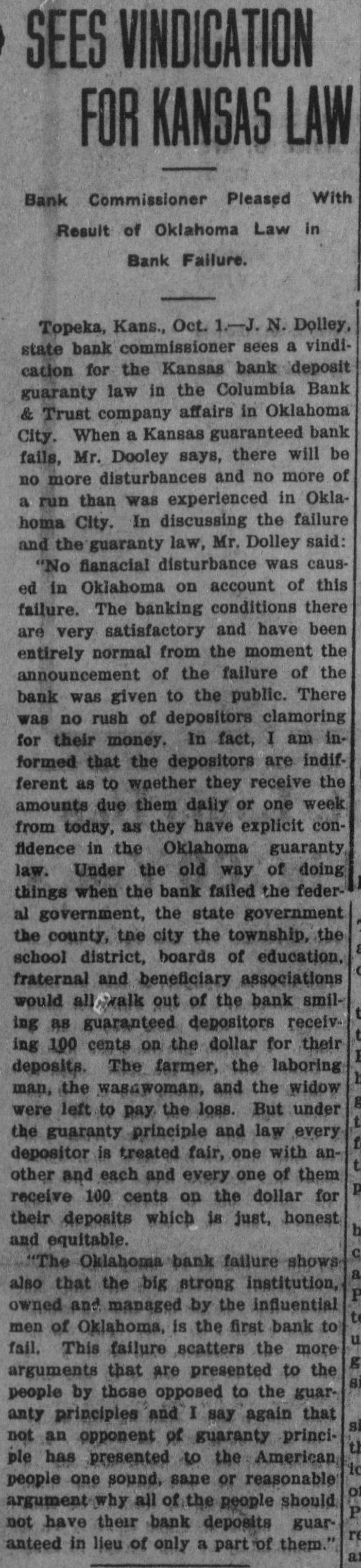
) SEES VINDICATION FOR KANSAS LAW Bank Commissioner Pleased With Result of Oklahoma Law in Bank Failure. Topeka, Kans., Oct. 1.-J. N. Dolley, state bank commissioner sees a vindication for the Kansas bank deposit guaranty law in the Columbia Bank & Trust company affairs in Oklahoma City. When a Kansas guaranteed bank fails, Mr. Dooley says, there will be no more disturbances and no more of a run than was experienced in Oklahoma City. In discussing the failure and the guaranty law, Mr. Dolley said: "No fianacial disturbance was caused in Okiahoma on account of this failure. The banking conditions there are very satisfactory and have been entirely normal from the moment the announcement of the failure of the bank was given to the public. There was no rush of depositors clamoring for their money. In fact, I am informed that the depositors are indifferent as to whether they receive the amounts due them daily or one week from today, as they have explicit confidence in the Oklahoma guaranty law. Under the old way of doing things when the bank failed the federal government, the state government the county, the city the township, the school district, boards of education. fraternal and beneficiary associations would all/walk out of the bank smiling as guaranteed depositors receiving 100 cents on the dollar for their deposits. The farmer, the laboring man, the wasawoman, and the widow were left to pay the loss. But under the guaranty principle and law every depositor is treated fair, one with another and each and every one of them receive 100 cents on the dollar for their deposits which is just, honest and equitable. C "The Oklahoma bank failure shows a also that the big strong institution, owned and managed by the influential men of Oklahoma, is the first bank to fall. This failure scatters the more arguments that are presented to the B people by those opposed to the guaranty principles and I say again that si not an opponent of guaranty princith ple has presented to the American i people one sound, sane or reasonable of argument why all of the people should P not have their bank deposits guarre anteed in lieu of only a part of them." a


Article from Evening Journal, October 1, 1909

Click image to open full size in new tab

Article Text

COMMEND BANK GUARANTEE LAW Say That the Oklahoma Plan Has Proven Its Worth By United Press Leased Special Wire. OKLAHOMA CITY, Okla., Oct. 1Chat the Oklahoma bank guarantee law has been severely tested and has proved its worth is the opinion expressed by many bankers to-day following a statement that the directors of the suspended Columbia Bank and Trust Company have submitted a proposition to the State banking board looking to a re-opening of the concern. The private depositors who had funds in the bank have withdra wn them and the only large deposits now held according to a statement generally credited to-day, are reserve funds of smaller Oklahoma State banks. The drain on the guarantee funds of the State banking board has been heavy, but it is declared there is still sufficient sums on hand to meet any demand on any of the smaller banks forced to call for the reserve held by the Columbia. Among National bankers throughout the State there has been considerable criticism of the law and since the suspension of the Columbia there has been a revival of the prediction made when the guarantee law was suggested that it would lead to loose banking methods. The officials of that institution stoutly maintain there has been no overdraw by the officers. State bankers in spite of a possible emergency assessment are taking a more optimistic view. They declare the test given the new law has been the severest that could be imagined. The bank involved is one of the biggest in the State and one whose failure would mean the crash of other banks. They say that the fact that all the other banks have been able to weather S the storm also through the trouble is proof that the law is effective. Had the trouble they say come a little later after the fund had been given a chance to grow from a regular assessment, there would have been no strain on the banks at all. The State bankers point also to the fact that the thing which bankers fear most in a case of such trouble-runshave practically been absent.


Article from The Vinita Daily Chieftain, October 1, 1909

Click image to open full size in new tab

Article Text

TESTING THE SYSTEM. The attention of the American banking world is turned toward Oklahoma City, where for the first time, the efficiency of a state guaranty to protect depositors has been put to the test by the failure of the Columbia Bank & Trust Company. Upon the result of this test will depend ,in a large measure, the future attitude of bankers, depositors and legislators toward the bank guaranty proposition. The magnitude of the institution which has failed is large enough to tax the system's strength. The bank held the reserve deposits of one hundred and fifty Oklahoma state banks, a total of more than $1,300,000. Failure in the application of the law would mean ruin to many of these smaller institutions, and would precipate a financial panic in the state. Realizing this fact, it is said, representatives of many of these banks have assured Governor Haskell of their moral and what is more to the point, financial support. In this assurance is demonstrated what has been urged as the strongest feature of the guaranty *system, namely, the ability, S by means of the system, to concentrate the finacial strength of a state's state banks to save the depositors of a weakened instiution. This concenS tration, it would seem, is possible only through the operation of such a system. Its application, similarly, depends upon the system to be effective. According to the statement of Governor Haskell, a concerted effort by national bankers to discredit the efficiency of the guaranty law has come to a head in the failure of the Columbia Bank & Trust company This belief may or may not be well founded.


Article from The Bridgeport Evening Farmer, October 1, 1909

Click image to open full size in new tab

Article Text

BANK GUARANTEE LAW PROVES WORTH (Special from United Press.) Oklahoma City, Okla., Oct. 1.-That the Oklahoma Bank Guarantee law has been severell tested and has proven its worth is the opinion expressed by many bankers to-day following a statement that the directors of the suspended Columbia Bank & Trust Company have submitted a proposition to the state banking board looking to a re-opening of the concern. The private depositors who had funds in the bank have withdrawn them and the only large deposits now held according to a statement generally credited to-day are reserve funds of smaller Oklahoma state banks. The drain on the guarantee funds of the state banking board has been heavy, but it is declared there is still sufficient sums on hand to meet any demand on any of the small banks forced to call for the reserve fund of the Columbia concern. Among bankers throughout the state there has been considerable criticism of the law and since the suspension of the Columbia there has been much speculation regarding the guarantee fund. State bankers in spite of a possible emergency assessment are taking a more optimistic view. They declare the test given the new law has been the severest that could be imagined. The bank involved is one of the biggest in the state and one whose failure would mean the crash of other banks. They hold that the fact that all the other banks have been able to weather the storm with so little trouble is proof that the law is effective. Had the trouble, they say, come a little later or after the fund had been given a chance to grow from regular assessment there would have been no strain on the banks at all. The state bankers point also to the fact that the thing which bankers fear most in a case of such trouble-runshave practically been absent.


Article from Omaha Daily Bee, October 3, 1909

Click image to open full size in new tab

Article Text

New Factor in Failure of Bank In Oklahoma Nonresident Depositors Get Temporary Order Restraining Further Payments. GUTHRIE, Okl., Oct. 2.-A temporary injunction restraining the officers of the Columbia Bank and Trust company of Oklahoma City, which failed recently, from paying out any funds of the bank was granted by Federal Judge Cotterel here today as the result of a suit filed by the National Insurance company of Chicago and G. C. Smith of Springfield, Mo. Alleging hopeless insolvency of the bank and the insufficiency of assets to pay depositors in full, the petition asks the court to compel the distribution of the funds pro rata. The petitioners also ask that a receiver for the bank be appointed. The injunction order is made returnable before Judge Cotterel next Monday. The National Insurance company holds a certificate of deposit in the bank for $25,000 and Smith is a depositor to the extent of $70,500. OKLAHOMA CITY, Okl., Oct. 2.-It was announced this afternoon that definite plans looking to the reorganization of a bank to take the place of the defunct Columbia Bank and Trust company, now in the hands of the state banking board, may be perfected Monday or Tuesday. A party of capitalists from St. Louis, headed, it is said, by C. W. Smith, formerly president of the Farmers' State bank of Tulsa, but now of St. Louis, is credited with being interested in taking over the bank. The bank continued today to pay depositors.


Article from The Vinita Daily Chieftain, October 4, 1909

Click image to open full size in new tab

Article Text

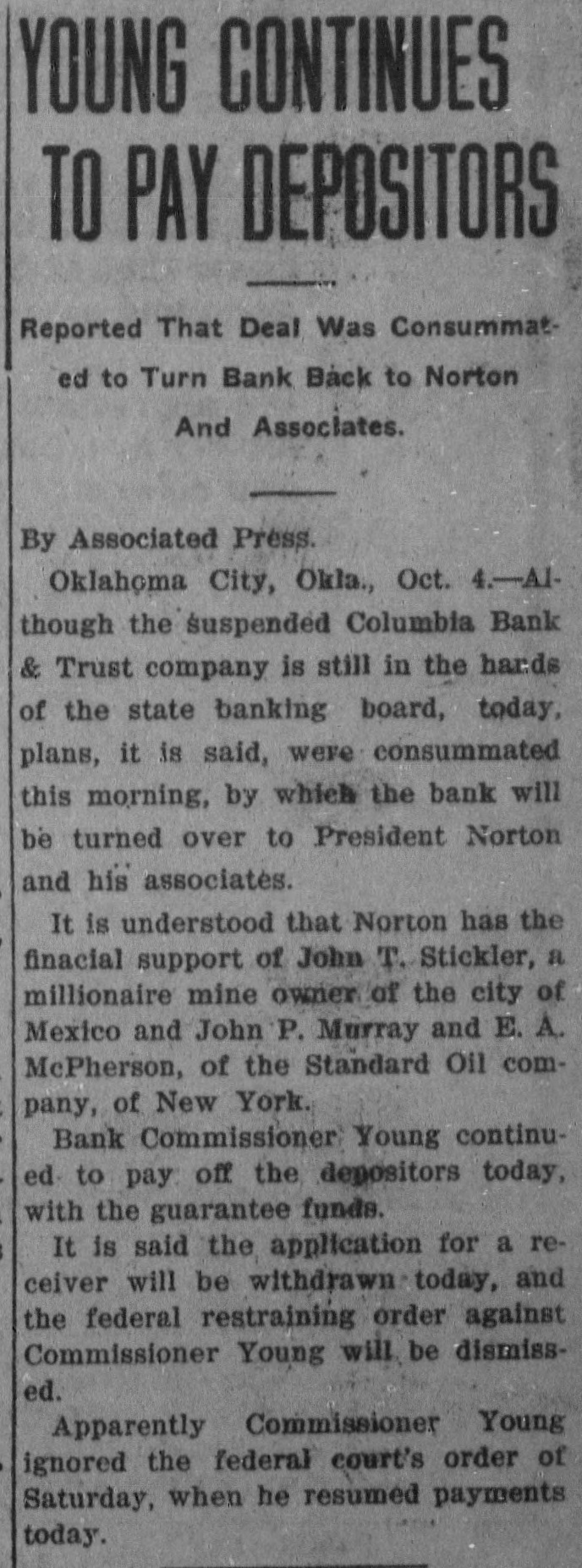
YOUNG CONTINUES TO PAY DEPOSITORS Reported That Deal Was Consummated to Turn Bank Back to Norton And Associates. By Associated Press. Oklahoma City, Okla., Oct. 4.-Although the suspended Columbia Bank & Trust company is still in the hards of the state banking board, today, plans, it is said, were consummated this morning, by which the bank will be turned over to President Norton and his associates. It is understood that Norton has the finacial support of John T. Stickler, a millionaire mine owner of the city of Mexico and John P. Murray and E. A. McPherson, of the Standard Oil company, of New York. Bank Commissioner Young continued to pay off the depositors today, with the guarantee funds. It is said the application for a receiver will be withdrawn today, and the federal restraining order against Commissioner Young will be dismissed. Apparently Commissioner Young ignored the federal court's order of Saturday, when he resumed payments today.


Article from Las Vegas Optic, October 4, 1909

Click image to open full size in new tab

Article Text

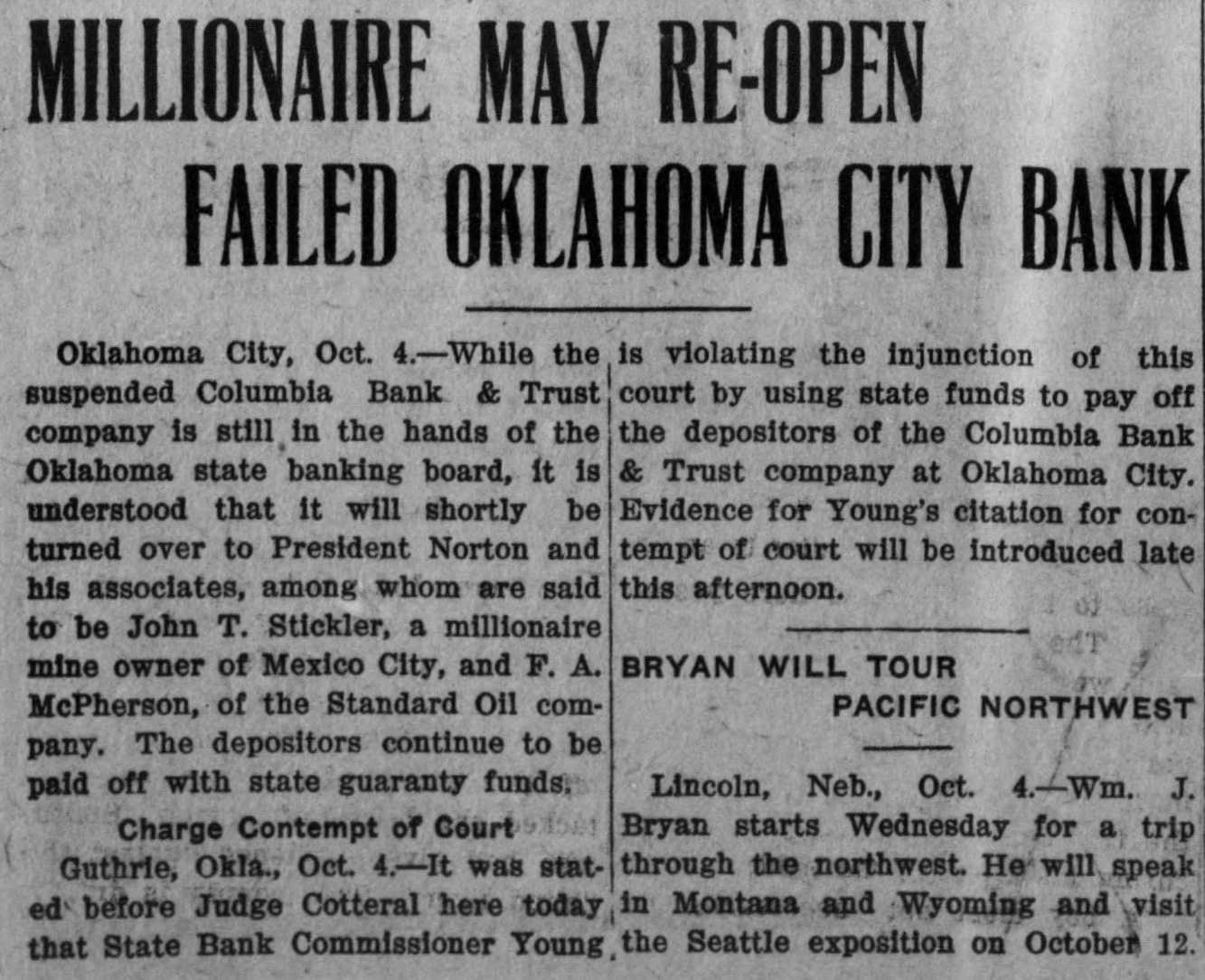
MILLIONAIRE MAY RE-OPEN FAILED OKLAHOMA CITY BANK Oklahoma City, Oct. 4.-While the is violating the injunction of this suspended Columbia Bank & Trust court by using state funds to pay off company is still in the hands of the the depositors of the Columbia Bank Oklahoma state banking board, it is & Trust company at Oklahoma City. understood that it will shortly be Evidence for Young's citation for conturned over to President Norton and tempt of court will be introduced late his associates, among whom are said this afternoon. to be John T. Stickler, a millionaire edT BRYAN WILL TOUR mine owner of Mexico City, and F. A. McPherson, of the Standard Oil comPACIFIC NORTHWEST pany. The depositors continue to be paid off with state guaranty funds. Lincoln, Neb., Oct. 4.-Wm. J. Bryan starts Wednesday for a trip Charge Contempt of Courts: through the northwest. He will speak Guthrie, Okla., Oct. 4.-It was stated before Judge Cotteral here today in Montana and Wyoming and visit that State Bank Commissioner Young, the Seattle exposition on October 12.


Article from The Topeka State Journal, October 6, 1909

Click image to open full size in new tab

Article Text

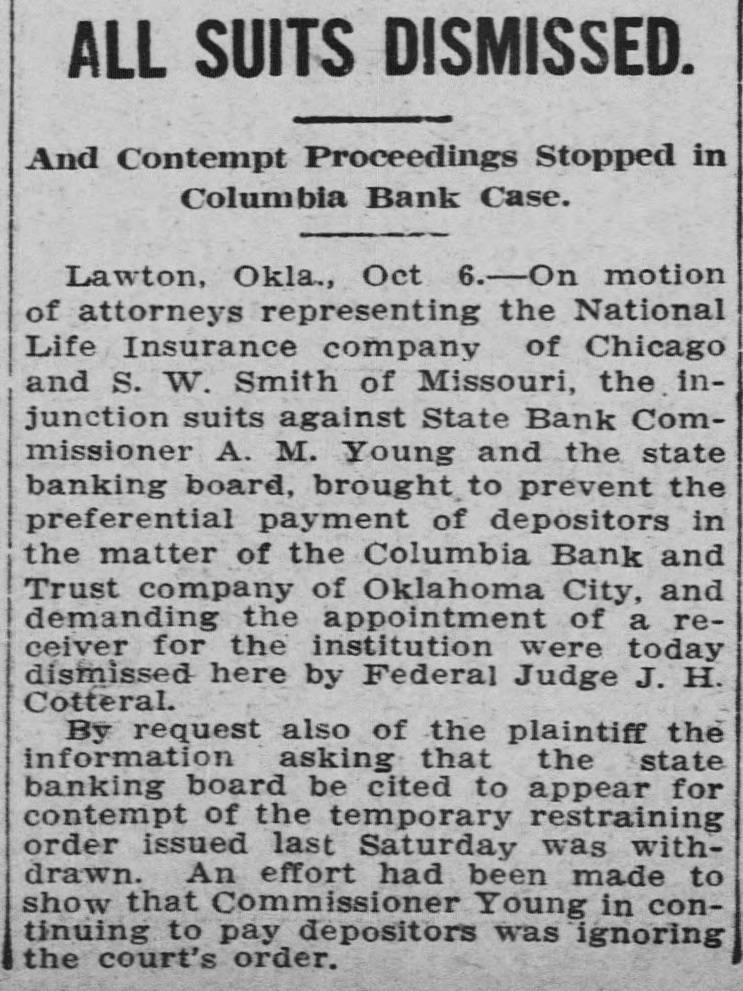
ALL SUITS DISMISSED. And Contempt Proceedings Stopped in Columbia Bank Case. Lawton, Okla., Oct 6.-On motion of attorneys representing the National Life Insurance company of Chicago and S. W. Smith of Missouri, the injunction suits against State Bank Commissioner A. M. Young and the state banking board, brought to prevent the preferential payment of depositors in the matter of the Columbia Bank and Trust company of Oklahoma City, and demanding the appointment of a receiver for the institution were today dismissed here by Federal Judge J. H. Cotteral. By request also of the plaintiff the information asking that the state banking board be cited to appear for contempt of the temporary restraining order issued last Saturday was withdrawn. An effort had been made to show that Commissioner Young in continuing to pay depositors was ignoring the court's order.


Article from The Chickasha Daily Express, October 6, 1909

Click image to open full size in new tab

Article Text

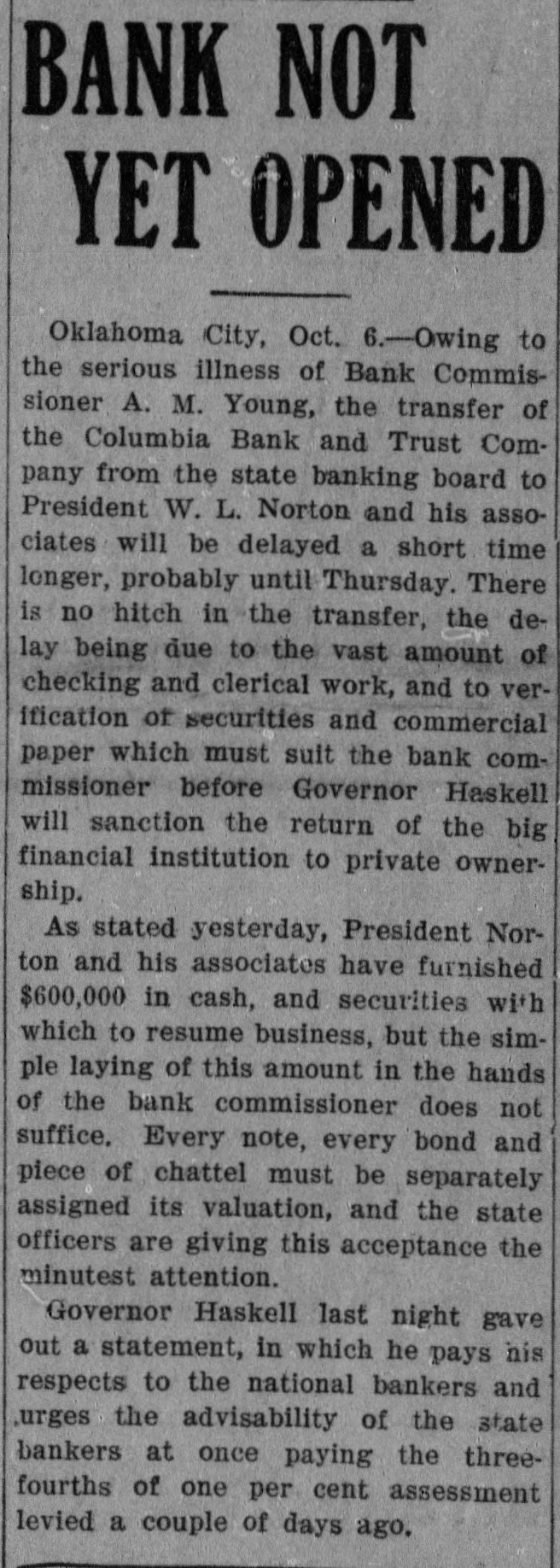
BANK NOT YET OPENED Oklahoma City, Oct. 6.-Owing to the serious illness of Bank Commissioner A. M. Young, the transfer of the Columbia Bank and Trust Company from the state banking board to President W. L. Norton and his associates will be delayed a short time longer, probably until Thursday. There is no hitch in the transfer, the delay being due to the vast amount of checking and clerical work, and to verification of securities and commercial paper which must suit the bank commissioner before Governor Haskell will sanction the return of the big financial institution to private ownership. As stated yesterday, President Norton and his associates have furnished $600,000 in cash, and securities with which to resume business, but the simple laying of this amount in the hands of the bank commissioner does not suffice. Every note, every bond and piece of chattel must be separately assigned its valuation, and the state officers are giving this acceptance the minutest attention. Governor Haskell last night gave out a statement, in which he pays his respects to the national bankers and urges the advisability of the state bankers at once paying the threefourths of one per cent assessment levied a couple of days ago.


Article from Arizona Republican, October 6, 1909

Click image to open full size in new tab

Article Text

$302,000, or only 10 per cent of the failed bank's deposits. Of this fund of $302,000, he found that $50,000 was It on deposit with the busted bank. was truly embarrassing for him to confess that if one-sixth of the total guaranty fund was on deposit with a bank that had failed, it was pretty good proof that his supervision of banks had not been altogether efficient. But, never mind that: the depositors were all right, anyhow. There were the other banks of the state upon which he could call for an emergency assessment of 2 per cent of their deposits, as provided by the law, wherewith to replenish the hungry guaranty fund. In the Oklahoma vernacular, he said to the banks: "Come across." But the banks refused to put up any assessment. They claimed that they could not be assessed until the assets of the failed bank had been exhausted. And they are standing pat on that proposition. Inasmuch as the liquidation of a bank as large as the Columbia Bank and Trust company is necessarily a matter of several years in time, it requires no prophet to foresee that the depositors of the failed bank have a long wait before them, unless the state authorities devise ready means of relief. To be sure, the depositors have this advantage under the guaranty law: Ultimately, if the other banks can be lawfully assessed to pay the liabilities of the failed bank, the depositors will be paid in full. But this satisfactory feature of the present situation would disappear in a time of panie-and it was to provide safety for depositors in periods of panic that the law was primarily advocated. Should two or three dozen banks fail, one after another, the guaranty law would speedily become a farce. It is to be expected that the authorities of Oklahoma, in order to justify this innovation in banking law, will make strenuous efforts to provide funds to satisfy the depositors of the failed bank at Oklahoma City: and if successful, they will merely postpone, until a time of stress, the real test of the scheme.


Article from Rock Island Argus, October 6, 1909

Click image to open full size in new tab

Article Text

Oklahoma's Law Vindicated. The charge that the guaranty of bank deposits law of Oklahoma would fail of the ends it was designed to serve has been completely refuted. The law has been tried and the experiences vindicate the far-sighted wisdom of the men who drafted it and the legislature which adopted it. The Columbia Bank & Trust company of Oklahoma City was declared insolvent by the state banking board shortly after midnight on the 29th of September. On the morning following the bank's doors were opened as usual, with officers of the state in charge, and announcement of the insolvency publicly made. Depositors demanding their money were paid in full without a moment's delay. Not one of them lost a penny. Not one of them could lose a penny because, besides the assets of the bank in cash, there was the immense guaranty fund of the state to draw upon. The Columbia had deposits of $3,000,000. How much of this amount was drawn out has not been stated. But a good deal more was withdrawn than in ordinary circumstances would be asked for because national bankers, who are hostile to the guaranty plan, circulated rumors that if depositors did not get their money immediately they would not get any money later. Governor Haskell has already announced that he will give the rod of attention to these libeling bankers when the grand juries next convene. The Columbia was a bank of reserve. and had $1,300,000 of the money of smaller state banks in its vaults. But these banks will feel no embarrassment because there is money enough to supply their needs, and if there should not be enough, it is within the province of the state board to levy an emergency assessment upon all banks, and thus secure enough, and more. The bank was closed by the state board because it had notes of oil operators totaling a large amount. If this paper was good, the bank was solvent: if not good, the bank would not be able to meet its obligations. The board concluded that much of the paper was not good, and so closed the bank. Now, the point is that if the state board had not closed the bank, the latter would have continued the policy of loaning on this dubious security. It would have done so under the old system, and one day, in all probability, there would have been a fail ure terrific in its consequences. And because the bank would be holding approximately $1,300,000 of the funds of other banks, these other banks, unable to get their money, would be compelled to close their doors. Oklahoma would thus have the same experience which was the whole country's in October, 1907. Then the reserve banks of New York refused to pay correspondent banks the money due them, and the correspondent banks had to refuse the depositors the money due them. Both proceedings were illegal, as illegal as proceedings could be. Adhering to the law, every one of the banks refusing to pay its obligations should have been declared insolvent. But no bank was, because the condition was universal, and there would have followed universal wreck. But in Oklahoma the correspondent banks had no such worry. And their depositors got what money they demanded, and can have all if they demand it. The loss, if any there shall be, will come out of the guaranty fund. Chicago clearing house banks of their ditiom - of $6 000 000


Article from New-York Tribune, October 7, 1909

Click image to open full size in new tab

Article Text

BANKS WILL RESIST ASSESSMENT. Result of Oklahoma Failure-Suits Against Columbia Bank Withdrawn. Enid. Okla., Oct. 6.-Interviews with local bank officials to-day indicate that Enid's five state banks will resist an assessment of 3/4 of 1 per cent on average deposits to replenish the guarantee fund now being used to re-establish the Columbia Bank and Trust Company, of Oklahoma City. Notice of the assessment was received to-day. On motion of attorneys representing the National Life Insurance Company, of Chicago, and S. W. Smith. of Missouri, the injunction suits against A. M. Young, State Bank Commissioner, and the State Banking Board brought to prevent the preferential payment of depositors of the Columbia Bank and demanding the appointment of a receiver, were dismissed by Federal Judge Cotteral at Lawton to-day. By request also of the plaintiff the information asking that the State Banking Board be cited to appear for contempt of the temporary restraining order issued last Saturday was withdrawn.


Article from The Butler Weekly Times, October 7, 1909

Click image to open full size in new tab

Article Text

AMERICAN CLOTHING HOUSE ing cared for may, however, cause OK. BANK GUARANTY trouble with the others. The guarFUND IS EXHAUSTED. anty law has apparently had the effect of causing greater confidence among the public generally than is usually the case at a time of financial stress. Columbia Run Leaves Only Few There has been no excitement and Dollars to Meet Another nothing in the nature of a panic as Failure. regards bank deposits in Oklahoma City or elsewhere. Governor Haskell and other friends LAW PREVENTS PANIC. of the guaranty law claim that attacks by national banks were largely reGuthrie, Ok., October.-Practically sponsible for the closing of the Columall of the State bank guaranty fund bia Bank, but admit that the direct was exhausted in paying off the decause was the fact that the bank was positors of the Columbia Bank and carrying a large amount of paper, Trust Company at Oklahoma City, which the Bank Commissioner deemand only a few dollars would be imed insecure. mediately available if another bank Some of the old-established nationshould fail. Even the assessment of threeal banks in Oklahoma City were undoubtedly jealous of the rapid growth fourths of 1 per cent, authorized by the Banking Board, has not been leviof the younger institution and were probably not sorry to see its progress ed yet, and possibly will not be if it suddenly checked, though they may can be avoided, as the temper of some of the State bankers is rather uncernot have contributed actively to its downfall. tain, and it is considered highly desirable to avoie all frictions as far as Since its close they are claiming possible in an important crisis like that the bank-guaranty law encourthis. aged loose banking methods. While If another failure should occur an there may have been some losses of emergency assessment would, of deposits to guaranteed banks as a result of the failure, they have not so course, be necessary. Present indications are that the far been large or numerous.


Article from Watertown Leader, October 8, 1909

Click image to open full size in new tab

Article Text

ENID'S BANKS RESIST. Oklahoma State Institutions Object to Assessment to Re-establish Columbia Company. ENID, Ok., Oct. 6.-Interviews with local bank officials today indicate that Enid's five state banks will resist efforts to collect an assessment of three-fourths of 1 per cent. on average deposits. The assessments is to replenish the guaranty fund now being used to reestablish the Columbia Bank and Trust company of Oklahoma City. LAWTON, Okla., Oct. 6.-On motion of attorneys representing the National Life Insurance company of Chicago and S. W. Smith of Missouri, the injunction suits against State Bank Commissioner A. M. Young and the state banking board, brought to prevent the preferential payment of depositors in the matter of the Columbia Bank and Trust Company of Oklahoma City, and demanding the appointment of a receiver for the institution, were today dismissed by Federal Judge J. H. Cotteral. By request also of the plaintiff the information asking that the state banking board be cited to appear for contempt of the temporary restraining order issued last Saturday was withdrawn. An effort had been made to show that Commissioner Young in continuing to pay depositors was ignoring the court's order.


Article from The Topeka State Journal, October 14, 1909

Click image to open full size in new tab

Article Text

KANSAS COMMENT ORGANIZATION NEEDED. The automobile enthusiasts of Kansas, as in other states, are forming clubs and associations, the chief end and aim of which is to win zinc loving cups which are frequently offered as prizes to the winners of pathfinding tours and endurance runs, but it never seems to occur to anybody that an organization for the purpose of detecting and punishing speed maniacs and others who bring motoring into disrepute, would be a good thing. When horse stealing became such a properous industry in the west that the sheriffs and other officers of the law couldn't cope with it, the farmers formed an organization for the special purpose of dealing with the thieves, and the latter became so discouraged that they practically went out of business. The Anti-Horsethief association is said to have lost some of its efficiency in recent years because the members devoted too much attention to its picnic features, but whenever the association does show signs of activity, the thieves take to the woods. The auto owners should have some organization for their own protection. Every accident that occurs increases the prejudice against the gasoline wagon, and emphasizes the demand for legislation that will make motoring seem like riding on a hearse. The other day a young man was run down in Emporia, and it was merely a bit of good luck that he wasn't killed. The man who was running the machine had important engagements somewhere else, and didn't wait to see what happened to the victim. He kept in the middle of the road, and is possibly making fast time yet. All efforts to discover his identity failed, and unless he dies of a guilty conscience, he will never be punished. If the autoists had the sort of an organization suggested, that man would be apprehended somewhere, and brought to punishment, regardless of expense. When they demonstrate that they have as little use as anybody for the reckless chauffeur, they will have accomplished something that will lessen the growing prejudice against the whole automobile business. And such work is surely as important as winning tin cups for running a machine a thousand miles through a swamp.β€”Emporia Gazette. TAKE OFF THE HIGH SPEED. Governor Haskell must have been speaking politically when he said, if he is correctly quoted, that the national banks of Oklahoma broke the Columbia bank and Trust Co. An examination of the records has shown that reckless banking broke the institution. It is not surprising that in Oklahoma City a catastrophe like this has happened. Oklahoma City has made marvelous speed in commercial growth, and high speed commerce in a new country always has a wreck somewhere along the way. Oklahoma City has had the high speed clutch on all along the line, and the one wreck may serve as a sufficient warning to other fast drivers in the business world down there. Oklahoma City is bound to be a great city, but the follies of impulsive youth are inevitable; no city can escape them.β€”Wichita Beacon.


Article from The Vinita Daily Chieftain, October 23, 1909

Click image to open full size in new tab

Article Text

Tulsa, Okla., Oct. .-The story sent out from here Thursday night as to the action taken by the state bankers of Eastern Oklahoma was a lie made out of whole cloth. The state bankers did not denounce the guarantee law as announced in the Muskogee Phoenix and - Tulsa World. No such action was taken or even suggested. The expression of 90 per cent of the state bankers present was favorable to the law and the declaration was freely made that the operation of this law alone saved the state of Oklahoma from the worst panic in her history The state bankers did, however, adopt a resolution demanding that certain changes be made in the law, chief among which was that the guarantee funds should not be segregated in a few banks, but be left in the banks making the payment, subject to the check of the banking board. In addition to this the state bankers want the banking board reorganized and one or more state bankers placed upon the board. There was also a strong sentiment against permitting state banks to use national banks as reserve agents on the theory that the state bank must guarantee its depositors while their deposits, carried as reserve in national banks, was wholly unprotected by any security of any nature. The following telegram was sent to Governor Haskell yesterday morning commending the work of the governor and state bank. Commissioner Young in settling up the affairs of the defunct Columbia Bank and Trust company, of Oklahoma City. October 22, 1909. C. N. Haskell, Governor State of Oklahoma, Guthrie Okla., Dear Sir: At a meeting held at Tulsa on October 21st of the Eastern Group of the State Bankers Section of Oklahoma Bankers Association the general discussion was largely relative to the tailure of the Columbia Bank & Trust company. Almost a unanimous sentiment was expressed that the affairs of the failed band was


Article from The Birmingham Age-Herald, November 2, 1909

Click image to open full size in new tab

Article Text

BANK GUARANTEE FUND IS TESTED Oklahoma City, November 1.-More than $500,000 contributed by the state banks under the deposit guaranty law has been used in paying depositors of the insolvent Columbia Bank and Trust company, which failed more than a month ago, and there remains more than $400,000 in deposits to be paid, with only $1123 in cash on hand to pay them, though sufficient assets, apparently, are available to provide for the remaining deposits. This condition is shown in a preliminary statement issued today by A. M. Young, state bank commissioner. When the bank 'failed it had $1,165,747 of individual deposits and $1,293,385 of deposits of other banks. Liabilities remaining amount to $1,125,000, and for this purpose the bank commissioner has total assets of $1,763,000, including $563,000 assigned after the failure by W. L. Norton, the bank's president, and others. Apparently no money has been received from the assessment of 100 per cent on the $200,000 of capital stock of the bank. Guthrie, November 1.-Suit asking the appointment of a receiver for the Co-


Article from The Chickasha Daily Express, November 12, 1909

Click image to open full size in new tab

Article Text

# Surety Company and Land Board Test Suit Guthrie, Okla., Nov. 11.-The National Surety company which has a bond securing $50,000 of state deposits in the defunct Columbia Bank and Trust company of Oklahoma City, has decided to join with the school land board in a suit on agreed statements of facts to determine the statute of the claims of the guaranty companies. The suit will be filed in the superior court here in a few days. The surety companies contend that when they pay bonds securing state funds, the state deposits thus indemnified should be assigned to them and that these should be considered secured by the state guaranty fund the same as other classes of deposits and surety. shrdlu shrdlu shrdl shrdlur the surety companies claim they should have first rank along with other deposits against the assets of the bank.


Article from The Salt Lake Herald-Republican, December 8, 1909

Click image to open full size in new tab

Article Text

HASKELL'S QUEER ACTION Governor of Oklahoma Prevents Attorney General From Representing State Before Grand Jury. Oklahoma City, Okla., Dec. 7.-By summarily cancelling the authority of Attorney General West to represent the state before the Oklahoma county grand jury, Governor Haskell today brought to a sudden termination the investigation the attorney general was making of the failure of the Columbia Bank & Trust company of Oklahoma City. The attorney general was not permitted to sign three indictments and two accusations reached by the grand jury before that body was discharged. The reason assigned by Governor Haskell for his action was that it is not to the best interests of the state that an investigation of the bank's affairs be made at this time. He declared that when the state banking board concludes its accounting, all records of the institution will be turned over to a grand jury should the district court SO demand.


Article from Iowa County Democrat, January 20, 1910

Click image to open full size in new tab

Article Text

# SPECIAL LEGISLATIVE COMMITTEE ON BANKING DISCUSSES GUARANTY PLAN. HAS A TENDENCY TO INVITE INFERIOR MEN INTO BUSINESS. WOULD SEGREGATE SAVINGS FROM COMMERCIAL DEPOSITS. Madison, Jan, 17. The report of the special legislative committee on banking, making its report to the legislature, proclaims at the very opening that no absolute preventive or bank failures can be provided by legislative enactments. "If the depositor, therefore, is to be made absolutely safe and secure," says the committee, "it is essential that some method be found by which his money may be restored to him in the event of the failure of a bank in which his money may happen to be deposited. Living, as we do in this day, in the light of the twentieth century civilΓ­zation, no scheme has yet been developed and proved which affords to the depositor absolute security. The most recent suggestion looking to this end is the plan commonly designated the "guaranteeing of bank deposits" after the manner exemplified by legislation enacted in a number of states. This was one of the subjects which was most diligently and exhaustively considered by this committee." The committee discusses at length the question of guarantee of bank deposits, taking for its text the Oklahoma law which has been the source of much discussion. Speaking upon that question the committee concludes: "We are of the opinion that the guaranty law has a tendency to invite men into the banking business of inferior banking ability, and the extent to which men of such inferior ability will be able to secure the control of banks and secure the management and control of the funds belonging thereto, depends to a considerable extent, on laws tending to discourage men of inferior qualifications from entering the business and on the strength and character of the commissioner of banking or other officer who administers the banking law." The committee made a careful investigation of the causes of the failure of the Columbia Bank & Trust company of Oklahoma City, which suspended and was taken over by the banking board on the day of the arrival there of the committee upon the occasion of its visit to that state. "The closing of the bank caused no riffle in the business world of Oklahoma City," says the report, "the public was not excited, there was no run on any other bank, state or national. Depositors apparently had confidence that they would get their money. They acted in an orderly and well behaved fashion. They drew their money out of the defunct bank and placed it in other banks. As a matter of fact, at the close of business on the day after the failure, the books of every other bank in the city showed an increase in deposits. While the lobby of the bank was quite well filled with depositors, there was no excitement or disorder, and so far as the street was concerned, there was nothing to raise the suspicion on the part of any one that he was passing by a bank whose doors had just been closed. No business interests in the city were disturbed, compromised or embarrassed in any manner. "The committee came in contact with a great many of the people who had money on deposit in the bank, some of whom appeared before the committee, and all gave expression to the sentiment that they were in no particular hurray for their money, that they knew it was safe and that they would call for it after the rush was over." A tabulated statement of the growth of Oklahoma banks, state and national, is given, covering a period of four months, and an analysis of the statement indicates that the total deposits of the state of Oklahoma, during the time, increased 43.3 per cent. in both state and national banks; that the increase in state banks, during that time, was 137 per cent., while the loss in national banks was one-half of one per cent.; that during the period the capital of both state and national banks increased approximately 10 per cent., and the increased capital stock in state banks was 75 per cent., while the decrease in stock of national banks was 20 per cent. February 29, 1908, the capital stock in the state banks, was 32 per cent. of their deposits, and on February 14, 1908, the capital stock of National banks was also 32 per cent. of their deposits. On June 28, 1909, the capital stock of the state banks was 24 per cent. of their deposits, while the capital stock of national banks, was 25Β½ per cent. of their deposits. The Oklahoma guaranty law went into effect February 14, 1908, since which time 165 state banks have been chartered, 73 of which were conversions of national banks, with $7,300,000.00 capital, Clearing House Association. "The suggestion was made to this committee by a number of bankers, that country clearing house associations could be established for that purpose with equally as good results, and it may be said that a number of prominent bankers have written papers on this subject in which the position is taken that the country clearing house association may be successfully formed and conducted and that it will serve a very useful purpose, but not so much for the purpose of afford-