Article Text
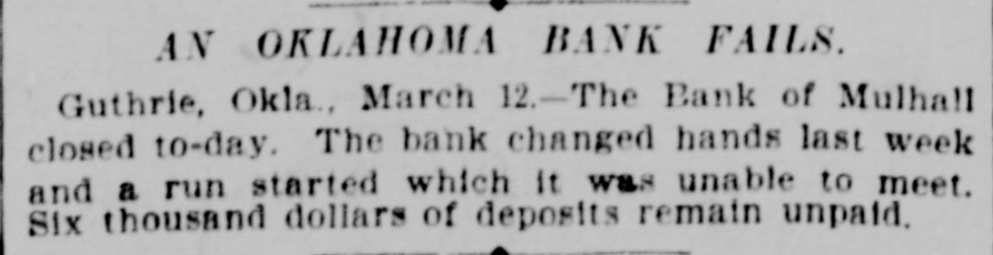
AN OKLAHOMA BANK FAILS. Guthrie, Okla., March 12.-The Bank of Mulhall closed to-day. The bank changed hands last week and a run started which it was unable to meet. Six thousand dollars of deposits remain unpaid.
fa302c002d887c26None
Click image to open full size in new tab
AN OKLAHOMA BANK FAILS. Guthrie, Okla., March 12.-The Bank of Mulhall closed to-day. The bank changed hands last week and a run started which it was unable to meet. Six thousand dollars of deposits remain unpaid.
Click image to open full size in new tab
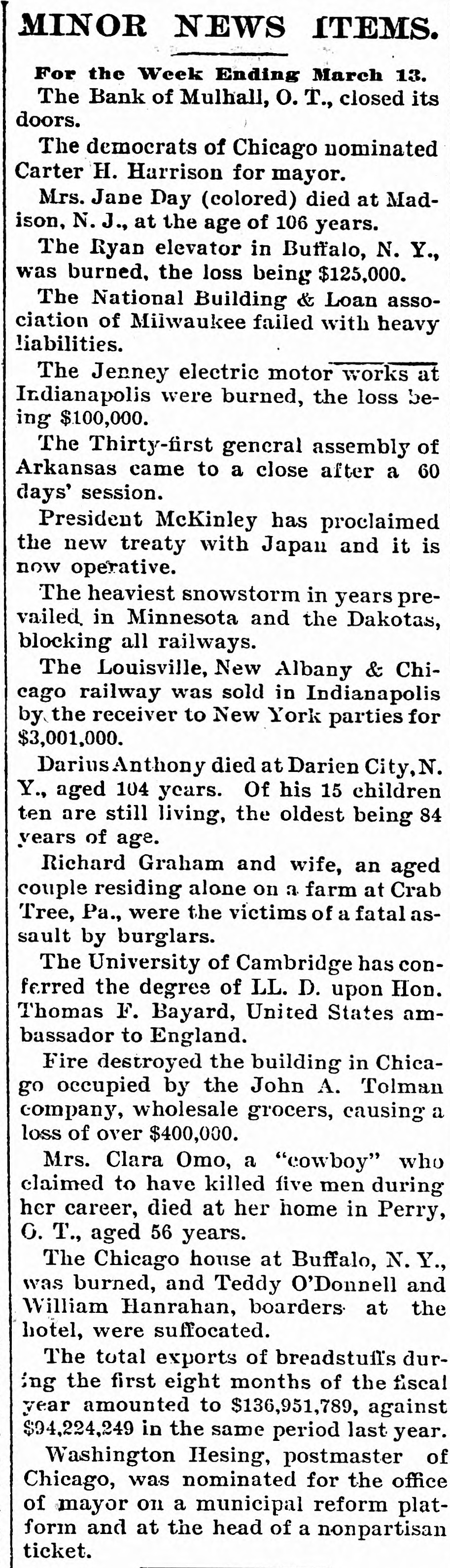
MINOR NEWS ITEMS. For the Week Ending March 13. The Bank of Mulhall, O. T., closed its doors. The democrats of Chicago nominated Carter H. Harrison for mayor. Mrs. Jane Day (colored) died at Madison, N. J., at the age of 106 years. The Ryan elevator in Buffalo, N. Y., was burned, the loss being $125,000. The National Building & Loan association of Milwaukee failed with heavy liabilities. The Jenney electric motor works at Indianapolis were burned, the loss being $100,000. The Thirty-first general assembly of Arkansas came to a close after a 60 days' session. President McKinley has proclaimed the new treaty with Japan and it is now operative. The heaviest snowstorm in years prevailed in Minnesota and the Dakotas, blocking all railways. The Louisville, New Albany & Chicago railway was sold in Indianapolis by the receiver to New York parties for $3,001,000. Darius Anthony died at Darien City, N. Y., aged 104 years. Of his 15 children ten are still living, the oldest being 84 years of age. Richard Graham and wife, an aged couple residing alone on a farm at Crab Tree, Pa., were the victims of a fatal assault by burglars. The University of Cambridge has conferred the degree of LL. D. upon Hon. Thomas F. Bayard, United States ambassador to England. Fire destroyed the building in Chicago occupied by the John A. Tolman company, wholesale grocers, causing a loss of over $400,000. Mrs. Clara Omo, a "cowboy" who claimed to have killed five men during her career, died at her home in Perry, O. T., aged 56 years. The Chicago house at Buffalo, N. Y., was burned, and Teddy O'Donnell and William Hanrahan, boarders at the hotel, were suffocated. The total exports of breadstuff's during the first eight months of the fiscal year amounted to $136,951,789, against $94,224,249 in the same period last year. Washington Hesing, postmaster of Chicago, was nominated for the office of mayor on a municipal reform platform and at the head of a nonpartisan ticket.

Click image to open full size in new tab
DOMESTIC. a mile A cyclone nearly wide struck house Ralston, town O.T., and every in and in the of the storm was blown down. persons were Many path wounded. The Western association baseball season will 29 Septemopen April total and of 126 close games. ber 22, making a in the at Mount N. Y., was away The Morris, dam Genessee washed of $100,000. river by a loss elevator in Y., The a flood, Ryan causing Buffalo, $125,000. N. was burned. the loss being have been sent to Indian reservation for pahgre Troops intruders. in the Utah Uncomthe purpose of removing A train on the Evansville & Terre Haute railroad struck a washout near Hazleton, Ind., wrecking the entire train and killing at least six persons and injuring several others. New was sold in The railway Louisville, Albany Indianapolis & Chithe receiver to New by cago York parties for $3,001,000. Richard Graham and wife, an aged alone on a at couple residing victims farm of fatal Crab Tree, Pa., were the a sault by burglars. A woman named Sandoval and her paramour, Silverio Martinez, re killed by the woman's husband at Coyote, N.M. C. widow of Frederick and a wealthy woman, was Bragg Mrs. Bragg, found shot at her in Chicago, her fatally and stepdaughter, crime. home aged 15, was charged with the the loss from RipIn county Indiana floods $150,000, in ley will aggregate in Decatur county $100,000, and in Lawrence county $2,000,000. general of The Thirty-first assembly 60 Arkansas came to a close after a days' session. Later dispatches say that only four lives were lost in the Evansville & Terre Haute wreck near Hazelton. Ind. The McKinley schedule on wools and woolens has been substantially adopted by the republican majority of the ways and means committee. President McKinley has proclaimed the new treaty with Japan and it is now operative. The National Building & Loan association of Milwaukee failed with heavy liabilities. The total exports of breadstuffs durfirst months to ing the eight amounted in the $136,951,789, against $94,224,249 same period last year. At Savannah, Tenn., Mrs. Alfred Alexander, a young wife, hanged herself because of jealousy. man named Harrington and his were drowned near while to ford Mich., A mother young trying Belle Romeo, river. the Missouri and James at S. D., is rivers The ice Yankton, on three before feet thick-a condition unknown at this time of the year. The St. Paul (Minn.) Plow company failed for $100,000. It is announced that the men who been appointed United States senthe governors in have had an have ators legislatures by states opportunity where to elect will not be admitted. There were 256 business failures in the United States in the seven days h on the 12th, against 246 the week and 300 in the previous ended corresponding period of 1896. The fourth legislature of Oklahoma t adjourned sine die at Guthrie after e ing a bill prohibiting a man from marrying his mother-in-law. e The exchanges at the leading clearing , houses in the United States during the S week ended on the 12th aggregated 11 against t week. The previous $925,145,384, decrease $1,010,426,627 week compared of 1896 with the corresponding was 2.2. d In a sparring match at Cheyenne, e between Privates and 7. of the Eighth inis Wyo., Gollie, United O'Shay blow States n fantry, Gollie was struck a that killed him instantly. le William Drossel his In a quarrel shot 1wife in Chicago and then shot himself dead. n s. Trade throughout the country is said 0 to but surely e a negro, was electroArthur be slowly Mayhew, improving. h cuted in the prison at Sing Y. for the murder of Stephen resident Sing. Powell, N. prominent and wealthy L. I., le r new tariff bill has been practical Hempstead, The March 7. 1896. it 0 completed and it is said that will 1. ly increase the revenues about $70,000,000 1, per year. 1The Jenney electric motor works a to Indianapolis were burned, the loss be g ing $100,000. 10 The Bank of Mulhall, O. T., closed it 10 doors. o eThe damage to railroads and indi ot viduals by the floods in Kentucky placed at $6,000,000. 11 The heaviest snowstorm in years pre nvailed in Minnesota and the Dakotas blocking all railways.
Click image to open full size in new tab
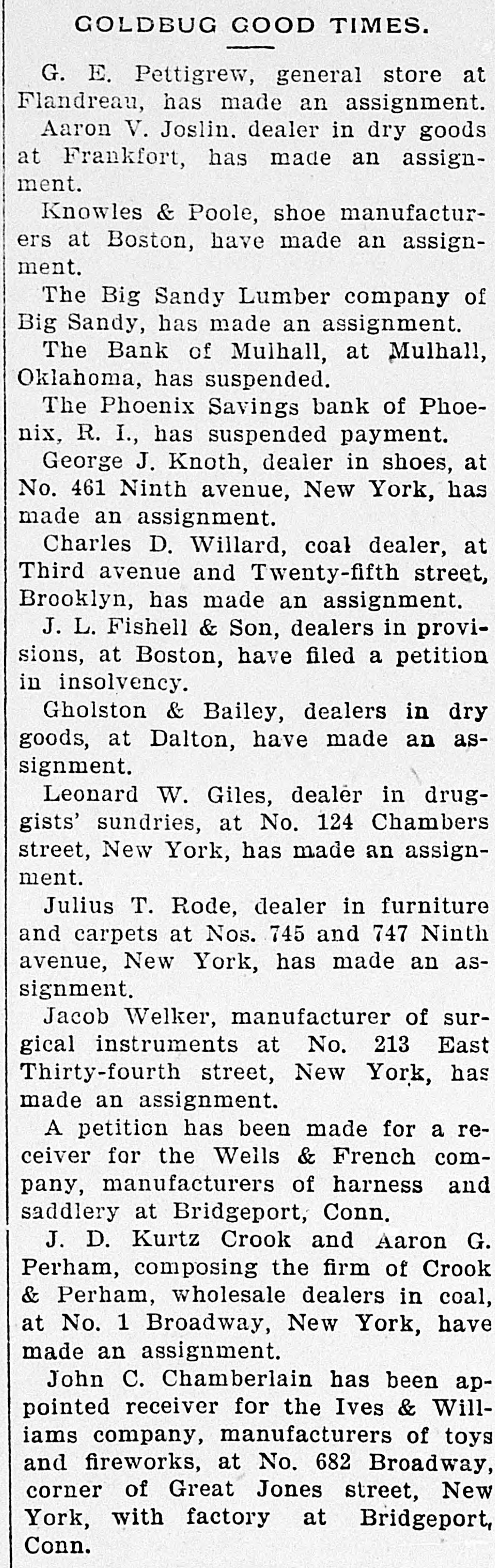
GOLDBUG GOOD TIMES. G. E. Pettigrew, general store at Flandreau, has made an assignment. Aaron V. Joslin. dealer in dry goods at Frankfort, has made an assignment. Knowles & Poole, shoe manufacturers at Boston, have made an assignment. The Big Sandy Lumber company of Big Sandy, has made an assignment. The Bank of Mulhall, at Mulhall, Oklahoma, has suspended. The Phoenix Savings bank of Phoenix, R. I., has suspended payment. George J. Knoth, dealer in shoes, at No. 461 Ninth avenue, New York, has made an assignment. Charles D. Willard, coal dealer, at Third avenue and Twenty-fifth street, Brooklyn, has made an assignment. J. L. Fishell & Son, dealers in provisions, at Boston, have filed a petition in insolvency. Gholston & Bailey, dealers in dry goods, at Dalton, have made an assignment. Leonard W. Giles, dealer in druggists' sundries, at No. 124 Chambers street, New York, has made an assignment. Julius T. Rode, dealer in furniture and carpets at Nos. 745 and 747 Ninth avenue, New York, has made an assignment. Jacob Welker, manufacturer of surgical instruments at No. 213 East Thirty-fourth street, New York, has made an assignment. A petition has been made for a receiver for the Wells & French company, manufacturers of harness and saddlery at Bridgeport, Conn. J. D. Kurtz Crook and Aaron G. Perham, composing the firm of Crook & Perham, wholesale dealers in coal, at No. 1 Broadway, New York, have made an assignment. John C. Chamberlain has been appointed receiver for the Ives & Williams company, manufacturers of toys and fireworks, at No. 682 Broadway, corner of Great Jones street, New York, with factory at Bridgeport, Conn.