First National Bank (Dover, DE)

Episode Information

Episode UID
156701165
Episode Type
Run β†’ Suspension β†’ Reopening
Bank Type
national
Bank ID
15670 national
Charter Number
1567
Start Date
January 1, 1897*
Location
Dover, Delaware (39.158, -75.524)

Metadata

Model
gpt-5-mini (chosen from majority vote of a three-model LLM ensemble)
Short Digest
aec993ea7a21e2fe

Response Measures

Accommodated withdrawals, Borrowed from banks or large institutions, Public signal of financial health, Capital injected, Full suspension

Description

Articles link an embezzlement by teller Boggs to heavy withdrawals, a suspension in May 1897, and a subsequent resumption with reduced capital; some accounts compress chronology.

Events (4)

1. September 23, 1865 Chartered
Source
historical_nic
2. January 1, 1897* Reopening
Newspaper Excerpt
but resumed with capital reduced from $100,000 to $50,000.
Source
newspapers
3. May 1, 1897* Suspension
Cause
Bank Specific Adverse Info
Cause Details
After discovery of Boggs's large defalcation the bank was forced to suspend operations in May 1897.
Newspaper Excerpt
The bank was forced to suspend in May, 1897 but resumed with capital reduced from $100,000 to $50,000.
Source
newspapers
4. June 7, 1897 Run
Cause
Bank Specific Adverse Info
Cause Details
Large embezzlement/defalcation by teller William N. Boggs (> $100,000) triggered depositor alarm and withdrawals.
Measures
Directors deposited over $150,000 and President Richardson personally assured backing the bank; assistance pledged by Farmers' Bank and National Bank of Philadelphia.
Newspaper Excerpt
At 10:30 o'clock a run was threatened, but President Richardson succeeded in assuring most of the depositors that there was no necessity for anxiety, and they departed.
Source
newspapers

Newspaper Articles (17)

Article from New-York Tribune, June 8, 1897

Click image to open full size in new tab

Article Text

BOGGS'S DEFALCATION GROWING. SAID TO BE OVER $100,000-A RUN ON THE DOVER BANK AVERTED. Dover, Del., June 7. - The First National Bank opened as usual this morning, prepared to meet a run, but the run did not occur. The Farmers' Bank here has pledged assistance, as has also the National Bank of Philadelphia, through which the local institution transacts its business. Sheriff Shaw this morning issued an execution against the former sureties of William N. Boggs, the defaulting paying teller, as follows: George V. Massey, John M. Moore, A. H. Moore, Dr. John M. Smith. Joseph R. Whitaker (estate) and William N. Boggs. This bond was entered December 3, 1891. and was for $10,000. While no definite statement of the amount of Boggs's defalcation is given out by the officers of the bank. it is known in financial circles that it will exceed $100,000. At 10:30 o'clock a run was threatened, but President Richardson succeeded in assuring most of the depositors that there was no necessity for anxiety, and they departed. The directors have since Saturday deposited over $150,000 as an evidence of their faith in the institution.


Article from Evening Journal, June 8, 1897

Click image to open full size in new tab

Article Text

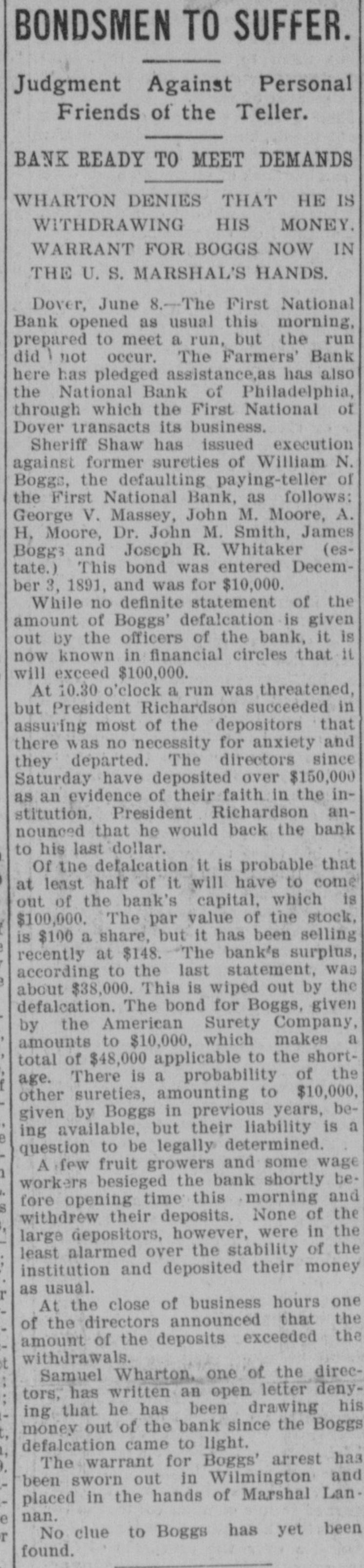
BONDSMEN TO SUFFER. Judgment Against Personal Friends of the Teller. BANK READY TO MEET DEMANDS WHARTON DENIES THAT HE IS WITHDRAWING HIS MONEY. WARRANT FOR BOGGS NOW IN THE U. S. MARSHAL'S HANDS. Dover, June 8.--The First National Bank opened as usual this morning, prepared to meet a run, but the run did ) not occur. The Farmers' Bank here has pledged assistance,as has also the National Bank of Philadelphia, through which the First National of Dover transacts its business. Sheriff Shaw has issued execution against former sureties of William N. Boggs, the defaulting paying-teller of the First National Bank, as follows: George V. Massey, John M. Moore, A. H, Moore, Dr. John M. Smith, James Boggs and Joseph R. Whitaker (estate.) This bond was entered December 3, 1891, and was for $10,000. While no definite statement of the amount of Boggs' defalcation is given out by the officers of the bank, it is now known in financial circles that it will exceed $100,000. At 10.30 o'clock a run was threatened, but President Richardson succeeded in assuring most of the depositors that there was no necessity for anxiety and they departed. The directors since Saturday have deposited over $150,000 as an evidence of their faith in the institution. President Richardson announced that he would back the bank to his last dollar. Of the defalcation it is probable that at least half of it will have to come out of the bank's capital, which is $100,000. The par value of the stock, is $100 a share, but it has been selling recently at $148. The bank's surplus, according to the last statement, was about $38,000. This is wiped out by the defalcation. The bond for Boggs, given by the American Surety Company, amounts to $10,000, which makes a total of $48,000 applicable to the shortage. There is a probability of the other sureties, amounting to $10,000, given by Boggs in previous years, being available, but their liability is a question to be legally determined. A few fruit growers and some wage 1 workers besieged the bank shortly before opening time this morning and S withdrew their deposits. None of the large depositors, however, were in the least alarmed over the stability of the institution and deposited their money as usual. At the close of business hours one of the directors announced that the amount of the deposits exceeded the withdrawals. Samuel Wharton, one of the directors, has written an open letter denying that he has been drawing his money out of the bank since the Boggs t. defalcation came to light. The warrant for Boggs' arrest has ). been sworn out in Wilmington and placed in the hands of Marshal Lan nan. e No clue to Boggs has yet been r found.
Article from The Wilmington Daily Republican, June 8, 1897

Click image to open full size in new tab

Article Text

Boggs' Stealings Over $100.000. Dover, Del., June 8.-The officials of the First National bank were prepared for a run yesterday, but nothing of the sort occurred. While no definite statement of the amount of Boggs' defalcation is given out by the officers of the bank, it is known in financial circles that it will exceed $100,000.


Article from The Wilmington Daily Republican, June 8, 1897

Click image to open full size in new tab

Article Text

Boggs' Sureties Liable. DOVER, June 7,-President Harry A. Richardson, of the First National Bank. stated to-night that the reports in regard to the increase of the Boggs defalcation are untrue, and that nothing definite will be known for at least a week. From another seource it was learned that the directors and others interested in the investigation had obligated themselves not to divulge any of the business of the bank until a final statement could be prepared. An execution was issued by Sheriff S. L. Shaw this morning, against George V. Massey, John M. Moore, William N. Boggs, A. H. Moore, Dr. J. M. Smith and the estate of Joseph R Whitaker, of which Judge Samuel W. Pennypacker and George V. Massey are executors. Boggs' bond in which the above names appear, amounts to $10,000, was issued on December 3, 1891. The directors of the bank were approbensive of a run when the institution opened for business this morning. but every preparation had been made to meet it and there was very little excitement. DEPOSITORS UNDISTURBED. The only accounts withdrawn were those of women and a few farmers, none of whom were large depositors. The large depositors, the substantial business people of the town and surrounding country appeared as usual with their Saturday night receipts and deposited them as if nothing out of the ordinary had occurred. President Richardson, who is individually worth half a million. said this morning it would be impossible to break the bank as if necessary his entire fortune would be placed in the vaults for the use of the institution in the emergency. It is hardly probable that the loss will exceed $78.000. It is probable that at least half of the defatcation will have to come out of the bank's capital, which is $100,000. The par value of the stock is $100 a share, but it has been selling recently at $148 The bank's surplus, according to the last statement, was about $38,000. The bond for Boggs given by the American Surety Company amounts to $10,000, which makes a total of $43,000 applicable to the shortage. There is a probability of the other securities amounting to $10.000, given by Boggs in previous years being available. but their liability is a question to be legally determined. Bank Examiner Buck appeared before Clerk Smith of the United States Court yesterday afternoon and swore out a warrant for the arrest of William N. Boggs, the defaulting teller of the First National Bank of Dover.


Article from Delaware Gazette and State Journal, February 24, 1898

Click image to open full size in new tab

Article Text

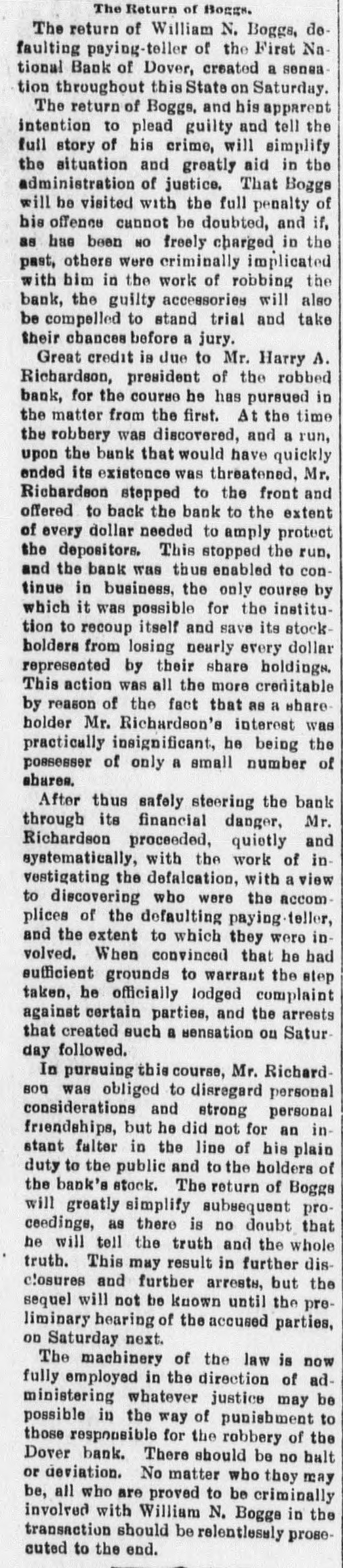
The Return of Boggs. The return of William N. Boggs, defaulting paying-teller of the First Na tional Bank of Dover, created a senea tion throughout this State on Saturday. The return of Boggs, and his apparent intention to plead guilty and tell the full story of his crime, will simplify the situation and greatly aid in the administration of justice. That Boggs will he visited with the full penalty of his offence cannot be doubted, and if, as has been NO freely charged in the past, others were criminally implicated with him in the work of robbing the bank, the guilty accessories will also be compelled to stand trial and take their chances before a jury. Great credit is due to Mr. Harry A. Ricbardson, president of the robbed bank, for the course he has pursued in the matter from the first. At the time the robbery was discovered, and a run, upon the bank that would have quickly ended its existence was threatened, Mr. Richardson stepped to the front and offered to back the bank to the extent of every dollar needed to amply protect the depositors. This stopped the run, and the bank was thus enabled to continue in business, the only course by which it was possible for the institution to recoup itself and save its stock holders from losing nearly every dollar represented by their share holdings. This action was all the more creditable by reason of the fact that as a share holder Mr. Richardson's interest was practically insignificant, he being the possesser of only a small number of shares. After thus safely steering the bank through its financial danger, Mr. Richardson proceeded, quietly and systematically, with the work of investigating the defalcation, with a view to discovering who were the accom plices of the defaulting paying-teller, and the extent to which they were involved. When convinced that he had sufficient grounds to warrant the step taken, he officially lodged complaint against certain parties, and the arrests that created such a sensation on Satur day followed. In pursuing this course, Mr. Richardson was obliged to disregard personal considerations and strong personal friendships, but he did not for an instant falter in the line of his plain duty to the public and to the holders of the bank's stock. The return of Bogga will greatly simplify subsequent proceedings, as there is no doubt that he will tell the truth and the whole truth. This may result in further disclosures and further arrests, but the sequel will not be known until the preliminary hearing of the accused parties, on Saturday next. The machinery of the law is now fully employed in the direction of administering whatever justice may be possible in the way of punishment to those responsible for the robbery of the Dover bank. There should be no halt or deviation. No matter who they may be, all who are proved to be criminally involved with William N. Bogge in the transaction should be relentlessly prosecuted to the end.


Article from The Times, December 9, 1898

Click image to open full size in new tab

Article Text

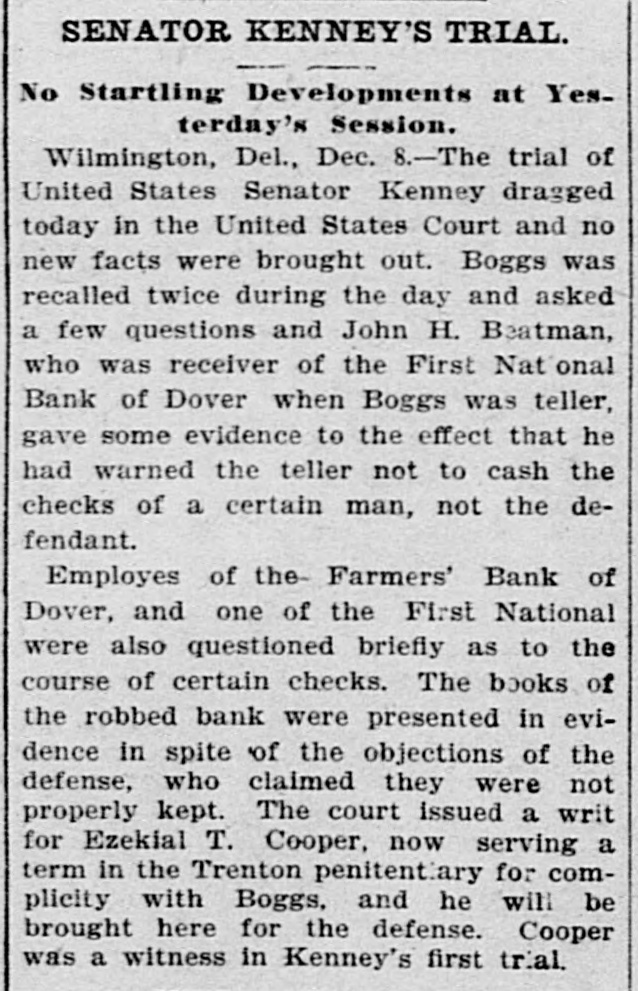
# SENATOR KENNEY'S TRIAL. No Startling Developments at Yesterday's Session. Wilmington, Del., Dec. 8.β€”The trial of United States Senator Kenney dragged today in the United States Court and no new facts were brought out. Boggs was recalled twice during the day and asked a few questions and John H. Beatman, who was receiver of the First National Bank of Dover when Boggs was teller, gave some evidence to the effect that he had warned the teller not to cash the checks of a certain man, not the defendant. Employes of the Farmers' Bank of Dover, and one of the First National were also questioned briefly as to the course of certain checks. The books of the robbed bank were presented in evidence in spite of the objections of the defense, who claimed they were not properly kept. The court issued a writ for Ezekial T. Cooper, now serving a term in the Trenton penitentiary for complicity with Boggs, and he will be brought here for the defense. Cooper was a witness in Kenney's first trial.


Article from Daily Inter Mountain, May 10, 1899

Click image to open full size in new tab

Article Text

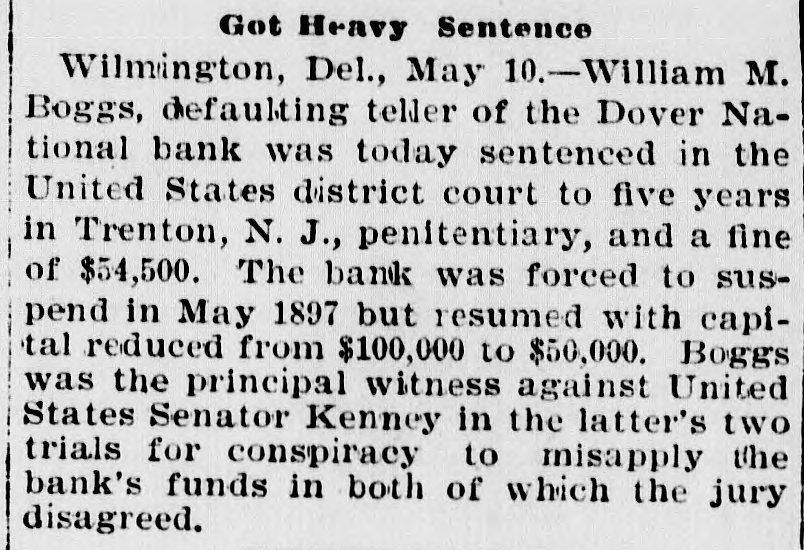
Got Heavy Sentence Wilmington, Del., May 10.-William M. Boggs, defaulting teller of the Dover National bank was today sentenced in the United States district court to five years in Trenton, N. J., penitentiary, and a fine of $54,500. The bank was forced to suspend in May 1897 but resumed with capital reduced from $100,000 to $50,000. Boggs was the principal witness against United States Senator Kenney in the latter's two trials for conspiracy to misapply the bank's funds in both of which the jury disagreed.


Article from The Topeka State Journal, May 10, 1899

Click image to open full size in new tab

Article Text

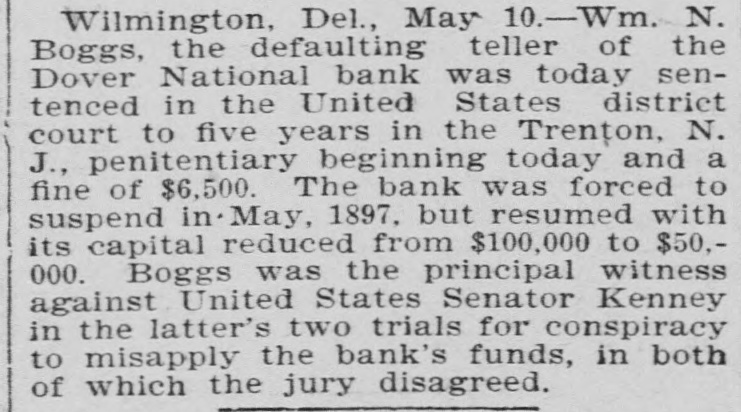
Wilmington, Del., May 10.-Wm. N. Boggs, the defaulting teller of the Dover National bank was today sentenced in the United States district court to five years in the Trenton, N. J., penitentiary beginning today and a fine of $6,500. The bank was forced to suspend in. May, 1897, but resumed with its capital reduced from $100,000 to $50,000. Boggs was the principal witness against United States Senator Kenney in the latter's two trials for conspiracy to misapply the bank's funds, in both of which the jury disagreed.


Article from The Indianapolis Journal, May 11, 1899

Click image to open full size in new tab

Article Text

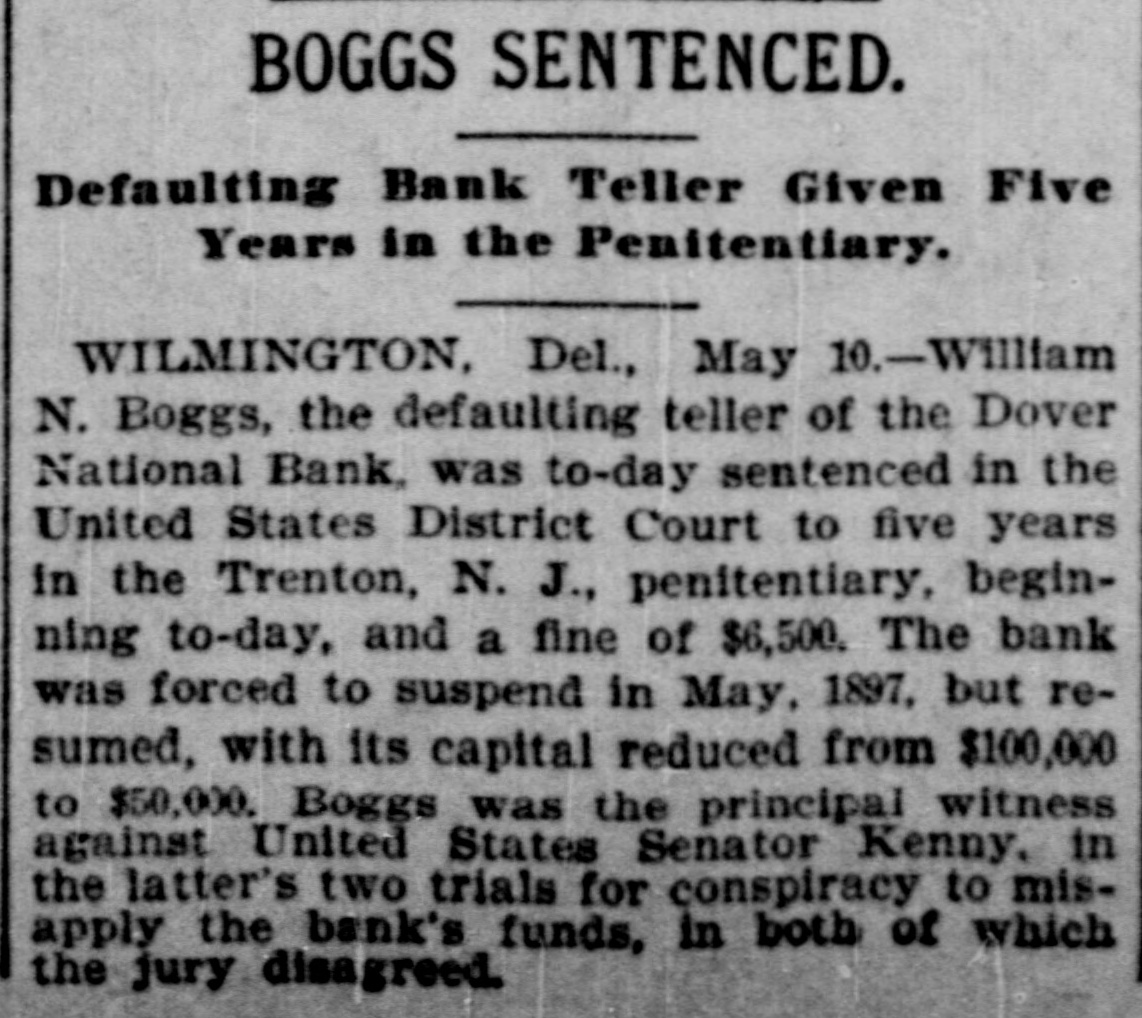
BOGGS SENTENCED. Defaulting Bank Teller Given Five Years in the Penitentiary. WILMINGTON, Del., May 10.-William N. Boggs, the defaulting teller of the Dover National Bank, was to-day sentenced in the United States District Court to five years in the Trenton, N. J., penitentiary, beginning to-day, and a fine of $6,500. The bank was forced to suspend in May, 1897, but resumed, with its capital reduced from $100,000 to $50,000. Boggs was the principal witness against United States Senator Kenny. in the latter's two trials for conspiracy to misapply the bank's funds, in both of which the jury disagreed.


Article from The Saint Paul Globe, May 11, 1899

Click image to open full size in new tab

Article Text

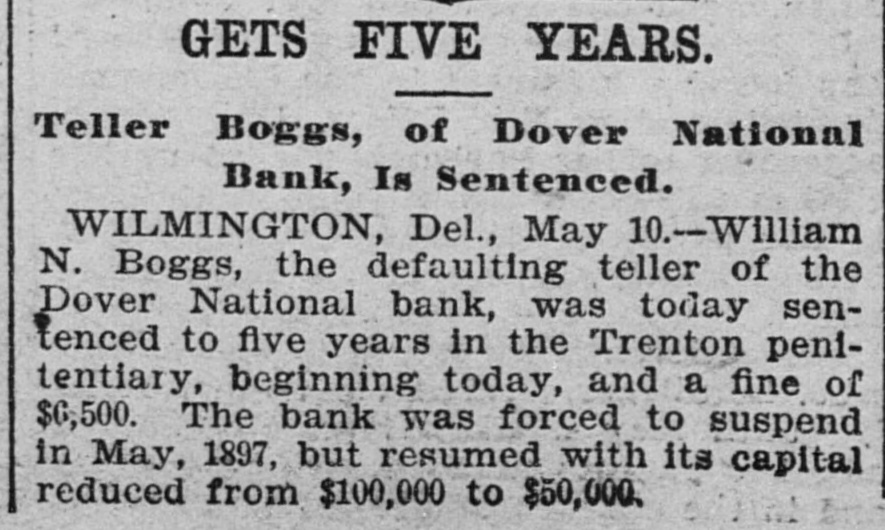
GETS FIVE YEARS. Teller Boggs, of Dover National Bank, Is Sentenced. WILMINGTON, Del., May 10.-William N. Boggs, the defaulting teller of the Dover National bank, was today sentenced to five years in the Trenton penitentiary, beginning today, and a fine of $6,500. The bank was forced to suspend in May, 1897, but resumed with its capital reduced from $100,000 to $50,000.


Article from Barre Evening Telegram, May 11, 1899

Click image to open full size in new tab

Article Text

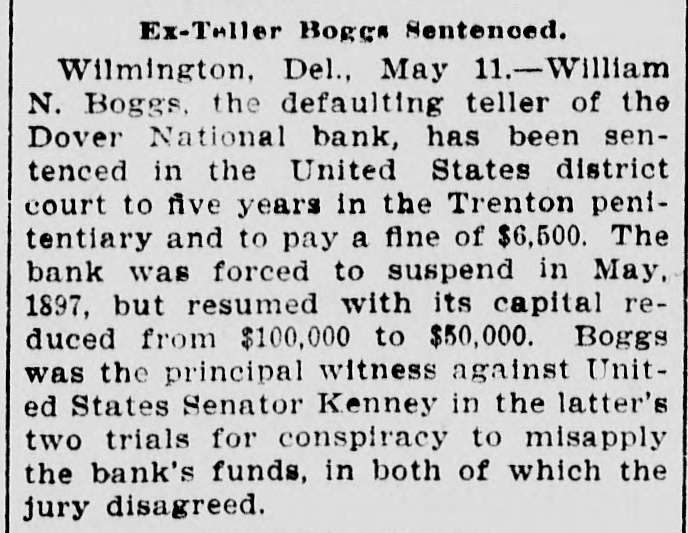
Ex-Teller Boggs Sentenced. Wilmington, Del., May 11.-William N. Boggs, the defaulting teller of the Dover National bank, has been sentenced in the United States district court to five years in the Trenton penitentiary and to pay a fine of $6,500. The bank was forced to suspend in May, 1897, but resumed with its capital reduced from $100,000 to $50,000. Boggs was the principal witness against United States Senator Kenney in the latter's two trials for conspiracy to misapply the bank's funds, in both of which the jury disagreed.


Article from The Seattle Post-Intelligencer, May 11, 1899

Click image to open full size in new tab

Article Text

SENTENCED TO FIVE YEARS. I Boggs, Implicated With Senator Kenney, Given His Deserts. WILMINGTON Del. May 10.-William M. Boggs. defaulting teller of the Dover National bank, was today sentenced in the United States district court to five years in Trenton. N. J., penitentiary and a fine of $6.500 The bank was forced to SURpend in May. 1897. but remumed. with its capital reduced from $100,000 to $50,000. Borgs was the principal witness against United States Senstor Kenney in the latter's two trials for conspiracy to misapply the bank's funds, in both of which the jury disagreed.


Article from Wheeling Register, May 11, 1899

Click image to open full size in new tab

Article Text

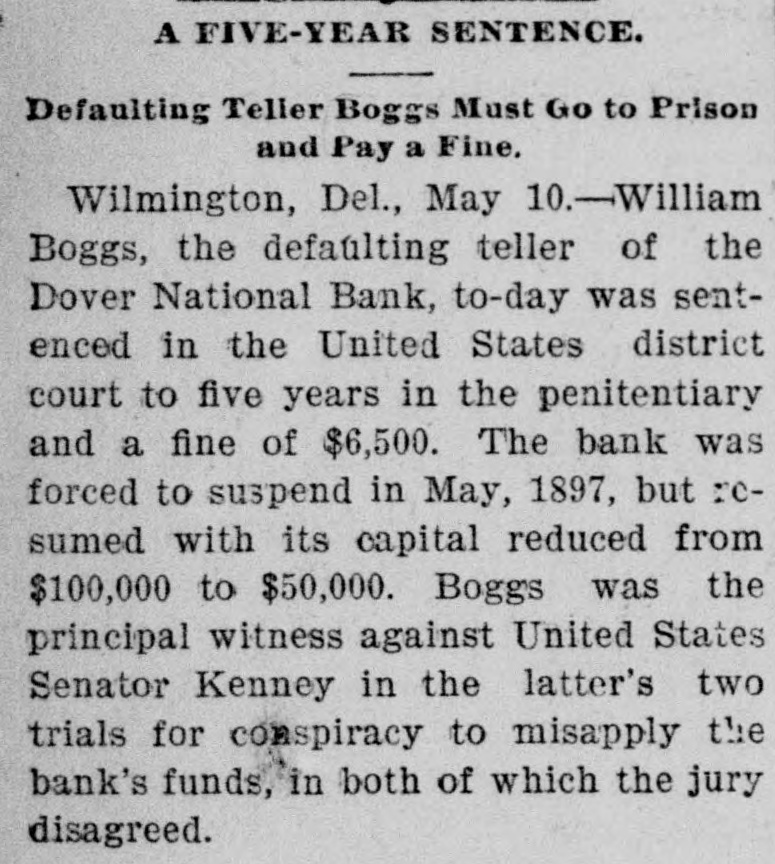
A FIVE-YEAR SENTENCE. I Defaulting Teller Boggs Must Go to Prison and Pay a Fine. Wilmington, Del., May 10.-William Boggs, the defaulting teller of the Dover National Bank, to-day was sentenced in the United States district court to five years in the penitentiary and a fine of $6,500. The bank was forced to suspend in May, 1897, but resumed with its capital reduced from $100,000 to $50,000. Boggs was the principal witness against United States Senator Kenney in the latter's two trials for conspiracy to misapply the bank's funds, in both of which the jury disagreed.


Article from The Record-Union, May 11, 1899

Click image to open full size in new tab

Article Text

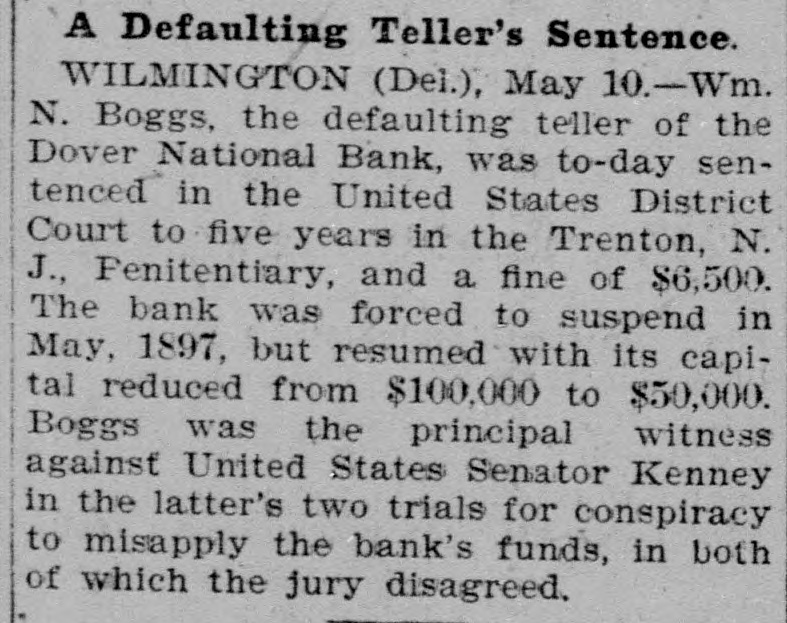
A Defaulting Teller's Sentence. WILMINGTON (Del.), May 10.-Wm. N. Boggs, the defaulting teller of the Dover National Bank, was to-day sentenced in the United States District Court to five years in the Trenton, N. J., Penitentiary, and a fine of $6,500. The bank was forced to suspend in May, 1897, but resumed with its capital reduced from $100,000 to $50,000. Boggs was the principal witness against United States Senator Kenney in the latter's two trials for conspiracy to misapply the bank's funds, in both of which the jury disagreed.


Article from Evening Journal, April 25, 1902

Click image to open full size in new tab

Article Text

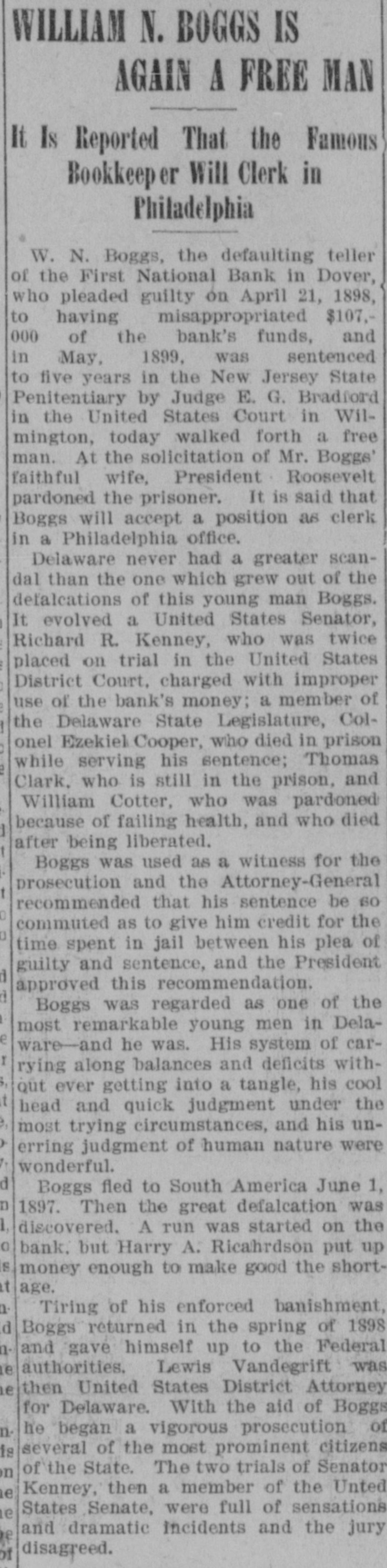
WILLIAM N. BOGGS IS AGAIN A FREE MAN It Is Reported That the Famous Bookkeeper Will Clerk in Philadelphia W. N. Boggs, the defaulting teller of the First National Bank in Dover, who pleaded guilty on April 21, 1898, to having misappropriated $107.000 of the bank's funds, and in May, 1899, was sentenced to five years in the New Jersey State Penitentiary by Judge E. G. Bradford in the United States Court in Wilmington, today walked forth a free man. At the solicitation of Mr. Boggs' faithful wife, President Roosevelt pardoned the prisoner. It is said that Boggs will accept a position as clerk in a Philadelphia office. Delaware never had a greater scandal than the one which grew out of the defalcations of this young man Boggs. It evolved a United States Senator, Richard R. Kenney, who was twice placed on trial in the United States District Court, charged with improper use of the bank's money; a member of the Delaware State Legislature, Colonel Ezekiel Cooper, who died in prison while serving his sentence; Thomas Clark, who is still in the prison, and William Cotter, who was pardoned because of failing health, and who died after being liberated. Boggs was used as a witness for the prosecution and the Attorney-General recommended that his sentence be 60 commuted as to give him credit for the time spent in jail between his plea of guilty and sentence, and the President approved this recommendation. Boggs was regarded as one of the most remarkable young men in Delaware-and he was. His system of carrying along balances and deficits withQut ever getting into a tangle, his cool head and quick judgment under the most trying circumstances, and his unerring judgment of human nature were wonderful. d Boggs fled to South America June 1, n 1897. Then the great defalcation was 1. discovered. A run was started on the 0 bank. but Harry A. Ricahrdson put up money enough to make good the shortage. Tiring of his enforced banishment, d Boggs returned in the spring of 1898 and gave himself up to the Federal e authorities. Lewis Vandegrift was e then United States District Attorney for Delaware. With the aid of Boggs he began a vigorous prosecution of several of the most prominent citizens is of the State. The two trials of Senator n Kenney, then a member of the Unted e States Senate, were full of sensations e and dramatic incidents and the jury e disagreed. of


Article from The Paducah Sun, April 25, 1902

Click image to open full size in new tab

Article Text

BOGGS IS OUT AGAIN A Man Convicted of Stealing $107,000 Released From Frison. He Served Four Years-A Political Scandal Recalled by His Home Coming. HIS WIFE HAS BEEN FAITHFUL. Dover, April 25-William N. Boggs, formerly teller of the First National bank of this city and who, in 1898, was.convicted of embezzling $107,000 of the funds of that institution, was released from the Trenton penitentiary today, and residents of Dever are awaiting with interest his return home. The sentence was for five years, but it was commuted to four by President Roosevelt. Delaware never had a greater scandal than the[one which grew out of It the defalcations of young Boggs. involves a United States senator, Richard R. Kenney, who was twice placed on trial in the United States district court, charged with improper use of the bank's money; a member of the Delaware state legislature, Colonel Ezekiel Cooper, who died in prison while serving his sentence, and several other prominent citizens. Next to Senator Kenney, Boggs was the most conspieuous figure in the scandal. Without his aid the government never could have unraveled the tangled books of the Dover bank. He was a wonder at figures. The fact that he stole more than the whole capital stock of the institution, in a very few years, right under the noses of the directors and the National bank examiner, is proof of his ability. Boggs was regarded as one of the most remarkable young men in Delaware. His system of carrying along balances and deficits without ever getting into a tangle, cool head and quick judgment under the most trying circumstances and his unerring judgment of human nature were wonderful. Deserted by the men who had profited by his violations of the law and who had helped to place him in the position of a criminal, Boggs fled to South America, June 1, 1897. Then the great defalcation was discovered. A run was started on the bank, but the Richardsons, prominent in the canning industry here, put up money enough to make good the shortage. Tiring of his enforced banishment, Boggs returned in the spring of 1898 and gave himself up to the federal authorities. With the aid of Boggs the United States district attorney began a vigorous prosecution of several of the most prominent citizens of the state. The two trials of Senator Kenney, then a member of the United States senatΓ©, were full of sensations and dramatic incidents. Upon each trial the jury in the case of Senator Kenney disagreed. During the imprisonment of Boggs his wife has resided in this city and most of her time has been devoted to efforts to bring about his release. It was she who visited the president and finally obtained a commutation of the sentence. Mrs. Boggs says that she and her husband have no definite_plans for the future but that there are several positions open to Boggs. LEAVE FOR REUNION.


Article from The Free Press, May 1, 1902

Click image to open full size in new tab

Article Text

BOGGS' PRISON TERM IS OVER THE NOTED EMBEZZLER IS RELEASED. THESCANDAL RECALLED Boggs, while a Bank Teller, Stole Notable Men Implicated. Dover, Del., April William N. Boggs, formerly teller of the First National Bank of this city and who, in 1898, was convicted of embezzling $107,000 of the funds of that institution, was released from the Trenton Penitentiary today, and residents of Dover are awaiting with interest his return home. The sentence was for five years, but it was commuted to four by President Roosevelt. Delaware never had a greater scandal than the one which grew out of the defalcations of young Boggs. It involved a United States Senator, Richard R. Kenney, who was twice placed on trial in the United States District Court, charged with improper use of the bank's money; a member of the Delaware state legislature, Colonel Ezekiel Cooper, who diad in prison while serving his sentence, and several other prominent citizens. Next to Senator Kenney Boggs was the most conspicuous figure in the scandal. Without his aid the governor never could have unraveled the tangled books of the Dover bank. He was a wonder at figures. The fact that he stole more than the whole capital stock of the institution, in a very few years, right under the noses of the directors and the National Bank Examiner, is proof of his ability. Boggs was regarded as one of the most remarkable young men in Delaware. His system of carrying along balances and deficits without ever getting into a tangle, his cool head and quick judgment under the most trying circumstances. and his unerring judgment of human nature were wonderful. Deserted by the men who had profited by his violations of the law and who had helped to place him in the position of a criminal, Boggs fled to South American June 1, 1897. Then the great defalcation was discoveerd. A run was started on the bank, but the Richardsons, prominent in the canning industry here, put up money enough to make good the shortage. Tiring of his enforced banishment, Boggs returned in the spring of 1898 and gave himself up to the Federal authorities. With the aid of Boggs the United States District Attorney began a vigorous prosecution of several of the most prominent citizens of the state. The two trials of Senator Kenney, then a member of the United States Senate, were full of sensations and dramatic incidents. Upon each tiral the jury in the case of Senator Kenney disgreed. During the imprisonment of Boggs his wife has resided in this city and most of her time has been devoted to efforts to bring abot his release. It was she who visited the President and finally obtained a commutation of the sentence. Mrs. Boggs says that she and her husband have no definite plans for the future, but that there are several positions open to Boggs.