15626. Citizens Savings Bank (New York, NY)

Bank Information

Episode Type
Run Only
Bank Type
savings bank
Start Date
August 1, 1893
Location
New York, New York (40.714, -74.006)

Metadata

Model
gpt-5-mini
Short Digest
bd2ef4cf

Response Measures

None

Description

Newspapers (Aug 1, 1893) describe a depositor panic and heavy withdrawals at Citizens Savings Bank (58 Bowery). Directors enforced the 30/60-day notice rule and paid small amounts; the bank remained open and paid out funds. No suspension or closure is mentioned.

Events (1)

1. August 1, 1893 Run
Cause
Rumor Or Misinformation
Cause Details
Panic among less-informed depositors spread by gossip/clubs/churches and holiday chatter leading crowds to check on their savings; banks posted 30/60-day notice to deter runs.
Measures
Enforced thirty- and sixty-day notice rules; paid sums under specified small limits (e.g., up to $100) and made exceptions for demonstrated necessity; paid mostly in gold.
Newspaper Excerpt
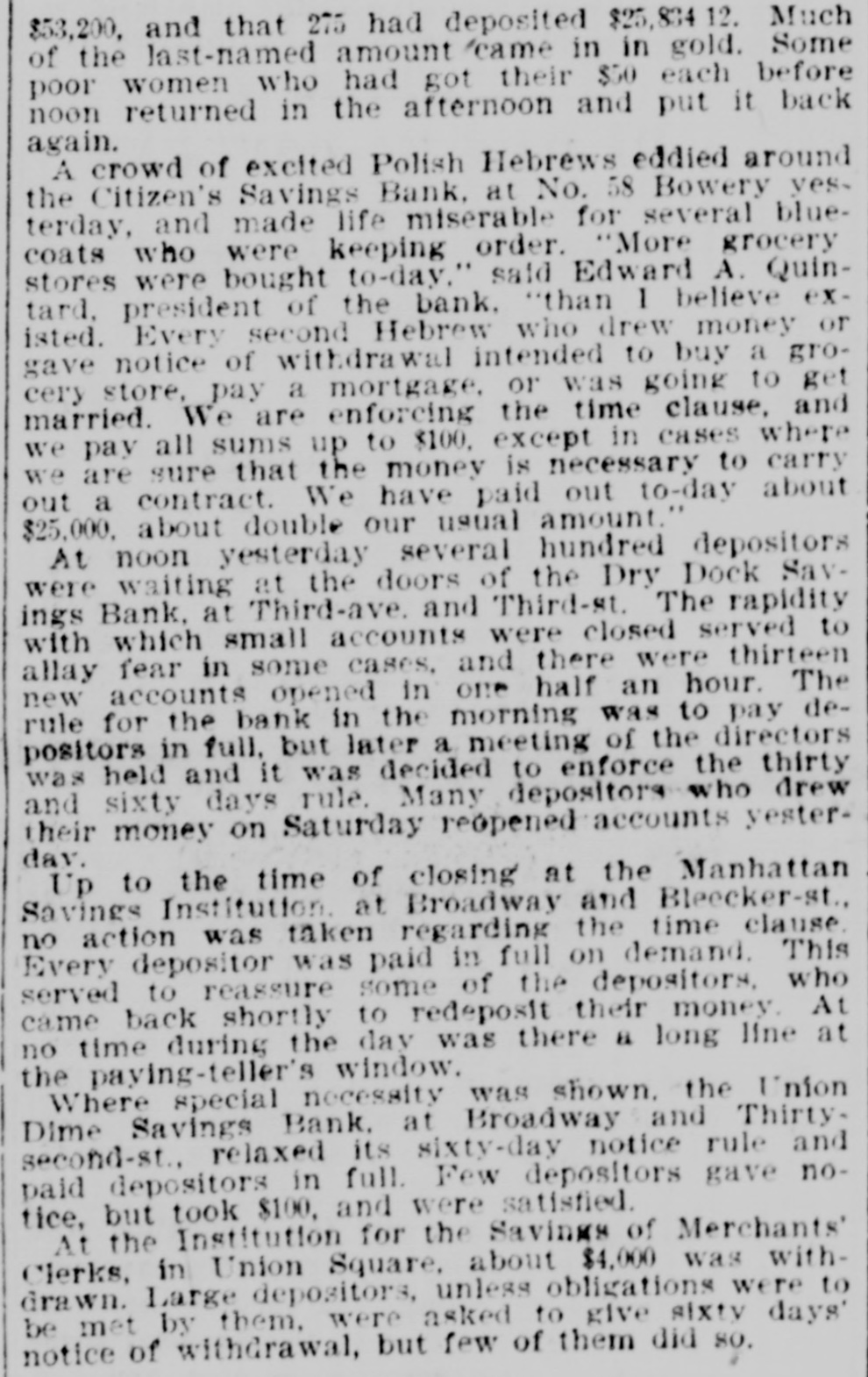
A crowd of excited Polish Hebrews eddied around the Citizen's Savings Bank, at No. 58 Bowery yesterday... We are enforcing the time clause, and we pay all sums up to $100, except in cases where we are sure that the money is necessary to carry out a contract. We have paid out to-day about $25,000.
Source
newspapers

Newspaper Articles (2)

Article from New-York Tribune, August 1, 1893

Click image to open full size in new tab

Article Text

$53,200, and that 275 had deposited $25,834.12. Much of the last-named amount came in in gold. Some poor women who had got their $50 each before noon returned in the afternoon and put it back again. A crowd of excited Polish Hebrews eddied around the Citizen's Savings Bank, at No. 58 Bowery yesterday, and made life miserable for several bluecoats who were keeping order. "More grocery stores were bought to-day," said Edward A. Quintard, president of the bank. "than 1 believe existed. Every second Hebrew who drew money or gave notice of withdrawal intended to buy a grocery store, pay a mortgage, or was going to get married. We are enforcing the time clause, and we pay all sums up to $100, except in cases where we are sure that the money is necessary to carry out a contract. We have paid out to-day about $25,000. about double our usual amount." At noon yesterday several hundred depositors were waiting at the doors of the Dry Dock Savings Bank, at Third-ave. and Third-st. The rapidity with which small accounts were closed served to allay fear in some cases, and there were thirteen new accounts opened in one half an hour. The rule for the bank in the morning was to pay depositors in full, but later a meeting of the directors was held and it was decided to enforce the thirty and sixty days rule. Many depositors who drew their money on Saturday reopened accounts yesterday. Up to the time of closing at the Manhattan Savings Institution. at Broadway and Bleecker-st., no action was taken regarding the time clause. Every depositor was paid in full on demand. This served to reassure some of the depositors, who came back shortly to redeposit their money. At no time during the day was there a long line at the paying-teller's window. Where special necessity was shown. the Union Dime Savings Bank. at Broadway and Thirtysecond-st., relaxed its sixty-day notice rule and paid depositors in full. Few depositors gave notice, but took $100, and were satisfied. At the Institution for the Savings of Merchants' Clerks, in Union Square, about $4,000 was withdrawn. Large depositors, unless obligations were to be met by them. were asked to give sixty days' notice of withdrawal, but few of them did so.


Article from The Sun, August 1, 1893

Click image to open full size in new tab

Article Text

PLENTY OF MONEY ON HAND. SAVINGS BANKS FIND THAT THERE'S HONK ION SCHRE General Enforcement of the Time Rule Ex. cept Where Money Was Actually Needed -The Poorest People Flocked to Their Banks, Which Are the Richest, and Drew the Limit-Plenty Who Came to Deposit, Not to Draw-Payments Chiefly In Gold. At second and third hand. in their clubs. churches. and other meeting places. in the gossip of the Sunday holiday. the less-informed classes of savings bank depositors had heard that something or other was up at the savings banks where their money was, and they took their bank books early yesterday morning and went around to see about it. What was up. as the newspaper readers knew. was that the banks proposed to check any ate tempt at a run by posting the sixty-day notice rule. The rule was applied whenever circumisou U 91 1I # ериш standed tive discourager of runs. and it did its work. Only one of the larger savings banks failed to post the rule. That was the Bank for Savings in Bleecker street. There had been no meeting of the trustees. and as President Trimble had plenty of cash he did not act. It is possible that a notice will be nosted there to-day. Several of the banks with deposits of less than ten millions did not post notices because the demand on them for money was notso great. Their depositors are.as a rule. of a class that is not ignorantly frightened. In New York city, with one exception. the biggest savings banks are those resorted to by the poorest people. These banks of the poor are the Bleecker Street. the Bowery. the Citizens'. the Emigrant Industrial. and the German. They have more of the and -steins than any others, and they naturally drew a crowd yesterday. At the German bank. at the corner of Fourteenth street and Fourth avenue. two hundred people were pushing and mauling each other for places nearest the door before the door opened. There was just as big a crowd at the Bleecker Street Bank. At the Bowery. the Citizens'. and the Emigrants the crowd was smaller. but was just as noisy. Of course, when the doors of those banks were opened line up places the 103 07 usns PIIM B SUM there for the paying tellers' windows. In a dozen places on the walls of the Emigrants' bank the following notice was posted: As provided by Chapter XVII. article 8, of the laws, -us our 10 notice sawp require IIIM queq #141 euo suins IIV JO pepues no фриш eq IIIM ROOM have ;unome 1841 01 B1 prud eq IIIM 001$ Suppesere uns ou puw "puetned each calendar month until further notice. The half-dozen watchmen who assisted in forming the crowd in line pointed out these notices. Some of those in the crowd who didn't want $50, put their books in their pockets and went home. Not more than one in a hundred left notice that be wanted his money when the time was up. A great many wailed. because they were born wallers. Up to 2 o'clock the Citizens' bank had recelved only thirty notices of withdrawal. The notice there was that sums under $100 would a thirty that pue рившер uo plud 0q would be required for the withdrawal of larger accounts. The notice at the Bowery bank permitted the withdrawal of sums under $300 on demand and required sixty days' notice on larger amounts. The crowd at these banks remained until 4 o'clock. It did not increase. and depositors got their money at the rate of about four a minute. At the Bleecker Street Bank and the German Bank the crowd extended out into the street all day. Competitors for place jostled each other 80 much that policemen were called W.JO.A eqf орвш pun Sujuend euror "up of paying slow. and they probably didn't average more than one in three minutes. The German Bank required sixty days' notice on '001$ JOAO suins The banks paid mostly in gold. with a little silver, small currency being scarce. The offiup perjun personsible baueq the 10 IIB 10 $100 saying that as a run the flurry was a complete failure. The President of the Dry Dock Bank said: eye "OM7 10 Aup B up 10A0 eq sterly IIIA 9I.. signs are that it is breaking already. There isn't even the possibility that any of the banks will use half of the cash it has ready.' President Trimble of the Bleecker Street Bank said: All the banks are in an excellent condition and can stand this sort of thing a long while. The notice demanded by some of the banks operates for the protection of the foolish depositor. and he needs it. People who object to this notice should remember that it is not possible for the banks to take money and invest it in order to make interest for them, and then to realize on the inand 91 seuon rection s quemous B qu Asstriet into savings banks to be saved and to earn more money The savings bank depositor must have his money locked up just as the business man has who invests his money. There is this difference. that the money of the savings bank depositor is absolutely safe. Thelaw fixes the nature of the investment." At the several banks where notice of withdrawal was required exceptions were madein show could OUM deposites 10 este the -ind offects AUB JOJ Aeuour our popeou they they " bardship V osiepun pinom pus 'esod did not get it. In two instances THE SUN repue 009'1$ another up pred $2.000 MUS Jersod our 1021 OUM ueur 140 $1.200 another up money brought with them the proof that it was required for immediate use. They were paid -sodep SUM Aeuou 10 [vep quest V check 4q "яморијм 10 108 euo 38 Aup our pepp while the timid were crushing each other at up 000'91$ recorded rusq euo new other the deposits before noon. On an average nearly products Aupuom JO sunows Jensn the was received The Greenwich Savings Bank. Sixth avenue and Sixteenth street, put up the sixty day notice. and most of the depositors who had come TEAM The AQUOU there no Map 01 em 18 line the affernoon the uI notice BUILD pus 1098 pus 1 MOLD MODUIM Pupied when the bank closed there were hardly more wodn there puno; eq 01 OJW than # up epiood any afternoon. President J. Harsen Rhoades said to a reporter: ply We for are depositors the want to enforcing purpose of the withdraw looking their it sixty-day up. rule money sim- Where where OM 1 10 001$ no aver 01 THAT SUSM Zeqz new 1 them 01 11 9A12 discritton uno esn 9M sums