Article Text
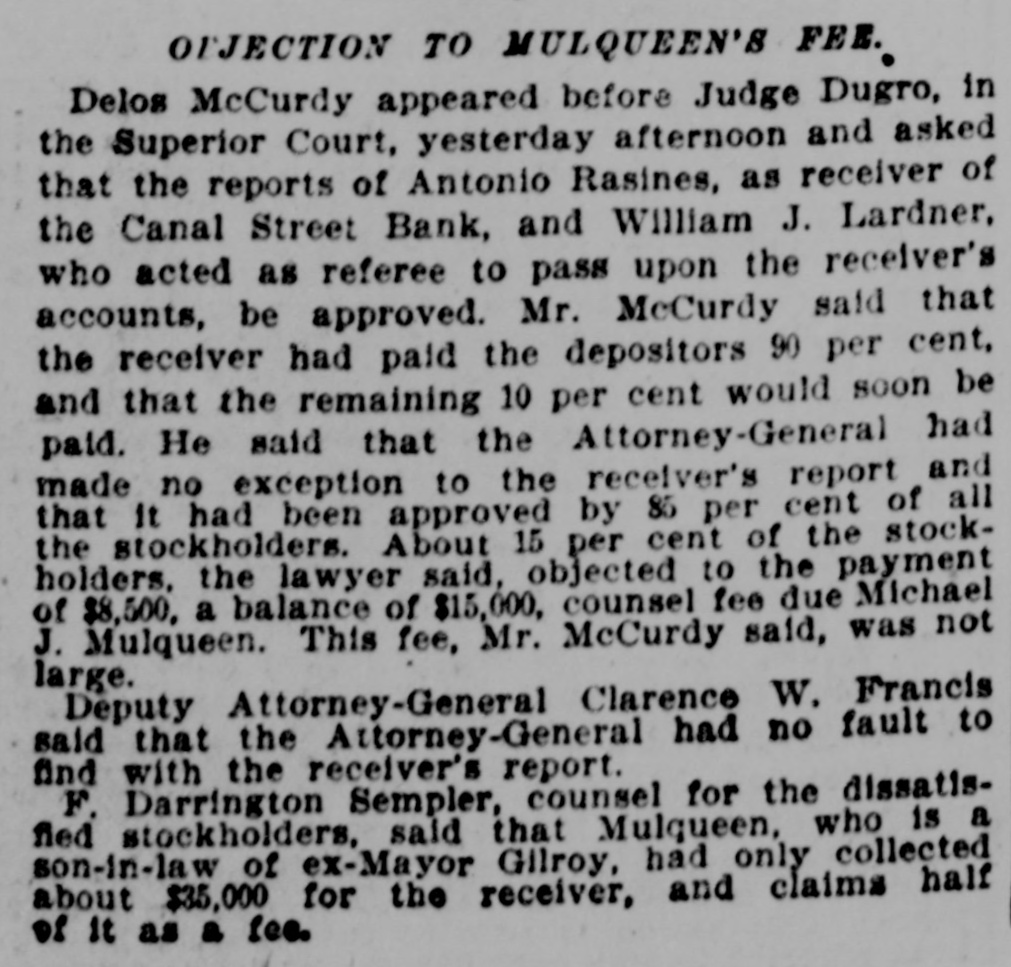
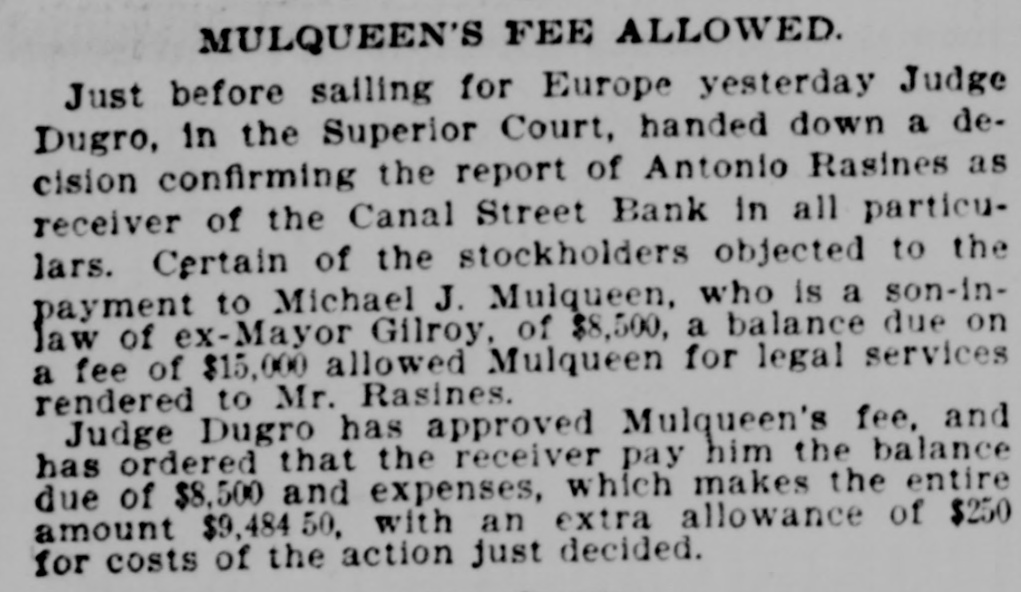
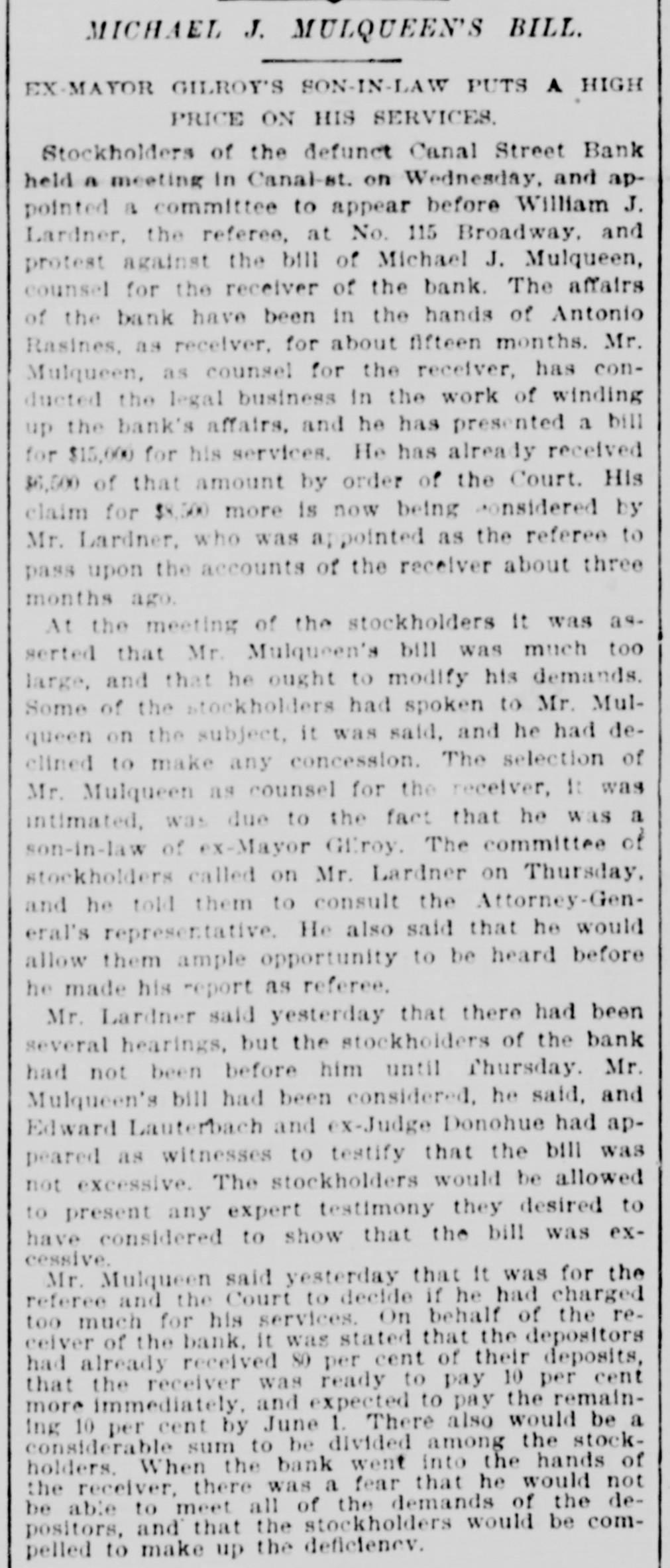
MICHAEL J. MULQUEEN'S BILL. EX-MAYOR GILROY'S SON-IN-LAW PUTS A HIGH PRICE ON HIS SERVICES. Stockholders of the defunct Canal Street Bank held a meeting In Canal-st. on Wednesday, and appointed a committee to appear before William J. Lardner, the referee, at No. 115 Broadway, and protest against the bill of Michael J. Mulqueen, counsel for the receiver of the bank. The affairs of the bank have been in the hands of Antonio Rasines, as receiver, for about fifteen months. Mr. Mulqueen, as counsel for the receiver, has conducted the legal business in the work of winding up the bank's affairs, and he has presented a bill for $15,000 for his services. He has already received $6,500 of that amount by order of the Court. His claim for $8,500 more is now being considered by Mr. Lardner, who was appointed as the referee to pass upon the accounts of the receiver about three months ago. At the meeting of the stockholders it was asserted that Mr. Mulqueen's bill was much too large, and that he ought to modify his demands. Some of the stockholders had spoken to Mr. Mulqueen on the subject, it was said, and he had declined to make any concession. The selection of Mr. Mulqueen as counsel for the receiver, It was intimated, was due to the fact that he was a son-in-law of ex-Mayor Giroy. The committee of stockholders called on Mr. Lardner on Thursday, and he told them to consult the Attorney-General's representative. He also said that he would allow them ample opportunity to be heard before he made his report as referee. Mr. Lardner said yesterday that there had been several hearings, but the stockholders of the bank had not been before him until Thursday. Mr. Mulqueen's bill had been considered, he said, and Edward Lauterbach and ex-Judge Donohue had appeared as witnesses to testify that the bill was not excessive. The stockholders would be allowed to present any expert testimony they desired to have considered to show that the bill was excessive. Mr. Mulqueen said yesterday that It was for the referee and the Court to decide if he had charged too much for his services. On behalf of the recelver of the bank. It was stated that the depositors had already received 80 per cent of their deposits, that the receiver was ready to pay 10 per cent more immediately. and expected to pay the remainIng 10 per cent by June 1. There also would be a considerable sum to be divided among the stockholders. When the bank went into the hands of the receiver, there was a fear that he would not be able to meet all of the demands of the depositors, and that the stockholders would be compelled to make up the deficiency.