Articles indicate the State National Bank of Ardmore closed in February 1922 and was placed in receivership by the Comptroller of the Currency. Multiple receivers were appointed, suits were filed to collect loans, and the bank remained defunct (liquidation and dividend payments to depositors continued). There is no mention of a depositor run prior to suspension in the articles, so this is a suspension leading to permanent closure under receiver control.
Events (9)
1.May 17, 1913Chartered
Source
historical_nic
2.February 1, 1922*Suspension
Cause
Government Action
Cause Details
Closed early in 1922 and placed in receivership by the Comptroller of the Currency; receiver appointed to wind up affairs.
Newspaper Excerpt
the bank closed its doors in February. 1922
Source
newspapers
3.March 4, 1922Receivership
Source
historical_nic
4.March 6, 1922Receivership
Newspaper Excerpt
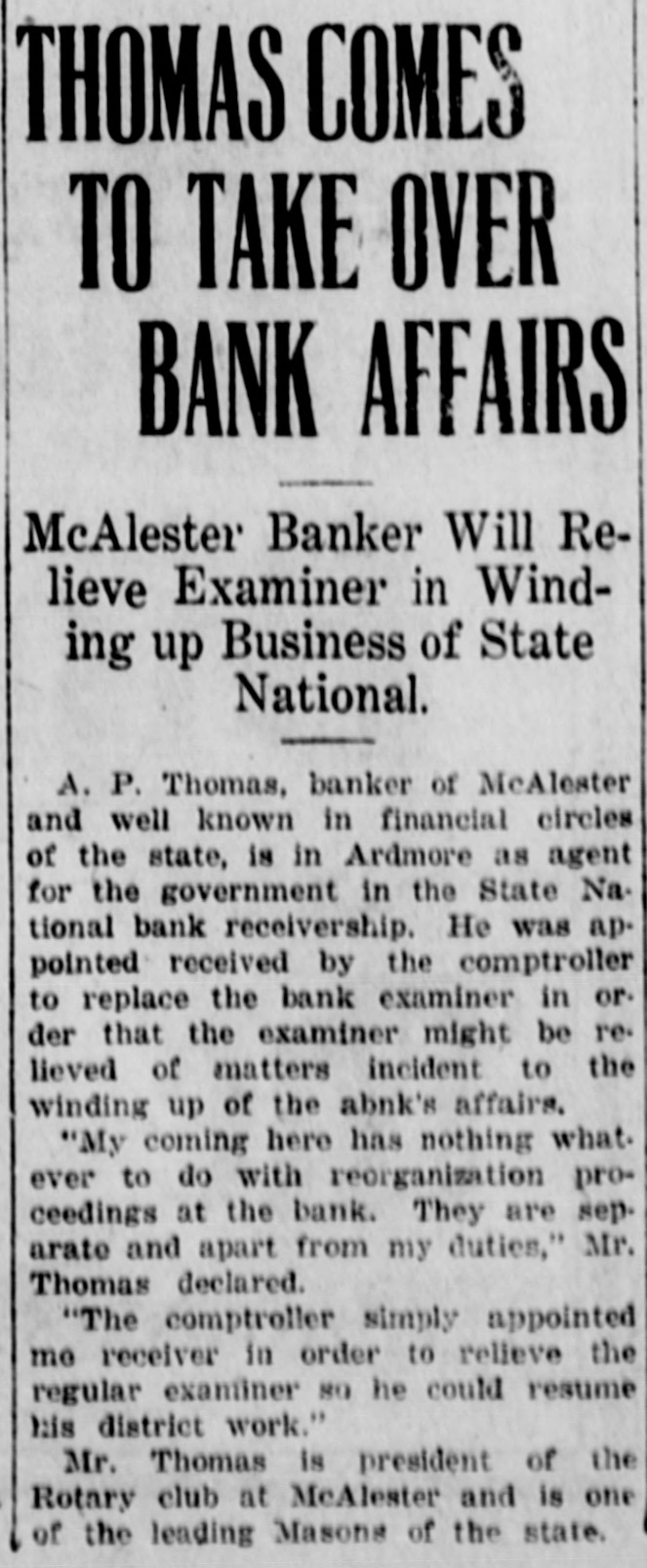
A. P. Thomas...is in Ardmore as agent for the government in the State National bank receivership. He was appointed receiver by the comptroller to replace the bank examiner in order that the examiner might be relieved of matters incident to the winding up of the bank's affairs.
Source
newspapers
5.March 17, 1922Receivership
Newspaper Excerpt
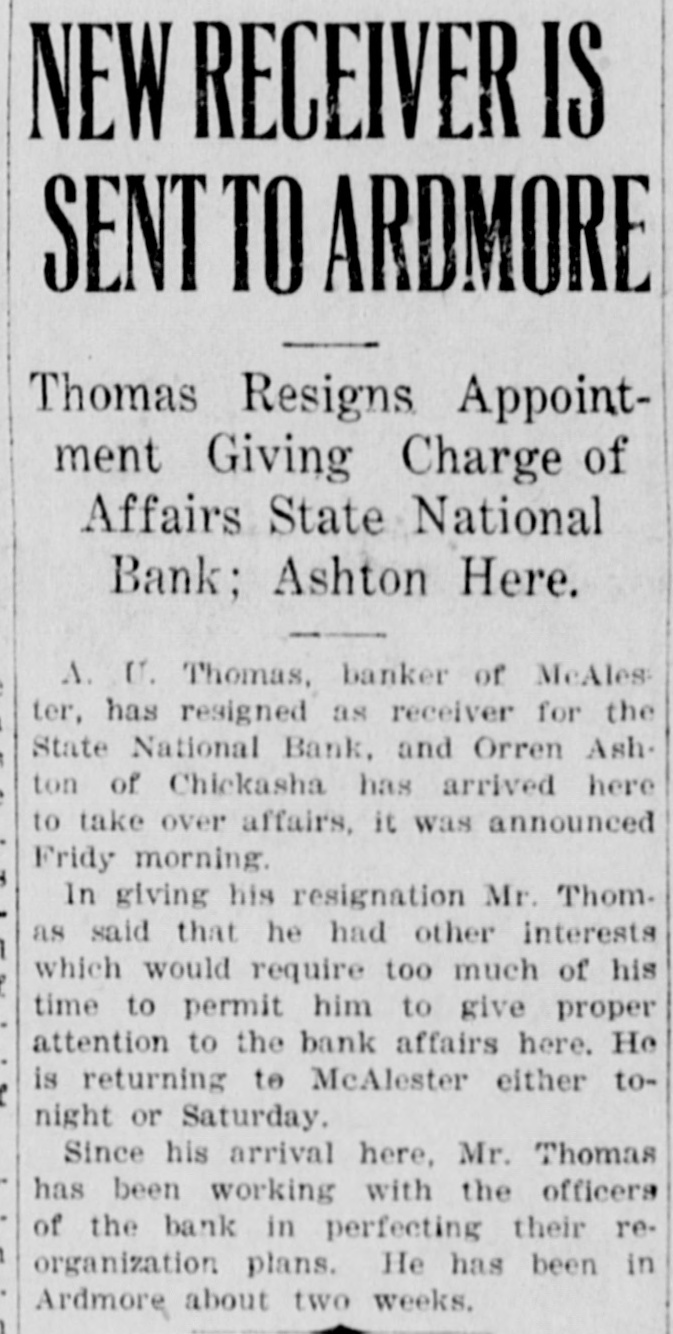
A. U. Thomas...has resigned as receiver for the State National Bank, and Orren Ashton of Chickasha has arrived here to take over affairs.
Source
newspapers
6.April 30, 1922Receivership
Newspaper Excerpt
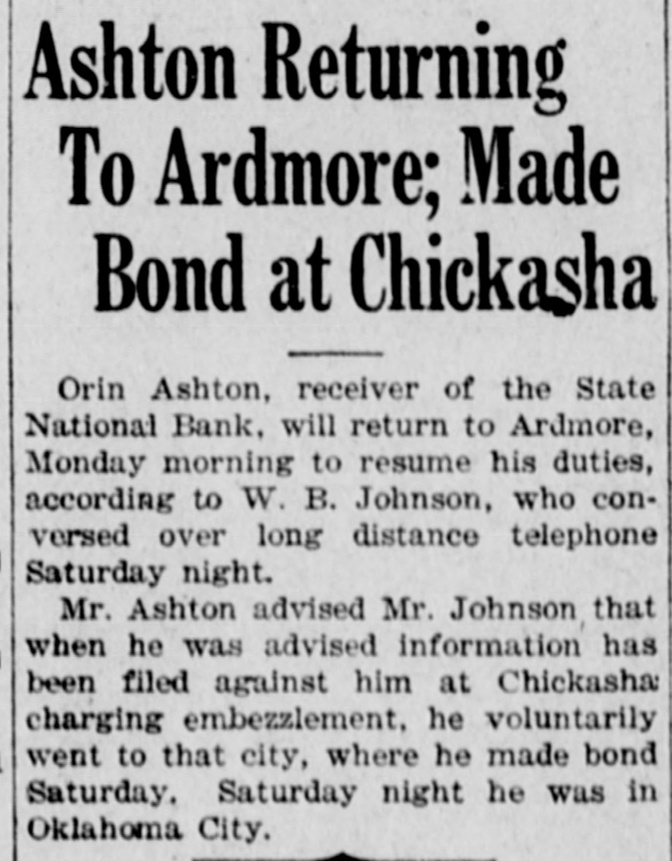
Orin Ashton, receiver of the State National Bank, will return to Ardmore...when he was advised information has been filed against him at Chickasha charging embezzlement, he voluntarily went to that city, where he made bond Saturday.
Source
newspapers
7.July 21, 1922Other
Newspaper Excerpt
Notice is hereby given to all persons who may have claims against The State National Bank of Ardmore, Okla that the same must be presented to B. Ulrich, receiver with the legal proof thereof, within three months from this date, or they may be disallowed.
Source
newspapers
8.December 27, 1922Other
Newspaper Excerpt
Proposition Submitted By Wallace...depositors believed that the bank would reopen if the matter can be legally sanctioned (discussion of reorganization), but this was a depositor effort and not an actual reopening.
Source
newspapers
9.March 19, 1925Other
Newspaper Excerpt
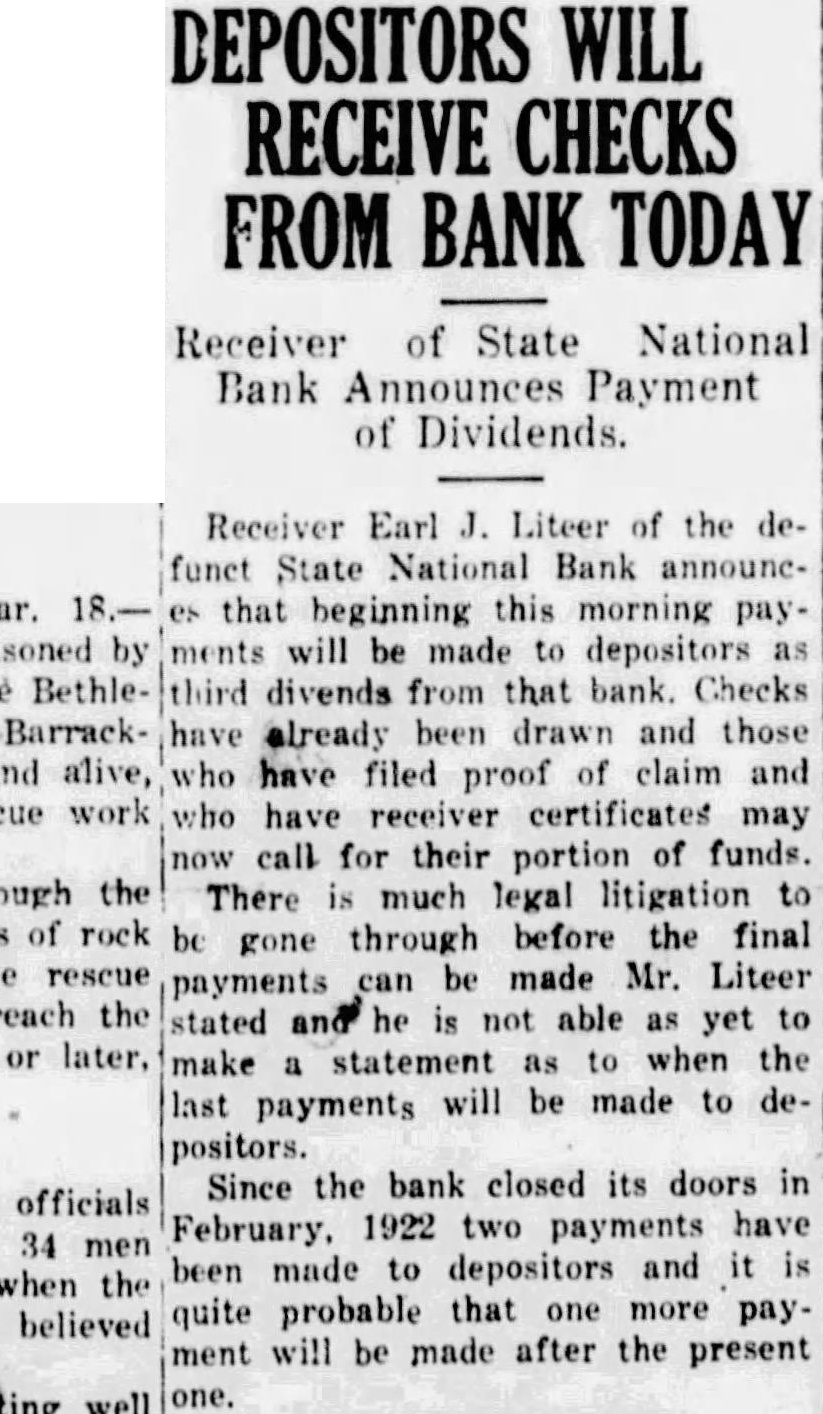
Receiver of State National Bank Announces Payment of Dividends...Since the bank closed its doors in February 1922 two payments have been made to depositors and it is quite probable that one more payment will be made after the present one.
Source
newspapers
Newspaper Articles (16)
1.March 6, 1922The Daily ArdmoreiteArdmore, OK
Click image to open full size in new tab
Article Text
THOMAS COMES TO TAKE OVER BANK AFFAIRS McAlester Banker Will Relieve Examiner in Winding up Business of State National. A. P. Thomas, banker of McAlester and well known in financial circles of the state, is in Ardmore as agent for the government in the State Na. tional bank receivership. He was appointed received by the comptroller to replace the bank examiner in order that the examiner might be relieved of matters incident to the winding up of the abnk's affairs. "My coming here has nothing what. ever to do with reorganization proceedings at the bank. They are sep. arate and apart from my duties," Mr. Thomas declared. "The comptroller simply appointed me receiver in order to relieve the regular examiner 80 he could resume his district work." Mr. Thomas is president of the Rotary club at McAlester and is one of the leading Masons of the state.
2.March 17, 1922The Daily ArdmoreiteArdmore, OK
Click image to open full size in new tab
Article Text
NEW RECEIVER IS SENT TO ARDMORE Thomas Resigns Appointment Giving Charge of Affairs State National Bank; Ashton Here. A. U. Thomas, banker of McAles ter, has resigned as receiver for the State National Bank, and Orren Ashton of Chickasha has arrived here to take over affairs, it was announced Fridy morning. In giving his resignation Mr. Thom. as said that he had other interests which would require too much of his time to permit him to give proper attention to the bank affairs here. He is returning to McAlester either tonight or Saturday. Since his arrival here, Mr. Thomas has been working with the officers of the bank in perfecting their reorganization plans. He has been in Ardmore about two weeks.
3.April 30, 1922The Daily ArdmoreiteArdmore, OK
Click image to open full size in new tab
Article Text
Ashton Returning To Ardmore; Made Bond at Chickasha Orin Ashton, receiver of the State National Bank, will return to Ardmore, Monday morning to resume his duties, according to W. B. Johnson, who conversed over long distance telephone Saturday night. Mr. Ashton advised Mr. Johnson that when he was advised information has been filed against him at Chickasha charging embezzlement, he voluntarily went to that city, where he made bond Saturday. Saturday night he was in Oklahoma City.
4.July 6, 1922The Daily ArdmoreiteArdmore, OK
Click image to open full size in new tab
Article Text
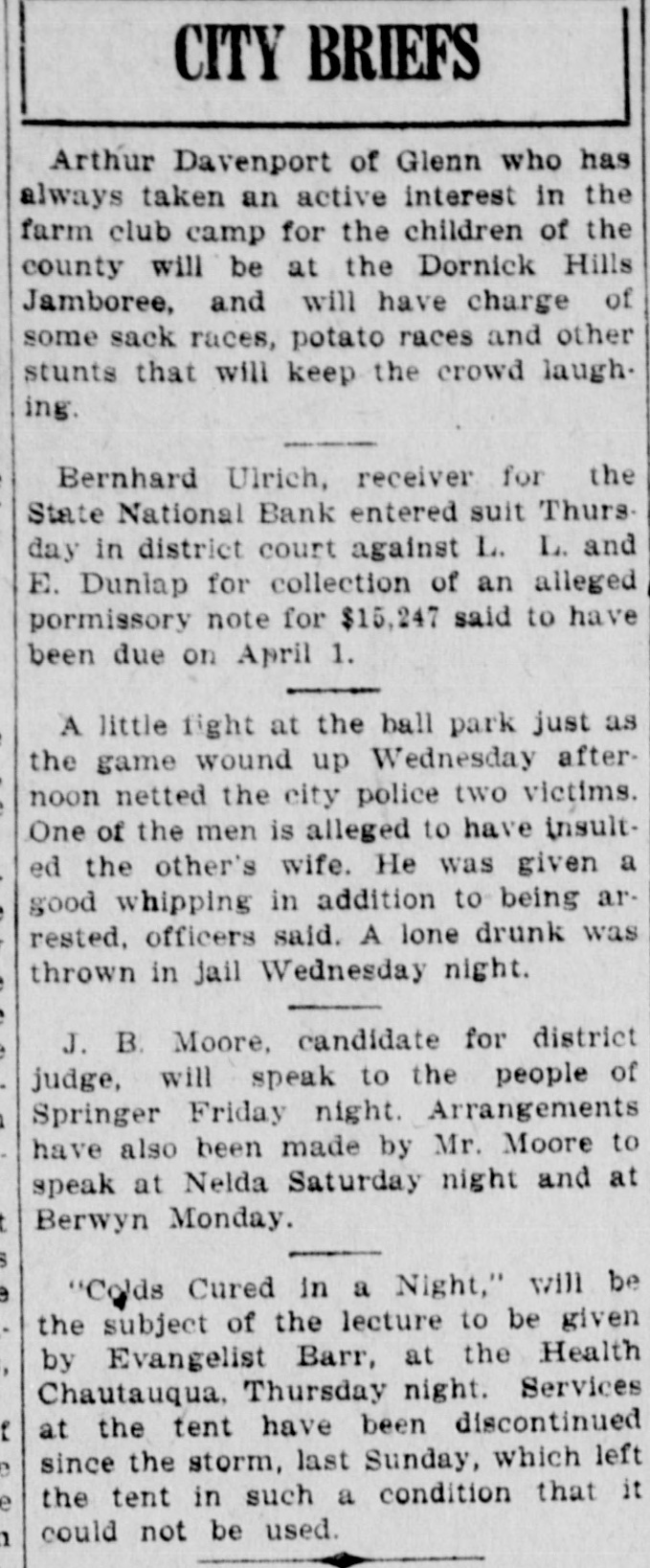
# CITY BRIEFS
Arthur Davenport of Glenn who has always taken an active interest in the farm club camp for the children of the county will be at the Dornick Hills Jamboree, and will have charge of some sack races, potato races and other stunts that will keep the crowd laughing.
Bernhard Ulrich, receiver for the State National Bank entered suit Thursday in district court against L. L. and E. Dunlap for collection of an alleged pormissory note for $15,247 said to have been due on April 1.
A little fight at the ball park just as the game wound up Wednesday afternoon netted the city police two victims. One of the men is alleged to have insulted the other's wife. He was given a good whipping in addition to being arrested, officers said. A lone drunk was thrown in jail Wednesday night.
J. B. Moore, candidate for district judge, will speak to the people of Springer Friday night. Arrangements have also been made by Mr. Moore to speak at Nelda Saturday night and at Berwyn Monday.
"Colds Cured in a Night," will be the subject of the lecture to be given by Evangelist Barr, at the Health Chautauqua, Thursday night. Services at the tent have been discontinued since the storm, last Sunday, which left the tent in such a condition that it could not be used.
5.July 13, 1922The Daily ArdmoreiteArdmore, OK
Click image to open full size in new tab
Article Text
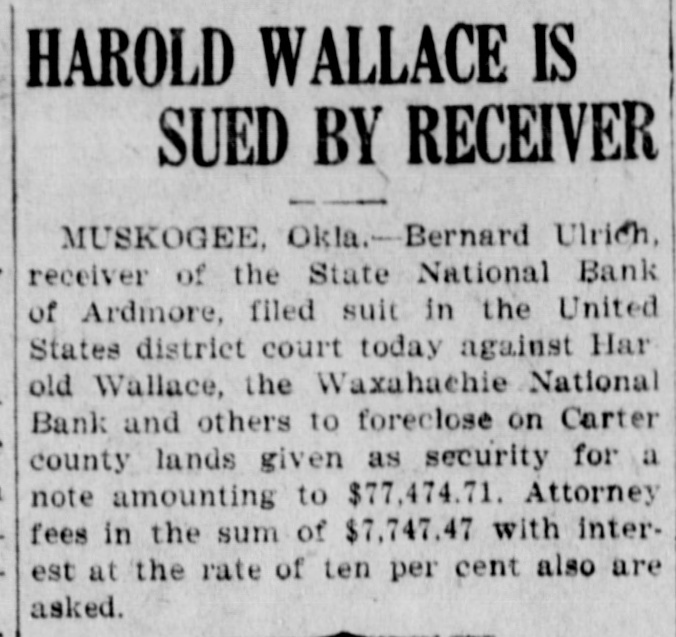
HAROLD WALLACE IS SUED BY RECEIVER MUSKOGEE, Okla.-Bernard Ulrich, receiver of the State National Bank of Ardmore, filed suit in the United States district court today against Har old Wallace, the Waxahachie National Bank and others to foreclose on Carter county lands given as security for a note amounting to $77,474.71. Attorney fees in the sum of $7,747.47 with interest at the rate of ten per cent also are asked.
6.July 18, 1922The Daily ArdmoreiteArdmore, OK
Click image to open full size in new tab
Article Text
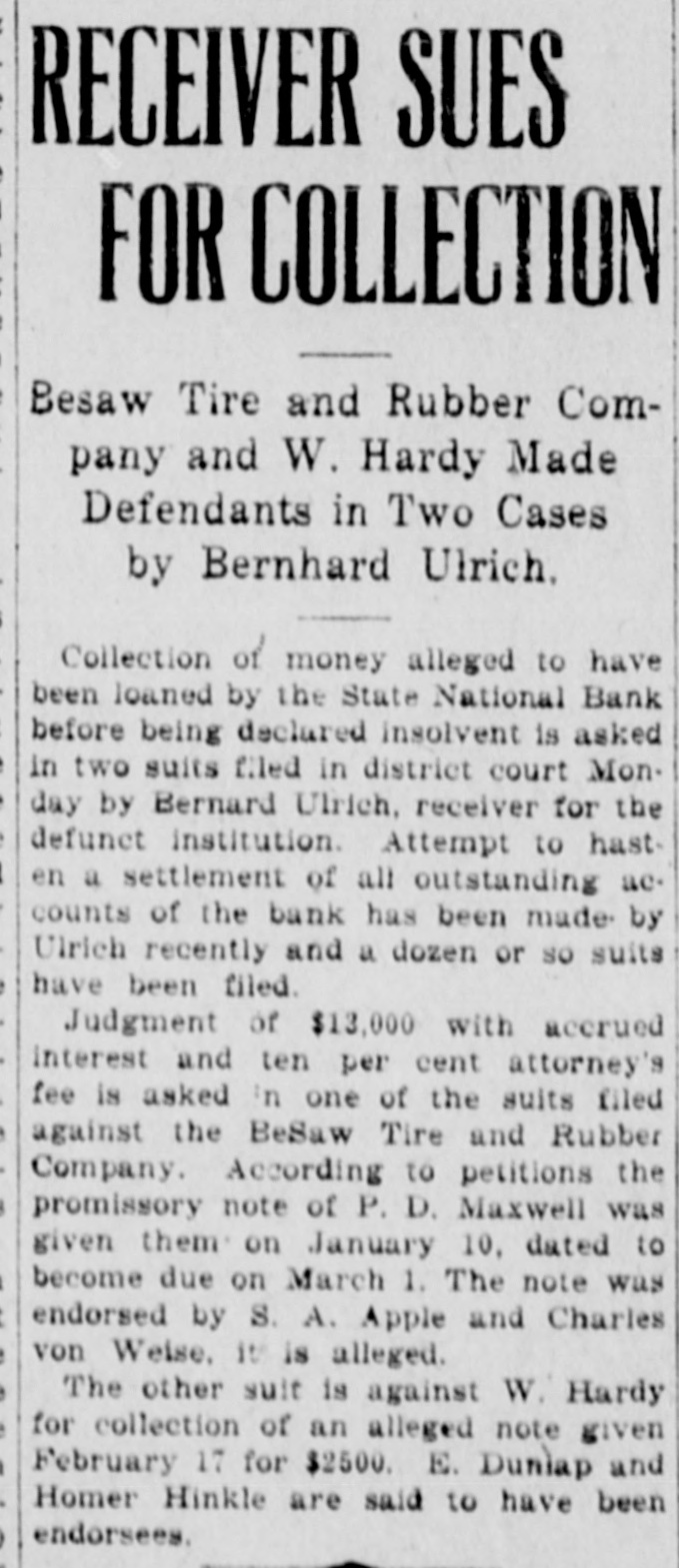
RECEIVER SUES FOR COLLECTION Besaw Tire and Rubber Company and W. Hardy Made Defendants in Two Cases by Bernhard Ulrich. Collection of money alleged to have been loaned by the State National Bank before being declared insolvent is asked in two suits filed in district court Mon. day by Bernard Ulrich, receiver for the defunct institution Attempt to hasten a settlement of all outstanding accounts of the bank has been made by Ulrich recently and a dozen or so suits have been filed. Judgment of $13,000 with accrued interest and ten per cent attorney's fee is asked in one of the suits filed against the BeSaw Tire and Rubber Company. According to petitions the promissory note of P. D. Maxwell was given them on January 10. dated to become due on March 1. The note was endorsed by S. A. Apple and Charles von Weise, it is alleged. The other suit is against W. Hardy for collection of an alleged note given February 17 for $2500. E. Duniap and Homer Hinkle are said to have been endorsees.
7.July 21, 1922The Daily ArdmoreiteArdmore, OK
Click image to open full size in new tab
Article Text
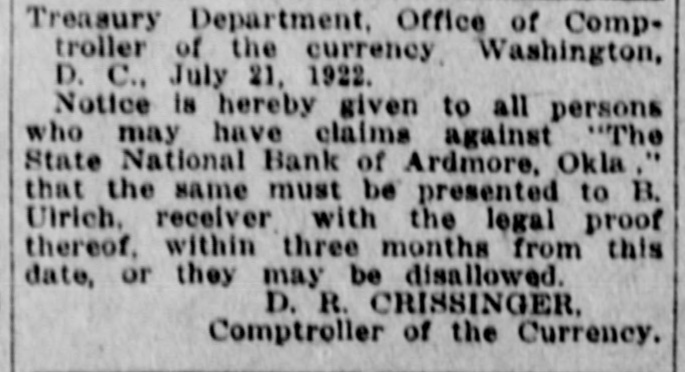
Treasury Department, Office of Comptroller of the currency Washington, D. C., July 21, 1922. Notice is hereby given to all persons who may have claims against "The State National Bank of Ardmore, Okla that the same must be presented to B. Uirich, receiver with the legal proof thereof, within three months from this date, or they may be disallowed. D. R. CRISSINGER, Comptroller of the Currency.
8.July 28, 1922The Daily ArdmoreiteArdmore, OK
Click image to open full size in new tab
Article Text
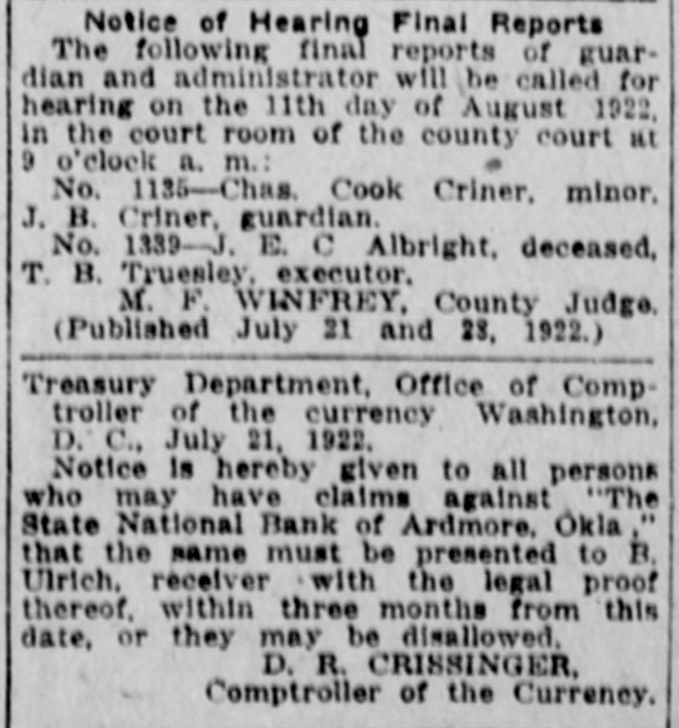
Notice of Hearing Final Reports The following final reports of guardian and administrator will be called for hearing on the 11th day of August 1922, in the court room of the county court at 9 o'clock a, m.: No. 1135-Chas. Cook Criner, minor. J. B. Criner, guardian. No. 1339-J. E. C Albright, deceased, T. B. Truesley, executor. M. F. WINFREY, County Judge. (Published July 21 and 28, 1922.) Treasury Department, Office of Comptroller of the currency Washington, D. C., July 21, 1922. Notice is hereby given to all persons who may have claims against "The State National Bank of Ardmore, Okla that the same must be presented to B. Ulrich, receiver with the legal proof thereof, within three months from this date, or they may be disallowed. D. R. CRISSINGER, Comptroller of the Currency.
9.August 2, 1922The Daily ArdmoreiteArdmore, OK
Click image to open full size in new tab
Article Text
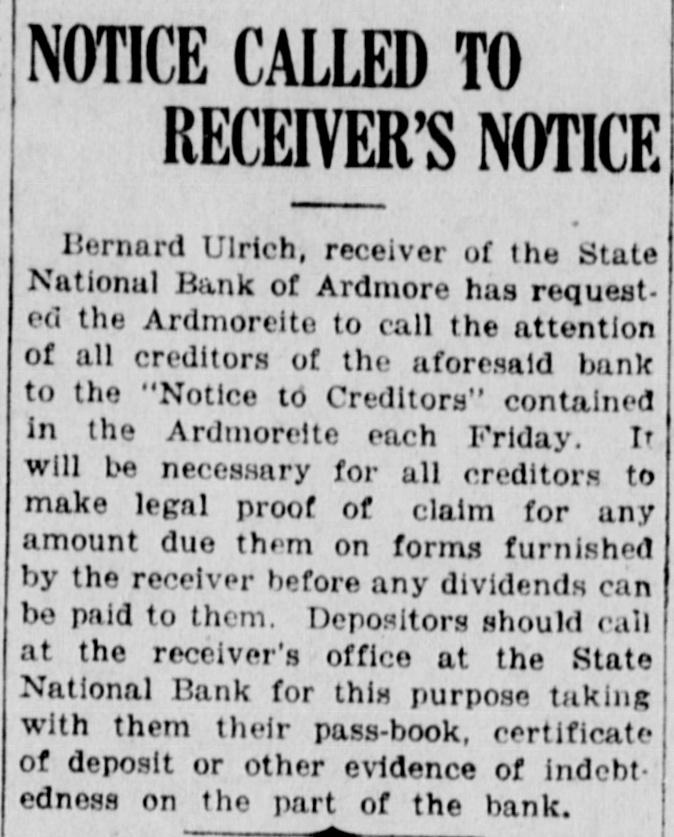
NOTICE CALLED TO RECEIVER'S NOTICE Bernard Ulrich, receiver of the State National Bank of Ardmore has requested the Ardmoreite to call the attention of all creditors of the aforesaid bank to the "Notice to Creditors" contained in the Ardmoreite each Friday. It will be necessary for all creditors to make legal proof of claim for any amount due them on forms furnished by the receiver before any dividends can be paid to them. Depositors should call at the receiver's office at the State National Bank for this purpose taking with them their pass-book, certificate of deposit or other evidence of indebtedness on the part of the bank.
10.September 13, 1922The Guthrie Daily LeaderGuthrie, OK
Click image to open full size in new tab
Article Text
ARDMORE BANKER IS DECLARED A BANKRUPT (By The Associated Press) Ardmore, Okla., Sept. 13.-Harold Wallace, eashier of the defunct State National bank. was declared bankrupt and Hugh L Sturm. prominent oil operator, was named receiver by Judge R. McMilian. referee in bankruptey, acting on authority from federal judge Williams, who is out of the district.
11.September 15, 1922The Daily ArdmoreiteArdmore, OK
Click image to open full size in new tab
Article Text
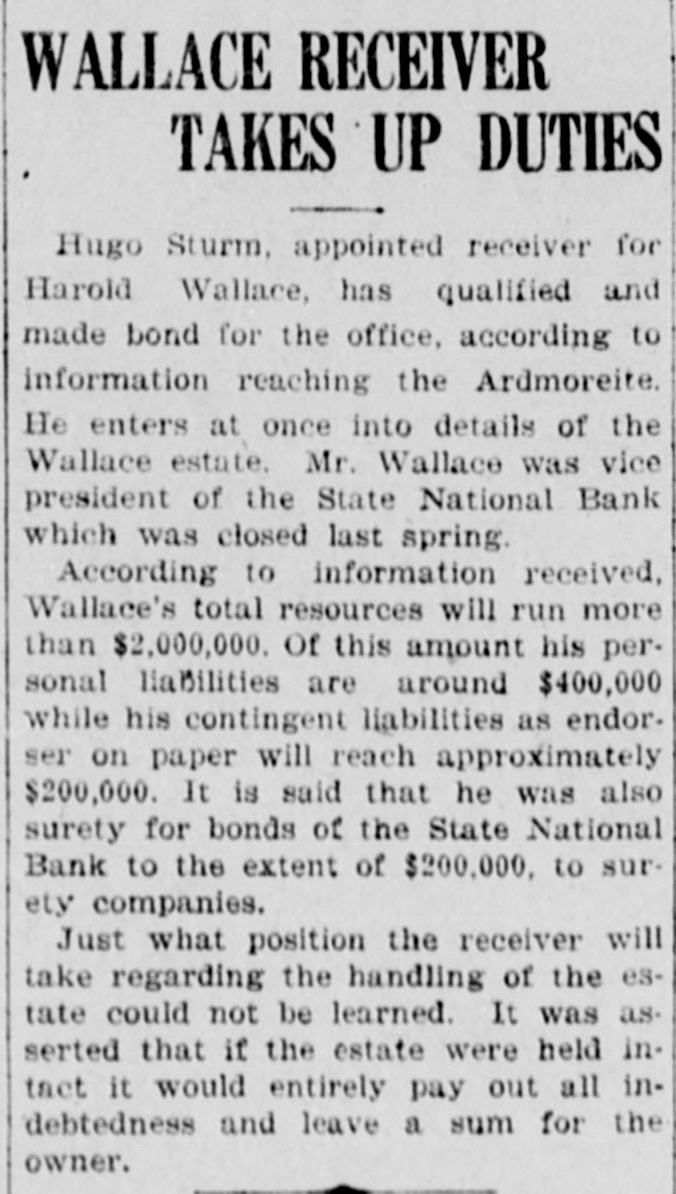
WALLACE RECEIVER TAKES UP DUTIES Hugo Sturm, appointed receiver for Harold Wallace, has qualified and made bond for the office, according to information reaching the Ardmoreite. He enters at once into details of the Wallace estate. Mr. Wallace was vice president of the State National Bank which was closed last spring. According to information received, Wallace's total resources will run more than $2,000,000. Of this amount his personal liabilities are around $400,000 while his contingent liabilities as endorser on paper will reach approximately $200,000. It is said that he was also surety for bonds of the State National Bank to the extent of $200,000. to surety companies. Just what position the receiver will take regarding the handling of the estate could not be learned. It was as. serted that if the estate were held intact it would entirely pay out all indebtedness and leave a sum for the owner.
12.October 13, 1922The Daily ArdmoreiteArdmore, OK
Click image to open full size in new tab
Article Text
# NO FARMER WHO TRIED HAS BEEN
# CLOSED OUT IN LAST TWO YEARS
# IS REPORT OF ARDMORE BANKER
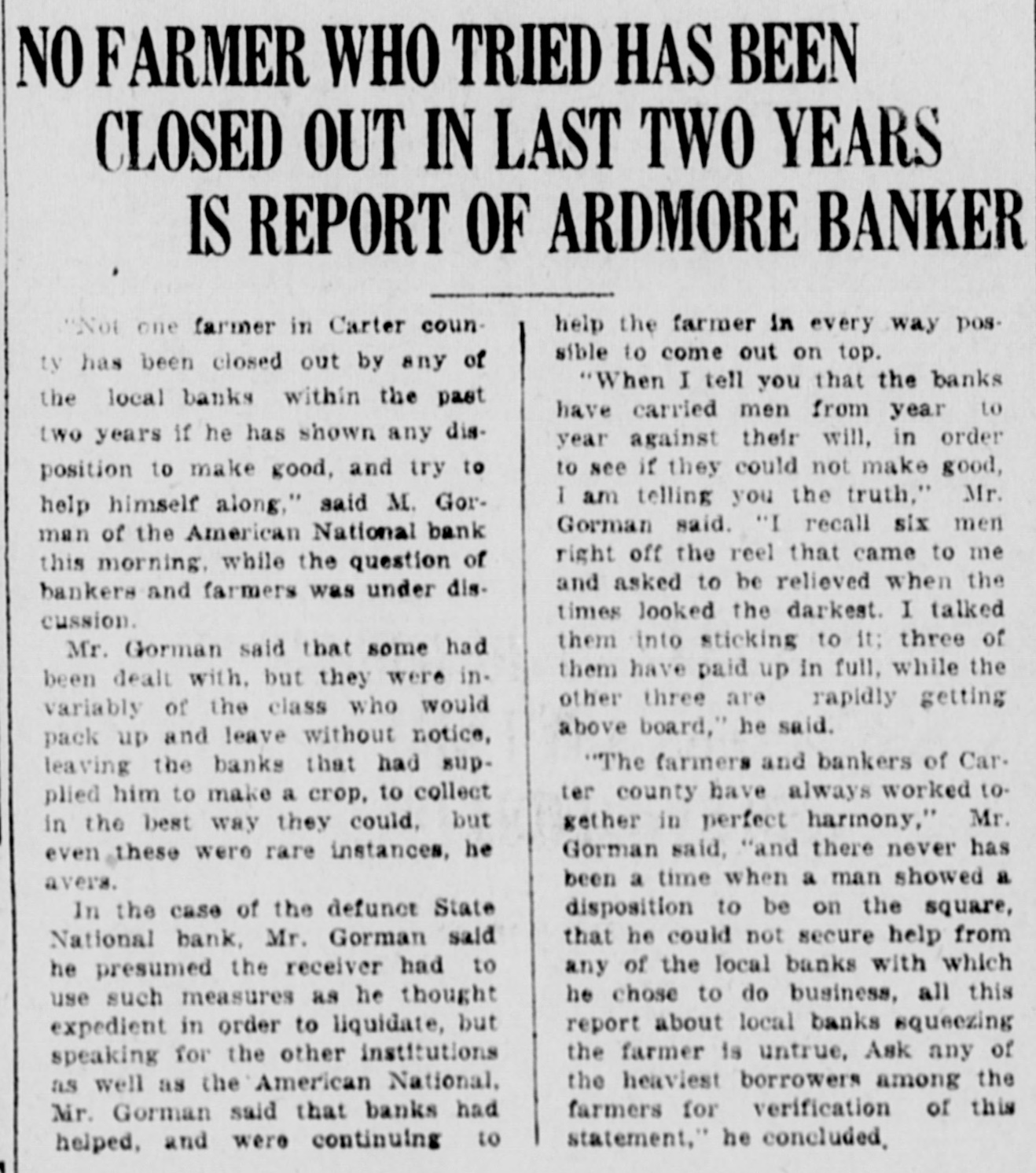
"Not one farmer in Carter county has been closed out by any of the local banks within the past two years if he has shown any disposition to make good, and try to help himself along," said M. Gorman of the American National bank this morning, while the question of bankers and farmers was under discussion.
Mr. Gorman said that some had been dealt with, but they were invariably of the class who would pack up and leave without notice, leaving the banks that had supplied him to make a crop, to collect in the best way they could, but even these were rare instances, he avers.
In the case of the defunct State National bank, Mr. Gorman said he presumed the receiver had to use such measures as he thought expedient in order to liquidate, but speaking for the other institutions as well as the American National, Mr. Gorman said that banks had helped, and were continuing to help the farmer in every way possible to come out on top.
"When I tell you that the banks have carried men from year to year against their will, in order to see if they could not make good, I am telling you the truth," Mr. Gorman said. "I recall six men right off the reel that came to me and asked to be relieved when the times looked the darkest. I talked them into sticking to it; three of them have paid up in full, while the other three are rapidly getting above board," he said.
"The farmers and bankers of Carter county have always worked together in perfect harmony," Mr. Gorman said, "and there never has been a time when a man showed a disposition to be on the square, that he could not secure help from any of the local banks with which he chose to do business, all this report about local banks squeezing the farmer is untrue, Ask any of the heaviest borrowers among the farmers for verification of this statement," he concluded,
13.November 29, 1922The Daily ArdmoreiteArdmore, OK
Click image to open full size in new tab
Article Text
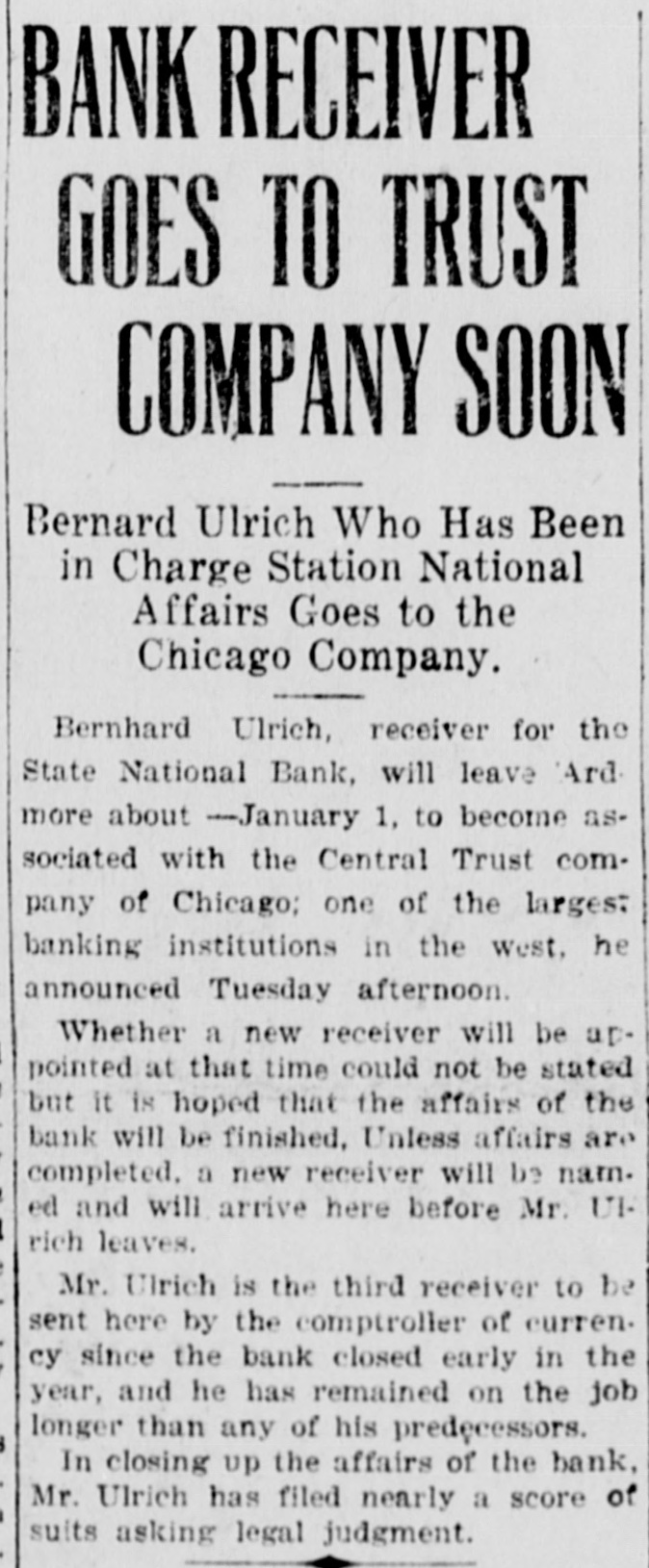
BANK RECEIVER GOES TO TRUST COMPANY SOON Bernard Ulrich Who Has Been in Charge Station National Affairs Goes to the Chicago Company. Bernhard Ulrich, receiver for the State National Bank, will leave Ard more about -January 1, to become associated with the Central Trust company of Chicago: one of the larges: banking institutions in the West, he announced Tuesday afternoon. Whether a new receiver will be ap. pointed at that time could not be stated but it is hoped that the affairs of the bank will be finished, Unless affairs are completed, a new receiver will be nam. ed and will arrive here before Mr. UI. rich leaves. Mr. Ulrich is the third receiver to be sent here by the comptroller of curren. cy since the bank closed early in the year, and he has remained on the job longer than any of his predecessors. In closing up the affairs of the bank, Mr. Ulrich has filed nearly a score of suits asking legal judgment.
14.December 2, 1922The Morning Tulsa Daily WorldTulsa, OK
Click image to open full size in new tab
Article Text
ARDMORE, Dec. 1.—Barnard Ulrich, receiver for the State National bank in Ardmore, will leave here on January 1 for Chicago where he will take up new duties following his association with the Central Trust company of that city. Ulrich is the third receiver to be sent here by the comptroller of currency since the bank closed early this year and has remained on the job longer than have his predecessors. In closing up the affairs of the bank, he filed almost a score of suits asking legal judgment.
15.December 27, 1922The Daily ArdmoreiteArdmore, OK
Click image to open full size in new tab
Article Text
BELIEVE DEFUNCT BANK WILL OPEN IN NEAR FUTURE Proposition Submitted By Wallace Satisfactory to the Depositors of the Institution. Some time ago certain depositors with the defunct State National Bank determined to secure a statement of its affairs from the receivers, and with that object in view, secured a list of the depositors who were in favor of such a movement that a meeting might be held, and the matter inteligently discussed. Pending that,period Harold Wallace had formulated a proposition for the reorganization of the bank which he stated he would submit to the depositors as soon as they held a meeting. One of the largest depositors at the meeting Tuesday afternoon stated that they were not ready to divulge what his proposition was, but added that it was entriely satisfactory to all depos. itors concerned and if the matter can be legally sunctioned, believed that the bank would reopen as an early date. Letter To Receiver The following communication was addressed to Earl A. Letteer, receiver for the State National Bank, who is expected in his official capacity to take the matter up with banking authorities to determine the status of the proposition. December 26th, 1922. Mr. Earl Jn Letteer, Receiver, The State National Bank, Ardmore, Okla. Dear Sir: At a meeting of the depositors of the State National Bank of Ardmore Oklahoma, held on December 26th, 1922 Mr. Harold Wallace submitted R prop. osition for they reorganization of the bank. His proposition involved certain concessions on the part of the depositors and was favorably received by the de positors, mut 12 is realized that they cannot intelligently consider this proposition without, definite knowledge as to the present status of the bank's at. fairs and unless they had some idea what the bank would pay upon final liquidation. For this reason, the following resolution was addipted: "Resolved: That the Chairmen of the meeting appoint a committee to be composed of Wimself, the secretary of the meeting at five others, depositors of the State National Bank, the duties of said commattee to be to make a request for, and It such request was granted, to eliamine into the affairs of said bank and ascertain the present fl. nancial condition of the same with a view of determining approximately the per cent the bank would pay upon final liquidation. "Further, that the Department be re. quested to Turnish in addition to the in formation and rights heretofore mentioned, a list of the depositors and the amount claimed by each." The above resolution was unanimously adopted, and pursuant thereto, the following committee was appointed: Thos. Norman, attorney in fact for Het. t) Norman; E. R. Hendon; O. 4. Marka
16.March 19, 1925The Ardmore Daily PressArdmore, OK
Click image to open full size in new tab
Article Text
DEPOSITORS WILL RECEIVE CHECKS FROM BANK TODAY
Receiver of State National Bank Announces Payment of Dividends.
Receiver Earl J. Liteer of the defunct State National Bank announethat beginning this morning payments will be made to depositors as divends from that bank. Checks have already been drawn and those who have filed proof of claim and who have receiver certificates may now call for their portion of funds. There much legal litigation to be gone through before the final payments can be made Mr. Liteer stated and he is not able as yet to make statement as to when the last payments will be made to depositors. Since the bank closed its doors in February. 1922 two payments have been made to depositors and it is quite probable that one more pay. ment will be made after the present one.