15433. Banks of New York (New York, NY)

Bank Information

Episode Type
Suspension → Reopening
Bank Type
state
Start Date
May 10, 1837
Location
New York, New York (40.714, -74.006)

Metadata

Model
gpt-5-mini
Short Digest
8289da84

Response Measures

None

Description

Multiple articles report that the Banks of New York suspended specie payments in May 1837 (meeting cited May 10–12, 1837). Subsequent articles (late 1837–1839) describe actions to restore specie payments and report that New York banks had resumed by early 1838. No article describes a depositor run on a specific New York bank; this is a coordinated suspension during the 1837 panic followed by resumption, so classify as a suspension with reopening.

Events (3)

1. May 10, 1837 Suspension
Cause
Macro News
Cause Details
Coordinated suspension amid the nationwide financial panic of 1837 (specie drain, international pressures, failures and general loss of confidence).
Newspaper Excerpt
in consequence of the information received this day, that Banks of New York ... have suspended specie payments
Source
newspapers
2. May 11, 1837 Other
Newspaper Excerpt
meeting of the officers of the several Banks of the City of Baltimore ... Resolved, That in consequence of the information received this day, that Banks of New York and Philadelphia have suspended specie payments, it is expedient and necessary ... to pursue, for a limited period, the same course.
Source
newspapers
3. January 1, 1838* Reopening
Newspaper Excerpt
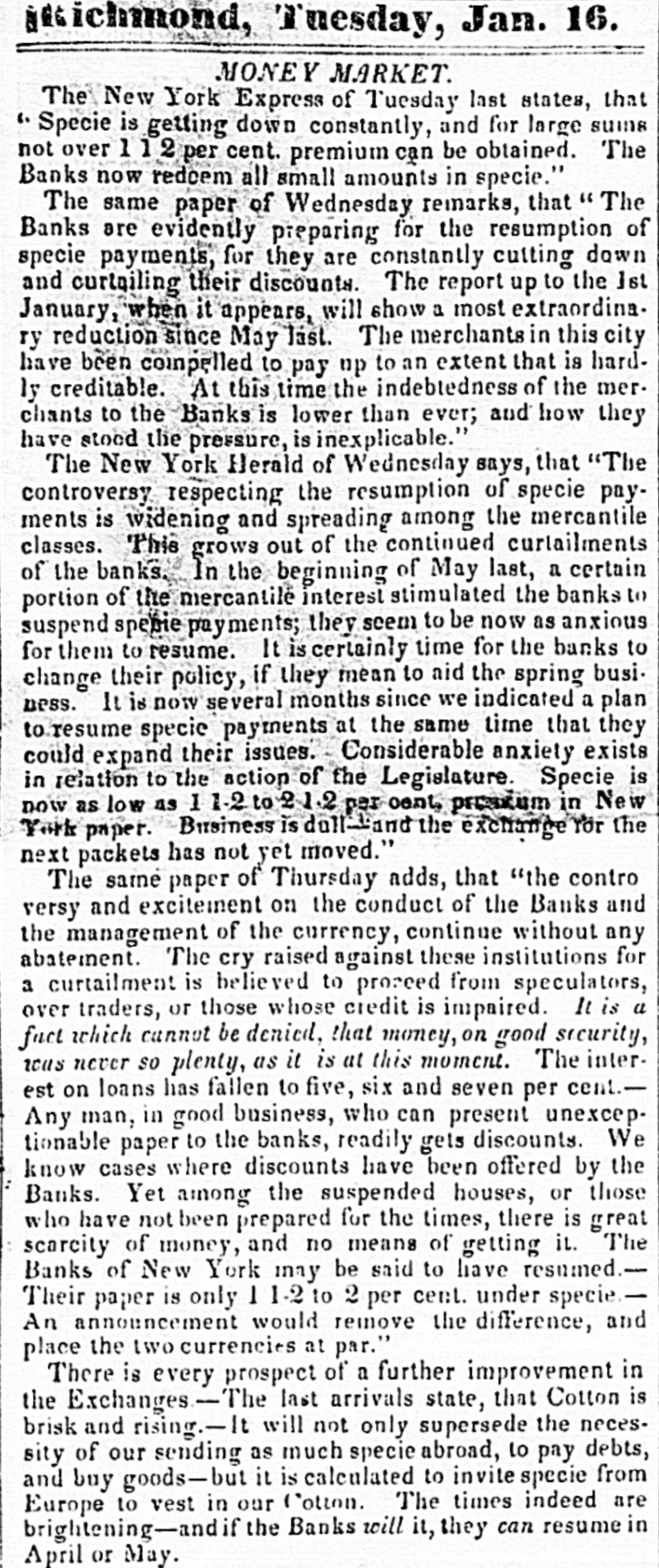
The Banks of New York may be said to have resumed. Their paper is only 1 1-2 to 2 per cent. under specie. An announcement would remove the difference, and place the two currencies at par. (Jan 1838 reports indicating resumption).
Source
newspapers

Newspaper Articles (13)

Article from South Branch Intelligencer, May 20, 1837

Click image to open full size in new tab

Article Text

much more danger is to be feared from the disrepute and alarm of this event, than from the event itself, bad as it is. THE PHILADELPHIA BANKS. 11 o'clock A. M. of the Officers and of the several banks of the city of At a meeting THURSDAY, and county Directors WedPhiladelphia, held at the Exchange on nesday evening, May 10, 1837, THOMAS SPARKS, Esq., was called to Sec- the Chair, and JACOB FRITH was appointed retary: The proceedings of the meeting of the Merchants and Citizens, held at the in to the suspension of specie relation Exchange, committee payments, been presented and read, a of officer from each bank was ed to a preamble and folhaving ONE prepare resolutions,wl appoint- the retired, and after some time reported lowing, which was under the peculiar circumstances Whereas, adopted itself this community finds placed the of specie payments our sister of New York; and by in which city suspension between whereas, by the in the state of the balances which would cause a chief part of our specie ties, existing the certain basis, and abstraction much wherewhich could never be reclaimed; measure has been as, of citizens, to the large the meetings recommended proceedings the morn- by of which publicity will be given in ing: RESOLVED, therefore That this meeting recomsuspension of specie payments as a measure which, less disastrous to the and menda be temporary however community painful, of this city and county, to continue its payment in attempt will institutions than the avain present state of things. RESOLVED, That, in the mean time, the the of all the banks will be received at different notes banks as usual, in payment of debts and On on motion, deposite. RESOLVED, That the proceedings be published andsigned.-Inquirer. BALTIMOBE, May 11, 1837. a meeting of the officers of the several Banks of the City of and of Directors At Delegations Baltimore, appointed from for that purpose; representatives all these institutions appeared. Robert Smith was called to the chair, & Robert Mickle appointed Secretary. Mr. Speed after briefly explaining the objects of the meeting, submitted the following resolutions, which were unanimously adopted Resolved, That in consequence of the the information received this day, that Banks of New York and Philadelphia have suspended specie payments, it is expedient and necessary for the Banks & in this city, for their own protection the interests of the whole community, to pursue, for a limited period, the same course. Resolved, That while the measure is recommended from a belief in its im- is perative necessity, every assurance felt in the stability of the moneyed institutions of this city. From the Baltimore Chronicle, May 8. The notes of the Farmers' Bank of Virginia, a depository of the public funds, have been, for the last week,utterly worthless in the Baltimore market. By this we mean to say that they could not, for several days, be turned into such funds as would answer to debts due at bank, at any price pay whatsoever; and we may add that they have, for three months, been only available at a sacrifice of from two to four per cent. The notes of the deposite banks in all the Western and Southern States are now and have been at a discount in this market of from three to ten per cent. and are scarcely available, even at those rates. The notes of other Western & Southern banks are, in many instances, altogether unsaleable, and answer the usual purposes of money scarcely better of than the products of the lead mines Galena. There is at this hour, in the United States NO bank, except the Bank the of the United States, chartered by State of Pennsylvania, whose notes are at in all parts of the Union, or constitute par a "general circulating medium." There is, in fact and in truth, in the United States no currency at all which answers the purposes of business, and that it is in consequence of the want of this currency; rather than from any absolute insolvency, that merchants are failing,banks are obliged to curtail their discounts, and ruin and desolation and are usurping the places of prosperity improvement. The Hagers-town Torch Light says have just been shown a letter from a in -We gentleman Baltimore which dated Monday the 8th inst., says-- here. "Last Saturday was an awful day We had three large failures, and to-day two more.
Article from The Columbia Democrat, May 20, 1837

Click image to open full size in new tab

Article Text

SUSPENSION OF SPECIE PAYMENTS. We learn by our last mails, that the banks of Philadelphia, New York, Baltimore, Harrisburg, Middletown and Northumberland, have suspended specie payments. It is supposed, however, that the adoption of this course was a measure of persecution only, and that the suspension will be of temporary duration. While the Banks in the commercial cities generally, refuse specie payments, the Northumberland Bank deems it advisable to pay out for the If purposes of change.' This course will preserve the institution safe and sound, and accommodate the public with change, until the present excitement blows over which will, we are confident, be in a short time.


Article from Lynchburg Virginian, May 22, 1837

Click image to open full size in new tab

Article Text

BOSTON, May 12. The Banks of this City.--In consequence of the in-telligence of the suspension of Specie payments, by the Banks of New York, received here yesterday, the banks of this city and vicinity were requested to send delegates to a meeting to be held at the Hall of the Tremont Bank, at half past 7 o'clock last evening, to consider what course it is expedient for those institutions to adopt in the present emergency. The meeting was accordingly held, consisting partly of delegates especially appointed by their respective boards of directors, or officers of Banks not especially authorized to bind their institutions to any course of measures. More than forty Banks of this city, Sa-


Article from Southern Telegraph, June 6, 1837

Click image to open full size in new tab

Article Text

in such a proceed was another reason against decisive. From the moment nsite Banks of New York failed with their engagements, it was that all the other deposite banks the same, that there must be a unisuspension throughout the country. that the Treasury itself, in the midst nominal abundance, must be practicalinkrupt. In such a state of things, the first considtion is to escape it-how to provide at earliest practicable moment to change dition which should not be tolerated nd the necessity which commanded it. old associations, the extensive connecthe established credit. the large capiof the Bank of the U. States, ren-ler it natural rallying point of the country the resumption of specie payments. It med wiser, therefore, not to waste its ength in struggle which might be doubtwhile the Executive persevered in its policy, but to husband all its rees.80 as to profit by the first favorable take the lead in the early respecie payments. Accordingof the U. States assumes that From this moment its eff rts will itself strong, and make itself always prepared and always anxassist in recalling the currency and of the country to the point they hrive fallen. It will CO opdially and zenlously with the GovBanks, and with anv other influhich can aid in that object. the mean time, two great duties deon the Banks and the country. first regards foreign nations, the seour own. We owe a debt to foreign no means large for our resources, proportioned to our present means of near We must take care that this late line shall not seem to be an effort to the payment of our honest debts to We have worn, and eaten, and the' produce of their industry, too of all perhaps, but that IS our fault, theirs. We may take less hereafter, the country is dishonored unless we disge that debt to the very uttermost far The second duty is to ourselves. We old bear constantly in mind, that the which we have taken is excusable onon the ground of an overruling necessiWe must not make the remedy itself a disease. It must not be the pretext of extravagant loans or issues. These are already sufficiently influted, and if we have volnntarily removed the most familiar and dstablished check upon all issues, their immediate convertibility into coin--it is our lity to substitute some effectual restraints which may enable IIS to restore the currenof the country with out delay or difficult to a safe and wholeso ne condition. The sult of the whole is, that a great disaster befallen the country. Its existence far is only a misfortune-its continuee must be a reproach, from which all no men must rally to save her. We must try to render it as short as possible, waiting patiently and calmly for the action of the Government, and in the mean time diminishing its dangers by great prudence and forbearance. For myself, you know how zealously I have labored to avert this misfortune. With not less anxiety I shall now strive to repair it. With great respect and regard, yours, N. BIDDLE. Hon. J.Q. ADAMS, Quincy, Mass.


Article from Western Courier, June 8, 1837

Click image to open full size in new tab

Article Text

The Warrenton Jeffersonian in an article on the pressure, remarks: The importers of the U. S. unable to meet these large and unusual demands, and having not received a tithe of the debt due to them in the South-west have felt severely the pressure, and in many instances, have become bankrupt. In consequence of the demand for money, and the bankruptcios of the merchants, the banks of New York, Philadelphia and Baltimore, with many others, have suspended specie payments. The rest will have to follow suit. No sooner is this the case than the Federalists one and all cry out we knew it--we told you so, this is the effect of refusing to re-charter the United States' Bank.' Well, and is not the United States' Bank still in operation? Has she ever suspended her business for a moment? When the U. S. refused to re-charter the monster' did not Pennsylvania give her a new charter with greater powers than she before possessed. Yes, she is still in existence, possessing more power than ever, with the same capital, the same President, the same Directors. If she be as her devotees seem rashly to consider, the genius of all good, where is now this beneficent power? Like the power of all banks, of all money-dealers, even of the Jewish Shylocks, it is impotent to help. The vaults of the monster,' are all locked, and no longer is the Bank of the United States a specie-paying bank. Able to regulate the issues of the State banks, why has it not done so? Able to regulate the currency, why has it not done so? Able to prevent over-trading, why has it not done so? Able to relieve the country in distress, why has it not done so? The truth is, from the size of its capital it is able to do some good, but it is not almighty, it is not indispensable to the nation. From the power attributed to it by its dealers, its auxiliaries, its adherents, its pensioned orators, its swiss guards, its devotees and humble followers, one would naturally think that there was no such institution in the country, and if there was that the time would be well. But let us not forget that the Bank of the United States is still in being, and now, as ever, is the great enemy of popular rights. Republicans be firm, be vigilant and let us invoke you to new exertions to sustain the cause of the people, the policy which has given you substance in place of shadow; gold and silver in place of


Article from The Madisonian, September 2, 1837

Click image to open full size in new tab

Article Text

From the Cincinnati Republican. THE PROPOSED BANK CONVENTION. The proposition emanating from the Richmond Enquirer, to hold a convention of the various Banking Institutions of the United States, seems very favorably received by a majority of the most influential democratic papers of the Union. The Banks of New York which were the first to suspend, we are happy to observe are first to adopt measures in pursuance to this proposition, to suggest a plan of calling a Convention of Bank Delegates to deliberate upon measures preparatory to the resumption of specie payments at some practicable period. The Madisonian, the new administration paper says, the more we reflect on this subject the better we are satisfied with the expediency and utility of the measure," and makes a very eloquent and forcible appeal in favor of carrying out the proposition. We wonder if our Cincinnati Banks will respond to the call. We wonder if they will avail themselves of this opportunity to clear their characters from the imputation of dishonesty and dishonor. We wonder if they will join in with their New York brethren and assist in restoring public ? confidence, public tranquility and national prosperity Nous verron. We agree perfectly with the Madisonian.


Article from The Madisonian, September 23, 1837

Click image to open full size in new tab

Article Text

SENATE. FRIDAY, Sept. 22. Mr. DAVIS presented a great number of petitions annexaMassachusetts. remonstrating against the memorials from of Texas to the Union, and two similar from tion Connecticut, which were laid on the table. TREASURY SYSTEM. The Senate proceeded to the consideration of the bill imposing additional duties as depositories of public revenue, on certain officers. Mr. TALLMADGE rose, and expressed his himself views the practical operation of this bill. He felt conon to give to this bill, the most respectful both on personal and political had existed the kindest called sideration, There upon always feelings grounds.- between Stateand self.-Natives of the same of the town- association had his the Executive same been bring always intimate. Yet he had been unable 10 the of the Sub-Treasury he as fraught with the greatest mind looked most to the upon support system, it evils had to which been the This was not a new measure of the adcountry. forward and scouted by the friends had brought ; and he knew of nothing which oca change of sentiment. curred Banks had been pronounced by the able ministration State to justify The party. fully system from of Jackson down to the lowest member, as Gen. the exchanges of the country, and from to the perform Exto regulate duties of the government; and fulfilled the the fiscal it was obvious that they had said that ecutive reports of the President, It was now It had expectations had failed. But why had it failed. of system of the occurrence of a state failed - the most extraordinary in its the things the consequence considers character, war- and to occur again. He as had been waged against the pet in them fare the confidence of the of scarcely which shaken likely people confidence banks, having Circular proved that the them. He and the specie also was withdrawn from the government to the rescinding this Circular as a panacea did not evils we were suffering but all the look he restoration considered for one of the items necessary to the will had it as public confidence; and if the legislative have been in a prevailed, of the present prevented. evils The might mercantile would interests have great measure York believed that the President in this of rescinded New that order. They were so strong confidence, that they were ready to exclaim, Now is the winter of our discontent, of Made confidence glorious was summer destroyed by this by son the course, York." Presi- which But this doubtless, satisfactory to himself, He the adverted for reasons, it proper for them to pursue. to sustain dent thought effort made by the State of New York and if the to the confidence in the State Banks of the public Circular had been rescinded, the suspension But as Specie would have been prevented. made on these specie payments perceived that runs were the Banks, soon as the it was depositors became alarmed, and of the city and Banks, approbation of the whole people He with the New York, suspended specie payments. had not state of therefore, that the experiment efficiently per- yet contended, the Banks, which had the late failed; but that duties entrusted to them, before formed the were capable of so discharging them the again. changes, the different position which Bill had passed counHe remarked have on occupied, if the Deposite the hands of the try would have placed the surplus in brought them in a form to the State certificates and We might States, taken in a moment like the present. of havinto market commanded some 27 millions, instead this expethus ing an have exhausted failed, Treasury. and therefore Gentlemen there must say be a be divorce popuriment has state catch phrase, calculated to would of bank and But ; a wise statesmen and doubtful politicans experilar for a time. before they entered on a the country. look deeper the greatest disasters to evil than any ment, threatening would be productive of more for a series of The divorce which has been brought forward understand, measure people understand, and will gold for years. The two currencies established-the for the people, when there are and the depreciated paper from the the servants, You will thus isolate the would people be to deGovernment. masters. The effect, by and bye, whatsoever. prive the people objections of any adequate to the amendment currency of the if SenaHe stated South his Carolina, as delusive and scheme, gen- let tor from desired to take the Treasury all dues to be it tlemen be understood that you There require can be no half way, paid in gold wished and that silver. fact to be known to the so crip- peoand he banks would gradually become currency. All pled ple.-The that there would by be us no has adequate been done by credit. of the which has been done man's capital, and the auxiliary kept down to Credit is Without the poor it the poor man would this be to be uprootrich. the day laborer. Why is hopes of the poor the level of of property reduced, the He thought ed, the destroyed price by this sub-treasury system Senators now on man means improbable that some enough to hear the it by no might remain here long denouncing their that floor of this sub-treasury system denouncing the projectors as they were even now and introduced advocated. the own measures, had formerly on against measures they why this warfare was carried to be the special banks He asked And why were He proceeded the merchants to enlogize the the country merchants object of of assault New York, as men trial. who He stood expressed by his should enin the astonishment hour of her that severest the Senator would from Missouri live to see the have tire thrown out the idea that of the he people of this absurd country as day when in the opinions would be held to be language as conthe banking system He could not find which the South with Sea the bubble. respect he felt that for at that this Senator late day, in with sistent to express his astonishment have had of the advantages He of would only say, credit, all the such experience doctrines we should be promulgated. Tis strange, 'tis passing strange." " that in 1834, New York paid this twelve s the ave- milHe stated customhouse duties. Setting to be paid in lions of how is this twelve millions found and amount, The specie could not scheine, be it is to gold and silver. the new ub-Treascry vault until diswould bursed. Specie be if it salted could, down under in the Sub-Treasury thus, to a large amount, be


Article from Richmond Enquirer, January 16, 1838

Click image to open full size in new tab

Article Text

loans has fallen to five, six can and present seven per unexcep- cent est Any on man, in good to the business, banks, readily who gets discounts offered by We the tionable paper where discounts have been houses, or those know Banks. cases Yet among prepared the suspended for the times, there it. is great The who have not been and no means of have getting resumed. scarcity Banks of of New money, York may be 2 per said cent. to under specie and Their announcement paper is only would to remove the difference, in is place An the two currencies prospect at of par." further improvement that Cotton There is every last arrivals supersede state, the necesthe Exchanges will not only abroad, to pay debts, in sity brisk of and our goods-bu rising.- sending as it is much calculated specie The to times invite specie indeed from are April or May. Europe brightenin and buy to vest -and in if our the Cotton. Banks will it, they can resume THE STATES in was adopted Report M ARYLAND The following by a vote of 50 constitute to 4. Messrs Committee H. of Delegates, of the House, Senate, the to Maulsby the and together Alexander, with a member of the proceed to Harrisburg: the was which referred The special committee Governor, to with the accompany the demand of communication of the and papers in relation upon the to Governor of Pennsy Vivania S. Bemis, for the Prigg and Stephen made in pursuance of the had ing Forward, of Maryland the correspondence Executive Edward fugitives surrender troin justice. of Nathan of Lewis, December citizens Jacob ulti. ask of same Maryland, an order as of this house on under the 26th consideration, and leave mo, have to Report, in part: have ascertained that the was only the l'hat your Committee the citizens demanded, slaves which offence alledged against into Maryland certain Harford county arrest and bringing from Margaret Ash ore, demanded of acted without it made absconded as whose agents with the the laws citizens of Pennsylvania, by them although to a justice application that State for the county for their arrest, were, by a constable who refused to appears, groes complying of was exexecuted the peace and of warrant had the been justice obtained of the county, thus where arrested and act the the which had, far. ne- negroes brought before and that the filed negroes their petitions for term free. court, free. upon ther down in in coming the the case, Harford into Maryland, and county had been court, found at by the a August jury and ad. so judged last demanded "Your of said by Committee the have Governor court been not agreed further of to be Maryland. to Pennsylvania report, be surrendered that and the authority for citizens by trial. his to Ex. for for cellency the and removal to of November last, issued the warded their arrest by him on vania, the 27th but day that the warrant to Governor agreeing Ge. agent has not of yet Pennsy been executed of Maryland before the Attorney subject; surrender "That the the said citizens whose written consulted opinions General he required was of neral of this State, and that the excellency, Attorney that he was persons bound under opinion on that the and Federal so advised the station Executive his to of surrender Maryland of Pennsylvani the then desdemanded. That to the Executive withdraw the patched a deputation them, if possible, attended to with no other petiorder to induce that the mission result was of the trials of should the than delay county court for been and success tioners mand, in and in Harford the until demand the not having constrained freedom withdrawn, to comply over be of therewith in known; the Governor and that ordered has felt the himself arrest and delivery this involved the Your citizens Committee demanded. importance view the principle to the interests willto of great an Mary. extent, nullify relation case, land, of and the are utmost of opinion, admit the if yielded power that of Article the non-sla of the of lavehold- Federal master ing injurious States in effect which 10 recognises right the of property perceive in perConstitution and guarantees They the are also unable citizens to demanded and slave, held to service. legal guilt in the their slaves. Your song moral, or even and bringing away report the legislative this They any the capture not yet prepared 10 by Maryland upon however, first Committee in are proper to be adopted are of opinion, resorted to, and the that with this view to the Senate: enactments all-important conciliatory subject. ineasure your Committee should be respectfully submit honorable following Gentlemen message of the Senate: the concurrence the of your Legislature con- of We propose, appoint with 11 Legislature deputation of from Pennsy shall be Ivania, immediately to Maryland, body, to to the whose duty it with the Legislature the sist to proceed of three session to members, Harrisburg at that place and now and confer demand pending from in Forward, York them coun- Ednow dismissal in of against the indictments Nathan S. Lewis, Bemis, citizens Jacob such of Maryland, modification ward ty Court Prigg and crime Stephen of kidnapping relating and to negroes, as will and recognize effectually his slave, away bring absconding for the of the alleged laws of that the State right of the and master we have to appointed be as honomay by named your to Messrs. join such to gentlemen constitute such submitted. deputation Chairman. rable body respectfully MAULSBY passed the All which is The Small D. Bill law repeals has the law $3) prohi- PreNEW YORK of 92 2.-It notes (under Buren) sembly by a circulation vote of small Mr. Mann, (Van in Committee prohibiting to the its final passage, which he suspension offered of which the was 93. vious newed Whole, the amendment providing instead for a amendments of its repcal, were offered, to, or rejected. question bitory of the law for one Several year, other by a majority now equal is, will are the all lost, of which the were above. thirds The of whose of this members Bill?- they We greater than more than concur two in the passage hope that insidious Senate, Van Buren men it, until we enough see to credit resist this of originating on will will not have believe, moral Let the courage Whigs have have the of honor Governor of arresting Everett atMASSACHUSETTS innovation. but the Republicans The the Address pecuniary and financial FiFederal and nancesand System, gives of a long the country. descant proceeds decided to touch supporter on the Bank. of the favor Sub. made have fairs The Governor comes our friend of National report in of as Governor (Whig) votes Treasury MAINE The of Committee Edward "whole Kent, number allowed, of at 68,642, the State : netitutionally Gorham Edward ly and necessary to 34,436, that 266, and that other of the number election They report returned and election Parks 34,322, per- of that the Edward that other Kent has persons 230 votes have more elected than all Governor that the Kent having for, is cons We have counter sons State of Maine. Committee have Whig of Resolutions the of The and intesentatives reveral 33.020, the minority voted the received Nashville itutionally made ascertained Administra. 6th day instant report. were preTENNESSEE that Preamble House of Repres of the General State; approvthe White in Felix in the the course divorce of Bank position to the to vote ing the vote allusion states, vious, tion, introduced and particularly censuring instructing of Senator the No Hon. The whatever and resolutions.ru is lie sys. tein, against the ineasure. National Bank. the Bank and in the State making was in the paper to In a the ment bonds in roads) Improvement payment only in (including proporting "The Whige to of the Kentucky calls begin adopted, the subscription Bill table. was passed which of the one with State directs half. an subscription An the the important Governor two East to on works to Tennessee private issue of Internal stock. to show Rail-


Article from Richmond Enquirer, January 16, 1838

Click image to open full size in new tab

Article Text

jichmond, Tuesday, Jan. 16. MONEY MARKET. The New York Express of Tuesday last states, that ". Specie is getting down constantly, and for large sums not over 112 per cent. premium can be obtained. The Banks now redcem all small amounts in specie." The same paper of Wednesday remarks, that " The Banks are evidently preparing for the resumption of specie payments, for they are constantly cutting down and curtailing their discounts. The report up to the 1st January, when it appears, will show a most extraordinary reduction since May last. The merchants in this city have been compelled to pay up to an extent that is hardly creditable. At this time the indebtedness of the merchants to the Banks is lower than ever; and how they have stood the pressure, is inexplicable." The New York Herald of Wednesday says, that "The controversy respecting the resumption of specie payments is widening and spreading among the mercantile classes. This grows out of the continued curtailments of the banks In the beginning of May last, a certain portion of the mercantilé interest stimulated the banks to suspend specie payments; they seem to be now as anxious for them to resume. It is certainly time for the banks to change their policy, if they mean to aid the spring busi. ness. It is now several months since we indicated a plan to resume specie payments at the same time that they could expand their issues. Considerable anxiety exists in relation to the action of the Legislature. Specie is now as low as I 1-2 to 2.1.2 per cent, prositum in New York paper. Business is doll-land the exchange for the next packets has not yet moved." The same paper of Thursday adds, that "the contro versy and excitement on the conduct of the Banks and the management of the currency, continue without any abatement. The cry raised against these institutions for a curtailment is believed to proceed from speculators, over traders, or those whose credit is impaired. It is a fact which cannot be denied, that money, on good security, tous never so plenty, as it is at this moment. Theinter est on loans has fallen to five, six and seven per cent.Any man, in good business, who can present unexceptionable paper to the banks, readily gets discounts. We know cases where discounts have been offered by the Banks. Yet among the suspended houses, or those who have not been prepared for the times, there is great scarcity of money, and no means of getting it. The Banks of New York may be said to have resumed.Their paper is only 1 1-2 to 2 per cent. under specie.An announcement would remove the difference, and place the two currencies at par." There is every prospect of a further improvement in the Exchanges.- - The last arrivals state, that Cotton is brisk and rising.-1 It will not only supersede the necessity of our sending as much specie abroad, to pay debts, and buy goods-but it is calculated to invite specie from Europe to vest in our Cotton. The times indeed are brightening-and if the Banks will it, they can resume in April or May.


Article from The Columbia Democrat, May 12, 1838

Click image to open full size in new tab

Article Text

How is it?-The Banks of Philadelphia suspended the payment of specie, about a year since, because the banks of N. York had done so, and to prevent the specie in the country from being shipped to Europe. Now, instead of specie being sent out of the country it is coming into it by millions, and the banks of New York have resumed the payment of specie; and how is it, that the Banks of Philadelphia cannot do likewise? This is a question which a people suffering under the most worthless, disgraceful and villanous rag-currency the world ever saw, will and ought to ask. The reasons assigned by Mr. Biddle are not satisfactory to all his friends, and much less so to the people at large.-Chambersburg Repository.


Article from Richmond Enquirer, December 25, 1838

Click image to open full size in new tab

Article Text

LETTER From Nicholas Biddle, Esquire, to the Honorabie John Quincy Adams PHILADELPHIA, Dec. 10, 1836. My Dear Sir-The general resumption of specie pay- ments presents a fit occasion to close our correspondence with an explanation of the course of the Bank of the U. S in regard to that subject. This shall be done briefly and finally. On the 10th of May, 1837, the Banks of New York suspended spzcie payinents, and their example was im- mediately and necessarily followed by the other Banks in the U. S. The country was thus placed in a situa- tion of extreme difficulty, from which it could be extri- cated only by instant and vigorous measures for its pro- tection. The dangers were the total prostration of its credit and character abroad the depreciation in prices of all its public securities and its staple productions- and, last and worst, that the defensive remedy of sus- pension might be protracted until it became itseif a dis- ease. It was manifest too, that the calamity had out- grown the capacity of mere politicians that the coun- try must take care of itself, and rely only upon itself- and as, in time of peril, the voice of the humblest citi- zen may sometimes be heard above the tumuit, my own personal position seeined to justify the assumption of instant and deep responsibility. Accordingly, at the very moment when this national misfortune occurred, imme- diate measures were adopted to mitigate and to repair it. Of these in their order. 1. Aware that the first intelligence of the suspension would degrade the character of the country, and subject us to the reproach of bad faith and insolvency, I address- ed to you a published letter, which went to Europe at the same time with the news of the suspension, in which I ventured to pledge myself for the fidelity of our coun- trymen. In that letter, of the 13th of May, 1837, I said: "In the meantime two great duties devolve on the Bank and the country. The first regards foreign na- tions; the second our own. We owe a debt to foreign- ers, by no means large for our resources, but dispropor- tioned to our present means of payment We must take care that this late measure shall not seem to be an effort to avoid the payment of our honest debts to them. We have worn and eaten and drunk the produce of their industry, too much of all perhaps--but that is our fault -not their's. We may take less hereafier; but the coun- try is dishonored unless we discharge that debt to the utmost farthing For this purpose the early and total discharge of our debt to foreigners-the whole power of the Bank of the United States was devoted. In such a crisis it was evi- dent, that if resort was had to rigid curtailment, the ability to pay would be proportionally diminished; while the only true system was, to keep the country as much at ease as consisted with its safety, so as to enable the debtors to collect their resources for the discharge of their debts For the same purpose, the Bank, though entirely out of its course of business, and in some degree of col- lision with its own exclusive interests, assumed an active agency in collecting the debts of the Bank of England -gave every facility for the recovery of all debts, and stimulated our countrymen to this duty, by earnest and constant appeale to their honor and their true interests. -With what a generous emulation that appeal was answered, you well know; for, it touched a chord which lies deep in all American hearts. If the uni- versal distress which pervaded the community could not be witnessed without a painful sympathy-its melancholy was redeemed by the high and manly spirit which it roused throughout the country. For, never, on its most glorious fields of battle was there dis- played a more lofty sentiment of honor and courage than was then exhibited. The honest payment of debt-the homely duty of private life-was elevated by its univer- sality into a sentiment of national honor-as the whole country in mass pressed forward to its performance, as to some sacred and patriotic obligation. Whatever could be paid, was paid instantly and cheerfully, what it was impossible to pay at once, was secured with am- ple interest for the delay, with an utter abandonment of mere selfishness and a disregard of any pecuniary sacrifice necessary to fulfil their engagements. Ac- cordingly the manner in which the United States have settled their immense commercial debt to Europe is a lasting monument of their integrity. No country could have better perfurined its duty. Even in the calmest moments of prosperity such a settlement could scarcely be imagined as was accomplished amidst the general wreck and confusion of all its great interests with which the country was afflicted. The conseq- uence is, that the general credit of the country never stood higher than at this moment;-for, it has now earned a distinction entirely exclusive and characteristic-that while the Government of the U. States is the only Go- vernment on earth that has ever paid to the last cent its national debt, the people of the U. S have discharged their private engagements with an unexampled fidelity; -a civil glory this, worth a thousand victories. In the midst of these troubles, the character of our institutions was threatened by a combination of politi- cians in Pennsylvania, who endeavored to establish, as the basis of American legislation, that a charter or other engagement made by any State Legislature, was liable to be annulled by any subsequent Legislature-and still more effectually by any political meeting called a Con- vention-which is only another form of extraordinary legislation, and an attempt was announced to carry that dogma into effect at a Convention then approaching. The assertion of such a right by the State Government, to annul all its engagements to foreigners, put forth at a moment when the country was laboring under a tempo- rary inability to pay its debts, was calculated to destroy all confidence in the integrity of our American institu- tions and I therefore said to you in my letter, "This must not be. It must be decided whether this Pennsyi- vania of ours is a virtuous community or a mere society of plunderers-nor will the honor of the State be re- lieved either at home or abroad from the stain which a few small politicians wish to fix upon her, until the Con- vention adopts some solemn declaration, that there is no power in this nation capable of violating the sacred en- gagements of the State authorities. That should be done and if any efforts of mine may avail, that shall be done, for the honor of this State, for the character of her sister States, and for the stability of our popular institu- tions. Accordingly, when the Convention met. one of its most decided acts was the following resolution, passed on the 21st of November 1837


Article from Richmond Enquirer, October 29, 1839

Click image to open full size in new tab

Article Text

to must thing of the and there del majority U. S But the Bank. in manner who but the Bank the with Federalis's that o be inved have is The assertion for in Sena: the betrayed gullen the by Burden in and Traders of that they the majority the ques on Bank only came which but tion. upon every the for up during action Federal Democrats found had themselves a other political through The by Federal therefore and ap. by Federal the majorities. all over the by Federal plauded calling Federalists, Antimasons whether themselves, Jw indle to have which the by reclared and more potent whole party under than hen acting and had Directors, or The Whigs S local Bankistution, and charter from Congress. the where Biddle Nicholas palace his Summer # continued ruin and tinessing morning for of claimed exercise by the mere bills the Bank S institution a Bank, It was considered and increased And would him. by the wanton which same had been recharter used by of the power. U. but hat ex liabilities. of that individual priously party the that 10 deny or ral with slended from onerous short time faced any effrontery Bank was a FedeWhig measure, for tic prinsible the (and as Bank, empted supposed would that have in rechart the brazen of that hold When the the Democra Whig shall become party rd the in road.) its heels were they never the stoutly, name: any known it as of of the States, the Bank The United Manifest neces we said, not has have does called. and the second sury between suspension connection the sus it that second this But establishes The to that is itution. solely pension were Boston. this from country. Banks the with and in more healthy sound never a circu of of the some country exception in of acas been has email lation lia their to were tive they ente an ave and least very With large bilities in to rage Crop, Cotton of of The duce specie history the as long this the for was of ready London money and Post State ne Bonds, her inthe Bank extend the West. of the for of the Intervania, Pennsy an incr and to nal discounts, to into of ed enter scale, Merchants for the of with those York, Trade Philadelphwestern rivalry of this became But source supply the made short London soon two British the no sale for fieid Stock longer Exchange the and or neg Notes. Bonds it, of and credit clumbled structure to pieces. was society here crime Now against of hich bility. Here the of Bank The United disregarded as the being States. d, in identifi to and Union, of with the view foreigners, of the and financial country, resources were from its credit. position of any the the what reputat course her on did and proud du'y elevation high ad to taken that she ought will contend re PO in of the facility vantage England, U. the in of pay after ments cemily specie to its limit and utinost credit States straining and wise to not forecast, have of occur those both. in disturb rences political Europe, drug, by which money. RECESS to not (11 only ght Ough! locked she possibility a from being or almost enter But prise. she h y did whe in than ec pitch Europe higher of State Pennsylva she to in Internal largely the creased discounts Merchants, Philadelphia in of the who Western anxious of she and pay period business Southern of by ment debts Western she of to the logses which instead binitting the the being hazard. guardian a of the limitali country, at if the of credit, abstaining from time same very The course pursued the issues credit and of the second lanation and abusGotes her ed that in Europe the of States mercial United prosperity the which her injury large of the financial and comPatriot of We in spe very secure large saying out New York, was from taken principally of no the which account Liverpool, to the has been According less us. not efforded than pounds cie, by the passengers from which that port we fully credit, was thus The sent England. of Nat by made in New stated the BANK UNITED of le: on of the Bank United W hich had been York THE Philadeiph letters that from the Mr. /audon, of " post hich by tively Measts ter from has received that the bills. Houinguer the had been accepted H States render it refused certain by Messrs Rothschild A 21. letter published that the of We doubt acceptance that letter. not copie in ing the to New be from York the bills not believe it written the we find subjoined S Gazette: satisfactory AND in Since Havie the article above was in the written, U. have Chronicle then to assert, of the U S. accepted the of that the funds Bank, HOTTINGUEI trouble enquire, all ,ne Rothschilds, of the Bank but to in with the place some that not only were the Messis France previously, that inether of OF the to the Bank credit the the all includbeyond liabilities the by the bills Messis ing accepted Rothschilds Inte The BANKS NORTH CAROLINA Petersburg ha ve that the sus Banks North Carolina gencer fr m the Deleaples Banks held Wednesday to pended AL specie adjourned of meeting Philadel Inhia of the October and adjeining 23d, 1939, distri prepare the appointed of Ivania, citizens Pennsy unanimous adopted Committee report address to which the was read. the Chairman and published presented and and the directed following, to be in signed all the by daily papers: PENNEY Secretar THE and CITIZENS OF having specie, to suspend deem the The Banks TO of Philadelphia ment of citizens notes of Pennsy frant their reasons of tiral and briefly for a duty time 10 the explain measure to the This they will do pay Enspended the Banks in New of York the Union follow was In May specie, 1837. and the FPSL and necessary measure this coon and try their ly ments examp in commercial This just relations of betw the United States directed immediate in of the honorable discharge required their Europe; by the and all the efforts Banks to assist debts, the count and to of There specie payments. resumption. for the easy w ben country and satisfactory prepare for were the to its foreign creditors, effort for


Article from Lynchburg Virginian, November 4, 1839

Click image to open full size in new tab

Article Text

DOMESTIC INTELLIGENCE. # THE PHILADELPHIA BANKS. At an adjourned meeting of the Delegates from the Banks in the city of Philadelphia and adjoining districts, held on Wednesday evening, Oct. 23d, 1839, the Committee appointed at a previous meeting to prepare and report an address to the citizens of Pennsylvania, presented the following, which was read, unanimously adopted, and directed to be signed by the Chairman and Secretaries, and published in all the daily papers: TO THE CITIZENS OF PENNSYLVANIA. The Banks of Philadelphia having decided to suspend for a time the payment of their notes in specie, deem it their duty to explain to the citizens of Pennsylvania, the reasons of that measure. Thus they will do frankly and briefly. In May, 1836, the Banks in New York suspended payments in specie, and the rest of the Union followed their example. This just and necessary measure was required by the commercial relations between this country and Europe; and all the Banks of the United States immediately directed their efforts to assist the country in the honorable discharge of its foreign debts, and to prepare for the resumption of specie payments. These operations were proceeding in a manner easy for the country and satisfactory to its foreign creditors, when their progress was disturbed by a premature effort for a general resumption of specie payments. The Banks of New York were unfortunately constrained by law to resume on a given day, whatever might be the state of the country; and they naturally endeavored to induce all the other Banks to do voluntarily what they were compelled to do. This purpose was effected, aided as it was by the impatience of the public, by the competition of political parties anxious to appropriate to their respective sides the popularity expected from hastening the resumption, and by feelings of local pride, which prevented many from declining to do what in reality they disapproved, and accordingly a day of resumption was named. The banks of Philadelphia were quite as ready to resume as those who were most anxious to begin, for they had greatly reduced their liabilities, and one of their number had no less than $7,357.000 in its vaults. But they believed the country at large had not yet sufficiently recovered from that violent shock to be ready for resumption. They recollected that under similar circumstances the Bank of England had continued her suspension for upwards of twenty years, and they avowed their apprehension that a resumption in the unprepared state of the country must be followed by a relapse. Overruled in this judgment, and obliged at the hazard of greater evils to unite in the resumption, they sincerely co-operated in it, and, being satisfied that the measure in order to be useful or permanent must be general, they made great efforts and large advances to the Southern and South-western States, who were thus enabled, almost exclusively by the assistance of the Philadelphia Banks, to unite in the resumption. But the inefficacy of the measure soon became obvious. The Southern and South-western States, placed by the resumption too much in advance of the crops, which alone could sustain them, gave way at the earliest demand for specie, thus breaking the general line of resumption, and weakening the Atlantic Banks by the amount of the advances made to support them. Not was this all. The delusive appearance of the resumption worked injuriously on bot sides of the Atlantic. In this country it caused the belief that all the danger was over, and individuals rushed into new enterprises, and States undertook new improvements, relying on the enjoyment of the old facilities of credit. Abroad, the extraordinary and honorable efforts made to discharge us debts, exalted the character of the country; and merchants hastened to sell on credit, and capitalists to lend on the public securities of a people who had been thus faithful to their engagements. It was then that the anticipations, under which the Philadelphia Banks gave their reluctant assent to the measure, were realized. And now, after little more than a year of nominal resumption, the Southern and South Western States are more embarrassed than ever. The Atlantic Banks are weakened by their fruitless endeavors to aid those States-the commercial debt to Europe is larger than at the resumption-the debt of the States in Europe much larger, and the specie means of the country much diminished. The premature resumption of specie payments therefore has left the country in a state of exhaustion, which has prevented its being able to stand the new shock, which forms the more recent and direct cause of the present suspension and drain of specie to England. In our relations with England, she is largely and habitually a creditor. Like all other creditors, she is willing to buy more and to lend more while her own situation is perfectly easy-but when she is herself pressed, she ceases to lend, ceases to buy, and proceeds at once to exact payment. Thus in ordinary times she receives payment for her goods in our own produce or in our own funds, and rarely requires, because she rarely needs, specie. But a sudden trouble has come upon England, which reverses the whole of our relations. Her crops have failed, and she is forced to protect her people against famine by purchasing food, and this not from our own country, which might furnish a market for our crops, but from her neighbors who can furnish it cheaper than us-and as these are comparatively small consumer of her products, she must pay with specie for her food. Accordingly, the Bank of England alone has been obliged to furnish more than thirty-five millions of dollars in specie to be shipped abroad-a drain that has threatened that institution with suspension. By the latest statement of her affairs, it appears that with immediate demands for which she is liable, of £25,742,000, the whole stock of specie is only £2.800,000, and this after borrowing from the bank of France £2,000,000-so that without this extraordinary aid, her position would have been extremely critical. The consequence is that money has risen to twice or three times its ordinary value-that the staples of this country are unsaleable except at ruinous sacrifices-that the stocks of this country sent by the states, or by the banks, or by individuals, are wholly inconvertible, leaving as the safest and the favorite mode of payment, the exportation of specie. The demand for this article is still further increased by the efforts made in England to produce relief at home. The manufacturer, pressed by some urgent want, empties his warehouse into the packets, and selling his goods here at a small sacrifice, for notes which are discounted at a second sacrifice, he ships the specie, which reaches England in time to relieve him, leaving this country flooded with goods without any regard to its wants or its consumption. The result is, that the coin of this country is wanted in England to send to the continent for food-that a very large portion of it has already gone, and that the rest will probably follow. The banks of Philadelphia have already contributed many millions-one single bank of their number having since the resumption in August, 1838, paid out no less than 8.712,000 dollars, in this city alone, and the demand seems to increase, instead of subsiding. Under these circumstances, they have had to adopt one of two alternatives-either to force the com-