Article Text
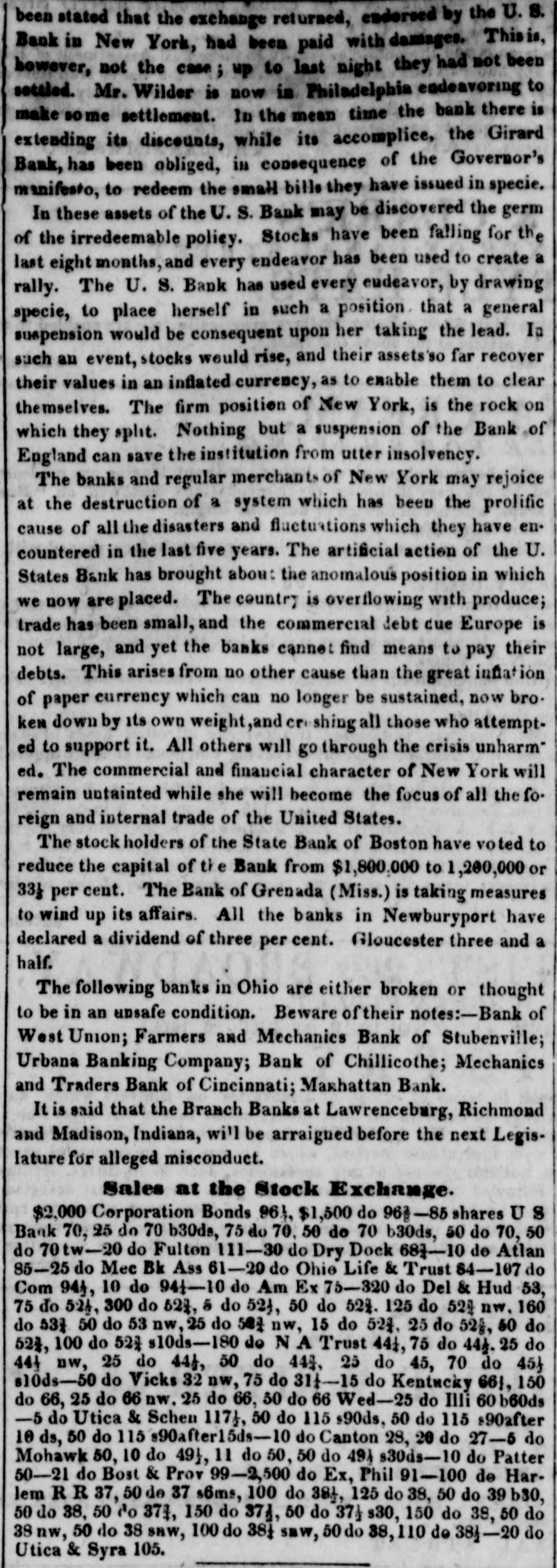
been stated that the exchange returned, endorsed by the U.S. Bank in New York, had been paid with damages. Thisis, however, not the case; up to last night they had not been settled. Mr. Wilder is now in Philadelphia endeavoring to make some settlement. In the mean time the bank there is extending its discounts, while its accomplice, the Girard Bank, has been obliged, in consequence of the Governor's manifesto, to redeem the smaH bills they have issued in specie. In these assets of the U. S. Bank may be discovered the germ of the irredeemable policy. Stocks have been falling for the last eight months, and every endeavor has been used to create a rally. The U. S. Bank has used every endeavor, by drawing specie, to place herself in such a position that a general suspension would be consequent upon her taking the lead. In such an event, stocks would rise, and their assets'so far recover their values in an inflated currency, as to enable them to clear themselves. The firm position of New York, is the rock on which they split. Nothing but a suspension of the Bank of England can save the institution from utter insolvency. The banks and regular merchants of New York may rejoice at the destruction of a system which has been the prolific cause of all the disasters and fluctuations which they have encountered in the last five years. The artificial action of the U. States Bank has brought about the anomalous position in which we now are placed. The country is overflowing with produce; trade has been small, and the commercial debt due Europe is not large, and yet the banks cannot find means to pay their debts. This arises from no other cause than the great inflation of paper currency which can no longer be sustained, now bro. ken down by its own weight, and cr shing all those who attempted to support it. All others will go through the crisis unharm ed. The commercial and financial character of New York will remain untainted while she will become the focus of all the foreign and internal trade of the United States. The stock holders of the State Bank of Boston have voted to reduce the capital of the Bank from $1,800.000 to 1,200,000 or 33} per cent. The Bank of Grenada (Miss.) is taking measures to wind up its affairs. All the banks in Newburyport have declared a dividend of three per cent. Gloucester three and a half. The following banks in Ohio are either broken or thought to be in an unsafe condition. Beware of their notes:-Bank of West Union; Farmers and Mechanics Bank of Stubenville; Urbana Banking Company; Bank of Chillicothe; Mechanics and Traders Bank of Cincinnati; Mashattan Bank. It is said that the Branch Banks at Lawrencebarg, Richmond and Madison, Indiana, will be arraigned before the next Legislature for alleged misconduct. Sales at the Stock Exchange. $2,000 Corporation Bonds 964, $1,500 do 96 - 85 shares US Bank 70,25 do 70 b30ds, 75 do 70, 50 do 70 b30ds, 50 do 70, 50 do 0tw-20 do Fulton 111-30 do Dry Dock 681-10 de Atlan 85-25 do Mec Bk Ass 61-20 do Ohie Life & Trust 84-107 do Com 94j, 10 do 941-10 do Am Ex 75-320 do Del & Hud 53, 75 do 524, 300 do 521, à do 52), 50 do 52% 125 do 524 nw. 160 do 53 50 do 53 nw, 25 do 50 nw, 15 do 524, 25 do 52g, 50 do 524, 100 do 52% s10ds-180 do N A Trust 441, 75 do 44 25 do 444 nw, 25 do 44j, 50 do 444, 25 do 45, 70 do 45} s10ds-50 do Vicks 32 nw, 75 do 311-15 do Kentucky 661, 150 do 66, 25 do 66 nw. 25 do 66, 50 do 66 Wed-25 do Illi 60 b60ds -5 do Utica & Schen 1171, 50 do 115 $90ds, 50 do 115 90after 10 ds, 50 do 115 s90after15ds-10 do Canton 28, 20 do 27-5 do Mohawk 50, 10 do 49}, 11 do 50, 50 do 494 s30ds-10 do Patter 50-21 do Bost & Prov 99-2,500 do Ex, Phil 91-100 de Harlem R R 37, 50 de 37 s6ms, 100 do 381, 125 do 38, 50 do 39 b30, 50 do 38, 50 do 373, 150 do 37A, 50 do 37} s30, 150 do 38, 50 do 38 nw, 50 do 38 saw, 100 do 38 saw, 50 do 38,110 de 381-20 do Utica & Syra 105.