Article Text
ALL SORTS
Mrs. Ray K. Windham of Washington, D. C. guest of her mother, Mrs. Grace Lees and family.
Mrs. Mary Wilgus and family will spend Thanksgiving Day in Casstown as guests of Mr. and Mrs. Adam Wilgus. Mr. and Mrs. H. Holsinger and daughter, Elaine, of Dayton will be Thanksgiving Day guests of her parents, Mr. and Mrs. Young. The West Milton and Union Rural schools will dismiss this afternoon for the Thanksgiving vacation and will resume work Monday, December 3rd.
Miss Patsy Aldrich, daughter of Mr. and Mrs. B. L. Aldrich of Front street is quarantined for scarle. fever. Patsy is a student of the fourth grade. Mr. and Mrs. Wm. Heffelfinger and Mr. and Mrs. Chas. B. Miller were entertained to turkey dinner Sunday at the home of Mr. and Mrs. Amzi Dull at Arcanum. Class No. of Sugar Grove church at Frederick will present playlet and bazarr Friday evening, December 7th at o'clock at the Jr. O. M. hall. Admission 10c and 22t1
Mrs. Amy Carroll left the latter part of the week to spend the winter with her son-in-law and daughter, Judge and Mrs. Lester Cecil and family, 448 Red Haw Road, Dayton. The Miltonian Woman's club will meet Wednesday afternoon, December 5th, at the home of Mrs. Wirt Kessler on North Miami street with Mrs. W. C. Keck assisting in receiving the members. Mr. and Mrs. Clyde Poor of near Anderson, Ind., Mrs. Charles Ballard and son, Howard, of Pershing, Ind. and Mrs. Anna McGill of Beckley, W. Va., called Mr. and Mrs. Clinton Sennett Sunday afternoon The Gleaners class of the Methodist Sunday School will meet Monday evening with Mrs. Harold Penny with Mrs. Russell Randall, assisting hostess. A Christmas exchange of 10c gifts will be feature of the meeting.
Mr. and Mrs. Allen Brann and family of Dayton were entertained Sunday in the home of Mr. and Mrs. H. A. Ireland. In the afternoon Mrs. Lula Wheelock and daughter, Freda, also of Dayton were guests in the home.
A public auction will be held in the community sale room on North Miami street Saturday afternoon, December 8th, commencing at 12 o'clock. Bazaar and general market in connection. Sponsored by the Christian Sunday School.
At the regular meeting of Union township trustees held Saturday afternoon bills in the amount of were allowed. A sheep claim was filed by Orrin Shaffer in the amount of for one sheep killed and one critically injured by dogs.
Rev. Ralph Haines of the Laura Gospel Mission has been appointed minister of the Pilgrim Holiness mission organized in Troy six months ago by Rev. Lawrence Roberts of West Carrollton. Rev. Haines will preach the mission each Sunday and Thursday evening.
Use Quaker State oil with perfect Home made mince meat, pounds satisfaction. Community for 25c. Harris Bakery. Station. 22t1 Mrs. Shaner of Hayes street is Chicken and dumplings, market confined to her bed with a compliand gift sale at the Friends church cation of diseases. Thursday, December 25% more lubrication in Quaker 13th. 22t2 State than there is in other oils.
New hats, turbans and brims, also Community Oil Station. nice line of new scarf sets. Mr. and Mrs. Bert Buzzard of Ft. Dresses at reduced prices the Wayne, Ind., were Tuesday guests of Warner Hat Shop. their niece, Mrs. H. G, Brown and Mr. and Mrs. D. W. Weddell and family. family of Indianapolis will be enMrs. Earl Falknor was hostess to tertained over Thanksgiving in the members her bridge club Tueshome of W. Vore and daughters. day, entertaining with o'clock Mr. and Mrs. R. Huston and luncheon. family of South Euclid are expected Miss Edith Clasz, Mrs. Grace here to spend Thanksgiving with Shepherd and Mrs. Herbert Hawker her mother, Mrs. Mina Pearson and of Dayton were Saturday guests of son. Miss Eliza Lutz.
Mr. and Mrs. Arthur Nill and baby of Celina were week end guests of Mr and Mrs. E. R. DeHaven and son. Mr. Nill was former instructor in high school.
Mr. and Mrs. Wm. Elleman left Monday morning for Port Orange, Fla. Mr. and Mrs. Harry Emrick and daughter, Jane, left at the same time for the same destination where they will spend the winter. Mr. and Mrs. Eli Dague and Mr. and Mrs. Walter Durham of Dayton spent Sunday with Mr. and Mrs. Walter Barnhart, celebrating the fourth wedding anniversary of Mr. and Mrs. Dague and the 26th anniversary of Mr. and Mrs. Barnhart.
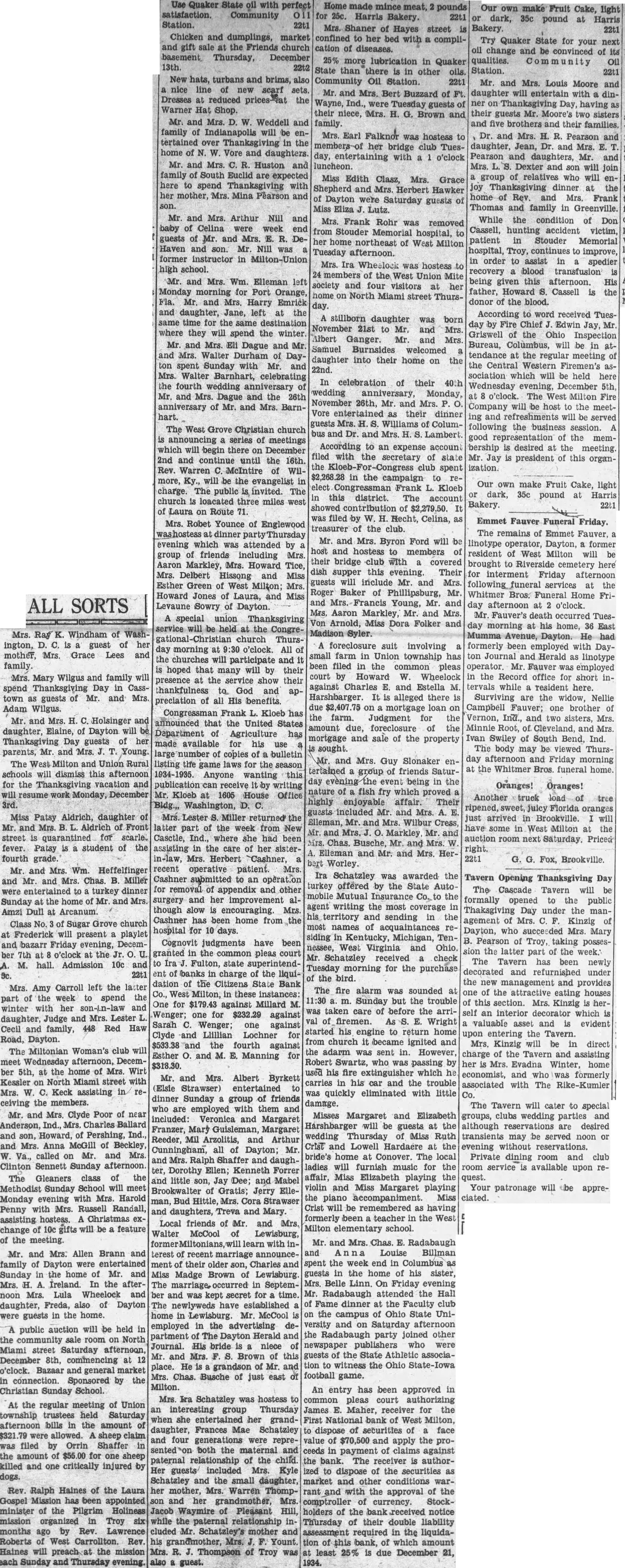
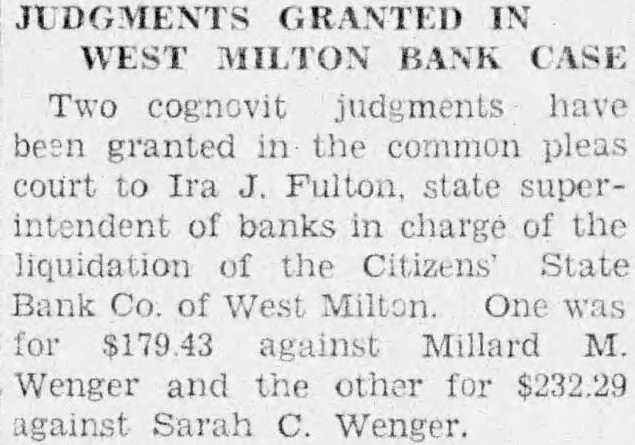
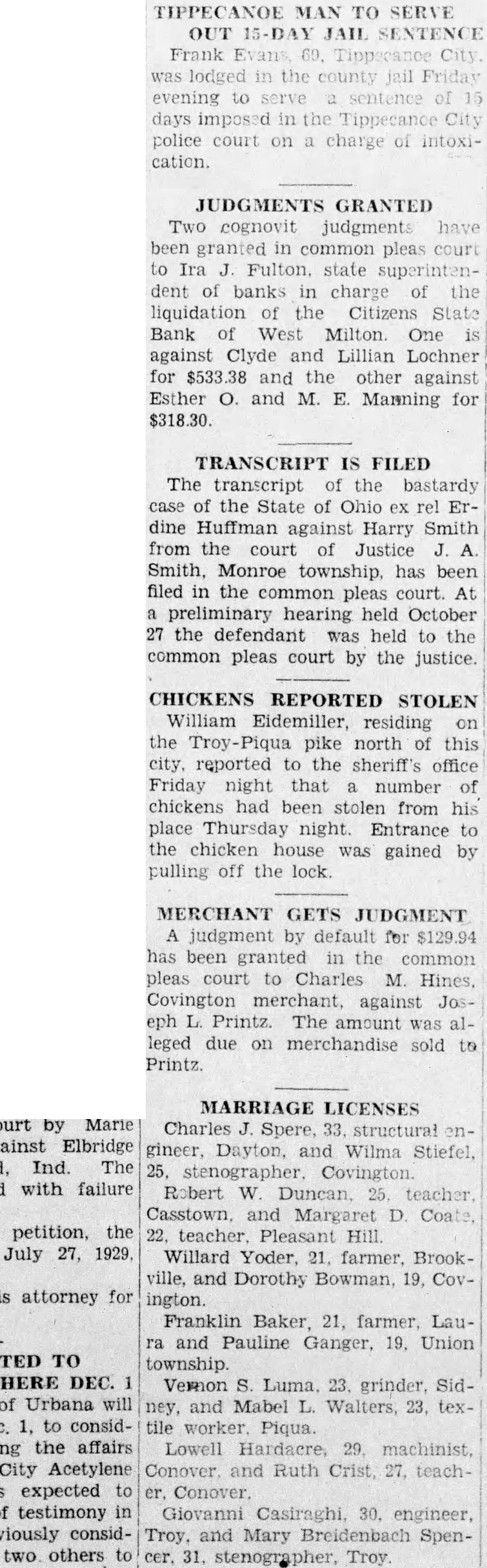
The West Grove Christian church is announcing a series of meetings which will begin there on December 2nd and continue until the 16th. Rev. Warren McIntire of Wilmore, Ky., will be the evangelist in charge. The public is invited. The church is loacated three miles west of Laura on Route 71. Mrs. Robet Younce of Englewood washostess dinner evening which was attended by group of friends including Mrs. Aaron Markley, Mrs. Howard Tice, Mrs. Delbert Hissong and Miss Esther Green of West Milton; Mrs. Howard Jones of Laura, and Miss Levaune Sowry of Dayton. A special union Thanksgiving service will be held the Congrechurch Thursday morning at 9:30 o'clock. All of the churches will participate and it is hoped that many will by their presence at the service show their thankfulness to God and appreciation of all His benefits. Congressman Frank L. Kloeb has announced that the United States Department of Agriculture has made available for his use large number of copies of a bulletin listing the game laws for the season Anyone wanting this publication can receive writing Mr. Kloeb at 1605 House Office Bldg.,, Washington, Mrs. Lester S. Miller returned the latter part of the week from New Casctle, Ind., where she had been assisting in the care of her sisterin-law, Mrs. Herbert Cashner, recent operative patient. Mrs. Cashner submitted to an operation for removal of appendix and other surgery and her improvement although slow is encouraging. Mrs. Cashner has been home from the hospital for 10 days. Cognovit judgments have been granted in the common pleas court to Ira Fulton, state superintendent of banks in charge of the liquidation of the Citizens State Bank Co., West Milton, in these instances: One for $179.43 against Millard M. Wenger; one for $232.29 against Sarah C. Wenger; one against Clyde and Llillian Lochner for and the fourth against Esther O. and M. E. Manning for $318.30.
Mr. and Mrs. Albert Byrkett (Elsie Strawser) entertained to dinner Sunday group of friends who are employed with them and included: Veronica and Margaret Franzer, Mary Guisleman, Margaret Reeder, Mil Arzolitis, and Arthur Cunningham, all of Dayton; Mr. and Mrs. Ralph Shaffer and daughter, Dorothy Ellen; Kenneth Forrer and little son, Jay Dee; and Mabel Brookwalter of Gratis; Jerry Elleman, Bud Hittle, Mrs. Cora Strawser and daughters, Treva and Mary. Local friends of Mr. and Mrs. Walter McCool of Lewisburg, will learn with interest of recent marriage announcement of their older son, Charles and Miss Madge Brown of Lewisburg The in September and was kept secret for time. The newlyweds have established home in Lewisburg Mr. McCool employed in the advertising department The Dayton Herald and Journal. His bride is niece of Mr. and Mrs. S. Brown of this place. He grandson of Mr. and Mrs. Chas. Busche of just east of Milton.
Mrs. Ira Schatzley was hostess to an interesting group Thursday when she entertained her granddaughter, Frances Mae Schatzley and four generations were represented both the maternal and paternal relationship of the child. Her guests included Mrs. Kyle Schatzley and the small daughter, her mother, Mrs. Warren Thompson and her grandmother, Mrs. Jacob Waymire of Pleasant Hill, while the paternal relationship included Mr. Schatzley's mother and his grandmother, Mrs. Yount. Mrs. R. J. Thompson of Troy was also guest.
22t1 22t1
Mrs. Frank Rohr was removed from Stouder Memorial hospital, to her home northeast of West Milton Tuesday afternoon.
Mrs. Ira Wheelock was hostess to 24 members of the West Union Mite society and four visitors at her home on North Miami street Thursday.
A stillborn daughter was born November 21st to Mr. and Mrs. Albert Ganger. Mr. and Mrs. Samuel Burnsides welcomed daughter into their home on the 22nd.
In celebration of their 40th wedding anniversary, Monday, November 26th, Mr. and Mrs. P. Vore entertained as their dinner guests Mrs. Williams of Columbus and Dr. and Mrs. S. Lambert. According to an expense account filed with the secretary of state the club spent $2,268.28 in the campaign to reelect Congressman Frank L. Kloeb in this district. The account showed contribution of $2,279.50. It was filed by W. H. Hecht, Celina, as treasurer of the club.
Mr. and Mrs. Byron Ford will be host and hostess to members of their bridge club with covered dish supper this evening. Their guests will include Mr. and Mrs. Roger Baker of Phillipsburg, Mr. and Mrs. Francis Young, Mr. and Mrs. Aaron Markley, Mr. and Mrs. Von Arnold, Miss Dora Folker and
A foreclosure suit involving small farm in Union township has been filed in the common pleas court by Howard W. Wheelock against Charles E. and Estella M. Harshbarger. It is alleged there is due $2,407.75 on mortgage loan on the farm. Judgment for the amount due, foreclosure of the mortgage and sale of the property sought. Mr. and Mrs. Guy Slonaker entertained group of friends Saturday evening the event being in the nature of fish fry which proved highly enjoyable affair. Their guests included Mr. and Mrs. Elleman, Mr. and Mrs. Wilbur Cress, Mr. and Mrs. Markley Mr. and Mrs. Chas. Busche, Mr. and Mrs. W. A. Elleman and Mr. and Mrs. Herbert Worley. Ira Schatzley was awarded the turkey offered by the State Automobile Mutual Insurance Co. to the agent writing the most coverage in his territory and sending in the most names of acquaintances residing in Kentucky, Michigan, Tennessee, West Virginia and Ohio. Mr. Schatzley received a check Tuesday morning for the purchase of the bird. The fire alarm was sounded at 11:30 m. Sunday but the trouble was taken care of before the arrival of firemen. As S. E. Wright started his engine to return home from church it became ignited and the adarm was sent in. However, Robert Swartz, who was passing by used his fire extinguisher which he carries in his car and the trouble was quickly eliminated with little damage.
Misses Margaret and Elizabeth Harshbarger will be guests at the wedding Thursday of Miss Ruth Crist and Lowell Hardaere at the bride's home at Conover. The local ladies will furnish music for the affair, Miss Elizabeth playing the violin and Miss Margaret playing the piano accompaniment. Miss Crist will be remembered as having formerly been teacher in the West Milton elementary school.
Mr. and Mrs. Chas. E. Radabaugh and Louise Billman spent the week end in Columbus as guests in the home of his sister, Mrs. Belle Linn. On Friday evening Mr. Radabaugh attended the Hall of Fame dinner at the Faculty club on the campus of Ohio State University and on Saturday afternoon the Radabaugh party joined other newspaper publishers who were guests of the State Athletic association to witness the Ohio football game.
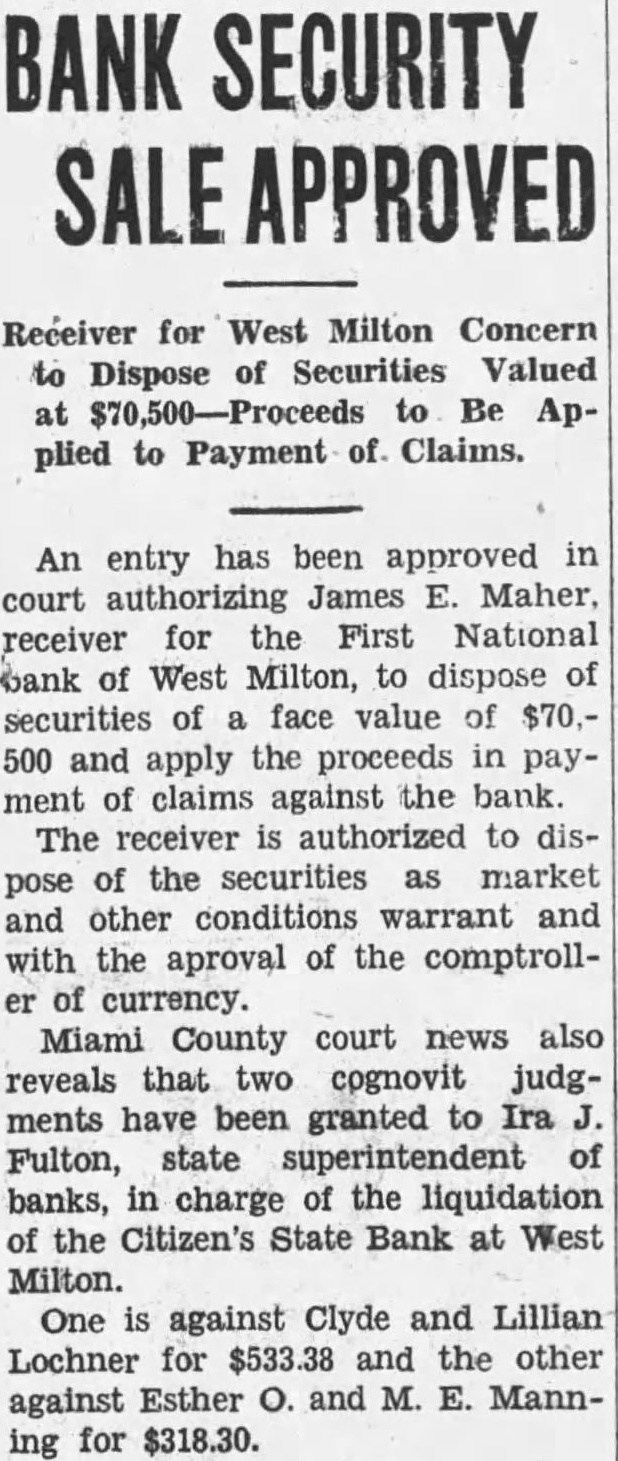
An entry has been approved in common pleas court authorizing James E. Maher, receiver for the First National bank of West Milton, to dispose of securities of face value of $70,500 and apply the proceeds in payment of claims against the bank. The receiver is authorized to dispose of the securities as market and other conditions warrant and with the approval of the comptroller of currency. Stockholders of the received notice Thursday of their double liability assessment required in the liquidation of this bank, of which amount at least 25% is due December 21, 1934.
Our own make Fruit Cake, light or dark, 35c pound at Harris Bakery. 22t1 Try Quaker State for your next oil change and be convinced of its qualities. Oil Station. 22t1 Mr. and Mrs. Louis Moore and daughter will entertain with a dinner on Thanksgiving Day, having as their guests Mr. Moore's two sisters and five brothers and their families. Dr. and Mrs. H. R. Pearson and daughter, Jean, Dr. and Mrs. Pearson and daughters, Mr. and Mrs. L. Dexter and son will join group of relatives who will enjoy Thanksgiving dinner at the Rev. and Mrs. Frank Thomas and family in Greenville. While the condition of Don Cassell, hunting accident victim, patient in Stouder Memorial hospital, Troy, continues to improve, in order to assist in spedier recovery a blood transfusion is being given this afternoon. His father, Howard S. Cassell is the donor of the blood.
According to word received Tuesday by Fire Chief Edwin Jay, Mr. Griswell of the Ohio Inspection Bureau, Columbus, will be in attendance at the regular meeting of the Central Western Firemen's association which will be held here Wednesday evening, December 5th, at o'clock. The West Milton Fire Company will be host to the meeting and refreshments will be served following the business session. A good representation of the membership is desired at the meeting. Mr. Jay is president of this organization.
Our own make Fruit Cake, light or dark, 35c pound at Harris Bakery. 22t1
Emmet Fauver Funeral Friday.
The remains of Emmet Fauver, linotype operator, Dayton, a former resident of West Milton will be brought to Riverside cemetery here for interment Friday afternoon following funeral services at the Whitmer Bros. Funeral Home Friday afternoon at o'clock. Mr. Fauver's death occurred Tuesday morning at his home, 36 East Mumma Dayton. formerly been employed with Dayton Journal and Herald as linotype operator. Mr. Fauver was employed in the Record office for short intervals while resident here. Surviving are the widow, Nellie Campbell Fauver; one brother of Vernon, Ind., and two sisters, Mrs. Minnie Root, of Cleveland, and Mrs. Ivan Swiley of South Bend, Ind. The body may be viewed Thursday afternoon and Friday morning at the Whitmer Bros. funeral home.
Oranges! Oranges!
Another truck load of tree ripened, sweet, juicy Florida oranges just arrived in Brookville. will have some in West Milton at the auction room next Saturday. Priced right.
22t1
G. G. Fox, Brookville.
Tavern Opening Thanksgiving Day The Cascade Tavern will be formally opened to the public Thaksgiving Day under the management Mrs. C. F. Kinzig of Dayton, who succeeded Mrs. Mary B. Pearson of Troy, taking possession the latter part of the week. The Tavern has been newly decorated and refurnished under the new management and provides one of the attractive eating houses of this section. Mrs. Kinzig is herself an interior decorator which is valuable asset and is evident upon entering the Tavern. Mrs. Kinzig will be in direct charge of the Tavern and assisting her is Mrs. Evadna Winter, home economist, and who was formerly associated with The Rike-Kumler Co.
The Tavern will cater to special groups, clubs wedding parties and although reservations are desired transients may be served noon or evening without reservations. Private dining room and club room service is available upon request. Your patronage will be appreciated.