15358. Bank of New York (New York, NY)

Bank Information

Episode Type
Suspension → Reopening
Bank Type
state
Start Date
June 1, 1837*
Location
New York, New York (40.714, -74.006)

Metadata

Model
gpt-5-mini
Short Digest
ada1fd41

Response Measures

None

Description

Articles discuss the Bank of New York in the 1837 suspension of New York banks during the nationwide panic and later resumption of payments. No single-article description of a discrete depositor 'run' on this specific bank is present; the suspension is described as part of the universal 1837 panic (macro/news). OCR in the second article contains year typos (e.g., '1939' and '1941' clearly meant 1839 and 1841); I used 1837 for the suspension and 1839 for the resumption as indicated by the text.

Events (2)

1. June 1, 1837* Suspension
Cause
Macro News
Cause Details
Part of the nationwide financial crisis of 1837 leading New York banks to suspend specie payments; described as 'universal suspension' rather than bank-specific failure.
Newspaper Excerpt
In 1837, universal suspension covered its insolvency.
Source
newspapers
2. January 1, 1839* Reopening
Newspaper Excerpt
Public opinion compelled all the banks to resume Jan. 1839. From that time to June ... the circulation was driven in upon it ... to the extent of $6,000,000, in consequence of the loss of credit.
Source
newspapers

Newspaper Articles (3)

Article from Herald of the Times, June 1, 1837

Click image to open full size in new tab

Article Text

the [From be will the the than and clear state ie astinfactors of ofthings, the course was bebe will most of the com of the Bank munity this mea; United and sure windom and that to to its their ing former 1837 13th, to My Dear of the 10 give in my that I last, stated the what embaropriate by that their in be restored in at OF least adoption twenty many experience has believe of events this readily prevent in the reduced But the country the have subject, and 10 look the banks and the each other. tive of the ed deposit their exam banks the by was ple; which course adopted the with not State banks governit is of certain ment. to cease that banks must cease, creditor in the the various in bank collection 1. paid certain if those requested. deif the these Now, not will pay very upon drawn of the them the ceases of the United reStates. the for and notes ceives its own of the Go deposit the notes vernment no of its receive not notes except Deposit the On Govern; Banks. in and is ment specie. bound except Treafrom with the all their notes for dufor ties, the while of the deposthe will not debts other Banks in warBanks specie Treasury exthis specie. inthe The instandFrench ample. to in due him demnity it in France. of gold importentionhis for portion own share tion. has rehe of his the but notes ceived the notes very of to receive debt which very from So he long owe might the and Gothe to therefore, other Banks Banks those Banks, to pay cannot they whom they the concer pay, the the with general saw Our Banks on carry They they were to 10 reYork New York. pay to to the fused pay Pennof New those Banks Kylvania did not. have York would and notes been specie the In Bank of the peculiar poand sition Had it consuited would have reserve. continued payments But other Bank#, of our the own aloof stand State; the from State other might regret, it censure. to disIt 2d. the of it. by credit paper the ceased State Banks pay specie, Pennsylvania when other speciellowed States in to pay costly breaking the of for down States, benefit of and mechanics all the of other


Article from The New York Herald, September 2, 1843

Click image to open full size in new tab

Article Text

Here is a concise history of the rise and fall of national, banking, and is full of instruction. From 1817 to 1828. a period of eleven years, the circulation never rose over $6,000,000, except in 1818, when it was brought within the brink of destruction, and was saved from suspension only by a miracle. In 1828 the bank entered the vortex of politics, which was inevitable-so large and overshadowing an institution cannot exist in a country like this where party politics run high, without being seized upon by ambitious lawyers for their OWD advancement. In the four succeeding years the "spread" of the bank was very rapid. Itsloans were pushed into all sections like an enormous political spider, its web was spread where ever votes were to be caught-but the result was very different from what it anticipated. Instead of defeating the opposing party, the inflation of the currency caused a universal rise in prices; and in 1832, with a full currency and high prices, the second election of General Jackson was carried almost by acclamation. The fact of high prices operated upon the whole country in favor of the party in power, and was far more effective than the immediate and direct influence of Bank loans, which resulted only in the ruin of the concern. From that moment its fate was sealed. The enor mous loans then made were never recovered, and to the extent of $20,000,000 now exist, characterized by the investigating committee only as not "mercantile paper." From that time up to 1837, the safety of the Bank existed only by the strength of its remaining credit and the universal expansion of other banks. In 1837, universal suspension covered its insolvency. Its struggles were desperate o prevent the resumption of the New York Banks in 1939, but in vain. Public opinion compelled all the banks to resume Jan. 1939. From that time to June it appears that the circulation was driven in upon it to the extent of $6,000,000, in consequence of the loss of credit. The immease mass of assets which the concern held were inac tive. To supply the active means. of which it was de. prived by the return of its circulation, post notes were sold at a heavy discount in all sections of the Union, and sale of fictitious bills of exchange was resorted avowed in the letter to, finally as the of J. Cowperthwaite, th cashier subsequently published, to compel a suspension of the New York Banks, in order that the universal insolvency might again cloak the bankruptcy of the late Na tional Bank. The ruse failed, however, and the mask was torn from the corrupt remains of one of the greatest curses ever inflicted upon a people. In the final failure of the bank, the country escaped, only by three, weeks one of the greatest calamities that could have befallen it The revolution of 1840, brought about by the fall of prices, occasioned by an approach of the currency to a specie level, brought into power the National Bank party March 1st, 1841. The Bank failed in February, 1941 Mr. Biddle explained, in a subsequent letter, the error the bank committed by resuming in Jan. 1841. He stated that if they had kept on until March 1, they then, under the new administration, would have received the Go. vernment deposits, have again become the National Bank, and with credit and means thus renewed, have re covered their affairs. The "financiers" overshot them. selves in this matter however. The Government could not have given its deposites to a suspended bank, and it was with the view to gain a little character prior to receiving


Article from The Indianapolis Journal, June 6, 1901

Click image to open full size in new tab

Article Text

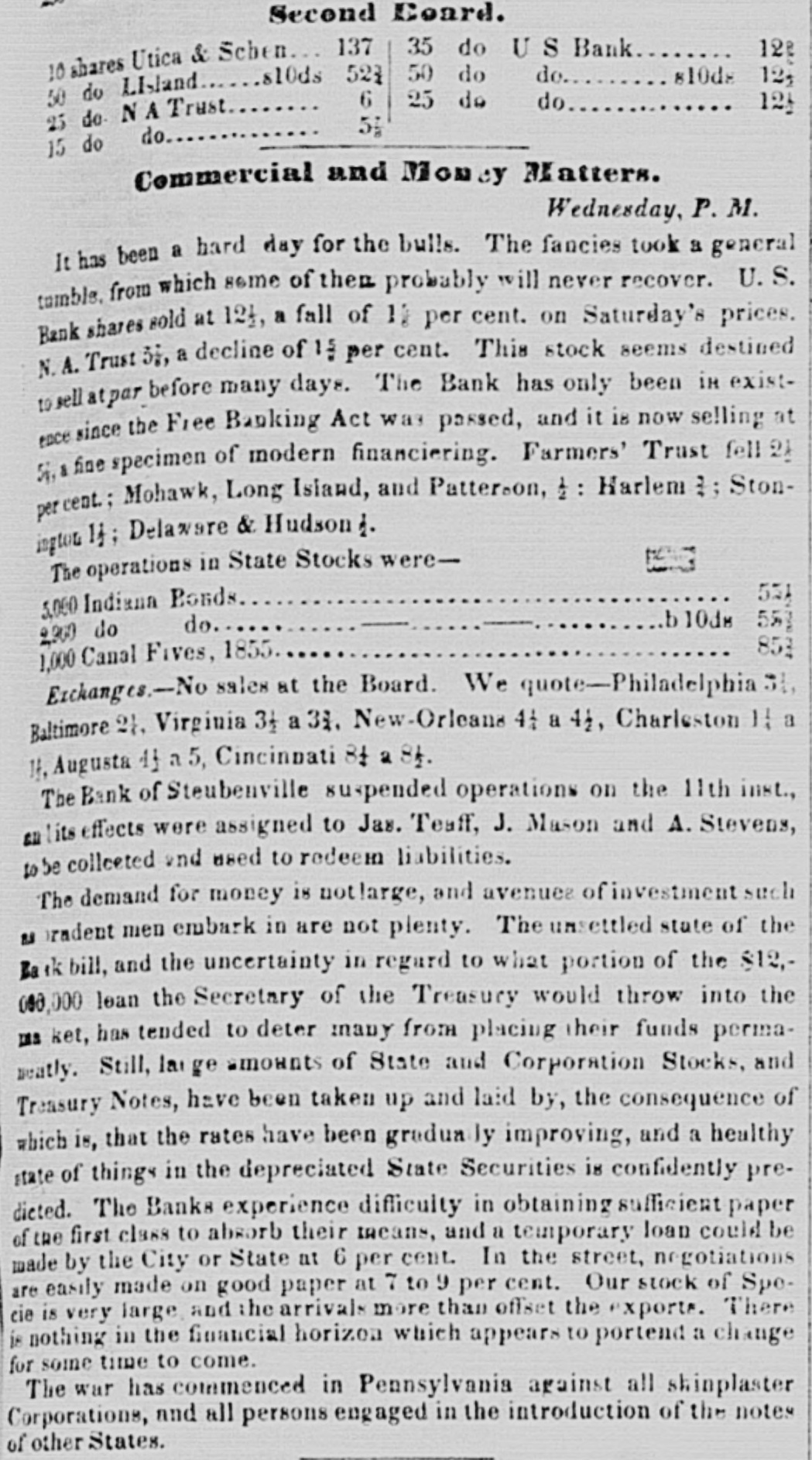
RICH MEN BY LONAMERICANS DON BANQUET CHAMBER TO OF COMMERCE. Handfrom New York by Are EmDelegates Entertained somely inent Englishmen. OF EXCHANGE COMPLIMENTS PRETTY TRIBUTES BY BOTH THE HOSTS AND GUESTS. and Lord Lord Lansdowne Brassey Welcomes the Toasts Visitors President McKinley. SPEECH BY MORRIS K. JESU IN COMMERCIAL HE TELLS OF ENGLAND'S CRISES, HELP to the Much Country And says Americans Carnegie owe DisMother cusses Friendly Relations. tendered LONDON, June 5-The banquet of Commerce to Chamber Chamber at the London New York was Commerce affairs the by delegates of Grocers' the Hall to- of night the kind hosof one of the in handsome city famed spared for lavish to honor ever pitality given No effort guests: was but it must the be repu- confessed the Ameri the latter did for not brilliant sustain after speak dintation America Nor has did the tedium British of four ner speaking much to relieve the the speeches, however, ers do speaking. All friendliness in the All the hours teemed with blishment extreme of speakers permathe would nent and faith friendly relations. belief that Great rule the Britain desunand tinies expressed the of United the world, States would and always that work their for alliance of mankind of written the benefit the Bank peace and Hall, just reputation opposite of being the England, Grocers has the chamber of all the recep- city most Interesting series of impressive bancompanies. leads A to the oak-paneled to-night were tion queting rooms hall. The profusion tables of flowers gal- and decorated with Around the hall is was historic plate. evening adva the lery, which, ladies as the who attended to hear filled with his right was speeches. Brassey presided. On left Lord LansMr Lord Choate and K. on Jesup, his Andrew Alverstone Carnedowne Cornelius Morris N. Bliss, ngland). Lord Mr. Grisand gie, (lord chief justice C. Ward, of Lord Strathcona Lord Ascom, George Levi P. Morton, ChamMount (president Royal, of the Associated J. Pierpont Morbury of Commerce) and seated at the table bers among those were present. gan were In all nearly 300 SPEECH of honor. BRASSEY'S Brassey, welcoming LORD the guests said: Lord We welwho In made the first speech, representatives of the the come them as the which have turned continent skill and resources enterprise of the American We are largely the vast the service these of benefits. mankind Our teeming food Ameri- miland us lions sharers could in not live the without raw materials lessons for our not the industries. ca produces America creation teaches but in the liberal disonly tribution in of wealth the debt Great Britain ComReferring to York Chamber dimeu the owed to the the New time the said Venezeul he sense of merce mark Great Lord Britain' no deep other we nation, to our service rendered we drawn a The wisely continued across "are the of Atlantic our two peoples directed kinsmen friendship erhaps should be yet, by formal orking together for may the mented potent influence. all trade. may common good the door for protect the and keep spread open civilization. we may may blish peace when among the nations." murmur of oreign expect expectancy There was the the McKinley. duty Lord to Lansdo toast President "that this honoral agine he said, to me because foreign been the that nected with may may seem fairs, my lips, mere private coming from more than and good will. something something of admiration to think think pression Majesty may say that the United States of his with cheers our relations relations (Pro foreign like hold those who, feel that they pains shall relations publicistic commission that the most no McKinley, maintain President he fills. With mainegard regard to great office member public he has addition to his of private anxiety the burden and his wife may continue be restored health whole and world a country bear. that that he may potent influence the of the human ADDRESS York the good JESUP'S New MR. president replying of the to the adMr Jesup, Commerce, thanking the memof Chamber of after Commerce dress the welcome, London Chamber said: of 'We do for bers their cordial you reception, instilled into our dealing minds habits in the dawn not forget of industry how thrift of and the fair twentieth with some we century relations business so that now, are able to state between rounding pride that the amount to the don't asto forget two countries yearly We 130 years, the $960,000,000 during the past primarily sum you have, auce this result; how aided aided us to produce product religion and have of those principles of Imbibed justice from transac you as foundation which we of all the free loaning of our tions, the enable us to make mines, use build capital to extend our hown us We do not forget distress. resours an the kindness notably in 1837 of financial people suspen disof our honored times when standstill payments and our citizens and business when one presheartened, princely merchants (after by his James high King of our visited London. your and, ranced financia £1,000 men Englar advanced that the Bank of and and sent the the control same New York, enable under the banks thus ATT King. to specie payments. no York to resume King on his the rantee, storing confidence. honor of Mr no stipulation Baring Brothers' as to the gua time the loan was to being made reward being the desire be rett the only act. We do not. quired and friendly when during do a kindly forget we were not when. only threatened overshad late struggle, country. but were war with you. with the menace of wise and Queen (God owed good. was our bless her memory)