Bank suffered runs in Oct 1875, adopted 60-day rule, then suspended in Dec 1875 with a receiver appointed and significant deficiency.
Events (3)
1.October 9, 1875Run
Cause
Local Banks
Cause Details
Run sparked by general distrust after the failure of the Third Avenue Savings Bank; panic spread to other local savings banks.
Measures
Bank invoked by-law to require sixty days' notice for withdrawals and refused large withdrawals except for urgent needs or small sums.
Newspaper Excerpt
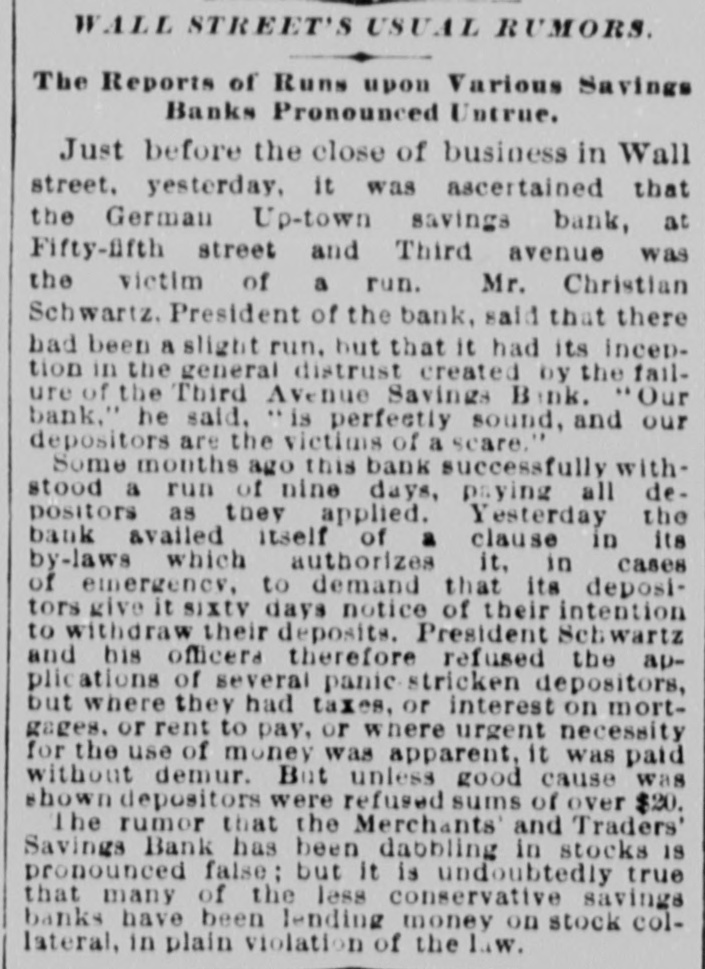
Just before the close of business ... the German Up-town savings bank ... was the victim of a run. ... our depositors are the victims of a scare.
Source
newspapers
+59 days
2.December 7, 1875Suspension
Cause
Bank Specific Adverse Info
Cause Details
Discovery of large deficiencies and bad Southern and other bonds; heavy prior withdrawals reduced liabilities and revealed insolvency leading to suspension and enforcement of 60-day rule prior to closure.
Newspaper Excerpt
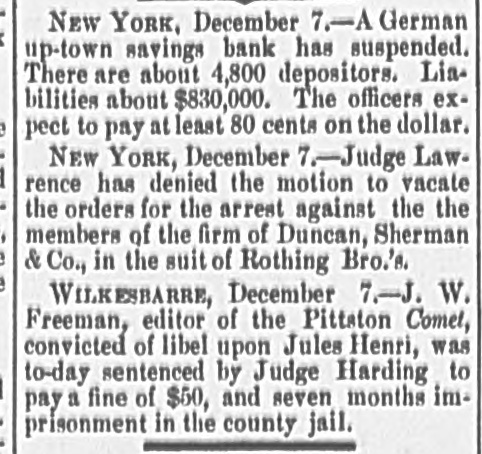
NEW YORK, December 7.-A German up-town savings bank has suspended. There are about 4,800 depositors. Liabilities about $830,000.
Source
newspapers
+1 day
3.December 8, 1875Receivership
Newspaper Excerpt
THE GERMAN UPTOWN SAVINGS BANK SUSPENSION-A RECEIVER APPOINTED ... the sudden collapse of the German Uptown Savings Bank ... a receiver is to be asked for. ... a receiver appointed for the bank was reported in subsequent articles and dividends later paid by the receiver.
Source
newspapers
Newspaper Articles (22)
1.October 9, 1875The SunNew York, NY
Click image to open full size in new tab
Article Text
WALL STREET'S USUAL RUMORS
The Reports of Runs upon Various Savings Banks Pronounced Untrue. Just before the close of business in Wall street. yesterday, it was ascertained that the German Up-town savings bank, at Fifty-fifth street and Third avenue was the victim of a run. Mr. Christian Schwartz. President of the bank, said that there bad been a slight run. but that it had its inception in the general distrust created by the failure of the Third Avenue Savings Bank. "Our bank, he said. is perfectly sound, and our depositors are the victims of a scare." Some months ago this bank successfully withstood a run of nine days, paying all depositors as they applied. Yesterday the bank availed itself of a clause in its by-laws which authorizes it, in cases of emergency, to demand that its depositors give it SIXTV days notice of their intention to withdraw their deposits. President Sebwartz and his officera therefore refused the applications of several panic stricken depositors, but where they had taxes, or interest on mortgages. or rent to pay, or where urgent necessity for the use of money was apparent, it was paid without demur. But unless good cause was shown depositors were refused sums of over $20. The rumor that the Merchants' and Traders' Savings Bank has been dabbling in stocks IS pronounced false: but it is undoubtedly true that many of the less conservative savings banks have been lending money on stock collateral, in plain violation of the law.
2.October 9, 1875Alexandria GazetteAlexandria, VA
Click image to open full size in new tab
Article Text
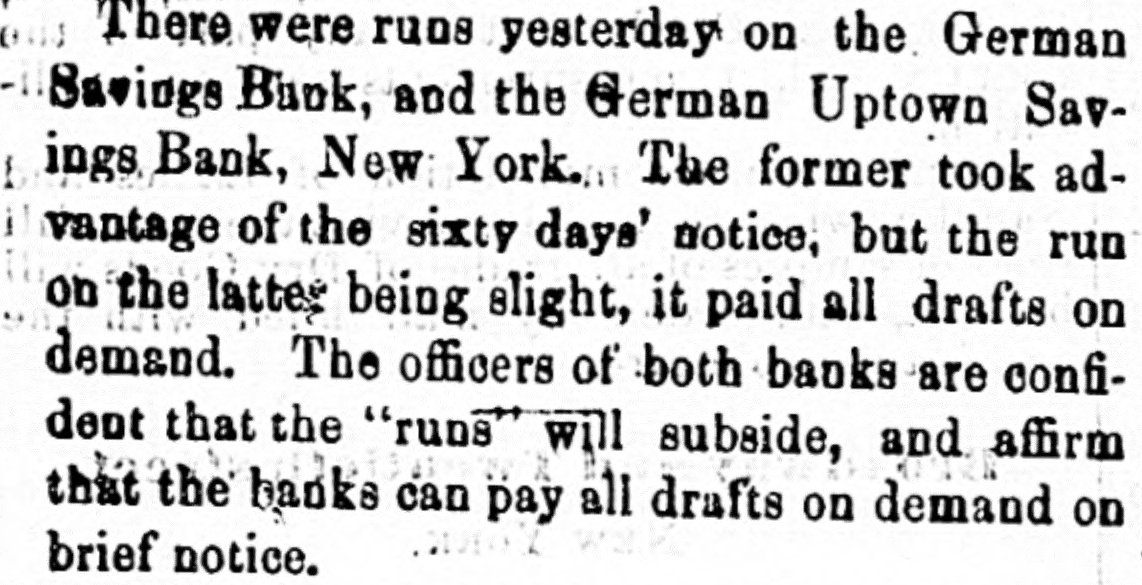
There were runs yesterday on the German Savings Bank, and the German Uptown Savings Bank, New York. The former took advantage of the sixty days' notice, but the run on the latter being slight, it paid all drafts on demand. The officers of both banks are confident that the "runs" will subside, and affirm that the banks can pay all drafts on demand on brief notice.
3.November 27, 1875The New York HeraldNew York, NY
Click image to open full size in new tab
Article Text
THE GERMAN UPTOWN SAVINGS BANK
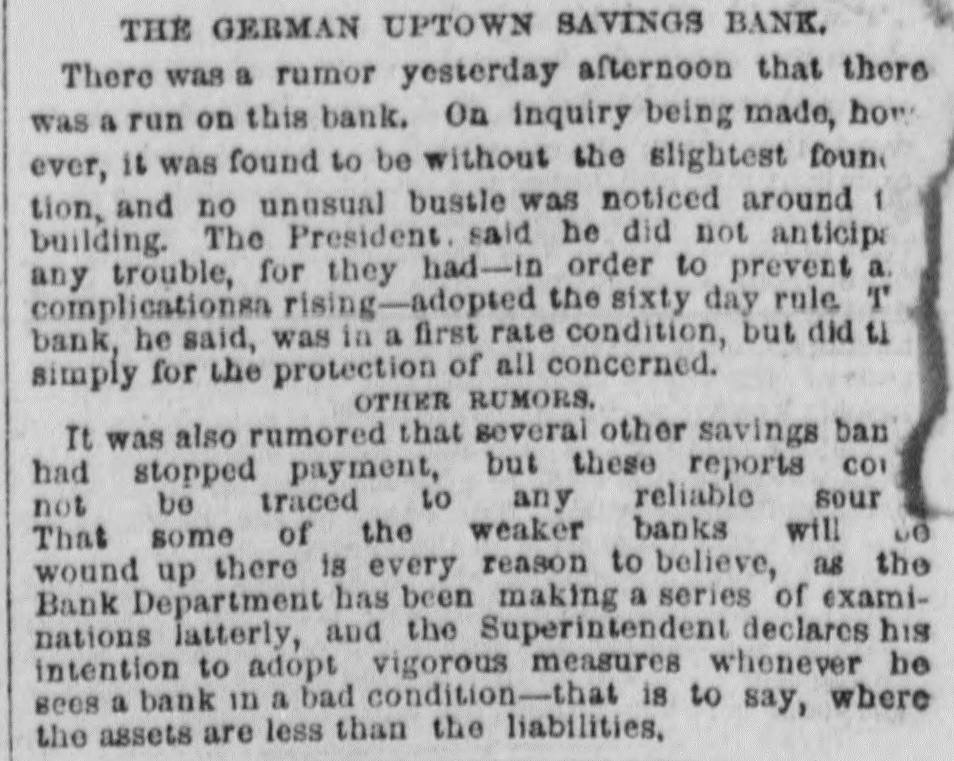
There was a rumor yesterday afternoon that there was a run on this bank. On inquiry being made, how ever, it was found to be without the slightest found tion, and no unusual bustle was noticed around 1 building. The President. said he did not anticipa any trouble, for they had-in order to prevent a. complicationsa rising-adopted the sixty day rule T bank, he said, was in a first rate condition, but did ti simply for the protection of all concerned. OTHER RUMORS. It was also rumored that several other savings ban had stopped payment, but these reports COI not be traced to any reliable sour That some of the weaker banks will 00 wound up there is every reason to believe, as the Bank Department has been making a series of examinations latterly, and the Superintendent declares his intention to adopt vigorous measures whenever he sees a bank in a bad condition-that is to say, where the assets are less than the liabilities,
4.November 29, 1875New-York TribuneNew York, NY
Click image to open full size in new tab
Article Text
LOCAL MISCELLANY
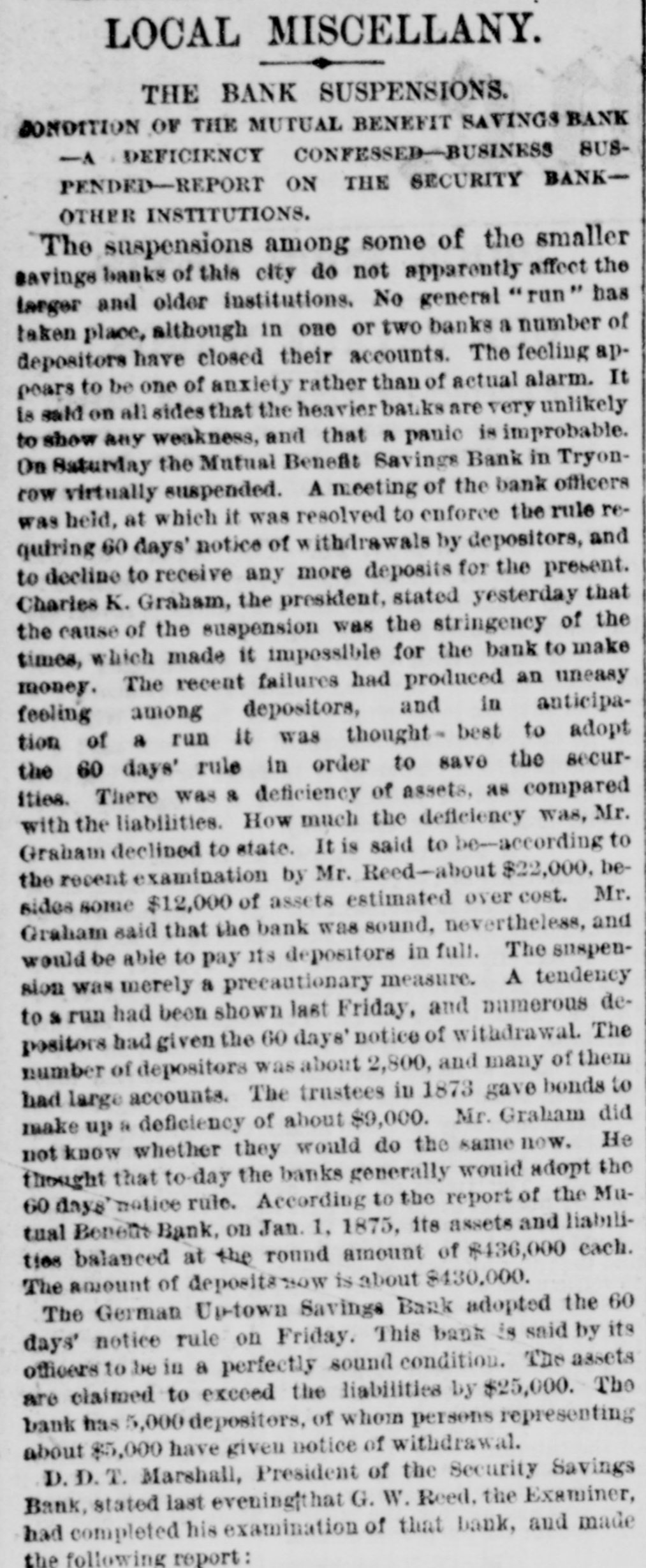
THE BANK SUSPENSIONS. DONOTTION OF THE MUTUAL BENEFIT SAVINGS BANK -A DEFICIENCY CONFESSED-BUSINESS SUSPENDED-REPORT ON THE SECURITY BANKOTHER INSTITUTIONS. The suspensions among some of the smaller savings banks of this city do not apparently affect the larger and older institutions. No general "run" has taken place, although in one or two banks a number of depositors have closed their accounts. The feeling appears to be one of anxiety rather than of actual alarm. It is said on all sides that the heavier bauks are very unlikely to show any weakness, and that a panic is improbable. On Saturday the Mutual Benefit Savings Bank in Tryonrow virtually suspended. A meeting of the bank officers was held, at which it was resolved to enforce the rule requiring 60 days' notice of withdrawals by depositors, and to decline to receive any more deposits for the present. Charles K. Graham, the president, stated yesterday that the cause of the suspension was the stringency of the times, which made it impossible for the bank to make money. The recent failures had produced an uneasy feeling among depositors, and in anticipation of a run it was thought best to adopt the 60 days' rule in order to save the securities. There was & deficiency of assets, as compared with the liabilities. How much the deficiency was, Mr. Graham declined to state. It is said to be-according to the recent examination by Mr. Reed-about $22,000, besides some $12,000 of assets estimated over cost. Mr. Graham said that the bank was sound, nevertheless, and would be able to pay its depositors in full. The suspension was merely a precautionary measure. A tendency to & run had been shown last Friday, and numerous depositors had given the 60 days' notice of withdrawal. The number of depositors was about 2,800, and many of them had large accounts. The trustees in 1873 gave bonds to make up a deficiency of about $9,000. Mr. Graham did not know whether they would do the same now. He thought that to-day the banks generally would adopt the 60 days' notice rule. According to the report of the Mutual Benefit Bank, on Jan. 1, 1875, its assets and liabilities balanced at the round amount of $436,000 each. The amount of depositsnow is about $430,000. The German Up-town Savings Bank adopted the 60 days' notice rule on Friday. This bank is said by its officers to be in a perfectly sound condition. The assets are claimed to exceed the liabilities by $25,000. The bank has 5,000 depositors, of whom persons representing about $5,000 have given notice of withdrawal. D. D. T. Marshall, President of the Security Savings Bank, stated last evening(that G. W. Reed, the Examiner, had completed his examination of that bank, and made the following report:
5.December 8, 1875The SunNew York, NY
Click image to open full size in new tab
Article Text
The Grent Showman's Scn-in-Law Appointed Receiver- Looking into the Books of the German Up-Town Savings Bank.
NEW YORK, December 7.-A German up-town savings bank has suspended. There are about 4,800 depositors. Liabilities about $830,000. The officers expect to pay at least 80 cents on the dollar. NEW YORK, December -Judge Lawrence has denied the motion to vacate the orders for the arrest against the the members of the firm of Duncan, Sherman & Co., in the suit of Rothing Bro.'s. WILKESBARRE, December 7.-J. W. Freeman, editor of the Pittston Comet, convicted of libel upon Jules Henri, was to-day sentenced by Judge Harding to pay a fine of $50, and seven months imprisonment in the county jail.
7.December 8, 1875The Morning HeraldWilmington, DE
Click image to open full size in new tab
Article Text
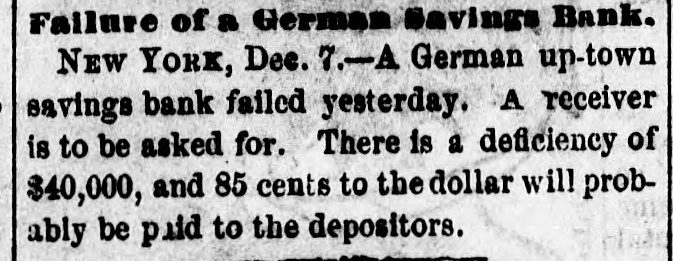
Failure of a German Savings Bank. NEW YORK, Dec. 7.-A German up-town savings bank failed yesterday. A receiver is to be asked for. There is a deficiency of $40,000, and 85 cents to the dollar will probably be paid to the depositors.
8.December 8, 1875The New York HeraldNew York, NY
Click image to open full size in new tab
Article Text
THE BROKEN BANKS
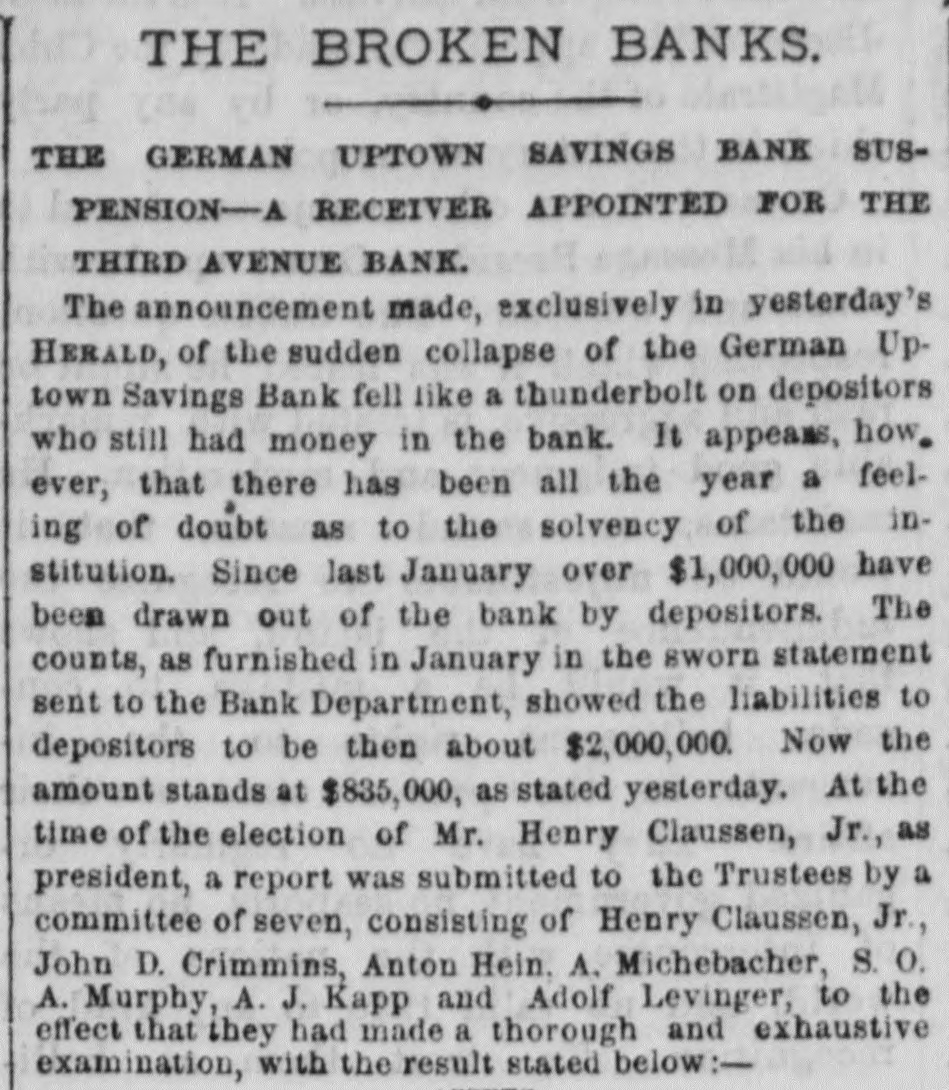
THE GERMAN UPTOWN SAVINGS BANK SUSPENSION-A RECEIVER APPOINTED FOR THE THIRD AVENUE BANK. The announcement made, exclusively in yesterday's HERALD, of the sudden collapse of the German Uptown Savings Bank fell like a thunderbolt on depositors who still had money in the bank. It appears, how. ever, that there has been all the year a feeling of doubt as to the solvency of the institution. Since last January over $1,000,000 have been drawn out of the bank by depositors. The counts, as furnished in January in the sworn statement sent to the Bank Department, showed the liabilities to depositors to be then about $2,000,000. Now the amount stands at $835,000, as stated yesterday. At the time of the election of Mr. Henry Claussen, Jr., as president, a report was submitted to the Trustees by a committee of seven, consisting of Henry Claussen, Jr., John D. Crimmins, Anton Hein. A. Michebacher, S. O. A. Murphy, A. J. Kapp and Adolf Levinger, to the effect that they had made a thorough and exhaustive examination, with the result stated below:-
9.December 18, 1875The SunNew York, NY
Click image to open full size in new tab
Article Text
THE GERMAN UP-TOWN BANK
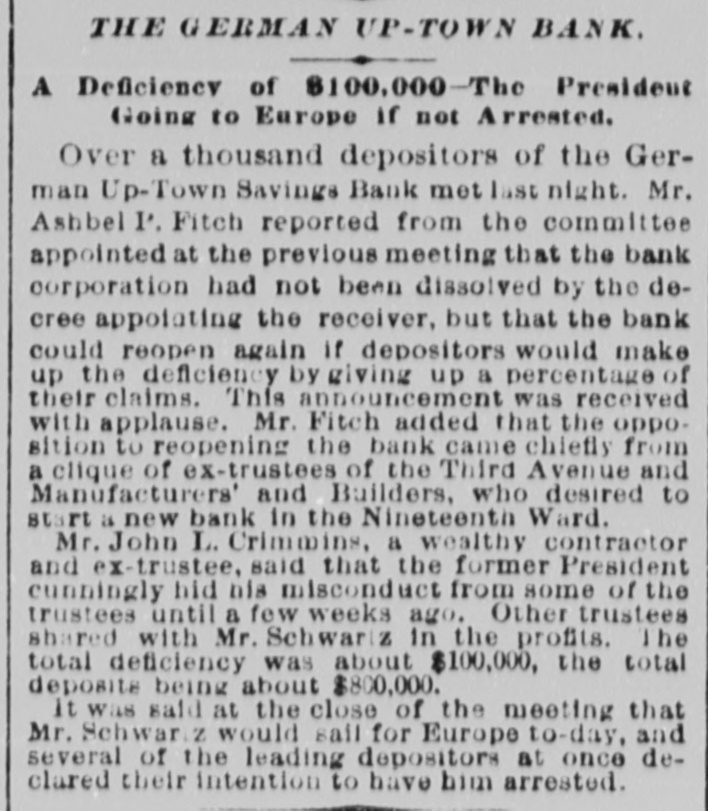
A Deficiency of $100,000-The President Going to Europe if not Arrested. Over a thousand depositors of the German Up-Town Savings Bank met last night. Mr. Ashbel P. Fitch reported from the committee appointed at the previous meeting that the bank corporation had not been dissolved by the decree appointing the receiver, but that the bank could reopen again if depositors would make up the deficiency by giving up a percentage of their claims. This announcement was received with applause. Mr. Fitch added that the opposition to reopening the bank came chiefly from a clique of ex-trustees of the Third Avenue and Manufacturers' and Builders, who desired to start a new bank in the Nineteenth Ward. Mr. John L. Crimmins, a wealthy contractor and ex-trustee, said that the former President cunningly hid his misconduct from some of the trustees until a few weeks ago. Other trustees shared with Mr. Schwartz in the profits. The total deficiency was about $100,000, the total deposits being about $800,000. it was said at the close of the meeting that Mr. Schwar: would sail for Europe to-day, and several of the leading depositors at once declared their intention to have him arrested.
10.December 20, 1875New-York TribuneNew York, NY
Click image to open full size in new tab
Article Text
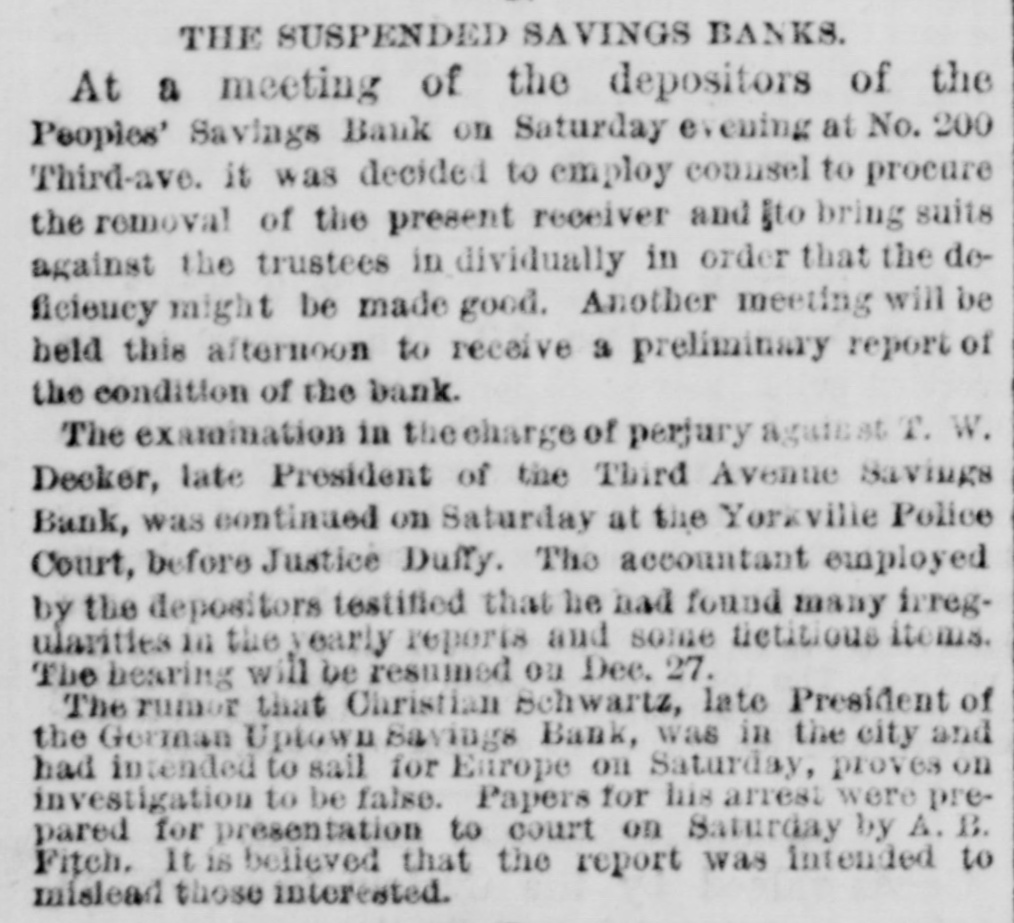
THE SUSPENDED SAVINGS BANKS
At a meeting of the depositors of the Peoples' Savings Bank on Saturday evening at No. 200 Third-ave. it was decided to employ counsel to procure the removal of the present receiver and Ito bring suits against the trustees in dividually in order that the deficiency might be made good. Another meeting will be held this afternoon to receive a preliminary report of the condition of the bank. The examination in the charge of perjury against T. W. Decker, late President of the Third Avenue Savings Bank, was continued on Saturday at the Yorkville Police Court, before Justice Duffy. The accountant employed by the depositors testified that he had found many irregularities in the yearly reports and some tietitious items. The hearing will be resumed on Dee. 27. The rumor that Christian Schwartz, late President of the German Uptown Savings Bank, was in the city and had intended to sail for Europe on Saturday, proves on investigation to be false. Papers for his arrest were prepared for presentation to court on Saturday by A. B. Fitch. It is believed that the report was intended to mislead those interested.
11.December 20, 1875Chicago Daily TribuneChicago, IL
Click image to open full size in new tab
Article Text
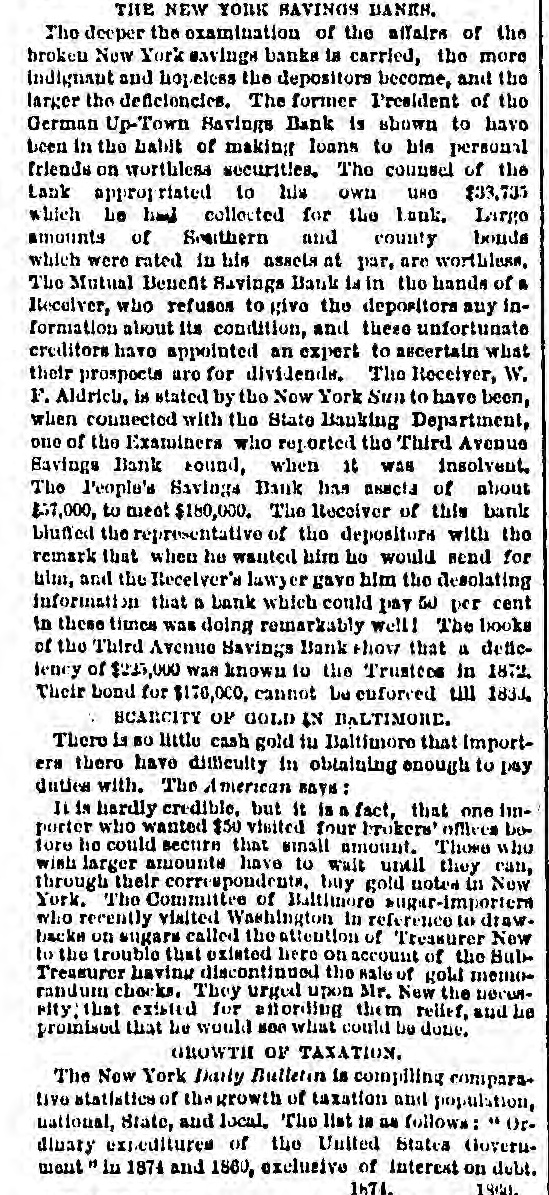
THE NEW YORK SAVINGS BANKS
The deeper the examination of the affairs of the broken New York savings banks is carried, the more Indignant and hopeless the depositors become, and the larger the deficiencies. The former President of the German Up-Town Havings Bank is shown to have been In the habit of making loans to bis personal friends on worthless securities, The counsel of the Lank approp risted to his own UHO $33,735 which Le had collected for the Lank. Large amounts of Seathern and county bonds which were rated in his assets at par, are worthless, The Mutual Benefit Ravings Bank is in the hands of A Receiver, who refusos to give the depositors any information about its condition, and these unfortunate creditors have appointed an expert to ascertain what their prospects are for dividends. The Receiver, W. F. Aldrich, in stated by the Now York Sun to have been, when connected with the State Banking Department, one of the Examiners who reported the Third Avenue Savings Bank sound, when it was insolvent. The People's Savings Bank has assets of about $57,000, to meet $180,000. The Receiver of this bank bluffed the representative of the depositors with the remark that when he wanted him he would send for him, and the Receiver's lawy er gave him the desolating informati >n that a bank which could pay 50 per cent to these titnes was doing remarkably well! The books of the Third Avenue Savings Bank thow that a deficiency of $235,000 was known to the Trustees in 1872. Their bond for $176,000, cannot be enforced till 183.1 SCARCITY OF GOLD IN BALTIMORE. There is BO little cash gold in Baltimore that Importera there have difficulty in obtaining enough to pay duties with. The American says: It is hardly credible, but it is n fact, that one Inporter who wanted $50 visited four brokers' offices be fore he could secure that small amount. Those who winh larger amounts have to wait until they can, through their correspondents, buy gold notes in New York. The Committee of Baltimore sugar-importers who recently visited Washington in reference to drawbacks on sugars called the attention of Treasurer New to the trouble that existed here on account of the BubTreasurer having discontinued the sale of gold memorandum checks. They urged upon Mr. New the necescity: that existed for affording them relief, and he promised that be would 800 what could be done. GROWTH OF TAXATION. The New York Daily Bulletin is compiling comparative statistics of the growth of taxation and population, national, State, and local, The list is as follows: 44 Ordinaty expeditures of the United States Government " in 1874 and 1860, exclusive of interest on debt. 1674. 1900.
12.December 23, 1875The SunNew York, NY
Click image to open full size in new tab
Article Text
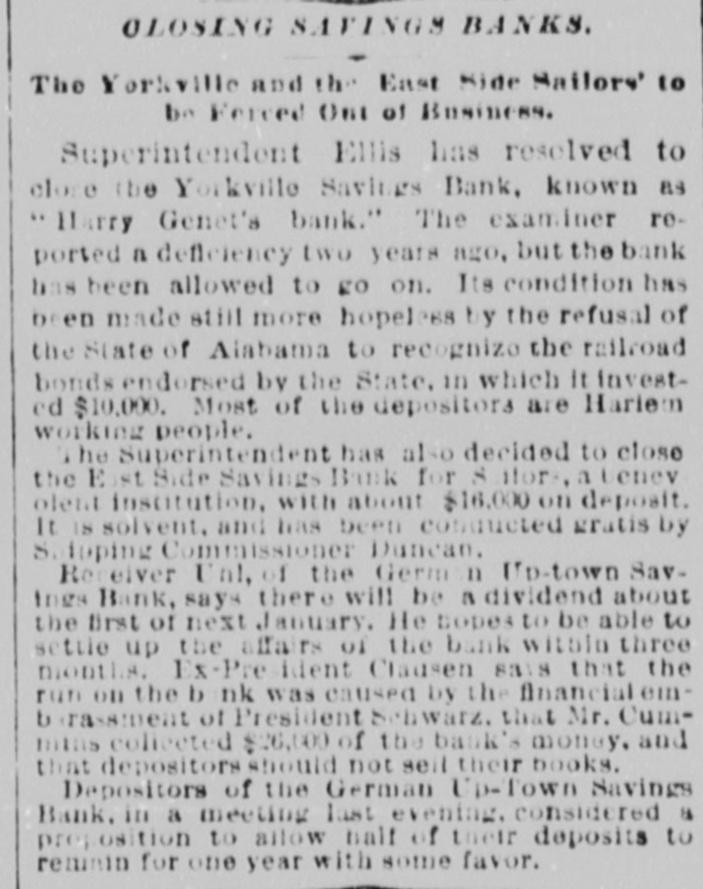
OLOSING SAVINGS BANKS
The Yorkville and the East Side Sailors' to be Forced One of Business. Superintendent Ellis has resolved to close the Yorkville Savings Bank, known as "Harry Genet's bank." The examiner reported a deficiency two years ago, but the bank has been allowed to go on. Its condition has been made still more hopeless by the refusal of the State of Alabama to recognizo the railroad bonds endorsed by the State, in which It Invested $10,000. Most of the depositors are Hariem working people. The Superintendent has also decided to close the East Side Savings Bank for 8 tor. a Uenev olent institution, with about $16,000 on deposit. It IS solvent. and has been conducted gratis by S. toping Commissioner Duncan. Rei reiver Uni, of the Germ 11 Up-town Savtries Bank, says there will be a dividend about the first of next January. He DODES to be able to settle up the affairs of the bank within three months. Ex-Pre-ident Clausen 8318 that the run on the b nk was caused by the financial emrassment of President Sebwarz. that Mr. Cummiss collected $26,000 of the bask's money. and that depositors should not seil their books. Depositors of the German i---Town Savings Bank. in a meeting last eventage considered is prej osition to allow half of their deposits to reminin for one year with some favor.
13.December 23, 1875New-York TribuneNew York, NY
Click image to open full size in new tab
Article Text
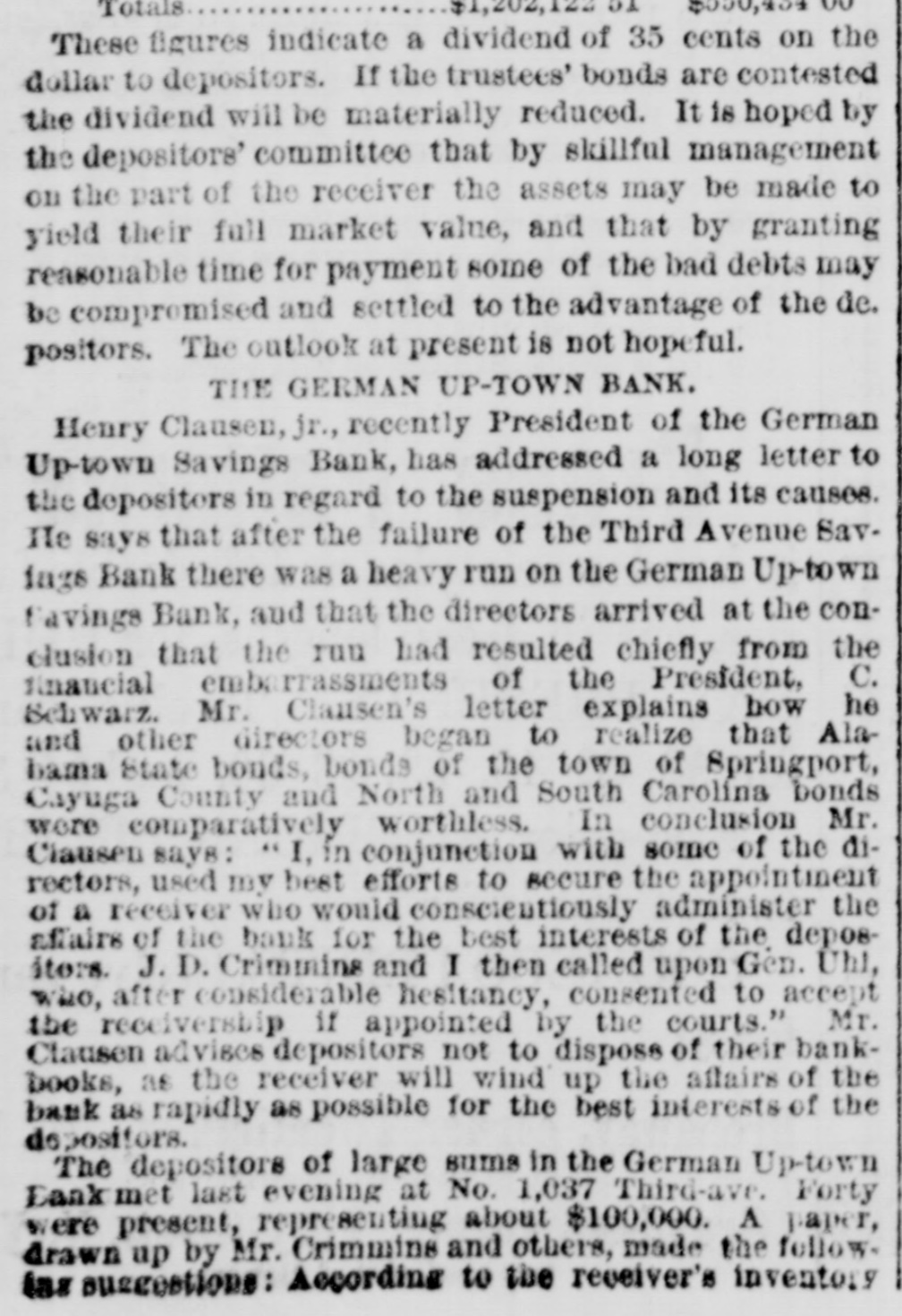
01 Totals These figures indicate a dividend of 35 cents on the dollar to depositors. If the trustees' bonds are contested the dividend will be materially reduced. It is hoped by the depositors' committee that by skillful management on the part of the receiver the assets may be made to yield their full market value, and that by granting reasonable time for payment some of the bad debts may be compromised and settled to the advantage of the de. positors. The outlook at present is not hopeful. THE GERMAN UP-TOWN BANK. Henry Clausen, jr., recently President of the German Up-town Savings Bank, has addressed a long letter to the depositors in regard to the suspension and its causes. He says that after the failure of the Third Avenue Savings Bank there was a heavy run on the German Up-town Savings Bank, and that the directors arrived at the conclusion that the run had resulted chiefly from the financial emba arrassments of the President, C. Schwarz. Mr. Clausen's letter explains how he and other directors began to realize that Alabama State bonds, bonds of the town of Springport, Cayuga County and North and South Carolina bonds were comparatively worthless. In conclusion Mr. Clausen says: "I, in conjunction with some of the directors, used my best efforts to secure the appointment of a receiver who would conscientiously administer the affairs of the bank for the best interests of the depositers. J. D. Crimmins and I then called upon Gen. Uhl, who, after considerable hesitancy, consented to accept the receivership if appointed by the courts." Mr. Clausen advises depositors not to dispose of their bankbooks, as the receiver will wind up the affairs of the bank as rapidly as possible for the best interests of the depositors. The depositors of large sums in the German Up-town Lank met last evening at No. 1,037 Third-ave. Forty were present, representing about $100,000. A paper, drawn up by Mr. Crimmins and others, made the fellow. las sucgestions: According to the receiver's inventory
14.December 29, 1875New-York TribuneNew York, NY
Click image to open full size in new tab
Article Text
THE SUSPENDED SAVINGS BANKS
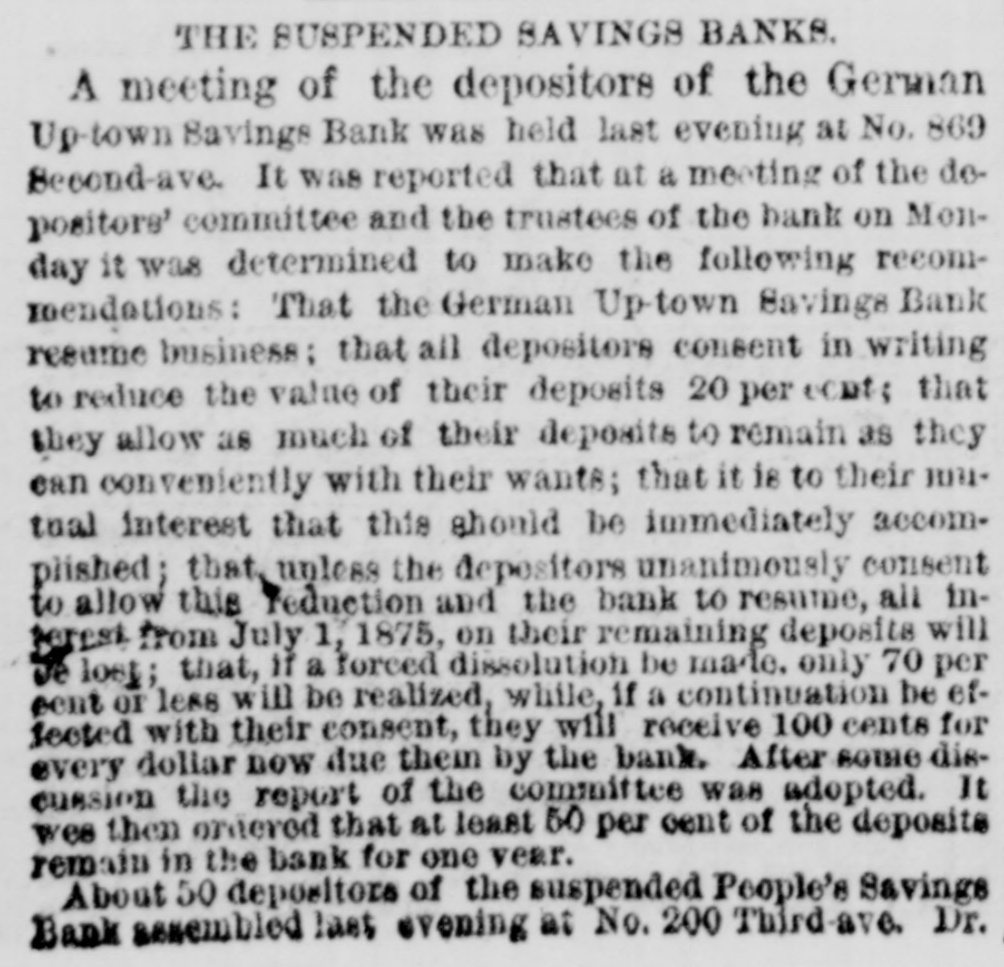
A meeting of the depositors of the German Up-town Savings Bank was held last evening at No. 869 Becond-ave. It was reported that at a meeting of the depositors' committee and the trustees of the bank on Monday it was determined to make the following recommendations: That the German Up-town Savings Bank resume business: that all depositors consent in writing to reduce the value of their deposits 20 per ocut; that they allow as much of their deposits to remain as they can conveniently with their wants; that it 18 to their mutoal interest that this should be immediately accomplished; that unless the depositors unanimously consent to allow this reduction and the bank to resume, all inperest from July 1, 1875, on their remaining deposits will ve lost; that, if a forced dissolution be made. only 70 per cent or less will be realized, while, if a continuation be effeeted with their consent, they will receive 100 cents for every dollar now due them by the bank. After some discussion the report of the committee was adopted. It wes then ordered that at least 50 per cent of the deposits remain in the bank for one year. About 50 depositors of the suspended People's Savings Bank assembled last evening at No. 200 Third-ave. Dr.
15.December 31, 1875The SunNew York, NY
Click image to open full size in new tab
Article Text
DEPOSITORS IN A RAGE
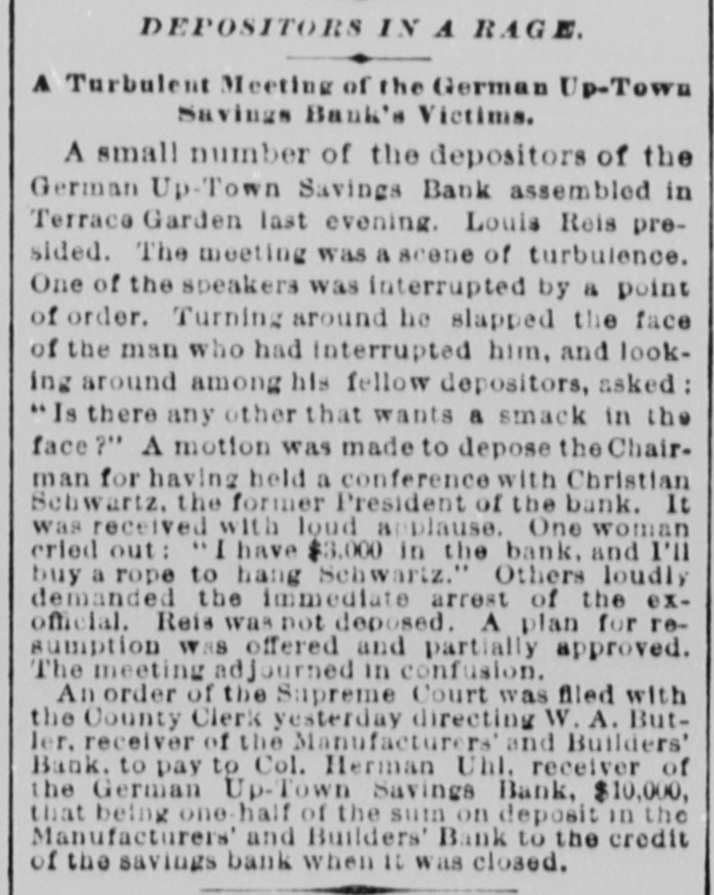
A Turbulent Meeting of the German Up-Town Savings Bank's Victims. A small number of the depositors of the German Up-Town Savings Bank assembled in Terrace Garden last evening. Louis Reis presided. The meeting was a scene of turbulence. One of the speakers was interrupted by a point of order. Turning around he slapped the face of the man who had interrupted him. and looking around among his fellow depositors, asked: Is there any other that wants a smack in the face?" A motion was made to depose the Chairman for having held a conference with Christian Schwartz. the former President of the bank. It was received with loud applause. One woman cried out: "I have $3.000 in the bank. and I'll buy a rope to hang Schwartz." Others loudly demanded the immediate arrest of the exofficial. Reis was not deposed. A plan for resumption WAS offered and partially approved. The meeting adjourned in confusion. An order of the Supreme Court was filed with the County Clerk yesterday directing W. A. Butler, receiver of the Manufacturers' and Builders' Bank. to pay to Col. Herman Uhl. receiver of the German Up-Town Savings Bank, $10,000, that being one half of the sum on deposit in the Manufacturers' and Builders' Bank to the credit of the savings bank when It was closed.
16.December 31, 1875New-York TribuneNew York, NY
Click image to open full size in new tab
Article Text
THE SUSPENDED SAVINGS BANKS
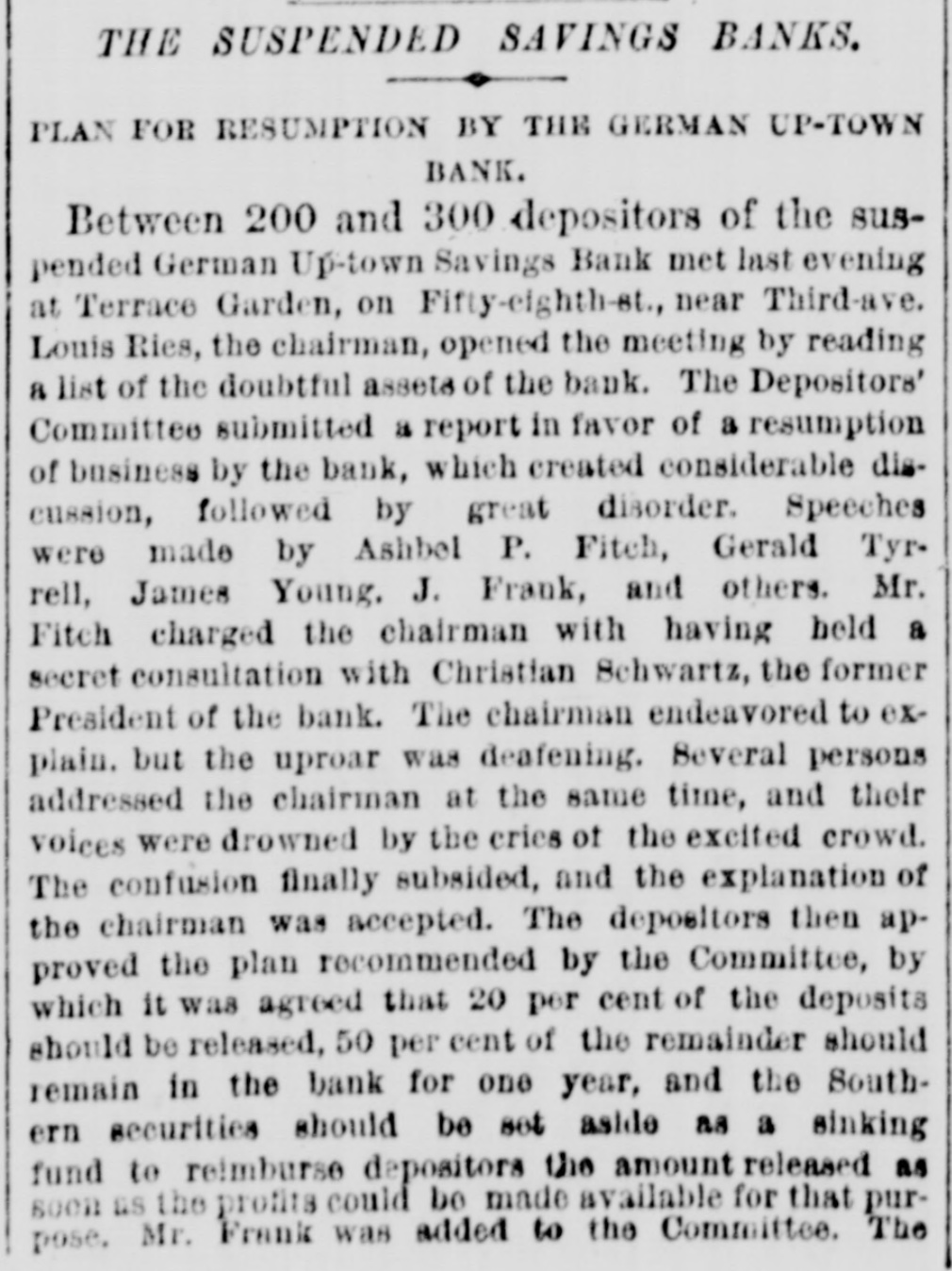
PLAN FOR RESUMPTION BY THE GERMAN UP-TOWN BANK. Between 200 and 300 depositors of the suspended German Up-town Savings Bank met last evening at Terrace Garden, on Fifty-eighth-st., near Third-ave. Louis Ries, the chairman, opened the meeting by reading a list of the doubtful assets of the bank. The Depositors' Committee submitted a report in favor of a resumption of business by the bank, which created considerable discussion, followed by great disorder. Speeches were made by Ashbel P. Fitch, Gerald Tyrrell, James Young. J. Frank, and others. Mr. Fitch charged the chairman with having held a secret consultation with Christian Schwartz, the former President of the bank. The chairman endeavored to explain. but the uproar was deafening. Several persons addressed the chairman at the same time, and their voices were drowned by the cries of the excited crowd. The confusion finally subsided, and the explanation of the chairman was accepted. The depositors then approved the plan recommended by the Committee, by which it was agreed that 20 per cent of the deposits should be released, 50 per cent of the remainder should remain in the bank for one year, and the Southern securities should be set aside as a sinking fund to reimburse depositors the amount released as soon as the profits could be made available for that purpose. Mr. Frank was added to the Committee. The
17.January 12, 1876New-York TribuneNew York, NY
Click image to open full size in new tab
Article Text
THE MUTUAL BENEFIT SAVINGS BANK
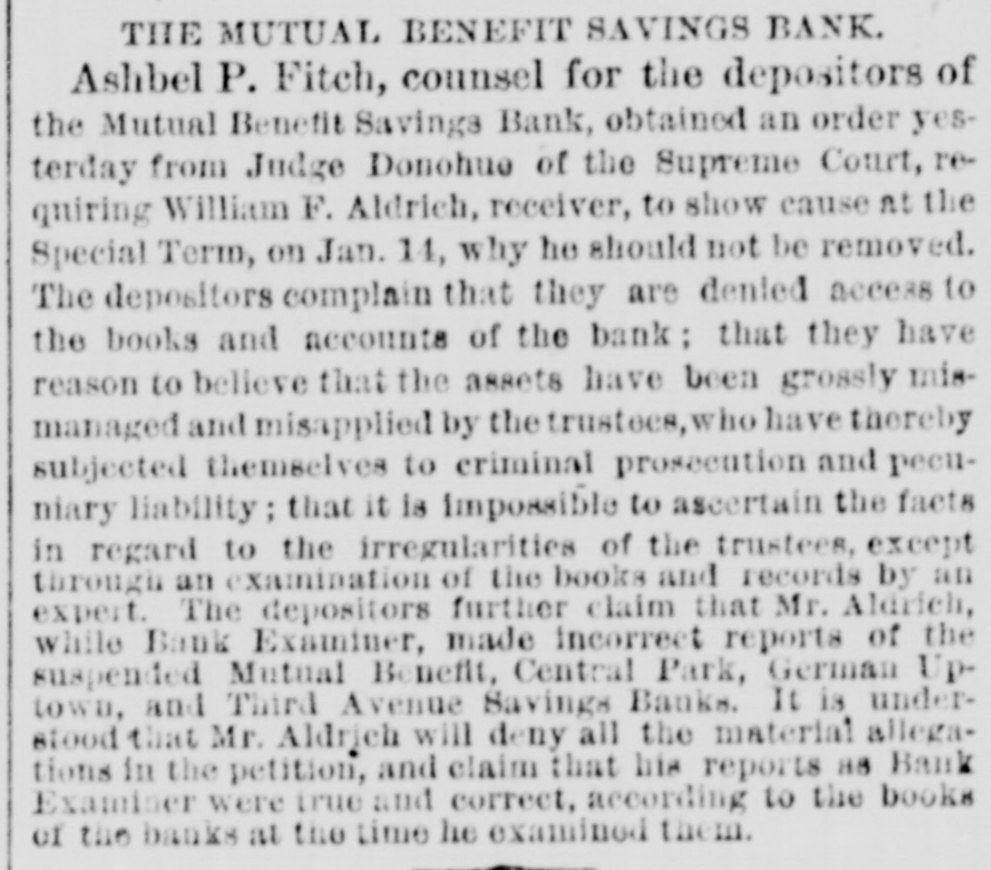
Ashbel P. Fitch, counsel for the depositors of the Mutual Benefit Savings Bank, obtained an order yesterday from Judge Donohue of the Supreme Court, requiring William F. Aldrich, receiver, to show cause at the Special Term, on Jan. 14, why he should not be removed. The depositors complain that they are dented access to the books and accounts of the bank: that they have reason to believe that the assets have been grossly mismanaged and misapplied by the trustoes, who have thereby subjected themselves to criminal prosecution and pecuniary liability; that it is impossible to ascertain the facts in regard to the irregularities of the trustees, except through an examination of the books and records by an expert. The depositors further claim that Mr. Aldrich, while Bank Examiner, made incorrect reports of the suspended Mutual Benefit, Central Park, German Uptown, and Third Avenue Savings Banks. It is understood that Mr. Aldrich will deny all the material allegations in the petition, and claim that his reports as Bank Examiner were true and correct, according to the books of the banks at the time he examined them.
18.January 21, 1876New-York TribuneNew York, NY
Click image to open full size in new tab
Article Text
THE GERMAN UP-TOWN SAVINGS BANK
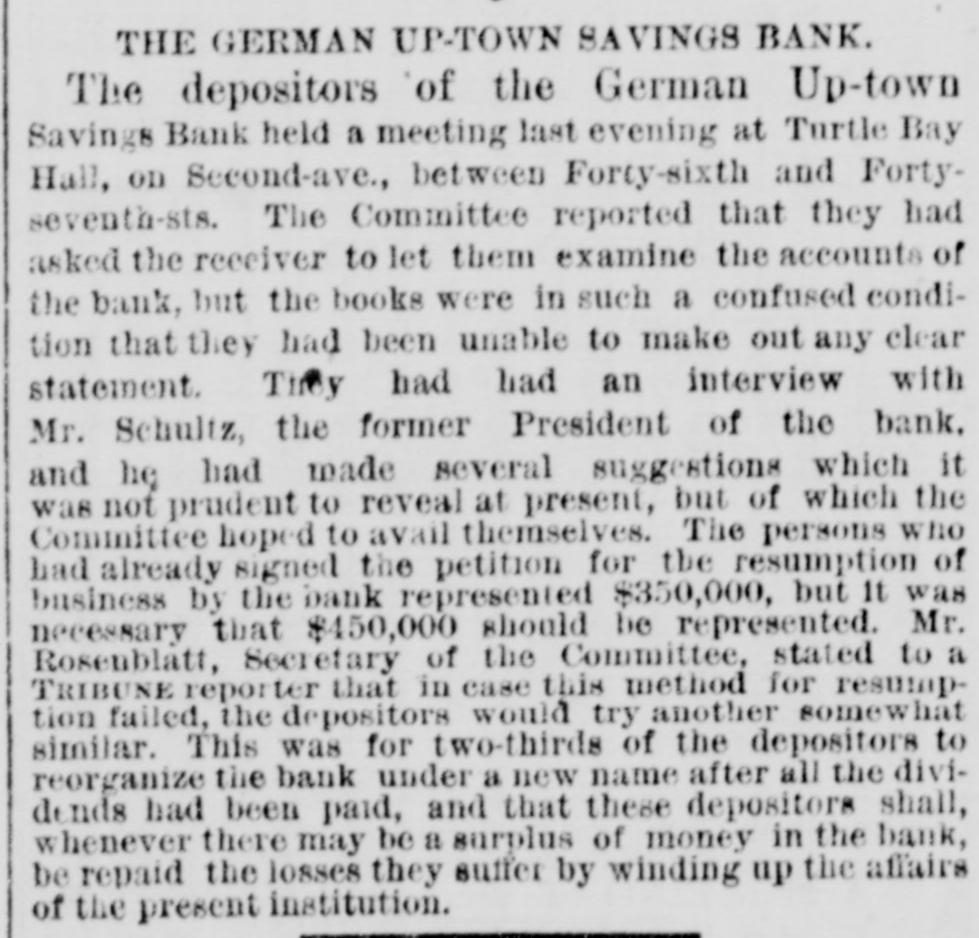
The depositors of the German Up-town Savings Bank held a meeting last evening at Turtle Bay Hall, on Second-ave., between Forty-sixth and Fortyseventh-sts. The Committee reported that they had asked the receiver to let them examine the accounts of the bank, but the books were in such a confused condition that they had been unable to make out any clear statement. They had had an interview with Mr. Schultz, the former President of the bank. and he had made several suggestions which it was not prudent to reveal at present, but of which the Committee hoped to avail themselves. The persons who had already signed the petition for the resumption of business by the bank represented $350,000, but It was necessary that $450,000 should be represented. Mr. Rosenblatt, Secretary of the Committee, stated to a TRIBUNE reporter that in case this method for resumption failed, the depositors would try another somewhat similar. This was for two-thirds of the depositors to reorganize the bank under a new name after all the dividends had been paid, and that these depositors shall, whenever there may be a surplus of money in the bank, be repaid the losses they suffer by winding up the affairs of the present institution.
19.January 31, 1876New-York TribuneNew York, NY
Click image to open full size in new tab
Article Text
THE GERMAN UP-TOWN SAVINGS BANK
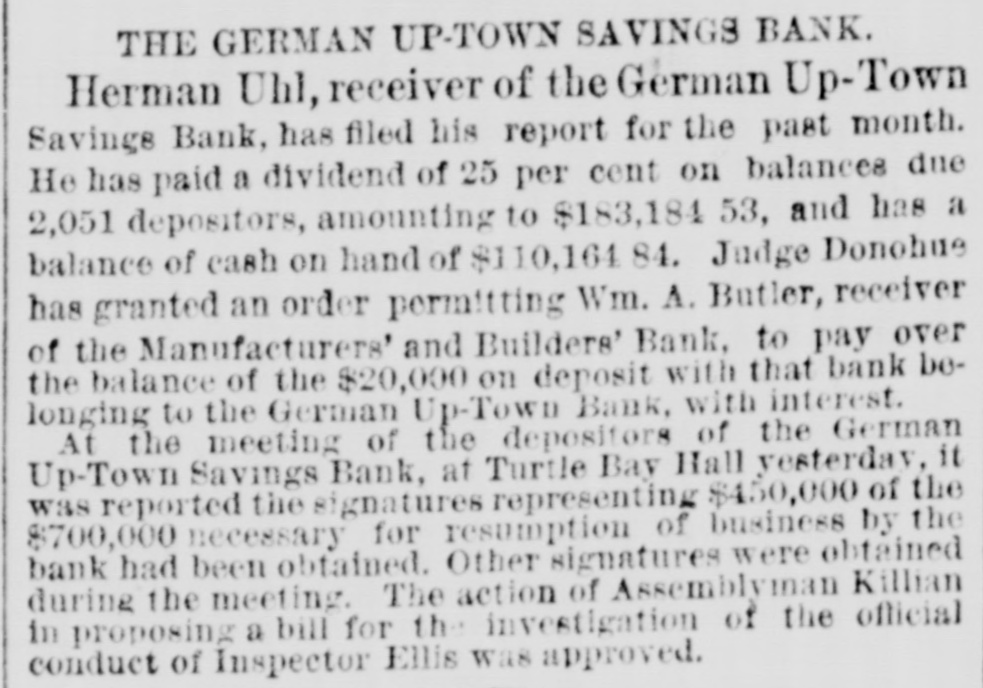
Herman Uhl, receiver of the German Up-Town Savings Bank, has filed his report for the past month. He has paid a dividend of 25 per cent on balances due 2,051 depositors, amounting to $183,184 53, and has a balance of cash on hand of $110,164 84. Judge Donohue has granted an order permitting Wm. A. Butler, receiver of the Manufacturers' and Builders' Bank, to pay over the balance of the $20,000 on deposit with that bank belonging to the German Up-Town Bank, with interest. At the meeting of the depositors of the German Up-Town Savings Bank, at Turtle Bay Hall yesterday, it was reported the signatures representing $450,000 of the $700,000 necessary for resumption of business by the bank had been obtained. Other signatures were obtained during the meeting. The action of Assemblyman Killian in proposing a bill for th investigation of the official conduct of Inspector Ellis was approved.
20.April 8, 1878The New York HeraldNew York, NY
Click image to open full size in new tab
Article Text
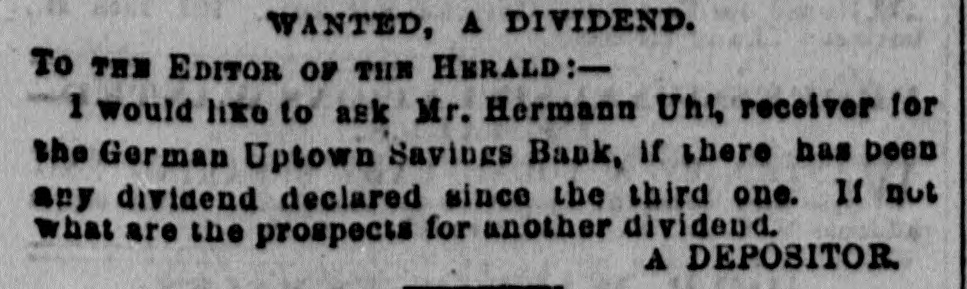
WANTED, A DIVIDEND. To THE EDITOR OF THE HERALD:1 would like to ask Mr. Hermann Uhi, receiver for the German Uptown Savings Bank, if there has been any dividend declared since the third one. If not what are the prospects for another dividend. A DEPOSITOR.
21.September 9, 1878The New York HeraldNew York, NY
Click image to open full size in new tab
Article Text
HOPE DEFERRED
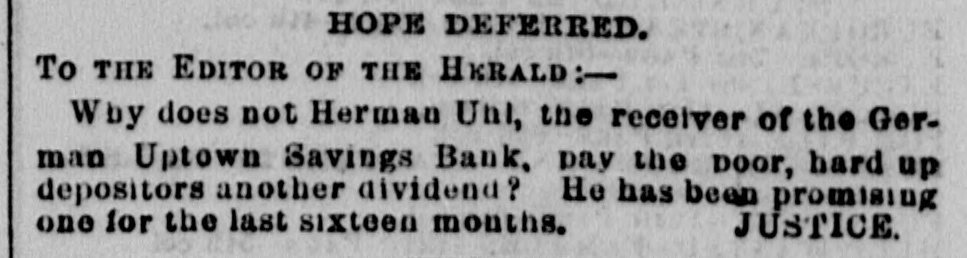
To THE EDITOR OF THE HERALD:Why does not Herman Uni, the receiver of the German Uptown Savings Bank, pay the Door, hard up depositors another dividend? He has been promising one for the last sixteen months. JUSTICE.
22.November 2, 1878The New York HeraldNew York, NY
Click image to open full size in new tab
Article Text
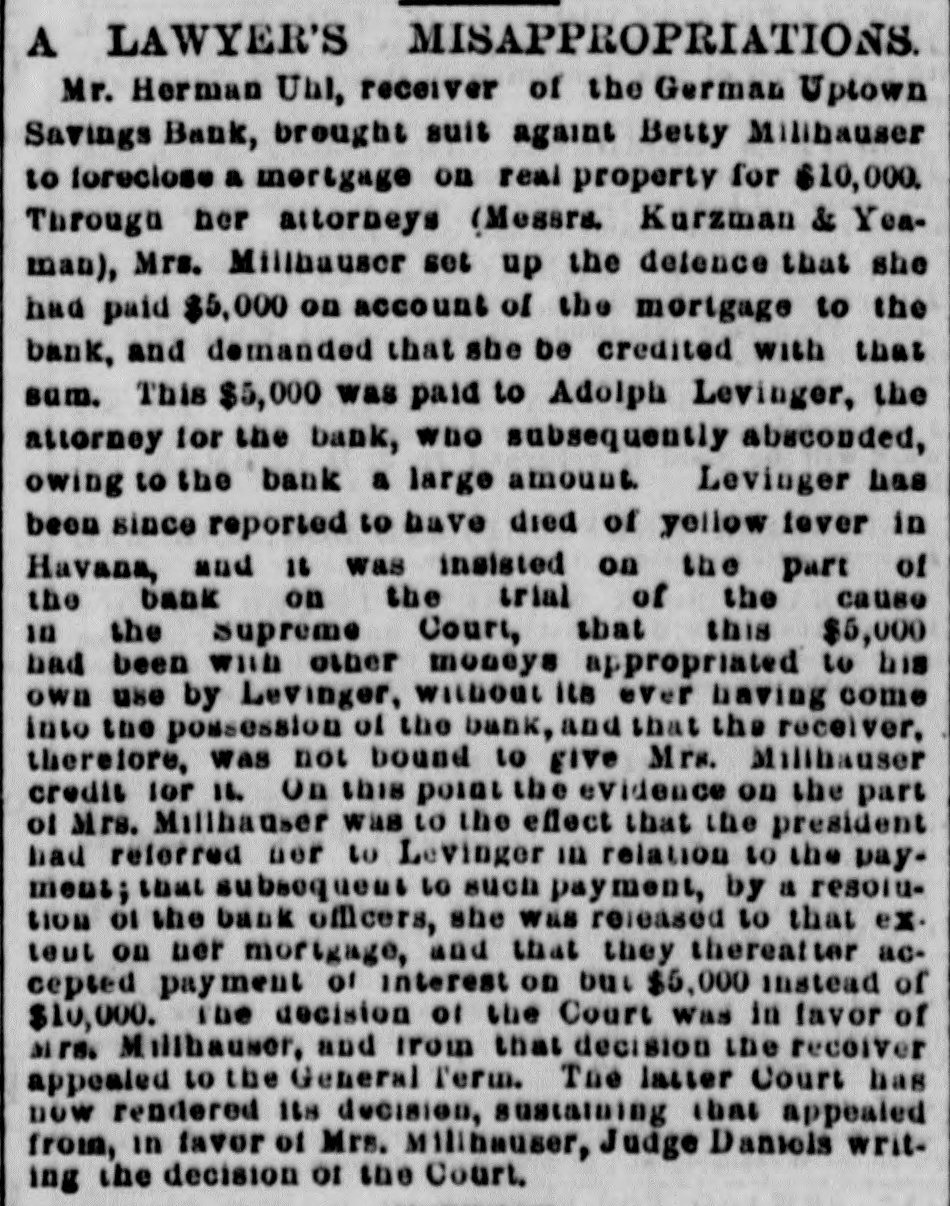
A LAWYER'S MISAPPROPRIATIONS.
Mr. Herman Uhl, receiver of the German Uptown Savings Bank, brought suit againt Betty Milihauser to foreclose a mortgage on real property for $10,000. Through her attorneys (Messrs. Kurzman & Yeaman), Mrs. Millhauser set up the defence that she had paid $5,000 on account of the mortgage to the bank, and demanded that she be credited with that sum. This $5,000 was paid to Adolph Levinger, the attorney for the bank, who subsequently absconded, owing to the bank a large amount. Levinger has been since reported to have died of yellow fever in Havana, and it was insisted on the part of the bank on the trial of the cause in the supreme Court, that this $5,000 had been with other moneys appropriated to his own use by Levinger, without its ever having come into the possession of the bank, and that the receiver, therefore, was not bound to give Mrs. Milthauser credit for it. On this point the evidence on the part of Mrs. Millhauser was to the effect that the president had referred her to Levinger in relation to the payment; that subsequent to such payment, by a resolution of the bank officers, she was released to that extent on her mortgage, and that they thereafter accepted payment of interest on but $5,000 instead of $10,000. The decision of the Court was in favor of Mrs. Millhauser, and from that decision the receiver appealed to the General Term. The latter Court has now rendered its decision, sustaining that appealed from, in favor of Mrs. Milihauser, Judge Daniels writing the decision of the Court.
Bank runs are almost always and everywhere a deterioration of bank fundamentals.
But not for you.
You are the measure-zero exception: great fundamentals, solid bank, and yet the Diamond Dybvig fairy spread its rumor. Depositors woke up. Your collateral was not prepositioned. The Clearinghouse had it for you.
Do not pass Go. Do not collect $200. Go directly to jail… or worse.
Flag Article for Review
Flag Episode for Review
German Uptown Savings Bank · Episode ID 1532191590910