1530. Farmers Bank (Bridgeport, CT)

Bank Information

Episode Type
Suspension → Reopening
Bank Type
state
Start Date
October 16, 1857
Location
Bridgeport, Connecticut (41.167, -73.205)

Metadata

Model
gpt-5-mini
Short Digest
35e14d0b

Response Measures

None

Description

Multiple contemporaneous newspaper reports (Oct 16, 1857) state the Farmers' Bank of Bridgeport suspended specie payments during the Panic of 1857. No article describes a depositor run on this specific bank; the suspension appears to be part of the wider financial crisis (macro shock). There is no explicit article here stating a later permanent failure or receiver; a Nov 13 item notes the bank discontinued redemption at the Suffolk Bank and had its notes redeemed in New York by private bankers, which suggests altered redemption arrangements but not a documented receivership. I classify as suspension_reopening (suspension due to macro financial crisis, with no clear evidence of permanent closure in the provided articles).

Events (2)

1. October 16, 1857 Suspension
Cause
Macro News
Cause Details
Suspension occurred amid the nationwide financial panic of October 1857; multiple papers list several banks suspending specie payments the same day.
Newspaper Excerpt
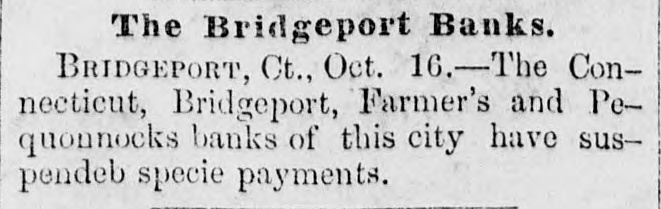
The Connecticut, Bridgeport, Farmer's, and Pequonmock banks of this city have suspended specie payments.
Source
newspapers
2. November 13, 1857 Other
Newspaper Excerpt
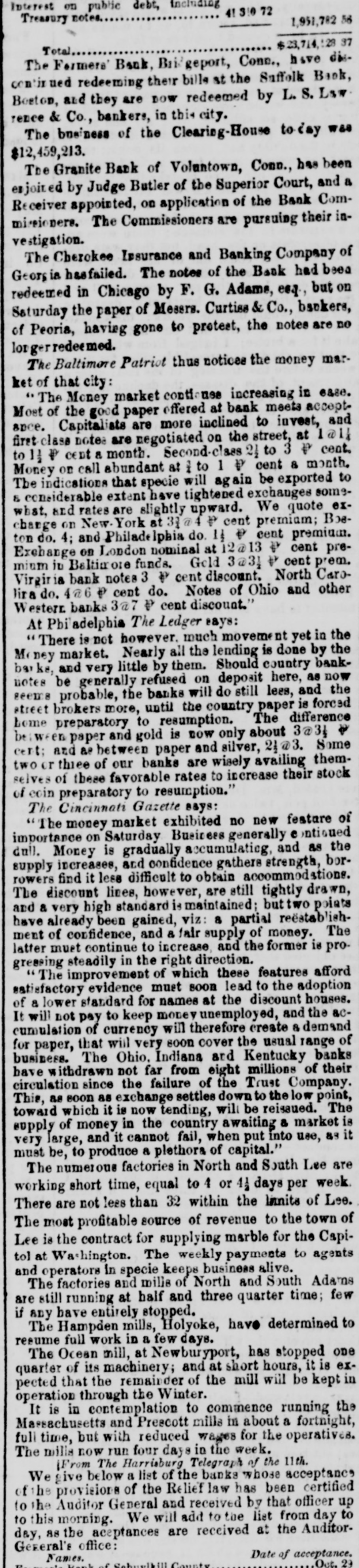
Farmers' Bank, Bridgeport, Conn., have discontinued redeeming their bills at the Suffolk Bank, Boston, and they are now redeemed by L. S. Lawrence & Co., bankers, in this city. (The Farmers' Bank notes are redeemed in New York by private bankers.)
Source
newspapers

Newspaper Articles (9)

Article from The New York Herald, October 17, 1857

Click image to open full size in new tab

Article Text

alarming, If not fatal, accumulation in the national Treasury have been inevitable; and that this accu mulation in 1857, after a heavy payment of national debi, would reach the sum of $30,000,000. On the 1st July, the 1858, would $ the in surplus estimated, Treasury, reach the amount of $44 000,000 Such condition of the public finances would be as fatal to the interests of the country as is would be to the integrity of the government This latter : the first which in the diroumstance aspect presented Itself to the administration of that year. It the choose ween an increase expenditures or the re duction of the revenue; and being como concerrent with the traditions of the democratic party she administration rep resented, as well as with the interes of the country, such reduction was decided on Mr Guthrie, of Kentucky, was then the Secretary of the Treasury and his ad. ministration of the duties had never been surpassed, and interest in the success of national industry prompted him to the thorough consideration of the plan of re re-orge nizing the revenue system. His purpose was to secure economy in the public fx penditure, and also the procerty every branch of Ame rican American industry There we the tariff of 1846 eight schedules, and he proposed to re duoe them to two-the first paying duty of 25 per cent and the second embracing articles admitted free of duty, which were obiefly raw materials used in the manuf clares this country The last schedule contained we hundred and eight specifications, on W bioh had been levied duty from ten to thirty per cent, and which duty to this extent was tax upon our manufa manufacturing industry or the to the people benefit treasury without any The reduction of the duty from 26 per cent, first sched schedule, would have diminished the revenue $43,000 000 year. The 210 articles the second, or free would have caused a further reduction of $8 $8,000,000, leaving but $5,000,000 in the treasury In 1855, when the tariff was to go into ope operation, the effect oa the country that disbursement $15,000,000 would been the have year, instead of on ac immulation of $80,000,000 in the reasury In 1857 11 woul h have relieved the manufac uring interest of $8,000,000 each year, and he peo the burthen of the dnties paid on their imports, of $1 500, 000. These two items of reduction from the two years preceding 1857 would have shown a difference of $28,000,000 saved to the people, instead of baing to the national treasury Such was the character of the mea sure of Mr Gathrie which was assetied on the ground that 18 was a departure from the principles of the act 1846. and protective measure It was del inded on the principle that it was measure for the revenue, with incidental protection to American Industry and in that view. that It was like every tariff which bad been established since beginning of the government, and that it improved the example 80: by the to nations move was a and Europe, nearly approaching free trade. Mr B nks, after explaining the provisions of the English and French tariff, said that almost the last pub declaration made by the late Str Robert Peel, in Parlia. ment, was, that in a service of forty years he d had never approached the subject of the renue imports out onS that the materials raw strengthen deavoring principle should have been furnished the manufacturers free of duty Robert Rantoul, the most eminent unab of his day bis knowledge of matters of trade, in his speech in Congress, in 1851, advocated the enlargement of the free and the admission of raw materials as an element of freedom in trade, and of prosperity in American industry But the true character of Mr. Gathrie's measure was not to determined by the a pect in which was regarded as free trade or protective measure-for it might be made either, as the government chose-ani in whate FOR direction It mored it would not les the industry of the country to the constant apprehension change With raw materials mitted free of duty no system venue ade to the xpeases of the government could would leave which the established not adopted manu factures of this country meet and undersell any other the in the world of Tae in markets people templation period like this, Mr. Banks said, was strong to recur to the ancie at principles and counsels upon the subject of prote ion, but would be well remember that any ex. treme measures adopted in a crisis like the present would be overtbrown by the return wave which comes back to season of great prosperity. What the industry of the country needed most was stability and tale would ould be most certainly found in the prine ple of the adm scion of raw manufacturing material free of duty. with such incidental protection as might be superadded to the import of mane factured articles as would meet the expenses of the go vernment That might be wenty five or thirty per cent more. as the people determ ne The stability which Industry deminded could be obtained by the substitution specific for ad valorem duties There were a bundred or two hundred a unles where specific duties could be substituted for ad valorem without detriment to the sterests of the country, and without departure from the principles of incidental protection which had been re cognized by every tariff since the Revolution Mr Blues article which of the tanced had from risen iron, forty to six dollars dollars two five : in ar seventy : years, ticle on which an ad valorem duty was essenval: and there were in be in many same others, the Mr. category continued to demonstrate that the interests the country had a right to includental pro ection In 1790 they were confined the hea th siones of the ple, but in 1857 they involved an inte interest est fifteen hen of millions dred dol This dollars had been principle Booos nised by the tariff bill of Mr. Guthrie It had the sanction General Pierce's Da spinet, and received the approval of the New Eegland manufacturers and the iron masters Pennsylvania. There was not a dem crat in the Northern States who would not have giadly yielded his consent to passage. It would have saved to the manuf of this country sixteen millions of dollars, without detriment the country, and relieved the treasury its accumu lated specie Mr. Guthrie's bill had the ap roval of the President And how did 1: fail? The Southern men assailed it as measure of protection- de parture from the principle of the act of 1848 government faltered in its support and the public and Congress had the Nebrasks bill instead of the tariff fasten ed on the political conte to of the country from that day until this. The manner in which President Pierce retired from the support of he tariff bill and the steps taken him with that object were described by Mr. Backs strictly historical shape, and with the most tem porate pression relative to the ffect of this policy on the country : United stated had that : the Sta not then more tythe of the South American trade, which was principally TAW left = but to materials, England monopoly by poly other nations. The rectprocal policy adopted between this country and Lasada was reviewed specific detail, exhibit its advaniages over the more narrow policy which affected us inour relations with our South American neighbors. The policy of Mr Guthrie would have given us all required in the latter instance. A question on the policy of giving land grants to railroads and on the sectional manner in which the grants were conferred, 08 Tae cupied the speaker nearly half an hour result of this policy had been to withdraw capital from a more legittimate investment, and . consequent inflation the currency, which led so sudden contraction, . the immediate CAUSE of our present diffit juities The expenses of the government, and the disturbed condition of the coustry on the slavery question, were next alluded He said that the people and the government were blind, deaf and dead every hing involving their character, and would remain 80 ust so long es freedem nod were the issue. The City Corporation and personal sgances were also Inded to, and the ladies very gallantly defended again the imputation that they were eminently 000 of the causes the present depression. He summed up this part of the subject by ing saying that on the overnment fuself-which the source of power, seen and unreen, and which forms the customs of a com munity and m yulds the habits of people-the major blame rested. The futl of the labor proving that slavery was recognized by the or natitu tion was discussed with much power, but in very tempo. rate language; and Mr. Banks closed by quoting Curran's very eloquent apostrophe to the dawning of freedom. RUN ON THE NEW ORLEANS BANKS. New ORLBANS, Ocs. 16-P. M. The run continues on all the banks except the Southern and all demands are promptly met except by the Citiz us', which pays specie for its notes but refuses is for deposite The other banks are expected to follow the same course. The great excitement in the middle of the day has now subsided, but the run will probably continue to morrow. No failures are reported to-day. None of the suspended banks have resumed, but their bills are taken as par in Strade. THE NEW LONDON BANKS. New LONDON, Oct. 16, 1837. The New London banks have not yet suspended specie payments. There is no excitement here. THE BRIDGEPORT BANKS. BRIDGEPORT, Conn Oct. 16, 1857 The Connecticut, Bridgeport, Farmer's, and Pequonmock banks of this city have suspended specie payments.

Article from The New York Herald, October 17, 1857

Click image to open full size in new tab

Article Text

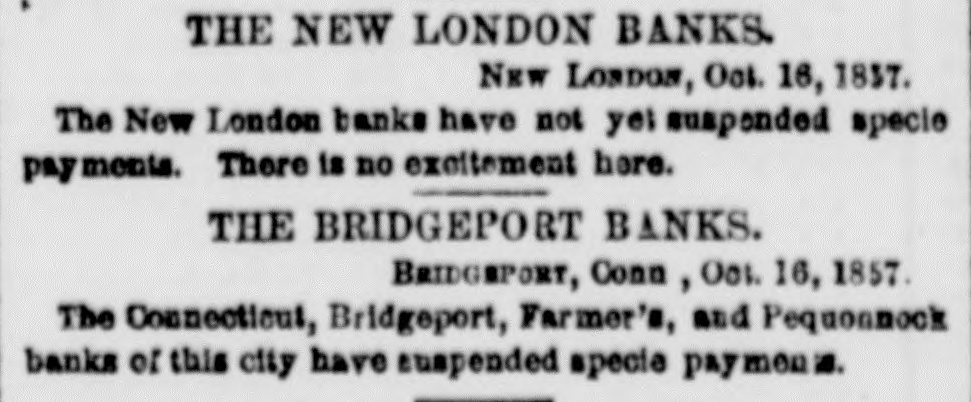
THE NEW LONDON BANKS. New LONDON, Oct. 16, 1837. The New London banks have not yet suspended specie payments. There is no excitement here. THE BRIDGEPORT BANKS. BRIDGEPORT, Conn, Oct. 16, 1857. The Connecticut, Bridgeport, Farmer's, and Pequonmock banks of this city have suspended specie payments.

Article from New-York Daily Tribune, October 17, 1857

Click image to open full size in new tab

Article Text

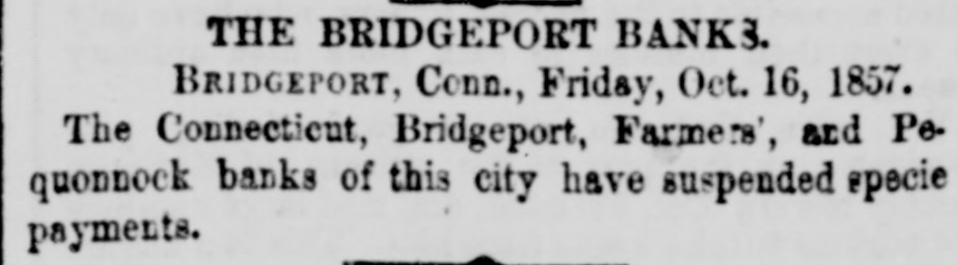
THE BRIDGEPORT BANK3. BRIDGEPORT, Conn., Friday, Oct. 16, 1857. The Connectient, Bridgeport, Farmers', and Pequonnock banks of this city have suspended specie payments.

Article from Daily Iowa State Democrat, October 19, 1857

Click image to open full size in new tab

Article Text

The Financial Crisis. New Orleans, Oct. 15. The Citizens and Louisiana Bank, of La., and the Canal Bank, all this morning refused to take the notes of the free tanks. The run commenced early on the free banks, and before 3 o'clock the Union, Merchants' and Bank of New Orleans, had suspended specie payments.There is no run upon the Southern Bank, and it is considered perfectly good. LATER. Affairs are very unsettled. It is supposed that the run will continue to-morrow, and great confidence is felt in the banks which are now standing. They have had large deposits to-day. There are rumors that the bank of New Orleans will open in the morning. Notes of the Bank of James Robb are taken at the citizens and Southern Banks. St. Louis, Oct. 16. The reported suspension of Doane, King & Co., and Collins, Kerley & Co., of this city, published in the New York Express of the 12th, is authoritatively contradicted. No paper of these firms is protested here, and they are regarded as among the most solvent and responsible houses in the city. New York, Oct. 16. Our financial and business affairs appear to improve. Stocks of all kinds took a further advance at the first board. New York State S ining at an average advance of 9 per cent. Specie is almost unsaleable at a are premium. quiet and irregular, Rates of domestic but the exchange bulk of the F stern is done at about 3 per cent. Our importers have concluded the work of reshipping British goods from the bonded warehouses, there being no market for them at the 2d board. Bridgeport, Ct., Oct. 16. The Connecticut, Bridgeport, Farmers' and Hequinnock banks at this city have suspended specie payments to day. Boston, Oct. 16. Money market quiet, and everybody appears to be waiting the result of the suspension. Stocks show a little more activity. The specie brokers are realizing small gains, gold being plenty. Oswego, Oct. 16. Luther Wright's bank does not open today. All the other banks are paying specie as usual. Albany, Oct. 16. Samuel A. Foot and Samuel G. Ruggles were heard this morning before Gov. King, in behalf of the New York city banks, objecting to an extra session of the Legislature. The Governor sees no necessity for it at present, but will hold the subject under advisal.


Article from The Davenport Daily Gazette, October 19, 1857

Click image to open full size in new tab

Article Text

The Financial Crisis. NEW ORLEANS Oct. 16. The Citizens and Louisiana Bank of La and the Canal Bank all this morning refused to take the notes of the free banks The run commenced early on the free banks and before 3 o'clock the Union, Merchants and Bank of New Orleans, had suspended specie payments. There was no run upon the Southern Bank, and it is considered perfectly good. The chartered banks are standing by each other Large Deposits are made in all the charter ed and Southera banks. more it is said, than has been withdrawn. There is considerable excitement but good humor prevails. LATER. Affairs are very unsettled. It is supposed that the run will continue to-morrow, and great confidence is felt in the banks which are now standing They have large deposits to day. There have been no failures and there is more cheerfulness than in the morning. There are rumors that the Bank of New Or leans will open in the morning. Notes of the Bank of James Robbare taken al the Citizens' and Southern Banks St. Louis. Oct. 16. The reported suspension of Donn, King & Co. and Collins, Kirby, & Co., of this city pub lished in the New York Express of the 12th is authoritatively contradicted. No paper of these firms is protested here, and they are re garded as among the most solvent and respon sible houses in the city, LATER. NEW YORK Oct. 16. Our financial and business affairs appear to improve Stocks of all kinds took a further advance at the first board. New York State gaining at an average advance of 1 per cent Specie is almost unsalable at a premium Rates of domestic exchange are quiet and ir regular, but the bank of the Eastern is done at about 3 per cent. Our importers have conclu ded the work of reshipping British goods from the bonded warehouses there being no market for them. BRIDGEPORT Ct., Oct. 16. The Connecticut, Bridgeport, Farmers and Pequannock Banks of this city suspendent specie payments to-day BOSTON, Oct. 16. Money market quiet, and everybody appears to be waiting the result of the suspension. Stocks show a little more activity. The specio brokers are realizing small gains gold being plenty


Article from The Daily Dispatch, October 19, 1857

Click image to open full size in new tab

Article Text

THE bridgeport (CONN.) BANKS. BRIDGEPORT, CONN., Oct. 16-The Connecticut, Bridgeport, Farmers' and Pequonnock Banks, of this city, have suspended specie payments. IOWA ELECTION.


Article from Evening Star, October 19, 1857

Click image to open full size in new tab

Article Text

Financial Matters. BOSTON, Oct. 17.-The result of the bank directors' meeting to-day authorizes an increase of loans to the extent of $3,000,000. The stock market is better, and there are more orders for investments coming. BRIDGEPORT, Conn, Oct. 16-The Connecti cut, Bridgeport, Farmers' and Pequonnock banks of this city have suspended specie payments. CINCINNATI, Oct. 17.-The money market here is unchanged. The failure of Messrs. Winslow, Lanier & Co., has produced some uneasiness in regard to Indian funds. At a meeting of the bankers of this city this morning, it was resolved to receive at par the notes of all the New Orleans banks, and all banks that are bankable in New York, Boston, Philadelphia, Pittsburg, and Baltimore. This causes a much improved feeling in the money market. Sr. Lours, Oct. 17 -There has been a run on the banks to-day. The rumored suspension of the Bank of the State of Missouri is untrue. The directors 1837. hope to weather the storm as they did In JEFFERSONVILLE, Ind., Oct. 17-The branch of the State bank of Indiana, located here, to-day refused specie for its bills. NEW ORLEANS, Oct. 16.-The run on the banks has subsided and confidence restored. No further tailures are announced. The suspended free banks anticipate an early resumption. Money is easier. and business affairs are more cheerful. Philadelphia, Oct. 19.-Two prominent dry goods jobbers have suspended: one being Raignel & Co., the heaviest in the city. Their assets are very large.

Article from The Day Book, October 20, 1857

Click image to open full size in new tab

Article Text

The Bridgeport Banks. BRIDGEPORT, Ct., Oct. 16.-The Connecticut, Bridgeport, Farmer's and Pequonnocks banks of this city have suspendeb specie payments.


Article from New-York Daily Tribune, November 13, 1857

Click image to open full size in new tab

Article Text

Interest on public debt, including 413072 Treasury notes. 1,951,782 56 $23,714,128 37 The Total Fermers' Bank, Bridgeport, Conn., have didcontir ued redeeming their bills at the Suffolk Bank, Boston, and they are now redeemed by L. S. Law rence & Co., bankers, in this city. The business of the Clearing-House to day was $12,459,213. The Granite Bank of Voluntown, Conn., has been enjoined by Judge Butler of the Superior Court, and a Receiver appointed, on application of the Bank Commissioners. The Commissioners are pursuing their investigation. The Cherokee Issurance and Banking Company of Georg is hasfailed. The notes of the Bank had been redeemed in Chicago by F. G. Adams, esq., but on Saturday the paper of Messrs. Curtise & Co., bankers, of Peoria, having gone to protest, the notes are no longerredeemed. The Baltimore Patriot thus notices the money market of that city: The Money market continues increasing in ease. Most of the good paper offered at bank meets acceptance. Capitalists are more inclined to invest, and first class notes are negotiated on the street, at 1@1k to P cent a month. Second-class 21 to 3 P cent. Money on call abundant at I to 1 P cent & month. The indications that specie will again be exported to & considerable extent have tightened exchanges somewhat, and rates are slightly upward. We quote exchange on New. York at 31 P cent premium; Boston do. 4; and Philadelphia do. 11 P cent premium. Exchange on London nominal at 12@13 P cent premium in Baltimor funds. Gold 3@31 P cent prem. Virgiria bank notes 3 P cent discount. North Carolira do. 4@6 P cent do. Notes of Ohio and other Western banks 3@7 P cent discount." At Philadelphia The Ledger says: There is not however. much movement yet in the Mc ney market. Nearly all the lending is done by the bar ke, and very little by them. Should country banknotes be generally refused on deposit here, as now seems probable, the banks will do still less, and the street brokers more, until the country paper is forced home preparatory to resumption. The difference paper and gold is now only about 3@3| * cert; and as between paper and silver, 21@3. Some two or three of our banks are wisely availing themselves of these favorable rates to increase their stock of coin preparatory to resumption." The Cincinnati Gazette says: The money market exhibited no new feature of importance on Saturday Business generally e ontioned dull. Money is gradually accumulating, and as the supply increases, and confidence gathers strength, borrowers find it less difficult to obtain accommodations. The discount lines, however, are still tightly drawn, and & very high standard is maintained; but two points have already been gained, viz: 8 partial reestablishment of confidence, and a fair supply of money. The latter muet continue to increase, and the former is progressing steadily in the right direction. The improvement of which these features afford satisfactory evidence must soon lead to the adoption of a lower standard for names at the discount houses. It will not pay to keep money unemployed, and the accumulation of currency will therefore create & demand for paper, that will very soon cover the usual range of business. The Ohio, Indiana and Kentucky banks have withdrawn not far from eight millions of their circulation since the failure of the Trust Company. This, as soon as exchange settles down to the low point, toward which it is now tending, will be reissued. The supply of money in the country awaiting a market is very large, and it cannot fail, when put into use, as it must be, to produce a plethora of capital." The numerous factories in North and South Lee are working short time, equal to 4 or 41 days per week. There are not less than 32 within the Innits of Lee. The most profitable source of revenue to the town of Lee is the contract for supplying marble for the Capitol at Washington. The weekly payments to agents and operators In specie keeps business alive. The factories and mills of North and South Adams are still running at half and three quarter time; few if any have entirely stopped. The Hampden mills, Holyoke, have determined to resume full work in a few days. The Ocean mill, at Newburyport, has stopped one quarter of its machinery; and at short hours, it is expected that the remainder of the mill will be kept in operation through the Winter. It is in contemplation to commence running the Massachusetts and Prescott mills in about a fortnight, full time, but with reduced wages for the operatives. The mills now run four days in the week. ¡From The Harrisburg Telegraph of the 11th. We give below a list of the banks whose acceptance of the provisions of the Relief law has been certified to the Auditor General and received by that officer up to this morning. We will add to the list from day to day, as the aceptances are received at the AuditorGeneral's office: Date of acceptance. Oct. 29 Names. of Schulkill County