National Webster Bank (Boston, MA)

Episode Information

Episode UID
152700885
Episode Type
Suspension → Reopening
Bank Type
national
Bank ID
15270 national
Charter Number
1527
Start Date
September 27, 1873
Location
Boston, Massachusetts (42.358, -71.060)

Metadata

Model
gpt-5-mini (chosen from majority vote of a three-model LLM ensemble)
Short Digest
c91ec62cc5bc5c35

Response Measures

None

Description

Articles describe a coordinated Boston-banks suspension during the Panic of 1873; the specific bank is not named.

Events (3)

1. August 14, 1865 Chartered
Source
historical_nic
2. September 27, 1873 Suspension
Cause
Macro News
Cause Details
Boston banks collectively suspended currency payments for large amounts following the panic originating in New York (Panic of 1873).
Newspaper Excerpt
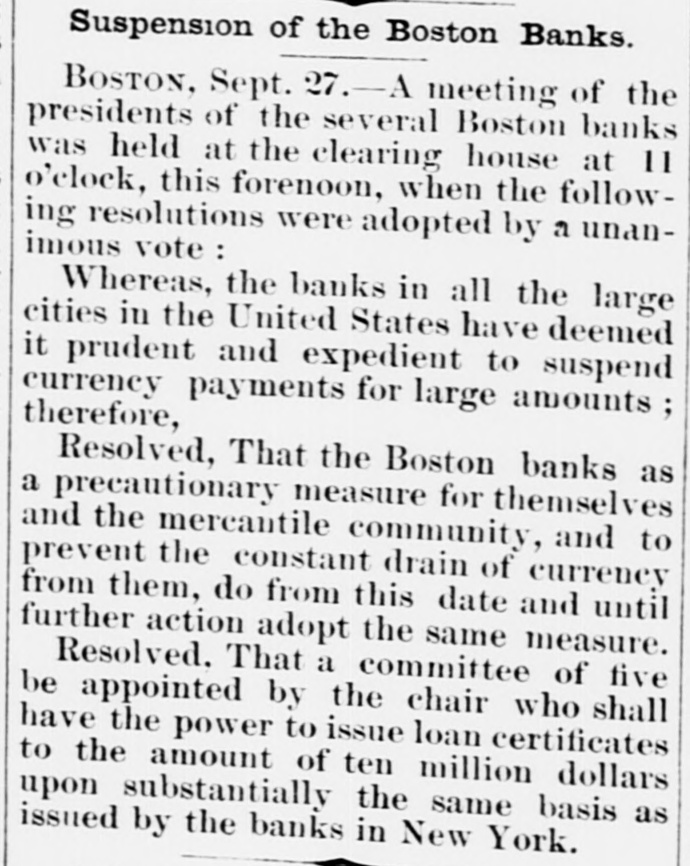
Resolved, That the Boston banks ... do from this date and until further action adopt the same measure
Source
newspapers
3. October 1, 1873* Reopening
Newspaper Excerpt
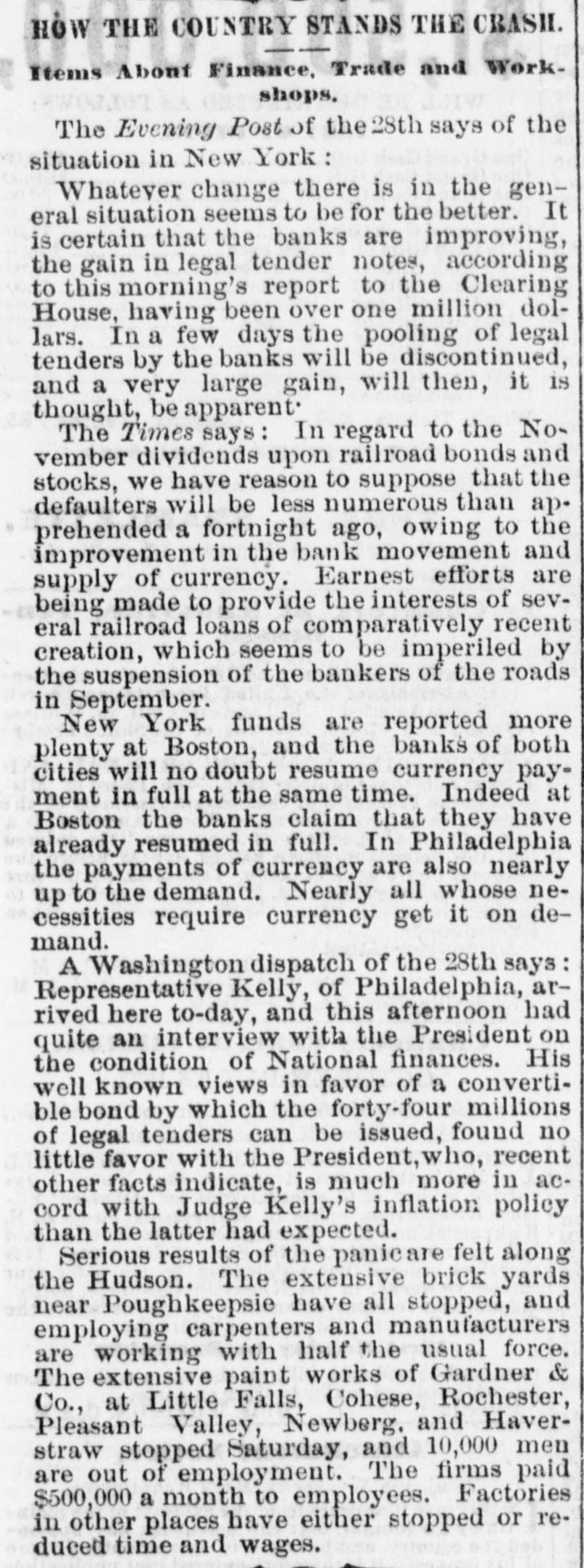
New York funds are reported more plenty at Boston, and the banks of both cities will no doubt resume currency payment in full; Indeed at Boston the banks claim that they have already resumed in full.
Source
newspapers

Newspaper Articles (8)

Article from Chicago Daily Tribune, September 28, 1873

Click image to open full size in new tab

Article Text

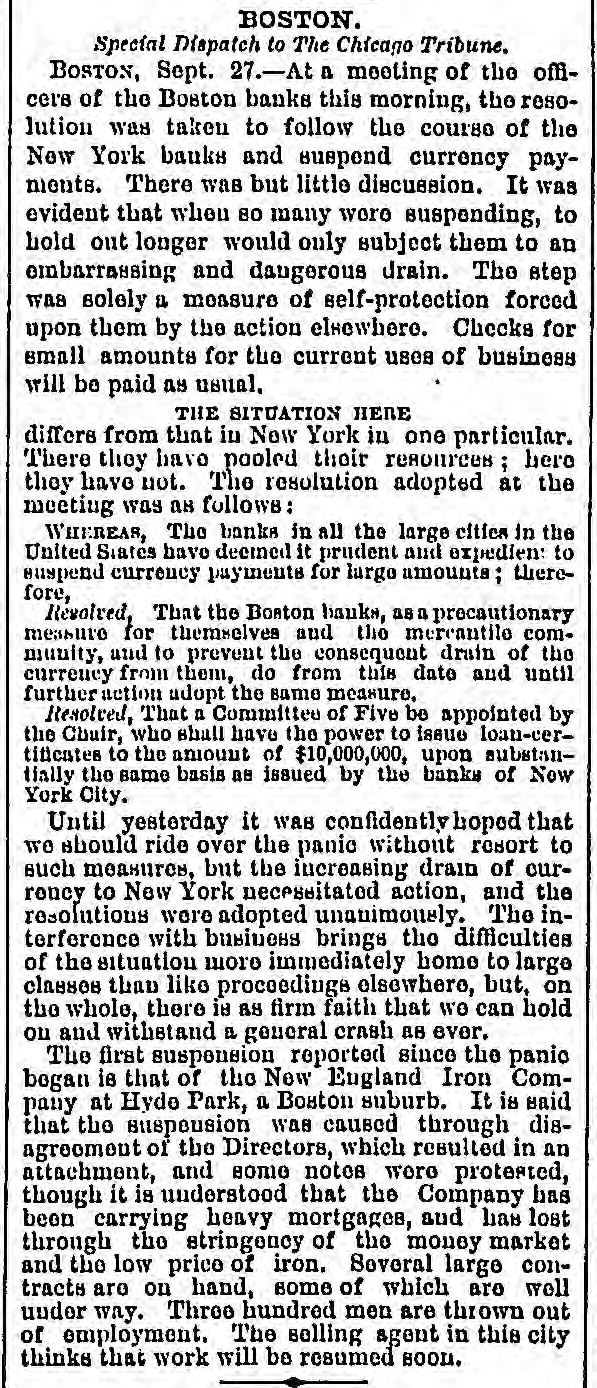
BOSTON. Special Dispatch to The Chicago Tribune. BOSTON, Sept. 27.-At a meeting of the officere of the Boston banks this morning, the resolution was taken to follow the course of the New York banks and suspond currency payments. There was but little discussion. It was evident that when 80 many were suspending, to hold out longer would only subject them to an embarrassing and dangerous drain. The step was solely a measure of self-protection forced upon them by the action elsewhere. Checks for small amounts for the current uses of business will be paid as usual. THE SITUATION HERE differs from that in New York in one particular. There they have pooled their resources : here they have not. The resolution adopted at the meeting was as follows: WHEREAR, The banks in all the large cities in the United States have deemed it prudent and expedient to suspend currency payments for largo amounts; therefore, Révolved, That the Boaton banks, as a precautionary measure for themselves and the mercantilo community, and to prevent the consequent drain of the currency from them, do from this date and until further action adopt the same measure, Resolved, That a Committee of Five be appointed by the Chuir, who shall have the power to issue loan-certiticates to the aniount of $10,000,000, upon substantially the same basis as issued by the banks of Now York City. Until yesterday it was confidently hoped that we should ride over the panic without resort to such measures, but the increasing drain of ourrency to New York necessitated action, and the resolutions were adopted unanimously. The interference with business brings the difficulties of the situation more immediately home to large classes than like proceedings elsewhere, but, on the whole, there is as firm faith that we can hold ou and withstand a general crash 88 ever. The first suspension reported since the panic began is that of the New Eugland Iron Company at Hyde Park, a Boston suburb. It is said that the suspension was caused through disagreement of the Directors, which resulted in an attachment, and some notes were protested, though it is understood that the Company has been carrying heavy mortgages, and has lost through the stringency of the money market and the low price of iron. Several large contracts are on hand, some of which are well under way. Three hundred men are thrown out of employment. The selling agent in this city thinks that work will be resumed soon.


Article from Oxford Democrat, September 30, 1873

Click image to open full size in new tab

Article Text

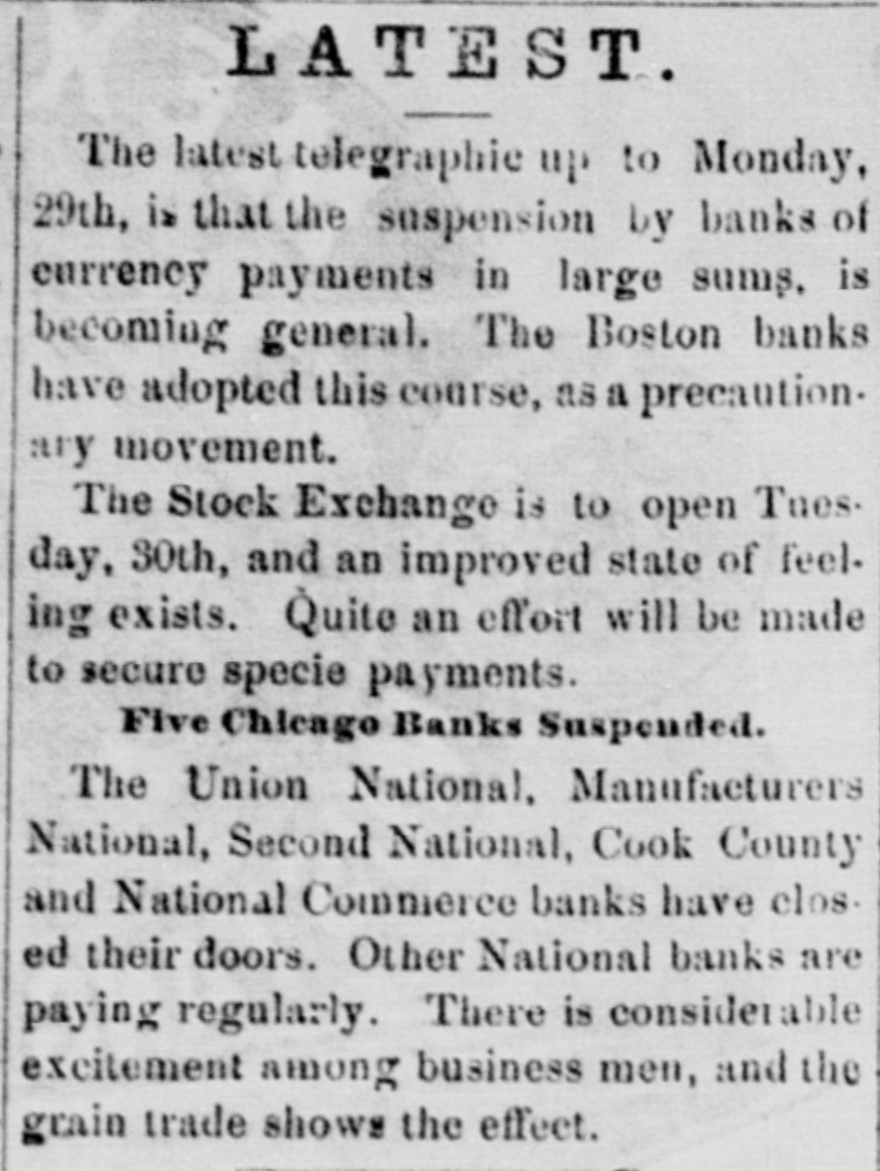
LATEST. The latest telegraphie up to Monday, 29th, is that the suspension by banks of currency payments in large sums. is becoming general. The Boston banks have adopted this course, as a precaution. ary movement. The Stock Exchange is to open Tuesday, 30th, and an improved state of feeling exists. Quite an eff'ort will be made to secure specie payments. Five Chicago Banks Suspended. The Union National, Manufacturers National, Second National, Cook County and National Commerce banks have clos. ed their doors. Other National banks are paying regularly. There is considerable excitement among business men, and the grain trade shows the effect.


Article from New-York Tribune, October 1, 1873

Click image to open full size in new tab

Article Text

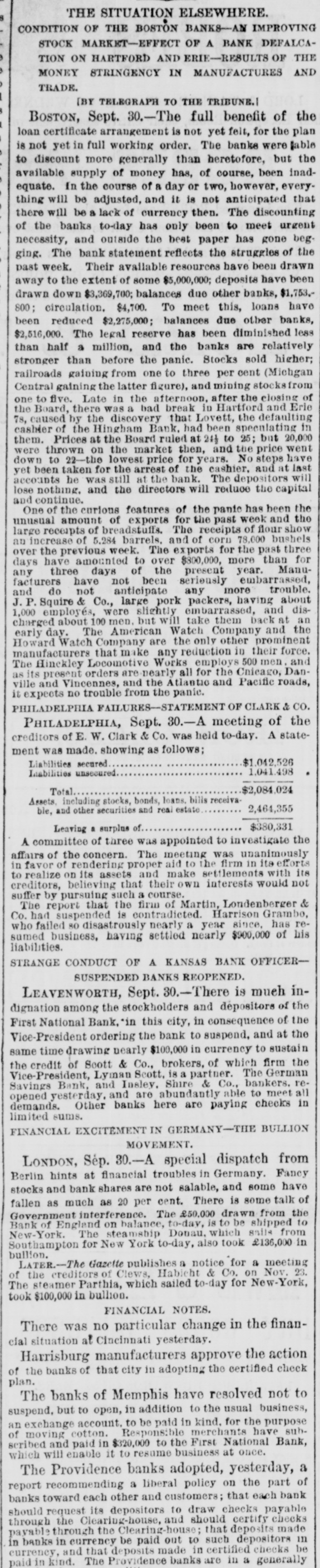
THE SITUATION ELSEWHERE. CONDITION OF THE BOSTON BANKS-AN IMPROVING STOCK MARKET-EFFECT OF A BANK DEFALCATION ON HARTFORD AND ERIE-RESULTS OF THE MONEY STRINGENCY IN MANUFACTURES AND TRADE. [BY TELEGRAPH TO THE TRIBUNE. BOSTON, Sept. 30.-The full benefit of the loan certificate arrangement is not yet felt, for the plan is not yet in full working order. The banks were lable to discount more generally than heretofore, but the available supply of money has, of course, been inadequate. In the course of a day or two, however, everything will be adjusted, and it is not anticipated that there will be a lack of currency then. The discounting of the banks to-day has only been to meet urgent necessity, and outside the best paper has gone begging. The bank statement reflects the struggles of the past week. Their available resources have been drawn away to the extent of some $5,000,000; deposits have been drawn down $3,369,700; balances due other banks, $1.753.800; circulation. $4,700. To meet this, loans have been reduced $2,275,000; balances due other banks, $2,516,000. The legal reserve has been diminished less than half a million, and the banks are relatively stronger than before the panic. Stocks sold higher; railroads gaining from one to three per cent (Michgan Central gaining the latter figure), and mining stocksfrom one to five. Late in the afternoon. after the closing of the Board, there was a bad break in Hartford and Eric 78, caused by the discovery that Lovett, the defaulting cashier of the Hingham Bank, had been speculating in them. Prices at the Board ruled at 24 to 25; but 20,000 were thrown on the market then, and the price went down to 22-the lowest price for years. No steps have yet been taken for the arrest of the cashier. and at last accounts he was still at the bank. The depositors will lose nothing. and the directors will reduce the capital and continue. One of the curious features of the pante has been the unusual amount of exports for the past week and the large receipts of breadstuffs. The receipts of flour show au increase of 5.284 barrels, and of corn 78.000 bushels over the previous week. The exports for the past three days have amounted to over $800,000, more than for any three days of the present year. Manufacturers have not been seriously embarrassed, and do not anticipate any more trouble. J.1 P. Squire & Co., large pork packers, having about 1,000 employés, were slightly embarrassed, and discharged about 100 men. but will take them back at an early day. The American Watch Company and the Howard Watch Company are the only other prominent manufacturers that make any reduction in their force. The Hinckley Locomotive Works employs 500 men. and asits present orders re-nearly all for the Chicago, Danville and Vincennes, and the Atlantic and Pacific roads, it expects no trouble from the panic. PHILADELPHIA FAILURES-STATEMENT OF CLARK & CO. PHILADELPHIA, Sept. 30.-A meeting of the creditors of E. W. Clark & Co. was held to-day. A statement was made. showing as follows; $1,042,526 Liabilities secured 1.041.498 Liabilities unsecured $2,084,024 Total Assets. including stocks, bonds, loans. bills receiva2,464,355 ble, and other securities and real estate $380,331 Leaving a surplus of A committee of three was appointed to investigate the affairs of the concern. The meeting was unanimously in favor of rendering proper aid to the firm in its efforts to realize on its assets and make settlements with its creditors, believing that their own interests would not suffer by pursuing such a course. The report that the firm of Martin, Londenberger & Co. had suspended is contradicted. Harrison Grambo, who failed 80 disastrously nearly a year since, has resamed business, having settled nearly $900,000 of his liabilities. STRANGE CONDUCT OF A KANSAS BANK OFFICERSUSPENDED BANKS REOPENED. LEAVENWORTH, Sept. 30.-There is mueh indignation among the stockholders and dépositors of the First National Bank, *in this city, in consequence of the Vice-President ordering the bank to suspend, and at the same time drawing nearly $100,000 in currency to sustain n the credit of Scott & Co., brokers. of which firm the Vice-President, Lyman Scott. is a partner. The German Savings Bank, and Insley, Shire & Co., bankers. reopened yesterday. and are abundantly able to meet all demands. Other banks here are paying checks in limited sums. FINANCIAL EXCITEMENT IN GERMANY-THE BULLION MOVEMENT. LONDON, Sép. 30.-A special dispatch from Berlin hints at financial troubles in Germany. Fancy stocks and bank shares are not salable, and some have fallen as much as 20 per cent. There is some talk of Government interference. The £50,000 drawn from the Bank of England on balance, to-day, is to be shipped to New-York. The steamship Donau, which sails from Southampton for New York to-day, also took £136,000 in bullion. LATER.-The Gazette publishes a notice for a meeting of the creditors of Clews, Habieht & Co. on Nov. 23. The steamer Parthia, which sailed to-day for New-York, took $100,000 in bullion. FINANCIAL NOTES. There was no particular change in the financial situation at Cincinnati yesterday. Harrisburg manufacturers approve the action of the banks of that city in adopting the certified check plan. The banks of Memphis have resolved not to suspend, but to open, in addition to the usual business, an exchange account. to be paid in kind, for the purpose of moving cotton. Responsible merchants have subscribed and paid in $320,000 to the First National Bank, which will enable it to resume business at once. The Providence banks adopted, yesterday, a report recommending a liberal policy on the part of banks toward each other and customers; that each bank should request its depositors to draw checks payable through the Clearing-house, and should certify checks payable through the Clearing-house; that deposits made in banks in currency be paid out to such depositors in currency, and that deposits made in certified checks be paid in kind. The Providence banks are in a generally
Article from Ellsworth American, October 2, 1873

Click image to open full size in new tab

Article Text

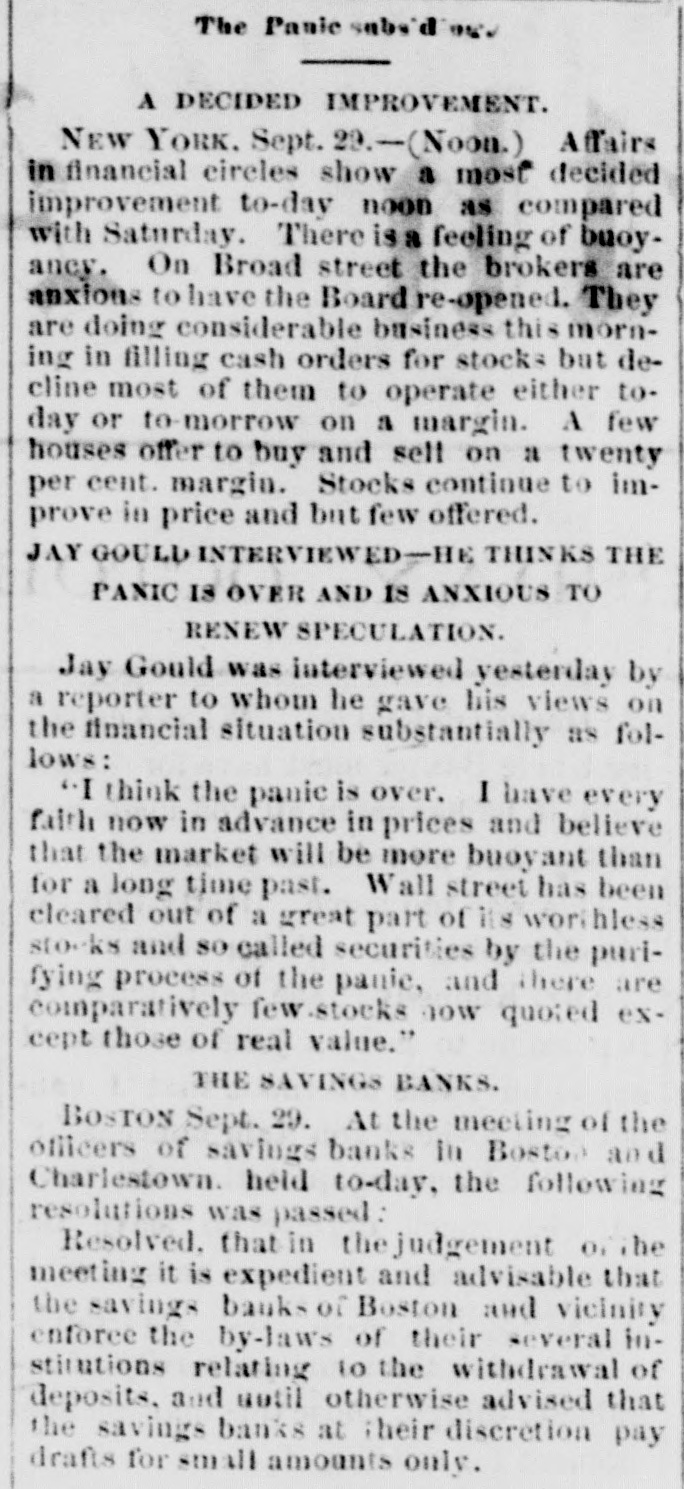
# A DECIDED IMPROVEMENT. NEW YORK, Sept. 29.-(Noon.) Affairs in financial circles show a most decided improvement to-day noon as compared with Saturday. There is a feeling of buoyancy. On Broad street the brokers are anxious to have the Board re-opened. They are doing considerable business this morning in filling cash orders for stocks but decline most of them to operate either to-day or to-morrow on a margin. A few houses offer to buy and sell on a twenty per cent. margin. Stocks continue to improve in price and but few offered. # JAY GOULD INTERVIEWED HE THINKS THE PANIC IS OVER AND IS ANXIOUS TO RENEW SPECULATION. Jay Gould was interviewed yesterday by a reporter to whom he gave his views on the financial situation substantially as follows: "I think the panic is over. I have every faith now in advance in prices and believe that the market will be more buoyant than for a long time past. Wall street has been cleared out of a great part of its worthless stocks and so called securities by the purifying process of the panic, and there are comparatively few stocks now quoted except those of real value." # THE SAVINGS BANKS. BOSTON Sept. 29. At the meeting of the officers of savings banks in Boston and Charlestown, held to-day, the following resolutions was passed: Resolved, that in the judgement of the meeting it is expedient and advisable that the savings banks of Boston and vicinity enforce the by-laws of their several institutions relating to the withdrawal of deposits, and until otherwise advised that the savings banks at their discretion pay drafts for small amounts only.


Article from St. Johnsbury Caledonian, October 3, 1873

Click image to open full size in new tab

Article Text

# Suspension of the Boston Banks. BOSTON, Sept. 27. - A meeting of the presidents of the several Boston banks was held at the clearing house at 11 o'clock, this forenoon, when the following resolutions were adopted by a unanimous vote: Whereas, the banks in all the large cities in the United States have deemed it prudent and expedient to suspend currency payments for large amounts; therefore, Resolved, That the Boston banks as a precautionary measure for themselves and the mercantile community, and to prevent the constant drain of currency from them, do from this date and until further action adopt the same measure. Resolved. That a committee of five be appointed by the chair who shall have the power to issue loan certificates to the amount of ten million dollars upon substantially the same basis as issued by the banks in New York.


Article from Burlington Weekly Free Press, October 3, 1873

Click image to open full size in new tab

Article Text

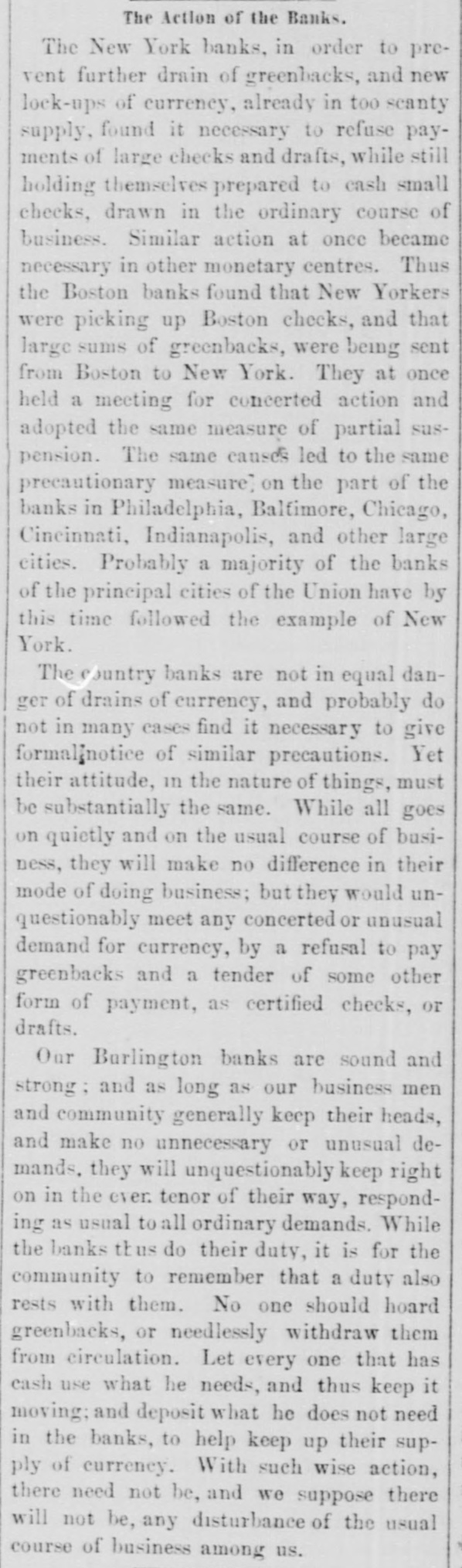
The Action of the Banks. The New York banks, in order to prevent further drain of greenbacks, and new lock-ups of currency, already in too scanty supply, found it necessary to refuse payments of large checks and drafts, while still holding themselves prepared to cash small checks, drawn in the ordinary course of business. Similar action at once became necessary in other monetary centres. Thus the Boston banks found that New Yorkers were picking up Boston checks, and that large sums of greenbacks, were being sent from Boston to New York. They at once held a meeting for concerted action and adopted the same measure of partial saspension. The same causes led to the same precautionary measure] on the part of the banks in Philadelphia, Baltimore, Chicago, Cineinnati, Indianapolis, and other large cities. Probably a majority of the banks of the principal cities of the Union have by this time followed the example of New York. The country banks are not in equal danger of drains of currency, and probably do not in many cases find it necessary to give formalinotice of similar precautions. Yet their attitude, in the nature of things, must be substantially the same. While all goes on quietly and on the usual course of business, they will make no difference in their mode of doing business; but they would unquestionably meet any concerted or unusual demand for currency, by a refusal to pay greenbacks and a tender of some other form of payment, as certified checks, or drafts. Our Burlington banks are sound and strong ; and as long as our business men and community generally keep their heads, and make no unnecessary or unusual demands. they will unquestionably keep right on in the ever. tenor of their way, responding as usual to all ordinary demands. While the banks tbus do their duty, it is for the community to remember that a duty also rests with them. No one should hoard greenbacks, or needlessly withdraw them from circulation. Let every one that has cash use what he needs, and thus keep it moving; and deposit what he does not need in the banks, to help keep up their supply of currency. With such wise action, there need not be, and we suppose there will not be, any disturbance of the usual course of business among us.


Article from Knoxville Weekly Chronicle, November 5, 1873

Click image to open full size in new tab

Article Text

# HOW THE COUNTRY STANDS THE CRASH. Items About Finance, Trade and Workshops, The Evening Post of the 28th says of the situation in New York: Whatever change there is in the general situation seems to be for the better. It is certain that the banks are improving, the gain in legal tender notes, according to this morning's report to the Clearing House, having been over one million dollars. In a few days the pooling of legal tenders by the banks will be discontinued, and a very large gain, will then, it is thought, be apparent. The Times says: In regard to the November dividends upon railroad bonds and stocks, we have reason to suppose that the defaulters will be less numerous than apprehended a fortnight ago, owing to the improvement in the bank movement and supply of currency. Earnest efforts are being made to provide the interests of several railroad loans of comparatively recent creation, which seems to be imperiled by the suspension of the bankers of the roads in September. New York funds are reported more plenty at Boston, and the banks of both cities will no doubt resume currency payment in full at the same time. Indeed at Boston the banks claim that they have already resumed in full. In Philadelphia the payments of currency are also nearly up to the demand. Nearly all whose necessities require currency get it on demand. A Washington dispatch of the 28th says: Representative Kelly, of Philadelphia, arrived here to-day, and this afternoon had quite an interview with the President on the condition of National finances. His well known views in favor of a convertible bond by which the forty-four millions of legal tenders can be issued, found no little favor with the President, who, recent other facts indicate, is much more in accord with Judge Kelly's inflation policy than the latter had expected. Serious results of the panic are felt along the Hudson. The extensive brick yards near Poughkeepsie have all stopped, and employing carpenters and manufacturers are working with half the usual force. The extensive paint works of Gardner & Co., at Little Falls, Cohese, Rochester, Pleasant Valley, Newberg, and Haverstraw stopped Saturday, and 10,000 men are out of employment. The firms paid $500,000 a month to employees. Factories in other places have either stopped or reduced time and wages.


Article from St. Johnsbury Caledonian, August 17, 1893

Click image to open full size in new tab

Article Text

LETTER FROM BOSTON. Some Fast Trotting.-Some Queer Features of the Financial Stringency.Winthrop's Coaching Parade. [Editorial Correspondence.] Ten thousand people endured Saturday's intense heat at Mystic park, Medtord, to see less than three minutes of fun. Within that time Nancy Hanks had trotted a mile to beat her record of 2.04. She failed to do it, but made the remarkable fast time of 2.081/4; first quarter, 321/4; half, 1.031/4; three quarters in 1.35 and the last and slowest quarter in 331/4 seconds. She trotted in beautiful shape, but tired herself before the home stretch was reached. Mr. Doble used the whip sparingly on the last quarter, but the great trotter was doing her best and could not keep up the fast time of the second and third quarters. Nancy Hanks was accompanied by a running mate and trotted in beautiful style. Thesameday Nelson, Maine's famous stallion, reduced his record to 2.09. One of the most curious features of the present financial stringency is the scarcity of currency. So much has been drawn out of the banks that they hate to part with any more, and 3 and 4 per cent premium was paid for currency last week. Thisis the first time since 1873 that such a premium has appeared and some people have netted snug sums by selling hoarded money to brokers and bankers. In many cases the banks refused to cash checks and two instances came to my knowledge where checks on Boston banks amounting to $25 and $90 could not be cashed at other Boston banks. At the office of register of deeds here checks of 65 cents are received for recording titles, owing to the scarcity of small change. The 60 days notice which the banks have enforced has prevented any runs on these institutions, but has been a great disapointment to the smaller stockholders. Many of the latter were women who were sure that their money was unsafe in the big Boston banks. Ofcourse in some cases the money was wanted for immeadiate use' In such cases the banks did all they could to accommodate their customers. A great many firm's are sailing very close to the winds and would be wrecked if they were hard pressed by either their creditors or the banks which hold their notes. But money is a little easier than it was last week and everybody is taking a more hopeful view of the situation. One of the prettiest suburbs of Boston is the town of Winthrop, five miles from the Hub, with eight miles of water front and three miles of ocean shore and beach. It is easily accessible by boat or rail from the city and is the permanent home of many Boston business men and the summer residence of thousands of