15268. New Rochelle Savings Bank (New Rochelle, NY)

Bank Information

Episode Type
Run → Suspension → Closure
Bank Type
savings bank
Start Date
November 17, 1877
Location
New Rochelle, New York (40.911, -73.782)

Metadata

Model
gpt-5-mini
Short Digest
84ef8ed9

Response Measures

Full suspension, Books examined

Other: Receiver appointed and civil suits brought by receiver against trustees; criminal prosecution of secretary for embezzlement.

Description

New Rochelle Savings Bank (state-chartered savings bank) faced heavy withdrawals/depositor agitation when the Bank Department found it insolvent in November 1877; trustees voted to suspend and investigate, the secretary absconded, a receiver was later appointed and the bank remained in receivership and was dissolved. OCR errors in some articles (e.g., Humphrey/Humphreys spelling variants) were corrected. Sequence: depositor runs/collections → suspension (Nov 1877) → receivership and permanent closure.

Events (4)

1. November 17, 1877 Run
Cause
Bank Specific Adverse Info
Cause Details
Depositors learned of insolvency and large peculations/irregularities (absconding secretary William R. Humphrey) and thronged the bank seeking their passbooks and funds.
Measures
Trustees posted notices, arranged times to receive passbooks and compared passbooks with ledgers; trustees decided to suspend and investigate.
Newspaper Excerpt
Depositors thronged its doorways. On assured that Humphrey the door of the had become posted placard on their books, ... about 100 books received them. turned in.
Source
newspapers
2. November 17, 1877 Suspension
Cause
Bank Specific Adverse Info
Cause Details
State Bank Department reported the institution 'insolvent and inefficiently conducted' and discovery of irregularities and alleged embezzlement by the secretary prompted trustees to suspend operations and investigate.
Newspaper Excerpt
After thinking about it for a week. they decided on Friday evening to suspend and investigate.
Source
newspapers
3. December 27, 1877 Receivership
Newspaper Excerpt
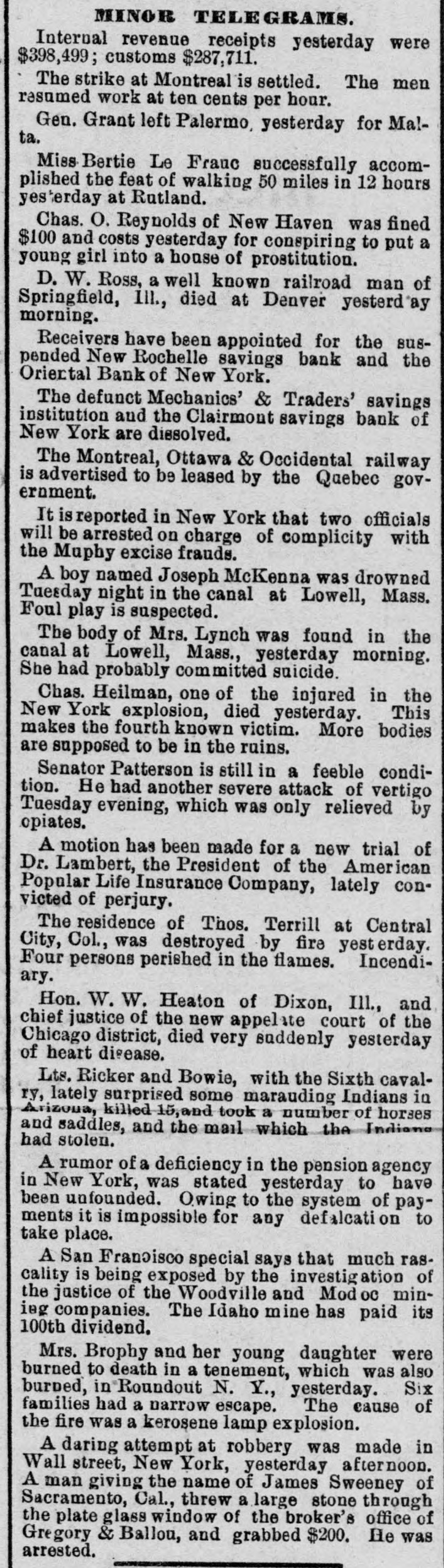
Receivers have been appointed for the suspended New Rochelle savings bank ... (Portland Daily Press, 1877-12-27).
Source
newspapers
4. February 26, 1878 Other
Newspaper Excerpt
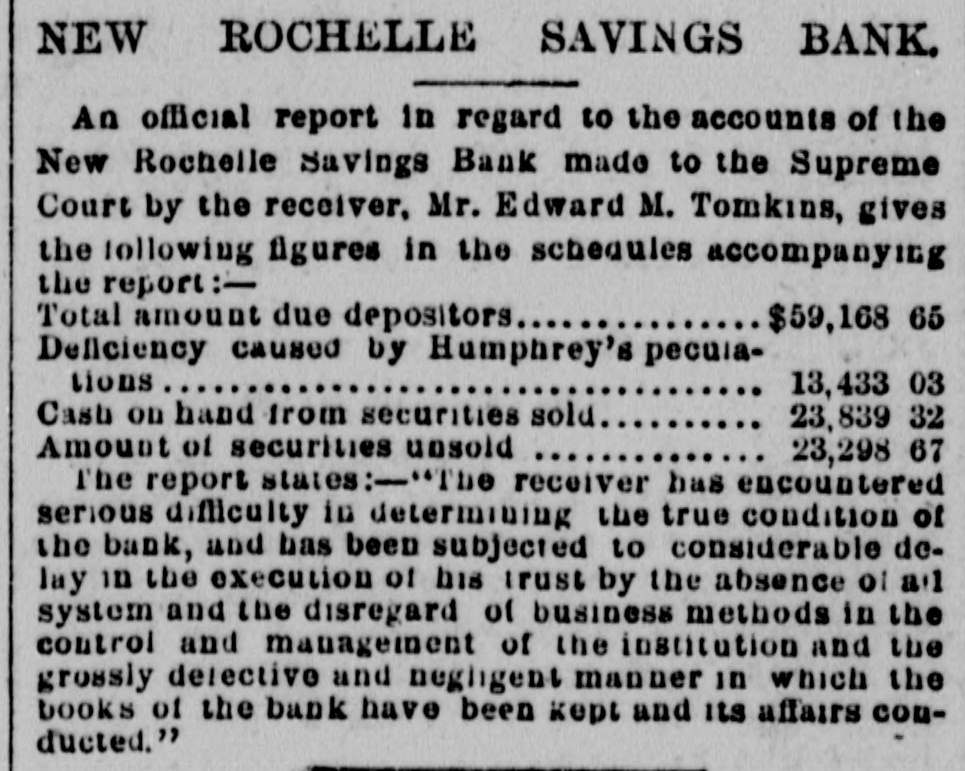
An official report ... by the receiver, Mr. Edward M. Tomkins, gives the following figures ... Total amount due depositors $59,168.65 ... Deficiency caused by Humphrey's peculations $13,433.03
Source
newspapers

Newspaper Articles (19)

Article from The Sun, November 26, 1877

Click image to open full size in new tab

Article Text

NEW ROCHELLE'S SILARY BANK. Some Pecullar Transactions la Connection with Leaning on Mortgages. "Yes," a New Rochelle workingman said to a reporter, "I had all my money in that bank. It was not much. but it was all I have been able to save for many years. I had full confldence in the ofilcers and the trustees. and believed that they were prudent business men. What I read this morning shows me that they have been anything but prudent. I am only one of nearly 500 poor people that suffer, and to these men a suspension for sixty days will cause great trouble and affliction." Mr. Crawford, a trusteo, said that he was in favor of keeping the bank open. It was true the mortgage line was far too large, as compared with the cash and readily available nssets, but still the bank should have been kept open. if only to make the necessary explanations to the stockholders. If ho had $10,000 in the bank it would not cause him to loss a wink of sleep. He was assured that persons stood ready to buy the mortgages at their face value, and believed that the bank would pay one hundred cents on the dollar. No money had been loaned on mortgages for eighteen months. Some time ago a Westchester German had resisted the foreclosure of a mortgage on his house. alleging that he had been forced to pay more than the legal rate of interest. He said that he had to pay a bonus of $250 on a mortgage of $1,600. but did not prove it. Being beaten in the lower court, he had appealed the case. This, it seems. is not the only case in which charges of this character have been brought against the bank. Some years ago Joseph Francis, now dead. applied to the bank for a loan of $1,500. His property was already mortgaged for $2,500, and he wanted to make a new mortgage for $4,000. He was told that the bank had no money to lend. Some days afterward Michael Ball called upon him and told him that he could raise the money he needed on consideration of a bonus of ten percent. Francis at first demurred to the exorbitant bonus demanded, but being hard pressed for money subsequently accepted t proposition. He was astenished. however, to find that the loan had been negotiated though the New Rochelle Savings Bank, and much more so when he dis. covered that he had to pay ten per cent. upon the new mortgage ($4,000) instead of upon the addition to the original mortgage ($1,500). Whether the bonus went into the pocket of the agent. or found its way into the hands of any one connected with the bank is not known. but gentlemen conversant with the transaction express surprise at the influence of Mr. Ball. Many of the mortgages held by the bank are dated several years back and were executed before the immense depreciation in real estate.


Article from The Sun, November 26, 1877

Click image to open full size in new tab

Article Text

These are days that try the soul of the savings bank official conscious of irregularities and vanished assets. After a trial of nearly four months, the HUNTZINGERS of PottsvillePresident and Cashier of the Miners' Trust Banking Company of that place, which shut its doors a year ago last August, owing its depositors over a million and a half-have been brought in guilty of conspiracy to defraud. Assuming that the verdict is justifled by the evidence, it is a case for the heaviest sentence allowed by the statute. The latest collapse near here is that of the New Rochelle Savings Bank. A week ago last Saturday. the Bank Department notified the trustees that their institution had been reported RS" insolvent and inefficiently conducted." and that they must apply immediate remedies or be shut up. After thinking about it for a week. they decided on Friday evening to suspend and investigate. One of the trustees insists that the bank is all right, notwithstanding the official report.


Article from The Sun, November 29, 1877

Click image to open full size in new tab

Article Text

Property TO e His Career. Hold to Liquidate his Then. After the doors of the New Rochelle SavBank were closed on Saturday last. its Secretary. ings William R. Humphrey. abeconded. evenIt was not generally known until Monday when Humphrey failed to attend a meeting of ing. the trustees. After the meeting several not of trustees called at his house. but he was his the found. All that his family knew of York to be was that he had gone to New movements Saturday. saying that he would be back soon. on had not sin e returned. Then the trustees. Humand for the first time. began to suspect that viliage was not honest. although in the since phrey were many citizens who had long there confidence in him. Their nscertained suspicions lost confirmed when they were he had left powers of attorney Lambthat Conrad Roth. A trustee. and Joseph of his with authorizing the former to dispose savings den. and turn the cash into the bank real estate, in liquidation of any deffeiency drug caused store by thefts. and the latter to sell his his other personal property for the same pur- thus and Neither of the gentlemen who had pose. made custodians of Humphrey's and property both been sought or desired the charge. had unavailingly to shirk the responsibility. was tried Roth consulted Counsellor Keogh. and of the Mr. to accept the trust for the benefit to advised The documents were handed evendepositors. Messrs. Roth and Lambden on Tuesday of the by Arthur Yutting. an adopted son had ing absconded Secretary who said that he been re- inon Saturday, and had Tuesday structed ceived them not to deliver them until evening Tuesday morning. after the trustees had run On assured that Humphrey the door of the had become posted placard on their books, away. they depositors to turn in members of bank. inv viting to have receive and made arrangements at certain hours to were their board present Tuesday about 100 books received them. turned in. On and yesterday the the women trustees depositors fifty or sixty. Some of books unless upon deliver their them personally. and this caused the refused receipt of trustees known trouble to and delay. of the that the affairs It was in vain not to be explain settled until the pass women books bank could with the Jedger: the to run were compared cheated once. and declined 450 deposhad been risk. There are about at the any furth r it be possible arrive until all itors, and amount Humphrey's turned in. of exact the pass books first shall books have been compared with Pel- the bank's One of ledger the was that of showed a Mr. Lynch the deposit on hamville. The pass book turning to the date 1,000, but on had been certain was found that only $100 a deposit ledger it to Mr. Lynch. In one case book without credited credited on the pass Adam had been been transferred to the ledger. $1,000, or having Kitsinger, a liquor dealer. deposit could be more but no entry his book of the was filled in Humfound although J. McNamara's account way phrey's handwriting These are only Decimens which Humphrey pocketed the of cash the of confiding positors. meeting of the trustees on Humphrey. night last, proposed that the bank There be pay Friday per cent. to_depos he would twenty-five to this scheme, he said to be ing opposition town on the following day Treasurer not stay in President Penfield and inmobbed. insisted upon a full and thorough money. vestigation sisbrow before the For the payment payment of of any twenRoth: and the vote stood: Humphrey Colebrook and ty-five against per cent.. it. Penfield. Barton. Disbrow. Lambden. and Wilson. estate valued at the Humphrey owned real in West New Rochelle, three lo street. one lot two houses in Drake's in Drake's on As $16,000. His personal and one or ty. far two mortgages Lane. can be necertained bis real proper- estate was mortgaged included about his drugstore in and the fur- Main street. property dollar store (both well latter hetrans: il niture of his Miss residence Alice Yutting The his adopted chattel mortgage ferred to prior to his departure. the yesterday. village daughter. having been recorded Postmaster Mr. Benjamin Badeau. public, the executed the documents. and also it the is said. notary although he did not know their contents. New Rochelle on the 2:29 YutHumphrey quitted Saturday afternoon. with Arthur in this city train on In the Grand Central Depot told him to go ing. bade the lad good-by and the powers of home he at once. intrusting to him Humphrey is sup: attorney already have gone mentione first to Plattsburg. relatives. and posed to to Canada where he has he had been ar If hence last evening that of the rumor been had received rested was rumored in Montreal. but no up infirmation late hour is at estimated from Humphrey's defalcation but until thorough examibeen made there is means nation arriving at the amount. of even approximately that the amount due deIt is certain. however. of being $46,000. as was she wn the positors. cooked-up instead statement presented nearer to trustees y the on Friday last. is probably $60,000. Penfield. Treasurer Disbrow Bank and President their counsel met Assistant yesMr. Keogh. Almy L Lamb in this city to Superintendent held along conference relative of orday. and the bank. It was the wish the he affairs intlement of first named that the winding by up we the institution should be accomplished to it. but to if brought by deposito friendly is n lease for uit Mr. Lamb demurred This the peohis he Attorney-General be he settled said. in the way y le 's ease, and cannot that the Attorney-ten The officers propose ra will take immediate evening nation. to offer nor if the bank resolved suit last be brought by the Atter M. istance to the It is said that Mr. Edwin One ey-General. to be named as the receiver. in Compkins of the worst phases in which the he career left his of Humphrey was his the manner adopted daughter. Mrs. mother and is 2 years of age and gossips in her dotage. were (umphrey Alice Yutting. whom the Humphrey, kept Liss out to speak of as Mrs. left without a cent. 10 Old ouse for him. She was place Mrs. Humphrey in Plattsburg. he hopes Ladies' able Home. to Then she intends to andled éturn to her friends Secretary in nor the Treasurer. who Neither all the the money of the bank, were remiredioging bonds. last evening that the officers of It was said knowing that there had shortage carried bout 10 bank $2,000 in the cash account. year. and had failed e item over it good until from year to after Humphrey who flight. held make consulted eminent counsel. made and prohe n they them the penalties to D ided before for such neglect. and they managed ertheir tracks. s career in New Rochelle has been a Humphrey varied one. He was first a gardener. (he brewed then in a rower of English small beer peddled it himself. then little at home and in which he made money the in drug pt a candy times. store. and was elected Justice of store. eace 10 war in 1864. elected and opened President of the builder, village. this he he was was a carpenter and a member ef erected re several houses. He was a nd the Episcopal Church. h


Article from The Portland Daily Press, December 27, 1877

Click image to open full size in new tab

Article Text

MINOR TELE GRAMS. Internal revenue receipts yesterday were $398,499; customs $287,711. The strike at Montreal is settled. The men resumed work at ten cents per hour. Gen. Grant left Palermo, yesterday for Malta. Miss Bertie Le Franc successfully accomplished the feat of walking 50 miles in 12 hours yesterday at Rutland. Chas. O. Reynolds of New Haven was fined $100 and costs yesterday for conspiring to put a young girl into a house of prostitution. D. W. Ross, a well known railroad man of Springfield, III, died at Denver yesterd'ay morning. Receivers have been appointed for the suspended New Rochelle savings bank and the Oriertal Bank of New York. The defunct Mechanics' & Traders' savings institution and the Clairmont savings bank of New York are dissolved. The Montreal, Ottawa & Occidental railway is advertised to be leased by the Quebec government. It is reported in New York that two officials will be arrested on charge of complicity with the Muphy excise frauds. A boy named Joseph McKenna was drowned Tuesday night in the canal at Lowell, Mass. Foul play is suspected. The body of Mrs. Lynch was found in the canal at Lowell, Mass., yesterday morning. She had probably committed suicide. Chas. Heilman, one of the injured in the New York explosion, died yesterday. This makes the fourth known victim. More bodies are supposed to be in the ruins. Senator Patterson is still in a feeble condition. He had another severe attack of vertigo Tuesday evening, which was only relieved by opiates. A motion has been made for a new trial of Dr. Lambert, the President of the American Popular Life Insurance Company, lately convicted of perjury. The residence of Thos. Terrill at Central City, Col., was destroyed by fire yest erday. Four persons perished in the flames. Incendiary. Hon. W. W. Heaton of Dixon, Ill., and chief justice of the new appelate court of the Chicago district, died very suddenly yesterday of heart disease. Lts. Ricker and Bowie, with the Sixth cavalry, lately surprised some marauding Indians in Arizona, killed 15,and took a number of horses and saddles, and the mail which the Indiana had stolen. A rumor of a deficiency in the pension agency in New York, was stated yesterday to have been unfounded. Owing to the system of payments it is impossible for any defalcation to take place. A San Francisco special says that much rascality is being exposed by the investigation of the justice of the Woodville and Modoc mining companies. The Idaho mine has paid its 100th dividend. Mrs. Brophy and her young daughter were burned to death in a tenement, which was also burned, in Roundout N. Y., yesterday. Six families had a narrow escape. The cause of the fire was a kerosene lamp explosion. A daring attempt at robbery was made in Wall street, New York, yesterday afternoon. A man giving the name of James Sweeney of Sacramento, Cal., threw a large stone through the plate glass window of the broker's office of Gregory & Ballou, and grabbed $200. He was arrested.


Article from The New York Herald, February 26, 1878

Click image to open full size in new tab

Article Text

ROCHELLE SAVINGS NEW BANK. An official report in regard to the accounts of the New Rochelle Savings Bank made to the Supreme Court by the receiver, Mr. Edward M. Tomkins, gives the following figures in the schedules accompanying the report:Total amount due depositors $59,168 65 Deficiency caused by Humphrey's peculations 13,433 03 Cash ou hand from securities sold 23,839 32 Amount of securities unsold 23,298 67 The report states:-"The receiver has encountered serious difficulty in determining the true condition of the bank, and has been subjected to considerable delay in the execution of his trust by the absence of a.1 system and the disregard of business methods in the control and management of the institution and the grossly delective and negligent manner in which the books of the bank have been kept and its affairs conducted."


Article from The New York Herald, February 27, 1878

Click image to open full size in new tab

Article Text

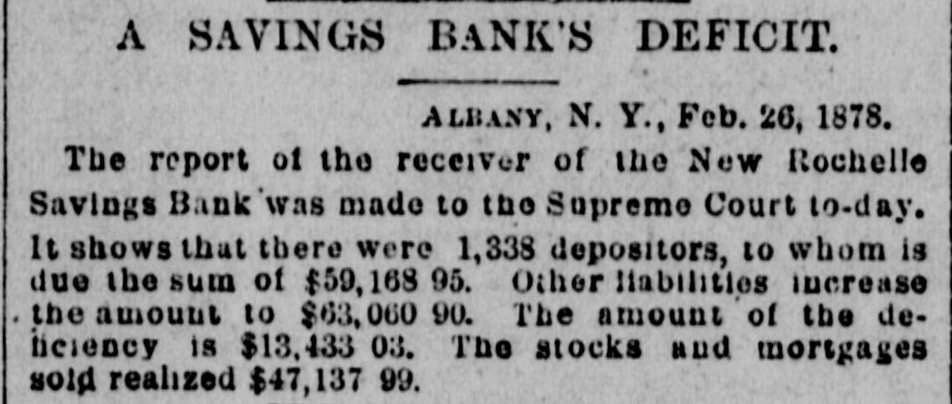
A SAVINGS BANK'S DEFICIT. ALBANY, N. Y., Feb. 26, 1878. The report of the receiver of the New Rochelle Savings Bank was made to the Supreme Court 10-day. It shows that there were 1,338 depositors, to whom is due the sum of $59,168 95. Other liabilities increase the amount to $63,060 90. The amount of the deticiency is $13,433 03. The stocks and mortgages sold realized $47,137 99.


Article from The Forest Republican, April 17, 1878

Click image to open full size in new tab

Article Text

NEWS SUMMARY. Eastern and Middle States. Before & commistee of the Pennsylvania Legislature appointed to investigate the Pittsburgh railroad riots, R. A. Ammon, of Pitteburgh, who was at the head of the Trainmen's Union at the time of the strike, testified that the citizens offered the strikers arms to resist the troops two prominent citizens having of fered a hundred stand of arms each one of these citizens went to see him at Allegheny told him that he hoped the men would stand for their rights, and promised them arms and money. The steam chimney of the Hudson river steamer Magenta exploded two miles below Sing Sing, N. Y., and two passengers were killed outright, two were fatally scalded and several others received seriousinjuries. Warren Lane, bookkeeper of the Planet Mills Manufacturing Company, Brooklyn, N. Y., was returning from the company's bank in New York where he had drawn $4,000 with which to pay off the employees. He was ao companied by an assistant, who carried $700 in silver. When in an unfrequented locality they were approached by three men, dressed as laborers, who suddenly attacked the two, knocking them down with blows from sand clubs and relieving them of the money in a twinkling. Before they could gain their feet the thieves were rattling off in a wagon that was waiting in charge of a confederate and made good their escape. Peter McHugh, Patrick Hester and Patrick Tully were hanged at Bloomsburg. Pa., for the murder of mining superinteudent named Rea, in 1868. The town was filled with people from the surrounding country, but only about two hundred persons were admitted to the jail The yard where the execution took place, three men were hanged together, and exhibited little signs of fear. Hester, who was in substantial circumstances and for whom strenuous efforts had been made to obtain an amelioration of the death sentence, protested his innocence to the last. While the men were still hanging a shed on the side of the jail yard gave way with a crash, precipitating about fifty persons to the ground and injuring a little boy 80 severely that he died soon after. Fires Twenty-three buildings were destroyed by fire in Keeseville, N Y., causing a loss aggregating $65,000. Nearly a whole block of large business houses in Philadelphia was burned, the fire being one of the largest that has ever visited the city and causing an estimated loss of over $1,000,000. Comptroller John Kelly, of New York city, has written a letter to the attorney general of the State in favor of the release of William M. Tweed from further confinement. Comptroller Kelly says in his letter " As a public officer I urge his discharge, because I believe his further detention in a debtors' prison is neither beneficial to the State as an example to evildoers, nor in any sense serviceable to the Meanwhile. Tweed has refused to testify further in regard to ring frauds until he is released. The Higgins Building five-story marble structure on Canal street, New York-was almost totally destroyed by fire, and seventeen business firms suffered losses aggregating $645,000. Judge Blatchford, of New York, has rendered an opinion against ex-Governor Samuel J Tilden. in the suit of the United States for the recovery of several years income tax. This snit was instituted during the election campaign in 1876. The effect of the deci-ion will be to bring the case before a jury on the question of the amount of Mr. Tilden's income during the eleven years from 1862 to 1872, during which he made up no return himse'f, but allowed the assessor to make up the return and paid the tax thereon subject to a penalty of five per cent. The recent report of Acting Superintendent Henry L Lamb on the condition of the savings banks in the State of New York shows that nine savings banks were closed during 1877the Long sland. of Brooklyn: Clairmont, Clinton. German, Oriental and Yorkville, of New York Rock and of Nyack, Saratoga, of Saratoga Springs, and the New Rochelle, with a total amount due depositors of $1,601,719.34. In the State, to-day, 186 savings banks are doing business. The total deposits and the number of depositors have decreased during the year. The deposits fell off nearly $6,000,000 the transactions of the year were smaller in their volume than in other recent years more accounts were opened than were closed the average of each deposit declined, and the surplus of the institutions has shrunk. The total resources of the banks. now in operation, was on January 1. 1878, $56,786,336 total liabilities, $51,455,238, leaving a surplus of $5,331,098. From these facts the superintendent finds reason for the belief that the savings banks are coming back to sound rules in administration, are commanding reasonable confidence of depositors, and are sound. The Broadway Savings Bank, of Lawrence, Mass., and the Sixpenuy Savings Bank, of New York city have been enjoined from doing further business. The latter institution was patronized by the remarkably large number of 33.000 depositors, most of them poor people and children with little accounts. Its liabilities are $1,808 269 77, and the deficiency is estimated at #82, 425. Careless management. amounting almost to indifference, is charged against its officers by the bank examiners The trial of Insurance Superintendent Smyth, of New York, charged by the governor with regularities in office, ended in his acquittal by the Senate by & vote of 19 to 12. The Vanderbilt contested will case drag along in the New York surrogate's court. Much of the evidence offered to show that the Commodore wasmentally unsound or unduly influenced in making his will is excluded. The Pennsylvania Republican State convention will be held at Harrisburg, May 15. Thomas P. Fisher was hanged at Mauch Chunk, Pa., for complicity in the murder of Morgan Powell, a mine boss." While on the scaffold Fisher read part of a statement, emphatically averring his innocence. A bill has been introduced in the New York Legislature providing for a Moffet liquor law similar to that which prevails in Virginia. By ts provisions liquor dealers will be compelled to register each drink sold. A receiver has been appointed for the emearrassed Sixpenny Savings Bank, of New York city. Western and Southern States. Rumors of an Indian confederation in the Northwest have been confirmed. Scouts are reported to have found several thousand Cheyennes and Sioux in Northern Montana on the warpath It is said that Big Bear, one of the chiefs of the league demands as an ultimatum hat the buffalo law shall be repealed, and that Indians shall be allowed to settle their troubles among themselves without interference from the mounted police or the Canadian government. Mrs. George Wallace. her infant child and Miss Church, & schoolgirl, were murdered near Wheeling, W Va., by the former's brother-inlaw, John Wallace. After the murder he aocused his brother of the crime and both we re

Article from The New York Herald, July 26, 1878

Click image to open full size in new tab

Article Text

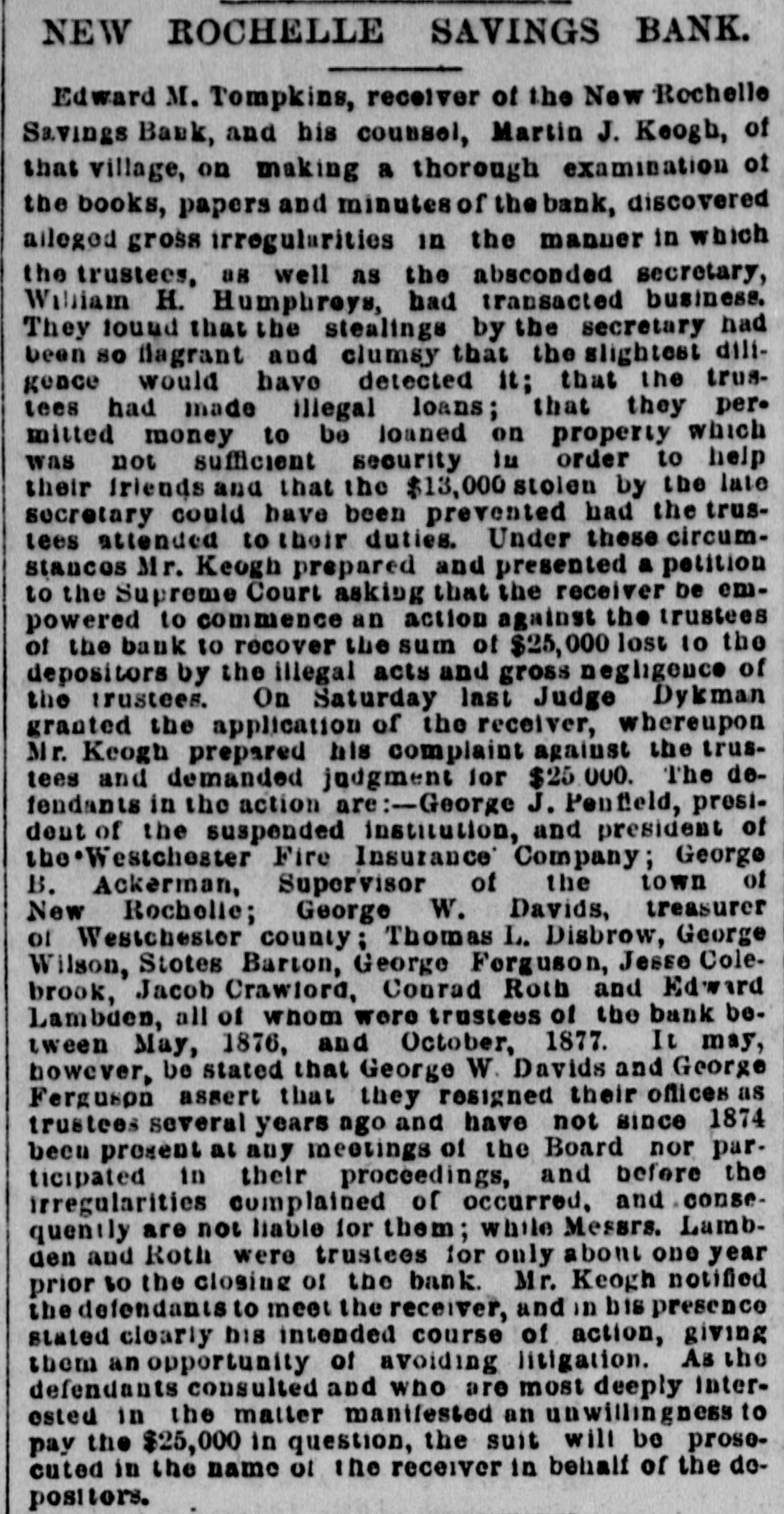
NEW ROCHELLE SAVINGS BANK. Edward M. Tompkins, receiver of the New Rochelle Savings Bank, and his counsel, Martin J. Keogh, of that village, on making a thorough examination of the books, papers and minutes of the bank, discovered alleged gross irregularities in the manner in which the trustees, as well as the absconded secretary, William H. Humphroys, had transacted business. They found that the stealings by the secretary had been so Magrant and clumsy that the slightest diligence would have detected it; that the trustees had made illegal loans; that they permitted money to be loaned on property which was not sufficient security in order to help their friends and that the $13,000 stolen by the late secretary could have been prevented had the trustees attended to their duties. Under these circumstances Mr. Keogh prepared and presented a petition to the Supreme Court asking that the receiver be empowered to commence an action against the trustees of the bank to recover the sum of $25,000 lost to the depositors by the illegal acts and gross negligence of the trustees. On Saturday last Judge Dykman granted the application of the receiver, whereupon Mr. Keogh prepared his complaint against the trustees and demanded judgment for $25.000. The defendants in the action are:-George J. Penfield, president of the suspended institution, and president of the*Westchester Fire Insurance Company; George B. Ackerman, Supervisor of the town of New Rochelle; George W. Davids, treasurer of Westchester county; Thomas L. Disbrow, George Wilson, Stotes Barton, George Forguson, Jesse Colebrook, Jacob Crawtord, Conrad Roth and Edward Lambden, all of whom were trustees of the bank between May, 1876, and October, 1877. It may, however, be stated that George W. Davids and George Ferguson assert that they resigned their offices as trustees several years ago and have not since 1874 been present at any meetings of the Board nor participated in their proceedings, and before the irregularities complained of occurred, and consequently are not liable for them; while Messrs. Lambden and Roth were trustees for only about one year prior to the closing of the bank. Mr. Keogh notified the defendants to meet the receiver, and in bis presence stated clearly his intended course of action, giving them an opportunity of avoiding litigation. As the defendants consulted and who are most deeply interested in the matter manifested an unwillingness to pay the $25,000 in question, the suit will be prosecuted in the name of the receiver in behalf of the depositors.


Article from The Sun, July 26, 1878

Click image to open full size in new tab

Article Text

NEGLIGENT BANK TRUSTEES. DEPOSITORS IN NEW ROCHELLE SUING FOR THE MONEY THEY LOST. President Penfield and his Fellow Officers Called to Account for the Deficiency of $25,000 Receiver Tompkins's ChargesHow Much the Absconding Secretary Stole. The New Rochelle Savings Bank was found to be insolvent by the Bank Department of the State in November Inst. Depositors thronged its doorways. but could get no satisfactory explanation. The next morning William R. Humphrey. the Secretary. absconded. It is supposed that he is in Canada. An action was begun to have the bank dissolved. and Edward M. Tompkins of New Rochelle was appointed receiver. Investigation showed that Humphrey had stolen $13,964 of the bank's money. His method had been exceedingly simple. For example: when a depositor would bring him $100. Humphrey on the with his amount him credit duly would pass-book and send him away satified. On the books of the bank. however, he would credit the depositor with $10 and would pocket the difference. Also, when a man who had borrowed money of the bank paid the debt Humphrey would give him a receipt. but would and on documents bond mortgage the retain which the money had been loaned. Having converted the money to his own use. he would show these documents to the Bank Department Examiner as assets. They were sworn to as assets by the President. George J. Penfield. and by himself. During 1876 and 1877 these reports werealso sworn to by an examining committee of the trustees. under the banking law of 1875. In one case it is alleged that among the mortgages sworn to as assets by Mr. Penfield was a $500 mortgage that had been satisfied personally by himself. The mortgages so misused range from $500 to $3,000. Yet. under the law of 1875. the trustees were compelled to make a thorough examination of all the books of the bank on Jan. 1 of each year. When the receiver sent notices to all persons whom the books of the bank showed to be in its debt, large numbers of astonished customers came forward with their receipts. In almost every case where borrowed money had been repaid to the bank. it was found that the borrowers had not insisted on a return to them of the mortgaged documents. On the discovery of these and other irregularities. Mr. Martin J. Keogh. counsel for the receiver. made application to the Supreme Court for permission for the receiver to sue the trustees. After due notice to Attorney General Schoonmaker, Judge Dykman granted an order on Saturday last authorizing an action against the trustees for $25 000-the full amount of the loss sustained by the depositors. The und of the action is gross negligence and it that this is the first time that proceed. ings against savings bank trustees. based on this ground have ever been instituted in this State. On btaining order Mr Keogh forthwith drew the complaints The charges in these complaints which put the trustees their defence are substantially ns foll WS They failed to require Humphrey to furnish suitable bond for the faithful forman his duties (alth though it is rumored that after Humphrey ran away and before the receiver got was under all its with bank the papers when control of the trustees A bond which had been signed by several them as security for Humphrey WAS stolen or destroyed) That under their charter were prohibited from loaning money on any real estate which was not worth double the amount of the 'sum that loaned 200 they vet 8 loaned: alleged man named W William Shaw in the town of West Farms, on an unin mproved swamp lot which was never worth $200 that this mort gage. which has been foreclosed, realized on sale only $77 75 They also loaned to Lewis Steineger $6 $6,000 on property in the town of West Chester, which was never worth that amount. much less double that amount and for which when put the by for under foreclosure receiver sale in no bids we re received. It was bought in by the the by Wedn him to sold and Vednesday = receiver highest dder for $2,000. The trustees likewise it is averred. in violation of one of their own by laws. took an assignment of a mortgage from harles H. R. Rosevelt on property has the bank which susNow no Rochelle, ta tained loss of $450. They likewise took other of violation similar u mortgages assignments of their by laws. one being from Peter Krayer of 100 on prope rty never worth that amount, and which. when recently offered for sale under foreclosure, WAS sold for $650 Further it is averred that in violation f their charter. which prohibited them from loaning more than $5,000 to any one per loaned they the of same property piece to Michael Ball. a barroom keeper, $6 500 on the same piece of property on Main street, in New Rochelle, thereby becoming individually liable for $1 500. being theexcess of the $5 000 allowed by charter. The fourth count in the complaint charges that since 1870. when Humph rey first acted as Secretary of the bank he was continu usly stealing in the clumsy and flagrant manner while he was in receipt of a salary from the trustees RS their agent that the exercise of the slightest diligence would have detected his wrong doing and that by comply with the of 1875 which provisions of the law made a thorough in investigation on Jan in each year imperative his is peculations which were greatest during 1876and and 1877,could have been easily discovered that Humphrey Was an ignorant man and grossly incapable of discharg ng the duties of secretary of a sav books were bank that no bank smaj regular kept that his cash book was never balanced and that the minutes of the meetings were not recorded, RS required by law During 1877 it is charged that the trustees borro wed $3 700 from the National Loan an Trust Company without authority of law that nvestments were made during that time and that such loan must have been made for the burpose of paying lividends which were never earned. and in direct violation of their charter. that declared puu It they 81 charged paid dividends without any vote having no when been entry that for taken purpose, thereof had been made in the minutes and when there was no surplus thereby becoming severally and jointly liable under the bank ng law of 1875 for the amount dividends is 80 paid aggregating $13,000 They wilfully and inten tionally deceived the Banking Department and their depositors it is averred by making fals reports, certifying that the bank had certain am unts on deposit at the National Trust ComDany when in fact they knew the contrary On the day previ the coming of the Ex am ner from the Banking Department Treas urer Thomas L. Disbrow, it is charged would deposit in the National nal Trust mpany 8 sum ufficient to make appear that the bank had surplus and on the day follo wing the departure of the Examiner would W fraw the money which did not belong to the Bank. The complaint also alleges that there was a violation of the bank charter. which specifi vally prohibits any trustee of the bank from procur


Article from New-York Tribune, July 26, 1878

Click image to open full size in new tab

Article Text

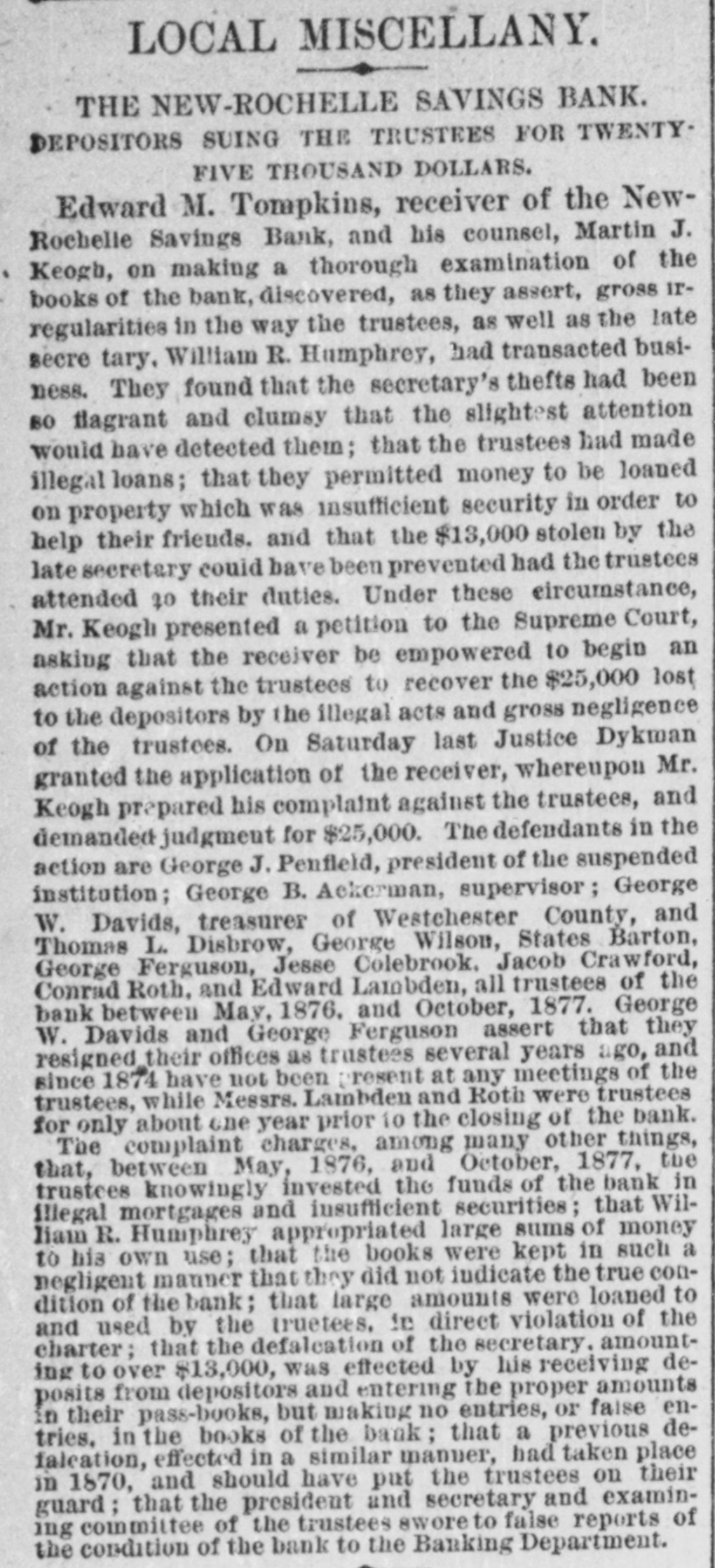
LOCAL MISCELLANY. THE NEW-ROCHELLE SAVINGS BANK. DEPOSITORS SUING THE TRUSTEES FOR TWENTY FIVE THOUSAND DOLLARS. Edward M. Tompkins, receiver of the NewRochelle Savings Bank, and his counsel, Martin J. Keogb, on making a thorough examination of the books of the bank, discovered, as they assert, gross II'regularities in the way the trustees, as well as the late secre tary, William R. Humphrey, had transacted business. They found that the secretary's thefts had been 80 flagrant and clumsy that the slightest attention would have detected them; that the trustees had made illegal loans; that they permitted money to be loaned on property which was insufficient security in order to help their frieuds. and that the $13,000 stolen by the late secretary could have been prevented had the trustees attended 10 their duties. Under these circumstance, Mr. Keogh presented a petition to the Supreme Court, asking that the receiver be empowered to begin an action against the trustees to recover the $25,000 lost to the depositors by the illegal acts and gross negligence of the trustees. On Saturday last Justice Dykman granted the application of the receiver, whereupon Mr. Keogh prepared his complaint against the trustees, and demanded judgmeut for $25,000. The defendants in the action are George J. Penfield, president of the suspended institution; George B. Ackerman, supervisor; George W. Davids, treasurer of Westchester County, and Thomas L. Disbrow, George Wilson, States Barton, George Ferguson, Jesse Colebrook. Jacob Crawford, Conrad Roth, and Edward Lambden, all trustees of the bank between May, 1876, and October, 1877. George W. Davids and George Ferguson assert that they resigned their offices as trustees several years ago, and since 1874 have not been resent at any meetings of the trustees, while Messrs. Lambden and Roth were trustees for only about one year prior 10 the closing of the bank. The complaint charges, among many other things, that, between May, 1876, and October, 1877, the trustees knowingly invested the funds of the bank in illegal mortgages and insufficient securities; that Williain R. Humphrey appropriated large sums of money to his own use; that the books were kept in such a negligent manner that they did not indicate the true condition of the bank; that large amounts were loaned to and used by the truetees. in direct violation of the charter; that the defalcation of the secretary. amounting to over $13,000, was effected by his receiving deposits from depositors and entering the proper amounts in their pass-books, but making no entries, or false entries. in the books of the bank; that a previous defalcation, effected in a similar manuer, had taken place in 1870, and should have put the trustees on their guard; that the president and secretary and examining committee of the trustees swore to false reports of the condition of the bank to the Banking Department.


Article from The New York Herald, November 21, 1878

Click image to open full size in new tab

Article Text

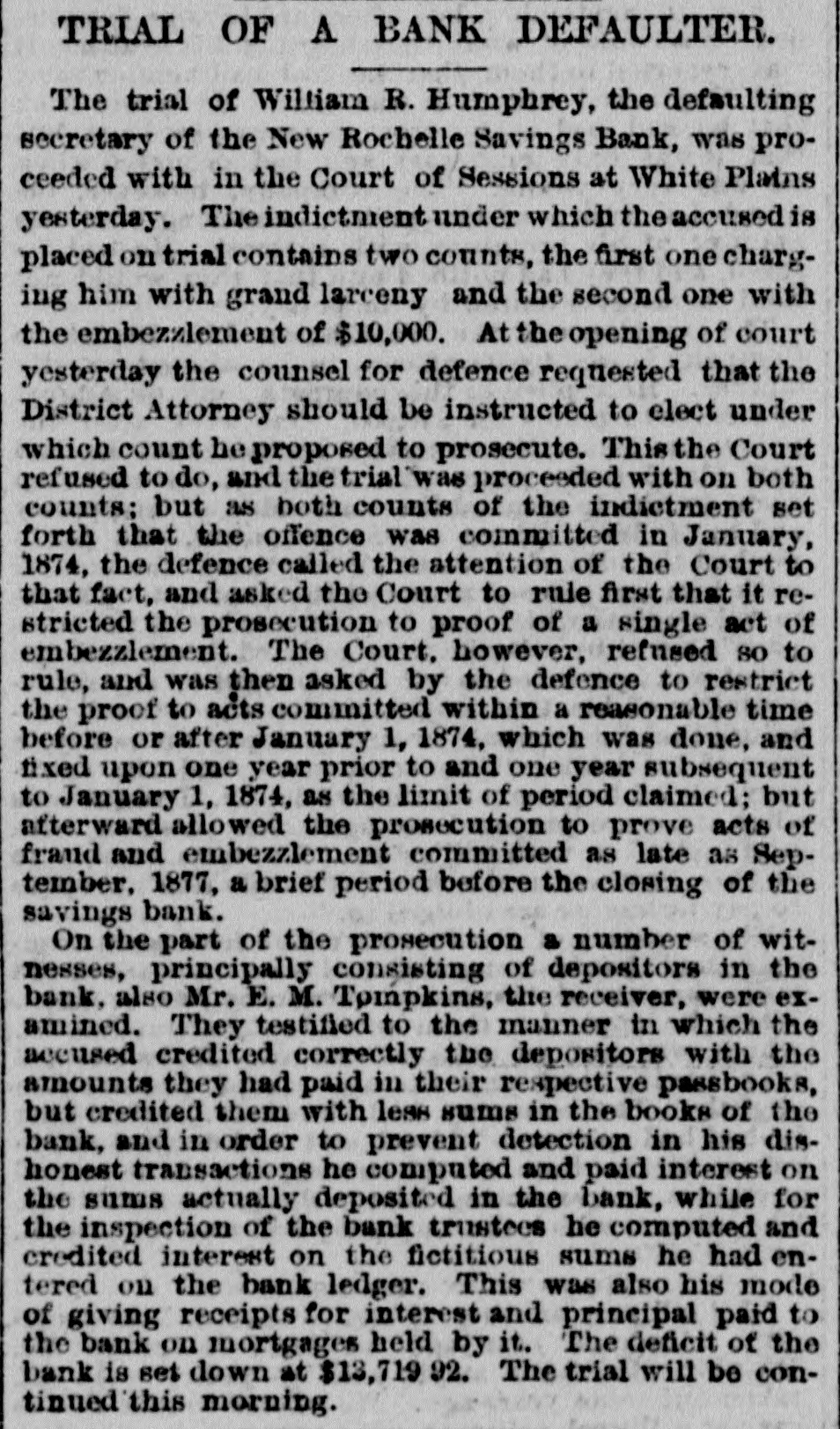
TRIAL OF A BANK DEFAULTER. The trial of William R. Humphrey, the defaulting secretary of the New Rochelle Savings Bank, was proceeded with in the Court of Sessions at White Plains yesterday. The indictment under which the accused is placed on trial contains two counts, the first one charging him with grand larceny and the second one with the embezzlement of $10,000. At the opening of court yesterday the counsel for defence requested that the District Attorney should be instructed to elect under which count he proposed to prosecute. This the Court refused to do, and the trial was proceeded with on both counts: but as both counts of the indictment set forth that the offence was committed in January, 1874, the defence called the attention of the Court to that fact, and asked the Court to rule first that it restricted the prosecution to proof of a single act of embezzlement. The Court. however, refused so to rule, and was then asked by the defence to restrict the proof to acts committed within a reasonable time before or after January 1, 1874, which was done, and fixed upon one year prior to and one year subsequent to January 1, 1874, as the limit of period claimed; but afterward allowed the prosecution to prove acts of fraud and embezzlement committed as late as September. 1877, a brief period before the closing of the savings bank. On the part of the prosecution a number of witnesses, principally consisting of depositors in the bank. also Mr. E. M. Tompkins, the receiver, were examined. They testified to the manner in which the accused credited correctly the depositors with the amounts they had paid in their respective passbooks, but credited them with less sums in the books of the bank, and in order to prevent detection in his dishonest transactions he computed and paid interest on the sums actually deposited in the bank, while for the inspection of the bank trustees he computed and credited interest on the fictitious sums he had entered on the bank ledger. This was also his mode of giving receipts for interest and principal paid to the bank on mortgages held by it.. The deficit of the bank is set down at $13,719 92. The trial will be continued this morning.


Article from The New York Herald, November 22, 1878

Click image to open full size in new tab

Article Text

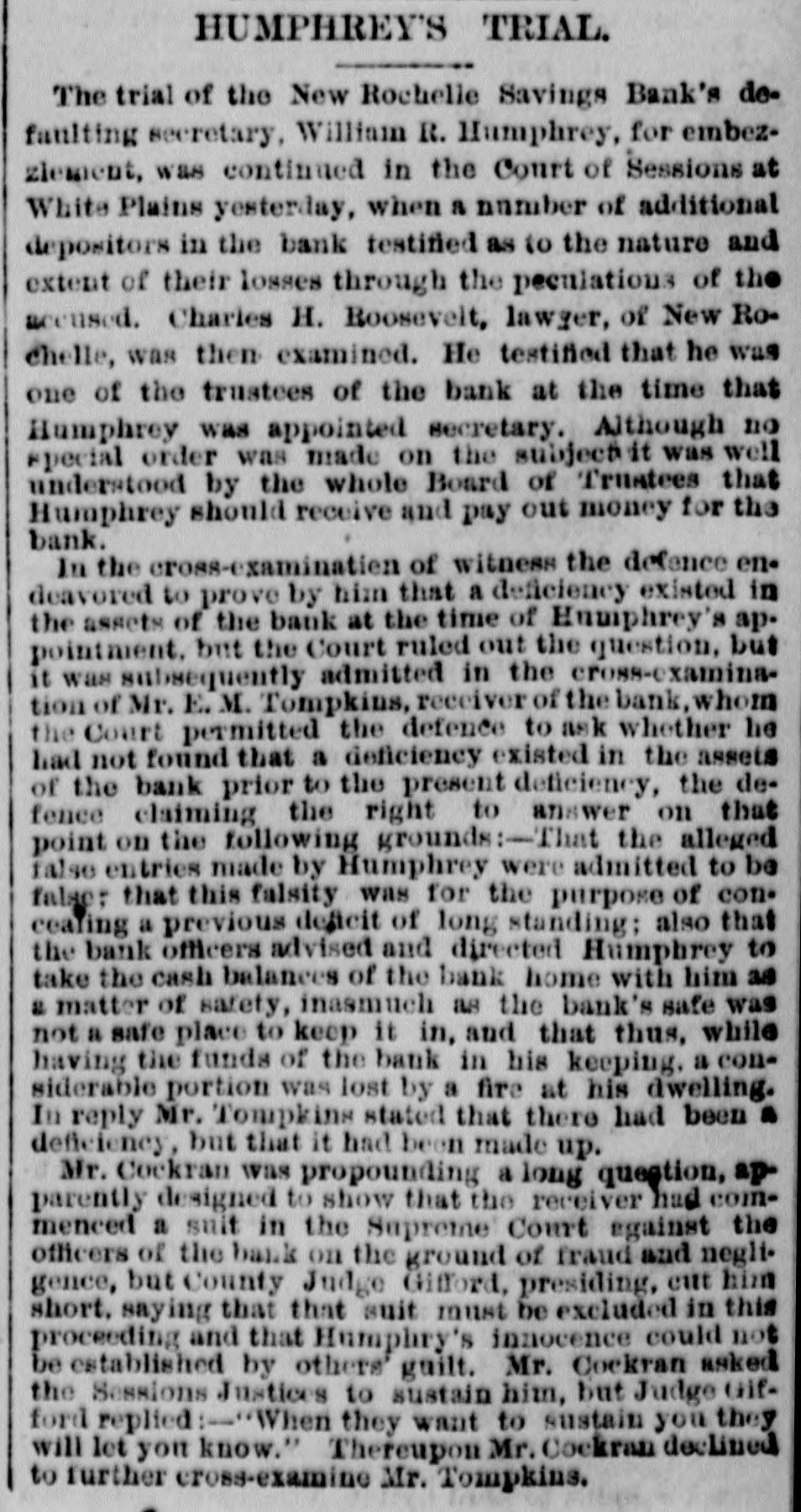
HUMPHREYS TRIAL. The trial of the New Rochelle Savings Bank's defaulting secretary, William R. Humphrey, for embezzlement, was continued in the Court of Sessions at White Plains yesterday, when a number of additional depositors in the bank testified as to the nature and extent of their losses through the peculations of the accused. Charles H. Boosevelt, lawger, of New Rochelle, was then examined. He testified that he was one of the trustees of the bank at the time that Humphrey was appointed secretary. Although no special order was made on the subject it was well understood by the whole Board of Trustees that Humphrey should receive and pay out money for the bank. In the cross-examinatien of witness the defence endeavored to prove by him that a deficiency existed in the assets of the bank at the time of Humphrey's ap. pointment. but the Court ruled out the question, but it was subsequently admitted in the cross-examination of Mr. E. M. Tompkins, receiver of the bank, whom the Court permitted the defence to ask whether he had not found that a deficiency existed in the assets of the bank prior to the present deficiency, the defence claiming the right to answer on that point on the following grounds:-That the alleged false entries made by Humphrey were admitted to be false: that this falsity was for the purpose of concealing a previous deficit of long standing: also that the bank officers advised and directed Humphrey to take the cash balances of the bank home with him as a matter of safety, inasmuch as the bank's safe was not a safe place to keep it in, and that thus, while having the funds of the bank in his keeping. a considerable portion was lost by a fire at his dwelling. In reply Mr. Tompkins stated that there had been n deficiency, but that it had been made up. Mr. Cockran was propounding a long question, apparently designed to show that the receiver had commenced a suit in the Supreme Court against the officers of the bank on the ground of fraud and negligence, but County Judge Gifford, presiding, cut him short. saying that that suit must be excluded in this proceeding and that Humphry's innocence could not be established by others' guilt. Mr. Coekran asked the Sessions Justices to sustain him, but Judge Gifford replied:- -When they want to sustain you they will let you know." Thereupon Mr. Cockran declined to further cross-examine Mr. Tompkins.


Article from New-York Tribune, April 10, 1879

Click image to open full size in new tab

Article Text

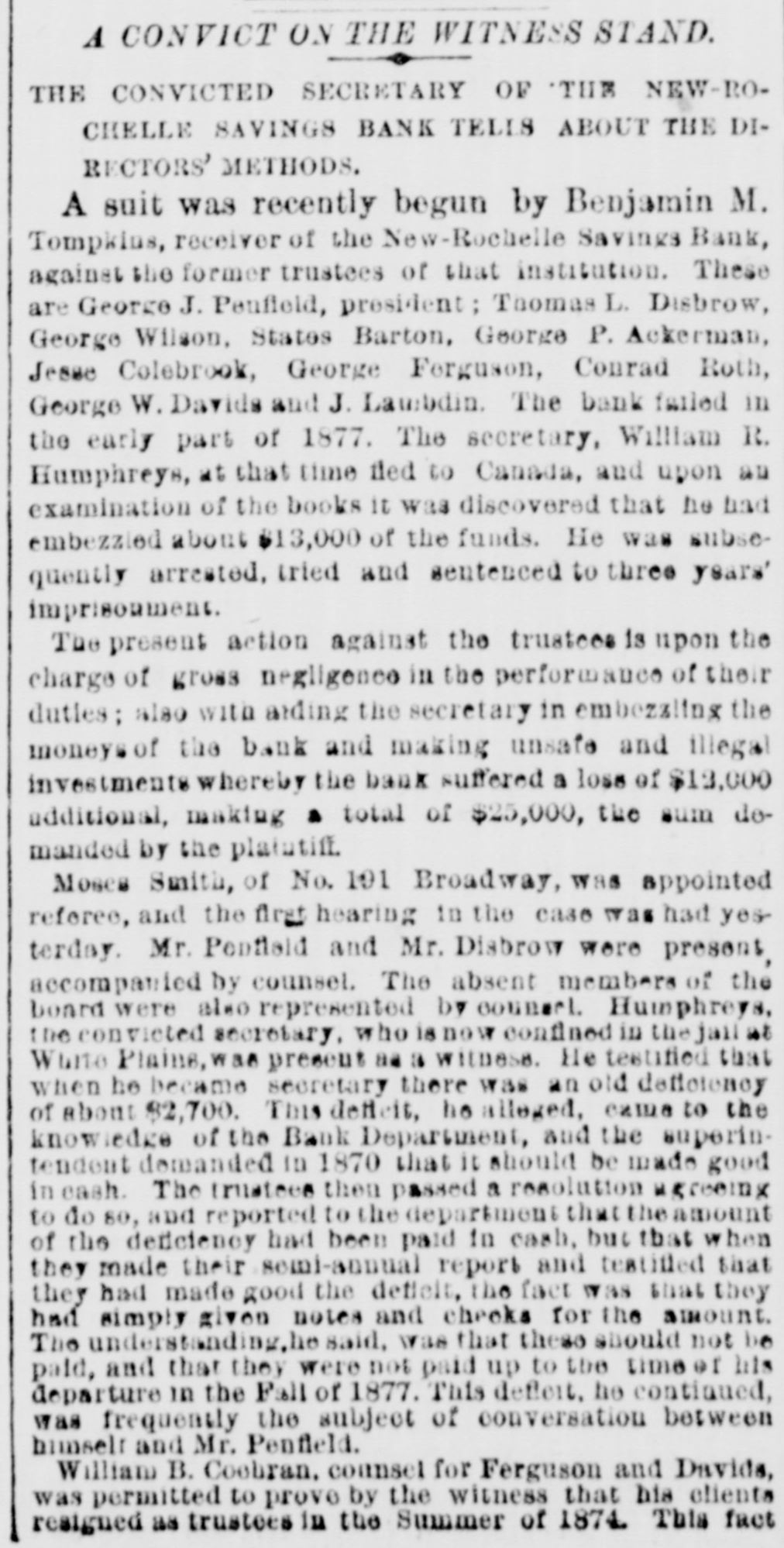
A CONVICT ON THE WITNESS STAND. THE CONVICTED SECRETARY OF THE NEW-ROCHELLE SAVINGS BANK TELLS ABOUT THE DIRECTORS' METHODS. A suit was recently begun by Benjamin M. Tompkins, receiver of the New-Rochelle Savings Bank, against the former trustees of that institution. These are George J. Penfield, president ; Thomas L. Disbrow, George Wilson, States Barton, George P. Ackerman, Jesse Colebrook George Forguson, Courad Roth, George W. Davids and J. Lambdin The bank failed in the early part of 1877. The secretary, William R. Humphreys, at that time fied to Canada, and upon an examination of the books it was discovered that he had embezzied about $13,000 of the funds. He was subsequently arreated. tried and sentenced to three years' imprisoment. The present action against the trustees is upon the charge of gross negligence in the performance of their duties: also with aiding the secretary in embezzling the moneys of the bank and making unsafe and illegal investments whereby the bank suffered a lose of $13,000 additional, making total of $25,000, the sum domanded by the platutiff. Moses Smith, of No. 191 Broadway, was appointed referee, and the first hearing in the case was had yes terday. Mr. Penflaid and Mr. Disbrow were present accompanied by counsel. The absent members of the board were also represented by countri Humphreys the convicted accretary. who is now confined in the jail at White Plains, was present as a witness. He testified that when be became secretary there was an old deflotency of about $2,700. This deficit, he alleged, came to the knowledge of the Bank Department, and the superintendent demanded in 1870 that it should be made good in cash. The trustees then passed a resolution greeing to do 80, and reported to the department that the mount of the deficiency had been paid in cash, but that when they made their somi-annual report and testified that they had made good the deffelt, the fact was that they had simply given notes and checks for the amount The understanding. he said, was that these should not be paid, and that they were not paid up to the time of his departure in the Fall of 1877. This defleit. he continued, was frequently the subject of conversation between humself and Mr. Penfield. William B. Coohran. counsel for Ferguson and Davids, was permitted to prove by the witness that his clients resigned as trustees in the Summer of 1874. This fact


Article from New-York Tribune, July 22, 1879

Click image to open full size in new tab

Article Text

LOCAL MISCELLANY. NEW-ROCHELLE SAVINGS BANK. HEARING UPON THE SUIT OF THE RECEIVER AGAINST THE FORMER TRUSTEES-TESTIMONY OF W. R. HUMPHREYS. There was another hearing yesterday before Referee Freling H. Smith, No. 115 Broadway, in the case of Benjamin M. Tompkins, receiver of the NewRochelle Savings Bank, against the former trustees of that institution, on the charge of gross negligence in the performance of their duties. W. R. Humphreys, the late secretary of the bank, who several months ago was convicted of embezzlement, was cross-examined by counsel for the trustees. Upon conviction last Fall Humphreys was confined in the jail at White Plains, and an appeal was made to the General Term by his counsel for a new trial. Pending a decision bail, in the sum of $5,000 was, after much delay, accepted. and yesterday, for the first time during the progress of the case, Humphreys came from White Plains to the city unaccompanied by a deputy-sheriff. The cross-examination yesterday was conducted by C. H. Roosevelt, attorney for Thomas L. Drsbrow and George Ackerman, trustees, and by Isaac N. Mills on behalf of George Wilson, another of the trustees George J. Penfield, late president of the bank, being represented by Calvin Frost. The witness adhered to his original statements respecting the false entries made by him. He has claimed from the beginning that when he entered the bank he was informed of the existence of a deficiency, and was told that he would be expected to conceal that deficiency as opportunity offered. He contends, therefore, that while the trustees were not apprised of each specific false entry made by him, his course in that direction was only in harmony with his original instructions. On his trial at White Plains, Humphreys in his defence testified that he had taken certain suws of money to his house and secreted it there for safe keeping, and that on the 30th of August, 1875 his house and its contents were destroyed by fire,and he had not seen the money since. When asked yesterday whether this statement was true, he declined to answer on the ground that his reply might tend to criminate him and be used to his injury in the new trial which he expects to secure. Being pressed by the referee, however, he said, after much hesitation, that so far as his memory on that point extended, it was true. He was then asked whether he at that time informed the trustees of the loss of that amount of money belonging to the bank, and he replied that he had not. In the criminal trial he also claimed that one evening he had tied $3,000 up in bundles and placed some portion of it in the waste basket and had thrown another lot under the safe, and that when he returned in the morning be found that the money was gone. After more hesitation, on the plea that he did not want to say anything that would criminate himself, he finally said that to the best of his knowledge and belief about $3,000 was stolen from the bank in the year 1876 or 1877 by some person to him unknown. He had, however, never spoken to the trustees about the theft, but had gone on covering up the deficiency by means of false entries. None of the money, so far as he knew, had ever been returned to the bank. The next hearing will take place September 26. at 10:30 a. m. The General Term of the Supreme Court of the Second Judicial District, at New-Rochelle, has rendered a decision affirming the conviction of William R. Humphreys, secretary of the broken savings bank of New-Rochelle, for embezzling its funds.


Article from The New York Herald, July 22, 1879

Click image to open full size in new tab

Article Text

THE NEW ROCHELLE BANK. TESTIMONY BEFORE A REFEREE IN A SUIT AGAINST THE TRUSTEES- FOUR THOUSAND DOLLARS THROWN INTO A WASTE BASKET. A continued hearing of the testimony in the suit of Edward M. Tompkins, receiver of the New Rochelle Savings Bank, against G. J. Penfield and others, was held yesterday before Freling H. Smith, referee, at No. 113 Broadway. Its object is to recover $23,000, which, as is claimed by the prosecution, was lost under the management of the trustees and through their "gross negligence, illegal acts and illegal investments." Mr. Humphreys, the convicted secretary of the bank, who has been admitted to $10,000 bail by Judge Dykman pending the decision of his appeal to the Supreme Court, was the only witness. He was examined at length by Mr. Keogh for the receiver and by Mr. Frost, of Mount Vernon, for Mr. Penfield, president of the bank, and by Mr. C. H. Roosevelt, attorney for Thomas L. Disbrow and George Ackerman, all three of whom were trustees at the time of the defalcation. A REMARKABLE DOCUMENT. The !eature of the morning's testimony was that it showed that George J. Penfield when president of the bank gave to it a bond in the penal sum of $5,000 guaranteeing the honesty and trustworthiness of Mr. Humphreys, their secretary, and for the safety of moneys in his possession. This remarkable document was deposited in Humphreys' care. None of the other trustees signed it. The witness said that he left it in the keeping of the bank. Counsel for the defence asked the receiver's lawyer for this bond. Mr. Keogh replied that the interval between the absconding of the secretary and the appointment of the receiver was about three weeks, and that during that interval many valuable papers disappeared, and he could only suggest that the bond might have gone astray with the other documents. In the atternoon Mr. Humphreys said that alterations were made on the books to cover deficiencies; that such was his understanding with and instructions from some of the trustees. He was asked if on some night in 1876 or 1877 he did not throw packages of money into the wastebasket and under the safe on the pretence that it would be sater there; also if the said money was not stolen before morning. The witness refused to answer in absence of counsel, but the question was so modified as to bring out the reply that some $3,000 or $4,000 was stolen on a night in one of these years. The case was adjourned till September 26, at ten A. M.


Article from New-York Tribune, November 22, 1879

Click image to open full size in new tab

Article Text

THE COURTS. ACCOUNTS OF A BANKRUPT BANK. The suit of Edward M. Tompkins, receiver of the New-Rochelle Savings Bank, to recover $20,000 from the trustees, was continued before Referee F. H. Smith, at No. 115 Broadway. yesterday. Martin J. Keogh appeared for the plaintiff. and Calvin Frost and Odell Close for the defendants. B. A. McDonald, au expert, who has examined the books.,Institutied that in the dividends declared from Janmary 1, 1876, to the insolvency, there appeared an increasing deficiency, beginne at $6,000 and growing to $14,000. The old defleiency of $1.814 was found. The bank had keptits accounts with the National Trust Company. On October 6. 1877. a deposit of $1,900 was made. Three days later $1.865 was drawn out. These transactions were made by the treasurer. T. 8. Dis. brow. Oa his cash-book he charges himself with $1,900 on October 6. 1877, but the draft of $1.865 does not appear on his books. Counsel for the plain.iff stated that the bank was paying 6 per cent dividend< when 121soivent. It was also shown that the bank, between February 20, 1874. and November 13, 1876, borrowed from the National Trust Company $17,200. This, the counsel claimed, it had no leval right to do. The ease was adjourned to December 12. It was stated after the adjournment that the bank had obtained the loans because it had United States bonds which it did not want to sell.


Article from New-York Tribune, January 24, 1880

Click image to open full size in new tab

Article Text

SUIT AGAINST BANK TRUSTEES. The hearing in the suit of Edward M. Tompkins, receiver of the New-Rochelle Savings Bank, to recover $20,000 from the trustees, was continued before Referee F. H. Smith, at No. 115 Broadway, yesterday. After much testimony about the value of property on which the bank had made loans, Theodore R. Disbrow, former treasurer and trustee of the bank, testified tkat he had drawn checks upon the National Trust Company. After the checks were drawn, be was in the habit of placing them in his desk. He could not tell where they are now. though he had made an earnest effort to find them. Mr. Close moved that the charge be withdra wn against his clients-Messrs. Crawford. Lambden and Roach--on the ground of a tack of evidence. C. H. Roosevelt made the same motion for Messrs. Ackerman and Colbrook, on the grounds of insolvency. The motions will be argued on February 14.


Article from New-York Tribune, February 22, 1880

Click image to open full size in new tab

Article Text

NEW-ROCHELLE SAVINGS BANK. THE SUIT DISCONTINUED AGAINST ALL THE OFFICERS EXCEPT THE PRESIDENT AND TREASURER. A hearing in the suit of Edward M. Tompkins, receiver of the New-Rochelle Savings Bank, against the trustees of the bank for the recovery of $25,000, was held before Referee F. H. Smith, at No. 115 Broadway yesterday. B. A. Maedonald, the expert who examined the books of the bank, was closs-examined by Erastus 8. Ransom, counsel for T. L. Disbrow. the treaseuror. He testified as follows: "The bank was apperently solvent at the time the dividends were declared. The defalcation of W. R. Humphrey, which amounted to $14.000, made the bank insolvent. It appears on the books of the bank that the interest on the bonds was collected by Humphrey. There is no discrepancy between Mr. Disbrow's accounts and those of the Trust Company in regard to the bank. All the money that Mr. Disbrow received as treasurer had been accounted for by him before the receiver was appoluted. Mr. Disbrow always showed in his reports to the trastees that the amount reported as cash. which was in the old defielency of $1,800. was not actual cash on hand. This amount was paid to the bank before the rec. |ver WHS appointed. If the three items of pretaining, accrued interest and the old deficiency had been a lowed in the examination of the bank's accounts by the expert. the assets would have exceeded the liabilities and the bank would have been warranted in declaring dividends in 1876. The books of the bank show no deficiencies, excluding the three items mentioned." At the close of the cross-examination Mr. Keogh, the plaint It's counsel, announced that the suit would be dieCO: tinned against all the trustees, except George A. Penfield, president of the bank, and Tuomas S. Disbrow, treasurer. The reasons given for this action were that these two persons were especially liable because they were at the bank during most of the time, while the other trustees had little know lodge of the affairs of the bank The caso was adjourned to saturday. March 6, at 10:30 a. 10.


Article from New-York Tribune, May 16, 1880

Click image to open full size in new tab

Article Text

THE NEW-ROCHELLE SAVINGS BANK. The defence in the suit of the receiver of the New-Rochelle Savings Bank against Penfield and Disbrow, the former president and treasurer of the bank, was continued yesterday before Freling H. Smith, referee. A motion was made by the counsel of Mr. Ackermann, one of the trustees, against whom proceedings were withdrawn several months ago, that all claims should be withdrawn against Mr. Ackerman. As the motion made before the Court was that the prosecution should be withdrawn without costs, the referee reserved his decision. Israel B. Robinson testified that Humphrey, while in jail awaiting trial, remarked to him that Penfield and Disbrow ought to be where he himself was, and he thought he would be able to get them there. Thomas Dooley testified that he had bad no money on deposit within twelve years of the closing of the bank. This evidence Was introduced to contradiet the statement sworn to by Humphrey that there was a deficiency in the witness's account at the time the bank closed. George Wilson, one of the trustees of the bank from its organization to its dissolution, said that checks had been given by the several trustees to make up the first deficit, but there was no understanding that they were not to be paid. Witness was a member of the Examining Committee, and made an examination of the books twice each year. The statements of Disbrow. as treasurer, were received as correct without any examination of his books, on account of their great confidence in him. Humphrey had never told the witness that the bank was insolvent. The accrued interest on the mortgages was always included in the assets. Mr. Barton, another trustee, was recalled and testitled to the same effect as the last witness. At the next hearing, June 1, both of the defendants will be examined and the testimony of the defence will be elosed.