Article Text
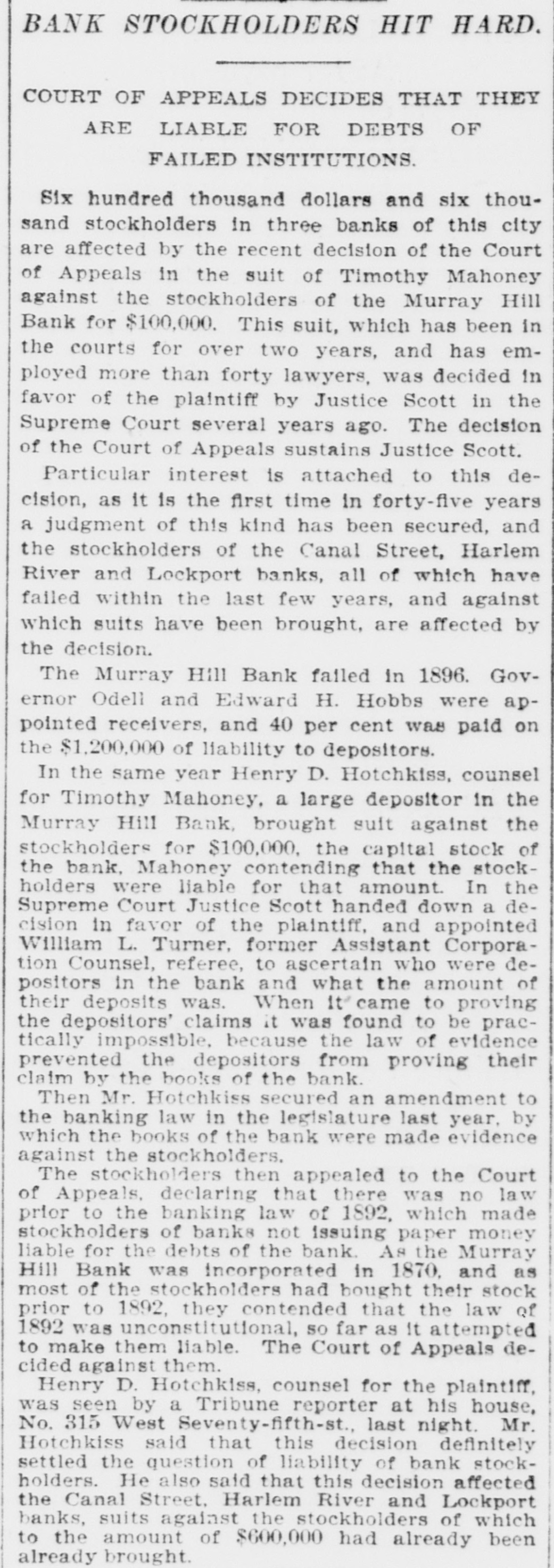
BANK STOCKHOLDERS HIT HARD. COURT OF APPEALS DECIDES THAT THEY ARE LIABLE FOR DEBTS OF FAILED INSTITUTIONS. Six hundred thousand dollars and six thousand stockholders in three banks of this city are affected by the recent decision of the Court of Appeals in the suit of Timothy Mahoney against the stockholders of the Murray Hill Bank for $100,000. This suit, which has been in the courts for over two years, and has employed more than forty lawyers, was decided in favor of the plaintiff by Justice Scott in the Supreme Court several years ago. The decision of the Court of Appeals sustains Justice Scott. Particular interest is attached to this decision, as it is the first time in forty-five years a judgment of this kind has been secured, and the stockholders of the Canal Street, Harlem River and Lockport banks, all of which have failed within the last few years, and against which suits have been brought, are affected by the decision. The Murray Hill Bank failed in 1896. Governor Odell and Edward H. Hobbs were appointed receivers, and 40 per cent was paid on the $1,200,000 of liability to depositors. In the same year Henry D. Hotchkiss, counsel for Timothy Mahoney, a large depositor in the Murray Hill Bank, brought suit against the stockholders for $100,000, the capital stock of the bank, Mahoney contending that the stockholders were liable for that amount. In the Supreme Court Justice Scott handed down a decision in favor of the plaintiff, and appointed William L. Turner, former Assistant Corporation Counsel, referee, to ascertain who were depositors in the bank and what the amount of their deposits was. When it came to proving the depositors' claims it was found to be practically impossible, because the law of evidence prevented the depositors from proving their claim by the books of the bank. Then Mr. Hotchkiss secured an amendment to the banking law in the legislature last year. by which the books of the bank were made evidence against the stockholders. The stockholders then appealed to the Court of Appeals, declaring that there was no law prior to the banking law of 1892, which made stockholders of banks not issuing paper money liable for the debts of the bank. As the Murray Hill Bank was Incorporated in 1870, and as most of the stockholders had bought their stock prior to 1892, they contended that the law of 1892 was unconstitutional, so far as it attempted to make them liable. The Court of Appeals decided against them. Henry D. Hotchkiss, counsel for the plaintiff, was seen by a Tribune reporter at his house, No. 315 West Seventy-fifth-st., last night. Mr. Hotchkiss said that this decision definitely settled the question of liability of bank stockholders. He also said that this decision affected the Canal Street, Harlem River and Lockport banks, suits against the stockholders of which to the amount of $600,000 had already been already brought.