
15137. Bank of Gallipolis (Gallipolis, OH)

Bank Information

Episode Type
Suspension โ†’ Closure
Bank Type
state
Start Date
January 18, 1841
Location
Gallipolis, Ohio (38.810, -82.202)

Metadata

Model
gpt-5-mini
Short Digest
459cf037809f905e

Response Measures

None

Description

Article from Jan 18, 1841 (Democratic Standard) announces the bank has suspended business because of an unprecedented system of fraud by former officers and an over-issue of circulation. No run is reported. Later articles (1846, 1850) list the Bank of Gallipolis among failed banks, supporting that the suspension led to permanent failure, though the 1841 notice does not explicitly state receivership or formal liquidation. OCR corrected minor spacing/typos in the 1841 excerpt.

Events (1)

1. January 18, 1841 Suspension
Cause
Bank Specific Adverse Info
Cause Details
Fraud by former officers: large over-issue of the bank's circulation concealed from directors; agents dispersing fraudulent issues in the western country.
Newspaper Excerpt
It becomes our painful duty to announce to the public that in consequence of an unprecedented system of fraud, practiced by the former officers of this institution, and which has just come to light, we have been compelled to suspend business.
Source
newspapers

Newspaper Articles (3)

Article from Democratic Standard, February 16, 1841

Click image to open full size in new tab

Article Text

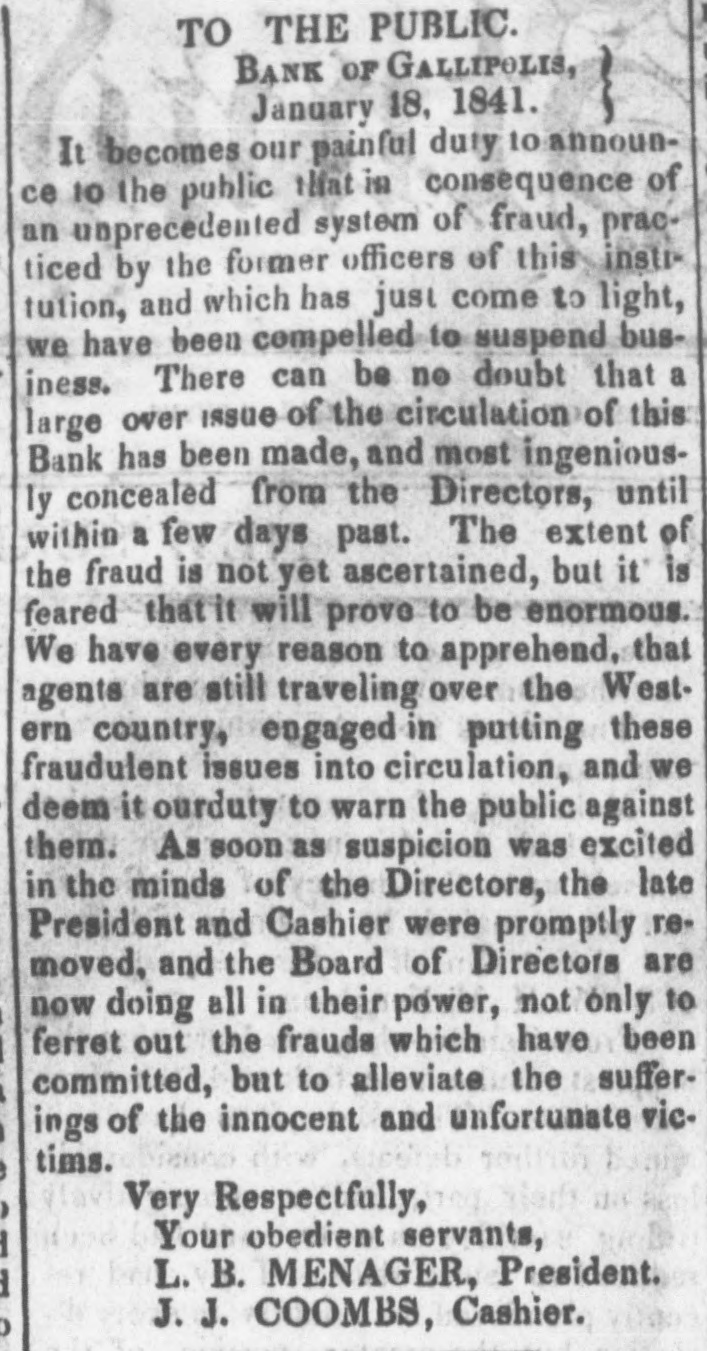
TO THE PUBLIC. BANK OF GALLIPOLIS, January 18, 1841. It becomes our painful duty to announce 10 the public that in consequence of an unprecedented system of fraud, practiced by the former officers of this instr tution, and which has just come to light, we have been compelled to suspend business. There can be no doubt that a large over issue of the circulation of this Bank has been made, and most ingeniously concealed from the Directors, until within a few days past. The extent of the fraud is not yet ascertained, but it is feared that it will prove to be enormous. We have every reason to apprehend, that agents are still traveling over the Western country, engaged in putting these fraudulent issues into circulation, and we deem it ourduty to warn the public against them. As soon as suspicion was excited in the minds of the Directors, the late President and Cashier were promptly removed, and the Board of Directors are now doing all in their power, not only to ferret out the frauds which have been committed, but to alleviate the sufferings of the innocent and unfortunate vic. tims. Very Respectfully, Your obedient servants, L. B. MENAGER, President. J. J. COOMBS, Cashier.


Article from The Spirit of Democracy, January 24, 1846

Click image to open full size in new tab

Article Text

# FOR GOVERNOR OF OHIO, DAVID TOD, of Trumbull. # THE CONSTITUTIONAL CURRENCY. In our paper of last week, we published the proceedings of the Democratic 8th of January Convention, which put in nomination, as the Democratic candidate for Governor of Ohio, the able advocate of equal rights-DAVID TOD. On the first page of to-day's paper will be found the proceedings of the Democratic Editorial State Convention, for which we bespeak an attentive perusal. The democracy of this county are well aware, that, when the democratic party of Ohio raised the "bank reform" banner, in 1838, they were triumphantly victorious at the ensuing elections. The people were well satisfied, from past experience, that the old villanous banking system needed much reformation, in order to secure them from the almost daily loss of thousands of dollars; a loss resulting as well from the total failure of these rascally shaving shops, as from a partial depreciation in the nominal value of their "promises to pay." In accordance with the views and doctrines, at that time advocated, the democratic members of the General Assembly, at subsequent sessions of the Ohio legislature, passed laws which, it was supposed, would have the effect to make bankers honest men; or, in other words, to prevent the old system of bank swindling of "contractions to-day, and expansions to-morrow"- from ever being again fastened upon the people of this State. Laws were enacted making stockholders liable in their individual capacity for the debts of a bank, in case of failure, as well as other laws equally salutary. When these laws were passed, it was thought that the people would, thereafter, be secured from losses by bank failures, and bank suspensions; and that all banks thereafter chartered would have engrafted in their charters these salutary provisions. But how have the people been disappointed in their hopes and expectations? Would bankers accept of charters with the individual liability clause? No. The determination of the moneyed aristocracy of this State was to grind down the people by enormous taxes, by bank failures, and bank suspensions, until they should be brought to tamely submit to any banking proposition that might be brought forward. The result has been, that by "deception, corruption, and accident," the bank power of the State has once more gained the ascendency in our legislative halls. Immediately, all the salutary measures, demanded by the people, were repealed; and a system of banking enforced upon the people only equalled by the old defunct banks of Gallipolis, West Union, and a host of others. Who does not recollect, and, not only recollect, but, by experience, know the thousands, and we might safely say millions, lost to the people of Ohio, by the explosion of such dens of iniquity as the Bank of Cincinnati, German Bank of Wooster, Bank of Steubenville, Bank of Granville, Bank of Urbana, Bank of Gallipolis, Bank of West Union, Miami Exporting Company, new Bank of Circleville, Lebanon Miami Bank, Bank of Cleveland, Commercial Bank of Lake Erie, Commercial Bank of Scioto, and a long list of others in this State, together with the losses sustained by the failure of the banks of the States of Illinois, Michigan, and others; and we might particularly mention as "last though not least," the Bank of St. Clair, familiarly known as the *Red-dog* bank? Have the people, we ask, forgotten all their losses occasioned by the failure of these institutions? No. They feel that forbearance will soon cease to be a virtue; and will, ere long, speak in tones of thunder to those nabobs of the bank-paper-mills, whose only rule of action seems

Article from Burlington Hawk-Eye, January 31, 1850

Click image to open full size in new tab

Article Text

Just as we expected!!! When our Low Water neighbers turned out Financiers, and made a futile effort to run a tilt gainst Clark's paper, and read puerile lectures on currency to their readers, we knew they must render themselves, and the whig party even, in a measure, ridiculous. The aim of the Whig party should be to establish in our State a banking system, with all checks and safeguards necessary to secure entire solvency and proper management. As the experiments heretofore made seem to indicate, all expedients have failed, and the solvency of banks has seemed to be the result of honest and judicious management, and not legislative restriction. If there be any exception, it is in New York. The State Branch system of Ohio never has and never will have the entire confidence of financiers. Whether the banks of that State are good or not, nobody can tell here or there. If any one personally knows the managers he can form an opinion satisfactory to his own mind, but after all, actually knows nothing. And yet the bulk of the currency of Iowa is Ohio paper. How much tter-would be a currency of our own, under our own control? The Keokuk Register published a statement of the condition of the Ohio Banks-as they said-to "head the advocates of Clark's paper !" This statement shows that the immediate liabilities of those banks exceed their immediate means $7,022,131, and that neither the editors at Keokuk nor the people of Ohio know any thing about the actual value of Ohio Bank paper. They show by their statement that their immediate means are not sufficient to meet their liabilities. But say these astute financiers of the Keokuk Register-we took our statement "from the Cincinnati Gazette-the oldest and most influential Whig paper in the State-the editor of which remarks, 'that the Banks of no State in the Union are stronger and more impregnable.' The fact that their immediate liabilities exceed their immediate means seven millions and more, does not prove to be true, what the Gazette says as to the solvency of these banks; but the fact that the oldest Whig paper in Ohio says so, satisfies the financiers of the Regis. ter, that such is the fact. Now weare pretty much of the same opinion-but for a very different reason. We do not think, with the Register, that the statement proves anything, except the inability of the Ohio Banks to pay; but when the editors of the Cincinnati Gazette assure us that we may have confidence in Ohio Banks-we are disposed to contide in the editors of that paper, because we believe they are honest and well informed. So in regard to Clark's paper. Men, as honest and well informed, assure us, and give us confidence. We cannot descend to the slang of the Register. We desire to reason and be met in the same way.If "billingsgate" suits better the appetites of the readers of the Register, we can forgive it. But in justice to Clark & Co., we must copy one remark of the Register, as follows make no objection whatever to the regular business of Clark & Co., in the Exchange and Broker line; that is entirely legitimate, and had they confined their operations to that, no one would have just cause of complaint." So far as we have been able to ascertain, the business of Clark s Co. in this place, has been, wholly confined to the business of buying and selling, of exchange, and to notes of foreign banks. We do not know of a single loan-nor, do we believe one to have been made. It is regretted by business men that their paper cannot be borrowed. And the reason why it cannot, is owing to the fact that it is worth 1 per cent. more at St Louis, than any paper in circulation in Iowa, (except Missouri Bank,) and will therefore return upon them as fast as issued. Is this the case with Ohio paper ? No! It is usually sent here in greatest abundance just before a failure as all know, who remember the rotten concerns-the bank of Cincinnati-bank of Gallipolis-bank of Norwalk-bank of Sandusky-bank of Steubenville-bank of West Union--bank of Wooster--Farmersbank of Canton--Farmers Bank of New Salem--Farmers and Mechanics bank of Chillionthe-Farmers and Mechanics bank of Cinbank of Wooster-Jefferson bank of New Salem, etc., etc., etc. All of which, Ohio newspapers, called gou. until they were broken, and Iowa footed the bill! In conclusion, we recommend the editors of the Register to abandon the wind-mill operation of one Sancho Panza, and to devote their energies to the Rail Road from Dubuque to Keokuk. Which will be built "if they only have time" !!! Gentlemen, you must tarry in Jericho a little longer I I