Article Text
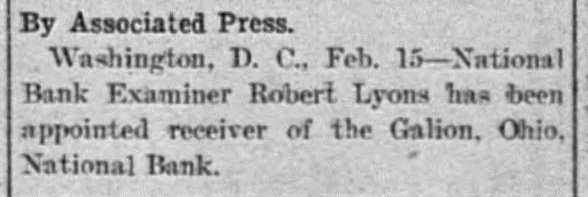
By Associated Press. Washington, D. C., Feb. 15-National Bank Examiner Robert Lyons has been appointed receiver of the Galion, Ohio. National Bank.
9dfc846fc1c3b2d2None
Click image to open full size in new tab
By Associated Press. Washington, D. C., Feb. 15-National Bank Examiner Robert Lyons has been appointed receiver of the Galion, Ohio. National Bank.
Click image to open full size in new tab
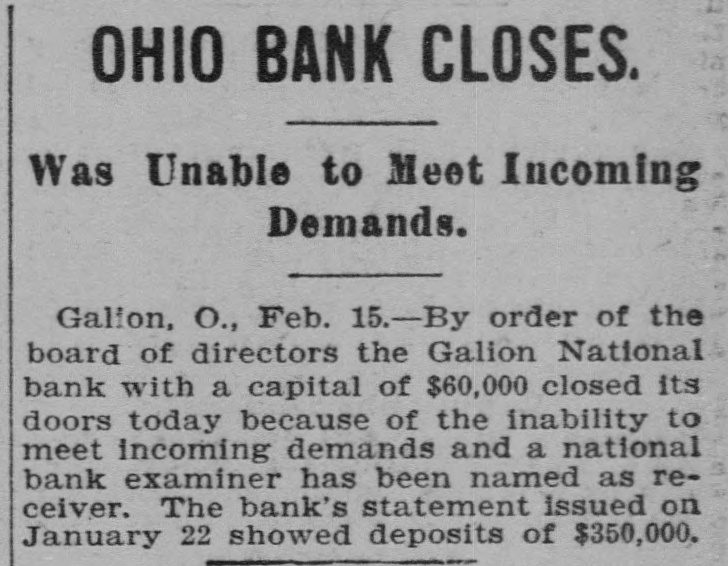
OHIO BANK CLOSES. Was Unable to Meet Incoming Demands. Galion, O., Feb. 15.-By order of the board of directors the Galion National bank with a capital of $60,000 closed its doors today because of the inability to meet incoming demands and a national bank examiner has been named as receiver. The bank's statement issued on January 22 showed deposits of $350,000.
Click image to open full size in new tab
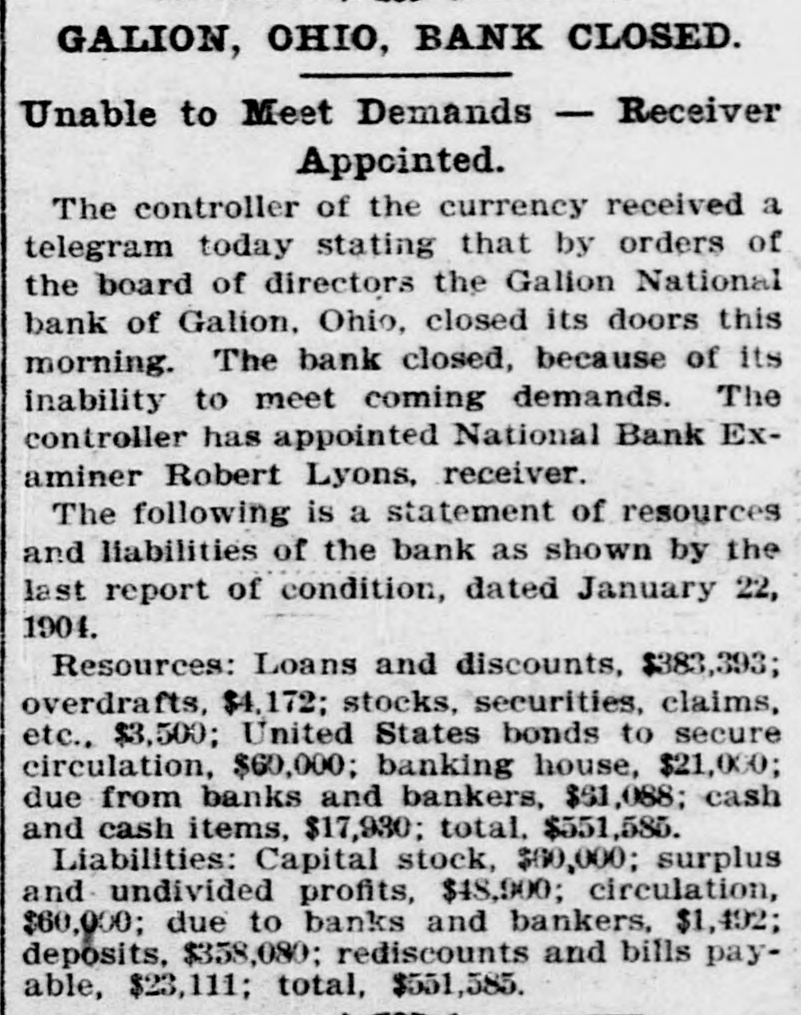
GALION, OHIO, BANK CLOSED. Unable to Meet Demands - Receiver Appointed. The controller of the currency received a telegram today stating that by orders of the board of directors the Galion National bank of Galion, Ohio, closed its doors this morning. The bank closed, because of its inability to meet coming demands. The controller has appointed National Bank Examiner Robert Lyons, receiver. The following is a statement of resources and liabilities of the bank as shown by the last report of condition, dated January 22, 1904. Resources: Loans and discounts, $383,393; overdrafts, $4,172; stocks, securities, claims, etc., $3,500; United States bonds to secure circulation, $60,000; banking house, $21,000; due from banks and bankers, $61,088; cash and cash items, $17,930; total. $551,585. Liabilities: Capital stock, $60,000; surplus and undivided profits, $48,900; circulation, $60,000; due to banks and bankers, $1,492; deposits, $358,080; rediscounts and bills payable, $23,111; total, $551,585.
Click image to open full size in new tab
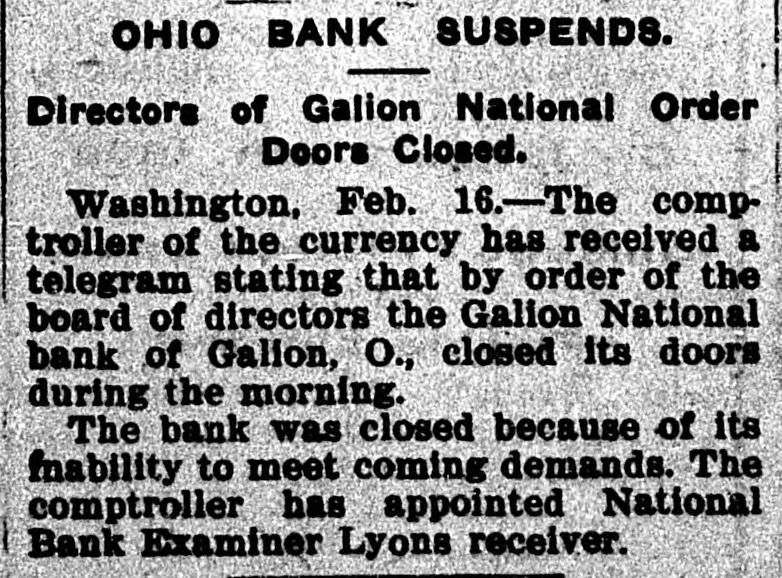
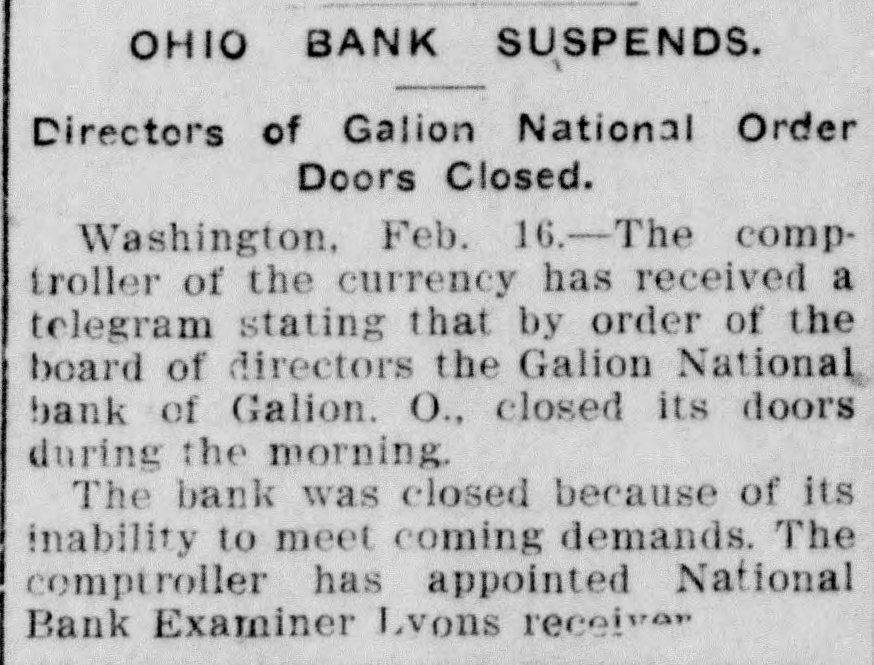
OHIO BANK SUSPENDS. Directors of Galion National Order Doors Closed. Washington, Feb. 16.-The comptroller of the currency has received a telegram stating that by order of the board of directors the Galion National bank of Gallon, O., closed its doors during the morning. The bank was closed because of its fnability to meet coming demands. The comptroller has appointed National Bank Examiner Lyons receiver.
Click image to open full size in new tab
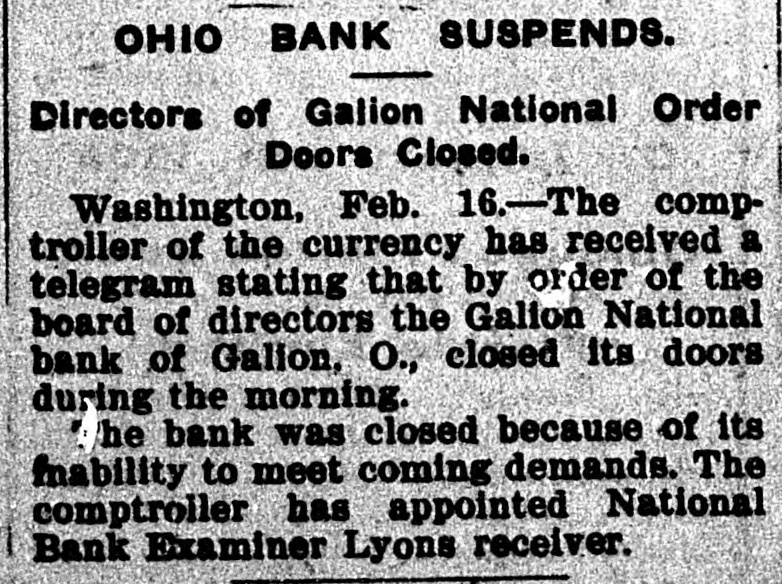
OHIO BANK SUSPENDS. Directors of Galion National Order Doors Closed. Washington, Feb. 16.-The comptroller of the currency has received a telegram stating that by order of the board of directors the Galion National bank of Galion. O., closed its doors during the morning. The bank was closed because of its inability to meet coming demands. The comptroller has appointed National Bank Examiner Lvons receiver
Click image to open full size in new tab
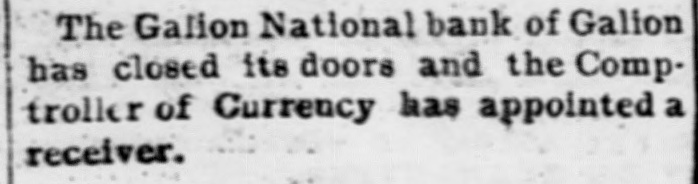
OHIO BANK SUSPENDS. I Directors of Galion National Order Doors Closed. Washington, Feb. 16.-The comptroller of the currency has received a telegram stating that by order of the board of directors the Galion National bank of Galion, O., closed its doors during the morning. he bank was closed because of its fnability to meet coming demands. The comptroller has appointed National Bank Examiner Lyons receiver.
Click image to open full size in new tab
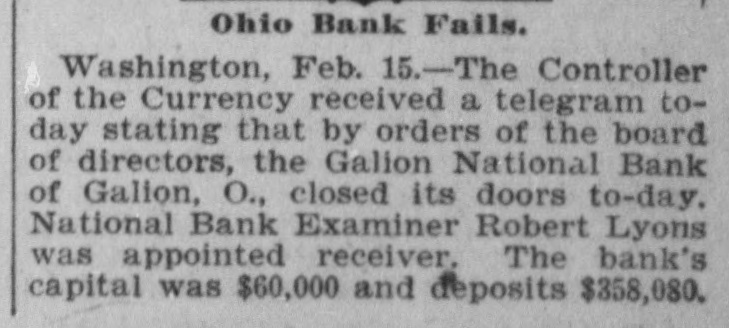
The Galion National bank of Galion has closed its doors and the Comptroller of Currency has appointed a receiver.
Click image to open full size in new tab
Ohio Bank Fails. Washington, Feb. 15.-The Controller of the Currency received a telegram today stating that by orders of the board of directors, the Galion National Bank of Galion, O., closed its doors to-day. National Bank Examiner Robert Lyons was appointed receiver, The bank's capital was $60,000 and deposits $358,080.
Click image to open full size in new tab
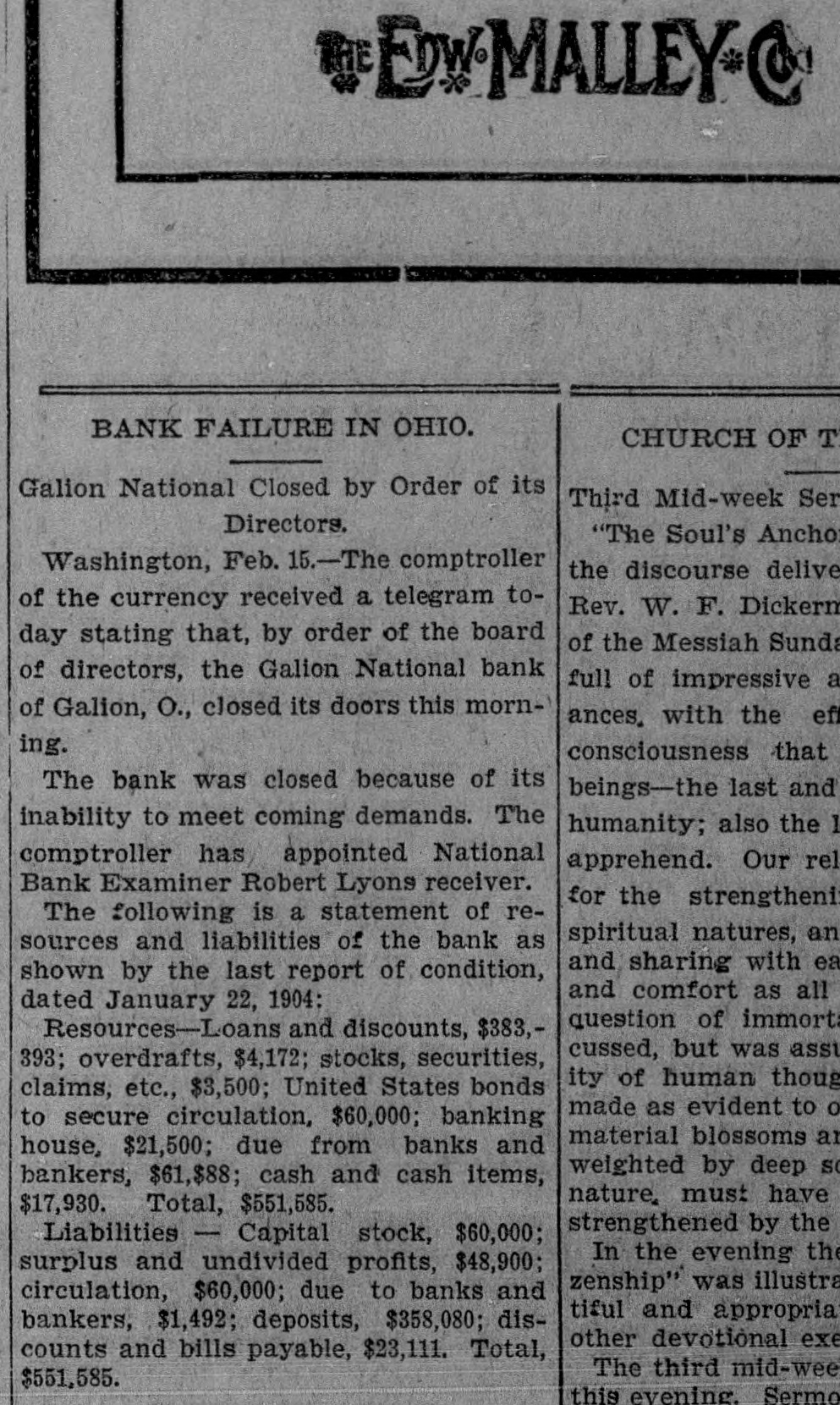
the EDMALLEY-C BANK FAILURE IN OHIO. CHURCH OF T Galion National Closed by Order of its Third Mid-week Ser Directors. "The Soul's Ancho: Washington, Feb. 15.-The comptroller the discourse delive of the currency received a telegram toRev. W. F. Dickern day stating that, by order of the board of the Messiah Sunda of directors, the Galion National bank full of impressive a of Galion, O., closed its doors this mornances, with the ef ing. consciousness that The bank was closed because of its beings-the last and inability to meet coming demands. The humanity; also the I comptroller has appointed National apprehend. Our rel Bank Examiner Robert Lyons receiver. for the strengtheni The following is a statement of respiritual natures, an sources and liabilities of the bank as and sharing with ea shown by the last report of condition, and comfort as all dated January 22, 1904: question of immort Resources-Loans and discounts, $383,cussed, but was asst 393; overdrafts, $4,172; stocks, securities, ity of human thoug claims, etc., $3,500; United States bonds made as evident to o to secure circulation, $60,000; banking material blossoms al house, $21,500; due from banks and weighted by deep s bankers, $61,$88; cash and cash items, nature. must have $17,930. Total, $551,585. strengthened by the Liabilities - Capital stock, $60,000; In the evening the surplus and undivided profits, $48,900; zenship" was illustra circulation, $60,000; due to banks and tiful and appropria bankers, $1,492; deposits, $358,080; disother devotional exe counts and bills payable, $23,111. Total, The third mid-wee $551,585. this evening. Sermo
Click image to open full size in new tab
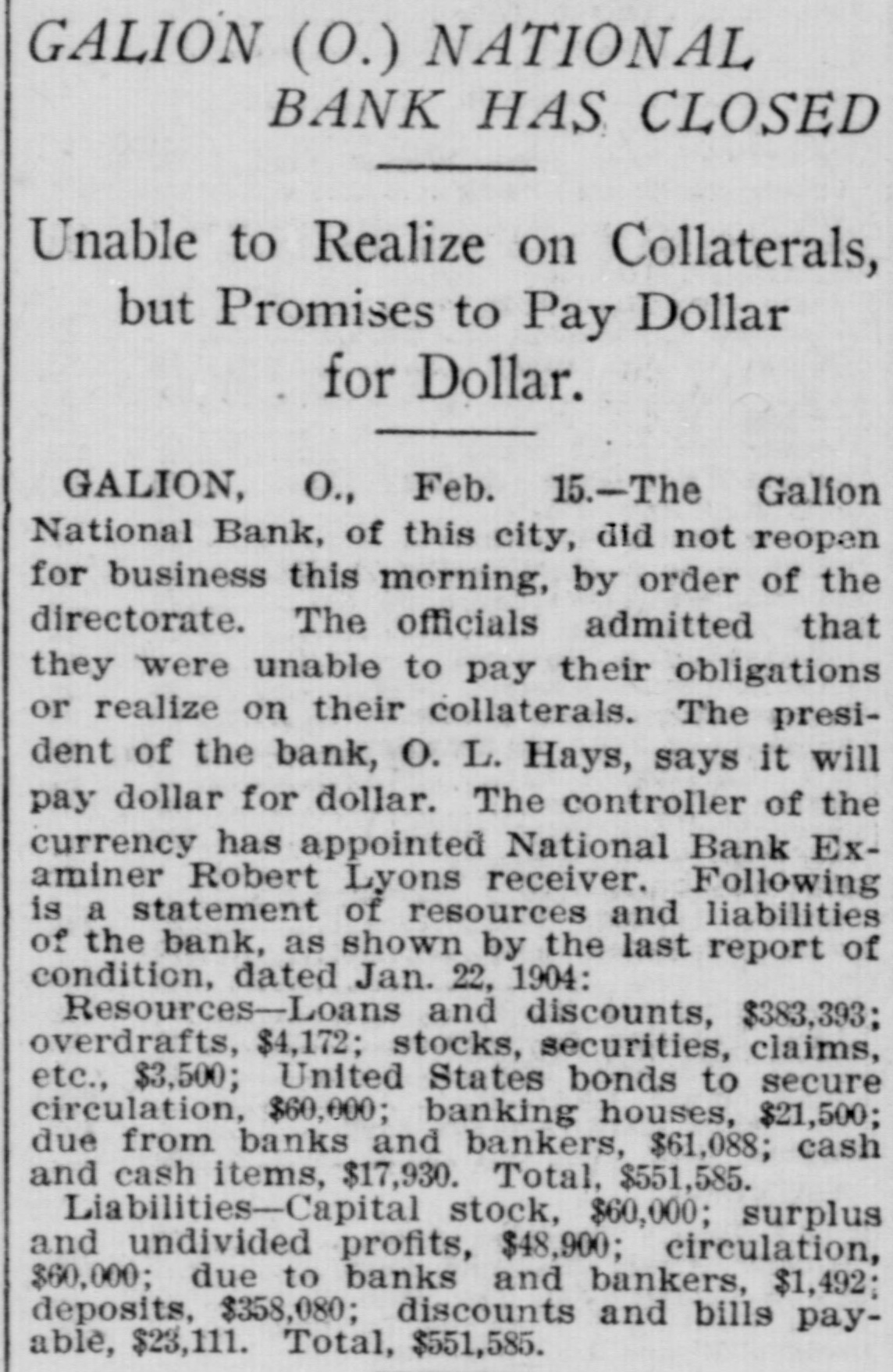
GALION (0.) NATIONAL BANK HAS CLOSED Unable to Realize on Collaterals, but Promises to Pay Dollar for Dollar. GALION, O., Feb. 15.-The Galion National Bank, of this city, did not reopen for business this morning, by order of the directorate. The officials admitted that they were unable to pay their obligations or realize on their collaterals. The president of the bank, O. L. Hays, says it will pay dollar for dollar. The controller of the currency has appointed National Bank Examiner Robert Lyons receiver. Following is a statement of resources and liabilities of the bank, as shown by the last report of condition, dated Jan. 22, 1904: Resources-Loans and discounts, $383,393; overdrafts, $4,172; stocks, securities, claims, etc., $3,500; United States bonds to secure circulation, $60,000; banking houses, $21,500; due from banks and bankers, $61,088; cash and cash items, $17,930. Total, $551,585. Liabilities-Capital stock, $60,000; surplus and undivided profits, $48,900; circulation, $60,000; due to banks and bankers, $1,492; deposits, $358,080; discounts and bills payable, $23,111. Total, $551,585.
Click image to open full size in new tab
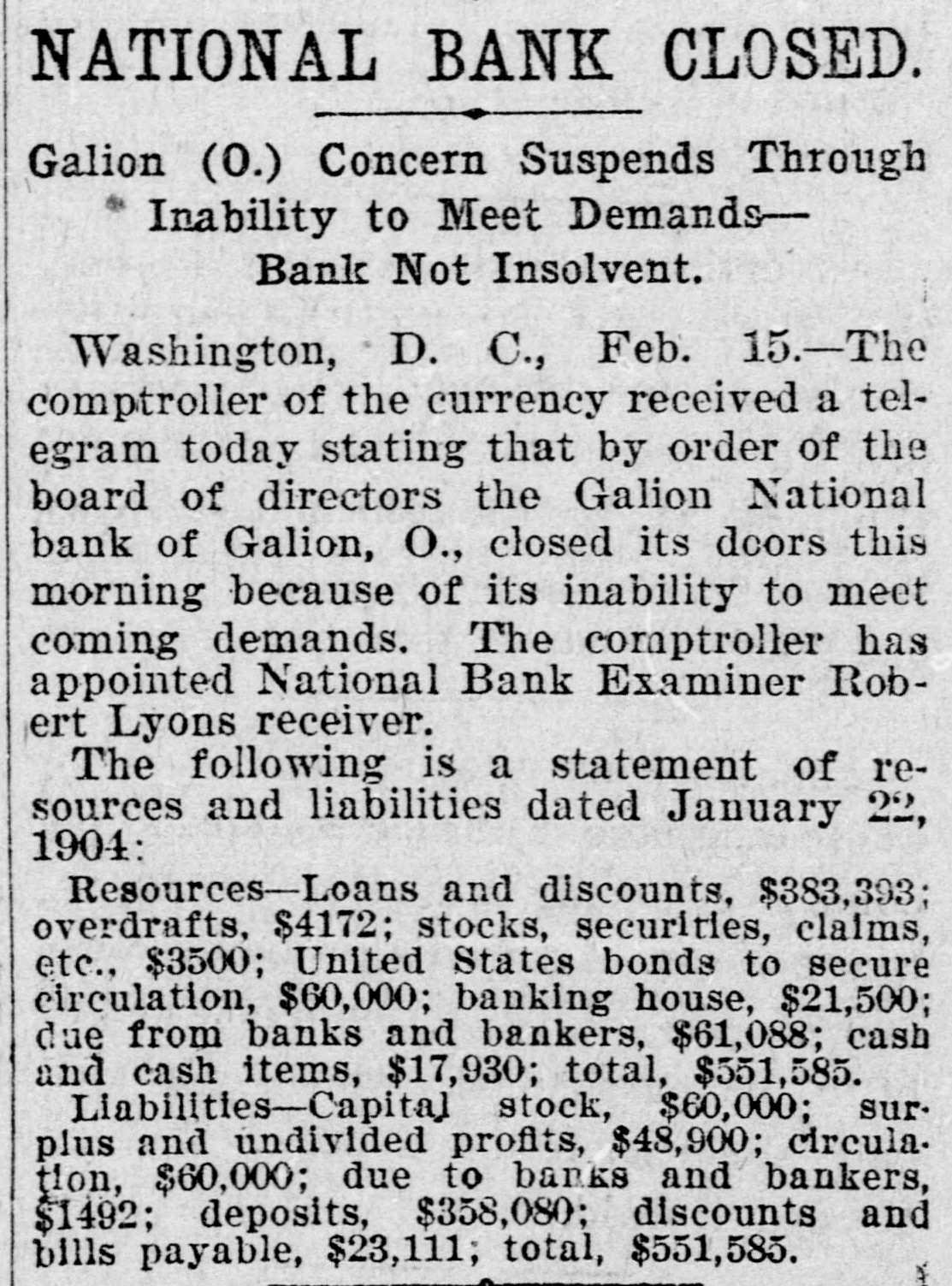
NATIONAL BANK CLOSED. Galion (0.) Concern Suspends Through Inability to Meet DemandsBank Not Insolvent. Washington, D. C., Feb. 15.-The comptroller of the currency received a telegram today stating that by order of the board of directors the Galion National bank of Galion, O., closed its doors this morning because of its inability to meet coming demands. The comptroller has appointed National Bank Examiner Robert Lyons receiver. The following is a statement of resources and liabilities dated January 22, 1904: Resources-Loans and discounts. $383,393; overdrafts, $4172; stocks, securities, claims, etc., $3500; United States bonds to secure circulation, $60,000; banking house, $21,500; due from banks and bankers, $61,088; cash and cash items, $17,930; total, $551,585. Liabilities-Capital stock, $60,000; surplus and undivided profits, $48,900; circula. tion, $60,000; due to banks and bankers, $1492; deposits, $358,080; discounts and bills payable, $23,111; total, $551,585.

Click image to open full size in new tab
SHORT TELEGRAMS. The town hall of Meriden, Connectb cut, was burned February 14th. Galion National Bank of Galion, of Ohio, The has been placed in the hands a receiver. imperial edict declares that leav- the Chinese An court has no intention of ing the capital. Anna H. Shaw has been elected Rev. of the National American Woman's president Suffrage Association. St. Petersburg dispatch of says the A directors of the art section abandoned the St. Louis exposition have preparations. and Young Corbett have signed match Britt agreement for a boxing Club before another the Hayes Valley Athletic in California March 31st. I Owing to the occupation of Seoul minister by troops, the Russian all Rushas Japanese left Korea, together with sians who resided at Seoul. is officially announced that Ad- to It Alexieff has been appointed Russian miral command of the East. the sea forces in the land supreme and Far Texas, that reported at Austin, Pacific It Cananea, is Yaqui River north & from the is to be extended to the railroad on the Arizona Colorado. border coal a point fields of southern 3 cablegram from Russia's World's com- Fair missioner A general to the war in the 1 that, owing to the imperial government Far states East. the will band not of be the sent to St. Louis. Russians in and around enlist Chicago in the are back to Russia to the Rusflocking against the Japanese. At it was said I war consul's office recently started sian that about 500 men had already to return to Russia. Automobile Associa tion The is American planning clubs from a grand New York tour estimated of city auto- to mobile Louis next August. It take is part in St. 2,500 machines will distance. 1 that for all or part of the e the At trip Saginaw, Michigan, Prosecuting cases Attorney O'Keefe nolle prossed and exagainst nine aidermen indictments brought the result of S aldermen as the recent grand jury. Int 9 returned sufficient by evidence was the prosecutor's t to g reason. George A. Castor, Congress Republican, from has the the S been elected Pennsylvania district to of fill Henry Third caused by the death defeated . vacancy Republican. Castor states5 e 8 Samuel Burk, J. Randall, son of the of the same name. h man At Honolulu, a meeting $142,000 of Japanese was subscribed There merchanta was to in the Japanese war $30,000. loan. The merraise chants one subscription will canvass considerable of the islands more and money expect to aid to their country's cause. 14th Frostburg, Maryland, on and the inst., At two persons twenty-five were killed seriously. sev- ran enty-five injured. accident. The car I in a trolley steep car grade. Sixteen at were Chaaway on in a a similar accident 1 t injured Falls, O., on the same day. grin jury at Grand the Rapids, collision on when twenty-two t h t e Michigan, December The coroner's the 26th, that Pere investigated Marquette returned railroad verdict perwere killed. has caused a by h sons charging that the wreck was operators. e - neglect and incompetent members of the SaA number of the Cardinals Sate College, including Vannutelli, Segna e 1 olli, cred Martinelli, Prisco, Vincent have written sympathy to Cardiand Gibbons expressing their on the V losses 1 with nal the sustained people of through Baltimore the recent h fire. Germur and George of silver Jensen, bulHenry stole 1,000 pounds Smelting and who the National were lion from Company at Chicago, police e 8 8 treasure Refining captured while engaged on by the the in South shore digging of Chicago up Lake the stolen Michigan. Standard Oil Company of for New the The has declared a dividend reduction of 1 Jersey of $16 is share, a paid at this last year. 1 e quarter $4 a share from The the previous rate dividend. a was $12 1 15th. t S time share. paid December The division 15th is last, payable March . Frank Jones, a notorious killed Montana by two h e outlaw, was instantly a sheriff's posse in the the part of that leader of northeastern members of Jones was the state on a inst. for ten years 1 h a d e h 11th gang has terrorized of desperadoes the section. cattlemen that Rewards and ag- the stockmen $1,500 hat were standing alive. for the 1 gregating of Jones, dead or capture The situation in the Balkans in Vienna. is The cregreat uneasiness rumors of the 1 h ating denials of the troops has 8 official of Austrian and it is 1 1 failed to that the mobilization asserted reassure the public government corps pro- ine still mobilize two army of guarding 1 visionally tends to for the purpose because of fears . e , s the that Balkan Turkey will frontier provoke Bulgaria into 8 of war. At League the close of of American the recent organization meeting Sportsmen was the Columbus. Ohio. an National Ase Fish e at effected of the and Game Ware sociation and of Commissioners. The of pur- law dens prosecution 1 breakers pose is and the the compiling of decisions
Click image to open full size in new tab
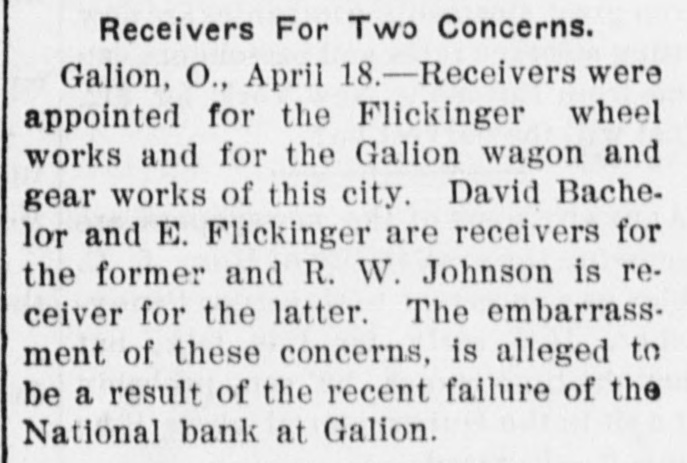
Receivers For Two Concerns. Galion, O., April 18.-Receivers were appointed for the Flickinger wheel works and for the Galion wagon and gear works of this city. David Bachelor and E. Flickinger are receivers for the former and R. W. Johnson is receiver for the latter. The embarrassment of these concerns, is alleged to be a result of the recent failure of the National bank at Galion.
Click image to open full size in new tab
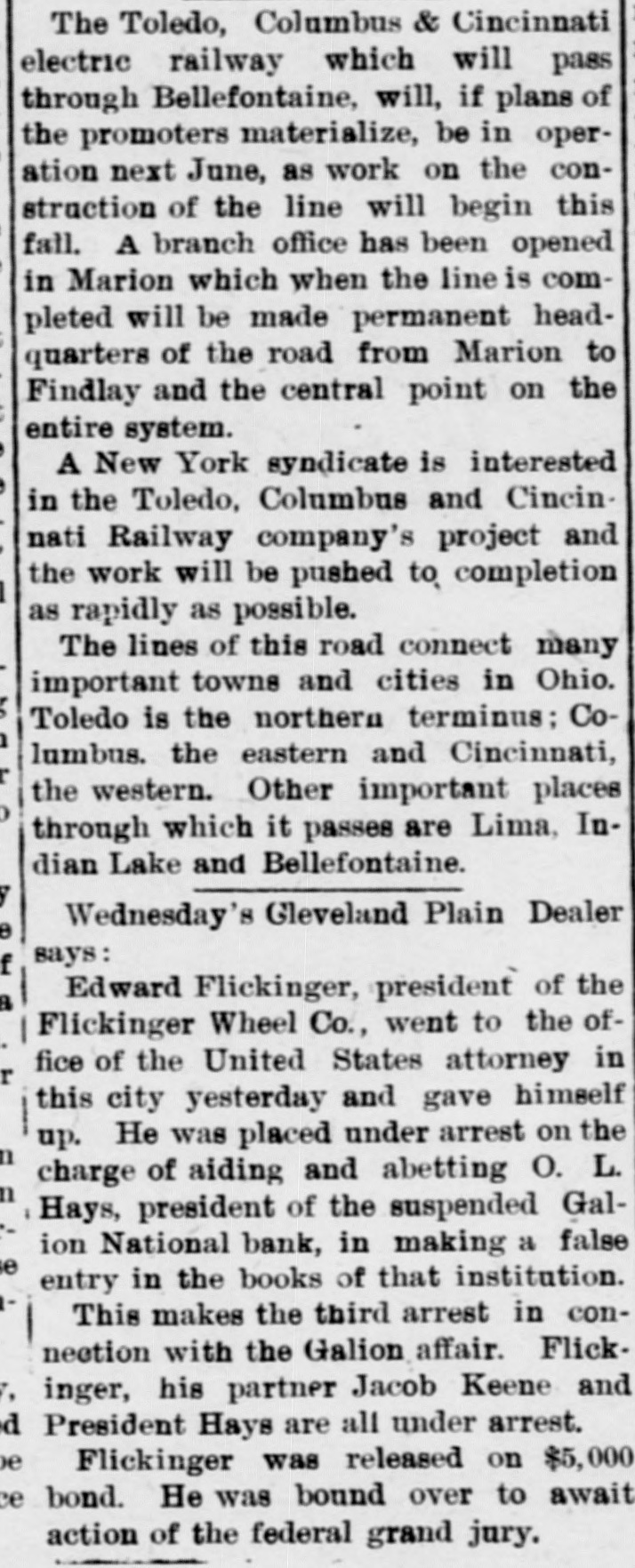
The Toledo, Columbus & Cincinnati electric railway which will pass through Bellefontaine, will, if plans of the promoters materialize, be in operation next June, as work on the construction of the line will begin this fall. A branch office has been opened in Marion which when the line is completed will be made permanent headquarters of the road from Marion to Findlay and the central point on the entire system. A New York syndicate is interested in the Toledo, Columbus and Cincinnati Railway company's project and the work will be pushed to completion as rapidly as possible. The lines of this road connect many important towns and cities in Ohio. Toledo is the northern terminus; Columbus, the eastern and Cincinnati, the western. Other important places through which it passes are Lima, Indian Lake and Bellefontaine. Wednesday's Cleveland Plain Dealer says: Edward Flickinger, president of the Flickinger Wheel Co., went to the office of the United States attorney in this city yesterday and gave himself up. He was placed under arrest on the charge of aiding and abetting O. L. Hays, president of the suspended Galion National bank, in making a false entry in the books of that institution. This makes the third arrest in connection with the Galion affair. Flickinger, his partner Jacob Keene and President Hays are all under arrest. Flickinger was released on $5,000 bond. He was bound over to await action of the federal grand jury.
Click image to open full size in new tab
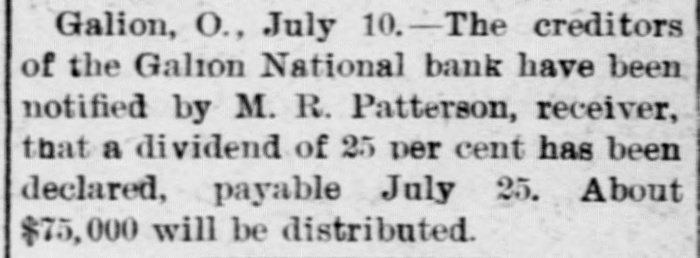
Galion, O., July 10.-The creditors of the Galion National bank have been notified by M. R. Patterson, receiver, that a dividend of 25 per cent has been declared, payable July 25. About $75,000 will be distributed.
Click image to open full size in new tab
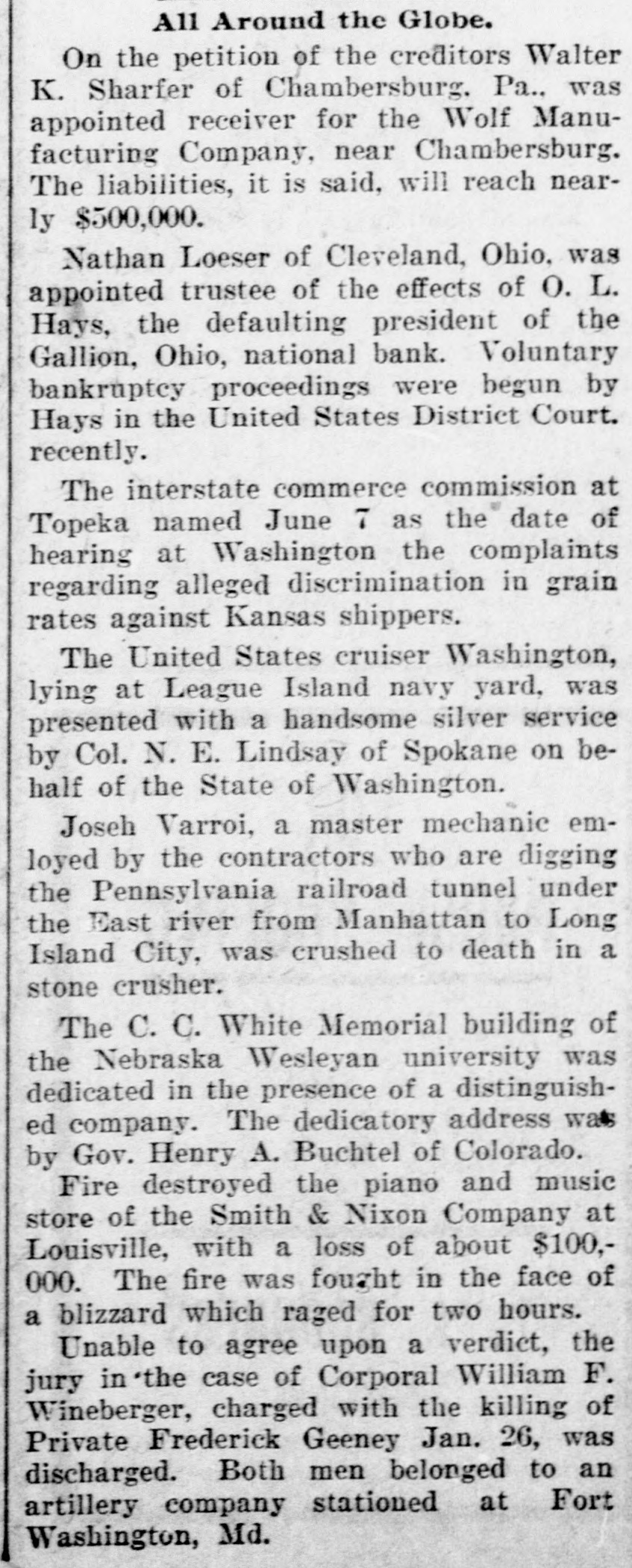
All Around the Globe. On the petition of the creditors Walter K. Sharfer of Chambersburg. Pa.. was appointed receiver for the Wolf Manufacturing Company, near Chambersburg. The liabilities, it is said, will reach nearly $500,000. Nathan Loeser of Cleveland, Ohio. was appointed trustee of the effects of O. L. Hays, the defaulting president of the Gallion, Ohio, national bank. Voluntary bankruptcy proceedings were begun by Hays in the United States District Court. recently. The interstate commerce commission at Topeka named June 7 as the date of hearing at Washington the complaints regarding alleged discrimination in grain rates against Kansas shippers. The United States cruiser Washington, lying at League Island navy yard, was presented with a handsome silver service by Col. N. E. Lindsay of Spokane on behalf of the State of Washington. Joseh Varroi, a master mechanic emloyed by the contractors who are digging the Pennsylvania railroad tunnel under the East river from Manhattan to Long Island City, was crushed to death in a stone crusher. The C. C. White Memorial building of the Nebraska Wesleyan university was dedicated in the presence of a distinguished company. The dedicatory address was by Gov. Henry A. Buchtel of Colorado. Fire destroyed the piano and music store of the Smith & Nixon Company at Louisville, with a loss of about $100,000. The fire was fought in the face of a blizzard which raged for two hours. Unable to agree upon a verdict, the jury in the case of Corporal William F. Wineberger, charged with the killing of Private Frederick Geeney Jan. 26, was discharged. Both men belonged to an artillery company stationed at Fort Washington, Md.