State superintendent Joseph A. Broderick took possession; bank was closed and later liquidated with receivers and criminal prosecutions.
Events (3)
1.December 11, 1930Run
Cause
Bank Specific Adverse Info
Cause Details
Large withdrawals and loss of depositor confidence following unfavorable reports on the bank's condition and reports of heavy withdrawals at multiple branches.
Measures
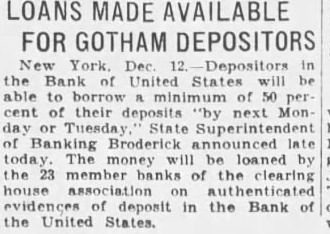
Leading financial interests and Federal Reserve worked overnight to arrange aid; clearinghouse banks agreed to loan against authenticated deposits (up to 50%).
Newspaper Excerpt
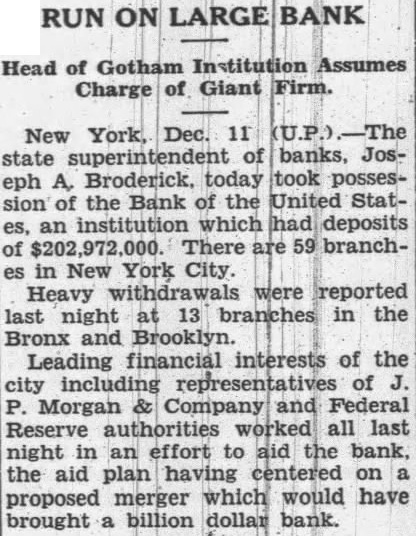
Heavy withdrawals were reported last night at 13 branches in the Bronx and Brooklyn.
Source
newspapers
same day
2.December 11, 1930Suspension
Cause
Government Action
Cause Details
State banking superintendent took possession of the institution and closed branches; state action following runs and concerns about solvency.
Newspaper Excerpt
New York banks today took possession of the Bank of the United States ... state superintendent of banking Joseph A. Broderick took possession of the Bank of the United States.
Source
newspapers
+63 days
3.February 12, 1931Receivership
Newspaper Excerpt
suit for $50,000,000 ... instituted in supreme court by the Irving Trust Company, receivers. The seven named are ... officers and directors of the Bankus Corporation ... in connection with the failure of the Bank of the United States, the Irving Trust Company, receivers, sued for recovery and indictments followed thereafter for misapplication of funds and criminal charges were brought against officers such as Marcus and Singer who later served terms in Sing Sing prison (photo caption 1933).
Source
newspapers
Newspaper Articles (21)
1.December 11, 1930The Winchester SunWinchester, KY
Click image to open full size in new tab
Article Text
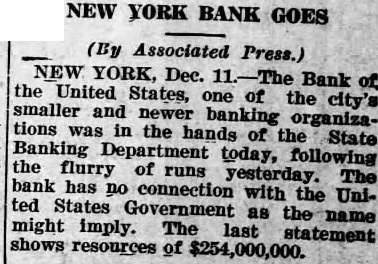
NEW YORK BANK
(By Associated YORK, Dec. Bank the United States, of the and banking organizations was in the hands of State Banking today, following the flurry of runs yesterday. The has no connection with the United States Government as might imply. The last shows resources of
2.December 11, 1930The RepublicanSpringfield, MA
Click image to open full size in new tab
Article Text
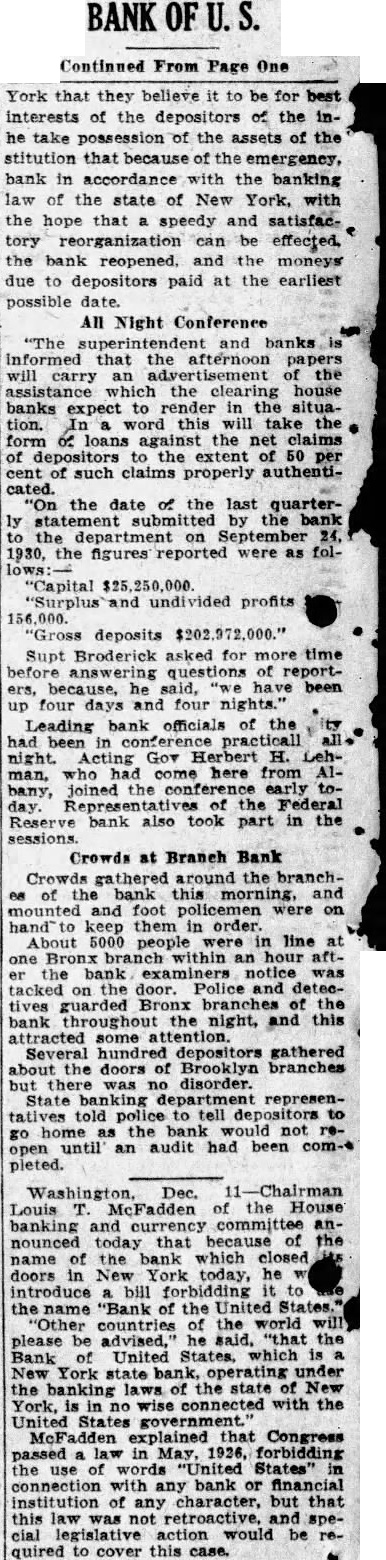
Continued From Page One
York that they believe it to be for best interests of the depositors of the he take possession of the assets of the stitution that because the emergency, bank in accordance the banking of the state of New York, the hope speedy and satisfacreorganization effected. the reopened. the moneys due to paid at the earliest possible date.
All Night Conference "The that the will which the house banks expect render the situation. will take the form loans against the net claims depositors extent such claims properly authenticated. the date the last quarteron 1930, the figures were as "Capital undivided profits Gross deposits Supt Broderick asked for more time before answering questions reporthe up four four nights. Leading officials of the night. H. from joined the conference early the Federal bank took part the sessions.
Crowds at Branch Bank
Crowds gathered around the branchbank and foot policemen were them in order. About people line Police and detecnight, and this attracted Several hundred depositors gathered about doors Brooklyn branches there disorder. tell home the bank not open until an audit had been pleted.
Dec. Louis the House banking committee nounced that because name of the bank which doors New today, he introduce forbidding the "Bank of the United countries the world please be Bank States, which York the the state York, with the explained Congress passed words "United connection bank financial character, but that this not would be quired cover this case.
3.December 11, 1930Evening CourierCamden, NJ
Click image to open full size in new tab
Article Text
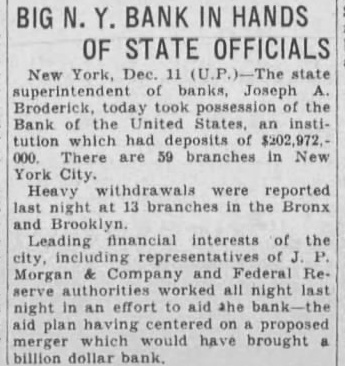
BIG BANK IN HANDS OF STATE OFFICIALS New York, Dec. Joseph Broderick the Bank States, institution which had 000. There are 59 branches in New Heavy reported branches the Bronx interests of the and Federal Reworked all night last night in effort aid the aid plan having centered proposed merger which would brought billion dollar bank.
4.December 11, 1930Delaware County Daily TimesChester, PA
Click image to open full size in new tab
Article Text
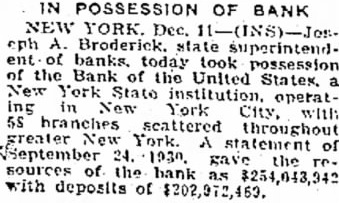
IN POSSESSION OF BANK NEW YORK
Dec. of banks. today took possession of the Bank of the United States. a New Ing York in State institution. operatYork 5S branches seattered City, throughout September greater York. statement of 24. gave of the bank $254,043,342 the rewith deposits of $202,972,460.
5.December 11, 1930The Falls City JournalFalls City, NE
Click image to open full size in new tab
Article Text
RUN ON LARGE
Head of Gotham Assumes Charge of Giant Firm.
New York, Dec. 11 of banks, Josstate today took posseseph A, of the Bank of the United Statsion an institution which deposits of There in New York City. Heavy withdrawals were reported last night at 13 branches in the Bronx and Brooklyn. Leading financial interests of the city including of Morgan Company and Federal Reserve authorities worked all last night in an effort to the bank, the aid plan having centered on proposed merger which would have brought billion dollar bank.
6.December 13, 1930Courier-PostCamden, NJ
Click image to open full size in new tab
Article Text
LOANS MADE AVAILABLE FOR GOTHAM DEPOSITORS
New York. Dec. Depositors Bank of United States will able to borrow minimum of 50 cent their "by next Mon day Banking Broderick announced late today. money will be loaned by the 23 member banks of the clearing association authenticated deposit in the Bank of the United States.
7.December 24, 1930The Daily WorkerChicago, IL
Click image to open full size in new tab
Article Text
DEPOSITORS
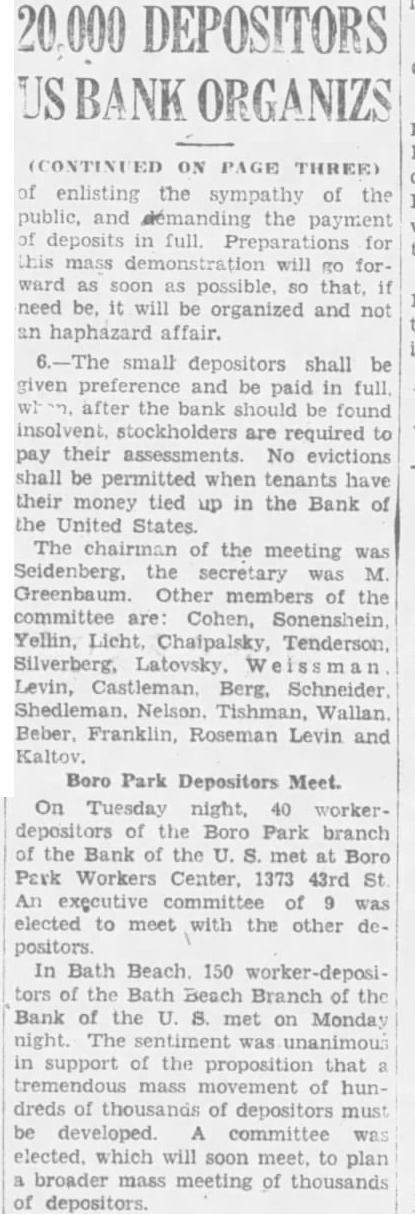
PAGE THREE) enlisting the sympathy of the public, and the payment deposits full Preparations for demonstration will forward as soon possible that, need be, will be organized and not an haphazard affair. small depositors shall be given preference and be paid in full after the bank be found insolvent. stockholders are required pay their assessments. No evictions shall be permitted when tenants have their money tied up in the Bank of the United States. The of the meeting Seidenberg, the secretary was Greenbaum. Other members of the committee Cohen, Sonenshein. Yellin, Licht Chaipalsky, Tenderson, Silverberg, Latovsky, Levin, Nelson. Tishman, Wallan. Beber. Franklin, Roseman Levin and Kaltov.
Boro Park Depositors Meet.
On Tuesday night, workerdepositors of the Boro Park branch the Bank of the met at Boro Park Workers Center, 1373 43rd An executive committee of elected to meet with the other positors In Bath Beach tors of the Bath Beach Branch of the Bank of met on Monday night. The sentiment unanimous support the proposition that tremendous mass movement of hundreds of thousands of depositors must developed. committee elected. which will soon meet, to plan broader mass meeting of thousands depositors.
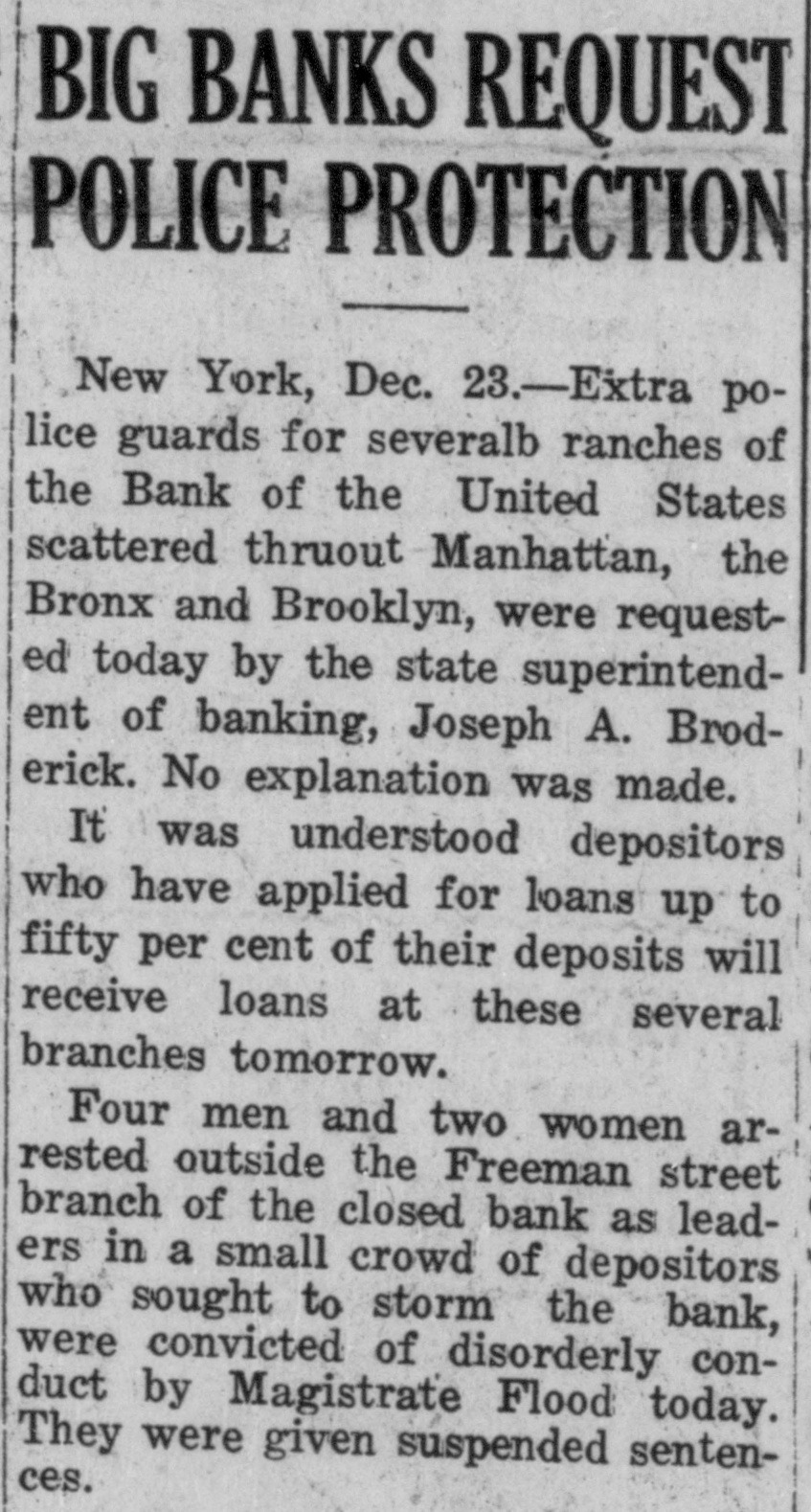
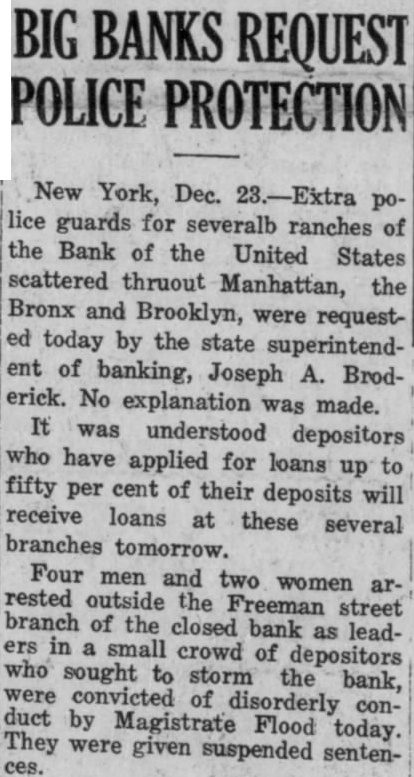
BIG BANKS REQUEST POLICE PROTECTION New York, Dec. 23.-Extra police guards for severalb ranches of the Bank of the United States scattered thruout Manhattan, the Bronx and Brooklyn, were requested today by the state superintendent of banking, Joseph A. Broderick. No explanation was made. It was understood depositors who have applied for loans up to fifty per cent of their deposits will receive loans at these several branches tomorrow. Four men and two women arrested outside the Freeman street branch of the closed bank as leaders in a small crowd of depositors who sought to storm the bank, were convicted of disorderly conduct by Magistrate Flood today. They were given suspended sentences.
New York, Dec. lice guards for severalb ranches of the Bank of the United States scattered thruout Manhattan, the Bronx and Brooklyn, were requested today by the state superintendent of banking, Joseph A. Broderick. No explanation was made. It was understood depositors who have applied for loans to up fifty per cent of their deposits will receive loans at these several branches tomorrow. Four men and two women rested outside the Freeman street arbranch of the closed bank as leaders in crowd of depositors who sought storm the bank, disorderly conby Magistrate Flood They were given suspended senten- today.
10.February 10, 1931The Patriot-NewsHarrisburg, PA
Article Text
INDICTMENTS DELAYED IN BANK OF U. S. CASE
New York, Feb. 9 (UP) spite rumors that three indict- 35c Each ments, naming as many as six persons, would be returned today in 3 for $1 connection with the failure of the Some of the titles are: Bank of the United States, the grand jury reported to Judge William Allen in general sessions that All rose bushes ofby Robert Graves no action would be taken before fered in this sale are A Primitive Arcadia tomorrow. The delay was believed to have ever-blooming varie- by Ellis Silas been caused by the insistence of ties. Each plant is The Semi-Annual A Naturalist at the Zoo Isidor J. Kresel, counsel for the by E. G. Boulenger bank, in appearing before the separately wrapped in grand jury even though he has Roumania and Her Rulers moss and burlap to Furniture Sale been ordered to remain in bed for by Philip Martineau ten days because of severe attack keep the roots in of bronchitis and laryngitis. After Cotton Mather good condition. Kresel appeared today Lionel Features for Today by Ralph and Louise Boas Strauss, grand jury foreman, informed Judge Allen no present- Columbia-pink Ophelia-white ments would be made today. 100 Fiber Rocking Chairs by Guisippe Prezzolini Betty-coppery rose Los Angeles-flame pink
11.February 12, 1931The Washington TimesWashington, DC
Click image to open full size in new tab
Article Text
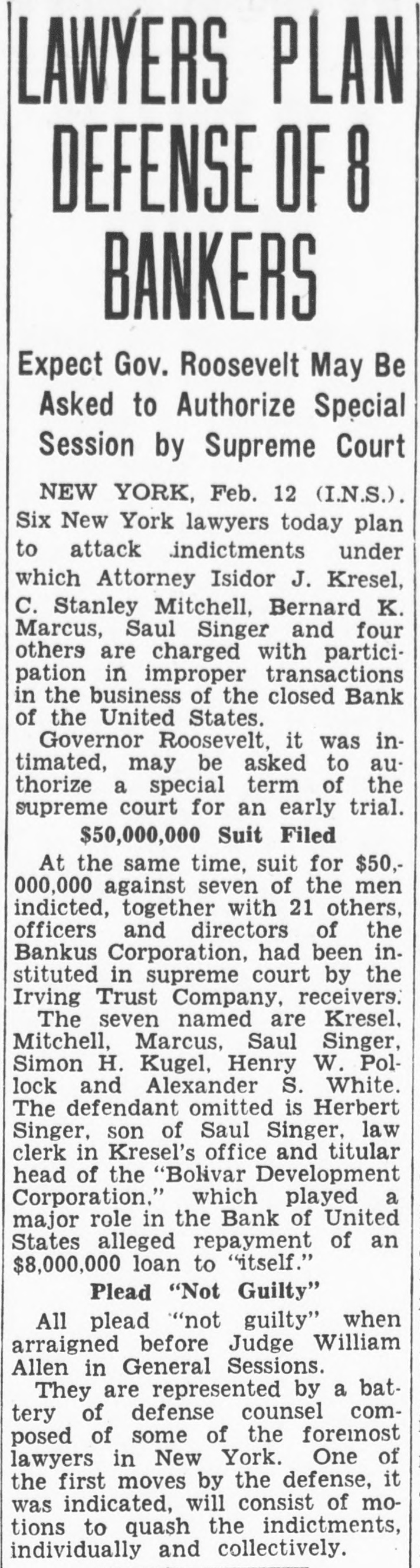
LAWYERS PLAN DEFENSE OF 8 BANKERS Expect Gov. Roosevelt May Be Asked to Authorize Special Session by Supreme Court NEW YORK, Feb. 12 (I.N.S.). Six New York lawyers today plan to attack .indictments under which Attorney Isidor J. Kresel, C. Stanley Mitchell, Bernard K. Marcus, Saul Singer and four others are charged with participation in improper transactions in the business of the closed Bank of the United States. Governor Roosevelt, it was intimated, may be asked to authorize a special term of the supreme court for an early trial. $50,000,000 Suit Filed At the same time, suit for $50,000,000 against seven of the men indicted, together with 21 others, officers and directors of the Bankus Corporation, had been instituted in supreme court by the Irving Trust Company, receivers. The seven named are Kresel, Mitchell, Marcus, Saul Singer, Simon H. Kugel, Henry W. Pollock and Alexander S. White. The defendant omitted is Herbert Singer, son of Saul Singer, law clerk in Kresel's office and titular head of the "Bolivar Development Corporation." which played a major role in the Bank of United States alleged repayment of an $8,000,000 loan to "itself." Plead "Not Guilty" All plead "not guilty" when arraigned before Judge William Allen in General Sessions. They are represented by a battery of defense counsel composed of some of the foremost lawyers in New York. One of the first moves by the defense, it was indicated, will consist of motions to quash the indictments, individually and collectively.
12.March 3, 1931The Houston ChronicleHouston, TX
Article Text
Probers Told Bank Sought Depositors After State Report
By Associated Press. New York, March 3.-Testimony that the Bank of the United States marshaled more than 60,000 new depositors shortly after the state banking department issued an unfavorable report on its condition stirred the Steuer investigation to-
Morris White. a director, testified yesterday that high officials had instituted drive for more depositors in February, 1930, and that he himself had recruited 1400 from among his employes in another venture. "This is the most startling testimony yet given, said Deputy Attorney General Max D. Steuer, who is into the reasons for the bank's Attorney General John H. Bennett, Jr., announced that several directors had started an independent movement to recompense depositors 100 cents on the dollar, either by constructive liquidation or by eorganization and reopening of the bank.
13.March 6, 1931The American GuardianOklahoma City, OK
Article Text
"BUY NOW"
In America, grave professors and mists" said that the depression "purely psychological;" that people timid and afraid Campaigns urging bankrupt consumers Now" were started.
Alexander Legge of the Federal Farm Board charged that the buying of few million bushels short by Russia caused wheat price despite the fact that the farm possession of 60,000,000 bushels had failed to steady the market.
Politicians blamed the failure of the Bank the United States (New York) rumors culated by Communists.
For nearly year after the Stock Market crash, President Hoover ignored the panie, frequently asserting that sound and the "temporary depression" would be at end
14.September 7, 1931The Daily WorkerNew York, Chicago, NY
Click image to open full size in new tab
Article Text
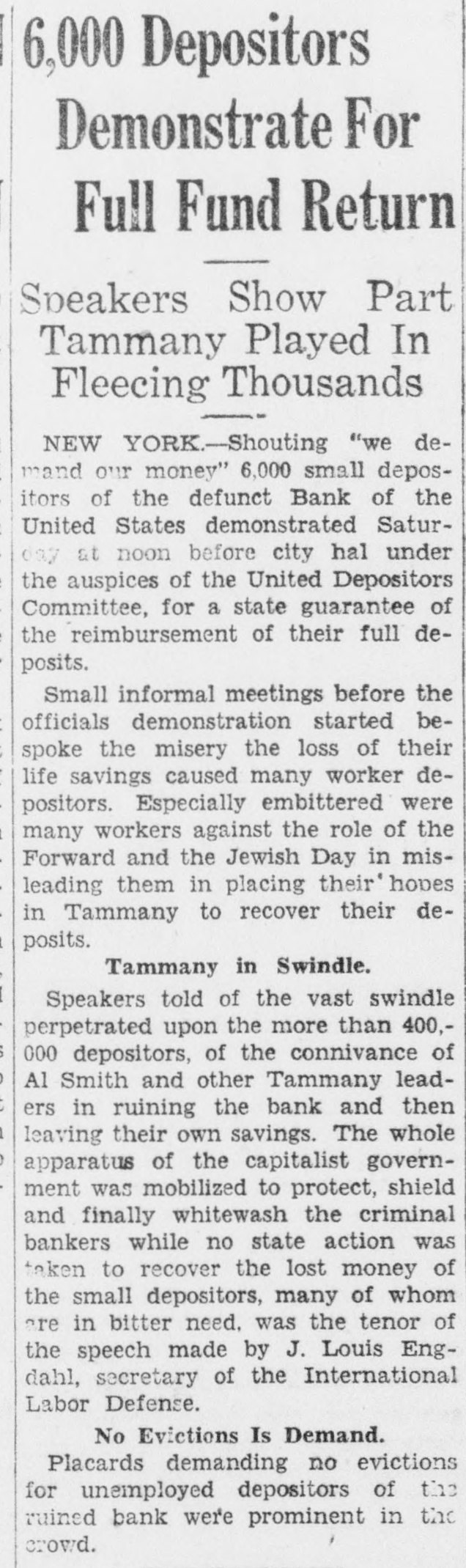
6,000 Depositors Demonstrate For Full Fund Return
Speakers Show Part Tammany Played In Fleecing Thousands
NEW YORK.--Shouting "we demand our money" 6,000 small depositors of the defunct Bank of the United States demonstrated Saturday at noon before city hal under the auspices of the United Depositors Committee, for a state guarantee of the reimbursement of their full deposits.
Small informal meetings before the officials demonstration started be-spoke the misery the loss of their life savings caused many worker depositors. Especially embittered were many workers against the role of the Forward and the Jewish Day in misleading them in placing their hopes in Tammany to recover their deposits.
Tammany in Swindle. Speakers told of the vast swindle perpetrated upon the more than 400,000 depositors, of the connivance of Al Smith and other Tammany leaders in ruining the bank and then leaving their own savings. The whole apparatus of the capitalist government was mobilized to protect, shield and finally whitewash the criminal bankers while no state action was taken to recover the lost money of the small depositors, many of whom are in bitter need, was the tenor of the speech made by J. Louis Engdahl, secretary of the International Labor Defense.
No Evictions Is Demand.
Placards demanding no evictions for unemployed depositors of the ruined bank were prominent in the crowd.
15.October 10, 1931Evening starWashington, DC
Article Text
LIQUID POSITION OF BANKS SHOWN BY CONTROLLER'S CALL
Figures Prove That Institutions of S. Have Greatly Increased Cash Assets in Recent Months.
BY CHARLES F. SPEARE.
Dispatch NEW October If the depositor in National or State or trust will take the trouble to look by these institutions under the call of September 30 he will once realize unusually liquid banks and their ability to any crisis that may them. For weeks they been fortifying themselves untoward while from the nature of their liquid assets their earnings not be sat isfactory to stockholders their position is most The liquid position of bank is expressed item of its on hand. the amount due from banks and its holdings securities These are usually set out leading the list the bank's resources. There are other items less visible in the statement. but also of liquid these reports, one finds that among the New York institutions the ratio of liquid assets deposits runs from 40 to 60 per cent. In the total cash securities exactly balanced deposits.
Normal Condition. Under conditions bank that had liquid say. of 20 to 25 per cent. be considered unusually condition. has been by New York banks duplicated in the statements already published by institutions in other large centers of the country, well as by "country Before the September 30 statement appeared was not possible average to just how liquid his had been made, for the last report that of June 30. In the intervening three months had the greatest shrinkage in securities in world history Now that up-to-date figures are available, no justification for scribed President Hoover statement. which been "accompanied by wholly unjustifiable withfrom the banks and hald led to estimated as high as Another phase of is reflected in the taking of this from banks and depositing it in postal savings to such that deposits of this tem approximated 000, which per cent had been added during that During 1930 there were in the United States nvolving deposits $864,000,000. Of this number 138 banks with about deposits In the eight months to August 31. there 932 deposits of about $699 Of the banks that had failed than 195, with $117 have The September record of failures was serious one: laso that in the first week of Ocwas steady in the number of suspensions this month and in the alarm of the depositor that had much do with about and the subsequent formation of the pool. One of the unfortunate of the tying up of the funds of the depositors. This works hardship on individuals and on their communities. Receivers banks have been extremely slow in liquidating their institutions and in returning that the marketable them. This delay was carried an aggravatdegree in the case of the Bank of ing the United States. Normally there is no a bank that event ually liquidate at 60 75 cents on the dollar cannot pay out to its depositors, within few weeks of suspension, at third of their claims. has recognized by the conof the urrency who recomto Congress which the of banks may obtain portion of their deposits within few days of the suspension. This scheme for the formation of "revolving fund," out of which these early paybe made and the of assets facilitated. There are numercases at present where local and State funds are represented the deposits closed institutions The inavailability of these funds has immediately checked all public neighborhood and added to the number unemployed.
16.February 23, 1932Dunkirk Evening ObserverDunkirk, NY
Article Text
-If you have anything to sell, an BRODERICK TRIAL advertisement In the OBSERVER will GETS UNDER WAY help you dispose of It.
New York. Feb. 23-(UP)-The much delayed tria) of State Banking OPTOMETRY Superintendent Joseph A. Broderick, charged with neglect of duty in connection with the Bank of the United States failure. finally started today after two jurors were excused and their places filled. General Sessions Judge George 1. Donnellan's courtroom was packed. Many of the the speciators **** de. positors of the defunct bank. One shawl. was in the courtroom under the mistaken impression her money would be paid there.
17.August 23, 1932Statesman JournalSalem, OR
Article Text
What About New York?
THAT Gov. Roosevelt is going to make the economic distress of the country the basis of his campaign for the presidency is shown by the speech he made in Columbus savagely attacking the republican regime and laying the responsibility for the depression at the door of the white house. It is campaign thunder for the democrats and Roosevelt does not hesitate to make full use of the TNT which the depression affords.
There is much of truth in his attack on the administration for failure to see the course which the country was following in those crazy years of 1928 and 1929. The Mellon idea seemed to be to encourage the speculative orgy which was leading the country to the dizzy heights from which it plunged with such calamitous consequences.
But it is unfair to make Hoover personally responsible for this depression. Hindsight is always better than foresight. The truth is that the country was in the grip of a hope psychology just as until lately it has been in the grip of a mob fear. Both were unreasoning, yet both controlled. Even the ablest prognosticators saw no clouds ahead in the early months of 1929 when Pres. Hoover took office.
It seems to us however that Candidate Roosevelt lays Gov. Roosevelt open to the same criticism. Most of the evils which he denounces so vigorously had their locale in New York. The international bankers have their offices in New York. Most of the stock emissions which the governor condemns roundly were the products of Wall street stock jobbers. The biggest bank failure in the United States, that of the Bank of the United States, occurred in New York. It was a state bank under the supervision of Gov. Roosevelt's own appointee. The crookedness of apartment house financing and other real estate promotion were carried to finest flower in New York state at a time when the democrats Al Smith and Frank Roosevelt were in power.
The remedies which Roosevelt recommends for the nation would apply most fittingly to New York state. Yet he has not urged his own legislature to control the issuance of securities, nor regulation of "exchanges in the business of buying and selling securities", nor "more rigid supervision of banks for the protection of depositors", nor for separation of investment banking from commercial banking.
The reforms he proclaims so enthusiastically would apply peculiarly to the state of New York. Yet Gov. Roosevelt has never sought to secure them for his state.
The same obscured vision, the same palsy in leadership which Gov. Roosevelt attributes to the republicans in Washington are chargeable to the democrats in New York. The governor made a good speech at Columbus; and we are glad to see him concerned about reforms to end the shocking piracies of New York bankers and others; but most of his chickens come home to roost in his offices at Albany.
His Columbus speech was a valiant thrust with his sharpest sword; but the effort left Roosevelt's own vitals unguarded.
18.October 29, 1932The Daily TimesDavenport, IA
Article Text
WHAT GOV
ROOSEVELT FAILED TO DO IN HIS OWN STATE cartoonist depicts Governor Roosevelt rat salesman, seeking sell his wares to neightrap bor whose and home is being overrun by rats yard and mice coming from the premises of the glib solicitor. In the sweeping charges which the Democratic nominee has addressed against the Hoover adminwhich he holds for all the ills istration, responsible which beset human race, he suggests the flotation of worthless securities and pability for the general collapse securities values. Franklin Roosevelt would have the voters believe that he is consumed with passion to save the country from the gambling mania and the irresponsible stock salesman. Yet nearly all the transactions which the governor complains transpired in his own state in violation of the laws which was his duty enforce. The federal government has no jurisdiction over the offenses which now SO deeply stir the The state of New York did have jurisgovernor. however, and has its statute books diction upon laws that would have protected the investment pubhad they been enforced. Charles Evans Hughes afforded the classic ample of what might be accomplished by tion and prosecution New York state to safeguard the nation. The insurance business was formed and cleansed of abuses through the vigor with which he moved of against operators guilty defrauding the policy holders. Since that day inhave the soundest kind surance policies represented investment. Governor Roosevelt had within his power to do as much in protecting those who victimized by practices, illegal in his state, but permitted nonetheless. When Mr Roosevelt to make political attempts capital of the failure many banks throughout the country, he overlooks again his own front yard. State controlled banks of his state which closed had deposits of while national bank suspensions affected deposits of only The worst bank crash in the country was that of the Bank of the United States, state trolled institution in New York City. More than depositors suffered. When State Superintendent Broderick was indicted and brought trial the governor took the stand in his behalf testifying that the official "had consulted at all times. He had my approval throughout." Hoover, through the of instrumentality the Finance Corp., saved the positors thousands of banks from losses when funds were made available in such volume as to finitely end the which panic forcing the closmany solvent institutions.
19.March 25, 1933El Paso Herald-PostEl Paso, TX
Article Text
Flanked by deputy sheriffs, Bernard K. Marcus (A) and Saul Singer (B), principal officers of the defunct Bank of the United States, New York, are shown as they entered the barred doors of Sing Sing prison at Ossining, N. Y., to serve terms of from three to six years for misapplication of the bank's funds. Depositors who lost their savings in the wrecked bank, crowded the criminal courts building and corridors where Marcus and Singer surrendered for their trip to prison.
20.February 27, 1935The Herald StatesmanYonkers, NY
Article Text
Bernard Marcus (left) and Saul Singer, heads of the Bank of the United States, New York, when it failed for many millions of dollars in the biggest banking crash in history, have won their freedom on parole from prison after spending less than two years behind the bars.
(Central Press)
21.February 3, 1939Evening StarWashington, DC
Click image to open full size in new tab
Article Text
business properties in sugar, lumber, construction, wheat and cattle. Mr. Eccles is somewhat better qualified to judge our national financial policies than most, if not all, American bankers. The seven years of his banking experience were the toughest years for our moneychangers. Nearly fourteen thousand financial institutions failed and the failures were most frequent in the rural regions of the South and West where the squeeze of deflation came hardest. The Bank of the United States in New York failed; the Chase National Bank, the National City Bank, and the Harriman National Bank were accused of unsound practices, and two of the leaders of metropolitan bankingAlbert H. Wiggin and Charles Mitchell-had to be ousted from the driver's seat. The Dawes Bank was a Chicago sore spot and the Detroit banks set off the explosion which almost wrecked the Nation. Yet in all those bitter years, Mr. Eccles ran his Western banks without a dollar's loss. In 1932, he disavowed the platforms of both political parties because they spoke of "balancing the budget" and "restoring confidence," and he realized that our economic problem was not as simple as all that. A few years back, Stuart Chase, the liberal economist, was due to lecture in Salt Lake City, but was delayed by a snowstorm. While waiting for the snowbound speaker to arrive, the audience asked Mr. Eccles to talk. Mr. Chase slipped in while Mr. Eccles was still holding forth and he listened in fascination to the first banker to see the New Deal light. Mr. Chase told Rex Tugweil about Eccles and Mr. Tugwell told the Treasury and the Treasury called on Mr. Eccles to serve his country in the crisis. Mr. Eccles has been running Federal Reserve Board policy ever since. On the face of the record, Mr. Eccles' views on Government spending would seem to be worth more attention than those of a successful Virginia apple grower and politician or those of the New York bankers who plunged the country into the last financial crisis. As chairman of the Board of Governors of the Reserve System, Mr. Eccles knows the problems of Government finance and national banking policy. As a successful private banker and businessman, he knows the practical side of finance, not from the air-conditioned offices of downtown Manhatout
Bank runs are almost always and everywhere a deterioration of bank fundamentals.
But not for you.
You are the measure-zero exception: great fundamentals, solid bank, and yet the Diamond Dybvig fairy spread its rumor. Depositors woke up. Your collateral was not prepositioned. The Clearinghouse had it for you.
Do not pass Go. Do not collect $200. Go directly to jail… or worse.
Flag Article for Review
Flag Episode for Review
Bank of the United States · Episode ID 1502541291572