Bank of the United States (New York, NY)

Episode Information

Episode Type
Run Only
Start Date
October 9, 1839
Location
New York, New York (40.714, -74.006)
Bank Type
state

Metadata

Events (1)

1. October 9, 1839 Run
Cause
Bank Specific Adverse Info
Cause Details
Announcement that U.S. Bank of Pennsylvania post notes would no longer be received in New York and reports of suspension/insolvency of the U.S. Bank of Pennsylvania triggered withdrawals
Measures
Refused to receive/redeem U.S. Bank of Pennsylvania post notes in New York; posted notice concentrating redemption in Philadelphia
Newspaper Excerpt
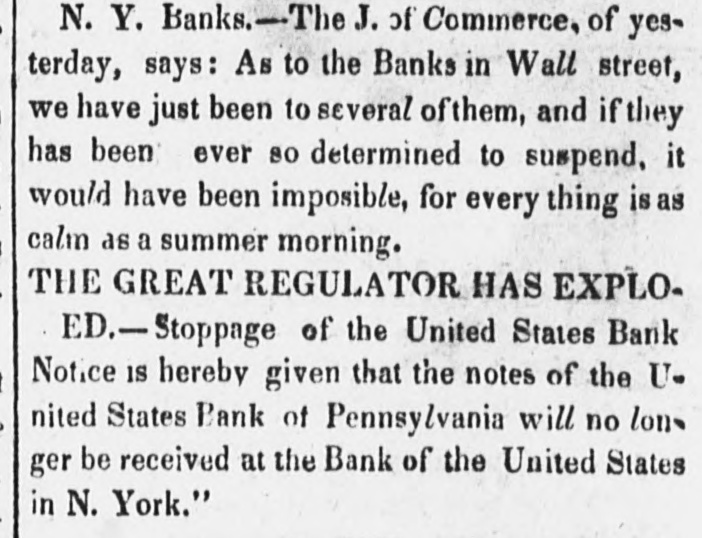
The United States Bank in New York posted up the following card... notes of the United States Bank of Pennsylvania will no longer be received at the Bank of the United States in New York... Many depositors in the U. Bank demanded the sums due them in specie, and the run for small amounts was increasing
Source
newspapers

Newspaper Articles (13)

Article from Richmond Enquirer, January 13, 1835

Click image to open full size in new tab

Article Text

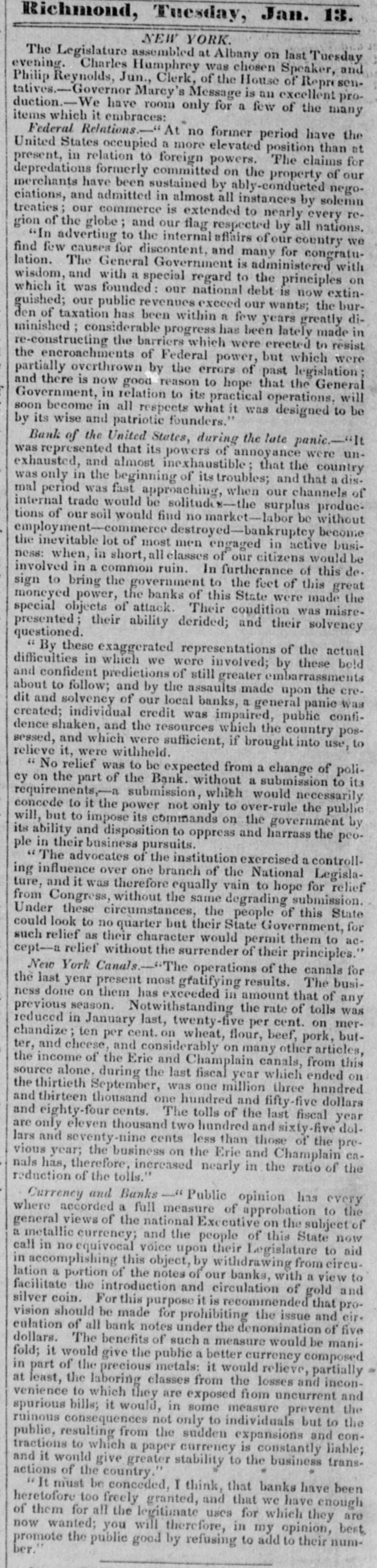
Richmond, Tuesday, Jan. 13.

NEW YORK. The Legislature assembled at Albany on last Tuesday evening. Charles Humphrey was chosen Speaker, and Philip Reynolds, Jun., Clerk, of the House of Represen- tatives. Governor Marcy's Message is an excellent pro- duction. We have room only for a few of the many items which it embraces:

Federal Relations." At no former period have the United States occupied a more elevated position than at present, in relation to foreign powers. The claims for depredations formerly committed on the property of our merchants have been sustained by ably-conducted nego- ciations, and admitted in almost all instances by solemn treaties; our commerce is extended to nearly every re- gion of the globe; and our flag respected by all nations. "In adverting to the internal affairs of our country we find few causes for discontent, and many for congratu- lation. The General Government is administered with wisdom, and with a special regard to the principles on which it was founded: our national debt is now extin- guished; our public revenues exceed our wants; the bur- den of taxation has been within a few years greatly di- minished; considerable progress has been lately made in re-constructing the barriers which were erected to resist the encroachments of Federal power, but which were partially overthrown by the errors of past legislation; and there is now good reason to hope that the General Government, in relation to its practical operations, will soon become in all respects what it was designed to be by its wise and patriotic founders."

Bank of the United States, during the late panic. It was represented that its powers of annoyance were un- exhausted, and almost inexhaustible; that the country was only in the beginning of its troubles; and that a dis- mal period was fast approaching, when our channels of internal trade would be solitudes the surplus produe- tions of our soil would find no market-labor be without employment-commerce destroyed-bankruptcy become the inevitable lot of most men engaged in active busi- ness: when, in short, all classes of our citizens would be involved in a common ruin. In furtherance of this de- sign to bring the government to the feet of this great moneyed power, the banks of this State were made the special objects of attack. Their condition was misre- presented; their ability derided; and their solvency questioned. "By these exaggerated representations of the actual difficulties in which we were involved; by these bold and confident predictions of still greater embarrassments about to follow; and by the assaults made upon the cre- dit and solvency of our local banks, a general panic was created; individual credit was impaired, public confi- dence shaken, and the resources which the country pos- sessed, and which were sufficient, if brought into use, to relieve it, were withheld. "No relief was to be expected from a change of poli- cy on the part of the Bank. without a submission to its requirements, a submission, which would necessarily concede to it the power not only to over-rule the public will, but to impose its commands on the government by its ability and disposition to oppress and harrass the peo- ple in their business pursuits. "The advocates of the institution exercised a controll- ing influence over one branch of the National Legisla- ture, and it was therefore equally vain to hope for relief from Congress, without the same degrading submission. Under these circumstances, the people of this State could look to no quarter but their State Government, for such relief as their character would permit them to ac- cept-a relief without the surrender of their principles."

New York Canals. The operations of the canals for the last year present most gratifying results. The busi- ness done on them has exceeded in amount that of any previous season. Notwithstanding the rate of tolls was reduced in January last, twenty-five per cent. on mer- chandize; ten per cent. on wheat, flour, beef, pork, but- ter, and cheese, and considerably on many other articles, the income of the Erie and Champlain canals, from this source alone, during the last fiscal year which ended on the thirtieth September, was one million three hundred and thirteen thousand one hundred and fifty-five dollars and eighty-four cents. The tolls of the last fiscal year are only eleven thousand two hundred and sixty-five dol- lars and seventy-nine cents less than those of the pre- vious year; the business on the Erie and Champlain ca- nals has, therefore, increased nearly in the ratio of the reduction of the tolls."

Currency and Banks-"Public opinion has every where accorded a full measure of approbation to the general views of the national Executive on the subject of a metallic currency; and the people of this State now call in no equivocal voice upon their Legislature to aid in accomplishing this object, by withdrawing from circu- lation a portion of the notes of our banks, with a view to facilitate the introduction and circulation of gold and silver coin. For this purpose it is recommended that pro- vision should be made for prohibiting the issue and cir- culation of all bank notes under the denomination of five dollars. The benefits of such a measure would be mani- fold; it would give the public a better currency composed in part of the precious metals: it would relieve, partially at least, the laboring classes from the losses and incon- venience to which they are exposed from uncurrent and spurious bills; it would, in some measure prevent the ruinous consequences not only to individuals but to the public, resulting from the sudden expansions and con- tractions to which a paper currency is constantly liable; and it would give greater stability to the business trans- actions of the country." * "It must be conceded, I think, that banks have been heretofore too freely granted, and that we have enough of them for all the legitimate uses for which they are now wanted; you will therefore, in my opinion, best promote the public good by refusing to add to their num- ber."

Article from Richmond Enquirer, June 5, 1835

Click image to open full size in new tab

Article Text

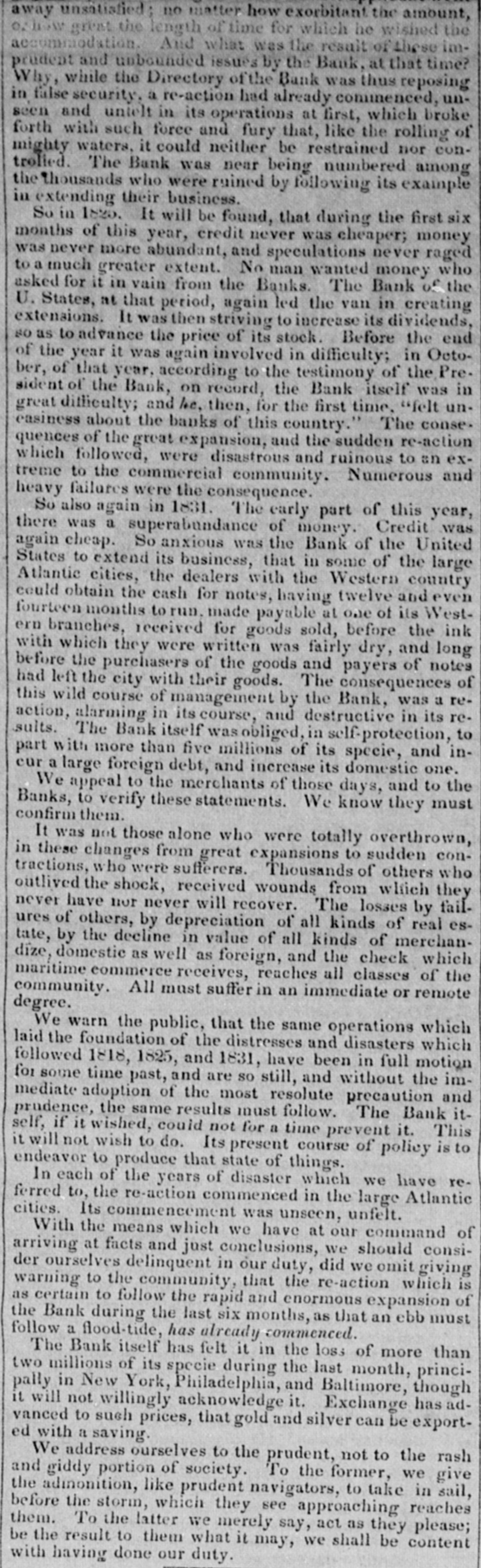
away unsatisfied no matter how exorbitant the amount, grient the length of time for which he wished the accommodation And what was the result of these imprudent and unbounded issues by the Bank, at that time? Why, while the Directory of the Bank was thus reposing in false security. a re-action had already commenced, unseen and untelt in its operations at first, which broke forth with such force and fury that, like the rolling of mighty waters, it could neither be restrained nor controlled. The Bank was near being numbered among the thousands who were ruined by following its example in extending their business. So in 1820. It will be found, that during the first six months of this year, credit never was cheaper; money was never more abundant, and speculations never raged to a much greater extent. No man wanted money who asked for it in vain from the Banks. The Bank of the U. States, at that period, again led the van in creating extensions. It was then striving to increase its dividends, so as to advance the price of its stock. Before the end of the year it was again involved in difficulty; in Oetober, of that year, according to the testimony of the Pre. sident of the Bank, on record, the Bank itself was in great difficulty; and be. then, for the first time. "felt uneasiness about the banks of this country. The conse. quences of the great expansion, and the sudden re-action which followed, were disastrous and ruinous to an extreme to the commercial community. Numerous and heavy failures were the consequence. So also again in 1831. The early part of this year, there was a superabundance of money. Credit was again cheap. So anxious was the Bank of the United States to extend its business, that in some of the large Atlantic cities, the dealers with the Western country could obtain the cash for notes, having twelve and even fourteen months to run. made payable at one of its Western branches, received for goods sold, before the ink with which they were written was fairly dry, and long before the purchasers of the goods and payers of notes had left the city with their goods. The consequences of this wild course of management by the Bank, was a reaction, alarming in its course, and destructive in its results. The Bank itself was obliged, in protection, to part with more than five millions of its specie, and incur a large foreign debt, and increase its domestic one. We appeal to the merchants of those days, and to the Banks, to verify these statements. We know they must confirm them. It was not those alone who were totally overthrown, in these changes from great expansions to sudden contractions, who were sufferers. Thousands of others who outlived the shock, received wounds from which they never have nor never will recover. The losses by failures of others, by depreciation of all kinds of real estate, by the decline in value of all kinds of merchandize, domestic as well as foreign, and the check which maritime commerce receives, reaches all classes of the community. All must suffer in an immediate or remote degree. We warn the public, that the same operations which laid the foundation of the distresses and disasters which followed 1818, 1825, and 1831, have been in full motion for some time past, and are so still, and without the immediate adoption of the most resolute precaution and prudence, the same results must follow. The Bank itself, if it wished, could not for a time prevent it. This it will not wish to do. Its present course of policy is to endeavor to produce that state of things. In each of the years of disaster which we have referred to, the re-action commenced in the large Atlantic cities. Its commencement was unseen, unfelt. With the means which we have at our command of arriving at facts and just conclusions, we should consider ourselves delinquent in our duty, did we omit giving warning to the community, that the re-action which is as certain to follow the rapid and enormous expansion of the Bank during the last six months, as that an ebb must follow a flood-tide, has already commenced. The Bank itself has felt it in the loss of more than two millions of its specie during the last month, principally in New York, Philadelphia, and Baltimore, though it will not willingly acknowledge it. Exchange has advanced to such prices, that gold and silver can be exported with a saving. We address ourselves to the prudent, not to the rash and giddy portion of society. To the former, we give the admonition, like prudent navigators, to take in sail, before the storm, which they see approaching reaches them. To the latter we merely say, act as they please; be the result to them what it may, we shall be content with having done our duty.


Article from Iowa News, June 17, 1837

Click image to open full size in new tab

Article Text

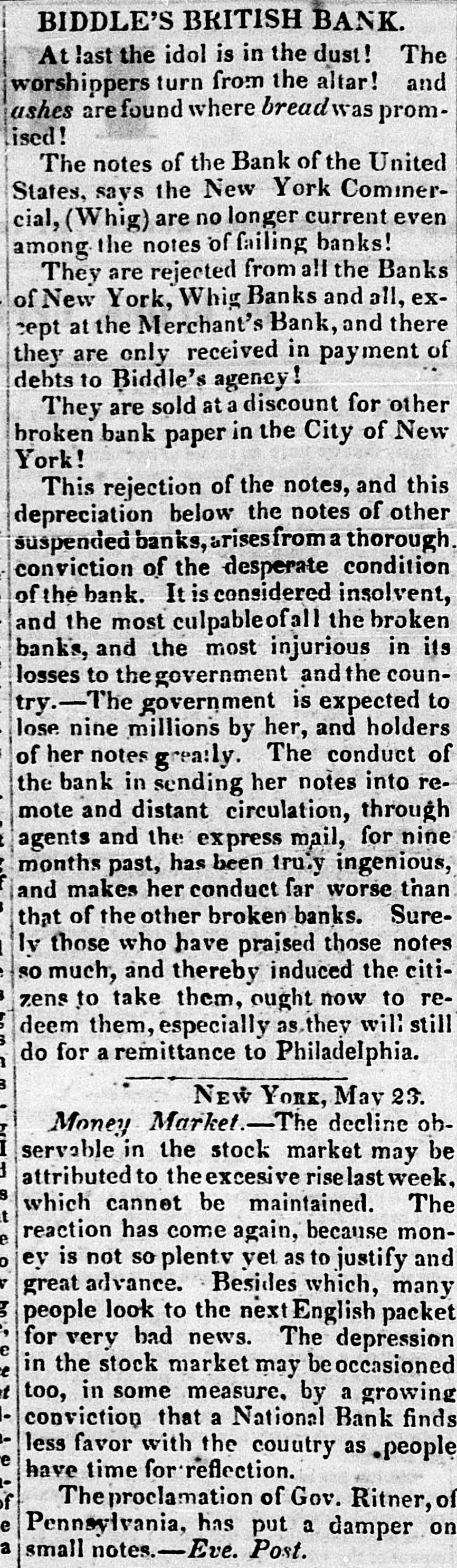
BIDDLE'S BRITISH BANK

At last the idol is in the dust! The worshippers turn from the altar! and ashes arefound where bread was promised! The notes of the Bank of the United States, says the New York Cominercial, (Whig) are no longer current even among the notes of failing banks! They are rejected from all the Banks of New York, Whig Banks and all, except at the Merchant's Bank, and there they are only received in payment of debts to Biddle's agency! They are sold at a discount for other broken bank paper in the City of New York! This rejection of the notes, and this depreciation below the notes of other suspended banks, arisesfrom a thorough conviction of the desperate condition of the bank. It is considered insolvent, and the most culpable of all the broken banks, and the most injurious in its losses to the government and the country.-The government is expected to lose nine millions by her, and holders of her notes greatly. The conduct of the bank in sending her notes into remote and distant circulation, through agents and the express mail, for nine months past, has been truly ingenious, and makes her conduct far worse than that of the other broken banks. Surelv those who have praised those notes so much, and thereby induced the citizens to take them, ought now to redeem them, especially as they will still do for a remittance to Philadelphia. NEW YORK, May 23. Money Market.-The decline observable in the stock market may be attributed to the excesive rise last week, which cannet be maintained. The reaction has come again, because monev is not so plentv yet as to justify and great advance. Besides which, many people look to the next English packet for very bad news. The depression in the stock market may be occasioned too, in some measure, by a growing conviction that a National Bank finds less favor with the country as .people have time for reflection. of The proclamation of Gov. Ritner, of e Pennsylvania, has put a damper on a small notes.-Eve. Post.


Article from Lynchburg Virginian, October 26, 1837

Click image to open full size in new tab

Article Text

10. 11 itself both TO their hopes and en fears. It saysto them. in effect. that whenever restime specie payments. (provided it be before certainday.) your notes. under the restrictions of the II shall be receivable in payments of everybranch of e public revenue, whether for lands or customs: it it you do not resume by that day. your notes all nothe received 111 payment of publis dues even longh ya may thereafter resine. The banks will us be doubly stimulated to a resu nition of specie lyyments-by the promise of a benefit on the one and-by the exhibition of a penalty on the o er. With these provisions 1 do not doubt the early re tablishment ofa sound and healday state of things that is the present condition of the country, and hat the treath ent it demands? It we look around , we find all the greatsources of national prosperistill unimpated-the land, the labor, the capital of e country in then accustomed fertili and abunmcc. And yet industry is paralysed, commerce a stand. the currency degraded and deranged, the ecious metals fled from circulation, the land overin with spurious substitutes of money, exposing ciy interest of society to insecurity and hazardinsecutity and hozard involving alike the wages labor. the value of property, the fulfilment of conacts, all the at quisitions of the past and all the pes of the future. Now what is the remedy for is extraordinary state of the body politic 11 is imprehended 111 a single word. The restoration of afidence. It will be admitted, on all hands, that the first ing to be brought about, with a view to the ame ration of the present condition of things, is the urn specie payments by the banks. But that ura cannot be effected without the restoration of infidence; and confidence IS to he restored main by the policy and example of the Government.ith its aid in the re-est bistment of confidence, thing sclearer than the ability of the banks, at an dy day. to resume and maintain specie payments. I us for a moment, look at the condition of the matry and of the banks 111 regard to those patient . which tornthe leading elements of this ques 11.- And first as to the stock of precious metals 11) e country. The supply 11 the country is most a ndant, for altho' a good deal has gone out reotly. to par offour foreigndebt, an equal, or nearly alquasting has come in. It is shown by official urnsthat the importations and exportations of spe. during the year. VETY nearly balanced eachother. 10 quantity in the country at this moment. accord to the estimates and statements we have receivfrom the Treasury Department. is nearly three es a g reat as it was four years ago. Th means enable the banks to resume and sustain specie ments are, the any le and inquestionable, soon as confidence shall be restored. Then, as to balance of 0111 foreign debt. which forms another portant element of this question-in has a use of oustant and progressive reduction for the SIX months and with the aid of the new t 'P' which is now coming 111. and the great dumintt 11 of foreign importe, we shall soon see it entirely ringuished. At the S me time. the great BLASS of banks throughout the country have endiligent preparing themselves for it return to specie payuts. by it steady and judicious I duction of then culation. Nothing, then, is wanting to a speedy accomplishut of that great object but the restoration conence. and 11 depends mainly on the action and lies 01 the Government to supply that requisite.-" currency of the country 18. at this moment, in condition of a body in state of suspend heart still beats-the principle vitality IS unextingushed-but the active trueusof hic are suspended. Let the government but rather the breath of confidence into it and will once be resuscitated. the more necessary that government should give its aid to this work of storing confidence. because. whether justly or un sily. 11 IS from the Government that the greatest uger of hostility is apprehended. Let this ap. chension, then. be queted by some pledge of curity, by so i.e taken 0. encouragement and confince. The Senator from South Carolina, (Mr. 'ALP UN.) asserted yesterday, that the disease of the nutry is debt. the only remedy stine. and that be lied much more on the cotton and tobacco crops rebel, than upon action of the Government r. the debt of the country, as I have already rearked. has nearly reached its either actual payments or the bankruptcy of unfortu te debtors. But it this were not SO. the cotton d tobacco O crops, though essential ingredients of rea 1. do HOL supersede the necessity of other and xiliary remedies. Examples are not wanting in e financial history of this and other countries, to ow the magical effects of confidence 111 periods of eat public distress. and how that confidence dendson the conduct and policy of the government ne year 1793 was a period of the severest commeril distress III England. More than a hundred untry banks became bankrupt, and the whole untry seemed destined to a similar catastrophe en d single act of the government encouraging produced immediate and general relief.ilude to the offer made by the British government, that crisis of suffering and alarm, to lend to solnt dealers five millions of pounds 111 Exchequer lls. A consider ble part of the sum WHIS not taken even applied for : but the simple offer of the credit the government. in restoring confidence between 11 and man, elicited the dormant resources of the antry, and relieved atonce the general distress. e have had a similar and striking example in r own country. You well recollect, Mr. Presiut, the memorable pante of 1834, which enstred on e removal of the deposites from the Bank of the nited States. The storm which was raised on that casion. was directed chiefly on the great commerI emporium of New York. The legislature of it patriotic and powerful State, with a paternal usibility to the interests and sufferings of her citins, came forward and authorized the creation of a ck of six millions of dollars to be lent to the liks. for the purpose of sustaining them under the traordinary pressure to which they were exposed. hat was ! Not a solitary dollar wa in by the banks, but the offer itself operated like a arm. It restore confidence, and relicced the pres rc. These examples may serve to show gentleen that there is some practical virtue in contince, and in the moral power of tite government to What


Article from Morning Herald, October 10, 1839

Click image to open full size in new tab

Article Text

6P.M. The storm has burst in Wall street, At 10 o'clock this morning, the United States Beak in New York, posted up the following card. BANK OF THE UNITED STATES in New York. New York, Wednesday Morning, Oct. 9, 10 A.M.S Notice is hereby given that notes of the United States Bank of Pennsylvani no longer be received at the Bank of the United States in New York." as This caused tremendous excitement, being considered the forerunner of and equivalent to a failure of the Philadelphia Banks. Accordingly at the stock exchange, the price of the United States Bank stock fell 14 per cent-Ohio Life Trust # per cent-Harlem 1/2 per ent-Delaware & Hudson improved 1 per cent-North American Trust & Backing 1 per cent-Kentucky 2t per cent. After the board it was ascertaind that about $800,000 in United States Bank post notes made payable at the bank in this city, fell due today, and were included in the bank notice. The announcement increased the excitement in a very great degree, many holders had them immediately protested without waiting for three o'clock; great many more sent their notes on by express to Philadelphia, with the intention in case of non payment of having them protested and placed in Chancery. The excitement momentarily increased, and the thousands of rumors which were put afloat seemed to heighten the panic.Many depositors in the U. Bank demanded the sums due them in specie, and the run for small amounts was increasing up to the close of the day. Some of the bills of the bank sold at five per cent discount in the fore part of the day, but were af terward unsaleable and United States Bank stock was dull at 95. Rumor stated that the Philadelphia banks had suspend. ed, and probably it is the case. This has been the state of the market-panic, rumor and excitement ruled the hour. The great question which is propounded at every corner of the street, is, has the bank actually failed? or will the bills be paid in Philadalphia? This will be decided by the arrival of the Philadelphia mail -night. The measure, as it now stands, does not involve a failure. Merely ceasing to redeem in New York may be means of concentrating er resources in Philadelphia, and thereby strengthening her position. This view receives support from the recent movements of the bank, which have been those of concentration. It is, however, in any light, a breach of contract with those who purchased notes with the understanding that they were to be cash in this city. Should even this be the case, the credit of the bank will have received a blow from which it cannot recover. The probability is, however, that it is a regular failure, and will involve the solvency of the other Philadelphia banks, and the attending panic will carry down the banks throughout the south, with the exception of those in New Or. leans, which are strong in specie. The banks of this city have. however,determined upon sustaining themselves at all hazardseven at a sacrifice of one Sourth part of their capital. This, how. ever,they will not be obliged to do. The contraction is so vesevere at this time. that their circulation can readily be ry and the great bulk of the depositors are men so far interested met, in the standing of our institutions- which are now the sheet auchor of the banking system of the country- -that they will, in all probability, stand by the banks, and any effort to force a suspension will be fruitless. The New York banks will now cut adrift from all connection with southern and speculating banks, and firmly persevere in estraight forward course all of meeting their engagements faithfully, and compelling these who have dealings with them to do likewise. As a pre liminary measure, they refused any longer to receive, on deposite, the certified checks on the banks under the general banking law. Their practices for the last few months have indeed laid open to animadversion, and have exasperated the mer. cantile them community against them. The well known fact available that made loans on stocks at par, which are not that they hav the market at 20 per cent discount, at the same time they have refused in to discount mercastile paper, may have The embarrassed them to a greater extent than is now supposed. they opinion is, however, that in their present position general impregnable, unless a panic spreads among depositors.are is a contingency which depends entirely upon the news which This will reach here tonight from Philadelphia. The anxiety, excitement,and growing panic in Wall street were very great United of business. A mob was collecting round the the States bank, the close and all mereantile mea seemed to feel that at which have predicted for the last few months, The storm crisis, risk of being called " croakers," is now upon The the break up the whole paper system of the country. prudential may course of the New York banks is now the only safe guard. demand for sterling exchange for the Liverpool taken will, The be very heavy. The heavy imports which have that doubtless, in July and August, are chiefly to be paid for by complace Some idea of the amount may be formed by first a and parative packet. table of the Custom House returns for the second quarters of this year and last, as follows Amount of duties paid in the District of New $3,688,885 York during the second quarter of the present year, 2,184 090 30 Second quarter, 1838, $1,504,795 14 $22,748,183 Increase, Imports for the same District, second quarter of the present year, 10,321,859 Exports, same period, $12,426,324 Importe This returnshows over exports vast increase, perhaps greater than difficulty we anti in July last, when we mentioned the probable due before the cipated would arise from foreign payments falling heavier specie which ready to meet them. A much this time had creps were have taken place before cause would undoubtedly This for drain been able to command the money. the the merchants the sale of any very heavy amount to likely to prevent consequence of which will be an is at injury a stand, next packet-a credit abroad. Business of every kind absorbe American news from Philadelphia is that which the arrievery and the one's next at tention, and is more important than even rival of the Liverpool. Sales at the Stock Exchange. Bank $9750 Corporation dos Bonds 15 96. ds 86.25 20 shares 981,76 United do States 15 ds 974 tw do set 105- 40 do Atlantic 851-60 Mechanics Bk of Com do Union Bk do Ohio Life & Trust 89-50 nw 574. do 574 Bk'g Acco Del Hudeon 678. 100 do dois tweet, 50 do 15ds 58). 100 do 571. M nw do 58, 584, 200 50 do 58j. 50 de : 125 58,45 do 58). N A Trust 64, 15 ds 581, do 58}- 50 do 54. 15 do 541, 10 do 54j, dob4. 5 de 684. 834, 60 de 32, 25 do 341-M do Vicksburg 73,250 do 10 do 724,90 341-80 do Kentucky b Mer ds Ex 35-10 do Utica & Syr 51-50 108-20 do b 10 724-18 do Mohawk 624-95 do Paterson 244.25 do s do Canton 30- 60 do 60 99-5 do Stonington Bost & Prov do Harlem Rail Read 42. do 342), 100 do nw 421,50 491,95 10 211-85 42, bnw 42 100 do tm 42 MARRIED. J. the Rev. Rev. Dr. Schroeder, of On Tuesday of Watertown, evening, by N. the Y., to Julia Antoinette, daughter John F Fish, 1. Mumford, of this city.


Article from The Ohio Democrat and Dover Advertiser, October 17, 1839

Click image to open full size in new tab

Article Text

N. Y. Banks.-The J. of Commerce, of yesterday, says As to the Banks in Wall street, we have just been to several of them, and if they has been ever so determined to suspend, it would have been imposible, for every thing is as calm as a summer morning. THE GREAT REGULATOR HAS EXPLO. ED. - Stoppage of the United States Bank Notice IS hereby given that the notes of the United States Pank of Pennsylvania will no lon ger be received at the Bank of the United States in N. York."


Article from Richmond Enquirer, October 18, 1839

Click image to open full size in new tab

Article Text

constantly increasing since morning

of the of conversation is relating to post notes due United toStates Bank given* out that the amount day is very large. Private letters from high authority at Philadelphia in timate that the banks there will have to suspend specie payments 4 o`clock, -The pressure in the money market this not abated, and the following notice, issued York: morning has by the Bank of the United States in New has letided to increase the lightness in Wall street. S. in New York, BANK or T Meaning, Oct 9. A M. Notice hereby dnes given that notes of the U.S. Bank of Pennsylvania will no longer be received at the Bank The Bank of of the U S in New York S. in this city has, as promised refused to redeem the notes of the Bank of the U. just States of Pennsylvania, even in cases in which course they their tenor made payable here This of great excitement. In this state has to be able to any, on good were is occasioned satisfactory by been authority, for of things, long it banks of this city, which have a main time that the strengthening themselves, are in a position to tain payments under any circumstances specie effect of this movement will be, that the drain Bank of One by the negotiation of the post notes of the the money United States will now cease. and money be of market, the WP may safely conclude. will in a few days more than it has been for months past. We easy hope that no attempt will be made to run upon the Banks for specie, or to do any thing that can impede only their efforts to sustain themselves. as wellas The give effect the can banks be unnecessary hurtful to trouble, the community, and excite alarm for which there nondequate cause-N Y. Express. (From the Baltimore Post ) S. BANK - The developments this made by the Intelligence institution THE U. by the show relative Liverpool, to the to sawith its operations at home, shifts and of every body the course S. has for expedients the Bank of the exist short tistaction connected sighted of artful U. of its time resorted to for the maintenance Hottinguer a long Although drafts The Measts. already have ence. been covered by specie which has may it that others falling due are not progone out, and appears will all probability be returned, conduct subject vided for, damage of 20 per cent. Concerning the of Satur of to the the Measts. Hottinguer, the U. S. Gazette days says: be proper to look for a moment at the conduct States "It Mesers may Hottinguer & Co towards the United the of That house was under agreement to accept hands the which it refused, and had in in very to guarantee it from in security Bank. drafts necessary of loss; panic its and, most a of nervous excitement, a sort and moment about, it violated its own faith, that of those rules for mercantile are most sacred by gentlemen terestedly broke deemed one brought who regulations occupy the place to which that house aspires. is the story of the Bank relative to the protested has in This The Washington Globe on the other hand drawn after bills. which states that the bills were if formation notice that they would not be accepted, which intendue shows the Bank to have been guilty of an sold.true tional fraud upon those to whom the bills were The Globe says: dishonor of the Bank's bills by the Hottinguers, "The was not only proper as regarded those the bankers public at Paris, but it was necessary as a caution to under themselves. home and abroad. The act of drawing the bills, who WAS A gross fraud on those pur in the them here, and on those who the chased circumetances, negatiated saying them that We have the best authority for had no authority to draw on he had expressly w.itten to Bank England that not only them, of Hottinguer, eaying letter he their bills- that the receipt this bills acknowledged by the Bank, and had been drawn without any could but had been not accept explanation." that the to its of the Bank a few days previous N. The proceeding as related in the following from the of the Y. suspension, to corroborate the above statement frauds Post, goes for an institution capable of the gross falter at the committed Globe; in the terinstances, would not former. The Post says: notes of the U S. Bank of Pennsylvania, dated Post only one day previous to its suspension of 7th made their appearance in A flood specie Is this any better than bills, just put in circulation, in yesterday. October, payments, swindling? bundles, Wall street also and of new in regular order, made their appearance had numbered having come from Virginia, where specie, they and the yesterday, at premium and turned into the been sold remitted a to Philadelphia just previous in contein- to proceeds Must this not have been done that the bank suspension of insolvency? It is understood ago, plation the idea of suspending thirty days by but postponed had entertained the event 10 make a further struggle means of facts its post offer notes abundant explanations of the late These of the Bank; and yet there are a few persons, to conduct few hope. who have the presumption and has been say, very suspension we is for the public good. the sus. that its by a too early resumption after Mr. brought about of 1837. We ask such persons to read let. pensions own opinion on that subject, expressed we in find a in Biddle's John Quincy Adams. which subjoin ter the addressed National Intelligencer to of June 4, 1833. We the letter: "PHILADELPHIA, May 31, 1938. of the 7th ult., I stated "My Dear Sir-1 there could my letter be sale not permanent the re my sumption belief, of that specie payments towards by the them banks, was changed. until policy of the specie circular by not "The I see now. what until now, 1 that change. of repeal the Government Congress have makes seen, the means very of sincerely restoring the at the currency termination CO operate of this rejoice and shall cordially banks unhappy Government controversy. by promoting what the of with the anxious to ffice-an early resumption specie am sure, payments throughout the Union With great respect, yours, N. BIDDLE. Hon J.Q ADAMS, time Washington." the National Gazette announced circu At the consequence same of the repeal of the specie establish lar. that, "in the U. S Bank has determined to a branch in New York.


Article from The Native American, November 2, 1839

Click image to open full size in new tab

Article Text

Correspondence of the National Intelligencer

NEW York, OCTOBER 30. Eight days' later news from Europe we rcceived last night by a. packet ship from Liverpool, by which we learn that the Rothschilds had agreed to protect the drafts for 10,000,000 franes of the Bank of the United States, refused by the Hottinguers. That Mr. Jaudon had been obliged to ask assistance of the Bank of England, some accounts say to the amount of ยฃ100,000 sterling, and others 300,000, which he had obtained partly under the guaranty of the Barings. The ยฃ100,000 were advanced for a term, and ยฃ200,000 more were to follow, it was said, on a loan of 30 days, in order to allow time for the arrival of the Great Western. That vessel, it is said, carried from here two millions of stocks, of the State of Pennsylvania, and from $800,000 to one million in specie, on account of the Bank of the United States, so that there is but little doubt that the Bank will have a fair account. No bills have been drawn by the bank since the 24th August, so that, if this-turns out as expected, all the liabilities incurred by Mr. Jaudon will be at an end. The fears of those who have purchased U. S. Bank Exchange will therefore now be nearly at an end. For ten days prior to the sailing of the packet ship, the weather, with some exceptions, had been so favorable as to strengthen the hopes for an average crop, and in consequence whent had receded. American flour, duty paid, was quoted at 39 to 40 shillings per barrel, and in bond 35s. to 38s. 6d. Wheat is 6d. to 9d. lower. Wheat was high in France, and the crop was not turning out to be as good as expected. The Hon. Mr. Macauley had been appointed Secretary at War in the place of Lord Howic resigned. Feargus O'Conner has been arrested Manchester for a seditious conspiracy. One of the Paris papers asserts that the intended marriage of Queen Victoria to the young Coburgh Prince has been officially announced to the French Government. Miss Julia Webster, the daughter of Daniel Webster, was married in London to Samuel Appleton, Esq. of Boston. Mr. Linn, of Missouri, and Mr. Young, of Illinois, with a great number of distinguished Englishmen and English ladies, being present at the wedding. The corn riots in France have been all suppressed. There is nothing new from the East, and Mehemet Ali has not yet given up the Ottoman fleet. From Spoin there is nothing remarkable. Don Carlos was journeying in France, and order was beiag restored in Spain. The cotton holders here have but few encouragements for an advance in price over sea. The drain of bullion was going on, and the probabilities of a suspension were anxiously discussed. The effect of the news here has not been favorable. 10 per U. cent., S. Bank but other stock stocks has fallen have partially to-day nearly maintained their ground. The rate of interest-in London was 7 and 8 per cent., and one pound notes were talked of. The Burnt District in Philadelphin. We observe with pleasure, that preparations are making, in Front and Chesnut streets, and upon the Wharf, on the ground covered with ruins by the late disastrous fire, for the erection of new buildings which.: soon to rise phonix-like, as from the ashes of the desolate district. Nearly two hundred workmen are at present employed, ing away the rubbish raising new walls,preparing the frame-work for the floors, new roofs, &c.Tel. & Observer. Fall of a Great Bridge. The Florence (Ala.) Gazette says that the great bridge recently erected over the Tennessee, at Muscle Shoals, and which was nearly two miles in length, fell down on the 6th instant with a tremendous crash. Mr. J. R. Henry, its projector, was on the bridge at the time. He was thrown off, but not seriously injured.


Article from Herald of the Times, April 30, 1840

Click image to open full size in new tab

Article Text

high hand hich banking of and specie vinch alike in every of hoarding encourage the the the public caused a system was again columns the of to commence same Kendall through and colleage 1833, time had short by this organ of himself In December been made to bring message against the Globe vite newspaper. after the President the charge the of anrea- Bank been adopted in his curtailment measures had would in raction their sonable after the which rigid contra the -and the conspiratocare of of the Bank. same by opinion render the a salvation articles of the pros necessary for other columns of that do hitherto followingpeared among 10 the journal, the Globe. to upon nature, and infamous) had bank nothing in the cast him tituted " We have Mr. Biddle's plainly. embarrass- if he per on the ment with west. runs But we tell to ruin bring on his debtors what is exorbitant the public depositos, or sists in his countryments and beyond WE or law use fully his by to pay ineads up we can effects of can nece-sary by every bank feel the than one the people in and the muggest, WILL, make his In more make ways their pow manifest in when the hive people, reckless course. of this country trepidation displayed a portion be movement, us has taught of the conduct of the Kentucky, bank by cash effect, paper, whenever necessary the from above article how gan last to make year war bank with shall make it the the by "how or expedient seems then by the had through learned their of feel" Globe,that It the they had tried to make war intended with to so prosecute Bank, which found they it neces that about Just ex expedient." the in the friends!! the U. S. soon as they the time SecreGlobe. appeared the tary deposite at New certain to gary this article of the Treasury points, furnished tarly particular the amount of Bank, Banks at with illegal on the dratts United unsferring States to law the deposits York, some millions purpose of agreeable regular 10 be U.States.br merely for (not the drafts payment drawn of branch govern Banks to refuse should distant of or for in the tanches posite, 10 meet used the in case receive the the notes liquidation of State from deposit bank balances the new of now these pet called banks. of the the Bank drafts Bank, generally matton of the and bank New Mechanic's America for one each held York, dollars. $500,000 in the for City dollars making $1500,000 he all (" ask readers re facts lating of New the York. writer acquainted with States the Bank) in in Now not alreacy on Kendall, U. written of of are to the attack letters of the Globe the and compare with the the article the Secretary days after October, transfer drafts forth about see furty whether than it is Treasury, the last put letter, and other conclusion same scheme. earing in nator? Kendall's possible to come all to parts any of the master and 18th origi- of Kendall / great tenderness hat, they the were impress of his one letter of the for the expresses its and explosion, to full hands I October, Bank, and fears of will have back her and read hat of she (the Bank, Then look of " the ,shewing receipts ave hersell." about the effects the bank it e says branch paper believed by by the conspirators to receive istant it was fully bank continued New York, hat at in case the its branches sustain" in itself the Now turn bills of all difficult to article from the Hobe which threatens on attacks ankdistant would he find back it and read the make war branches on by of of Isaac beans Hill's opin species "public for of out the occasion manufactured to be and then, draft i m," friends of look Gen. at the creatures of the banks conspirators: n and New York : ap the climax, the hands of of the the deposite be present d U. to the the and Bank States placed in at the other head cities, to specie de i for the them that sanded moment institution of weak any signs manifested branches, the of is bills distant receive t of balan es h from of ilure their ess its by refusing to or in payment It seems branch by the attempt ร  the ranches in the deposito Pet Banks.- to break the had beconspirators to d not intend t success. Savannana that and until did they infidence were sure of the " solvency t the me inko more another But attempt such was the and treacher integrity is h plans at ere to h last e community in Bank, that all failed, and they forced of a ead and the being broken the U. States of the conspirators that bank in " as too strong. fr sure have been must Kendall for to the break plans w the the Bank, in extracts, published To show ultimate how success writer of will refer the in the reader N. de by addressed at N. g the following from a letter editor of the cc h ork Star. ENDALL taken to date the of Oct. public 9, 1839. mo tli ni MOS Standard, K consider under that the $9,868. 000; withdrawal m " rk When you bank were about would private carry in of ys their in the sudden 3,000,000 about of the $8,000,000 n th at it probable two or three in as posites now has now cents, pay deferred cur be m llions at the of bank the three upon per 80 extensive millions a of its in it and business, that many must soon you irope; |ment of in circulation that sudden at CC moneys eteen millions will perceive would no giant sh hdrawal urn upon of the Yes. public sir, this boasting feel of the sec. at 18 in ce destroy but a replie it. beneath which the he can and crush will. dis Pr now ary of the treasury by his forbearance, great forbearance tre crists forty days and destru be the the next require to save it from the bank will towards per- the te of institutions it is the the which easure policy / tted But it do pursue not suppose a and hostile thereby course of produce the admin that ab of such Manifestations the bank will undoubt the to no to the ration course on to prevent. the a part of the make transfer the bank of the feel bu haughty of try the step blic y be money, met by which consequences shall of institution its own policy. been the the l . Thus to has this knees at the result first of a necessity of W night banks. to its But the foresight and energy is now, the ced upon it by the of the treasury, set down to de ind M despotic 1 new account secretary racteristic of its own impudence. liberality and forbear- removal the the public subsel'he panic caused deposites, by the and by the


Article from New-York Daily Tribune, July 11, 1850

Click image to open full size in new tab

Article Text

HARLEM RAILROAD TRAFFIC

1850. 1849. 1849. 1850. 56,574 44,440 January $27,722 $31.41 May 45,853 June 29,786 36,466 February 28,816 32.666 March. 30,105 $223,563 Total $192,709 April... 33,010 59,375 Excess in 1850, $30,860-equal to 16 PC. The earnings of the last six months of 1849 were $228,500 and should the same rate of increase hold good as has been realized thus far this year, the re ceipts of the six months ending 31st December 1850, will be $265,000, and the earnings for that year $188,500. The probabilities however are that the increase in the coming six months will be greater than during the last, and the gross earning of the Road reach $500,000. Deducting 50 P ct. for running expenses and repairs, this will leave a sur plus of $225,000 for the payment of interest on the debt, which is on the and common preferred about $450,000 stock. The and Dover dividends Extension Bonds of this Company are certainly, considering the amount of property covered by them, a security well worthy the attention of capitalists. They are ten paid from expenses P cent. any surples year beyond bonds, the and running the interest is and repairs, before even the preferred stock dividend is paid. These bonds are now selling at 1031, with 34 p ct. dividend due on the 1st August, being in fact par and interest. None of the Wall-st. Insurance offices, as from as we can learn, lose anything by the Philadelphia fire The Sub Treasury balance continues to increase Receipts day $180,184, Payments $20,781, Balance$2,593,259. A negotiation has been going on between the Secretary of the Treasury and a bank ing house for the transfer of a million of dollars from New-York to New-Orleans. There will be no moving of coin. The Macon and Western Railroad Company have declared a dividend of 82 P share, payable at the Bank of New York, on the 1st of August The Pacific Mail Steamship Company, of which Messrs. Howland & Aspinwall are the representa tives, have declared a dividend of 50 y cent-their frat dividend. This Company started, we believe, witha capital not exceeding $600,000. Ithas since purchased the steamships Unicorn, Tennessee, Cherokee and Philadelphia, for which there must have been paid all of $700,000 The Savings In. stitution of Newark, a semi-annual dividend at the rate of 5 โ‚ฝ ct. The amount of money coined in the New-Orleans Branch of the U. 8. Mint during the last month is $1,205,000, of this $193,000 were coined into half dollars, $7,000 in dimes, $100,000 in eagles, and 705,000 in double eagles. The receipt of gold bul. lion during the same time amounted to 20,000 ounces. A new bank, with Geo. Palmer, Esq. as President, and $175,000 capital, is about to go into operation at Buffalo. The Annual Report of the Rutland and Burling. ton Hailroad has been published. The road is 120 miles in length, and forms a link of the great trank from Boston to Lake Champlain. The expenditures have been $3,661,410, the original estimate having been $3000,000. The entire track was laid in months. The was rix road earnings opened from to 1st Barlington December 8,1849. The January Nett a 31st earnings May have $34,358, been which $57,062, would expenses give dividend $22,704. of little over 1 P per cent. for six months. The receipts at the Baltimore Custom House for the year ending 30th ult. amounted to $996,679, showing an increase over previous years. The receipts in 1849 were $767,553; in 1848, $899,297, and in 1847, $753,438. The receivers of the New Hope and Delaware Bridge Co. appointed by the Court of Chancery of New-Jersey, have given notice to all creditors of the and Bank to present prove their claims at the office of the Receivers in Lamber:ville, within six months from the 1st inst. The Trustees of the Bank of the United States have filed a petition in the Court of Common Pleas of this County, praying for an order of Court in to certain Texas bonds held Wm. S. Wetmore, a regard by be and and the other deposit securities by of sum of money in a place to designated the Supreme Court of the State of New-York, to meet the claim of said Wetmore: and the Court has given notice to the creditors of the Bank to appear on Saturday, 13th inst. to show cause why said or der, as suggested, should not be made. The G.orgia Sentinel has been shown a letter from Maj. Robert S. Hardaway, President of the Girard and Mobile Railroad, who is at present, in company with an efficient corps of engineers, locating the Road. The Major speaks in cheering a terms of the prospects of success. Capt. Aber$ crombie, who has recently been at Washington a City, entertains DO doubt of obtaining a grant of Government the public lands on the route fr the and Mr. Egerton, one of the Directors, resident in 3 the City of New Orleans, speaks confidently of a d cesh subscription of a half a million of dollars ia that r city. With the aid which may be safely reckoned OR from these sources, we think we may reasons. t y predict the speedy accomplishment of this mam. from e moth enterprise. The grading of the road Ginard to the distance of 150 miles has been all ta


Article from The Sun, July 2, 1913

Click image to open full size in new tab

Article Text

BESIEGED BY DEPOSITORS

East Siders Fight to Put Money in Joneph Marcus's New Bank. In a run not on a bank but for a bank East Siders trampled one another yesterday to deposit money in the. new Bank of the United States at 81 and 83 Delancey street, of which Joseph S. Marcus."for twenty-five years a tailor and later the founder and president of the Public Bank of New York. is the head. The sidewalks and street were thronged and would-be depositors who brandished bills and coins fought for a chance to get past the guards at the door. Every window was a receiving window and thirty-five special clerks worked to open accounts. "I have seen runs." said Manager W. F. H. Koelsch. "but this is the worst!" Handbags or leather wallets were handed out as souvenirs with the books. A $300,000 marble building is shortly to be erected on the site of the present temporary quarters. Mr. Marcus was born in 1862 at Memel, Germany. He came to New York in 1879 and for twenty-five years was in the clothing business. People gave him small sums to keep for them and in that way his attention was turned to private banking. In 1906 he became president of the Public Bank of New York. His home is at 315 Riverside Drive.


Article from The Washington Herald, September 19, 1920

Click image to open full size in new tab

Article Text

Jar Tightens Wall Street's Grip on Fame as World's Thoroughfare of Sensations By RAYMOND G. CARROLL Pearl streets is the location of the birth of life insurance business in (Copyright. 1920, by Public Ledger Co.) America-an enterprise brought to New York, Sept. 18.-0f the Wall Street by Morris Robinson, a streets of New York, Wall Street is Scotchman from Canada. Nearby is the site of the very house where by long odds the most famous. Its Capt. Kidd resided for a time. diminutive size does not detract Further on is the Tontine Building, from its importance as the greatest reminiscent of the Tontine Coffee of all financial centers. House. Now let us start back from Pearl The street has physical dignity, street on the south side of Wall for both of its sides are lined with buildings of the most costly and street. First we come upon the compelling grandeur. We shall enoffices of the American Sugar Refinter from its mouth at Broadway. ing Company, "The Sugar Trust." At No. 1 is the First National Bank. Important financial institutions of This grim edifice still called "Fort the early days succeed each other Sherman" because of the part it including the old Baltimore firm of played in the resumption of specie Brown Brothers and Company. Next payments when John Sherman was is the National City Bank and the Secretary of the Treasury. Next old U. S. Custom House itself erectdoor we have the Schermerhorn ed upon the site of the original Building, owned by the Astor estate, Merchants' Exchange destroyed by which in the days passed into slumthe great fire of 1835. ber, was the site of the old first A Notable Block. Presbyterian meeting house where In the block between William Jonathan Edwards preached. street and Broad street before reachBank on Tavern Site, ing the Morgan Building we have On the corner of Nassau street the U. S. Trust Company and the rises the well-known Bankers' Equitable Trust Company, whose Trust Co. which occupies the exact president, Alvin W. Kroch, was cut location of John Simmons' tavern by glass from the bomb explosion which was frequented by Henry while seated at his desk. During Brevgort and Washington Irving the panic of 1907 the same offices, Jumping to Nassau street we have then the Trust Company of North a view of the U. S. Subtreasury, America, was a storm center with the massive bronze replica Now we have reached what is of George Washington in the center probably the most widely known of the steps. Here once stood the bank in the world-J. P. Morgan & first city hall built by the British Co. It is a low, attention-gripping in 1699. The new building that building of classic outline. The rose in its place is now filled with structure is new, but this afternoon the gold of London Paris, acit looked as if it had been machine cumulated during the great war. gunned. Site of Old Assay Office. Directly across Broad street is Adjoining the Subtreasury is the the stock exchange, a ten-story site of the famous assay office. marble building that cost $3,000,000 It used to be the New York branch with its six Corinthian columns risof the Bank of the United States ing to the fifth floor. The pediment until "Old Hickory" Jackson sucstatues represent integrity, agriculceeded in killing the institution ture, mining. motive power, science and brought a panic on the country and mechanics. in so doing. All Marked by Blast. The next building has been OCAll of the group were marked and cupied for 120 years by the Mannicked by the crash of glass and hattan Company which purchased flying debris. Office buildings dot the plot in 1799. the south side of Wall street beNext along Wall street are four tween Broad and Broadway. All century old banks-the Bank of New had their windows blown out. York, the Bank of Manhattan, the You can walk Wall street from Merchants Bank, and the Bank of end to end and return in less than America. The first was organized fifteen minutes. Yet more history by Alexander Hamilton and the sechas been made in that short stretch ond by Aaaon Burr. than anywhere in the country. In the block between William and


Article from The Washington Herald, September 19, 1920

Click image to open full size in new tab

Article Text

By RAYMOND G

CARROLL. (Copyright, 1920, by Public Ledger Co.) New York, Sept. 18.-0f the streets of New York, Wall Street is by long odds the most famous. Its diminutive size does not detract from its importance as the greatest of all financial centers. The street has physical dignity, for both of its sides are lined with buildings of the most costly and compelling grandeur. We shall enter from its mouth at Broadway. At No. 1 is the First National Bank. This grim edifice still called "Fort Sherman" because of the part it played in the resumption of specie payments when John Sherman was Secretary of the Treasury. Next door we have the Schermerhorn Building, owned by the Astor estate, which in the days passed into slumber, was the site of the old first Presbyterian meeting house where Jonathan Edwards preached. Bank on Tavern Site, On the corner of Nassau street rises the well-known Bankers' Trust Co. which occupies the exact location of John Simmons' tavern which was frequented by Henry Brevgort and Washington Irving. Jumping to Nassau street we have a view of the U. S. Subtreasury, with the massive bronze replica of George Washington in the center of the steps. Here once stood the first city hall built by the British in 1699. The new building that rose in its place is now filled with the gold of London and Paris, accumulated during the great war. Site of Old Assay Office. Adjoining the Subtreasury is the site of the famous assay office. It used to be the New York branch of the Bank of the United States until "Old Hickory" Jackson succeeded in killing the institution and brought a panic on the country in so doing. The next building has been OCcupied for 120 years by the Manhattan Company which purchased the plot in 1799. Next along Wall street are four century old banks-the Bank of New York, the Bank of Manhattan, the Merchants Bank, and the Bank of America. The first was organized by Alexander Hamilton and the second by Aaaon Burr. In the block between William and