Woodridge Langdon Savings & Commercial (Washington, DC)

Episode Information

Episode UID
15010871607
Episode Type
Suspension โ†’ Closure
Bank Type
state
Bank ID
1501087 routing
Routing Number
15-0108
Start Date
November 1, 1933
Location
Washington, District of Columbia (38.895, -77.036)

Metadata

Model
gpt-5-mini (chosen from majority vote of a three-model LLM ensemble)
Short Digest
f87ef63d6f5eb9ee

Response Measures

None

Description

Controller of the Currency appointed receivers and the institution remained in liquidation through at least 1936.

Events (3)

1. November 1, 1933 Suspension
Cause
Government Action
Cause Details
Controller of the Currency actions: conservators/receivers appointed and banks taken into receivership by federal controller.
Newspaper Excerpt
The conservators of the member banks ... WoodridgeLangdon Savings and Commercial, E. L. Norris,
Source
newspapers
2. April 11, 1934 Receivership
Newspaper Excerpt
Keene Made Bank Receiver. ... has been named receiver for the Woodridge-Langdon Savings & Commercial ... the bank is being operated as unit of the Hamilton National Bank but assets ... have been taken in charge by the receiver
Source
newspapers
3. December 31, 1936 Other
Newspaper Excerpt
Woodridge-Langdon Savings & Commercial, 100 per cent, $400,000.
Source
newspapers

Newspaper Articles (5)

Article from Evening Star, November 1, 1933

Click image to open full size in new tab

Article Text

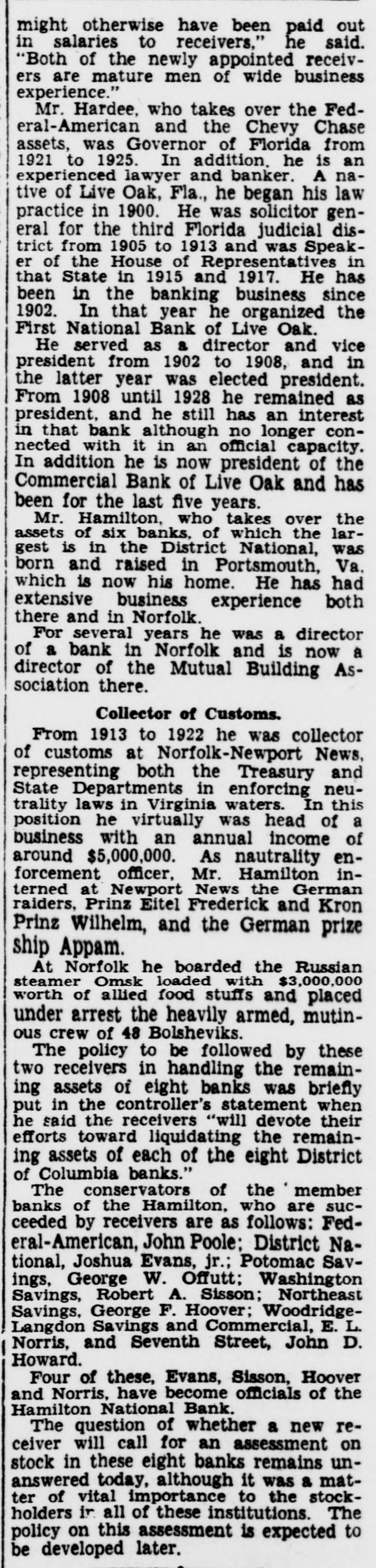
might otherwise have been paid out in salaries to receivers." he said. "Both of the newly appointed receivers are mature men of wide business experience." Mr. Hardee, who takes over the Federal-American and the Chevy Chase assets, was Governor of Florida from 1921 to 1925. In addition, he is an experienced lawyer and banker. A native of Live Oak, Fla., he began his law practice in 1900. He was solicitor general for the third Florida judicial district from 1905 to 1913 and was Speaker of the House of Representatives in that State in 1915 and 1917. He has been in the banking business since 1902. In that year he organized the First National Bank of Live Oak. He served as a director and vice president from 1902 to 1908, and in the latter year was elected president. From 1908 until 1928 he remained as president, and he still has an interest in that bank although no longer connected with it in an official capacity. In addition he is now president of the Commercial Bank of Live Oak and has been for the last five years. Mr. Hamilton, who takes over the assets of six banks, of which the largest is in the District National, was born and raised in Portsmouth, Va. which is now his home. He has had extensive business experience both there and in Norfolk. For several years he was a director of a bank in Norfolk and is now a director of the Mutual Building Association there. Collector of Customs. From 1913 to 1922 he was collector of customs at Norfolk-Newport News, representing both the Treasury and State Departments in enforcing neutrality laws in Virginia waters. In this position he virtually was head of a business with an annual income of around $5,000,000. As nautrality enforcement officer, Mr. Hamilton interned at Newport News the German raiders, Prinz Eitel Frederick and Kron Prinz Wilhelm, and the German prize ship Appam. At Norfolk he boarded the Russian steamer Omsk loaded with $3,000,000 worth of allied food stuffs and placed under arrest the heavily armed, mutinous crew of 48 Bolsheviks. The policy to be followed by these two receivers in handling the remaining assets of eight banks was briefly put in the controller's statement when he said the receivers "will devote their efforts toward liquidating the remaining assets of each of the eight District of Columbia banks." The conservators of the member banks of the Hamilton, who are succeeded by receivers are as follows: Federal-American, John Poole: District National, Joshua Evans, jr.; Potomac Savings, George W. Offutt; Washington Savings, Robert A. Sisson: Northeast Savings, George F. Hoover; WoodridgeLangdon Savings and Commercial, E. L. Norris, and Seventh Street, John D. Howard. Four of these, Evans, Sisson, Hoover and Norris, have become officials of the Hamilton National Bank. The question of whether a new receiver will call for an assessment on stock in these eight banks remains unanswered today, although it was a matter of vital importance to the stockholders ir all of these institutions. The policy on this assessment is expected to be developed later.

Article from Evening Star, December 14, 1933

Click image to open full size in new tab

Article Text

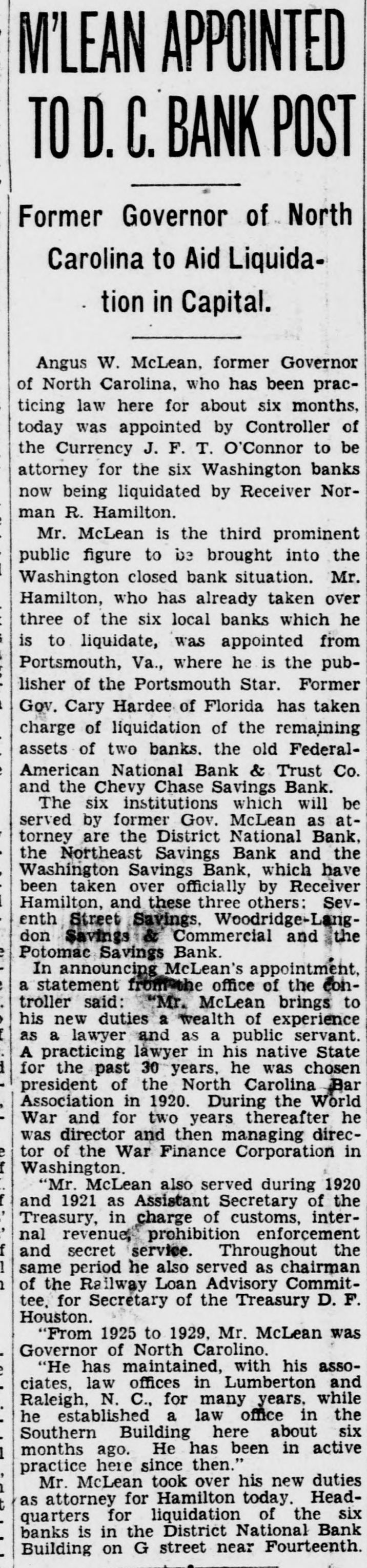
M'LEAN APPOINTED TOD. C. BANK POST Former Governor of North Carolina to Aid Liquidation in Capital. Angus W. McLean. former Governor of North Carolina, who has been practicing law here for about six months, today was appointed by Controller of the Currency J. F. T. O'Connor to be attorney for the six Washington banks now being liquidated by Receiver Norman R. Hamilton. Mr. McLean is the third prominent public figure to be brought into the Washington closed bank situation. Mr. Hamilton, who has already taken over three of the six local banks which he is to liquidate, was appointed from Portsmouth, Va., where he is the publisher of the Portsmouth Star. Former Gov. Cary Hardee of Florida has taken charge of liquidation of the remaining assets of two banks. the old FederalAmerican National Bank & Trust Co. and the Chevy Chase Savings Bank. The six institutions which will be served by former Gov. McLean as attorney are the District National Bank, the Northeast Savings Bank and the Washington Savings Bank, which have been taken over officially by Receiver Hamilton, and these three others: Seventh Street Savings, Woodridge-Langdon Savings & Commercial and the Potomac Savings Bank. In announcing McLean's appointment, a statement from the office of the controller said: "Mr. McLean brings to his new duties a wealth of experience as a lawyer and as a public servant. A practicing lawyer in his native State for the past 30 years, he was chosen president of the North Carolina Bar Association in 1920. During the World War and for two years thereafter he was director and then managing director of the War Finance Corporation in Washington. "Mr. McLean also served during 1920 and 1921 as Assistant Secretary of the Treasury, in charge of customs, internal revenue, prohibition enforcement f and secret service. Throughout the I same period he also served as chairman 1 of the Railway Loan Advisory Committee, for Secretary of the Treasury D. F. Houston. "From 1925 to 1929, Mr. McLean was Governor of North Carolino. "He has maintained, with his associates, law offices in Lumberton and Raleigh, N. C., for many years. while he established a law office in the : Southern Building here about six months ago. He has been in active practice here since then." Mr. McLean took over his new duties as attorney for Hamilton today. Headquarters for liquidation of the six banks is in the District National Bank Building on G street near Fourteenth.


Article from Evening Star, December 15, 1933

Click image to open full size in new tab

Article Text

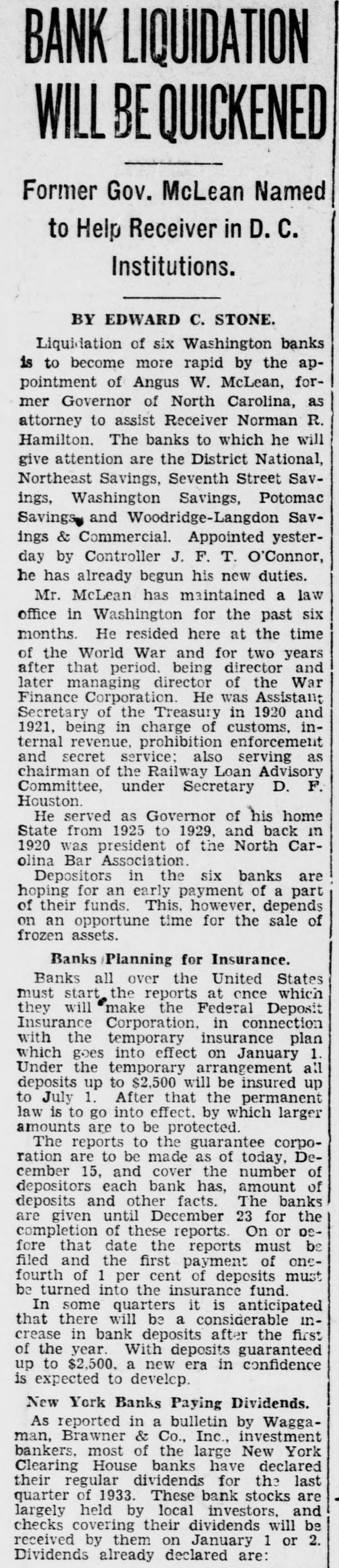
BANK LIQUIDATION WILL BE QUICKENED Former Gov. McLean Named to Help Receiver in D.C. Institutions. BY EDWARD C. STONE. Liquidation of six Washington banks is to become more rapid by the appointment of Angus W. McLean, former Governor of North Carolina, as attorney to assist Receiver Norman R. Hamilton. The banks to which he will give attention are the District National, Northeast Savings, Seventh Street Savings, Washington Savings, Potomac Savings and Woodridge-Langdon Savings & Commercial. Appointed yesterday by Controller J. F. T. O'Connor, he has already begun his new duties. Mr. McLean has maintained a law office in Washington for the past six months. He resided here at the time of the World War and for two years after that period. being director and later managing director of the War Finance Corporation. He was Assistant Secretary of the Treasury in 1920 and 1921, being in charge of customs. internal revenue, prohibition enforcement and secret service: also serving as chairman of the Railway Loan Advisory Committee, under Secretary D. F. Houston. He served as Governor of his home State from 1925 to 1929, and back in 1920 was president of the North Carolina Bar Association. Depositors in the six banks are hoping for an early payment of a part of their funds. This, however, depends on an opportune time for the sale of frozen assets. Banks Planning for Insurance. Banks all over the United States must start the reports at once which they will make the Federal Deposit Insurance Corporation, in connection with the temporary insurance plan which goes into effect on January 1. Under the temporary arrangement all deposits up to $2,500 will be insured up to July 1. After that the permanent law is to go into effect. by which larger amounts are to be protected. The reports to the guarantee corporation are to be made as of today, December 15, and cover the number of depositors each bank has, amount of deposits and other facts. The banks are given until December 23 for the completion of these reports. On or 08fore that date the reports must be filed and the first payment of onefourth of 1 per cent of deposits must be turned into the insurance fund. In some quarters it is anticipated that there will be a considerable increase in bank deposits after the first of the year. With deposits guaranteed up to $2,500. a new era in confidence is expected to develop. New York Banks Paying Dividends. As reported in a bulletin by Waggaman, Brawner & Co., Inc., investment bankers, most of the large New York Clearing House banks have declared their regular dividends for the last quarter of 1933. These bank stocks are largely held by local investors, and checks covering their dividends will be received by them on January 1 or 2. Dividends already declared are:


Article from Evening Star, April 11, 1934

Click image to open full size in new tab

Article Text

W. watter. son. jr president of the Security Savings & Commercial Bank; Robert V. Fleming, president Riggs National Howard Moran, vice president American Security & Trust Co., and M. D. Rosenberg, president Bank of Commerce & Savings The program will cover such topics as current legislation and its effect upon banking practices, interest problems, constructive customer relations accounting and analysis of accounts safe deposit methods and savings department details, Chairman Waller said It is especially interesting to note that each member of the Program Committee is a former president of the association so has had extra valuable experience in arranging for speakers and discussions. Bankers Keeping "Hands Off." In addition to the list of bills in Congress favored by the American Bankers' Association. and the list opposed, which have already been published the A B. A., through its Committee on Federal Legislation of which Robert V. Fleming is chairman, decided to remain neutral on the following measures Requiring State member banks of the Federal Reserve System to publish condition reports relating to protection of trust funds awaiting investment in national banks guaranteeing Home Owners Loan Corporation bonds: authorizing direct loans by Federal Reserve banks numerous bills repealing the check tax: relating to preference for collection items in national banks: permitting Reconstruction Finance Corporation participation in loans through banks authorizing Reconstruction Finance Corporation to establish industrial credit corporations authorizing circulation against Home Owners' Loan Corporation bonds: permitting capitalization of national banks at $25,000 in places up to 3.000 inhabitants relating to branches of national banks Also a number of Senate and House bills relating to specific details of the Federal deposit insurance plan; relating to insured bankruptcy funds: a number of bills referring to payment to depositors of closed banks; relating to State taxation of national banks; relating to escheat of dormant accounts in national banks to United States Treasury, and a bill relating to Federal Reserve loans real estate loans, bad debts and double liability. New Bank Director Elected. F E. Pope, president of the Federal Services Finance Corporation was elected a director in the Washington Mechanics Savings Bank, at the annual meeting held in Alexandria yesterday. The stockholders authorized an increase in capital stock from $200,000 to $250,000. All officers were reelected. They include Clarence F Burton, president; A Scott Offutt Frank W Lee and F P Williams. vice presidents; M. H. Buckingham, cashier and secretary; Joseph M. McCarthy, William B. Mehler jr Bernard M Grant, T. Eugene Elgin and T. Howard Norris, assistant cashiers The directorate, in addition to the new members, is composed of Walter K Bachrach, M. H. Buckingham, C F. Burton, Gustave Bugniazet. Fred Hewitt, F. W. Lee, A. S. Offutt. Edward F. Pickford, J. B Pruitt. J. C Pyles, Arthur o Wharton and F P Williams. The bank will change its name to the City Bank of Washington in the near future and also take over the Franklin National Bank as a branch. Keene Made Bank Receiver. Carter B. Keene, who has been acting for several weeks as receiver for the nited States Savings Bank. has been named receiver for the Woodridge-Langdon Savings & Commercial, the additional duties being assigned by Controller of the Currency J. F. T .O'Connor. The bank is being operated as unit of the Hamilto National Bank but assets which became frozen in the original bank have been taken in charge by the receiver When the Woodridge-Langdon became a part of the Hamilton National. it paid depositors 50 cents on the dollar. Mr. Norris, who now is manager of this branch of the Hamilton National, has been acting as conservator of the Woodridge-Langdon institution. From now on he will devote all his time to the duties of a branch manager. Business Up 300 Per Cent. Thomas P. Morgan, jr. manager of the Washington office of the Mutual Life Insurance Co. of New York, reported today that new paid-for business for March. 1934. showed an increase of 300 per cent over March, 1933, also an increase of 100 per cent in the number of producing agents participating in this accomplishment To date. Mr Morgan says, April business shows a like increase While the record is a brilliant one it also should be recalled that during a part of March, 1933, all the banks were closed and business was practieally at a standstill Exchange Trading Lively. Business was much better today on the Washington Stock Exchange in both bonds and stocks. Washington Gas 6s. Series B, opened the session with $100 selling at 10234 Washington Railway & Electric 4s recorded two $1,000 sales at 931/4 Anacostia & Potomac R. R. 5s opened with $1,000 moving at 66 and closed with another $1,000 going at 661/4. The first stock sale was in Washington Railway & Electric preferred, a small lot moving at 951/2 Potomac Electric Power 5 1/2 per cent preferred appeared on the board at 110 Capital Traction woke up today after sleeping for several sessions, six consecutive sales involving 100 shares taking place at 25. The largest sale was a block of 60 shares. The stock closed with 241/2 bid and 26 asked. Virginian Railway has declared the regular quarterly dividend of $1.50 on the preferred stock, payable May 1 to stock of record April 14. The recovery administration announces public hearings will be held April 23 on codes submitted by the Bell System and the independent com-


Article from Evening Star, December 31, 1936

Click image to open full size in new tab

Article Text

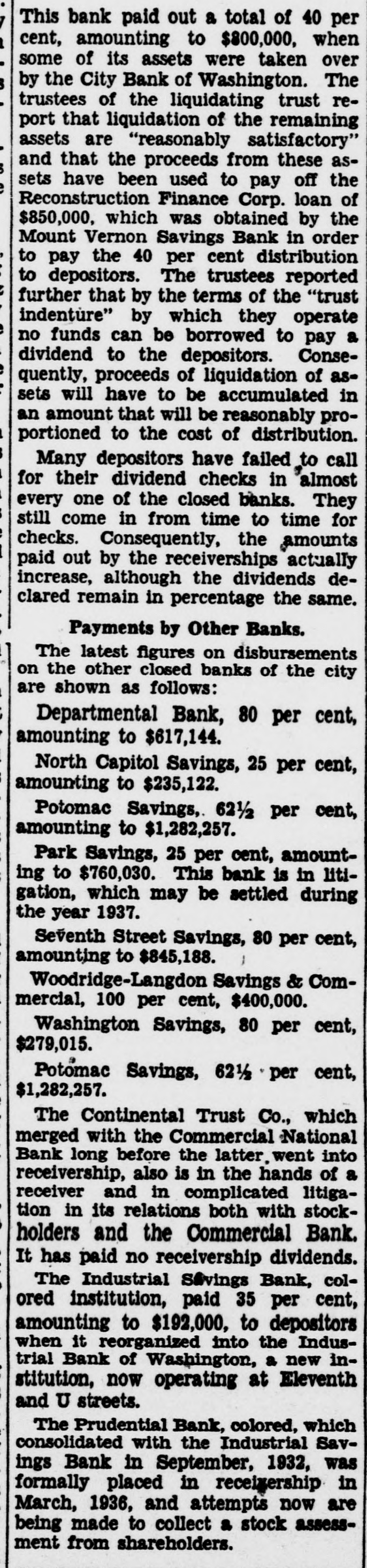
This bank paid out a total of 40 per 7 cent, amounting to $800,000, when some of its assets were taken over $ by the City Bank of Washington. The trustees of the liquidating trust report that liquidation of the remaining assets are "reasonably satisfactory" and that the proceeds from these assets have been used to pay off the Reconstruction Finance Corp. loan of $850,000, which was obtained by the Mount Vernon Savings Bank in order to pay the 40 per cent distribution to depositors. The trustees reported further that by the terms of the "trust indenture" by which they operate no funds can be borrowed to pay a dividend to the depositors. Consequently, proceeds of liquidation of assets will have to be accumulated in an amount that will be reasonably proportioned to the cost of distribution. Many depositors have failed to call for their dividend checks in almost every one of the closed banks. They still come in from time to time for checks. Consequently, the amounts paid out by the receiverships actually increase, although the dividends declared remain in percentage the same. Payments by Other Banks. The latest figures on disbursements on the other closed banks of the city are shown as follows: Departmental Bank, 80 per cent, amounting to $617,144. North Capitol Savings, 25 per cent, amounting to $235,122. Potomac Savings, 62 1/2 per cent, amounting to $1,282,257. Park Savings, 25 per cent, amounting to $760,030. This bank is in litigation, which may be settled during the year 1937. Seventh Street Savings, 80 per cent, amounting to $845,188. Woodridge-Langdon Savings & Commercial, 100 per cent, $400,000. Washington Savings, 80 per cent, $279,015. Potomac Savings, 62 1/2 . per cent, $1,282,257. The Continental Trust Co., which merged with the Commercial National Bank long before the latter. went into receivership, also is in the hands of a receiver and in complicated litigation in its relations both with stockholders and the Commercial Bank. It has paid no receivership dividends. The Industrial Slivings Bank, colored institution, paid 35 per cent, amounting to $192,000, to depositors when it reorganized into the Industrial Bank of Washington, a new institution, now operating at Eleventh and U streets. The Prudential Bank, colored, which consolidated with the Industrial Savings Bank in September, 1932, was formally placed in receizership in March, 1936, and attempts now are being made to collect a stock assessment from shareholders.