Multiple contemporaneous articles (Apr 27–28, 1933) describe a three-day run on the Cleveland Trust Company started by unfounded/malicious rumors. Federal Reserve statements and the president Harris Creech's actions halted the run; the bank remained open and resumed normal operations. No suspension or permanent closure is reported.
Events (1)
1.April 27, 1933Run
Cause
Rumor Or Misinformation
Cause Details
A planned whispering campaign / malicious and unfounded rumors circulated about the Cleveland Trust Company, prompting depositors to withdraw funds; Secret Service investigators were sent to trace rumor spreaders.
Measures
Bank president Harris Creech addressed depositors from the lobby, kept the bank open two extra hours to meet withdrawals; Cleveland Federal Reserve issued a formal statement backing licensed banks; federal investigators/Secret Service sought rumor spreaders.
Newspaper Excerpt
the three-day run on the Cleveland Trust Company was halted by prompt action of the Federal government ... started by unfounded rumors.
Source
newspapers
Newspaper Articles (14)
1.July 28, 1932Richmond Times-DispatchRichmond, VA
Click image to open full size in new tab
Article Text
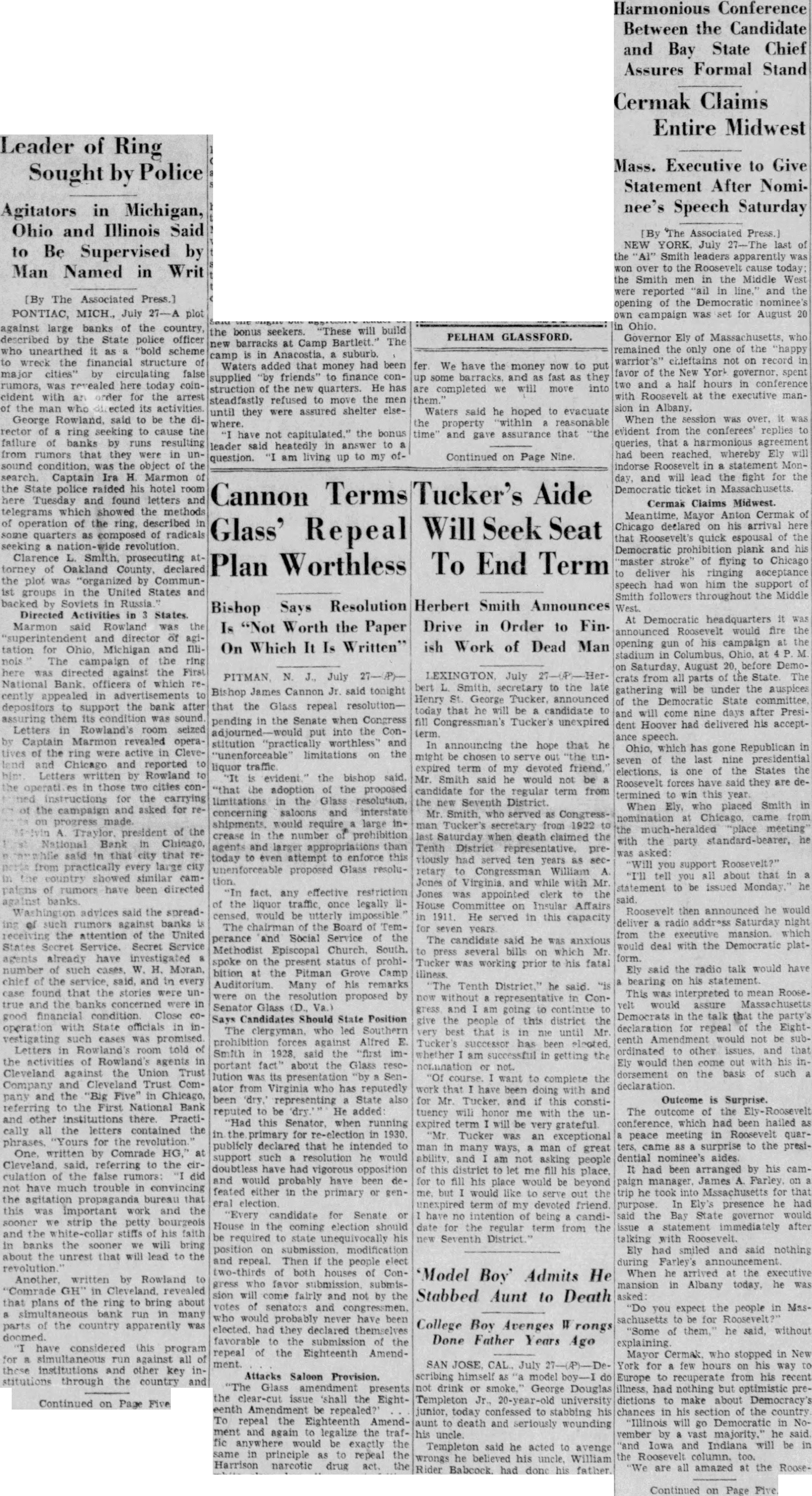
Leader of Ring Sought by Police
Agitators in Michigan, Ohio and Illinois Said to Be Supervised by Man Named in Writ
[By The Associated Press.] PONTIAC, MICH., July plot against banks the described by State police officer who "bold scheme structure major circulating false rumors, was here today coincident with order for the arrest of the ected its activities George Rowland. said be the rector of ring seeking to failure banks by runs resulting from rumors that they were in unsound condition. the object of the search. Captain Ira Marmon of the police raided his hotel and letters and the methods of operation of the ring, described of radicals seeking revolution Smith prosecuting Oakland County declared the plot was by Commungroups the United States and backed Soviets in Russia Directed Activities States. Marmon Rowland the and director of tation for Ohio, and Illinois the ring was the First Bank which cently depositors to support the bank after assuring them was sound Letters Rowland's room seized Captain Marmon revealed the ring were active CleveChicago reported Letters written Rowland the operati in those two cities for the the campaign and asked for president the National Bank Chicago, that city that refrom practically every city country similar campaigns rumors have been directed banks advices the spreadof such rumors banks the attention the United States Service. Secret Service agents already number Moran. chief the said, and every found that the stories untrue the were financial Close operation with State officials cases was promised Letters Rowland's room told the activities of Rowland's agents in Cleveland against the Union Trust Company and Cleveland Trust Company and the "Big Five" Chicago, the Bank and other there Practically the letters contained the "Yours for the revolution. One. written by Comrade HG, referring the circulation the false did not have trouble in convincing the agitation bureau that this important work the sooner strip petty bourgeois the white-collar his faith banks will about the unrest that will lead to the Another written by Rowland "Comrade plans of the to about run many parts the country apparently was considered this program simultaneous against institutions and other key institutions through the country and
Continued on Page Five.
Harmonious Conference Between the Candidate and Bay State Chief Assures Formal Stand
Cermak Claims Entire Midwest
Mass. Executive to Give Statement After Nominee's Speech Saturday
[By The Associated Press NEW YORK July last Smith leaders was over Roosevelt cause today Smith in the Middle reported in and own set for August Ohio. Governor who remained the one "happy warrior's' chieftains on record favor the New York spent two and half hours with Roosevelt the executive manAlbany When the session was over. was evident from the conferees replies queries, that harmonious agreement had been reached. whereby Ely will statement and will the fight for the ticket
Cermas Claims Midwest. Mayor Cermak Chicago on his here that quick Democratic plank and his master of fiying Chicago ringing speech had him support throughout Middle At Democratic headquarters would opening gun campaign Ohio, August before Demofrom parts the State The gathering will be under the auspices Democratic State and will come President Hoover delivered his acceptspeech. has gone Republican in the last the States the Roosevelt said determined When placed Smith came "place meeting with the party was asked will you support Roosevelt?" "I'll tell about that statement to issued Monday then he from the which deal with the Democratic platEly the radio talk would have This was mean assure Democrats talk that the declaration repeal the Eight eenth not ordinated other and that Ely would then come out dorsement the basis of such declaration
Outcome is Surprise The outcome which had been hailed peace in quarthe presibeen his James trip for that presence he had said the Bay after talking Ely had said nothing When he the executive mansion Albany today, he was "Do you expect the people Massachusetts he said, without Mayor who stopped New York for few on his way from his had nothing but predictions make about Democracy's chances in his section the country "Illinois will Democratic vember by vast said Iowa will be column. We are all amazed the Roose-
Continued on Page Five
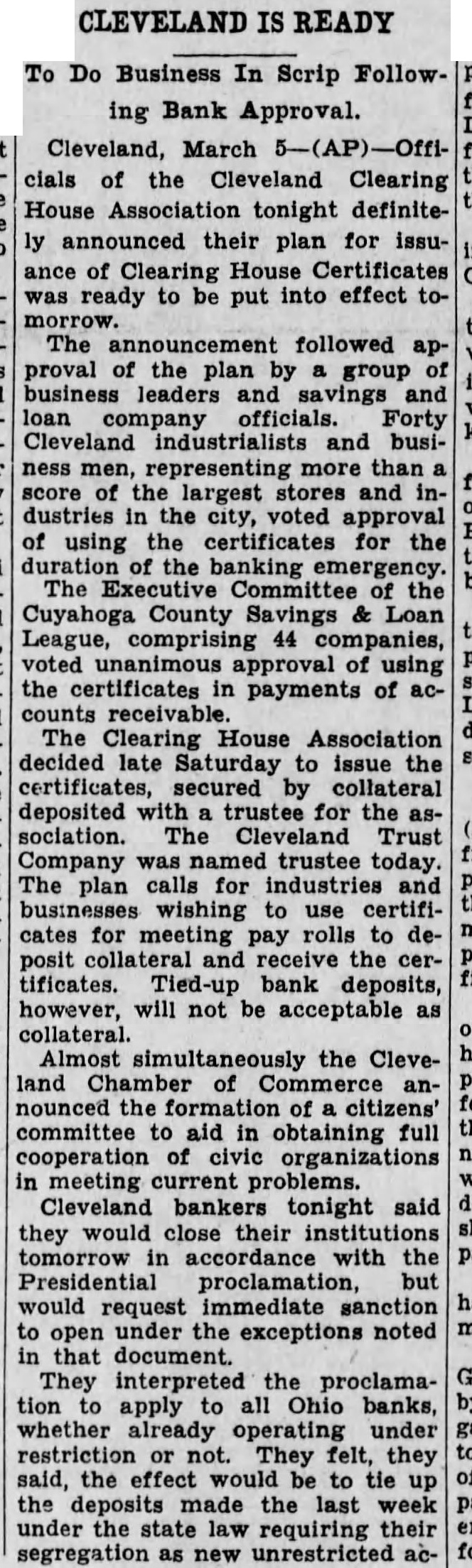
CLEVELAND IS READY
To Do Business In Scrip Following Bank Approval.
Cleveland, March cials of the Cleveland Clearing House tonight definiteannounced their plan for issuance Clearing House Certificates ready to be into effect morrow. The announcement followed proval the plan group business leaders savings and officials. Forty industrialists and business men, representing than score of largest stores industries the city, voted using the certificates for the the banking The the Cuyahoga County Savings Loan League, 44 voted of using the certificates payments of The Clearing House Association decided late Saturday issue secured by collateral deposited trustee the sociation. The Cleveland Trust Company was named trustee today. The plan calls for industries wishing use certificates for meeting pay rolls to posit receive the tificates. bank deposits, however, will not be acceptable collateral. Almost the Cleveland of nounced the of committee to aid in obtaining full cooperation of civic in meeting Cleveland tonight said they would close their with Presidential proclamation but would request immediate under the exceptions noted document. They interpreted the proclamaapply all Ohio banks, whether already operating under restriction They they said, would tie the deposits made the under state requiring their segregation new unrestricted
DEPOSITORS
Granted Major Voice
On Reorganization Committee or Cleveland Bank-Two Pay Off Loans.
Cleveland, Ohio, March President Harold H. Burton, of the Reorganization Committee of the Guardian Trust Company, today announced that depositors of the bank had given majority representation on the committee. committee's membership was increased from six eight the additions today of Auxiliary Bishop James A. McFadden, of the Catholic Diocese Cleveland, George W. Grill, Assistant School Superintendent of Lakewood, suburb. Five of the committeemen represent depositors, represent Directors and stockholders and one represents the stockholders The Union Trust Company and the Guardian Trust Company, neiof which been operating normal basis since national bank crisis, both have been cutting expenses drastically in anticipation of arrangement for has dismissed 200 of its 957 employees recently, and cut deeply In tion announced today that the Union Trust was closing 10 Meanwhile, the Cleveland Trust Company, which reopened Federal license after the crisis, announced today it had repaid of $15,800,000 Finance Corporation. Simultaneously the Central United National Bank. 100 per cent operative, said had repaid obligation to the corporation of $1,100,000 This repayment wiped out the indebtedness of both banks corporation.
DEPOSITORS
Granted Major Voice
On Reorganization Committee Of Cleveland Bank-Two Pay Off R. C. Loans.
Cleveland, Ohio, March -President Harold H. Burton, the Reorganization Committee of the Guardian Trust Company, today announced that depositors of the bank had been majority on the committee. The committee's membership was increased from six eight the additions today of Auxiliary Bishop James A. McFadden, of the Catholic Diocese of Cleveland, George W. Grill, Assistant School Superintendent of Lakewood, suburb. Five of the committeemen represent depositors, two represent Directors and stockholders, one represents the stockholders. Union Trust Company and the Guardian Trust Company, neither of which has been operating normal basis the national crisis, both been cutting expenses drastically in anticipation of reorganization arrangement shortly. The Union Trust has dismissed of its 957 employees recently, cut salaries deeply. tion announced today that Union Trust closing branches. Meanwhile, the Cleveland Trust Company, which reopened with eral other banks Federal license after the crisis, announced today repaid loan of 800,000 Finance Corporation. Simultaneously the Central National Bank, 100 cent operative, said repaid obligation to the corporation of $1,100,000. This repayment wiped out the total indebtedness of both banks the corporation.
5.April 27, 1933The RepublicanSpringfield, MA
Click image to open full size in new tab
Article Text
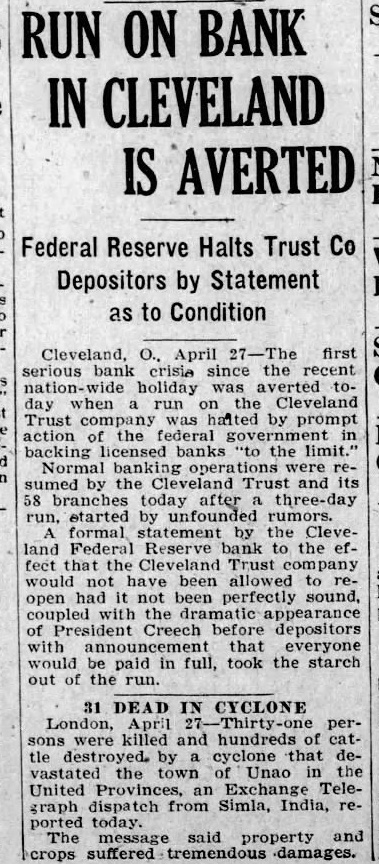
RUN ON BANK IN IS AVERTED
Federal Reserve Halts Trust Co Depositors by Statement as to Condition
Cleveland, O., April 27-The first serious bank crisia since the recent holiday was averted day when run Cleveland Trust was halted by prompt action the backing licensed banks the limit." Normal banking sumed by the Trust and its 58 branches today after three-day run, started by unfounded rumors. formal statement by the CleveFederal Reserve bank to the effect Cleveland Trust company would been allowed to open had not been perfectly sound, the appearance of President Creech before depositors with announcement that everyone would be paid in full, took the starch out of the run.
31 DEAD IN CYCLONE perkilled and hundreds of cattle destroyed. by cyclone that devastated the of Unao the United Provinces, an Exchange Telegraph dispatch from Simla, India, reported today. The message said property and crops suffered tremendous damages.
6.April 27, 1933The Akron Beacon JournalAkron, OH
Click image to open full size in new tab
Article Text
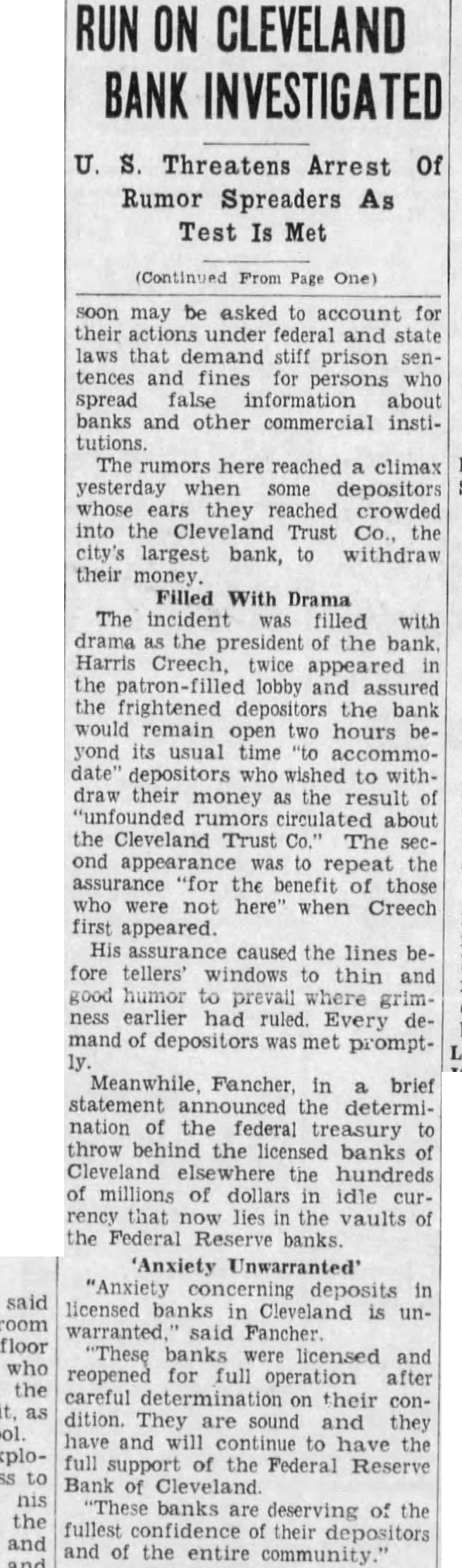
ON CLEVELAND BANK INVESTIGATED
U. Threatens Arrest Of Rumor Spreaders As Test Is Met
(Continued From Page One) may be asked for under that stiff prison tences fines for persons spread about banks and other commercial institutions. The here reached climax yesterday when some depositors whose they reached crowded into the Cleveland Trust Co., city's largest bank, to withdraw their money Filled With Drama The incident filled with drama the president the bank. Harris Creech, appeared the lobby assured the frightened depositors the would remain open two hours yond its usual to withdraw their money result the Cleveland Trust ond repeat the who were when Creech first appeared. His caused the lines before tellers' windows humor prevail ness earlier had ruled. Every mand depositors was met prompt- in brief statement the determination federal treasury throw behind the licensed banks the hundreds of millions of dollars idle curlies the vaults the Federal banks.
"Anxiety deposits licensed banks Cleveland is un"These licensed and reopened operation careful on their dition. are sound and will have the Federal Reserve banks of the fullest their of the entire
7.April 27, 1933The Dayton HeraldDayton, OH
Click image to open full size in new tab
Article Text
GOVERNMENT IN AND PUTS STOP TO 'RUN' ON BANK
Depositors at Cleveland Are Quieted After False Rumors Precipitate Flurry.
FEDERAL AUTHORITIES
GO AFTER CRIMINALS
Perpetrators of Unfounded Reports Sought After All Demands Are Met.
CLEVELAND. O., April
-Cleveland's licensed banks were "backed the limit" today by the federal government.
Aroused three-day run the Cleveland Trust company, the city's largest bank, federal authoriannounced that secret service ties in the city in operatives were attempt to trace down perperators of malicious rumors which caused the withdrawals. the Cleveland Simultaneously, Federal Reserve bank issued formal statement, signed by Gov. Fancher of this Federal Reserve out that the district, pointing Cleveland Trust and other licensed banks were allowed to reopen "only after careful determination of their condition proved them to be sound. DRAMATIC CLIMAX.
The run on the Cleveland Trust its 59 branches came to dramatic climax late yesterday when Harris Creech. president, appeared in lobby crowded with depositors, announced that every person would be paid in full, and that the bank would be kept open two extra hours to accommodate anyone wishing withdraw money. The Cleveland Trust company one of the first in this vicinity to obtain license to reopen after the recent banking holiday. Just prior to the closing of all banks, the trust company had placed bales of money in plain view in the lobby, assuring all depositors there was plenty of cash to pay everyone in full.
FEARS ALLAYED.
President Creech's dramatic appearance before the depositors yesterday had the effect of restoring confidence among depositors, and only handfull were in the lobby when the bank finally closed The statement of Gov. Fancher of the Federal Reserve, said: "Anxiety concerning deposits licensed banks in Cleveland is warranted. These banks were censed and reopened after careful determination of their condition. They are sound and they have and will continue to have the full support of the Federal Reserve bank.' The run on the Cleveland Trust and its branches came while officials of the Union Trust and Guardian Trust, the city's second and third largest were working reorganization plans which will allow the institutions to reopen. Sale of common stock in new tional bank to succeed both Union and Guardian now underway.
8.April 27, 1933The NewsPaterson, NJ
Click image to open full size in new tab
Article Text
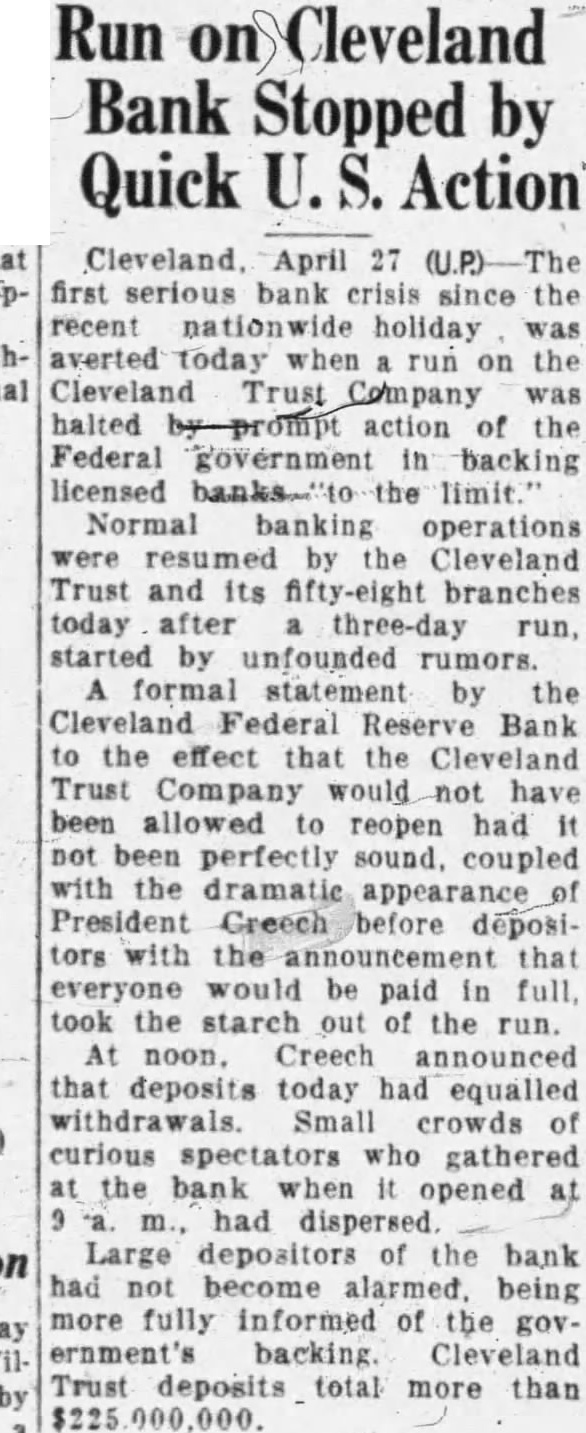
Run on Cleveland Bank Stopped by Quick Action
Cleveland. April 27 (U.P.)-The first serious bank crisis since recent nationwide holiday was averted today when run on the Cleveland Trust Company was halted by-prompt action of the Federal government in backing licensed the limit Normal banking operations were resumed by the Cleveland Trust and its fifty-eight branches today after three-day run, started by unfounded rumors. formal statement by the Cleveland Federal Reserve Bank the effect that the Cleveland Trust Company would have been allowed reopen had not been perfectly sound. coupled with the dramatic appearance President depositors with the announcement that everyone would be paid in full took starch out of the run. At noon. Creech announced that deposits today had equalled withdrawals. Small crowds of curious spectators who gathered at the bank when opened had dispersed. Large depositors of the bank had become alarmed. being more fully informed of the gov ernment's Cleveland Trust deposits total more than
9.April 27, 1933The Daily AdvocateGreenville, OH
Click image to open full size in new tab
Article Text
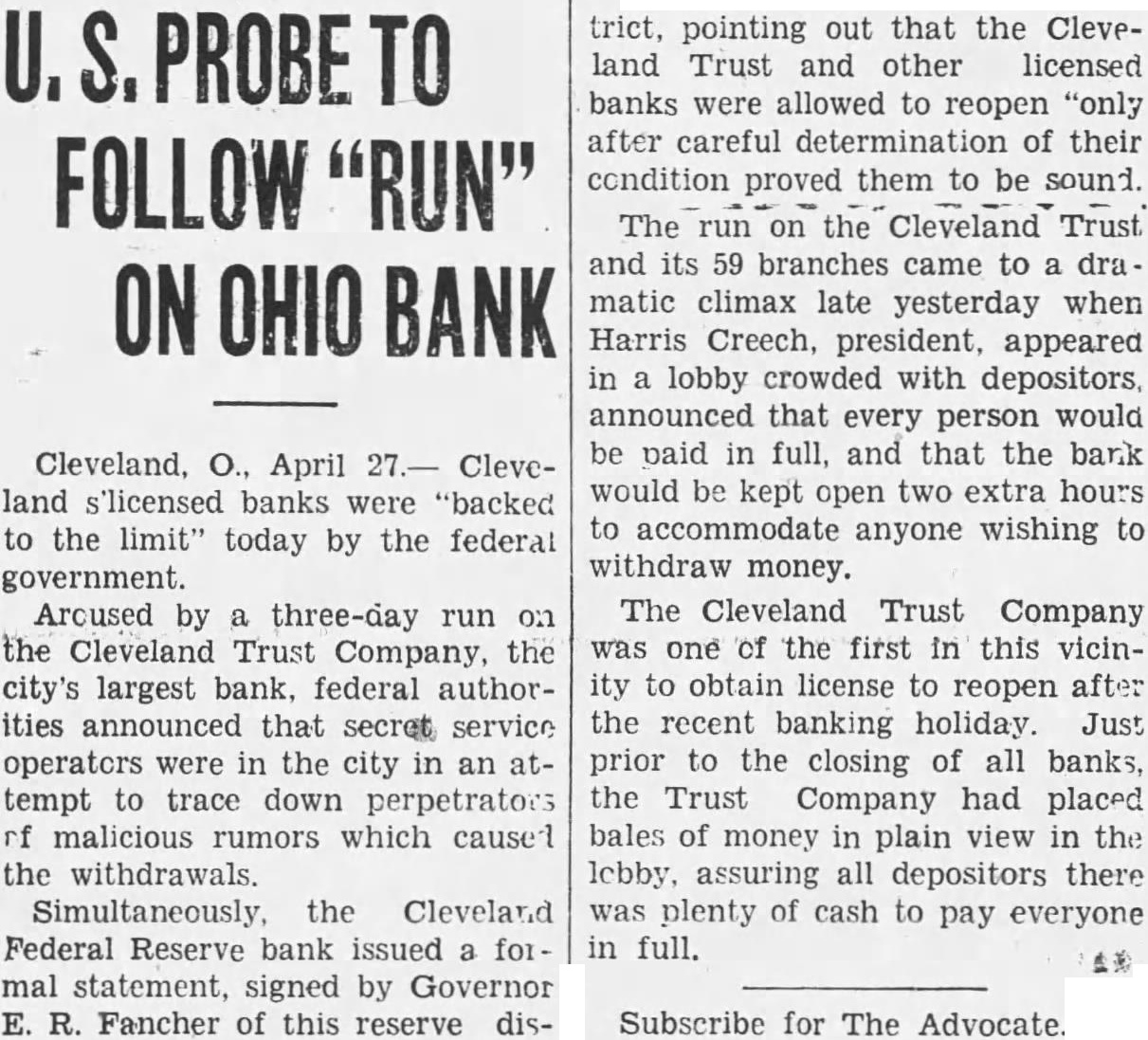
PROBE TO FOLLOW "RUN" ON OHIO BANK
Cleveland, O., April 27.- Cleveland s'licensed banks were "backed to the limit" today by the federal government. Arcused by a three-day run on the Cleveland Trust Company, the city's largest bank. federal authorities announced that secret service operators were in the city in an attempt to trace down perpetrators rf malicious rumors which caused the withdrawals. Simultaneously, the Cleveland Federal Reserve bank issued a formal statement, signed by Governor E. R. Fancher of this reserve dis- trict. pointing out that the Cleveland Trust and other licensed banks were allowed to reopen "only after careful determination of their condition proved them to be sound. The run on the Cleveland Trust and its 59 branches came to a dramatic climax late yesterday when Harris Creech. president, appeared in lobby crowded with depositors. announced that every person would be paid in full. and that the bank would be kept open two extra hours to accommodate anyone wishing to withdraw money. The Cleveland Trust Company was one of the first in this vicinity to obtain license to reopen after the recent banking holiday. Just prior to the closing of all banks, the Trust Company had placed bales of money in plain view in the lebby, assuring all depositors there was plenty of cash to pay everyone in full.
Subscribe for The Advocate.
10.April 27, 1933News JournalWilmington, OH
Click image to open full size in new tab
Article Text
HUNTING SPREADERS OF FALSE RUMORS
Who Start Untrue Reports of Banks To Be Called to Account
RUN ON BANK IS STARTED
When Malicious Reports Get Ears of Depositors Of Cleveland Bank
CLEVELAND, April The United States Secret Ser. vice today picked up the trail of rumor spreaders as the treasury renewed its pledge of "full support" to the Cleveland banks licensed following the national bank holiday.
A squad of operatives who have brought about the arrest and conviction persons who spread "false and rumors about banks in other cities worked quietly to find the source of similar stories recently circulated here.
Some Are Known
The men were assigned to work directly under William G. Harper, agent in charge of the Secret Service in this district, said E. R. Fancher, governor of the Fourth Federal Reserve Bank. Some of the it said, already are known and may be asked account for actions. Federal and state stiff prison sentences and fines for persons false information about banks and other commercial institutions. max yesterday when some depositors whose ears they reached crowded into the Cleveland Trust Company, the city's largest bank, to withdraw their money. Reassures Crowd The incident was filled with drama as the president of the bank. Harris Creceh, twice appeared in the patron-filled lobby and assured the frightened depositors the bank would remain open two hours beyond Its usual time accommodate" depositors who wished to withdraw their money the result of "unfounded rumors circulated about the Cleveland Trust Co." The second appearance was to repeat the assurance "for the benefit of those who were not here" when Creech first appeared. assurance caused the lines tellers' windows to thin and good humor to prevail. Every demand of depositors was met promptly and Creech assured them the institution would be opened at the usual time today. Meanwhile, Fancher, in brief statement, announced the determination of the federal treasury throw behind the licensed banks of Cleveland and elsewhere the hundreds of millions of dollars in idle currency that now lies in the vaults of the Federal Reserve banks. When the doors of the main of. fice of the Cleveland Trust were opened at 8:45 A. M., fewer than dozen persons were waiting to en ter the bank. During the next hour the number of persons in the bank's lobby never exceeded 50, and observers for the Cleveland News said the number was well below normal. President Creech announced late in the morning that deposits and withdrawals were about
11.April 28, 1933The Plain DealerCleveland, OH
Click image to open full size in new tab
Article Text
CASH ENDED; FLOWING
Cleveland Trust Depositors Set Pace in Afternoon,
Returning Money.
NO BIG CROWDS ALL DAY
Total of *Funds Brought in Exceeds Withdrawals.
Cleveland Trust depositors ran to the bank Wednesday to withdraw money, the result of whispering campaign which appeared to have been planned. yesterday began run back the bank again deposit the same money Thus ended in less than 24 hours the city run since the banking troubles began months ago more than it began. Deposits the main office at Street and Euclid Avenue, focal point of Wednesday's trouble, mornAt noon they began creep ahead. In the afternoon, bank officials the movement had definitely changed and deposits exceeding which those of normal business less. confidence placed in the Cleveland Trust Co. by informed opinion shown by the fact that the large deposits in the bank wavered officials said. Confined
Authorities the institution also confirmed observations had in. dicated the disturbances Wednesday confined almost exclusiveto the East Side and the nearer eastern suburbs. Branches the West Side the city and in other suburbs reported no unusual mands The phenomenal cessation of the run was ascribed two things, the supporting action the federal ernment through Fancher governor of the Federal Reserve Bank of Cleveland, and the personal initiative Harris Creech. president of the Cleveland twice mounted lobby tables to tell the crowd it could its money whenever wanted it and kept the bank open after normal hours to prove meant One result of this coup appeared yesterday, large basket of flowers the accounts desk in the main lobby. sent by the Jones-Russell Co., and bearing card which May these ers express our admiration for your courage. The other and more important that the lobby crowd alim throughout the day and the (Continued Page Column
12.April 28, 1933The Cleveland PressCleveland, OH
Click image to open full size in new tab
Article Text
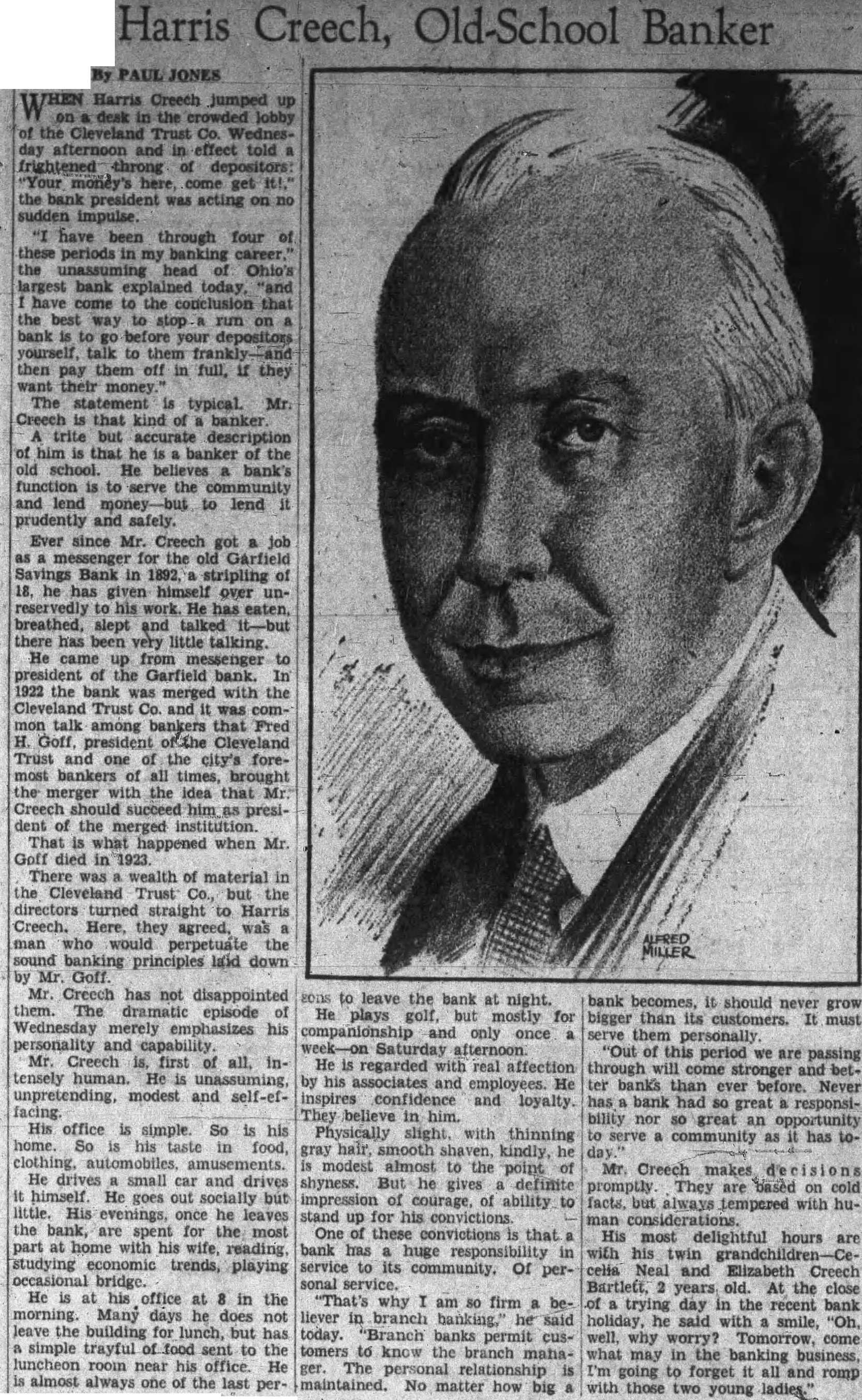
Harris Creech, Old-School Banker
Harris Creech jumped the lobby Cleveland Trust Wedneseffect frightened depositors: the president was acting impulse. have been through four periods head Ohio's bank today, the the run talk them then them off full, they money.' typical. Mr. Creech that kind banker. but description him the school. He believes bank's function the lend safely. Ever since Mr. Creech for the Garfield Bank in stripling 18, himself over unHe breathed, slept talked has been little talking. He came from president Garfield bank. 1922 the bank was merged Cleveland Trust Co. talk among bankers that Goff, president Cleveland Trust and one the city's forebankers all times, brought the merger the idea that Creech presithe merged institution. That when Mr. material Trust the Harris Creech. Here, they agreed. who laid Goff. Creech has not disappointed them. episode Wednesday his personality Mr. Creech first all. tensely human. unpretending, and facing. His office simple. So home. his in food, He drives small car and drives himself. He out socially but little. he leaves the bank, for most part home wife, reading studying economic trends, bridge. He his office in the morning. Many he does leave building lunch, but simple to luncheon room near his office. almost always one the last the bank night. He plays mostly only once He regarded real his confidence and loyalty. believe with thinning kindly, modest almost the point shyness. for his One these convictions has huge responsibility or service. why so firm in branch banking, today. banks customers the branch mahaThe maintained. No matter how big becomes, should never than customers. must personally. this period passing through come banks ever before. Never great responsigreat an community Creech makes promptly are based cold always tempered most delightful hours and Elizabeth Creech Bartlett, At the close day the recent bank holiday, smile, "Oh, why worry? may banking going forget romp those two young
13.April 28, 1933Evening StarWashington, DC
Click image to open full size in new tab
Article Text
U. S. TO INVESTIGATE FALSE BANK RUMORS Treasury Details Special Corps to Cleveland, Reserve Official Announces. By the Associated Press. CLEVELAND, April 28.-E. R. Fancher. governor of the Cleveland Federal Reserve Bank, has announced the United States Treasury Department had advised him it has detailed a special corps of Federal investigators to this city to "investigate false and malicious rumors about Cleveland banks." In another statement Fancher said all Cleveland banks which have been licensed since the national banking holiday "are sound" and "will have the full support of the Federal Reserve Bank." His announcement followed a dramatic action taken Wednesday by Harris Creech. president of the Cleveland Trust Co., largest Cleveland bank, when a number of depositors started withdrawing their money. Creech clambered to the top of a counter and told those in the lobby of the main office they could have two extra hours after the regular closing time to withdraw their money if they wanted it. The depositors greeted his remarks with applause and some of their numbers departed. Later Fancher issued a public statement concerning the Federal investiga. tion of malicious rumors and added: "Anxiety concerning deposits in licensed banks in Cleveland is unwarranted. These banks were licensed and reopened for full operation after careful determination of their condition."
14.April 28, 1933Daily NewsNew York, NY
Click image to open full size in new tab
Article Text
GOVERNMENT STOPS RUN ON OHIO BANK
Cleveland, April 27 (U.P.).-The first serious bank crisis since the nation-wide holiday was averted today when a run on the Cleveland Trust Company was halted by prompt action of the Government in backing licensed banks to the limit.
ASK Wynn to send your Horoscope