Munsey Trust Company (Washington, DC)

Episode Information

Episode UID
15008171367
Episode Type
Run Only
Bank Type
trust
Bank ID
1500817 routing
Routing Number
15-0081
Start Date
November 22, 1913
Location
Washington, District of Columbia (38.895, -77.036)

Metadata

Model
gemini-3-flash-preview (chosen from majority vote of a three-model LLM ensemble)
Short Digest
022c2cd65fc92085

Response Measures

None

Description

The Munsey Trust Company absorbed the United States Trust Company during a run on the latter; while the Munsey Trust Company itself experienced heavy withdrawals (a run) as a result of the merger and associated rumors, it remained open with Treasury support.

Events (2)

1. November 22, 1913 Other
Newspaper Excerpt
Approval has been given to the merger of the United States Trust Company with the Munsey Trust Company
Source
newspapers
2. November 22, 1913 Run
Cause
Local Banks
Cause Details
The run was triggered by the absorption of the failing United States Trust Company and subsequent public uncertainty and political controversy.
Measures
The U.S. Treasury deposited $1,000,000 with local national banks to be funneled to the Munsey Trust Company to meet withdrawals.
Newspaper Excerpt
This money was deposited by the department in pursuance of the administration policy to aid any institution known to be sound and good in meeting an unwarranted or unreasonable run.
Source
newspapers

Newspaper Articles (16)

Article from Evening Star, August 13, 1913

Click image to open full size in new tab

Article Text

Trustee for Sale of Apartment House The Munsey Trust Company has been appointed by Justice Barnard as trustee to sell the Lenman apartment in Bloomingdale said to be worth $75,000. The trust company was also designated as receiver to collect the rents of the property pending sale at auction in the early fall. The case was also referred to the auditor to adjust the question of previous rents and profits between Mrs. Margaret Kopp and Samuel Miller, who own the property. Attorneys Wilton J. Lambert and R. H. Yeatman represented Mrs. Kopp. Attorney L. Cabell Williamson appeared for Mr. Miller.


Article from New-York Tribune, December 3, 1913

Click image to open full size in new tab

Article Text

Williams Issues Statement. Assistant Secretary Williams issued an official statement on Saturday, November 22. which, in part, is as follows: "There is no need for apprehension. The situation over which the department and financial interests have been working has been fully met by the Munsey Trust Company. The Munsey Trust Company was the best qualified bank in Washington to handle the situation. This company had the largest reserve fund-more cash on hand-than perhaps any other Washington institution. "The cash at hand is sufficient to meet any situation, the department is fully assured. Approval has been given to the merger of the United States Trust Company with the Munsey Trust Company, and every dollar is safe. One million dollars in cash was deposited with the eleven national banks of the city this morning, on the receipt of proper security by the Treasury, this money going through the Clearing House to meet the needs of the Munsey Trust Company. This money was deposited by the department in pursuance of the administration policy to aid any institution known to be sound and good in meeting an unwarranted or unreasonable run." Mr. Williams's assertions that the Munsey Trust Company-a concern hardly more than six months old-was "the best qualified bank in Washington to handle the situation," and his further assertion that "this company had the largest reserve fund-more cash on hand-than perhaps any other Washington institution," are ridiculed by Washington bankers. They maintain that even Assistant Secretary Williams must have known the contrary to have been true, and assert that while the Munsey Trust Company, by the most liberal estimate, could not have had more than $400,000 in cash, probably much less, before it received the government deposit of $1,000,000, other Washington banks had considerably larger sums, one having not less than $2,000,000 in available cash in its vaults. The value of an official indorsement of this character from the Assistant Secretary of the Treasury to a new bank in the financial field is not lost sight of by the other bankers.


Article from The Washington Herald, December 4, 1913

Click image to open full size in new tab

Article Text

BANK TROUBLE d 8 MAY BE PROBED it Inquiry by Congress Into the U. S. Trust Company d Declared Likely. d INSINUATIONS ARE MADE Assistant Secretary Williams, Whose Action Is Criticised, Is Brother of Munsey Concern Director. Early investigation of the troubles from which resulted the absorption of the United States Trust Company by the Munsey Trust Company will be instituted by Congress, according to a circumstantial article published yesterday by The New York Tribune under the name of its Washington bureau. No names of the Washington bankers understood to desire the investigation are published, but the impression is given that certain of the presidents of national banks are authority for the reports. By inference, some sinister insinuations are made. The statement that Assistant Secretary of the Treasury John Skelton Williams, who is alleged to have reversed the judgment of Acting Comptroller of the Currency Thomas P, Kane and National Bank Examiner Richard W. Goodhart, in the conduct of the affairs of the United States Trust Company, after Mr. Goodhart had reported an impairment of the company's assets, is a brother of R. Lancaster Williams, a director of the Munsey Trust Company, is given prominence in the article. This relation is made the more notable through its being connected with the quotation of unnamed bankers in adverse criticism of Assistant Secretary Williams' official statement, after the absorption of the United States Trust by the Munsey Trust, to the effect that "the Munsey Trust Company was the best quΓ‘lified bank in Washington to handle the situation." I Statement Is Ridiculed. n Some Washington bankers, The Tribn une article asserts, are ridiculing the n official statement of Assistant Secretary Williams that the Munsey was the "best I qualified bank" or that "this company had the largest reserve fund-more cash I on hand-than perhaps any other insti6 tution." o The Tribune continues that "The value V of an official indorsement of this charac0 ter from the Assistant Secretary of the N Treasury to a new bank in the financial G field is not lost sight of by the other C bankers." c After casting umbrage upon the relaM tions of John Skelton Williams, as AsS sistant Secretary of the Treasury, and e R. Lancaster Williams, as a director of C the Munsey Trust Company, in the reB cent negotiations, the article proceeds M to state that "it is broadly intimated" G that the bankers * "deplore the P course of John Skelton Williams in huT miliating a national bank examiner whose m good judgment and intergrity are unS questioned by the bankers, and Mr. WillE iams' overruling of the Acting Controller m of the Currency, which, it is ass/rted, S. must inevitably militate against the inP dependence, and therefore the usefulH ness, of the office of the Comptroller of $ the Currency." A The Tribune reviews at length the negoL tiations and transactions through which E the United States Trust Company, after C its straitened conditions, following a rea port by the national bank examiner, culN minating in a "run," with the subsequent absorption of the company by the G Munsey Trust Company, was taken over B by the Munsey Company. U


Article from The Richmond Virginian, December 5, 1913

Click image to open full size in new tab

Article Text

Secretary McAdoo Brands as False Publications in New York Papers and Welcomes Investigation. Presence of Lancaster Williams on Board of Directors of Munsey Trust Company is Basis of Stories Criticizing Treasury. WASHINGTON, Dec. 4.-Secretary McAdoo issued a statement today defending the course of his assistant, John Skelton Williams, and other officials of the treasury department, in assisting the Munsey Trust company to absorb the United States Trust company, of this city, when the latter's doors were about to be closed by the comptroller of the currency. This statement was forced from Mr. McAdoo by stories which have been In circulation in Washington ever since the merger took place two weeks ago, and which finally found their way into type. BASIS OF STORIES. The basis of the stories was the presence of R. Lancaster Williams. a brother of Mr. McAdoo's assistant. on the board of directors of the Munsey Trust company during the negotiations. which resulted in the taking over of the embarrassed trust company by the Munsey Institution after John Skelton Williams. for the United States treasury, had agreed to deposit $1,000,000 with the Munsey company. Members of congress have shown a keen interest In the merger, and two or three Republican leaders have gone so far as to consider the advisability of Introducing a resolution calling for an investigation to ascertain all the facts. In his statement Mr. McAdoo characterizes as false the publirations in a New York newspaper concerning the action of the treasury department in the matyer, and says if an investigation of the local banking system by pongress was cont "mplated he would welcome such an investigation. It could not, he said. fail to disclose the complete falsity of the publications in question, and emphasized the wisdom of the department in having saved by its prompt action a large number of Innocent depositors from threatened losses. Cause of Better Feeling. Mr. MaAdoo's statement. together with the stories that have been afloat in Washington for two weeks. have engendered bifter feelings in banking circles. According to the story told by Washington bankers, Richard W. Goodhart, the bank examiner, after an investigation into the United States Trust company's condition, recommended that the institution be taken in charge by the comptroller of the currency unless the clearing house banks would come to its resoue. A little later a run began on the United States Trust company. and then negotiations were opened which resulted in Frank A. Munsey's recently organized trust company taking over all the assets of the United tSates company. and guaranteeing the depositors in full. The announcement was made that the treasury department had agreed to deposit $1,000,000 in Mr. Munsey's company. but before this could be done the national banks belonging to the clearing house association had to stand sponsor for the amount. Mr. Williams could not deposit the money directly with the trust company, because he was forbidden to do 80 by law, but entries were made in the books of the national banks which made them liable for the entire amount.


Article from The Washington Herald, December 11, 1913

Click image to open full size in new tab

Article Text

V THE come through three national banks. (I think it was three, not over four at most.) The names of two of these banks I recall, one the Commercial National and the other the District National. Having agreed to take over the United States Trust Company and to guarantee its deposits, I prepared a statement for the newspapers setting forth the facts in the transaction, in which I assured depositors. in the United States Trust Company of their safety through the guarantee of the Munsey Trust Company and my own individual guarantee. Selected Eleven Banks. After I had gone to my hotel a meeting of the clearing-house was called. It developed in that meeting that there was objection on the part of some banks to this loan being handled through three banks, or four, whatever the number was scheduled to be. The result of the discussion, in a word, was that eleven national banks should participate in the matter, each to take $90,000 of the government money and turn it over to the United States Trust Company The question was raised by the clearinghouse as to how much money Mr. Munsey would put up, and on this point the success or failure of the government's plan to aid in restoring confidence hung in the balance. The situation was critical in the extreme. It was 4 o'clock in the morning. Word had gone out to the citizens of Washington through the newspapers that the United States Trust Company had been absorbed and that depositors were guaranteed against loss by the Munsey Trust Company, which had taken over the United States Trust Company. Under this pressure, the men at that meeting associated with me in the management of the Munsey Trust Company volunteered the statement that I would bring on from New York half a million dollars and have it here early in the morning. Protected Depositors. The strained situation was further aggravated by a suggestion from Mr. Flather, of the Riggs National Bank, that this money be deposited with the American Security and Trust Company, an affiliated institution with the Riggs National Bank, but this suggestion was turned down hard by the men of the Munsey Trust Company. The proposition of the government concerning the loan of $1,000,000 to the United States Trust Company carried no conditions other than that I protect the depositors of the United States Trust Company It had no strings attached to it and placed me under obligations to no one. The question as to what I would do, which came up after I had gone to my hotel, was entirely foreign to my acceptance of the government's proposal and could net be made a part of the transaction. What I would do to carry through to a successful conclusion the work I had undertaken, was my business and not the business of any one else. When I learned in the morning what had happened at the clearing-house meeting I resented the interference and presumption, and said that I would run my business in my own way and accept dictation from nobody. I had asked no favors from any bank or body of bankers, and had none to ask. Saw No Occasion. That afternoon, in response to a request, I went to a meeting of the clearing-house. The chairman of the meeting asked me if I had brought over the $500,000 promised by my representatives. I replied that I had not, and was then asked why I had not done so. I answered, that with $1,631,000 in currency in the vaults of the United States Trust Company and the run on the banks broken I saw no occasion for doing so. Furthermore, I added that no one had been authorized to represent me in this phase of the matter, a condition that had been injected into the situation long after I had gone to my hotel for the night. After some discussion, the chairman of the meeting-I think it was the chairman-asked me If I was then willing to square myself to the statement of my representatives and bring over the $500,000 from New York. I answered that I would do EO if the clearing-house committee would take the responsibility of asking me to do it merely on technical grounds; that failing to take this responsibility, I declined to bring over the money until I saw some occasion for doing so. In view of these facts. to say and to circulate to the world that I have not kept faith with the clearing-house is to say and to circulate something that is absolutely false and misleading. It was finally agreed at that meeting that it should be left to Mr. Flather, chairman of the Clearing-house Associa tion, and to myself to determine if there was any occasion for bringing the money from New York. Up to date I have received no notification from Mr. Flather of any occasion for bringing or. the money, and I have seen none myself. If there had been any necessity for it it would have been done. In view of these facts, to say and to circulate to the world that I have not kept faith with the clearing-house, is to say and to circulate something that is misleading and absolutely false. Showed Its Strength. The above statement briefly covers the facts and covers them accurately. Now word of comment. It was not at all necessary to the MunTrust Company or to myself that it sey absorb the United States Trust Company or any other bank. The Munsey Trust Company had been in business only six months, but had already demonstrated its strength and standing in this community. Its absorption of the United States Trust Company was not, therefore, whola business mdve. It was done in large ly part to save a serious situation. In my judgment the failure of the United States Trust Company with its 55,000 depositors would have dragged down other banks in Washington, but the Munsey Trust Company would not have been one of them. It could have paid off Immediately its nearly 4,000 depositors and would have had a large margin of ready cash on hand that


Article from The Birmingham Age-Herald, December 12, 1913

Click image to open full size in new tab

Article Text

e uable lessons respecting some features of modern banking in the United States. Can It Keep Deposits? The first point discussed by bankers in this city is this: Will the Munsey instibe able to keep all or of the deposits which were part tution the greater carried by the trust company which found itself in embarassment two weeks ago? Our bankers are inclined to think that there are two reasons in explanation of the transactions either one of which would be a suffcient explanation. First a paniclike attack by frightened depositors upon the trust institution deproportions. veloped large cyclonic might The have banking fabric of the District of Columbia might have been seriously although only for a short time imperiled. Therefore it was the wisest policy for strong institutions to co-operate with intent to prevent panic. In the second place, there was the prize of some $600,000,000 of deposits. Any aswhich saved an to the extent at least of tution sistance imperiled regarded saving insti- its from loss might be as if the their deposits to itors depositors fully transferred compensated imperiled the depos- This inwhich came to the rescue. is interesting point to a exstitutions bankers. the most They question number to of local that in recent years which show no good precedent to periences there is transfer justify their the belief that depositors will accounts to a safe institution and keep them there, while. on the other hand, there are examples of the transference in block of deposit accounts of one institu- that tion which liquidated or absorbed institution. In Different Parts of the Country a curious fact that experience in York city is not in line other cities with respect to ience New It is in with understand- exper- transference of deposits. It is the 1g in New York that some of the mergers liquidations or purchases which have by or in Boston in recent of which strong means taken place institutions years large have taken over others not so strong or so not been followed in every case oy the of the depositors have retention carried the Bos- by the weaker institutions. Some of have ton experiences are reported here to been not very satisfactory in this respect, although in every other respect the transaction which led to mergers or purchase of was The liquidation Boston experience succesful. is understood here to have been similar to that which by cities followed the absorption bank of one or two or a The stronger smaller in strong other banks. bank weaker deposits. has not always been able to keep these On the other hand, it has rarely happened in New York that the absorption or merof one or more large institution has by ger a or single liquidation retention not banks been of accompanied also by the the entire lines the National City bank 20 years practically When of almost deposit. ago all the Third National of of the Third liquidated the deposits National and were retransferred to the National City It may be that one success, from the point for tained the there. of absorb- reason view of strength, which has followed tion or of smaller that inis to be found in the stitutions. liquidation the banking open fact and the were made in terms and the which were taken over resources upon bargains reasonable asests instances found and to be of value and in many liquid. will. then, be in this city a good interest in banking will the disclosures deal tered There of upon Munsey's circles which censhow whether or not Mr. the 11stitution will be able to retain all or greater part of the deposits carried in the other trust institutions. An Indirect Object Lesson be that this recent transaction of Columbia will in or to defend It the may to District explain certain be util- tea- bill of the banking and it is now presumed a ized tures which will curency become One probefore the first of the year. of that measure is preundue concentration of money of vent law fessed object of to panic or in New York. In times New York has been country where money dis- be in credit city in the the past, been could the only Elsewhere banks have in panic times. in fact secured. posed if to not make in name, to suspend payments or the only in devious ways. of bankers all over panic payments 1907, conservative. the In In coun- some became very as accumulated as 50 per cent or even 60 per on high instances try they reserves York, cent of their entire deposits. New the other hand, was depleting its reserves in at one time, the aggregate deficiency at reserves of New York banks being that time high up in the millions. These banks also sent to other parts almost all of the which was within or of of New the gold York country three $100,000,000 four weeks imported from Europe. on the part framed the pending curency who The presumption of bill estab- those has if regional banks were and if state chartered into the system, then lished been came that there institutions could be or if there a the It panicky no panics. disposition, regional seemed spread. to banks be would so act as to prevent its is said here that were a system of that


Article from The Washington Herald, January 14, 1914

Click image to open full size in new tab

Article Text

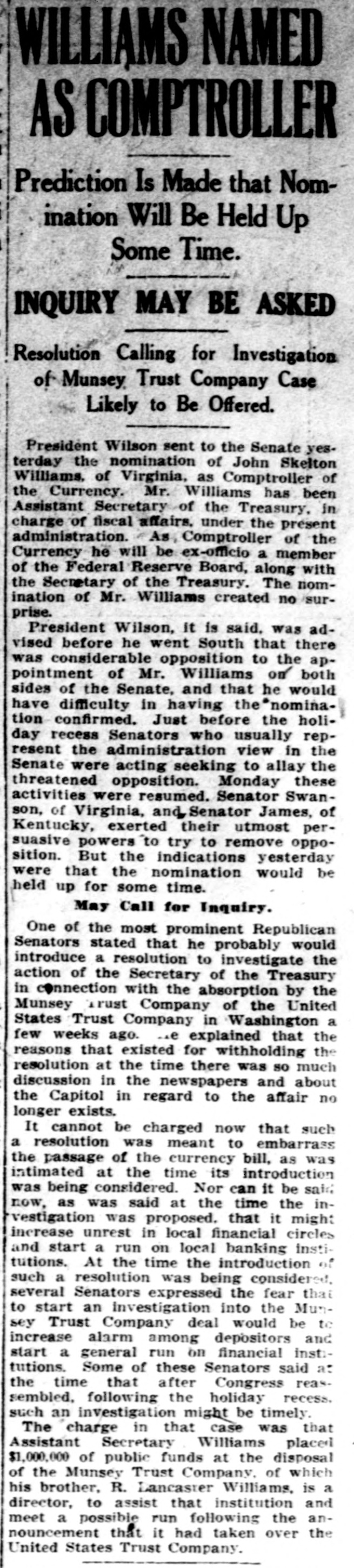
WILLIAMS NAMED AS COMPTROLLER Prediction Is Made that Nomination Will Be Held Up Some Time. INQUIRY MAY BE ASKED Resolution Calling for Investigation of Munsey Trust Company Case Likely to Be Offered. President Wilson sent to the Senate yesterday the nomination of John Skelton Williams. of Virginia, as Comptroller of the Currency. Mr. Williams has been Assistant Secretary of the Treasury, in charge of fiscal affairs. under the present administration. As, Comptroller of the Currency he will be ex-officio a member of the Federal Reserve Board, along with the Secretary of the Treasury. The nomination of Mr. Williams created no surprise. President Wilson, it is said, was advised before he went South that there was considerable opposition to the appointment of Mr. Williams on both sides of the Senate, and that he would have difficulty in having the "nomination confirmed. Just before the holiday recess Senators who usually represent the administration view in the Senate were acting seeking to allay the threatened opposition. Monday these activities were resumed. Senator Swanson, of Virginia, and Senator James, of Kentucky, exerted their utmost persuasive powers to try to remove opposition. But the indications yesterday were that the nomination would be held up for some time. May Call for Inquiry. One of the most prominent Republican Senators stated that he probably would introduce a resolution to investigate the action of the Secretary of the Treasury in connection with the absorption by the Munsey Trust Company of the United States Trust Company in Washington a few weeks ago. -.e explained that the reasons that existed for withholding the resolution at the time there was so much discussion in the newspapers and about the Capitol in regard to the affair no longer exists. It cannot be charged now that such a resolution was meant to embarrass the passage of the currency bill, as was intimated at the time its introduction was being considered. Nor can it be sair; now, as was said at the time the investigation was proposed. that it might increase unrest in local financial circles and start a run on local banking Institutions. At the time the introduction of such a resolution was being considered, several Senators expressed the fear that to start an investigation into the Munsey Trust Company deal would be to increase alarm among depositors and start a general run on financial inst:tutions. Some of these Senators said a: the time that after Congress reassembled, following the holiday recess. such an investigation might be timely. The charge in that case was that Assistant Secretary Williams placed $1,000,000 of public funds at the disposal of the Munsey Trust Company, of which his brother, R. Lancaster Williams, is a director, to assist that institution and meet a possible run following the announcement that it had taken over the United States Trust Company.


Article from The Sun, January 14, 1914

Click image to open full size in new tab

Article Text

President Throws Down Gauntlet to Senate in Selecting Comptroller. LONG FIGHT PREDICTED Investigation Is Likely Into Charge of Favoritism to Munsey Trust Co. WASHINGTON, Jan. 13.-President Wilson sent to the Senate to-day the nomination of John Skelton Williams of Virginia to be Comptroller of the Currency. Mr. Williams is Assistant Secretary of the Treasury in charge of fiscal affairs. As Comptroller of the Currency he would be ex officio a member of the Federal Reserve Board with the Secretary of the Treasury. The nomination of Mr. Williams created no surprise. It has been known for several months that he was bending every effort to get the appointment. It can be said on authority that Pres!dent Wilson was reluctant to name Mr. Williams for Comptroller, but that Secretary McAdoo was insistent. The appointment may be ascribed solely to the influence of Secretary McAdoo, for Mr. Willlams was without influential, political or financial indorsement. Has Been Active Lately. Several months ago, after Lawrence O. Murray resigned, and Thomas P. Kane, Deputy Comptroller, became acting Comptroller. Assistant Secretary Williams practically assumed control of the office. He participated actively in the work of closing the First-Second National Bank of Pittsburg and also gave directions respecting the personnel of the Comptroller's office. He was primarily responsible for the order which excluded from the offices a young woman who had been employed for years by the National City Bank of New York to get and forward information to the bank. For years the Secretary of the Treasury had permitted this young woman to have a desk in one corner of a room as a matter of convenience in her work. The same courtesy had been extended to representatives of the press, various bond concerns and compilers of material for bankers' publications and other financial publications. Assistant Secretary Williams took the view that the National City Bank enjoyed a privilege over other financial institutions and ejected the young woman. Appointment Once Denied. About the time these activities of Mr. Williams were at their height information came to the Washington correspondent of THE SUN that Assistant Secretary Williams expected to be appointed Comp. troller and that the President had purposely refrained from filling the office Immediately following the resignation of Comptroller Murray until after the currency bill was passed and the salary of the office increased. This news created considerable interest in Washington and Secretary McAdoo called in the newspaper correspondents and denied explicitly that n Williams. there was any intention of appointing Mr. In sending to the Senate the name of Mr. Williams to be Comptroller President Wilson has thrown down the gauntlet to the Senate. He was advised before he went South that there was opposition to the appointment and that he would have difficulty in having the nomination confirmed. Just before the holiday recess Senators who usually represent the Administration view in the Senate were active in seeking to allay the threatened opposition. Yesterday these activities were resumed Senator Swanson of Virginia and Senator James of Kentucky exerted their utmost persuasive powers to try to remove opposition, but the indications are that the nomination will be held up for some time. One of the most prominent Republican Senators said to-day that he probably would introduce a resolution to investigate the action of the Secretary of the Treasury in connection with the absorption by the Munsey Trust Company of the United States Trust Company in Washington a few weeks ago. He explained that the reasons for withholding the resolution when there was 80 much discussion in the newspapers in regard to the affair no longer existed. Charge of Favoritism At that time several Senators expressed the fear that to start an investigation would be to increase atarm among depositors and start general run on finang cial institutions The charge in the Munsey case was that Assistant Secretary Williams placed $1,000,000 of public funds at the disposal of the Munsey Trust Company. of which his brother, R. Lancaster Williams, is a director, to assist that institution and meet a possible run follow. ing the announcement that it had taken over the United States Trust Company Various official statements put out the Treasury Department at the from time eulogizing Frank A. Munsey and referring to the financial strength of his trust comed pany were looked on by local bankers as F favoritism to one Institution in which a brother of the Assistant Secretary of the Treasury was an active agency and at the same time reflected unjustly on other local banking institutions Enlogy in Munsey's Paper. The Washington Times published by Frank A. Munsey, printed a eulogy of John Skelton Williams this afternoon in which a lot of personal information as ge to Mr Williams's early successes in financial affairs is given with a wealth of detail that indicates the writer had access to family records 61 Mr. Williams is portrayed as a young St. George of finance wrestling with the Wall Street dragon over railroad control in the South The article narrates personal interviews between Mr. Williams in and President Cassatt of the Pennsylvania Railroad and tells of encounters between Mr. Williams and Thomas F. Ryan and J. P. Morgan. in all of which Mr. Williams gets credit for clever work This article intimates that Wall Street he is still cherishing resentment against Mr to Williams and that the fight in the Senate is really to be a contest between financial interests in New York and the man who has been fighting Wall Street for


Article from The Richmond Virginian, January 14, 1914

Click image to open full size in new tab

Article Text

WILSON APPOINTS WILLIAMS DESPITE INSIDIOUS ATTACKS Throws Down the Gauntlet to Enemies of Virginian in Senate and Names Comptroller of Currency. Nomination Creates No Surprise, and Opposition is Not as Outspoken as Formerly. Swanson and James are Active. WASHINGTON, Jan. 13.-President Wilson sent to the senate today the name of John Skelton Williams, of Virginia, to be comptroller of the currency. Mr. Williams is at present assistant secretary of the treasury in charge of fiscal affairs under the present administration. As comptroller of the currency he will be ex officio a member of the federal reserve board along with the secretary of the treasury. The nomination of Mr. Williams created no surprise. For several months it has been known in Washington that he would secure the appointment. His greatest asset was the friendship of Secretary McAdoo. Williams to Charge. Several months ago, after Lawrence O. Murray resigned from the office and Thomas P. Kane, deputy comptroller, became acting comptroller. Assistant Secretary Williams was given practical control of the office of comptroller. He participated actively in the work of closing the First-Second National Bank of Pittsburg, and also gave directions respecting the personnel of the comptroller's officers. He was responsible for the order which excluded from the comptroller's office of a young woman clerk who had been employed for years by the National City Bank of New York to obtain and forward information to the bank after it had been received at the comptroller's office, and It was changed before is was available for public se. In sending to the senate the name of Mr. Williams to be comptroller, President Wilson has thrown down the gauntlet to the senate. He was advised before the went south that there was opposition to the appointment and that he would have difficulty in having the nomination confirmed. Just before the holiday recess senators who usually represent the administration view in the senate were actively seeking to allay the threatened opposition. Yesterday these activities were resumed. Senator Swanson, of Virginia, and Senator James. of Kentucky, exerted their utmost persuasive powers to try to remove opposition with some effect. Investigate Merger. One of the most prominent Republican senators stated today that he would probably introduce a resoltion to investigate-the action of the secretary of the treasury in connection with the absorption by the Munsey Trust company of the United States Trust company in Washington a few weeks ago. He explained that the reasons existed for withholding the resolution at the time there was so much discussion in the newspapers in regard to the affair. no longer exists. At the time the introduction of such a resolution was being considered. severab senators expressed the fear that to start an investigation into the Munsey Trust company deal would be to increase alarm among depositors and start a run on financial Institutions The charge In the Munsey case, made by a Republican newspaper. was that Assistant Secretary Williams placed one million dollars of public funds at the disposal of the Munsey Trust company, of which his brother, R. Lancaster Williams, is a director, to assist that institution and meet a possible run following the announcement that It had taken over the United States Trust company.


Article from Daily Kennebec Journal, January 20, 1914

Click image to open full size in new tab

Article Text

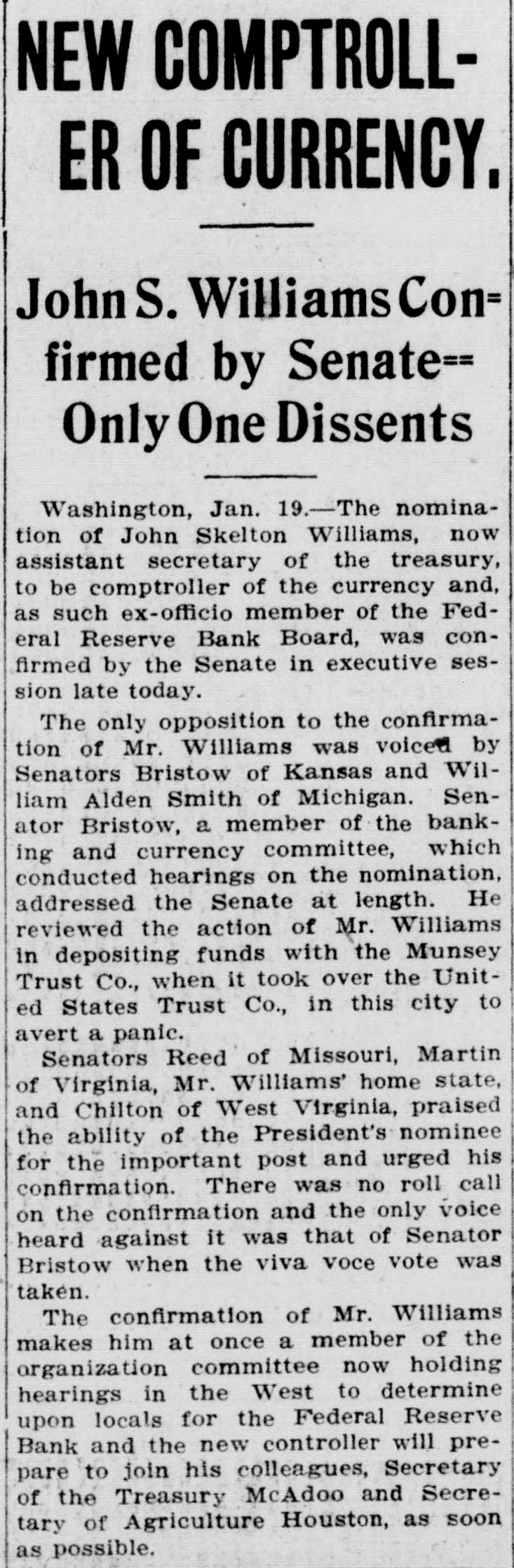
NEW COMPTROLLER OF CURRENCY. JohnS. Williams Con= firmed by Senate== Only One Dissents Washington, Jan. 19.-The nomination of John Skelton Williams, now assistant secretary of the treasury, to be comptroller of the currency and, as such ex-officio member of the Federal Reserve Bank Board, was confirmed by the Senate in executive session late today. The only opposition to the confirmation of Mr. Williams was voiced by Senators Bristow of Kansas and William Alden Smith of Michigan. Senator Bristow, a member of the banking and currency committee, which conducted hearings on the nomination, addressed the Senate at length. He reviewed the action of Mr. Williams in depositing funds with the Munsey Trust Co., when it took over the United States Trust Co., in this city to avert a panic. Senators Reed of Missouri, Martin of Virginia, Mr. Williams' home state, and Chilton of West Virginia, praised the ability of the President's nominee for the important post and urged his confirmation. There was no roll call on the confirmation and the only voice heard against it was that of Senator Bristow when the viva voce vote was taken. The confirmation of Mr. Williams makes him at once a member of the organization committee now holding hearings in the West to determine upon locals for the Federal Reserve Bank and the new controller will prepare to join his colleagues, Secretary of the Treasury McAdoo and Secretary of Agriculture Houston, as soon as possible.


Article from The Manchester Journal, January 22, 1914

Click image to open full size in new tab

Article Text

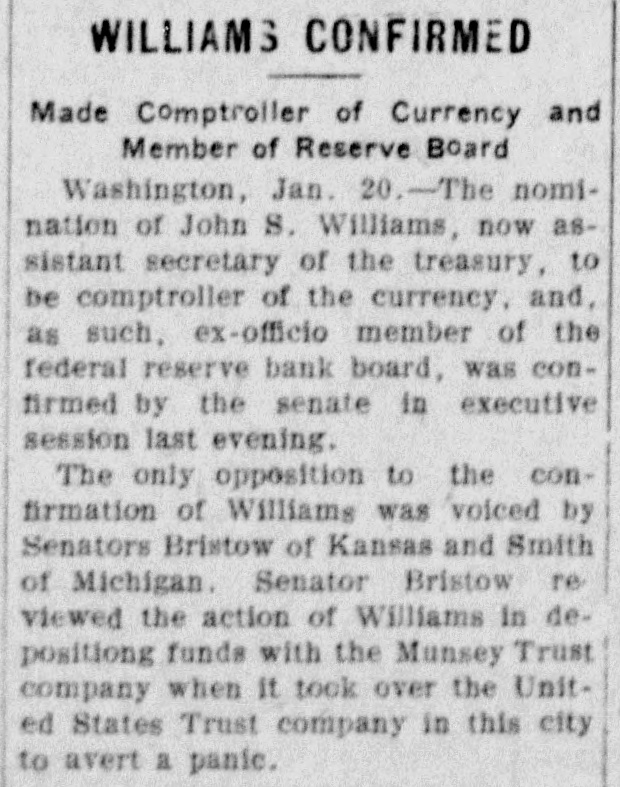
WILLIAMS CONFIRMED Made Comptroller of Currency and Member of Reserve Board Washington, Jan. 20.-The nomination of John S. Williams, now assistant secretary of the treasury, to be comptroller of the currency, and, as such, ex-officio member of the federal reserve bank board, was confirmed by the senate in executive session last evening. The only opposition to the confirmation of Williams was voiced by Senators Bristow of Kansas and Smith of Michigan. Senator Bristow reviewed the action of Williams in depositiong funds with the Munsey Trust company when It took over the United States Trust company in this city to avert a panic.


Article from The Washington Herald, October 8, 1914

Click image to open full size in new tab

Article Text

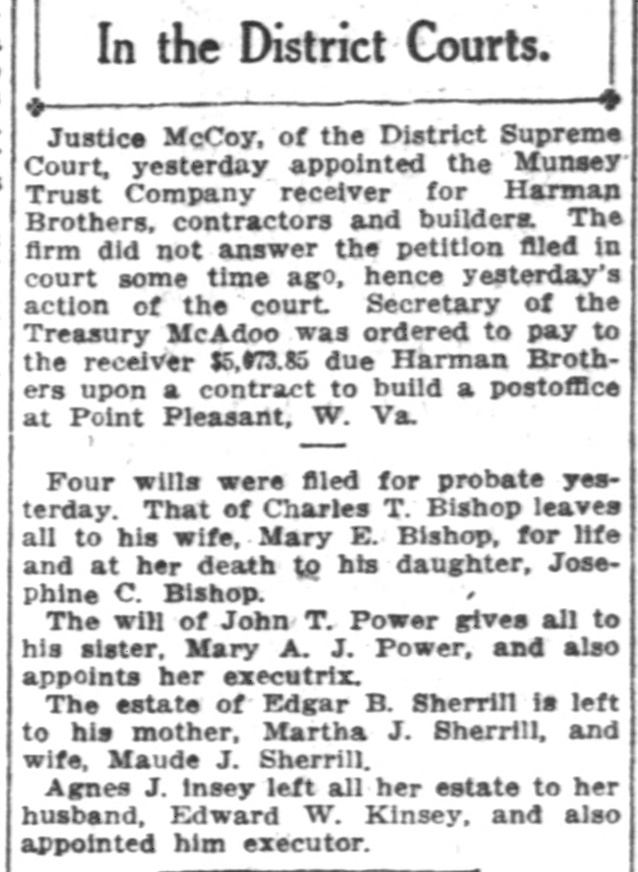
In the District Courts. Justice McCoy, of the District Supreme Court, yesterday appointed the Munsey Trust Company receiver for Harman Brothers, contractors and builders. The firm did not answer the petition filed in court some time ago, hence yesterday's action of the court. Secretary of the Treasury McAdoo was ordered to pay to the receiver $5,073.85 due Harman Brothers upon a contract to build a postoffice at Point Pleasant, W. Va. Four wills were filed for probate yesterday. That of Charles T. Bishop leaves all to his wife, Mary E. Bishop, for life and at her death to his daughter, Josephine C. Bishop. The will of John T. Power gives all to his sister, Mary A. J. Power, and also appoints her executrix. The estate of Edgar B. Sherrill is left to his mother, Martha J. Sherrill, and wife, Maude J. Sherrill, Agnes J. insey left all her estate to her husband, Edward W. Kinsey, and also appointed him executor.


Article from New-York Tribune, December 30, 1914

Click image to open full size in new tab

Article Text

John Skelton Williams Says Absorption of U. S. Trust Saved Banks. VIEW OF CASE GIVEN IN ANNUAL REPORT New York Interests Instigated Attack on Deal, Currency Controller Contends. [From The Tribune Bureau.] Washington, Dec. 29.-John Skelton Williams, Controller of the Currency, exonerates himself from all blame and gives the Munsey Trust Company a clean bill of health in connection with the absorption of the United States Trust Company, of Washington, in his annual report, submitted to Congress to-day Mr. Williams devotes several pages of his report to a history of this transaction, the circumstances of which were disclosed by The Tribune at the time. He says that what he characterizes as a newspaper attack "had been instigated and promoted by individuals connected with a local national bank which was affiliated with a banking interest in New York City." "The $1,000,000," he adds, "deposited by the government with the national banks in Washington, and by them deposited with the Munsey Trust Company to assist im averting the bank failures, was duly returned." The Munsey Trust Company was reimbursed for "all moneys which it had advanced to the United States Trust Company," and, according to Mr. Williams, the transaction has been closed with credit to himself, the Treasury Department and the Munsey Trust Company. In support of these conclusions Mr. Williams quotes verbatim statements issued by the Secretary of the Treasury denying various reports made at the time of the absorption of the United States Trust Company by the Munsey Trust Company. "The announcement was made in the newspapers on the morning of November 22, 1913," Mr. Williams says, "that the deposits of the United States Trust Company were thus assured allayed the threatened panic and restored confidence in the banking community. About ten days later, on December 3, 1913, a New York newspaper hostile to the administration made an attack upon the Treasury Department and its officials for the part which the government had taken-and which had been in strictly within the law in its effort to avert the disaster which, had it not I been prevented, would surely have brought much suffering and loss to more than fifty thousand depositors of 4 the United States Trust Company as well as to other local interests, and 4 which would probably have been farreaching in its evil results. is "Information which reached the deet partment indicated that this newspaper attack had been instigated and promoted by individuals connected with a local national bank which was affiliated with a banking interest in S New York City, also hostile to the present administration, and which interest, under previous administrations, had enjoyed special favors and privileges from the government, particu= larly in connection with the Treasury Department, as existing records abunJ dantly show. $ "The publication by the New York 0 newspaper referred to of false and misleading statements in connection 11 with the transaction, by which bank failures had been averted and confii dence restored in the community, conu tinued for several weeks, but subsided 7 with the publication of the report of the Senate committee. The President's o nomination for Controller of the Currency of the Assistant Secretary of the Treasury, who had taken part of a ficially in preventing the threatened I failures in Washington, and who had been the special object of attack by a the newspaper and banking interests = referred to, was confirmed by the a United States Senate on January 19, 1914. with but one dissenting vote. a "The $1,000,000 deposited by the government with the national banks in a Washington and by them deposited with the Munsey Trust Company to as sist in averting the bank failures was duly returned to the government, with a. interest at the rate of 2 per cent Feb. per


Article from Evening Star, February 20, 1915

Click image to open full size in new tab

Article Text

THE COURTS. District Supreme Court. EQUITY DIVISION 1-Justice McCoy. Hutchinson agt. Munsey Trust Company; order to deposit certificate of stock in registry: plaintiff's attorneys, Hamilton. Yerkes & Hamilton: defend ant's attorneys, C. C. Tucker, Leon Tobriner and H. P. Gatley. National Surety Company agt. Wise: order appointing Munsey Trust Company as receiver: plaintiff's attorney. B. E. Hinton Dante agt. Hutchins: report of guardian referred to auditor: plaintiff's attorneys, Brandenburg & Brandenburg: defendant's attorneys, W. G. Johnson, R. Ross Perry and E. H. Thomas. Bulman agt. Bulman: order for counsel fee and costs; plaintiff's attorney, J. A. Moriarty; defendant's attorney, A. E. Steinem. DeNicola agt. DeNicola: decree dismissing cause: plaintiff's attorneys, C. E. Nicol, W J. Lambert and R. H. Yeatman: defendant's attorneys, F. A. Fenning and Spencer Gordon. Sharpe agt. Pape; reference to auditor: plaintiff's attorney, W. K. Quinter: defendant's attorney, M. H. Beach. EQUITY DIVISION 2-Justice Siddons Hufty agt. Lynham: motion to amend bill granted plaintiff's attorney. Edmund Burke: defendant's attorney, George E. Sullivan. Almy agt. Almy sale decreed and A. C. Almy appointed trustee bond, $8,000: plaintiff's attorney, R. A. Ford Washington Loan and Trust Company agt. Randle et al.: sale ratified; plaintiff's attorney. J B. Larner: defendant's attorney. W. C. Woodward Thompson agt. Thompson: rule as to alimony returnable February 26; plaintiff's attorney. George A. Berry. Friedling agt. Friedling (two cases) rules returnable February 23 plaintiff's R A and Leanbert T M attorneys Whippler. Hill agt. Hill: counsel fee and arrears of alimony ordered paid: plaintiff's attorney, Edmund Brady: defendant's attorneys S. Comas Hawken and George A Havell Washington Steel and Ordnance Company agt. Martin: order striking out certain paragraph of bill: plaintiff's attorneys, Gittings & Chamberlin: defendant's attorney, H. H. Glassie Cullen agt. Cullen: order for arrears of alimony: plaintiff's attorneys, E. L. Gles and Michael C. O'Brien: defendant's attorneys, Gibbs L. Baker and S. F Taliaferro Deck agt. Deck: proof ordered taken before Nellie Corrigan, examiner; plaintiff's attorney. George A. Maddox; defendant's atterneys, Leo P. Harlow A Charles pue CIRCUIT DIVISION 1-Justice Gould. Van Senden agt. Hazen et al.: mandate of Court of Appeals presented: judgment for costs against plaintiff: plaintiff's attorney. Charles Poe: defendants' attorney, George E. Sullivan. Kline agt. Melton-Rhodes Company: motion for judgment overruled; plaintiff's attorneys, Tucker. Kenyon & Macfarland, Faber: defendant's attorneys, Rhodes, Cromelin, Maupin. Roth agt. Love: motion to place cause on trial calendar granted, to be placed at end: plaintiff's attorneys, Carmody, Mather: defendant's attorney, A. L. Newmyer. Billings-Chapin Company agt. Bowdler et al.; motion for judgment for insufficient amended affidavit overruled: motion to strike out amended notice of recoupment overruled: plaintiff's attorney. H. Winship Wheatley; defendants' attorneys, M. N. Richardson and HID Franklin National Bank agt. Thompson: motion to withdraw second count of declaration granted: motion to strike out second plea of defendant granted: motion of plaintiff for judgment denied, with leave to file a substituted affidavit of merit within ten days; plaintiff's at torneys, S. McComas, Hawken. George F. Havell and John Ridout: defendant's attorneys, H. E. Davis and J B. Larner Washington Railway and Electric Company agt. Washington Terminal Company et al.; motion of plaintiff for new trial overruled and judgment on verdict for defendant Washington Terminal Company for costs: appeal noted: bond, $100, or deposit; plaintiff's at. torneys. J. J. Darlington and W C. Sullivan: defendant's attorneys, Ham ilton, Yerkes & Hamilton Washington Railway and Electric Company agt. Philadelphia, Baltimore and Washington Railroad Company motion for new trial overruled and judgment on verdict for plaintiff for $4,067.17 appeal by plaintiff in open court: bond, $100, or deposit; plaintiff's attorneys, J. Darlington and W C. Sullivan: defendant's attorneys, McKenney. Flannery & Hitz. Colbert agt. McQuigg: demurrer to replication to second plea sustained with leave to amend said replication within ten days: motion to dismiss cause denied. with leave to file replication within ten days: plaintiff's attorney, J. H. Adriaans: defendant's attorney. D. W. O'Donoghue Wiedle agt. Fuller: motion to quash certiorari overruled: plaintiff's attorneys. Darr, Peyser & Koenigsberger: defendant's attorney, E. S. Duvall, jr. CIRCUIT DIVISION 2-Justice Stafford. Ransom & Co. agt. Rosenthal: security for costs ordered in ten days, with leave to deposit $50: plaintiff's attorney, George C. Gertman: defendant's attorney. Louis Ottenberg. Munn agt. Strasburger: security for costs ordered in ten days, with leave to deposit $50: plaintiff's attorney, Nelson Wilson: defendant's attorneys, Darr, Pevser & Koenigsberger. Clark agt. Washington Railway and Electric Company: plaintiff guaranteed leave to amend declaration forthwith: plaintiff's attorneys. Whitford & Lambert: defendant's attorney. George P. Hoover Forbes agt. Graham: motion for new trial overruled: judgment on verdict for plaintiff for $700: appeal noted: supersedeas bond. $1,200: plaintiff's attorney. G. L. Whitford: defendant's attorney, R. M Hudson Starr agt. Biggs: defendant granted leave to file substituted affidavit of defense within four days and motion for judgment continued: plaintiff's attorneys. Brandenburg & Brandenburg: defendant attorney. W. W. Biggs Spence agt. Adams Express Company: motion to quash service overruled: plaintiff's attorneys, Turnage Ahalt & Quinn: defendant's attorneys, Alexander Wolf and G. W. Offutt. Smolik
Article from New-York Tribune, April 13, 1915

Click image to open full size in new tab

Article Text

ment of its resources, and Richard W. Goodhart, the examiner, had recommended that the institution either go into bankruptcy or be taken in charge by the Controller of the Currency. The acting Controller, T. P. Kane, indorsed this view, and on November 18, 1913, he called a meeting of Washington bankers to discuss the situation. Instead of closing the bank, they arranged to take over its assets and to guarantee the depositors against loss. On the following morning, however, Mr. Williams overruled the report of the examiner and the action of the Controller and allowed the bank to continue operating. Knoweldge of affairs soon leaked out, and on November 21 a run on the bank developed. Another meeting of bankers was hastily summoned at 1 o'clock a. m., after it had been announced that the Munsey Trust Company had taken over the assets of the United States Trust Company and would guarantee depositors. To tide over the situation the bankers were informed that the United State Treasury would advance $1,00,000, secured by the eleven national banks of the District, to be deposited with the Munsey Trust Company, and that Mr. Munsey would deposit $500.000. Mr. Munsey subsequently repudiated this part of the agreement. Thus, as a result of the operations, the six months old Munsey Trust Company, with a capital of scarcely $400,000, on the strength of the government's million and without the expenditure of a single dollar secured the assets and good will of the United States Trust Company, valued at between $4,000,000 and $5,000,000. When the transaction was first disclosed in The Tribune there was an immediate and insistent demand for an investigation, but owing to strong pressure from the administration Congress took no action on the matter.


Article from Evening Star, February 26, 1921

Click image to open full size in new tab

Article Text

By virtue of a decree of the Supreme Court of the District of Columbia, Equity No. 38137. the undersigned receiver will offer for sale at public auction in front of the respective prem ises on MONDAY. THE TWENTY-EGHTH DAY OF FEBRUARY. 1921, COMMENCING AT THREE-THIRTY O'CLOCK P.M., all of lot 18 and the west 10 feet front on U st. n.w., by the full depth thereof of lot 17, in square 189. improved by a three-story modern laboratory and office building, No. 1513 U st. n.w., equipped for the production of biologies, including laboratory equipment, good will, trade rights, designs, formulae, outstanding contracts, office furniture, vaccine, antitoxius and miscellaneous assets, to be offered either as a whole or in separate parts, subject to the approval of the court. IMMEDIATELY THEREAFTER, Lot 16 and the east 10 feet front on U st. n.w., by depth of lot 17, in square 189, unimproved, adjoining the above parcel on the east. IMMEDIATELY THEREAFTER, Lot 15, in square 189, together with improvements, consisting of a three-story brick residence, No. 1509 U st. n.w., subject to an incombrance of $3,800. Terms and further information will be furnished upon application to the undersigned receiver. THE MUNSEY TRUST COMPANY, Receiver. By C. H. POPE. Vice President. fe25,26,27 Washington, D. C.