Click image to open full size in new tab
Article Text
COURT DECLARES
POTOMAC SAVINGS
LIABILITY LIMITED
Chartered in Virginia, So Double Assessment on Stock Fails.
DISSENTING OPINION
PRESENTED BY HITZ
Decision Opens Way to 48 Different Standards, He Declares.
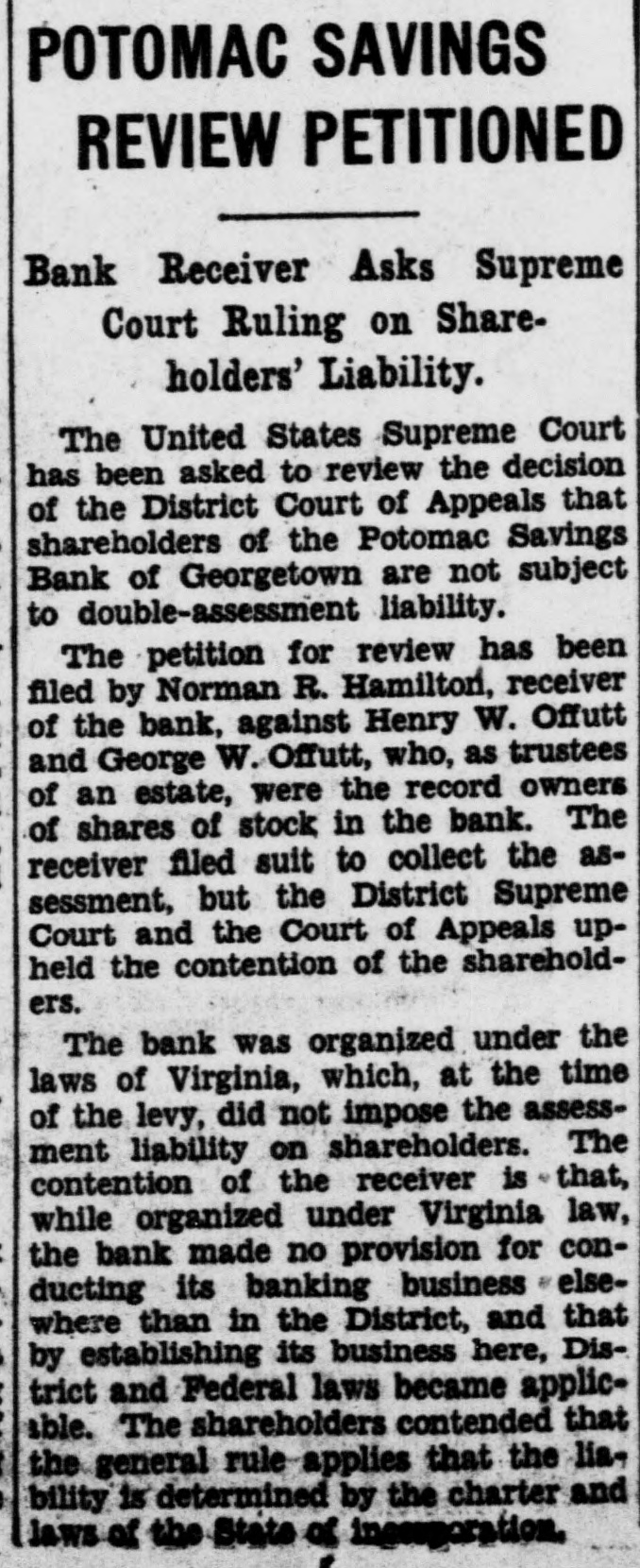
Stockholders in the Potomac Savings Bank were held not liable to double assessment under the District laws by the United States Court of Appeals today in an opinion described by Associate Justice Hitz, who dissented, as demonstrating "that a foreign charter for a local bank is a source of danger in the community."
The majority opinion, written by Associate Justice Groner, affirmed a decision by the District Supreme Court in a suit brought by Norman R. Hamilton, the bank's receiver, to collect a double assessment on 2,044 shares of stock in the estate of the late George W. Offutt.
The bank was incorporated in Virginia, whose laws do not provide for a double assessment, and Attorneys Charles V. Imlay and Ross H. Snyder, representing the trustees of the estate, contended this fact relieved the stockholders of such an assessment, even though the bank did business exclusively in the District.
Controller Can Take Charge.
It was pointed out the District Code authorizes the controller of the currency, in event of insolvency, to take possession of any bank doing business in Washington. From this it was argued that the laws of the United States, providing for a double assessment in certain cases, should be extended to cover a bank incorporated in Virginia and doing business here.
In refusing to accept this view, the majority opinion pointed out it is fundamental that the liability of a stockholder is determined by the charter of incorporation and the laws of the State in which it was incorporated. The court, therefore, held that since the Virginia law did not provide for a double assessment, the receiver could not enforce his claim against the Offutt estate.
In disagreeing, Justice Hitz said he thought the opinion proceeded upon a meager and narrow construction of statutory provisions to a conclusion contrary to their purpose and defeating their object.
D. C. Law Held Accepted.
"When this group of Washington business men brought their Virginia charter across the Potomac River and set up in the City of Washington the bank's only place of business, it necessarily accepted and adopted all provisions of local law governing local banks, including the acts of Congress intended in general terms to place banks created outside of the national banking system on the same footing as national banks doing business in the District of Columbia," he continued.
"I read these statutes as intending not only to give the national banking authorities certain powers of visitation and inspection, and to define how and why and when the controller may take control, but as imposing the same liabilities and regulations upon State banks as upon national banks doing business here, both in respect of report and condition, and in respect of protecting depositors and other creditors as against the owners of the bank by the same liability upon stockholders for the debts of the bank.
48 Kinds of Liability Seen.
"Under the judgment of the court in this case, 48 State banks engaged here in the same business at the same time could have 48 separate measures of liability of their stockholders to their creditors, all differing from each other and all differing from the liability of national banks in the same respect, yet all operating within the legislation of Congress intended to make such liability uniform and equal.
"While this construction of the statutes is legally possible, it is neither reasonable nor necessary, and I cannot accept the judgment as a sound conclusion, though recognizing its value as a demonstration that a foreign charter for a local bank is a source of danger in the community."