15000. Canal Bank (Cleveland, OH)

Bank Information

Episode Type
Run → Suspension → Closure
Bank Type
state
Start Date
November 14, 1854
Location
Cleveland, Ohio (41.499, -81.695)

Metadata

Model
gpt-5-mini
Short Digest
2d5b1e605cdc657f

Response Measures

None

Description

Contemporary newspapers report a run/duress on the Canal Bank of Cleveland in November 1854 during a wider banking panic; the bank suspended payment (depositors/time-draft holders affected) and was later in the hands of a receiver by 1860. Cause of the initial run is the regional banking panic (runs on other local banks / general money pressure) and legal actions against the bank. OCR errors in articles were corrected (e.g., 'Canal Bank of Cleveland' clearly referenced).

Events (3)

1. November 14, 1854 Run
Cause
Local Banks
Cause Details
Part of the widespread November 1854 banking panic—runs and failures in other Ohio and Western banks created depositor pressure and local legal actions (assignee/sheriff breaking into the safe) that precipitated agitation at the Canal Bank.
Measures
Legal contest over access to bank property (assignee / sheriff action); bank apparently restricted depositor withdrawals and faced heavy agitation.
Newspaper Excerpt
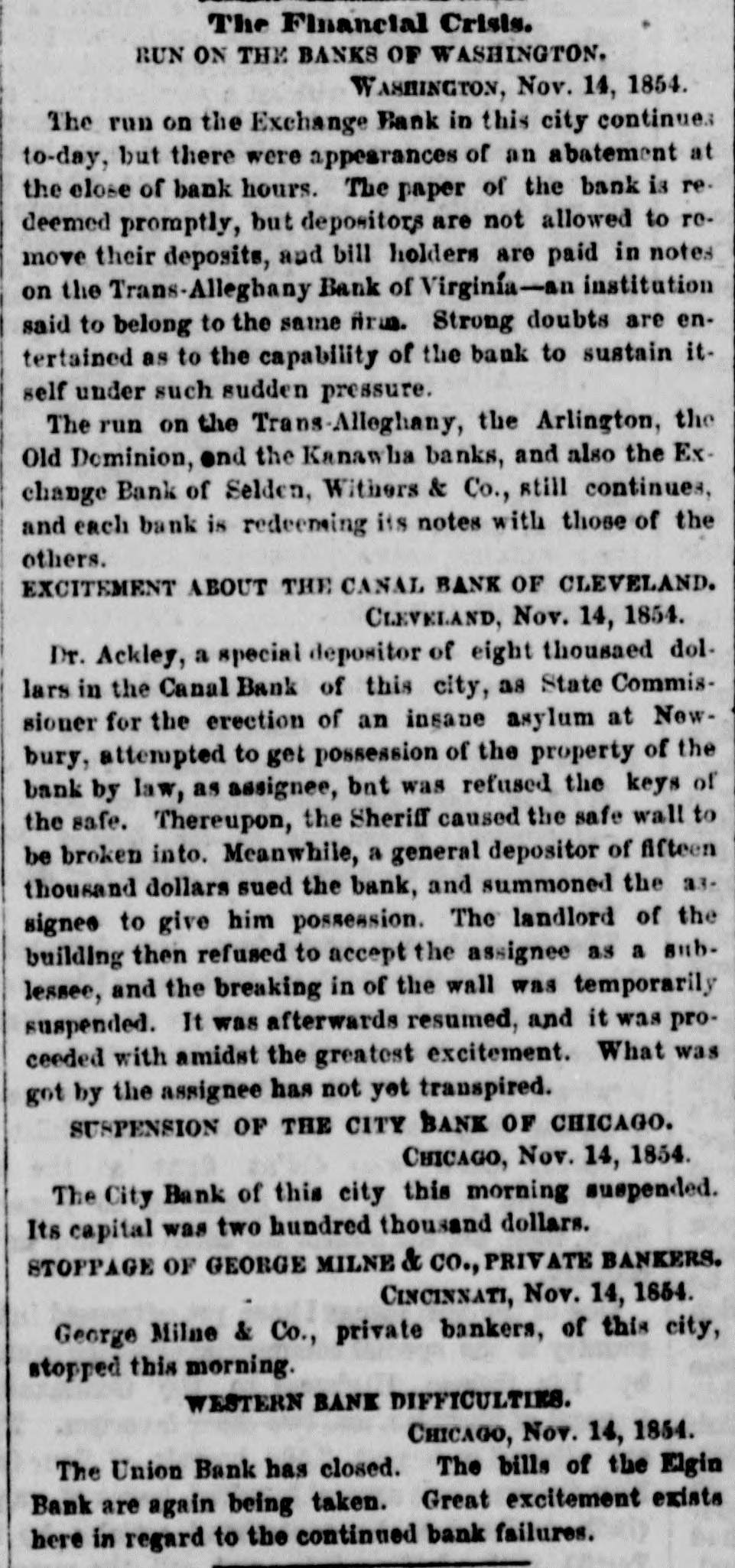
EXCITEMENT ABOUT THE CANAL BANK OF CLEVELAND... Dr. Ackley, a special depositor of eight thousand dollars ... attempted to get possession ... the Sheriff caused the safe wall to be broken into... proceeded with amidst the greatest excitement.
Source
newspapers
2. November 15, 1854 Suspension
Cause
Local Banks
Cause Details
Suspension occurred amid the regional banking panic and runs on multiple local banks; deposits and time-draft holders were not paid though noteholders were secured by state/US stock deposits (per contemporaneous reports).
Newspaper Excerpt
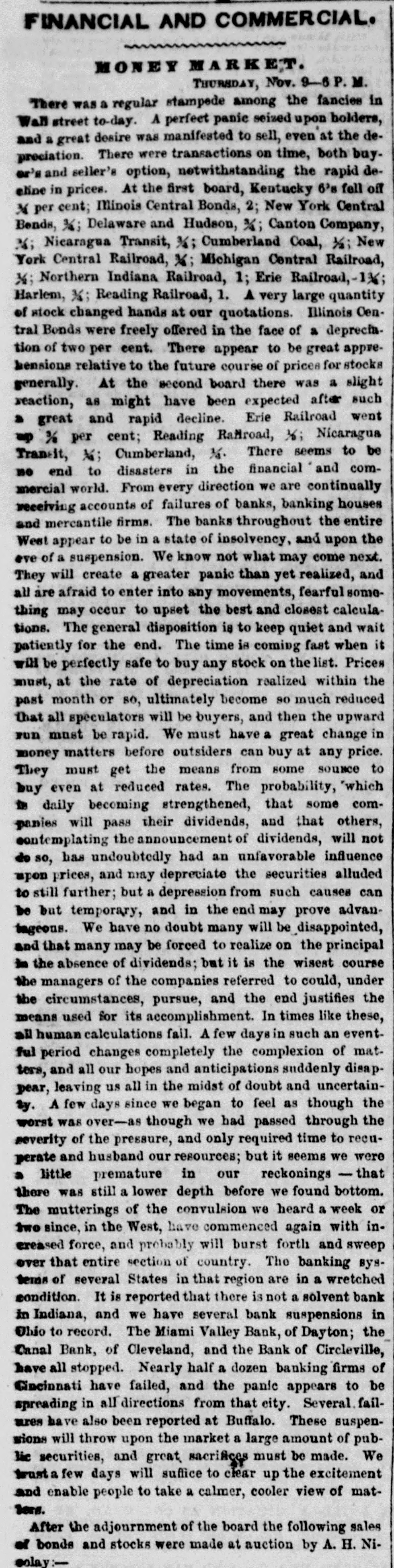
The Canal Bank, of Cleveland, and the Bank of Circleville, have all stopped. ... The Canal Bank of Cleveland have suspended payment so far as depositors and time draft holders are concerned, but the bill holders are secured by State and United States Stocks.
Source
newspapers
3. November 12, 1860 Receivership
Newspaper Excerpt
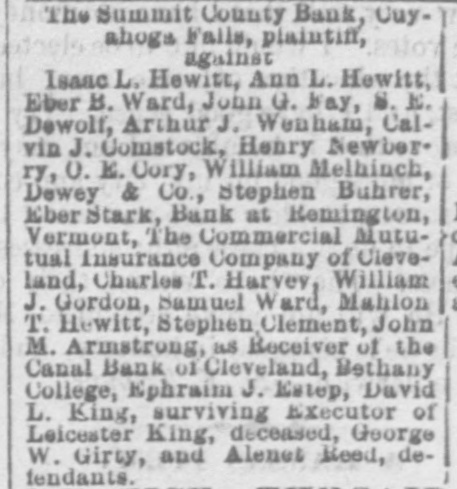
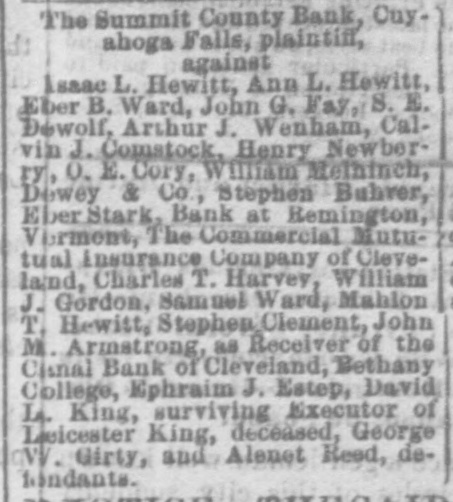
John M. Armstrong, as Receiver of the Canal Bank of Cleveland, ... defendants (suits naming the Receiver). (Cleveland Morning Leader, 1860).The Summit County Bank ... against ... John M. Armstrong, as Receiver of the Canal Bank of Cleveland (multiple notices Nov–Dec 1860).
Source
newspapers

Newspaper Articles (23)

Article from The New York Herald, November 10, 1854

Click image to open full size in new tab

Article Text

FINANCIAL AND COMMERCIAL. MONEY MARKET. THURSDAY, Nov. 9-6P.M. There was a regular stampede among the fancies in Wall street to-day. A perfect panie seized upon holders, and a great desire was manifested to sell, even at the depreciation. There were transactions on time, both buyor's and seller's option, netwithstanding the rapid deeline in prices. At the first board, Kentucky 6's fell off x per cent; Minois Central Bonds, 2; New York Central Bends, %; Delaware and Hudson, %; Canton Company, 36; Niearagua Transit, %; Cumberland Coal, ½; New York Central Railroad, X; Michigan Central Railroad, ½; Northern Indiana Railroad, 1; Erie Railroad,-1%; Harlem, %; Reading Railroad, 1. A very large quantity of stock changed hands at our quotations. Illinois Oentral Bonds were freely offered in the face of a depreciation of two per cent. There appear to be great apprebensions relative to the future course of prices for stocks generally. At the second board there was a slight reaction, as might have been expected after such a great and rapid decline. Erie Railroad went up % per cent; Reading Raflroad, ½; Nicaragua Transit, %; Cumberland, ½. There seems to be no end to disasters in the financial and commercial world. From every direction we are continually receiving accounts of failures of banks, banking houses and mercantile firms. The banks throughout the entire West appear to be in a state of insolvency, and upon the ave of a suspension. We know not what may come next. They will create a greater panic than yet realized, and all are afraid to enter into any movements, fearful something may occur to upset the best and closest calculations. The general disposition is to keep quiet and wait patiently for the end. The time is coming fast when it will be perfectly safe to buy any stock on the list. Prices must, at the rate of depreciation realized within the past month or so, ultimately become so much reduced that all speculators will be buyers, and then the upward run must be rapid. We must have a great change in money matters before outsiders can buy at any price. They must get the means from some source to buy even at reduced rates. The probability, "which to daily becoming strengthened, that some companies will pass their dividends, and that others, contemplating the announcement of dividends, will not do so, has undoubtedly had an unfavorable influence upon prices, and may depreciate the securities alluded to still further; but a depression from such causes can be but temporary, and in the end may prove advantageons. We have no doubt many will be disappointed, and that many may be forced to realize on the principal to the absence of dividends; but it is the wisest course the managers of the companies referred to could, under the circumstances, pursue, and the end justifies the means used for its accomplishment. In times like these, all human calculations fail. A few daysin such an eventful period changes completely the complexion of matters, and all our hopes and anticipations suddenly disappear, leaving us all in the midst of doubt and uncertainby. A few days since we began to feel as though the worst was over-as though we had passed through the severity of the pressure, and only required time to recuperate and husband our resources; but it seems we were a little premature in our reckonings - that there was still a lower depth before we found bottom. The mutterings of the convulsion we heard a week or two since, in the West, have commenced again with increased force, and probably will burst forth and sweep over that entire section of country. The banking systenan of several States in that region are in a wretched condition. It is reported that there is not a solvent bank in Indiana, and we have several bank suspensions in Ohio to record. The Miami Valley Bank, of Dayton; the Canal Bank, of Cleveland, and the Bank of Circleville, have all stopped. Nearly half a dozen banking firms of Cincinnati have failed, and the panic appears to be spreading in all directions from that city. Several. failares have also been reported at Buffalo. These suspensions will throw upon the market a large amount of public securities, and great sacrifices must be made. We trusta few days will suffice to clear up the excitement and enable people to take a calmer, cooler view of matSerm. After the adjournment of the board the following sales of bonds and stocks were made at auction by A. H. Nisolay:-

Article from The New York Herald, November 15, 1854

Click image to open full size in new tab

Article Text

The Financial Crisis. RUN ON THE BANKS OF WASHINGTON. WASHINGTON, Nov. 14, 1854. The run on the Exchange Bank in this city continue. to-day, but there were appearances of an abatement at the close of bank hours. The paper of the bank is re. deemed promptly, but depositors are not allowed to remove their deposits, and bill holders are paid in notes on the Trans-Alleghany Bank of Virginía-an institution said to belong to the same firm. Strong doubts are entertained as to the capability of the bank to sustain itself under such sudden pressure. The run on the Trans-Alleghany, the Arlington, the Old Deminion, and the Kanawha banks, and also the Exchange Bank of Selden, Withers & Co., still continues, and each bank is redeeming its notes with those of the others. EXCITEMENT ABOUT THE CANAL BANK OF CLEVELAND. CLEVELAND, Nov. 14, 1854. Dr. Ackley, a special depositor of eight thousaed dollars in the Canal Bank of this city, as State Commissioner for the erection of an insane asylum at Newbury, attempted to get possession of the property of the bank by law, as assignee, bnt was refused the keys of the safe. Thereupon, the Sheriff caused the safe wall to be broken into. Meanwhile, a general depositor of fifteen thousand dollars sued the bank, and summoned the 33signee to give him possession. The landlord of the building then refused to accept the assignee as a sublessee, and the breaking in of the wall was temporarily suspended. It was afterwards resumed, and it was proceeded with amidst the greatest excitement. What was got by the assignee has not yet transpired. SUSPENSION OF THE CITY BANK OF CHICAGO. CHICAGO, Nov. 14, 1854. The City Bank of this city this morning suspended. Its capital was two hundred thousand dollars. STOPPAGE OF GEORGE MILNE & co., PRIVATE BANKERS. CINCINNATI, Nov. 14, 1654. George Milne & Co., private bankers, of this city, stopped this morning. WESTERN BANK DIFFICULTIES. CHICAGO, Nov. 14, 1854. The Union Bank has closed. The bills of the Elgin Bank are again being taken. Great excitement exists here in regard to the continued bank failures.


Article from The Weekly Portage Sentinel, November 15, 1854

Click image to open full size in new tab

Article Text

The Bank Failures. Failures are the order of the day. A commercial crisis has come, which threatens to overthrow the would be "money Kings" of the country, and exhibit their affairs in a true but not very enviable light. Storms are said to purify the atmosphere, and it is to be hoped that the financiel storm now upon us will clear away the rubbish and show business men where and how they stand. The heavy failures which have recently occurred, have caused a feeling of insecurity throughout the whole country, and the people very justly begin to make an examination of their financial concerns. A month or two ago every day brought us news of Bank failures from New York, Michigan, Indiana, Kentucky and other States around us, 80 that some began to congratulate themselves, that our home institutions were better than foreign, (this may be the case; they are all bad enough;) but the recent news from Cincinnati, Dayton, Circleville, Columbus and Cleveland, is beginning to shake the confidence of the people in every thing, like banking institutions anywhere. First came the failure of Ellis & Sturges; about the same time, word was received that the Circleville Bank had 'gone by the board.' The next day the Miami Valley Bank "suspended payment." The day after, the Clin. ton bank of Columbus was said to be in a fainting condition, and last, but not least the Canal Bank at Cleveland has "given up the ghost" and robbed its depositors and time draft holders of one hundred and eighty thousand dollars! Beautiful institutions truly. If a poor man were to steal $35 to get food for his family, he would be deemed a felon and sent to the Penitentiary; but a Bank may receive thousands on deposite just on the eve of failure, suspend payment, defraud its credit. ors, out of their money and its directors and officers go unpunished! These are the same privileged institutions which are exempted from the payment of taxes, and as a consequenee are licensed to defraud and wrong the laboring classes without hinderance or restraint. The circulation of some of these Banks however, is secured by State or United States Stocks. Where this is the case the bill holders are secure. But the depositors of money with them, are without security and as a consequence lose the whole amount of their deposites. Below, we append a list of the only Banks in Ohio whose circulation is secured by State or United Statas Stocks deposited with the officers of State: Bank of Geauga; Canal Bank of Cleveland; City Bank of Cleveland; City Bank of Columbus; City Bank of Cincinnati; Commercial Bank of Cincinnati; Franklin Bank of Zanesville; Mahoning County Bank, Youngstown; Sandusky City Bank; Seneca County Bank, Tiffin; Western Reserve Bank, Warren; Bank of Commerce, Cleveland; Bank of Marion; Champaign County Bank, Urbana; Franklin Bank of Portage Co., Franklin; Forest City Bank, Cleveland; Iron Bank of Ironton; Merchants' Bank of Massillon; Miami Valley Bank of Dayton; Pickaway County Bank, Circleville; Springfield Bank; Stark County Bank, Canton; Union Bank, Sandusky City. 05 P. S. Since writing the above, news has reached us of the failure of the City Bank of Columbus, Farmers Joint Stock Bank, Buffalo; Wondbury Bank, Connecticut and Exchange Bank, Buffalo. So they go. We are a fast people.


Article from Staunton Spectator, November 15, 1854

Click image to open full size in new tab

Article Text

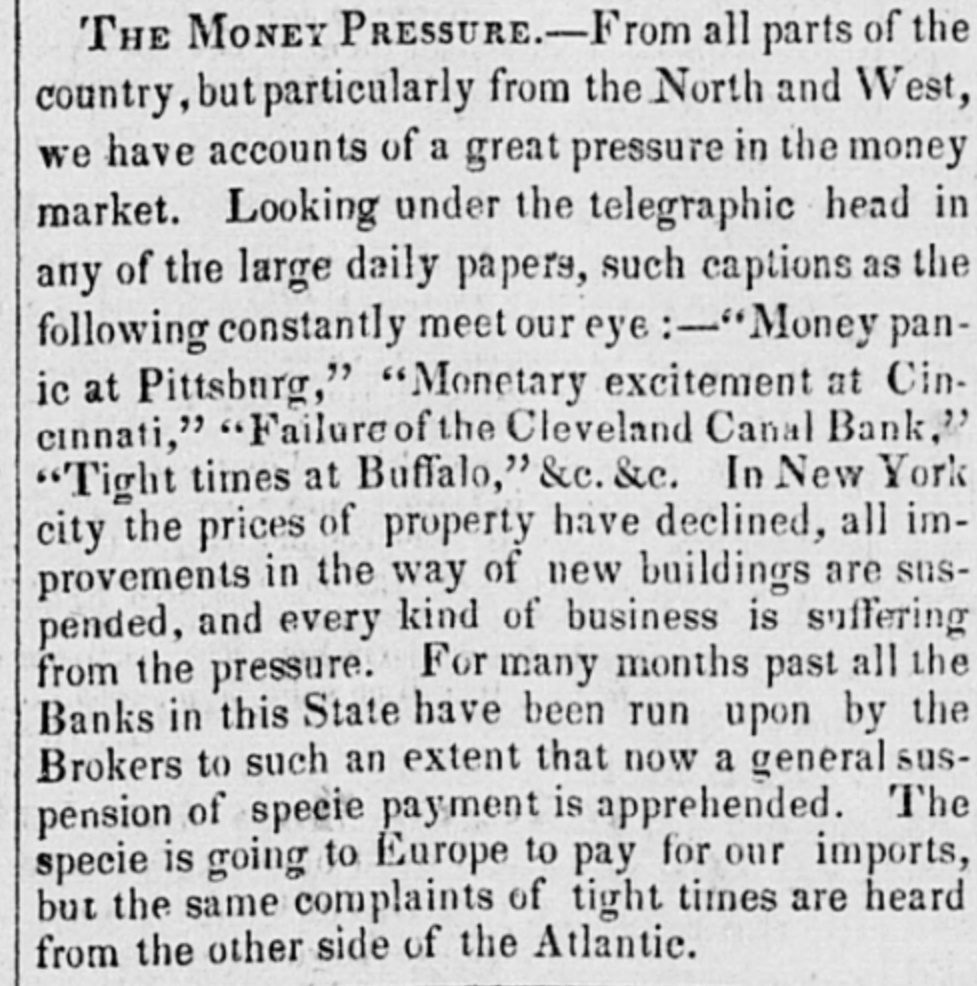
THE MONEY PRESSURE.-From all parts of the country, but particularly from the North and West, we have accounts of a great pressure in the money market. Looking under the telegraphic head in any of the large daily papers, such captions as the following constantly meet our eye :-"Money panic at Pittsburg," "Monetary excitement at Cineinnati," 'Failure of the Cleveland Canal Bank," "Tight times at Buffalo," &c. &c. In New York city the prices of property have declined, all improvements in the way of new buildings are suspended, and every kind of business is suffering from the pressure. For many months past all the Banks in this State have been run upon by the Brokers to such an extent that now a general suspension of specie payment is apprehended. The specie is going to Europe to pay for our imports, but the same complaints of tight times are heard from the other side of the Atlantic.


Article from Burlington Tri-Weekly Hawk-Eye, November 16, 1854

Click image to open full size in new tab

Article Text

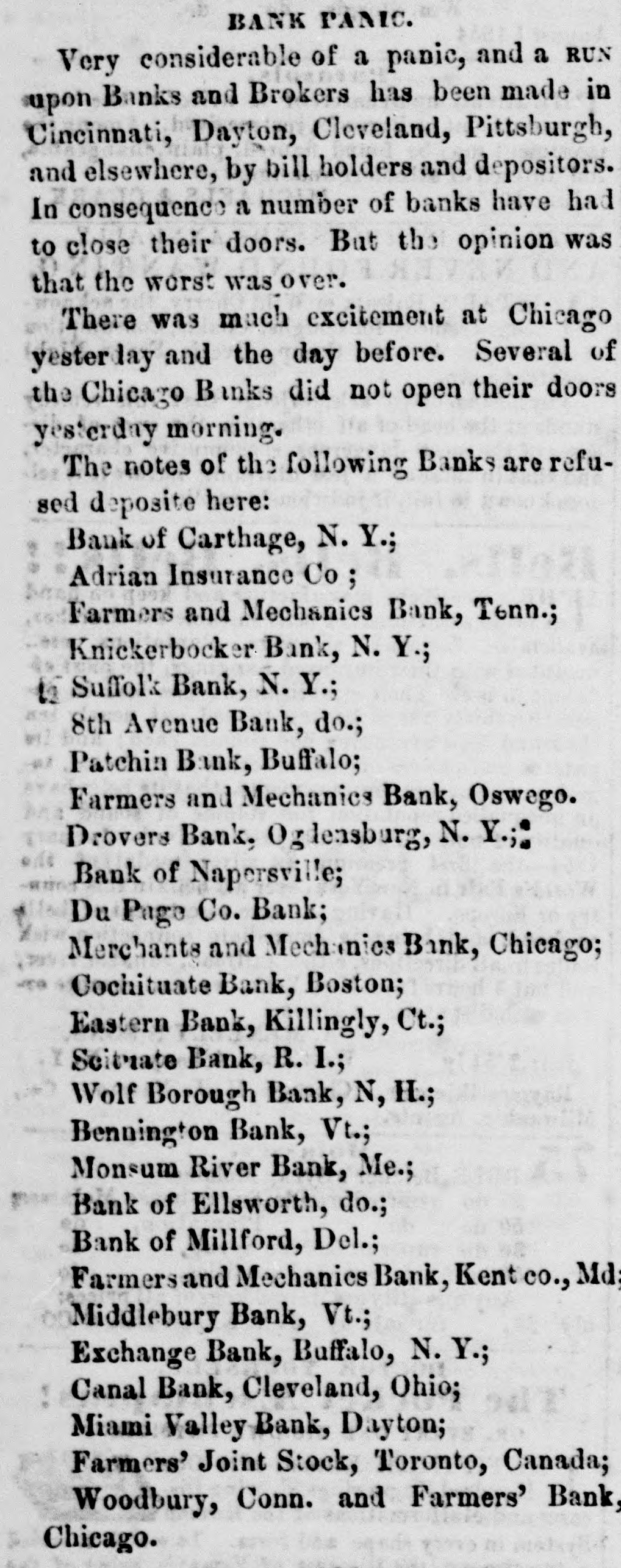
BANK PAMC. Very considerable of a panic, and a RUN upon Banks and Brokers has been made in Cincinnati, Dayton, Cleveland, Pittsburgh, and elsewhere, by bill holders and depositors. In consequence a number of banks have ha 1 to close their doors. But the opinion was that the worst was over. There was much excitement at Chicago yester day and the day before. Several of the Chicago B unks did not open their doors yesterday morning. The notes of the following Banks are refused deposite here: Bank of Carthage, N. Y.; Adrian Insurance Co ; Farmers and Mechanics Bank, Tenn.; Knickerbocker Bank, N. Y.; to Suffolk Bank, N. Y.; 8th Avenue Bank, do.; Patchin Bank, Buffalo; Farmers and Mechanics Bank, Oswego. Drovers Bank, Og lensburg, N. Y.;: Bank of Napersville; Du Page Co. Bank; Merchants and Mechanics Bank, Chicago; Cochituate Bank, Boston; Eastern Bank, Killingly, Ct.; Scituate Bank, R. I.; Wolf Borough Bank, N, H.; Bennington Bank, Vt.; Monsum River Bank, Me.; Bank of Ellsworth, do.; Bank of Millford, Del.; Farmersand Mechanics Bank, Kent co., Md; Middlebury Bank, Vt.; Exchange Bank, Buffalo, N. Y.; Canal Bank, Cleveland, Ohio; Miami Valley Bank, Dayton; Farmers' Joint Stock, Toronto, Canada; Woodbury, Conn. and Farmers' Bank, Chicago.


Article from Daily Davenport Gazette, November 17, 1854

Click image to open full size in new tab

Article Text

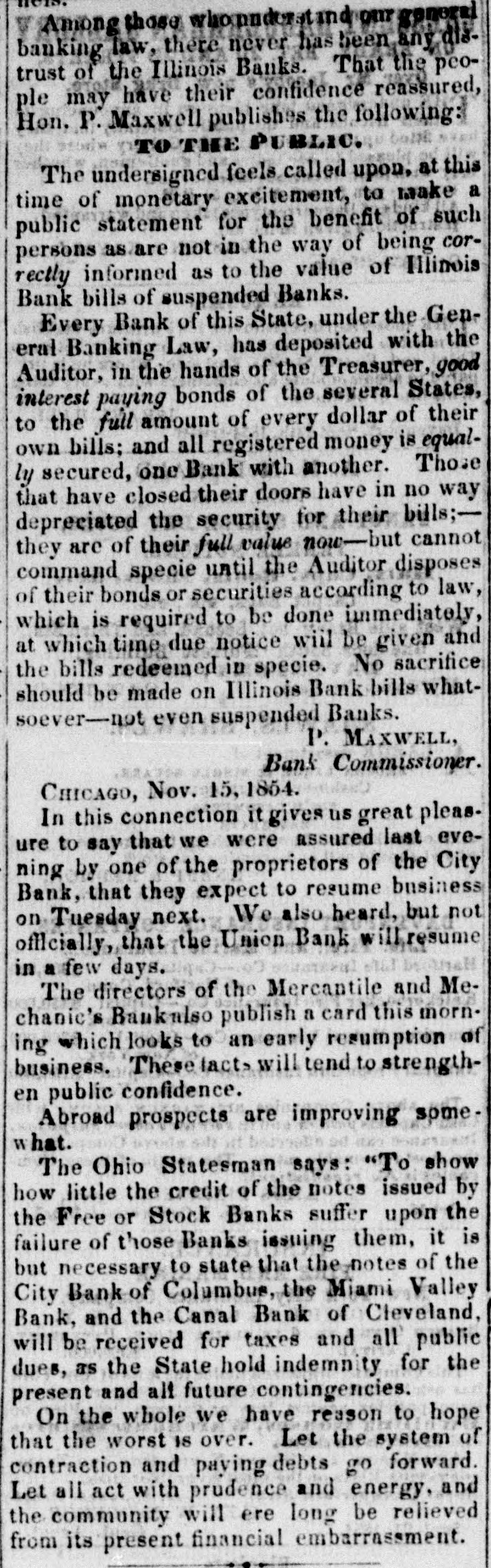
Among those whounderst and our general banking law, there never has been any distrust of the Illinois Banks. That the people may have their confidence reassured, Hon. P. Maxwell publishes the following: TO THE PUBLIC. The undersigned feels called upon, at this time of monetary excitement, to make a public statement for the benefit of such persons as are not in the way of being correctly informed as to the value of Illinois Bank bills of suspended Banks. Every Bank of this State, under the General Banking Law, has deposited with the Auditor, in the hands of the Treasurer, good interest paying bonds of the several States, to the full amount of every dollar of their own bills; and all registered money is equally secured, one Bank with another. Those that have closed their doors have in no way depreciated the security for their bills:they are of their full value now-but cannot command specie until the Auditor disposes of their bonds or securities according to law, which is required to be done immediately, at which time due notice will be given and the bills redeemed in specie. No sacrifice should be made on Illinois Bank bills whatsoever-not even suspended Banks. P. MAXWELL, Bank Commissioner. CHICAGO, Nov. 15, 1854. In this connection it gives us great pleasure to say that we were assured last evening by one of the proprietors of the City Bank, that they expect to resume business on Tuesday next. We also heard, but not officially, that the Union Bank will resume in a few days. The directors of the Mercantile and Mechanic's Bank also publish a card this morning which looks to an early resumption of business. These facts will tend to strengthen public confidence. Abroad prospects are improving somewhat. The Ohio Statesman says: "To show how little the credit of the notes issued by the Free or Stock Banks suffer upon the failure of those Banks issuing them, it is but necessary to state that the notes of the City Bank of Columbus, the Miami Valley Bank, and the Canal Bank of Cleveland, will be received for taxes and all public dues, as the State hold indemnity for the present and all future contingencies. On the whole we have reason to hope that the worst is over. Let the system of contraction and paying debts go forward. Let all act with prudence and energy, and the community will ere long be relieved from its present financial embarrassment.


Article from The Weekly Portage Sentinel, November 22, 1854

Click image to open full size in new tab

Article Text

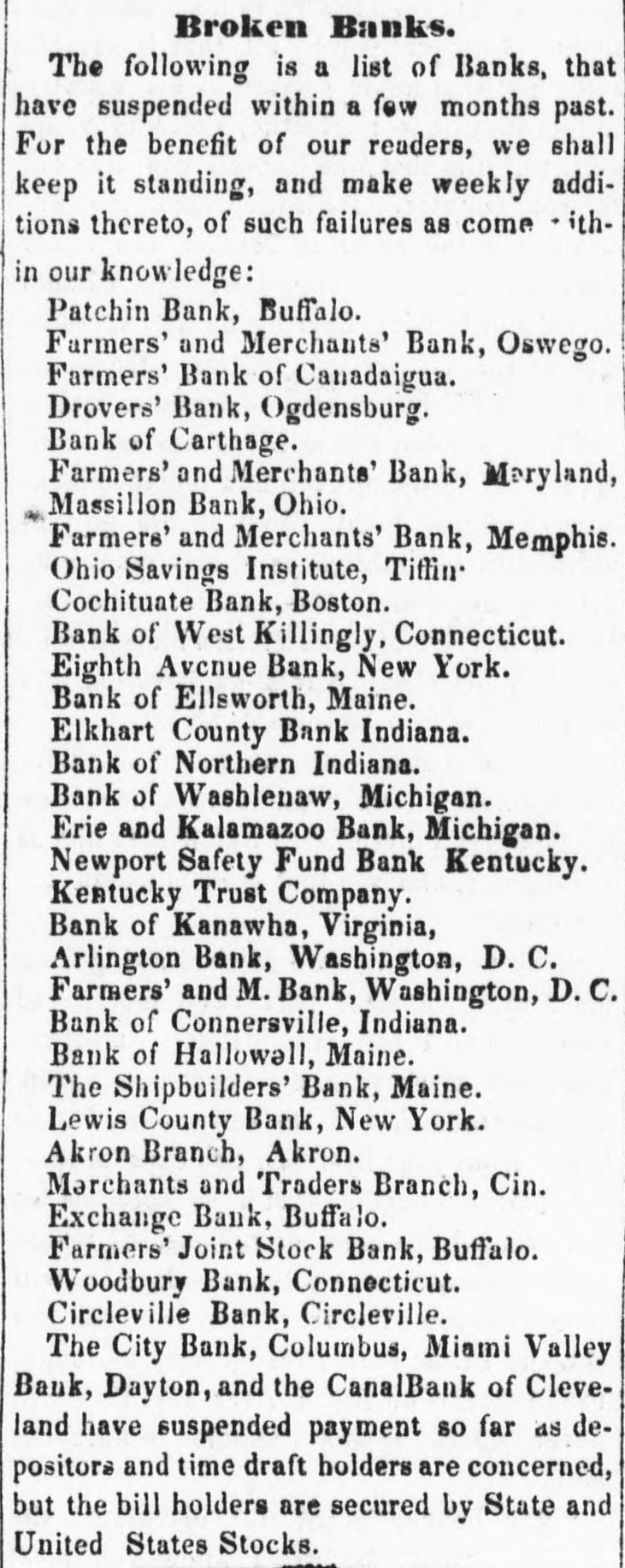
Broken Banks. The following is a list of Banks, that have suspended within a few months past. For the benefit of our readers, we shall keep it standing, and make weekly additions thereto, of such failures as come ithin our knowledge: Patchin Bank, Buffalo. Farmers' and Merchants' Bank, Oswego. Farmers' Bank of Canadaigua. Drovers' Bank, Ogdensburg. Bank of Carthage. Farmers' and Merchants' Bank, Meryland, Massillon Bank, Ohio. Farmers' and Merchants' Bank, Memphis. Ohio Savings Institute, Titfin Cochituate Bank, Boston. Bank of West Killingly, Connecticut. Eighth Avenue Bank, New York. Bank of Ellsworth, Maine. Elkhart County Bank Indiana. Bank of Northern Indiana. Bank of Washlenaw, Michigan. Erie and Kalamazoo Bank, Michigan. Newport Safety Fund Bank Kentucky. Kentucky Trust Company. Bank of Kanawha, Virginia, Arlington Bank, Washington, D. C. Farmers' and M. Bank, Washington, D.C. Bank of Connersville, Indiana. Bank of Hallowell, Maine. The Shipbuilders' Bank, Maine. Lewis County Bank, New York. Akron Branch, Akron. Marchants and Traders Branch, Cin. Exchange Bank, Buffalo. Farmers' Joint Stock Bank, Buffalo. Woodbury Bank, Connecticut. Circleville Bank, Circleville. The City Bank, Columbus, Miami Valley Bank, Dayton, and the CanalBank of Cleveland have suspended payment so far as depositors and time draft holders are concerned, but the bill holders are secured by State and United States Stocks.


Article from The Kalida Venture, November 24, 1854

Click image to open full size in new tab

Article Text

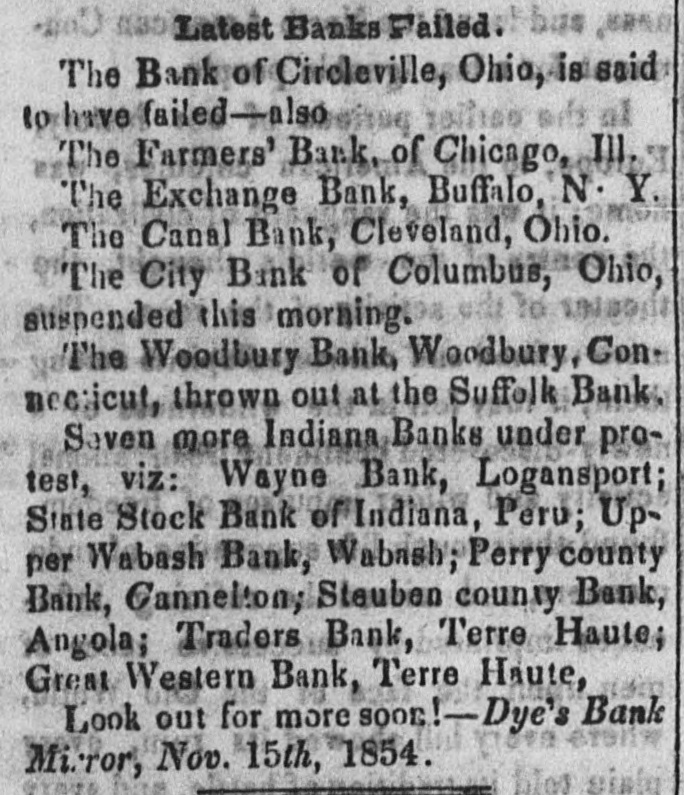
bas Latest Banks Failed. The Bank of Circleville, Ohio, is said to have failed-also The Farmers' Bank, of Chicago, Ill. The Exchange Bank, Buffalo, N. Y. The Canal Bank, Cleveland, Ohio. The City Bank of Columbus, Ohio, suspended this morning. The Woodbury Bank, Woodbury, Con nec:icut, thrown out at the Suffolk Bank Seven more Indiana Banks under protest, viz: Wayne Bank, Logansport; State Stock Bank of Indiana, Peru; Upper Wabash Bank, Wabash; Perry county Bank, Cannelton; Steuben county Bank, Angola; Traders Bank, Terre Haute; Great Western Bank, Terre Haute, Look out for more soor!-Dye's Bank Mirror, Nov. 15th, 1854.


Article from The Weekly Minnesotian, November 25, 1854

Click image to open full size in new tab

Article Text

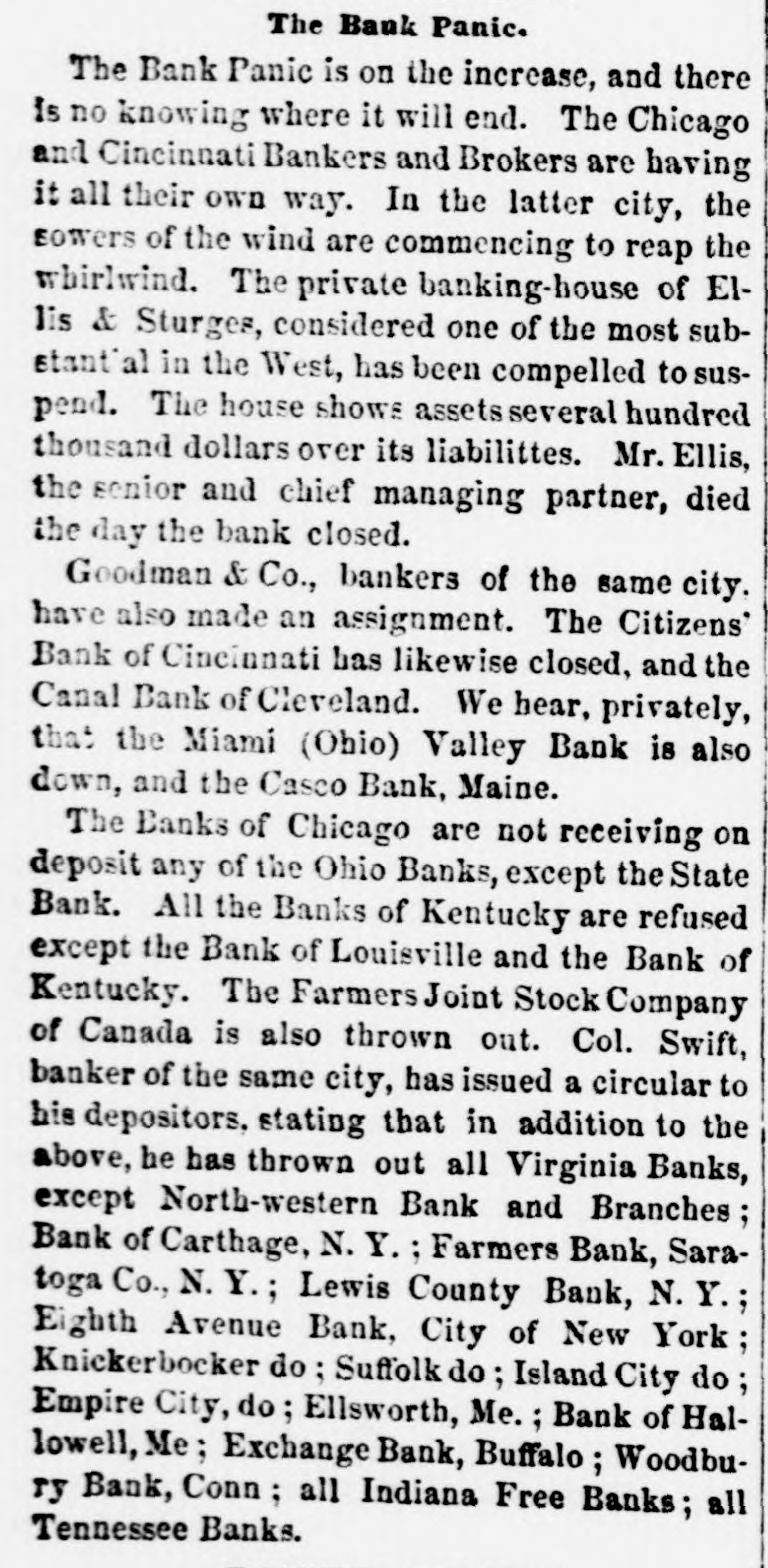
The Bank Panic. The Bank Panic is on the increase, and there Is no knowing where it will end. The Chicago and Cincinnati Bankers and Brokers are having it all their own way. In the latter city, the sowers of the wind are commencing to reap the whirlwind. The private banking-house of Ellis & Sturges, considered one of the most substantial in the West, has been compelled to suspend. The house shows assets several hundred thousand dollars over its liabilittes. Mr. Ellis, the senior and chief managing partner, died the day the bank closed. Goodman & Co., bankers of the same city. have also made an assignment. The Citizens' Bank of Cincinnati has likewise closed, and the Canal Bank of Cleveland. We hear, privately, that the Miami (Ohio) Valley Bank is also down, and the Casco Bank, Maine. The Banks of Chicago are not receiving on deposit any of the Ohio Banks, except the State Bank. All the Banks of Kentucky are refused except the Bank of Louisville and the Bank of Kentucky. The Farmers Joint Stock Company of Canada is also thrown out. Col. Swift, banker of the same city, has issued a circular to his depositors, stating that in addition to the above, he has thrown out all Virginia Banks, except North-western Bank and Branches ; Bank of Carthage, N. Y. ; Farmers Bank, Saratoga Co., N. Y. ; Lewis County Bank, N. Y. ; Eighth Avenue Bank, City of New York ; Knickerbocker do ; Suffolk do ; Island City do ; Empire City, do ; Ellsworth, Me. ; Bank of Hallowell, Me; Exchange Bank, Buffalo ; Woodbury Bank, Conn ; all Indiana Free Banks; all Tennessee Banks.


Article from The Daily Union, November 26, 1854

Click image to open full size in new tab

Article Text

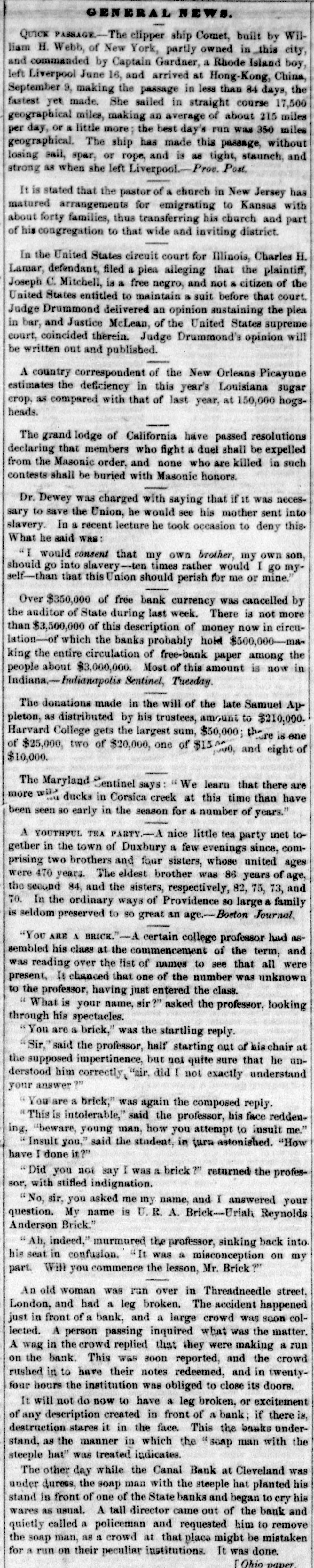
GENERAL NEWS. QUICK PASSAGE The clipper ship Comet, built by William H. Webb, of New York, partly owned in this city, and commanded by Captain Gardner, a Rhode Island boy, left Liverpool June 16, and arrived at Hong-Kong, China, September 9, making the passage in less than 84 days, the fastest yet made. She sailed in straight course 17,500 geographical miles, making an average of about 215 miles per day, or a little more: the best day's run was 350 miles geographical The ship has made this passage, without losing sail, spar, or rope, and is as tight, staunch, and strong as when she left Liverpool.- Proc. Post. It is stated that the pastor of a church in New Jersey has matured arrangements for emigrating to Kansas with about forty families, thus transferring his church and part of his congregation to that wide and inviting district. In the United States circuit court for Illinois, Charles H. Lamar, defendant, filed a plea alleging that the plaintiff, Joseph C. Mitchell, is a free negro, and not a citizen of the United States entitled to maintain a suit before that court. Judge Drummond delivered an opinion sustaining the plea in bar, and Justice McLean, of the United States supreme court, coincided therein. Judge Drummond's opinion will be written out and published. A country correspondent of the New Orleans Picayune estimates the deficiency in this year's Louisiana sugar crop. as compared with that of last year, at 150,000 hogsheads. The grand lodge of California have passed resolutions declaring that members who fight a duel shall be expelled from the Masonic order. and none who are killed in such contests shall be buried with Masonic honors. Dr. Dewey was charged with saying that if it was necessary to save the Union, he would see his mother sent into slavery. In a recent lecture he took occasion to deny this. What he said was "I would consent that my own brother, my own son. should go into slavery-ten times rather would I go myself-than that this Union should perish for me or mine. Over $350,000 of free bank currency was cancelled by the auditor of State during last week. There is not more than $3,500,000 of this description of money now in circulation-of which the banks probably hold $500,000-making the entire circulation of free-bank paper among the people about $3,000,000. Most of this amount is now in Indiana,-Indianapolis Sentinel, Tuesday. The donations made in the will of the late Samuel Ap pleton, as distributed by his trustees, amount to $210,000. Harvard College gets the largest sum, $50,000; there is one of $25,000, two of $20,000, one of $15.00 and eight of $10,000. The Maryland Sentinel says We learn that there are more will ducks in Corsica creek at this time than have been seen so early in the season for a number of years." A YOUTHFUL TEA PARTY.-A nice little tea party met together in the town of Duxbury a few evenings since, comprising two brothers and four sisters, whose united ages were 470 years. The eldest brother was 86 years of age, the second 84, and the sisters, respectively, 82, 75, 73, and 70. In the ordinary ways of Providence so large a family is seldom preserved to 80 great an age.-Boston Journal "You ARE A BRICK.-- certain college professor had assembled his class at the commencement of the term, and was reading over the list of names to see that all were present, It chanced that one of the number was unknown to the professor, having just entered the class. " What is your name, sir ?" asked the professor, looking through his spectacles. You are a brick," was the startling reply. Sir," said the professor, half starting out of mischair at the supposed impertinence, but not quite sure that he understood him correctly, "air. did I not exactly understand your answer 9" You are a brick," was again the composed reply. This is intolerable, said the professor, his face reddening. "beware, young man, how you attempt to insult me. Insult you," said the student, in turn astonished. "How have I done it? Did you not say I was a brick 2" returned the professor, with stifled indignation. No, sir, you asked me my name, and I answered your question. My name is U. A. Brick-Uriah Reynolds Anderson Brick." Ah, indeed," murmured the professor, sinking back into his seat in confusion. It was a misconception on my part. Will you commence the lesson, Mr. Brick? An old woman was run over in Threadneedle street. London, and had a leg broken. The accident happened just in front of a bank. and a large crowd was soon collected. A person passing inquired what was the matter. A wag in the crowd replied that they were making a run on the bank. This was soon reported, and the crowd rushed in to have their notes redeemed, and in twentyfour hours the institution was obliged to close its doors. It will not do now to have a leg broken, or excitement of any description created in front of a bank: if there is, destruction stares it in the face. This the banks understand, as the manner in which the " soap man with the steeple hat" was treated indicates. The other day while the Canal Bank at Cleveland was under duress, the soap man with the steeple hat planted his stand in front of one of the State banks and began to cry his wares as usual. A tall director came out of the bank and quietly called a policeman and requested him to remove the soap man, as a crowd at that place might be mistaken for a run on their peculiar institutions. It was done. Ohio paper


Article from Evening Star, December 1, 1854

Click image to open full size in new tab

Article Text

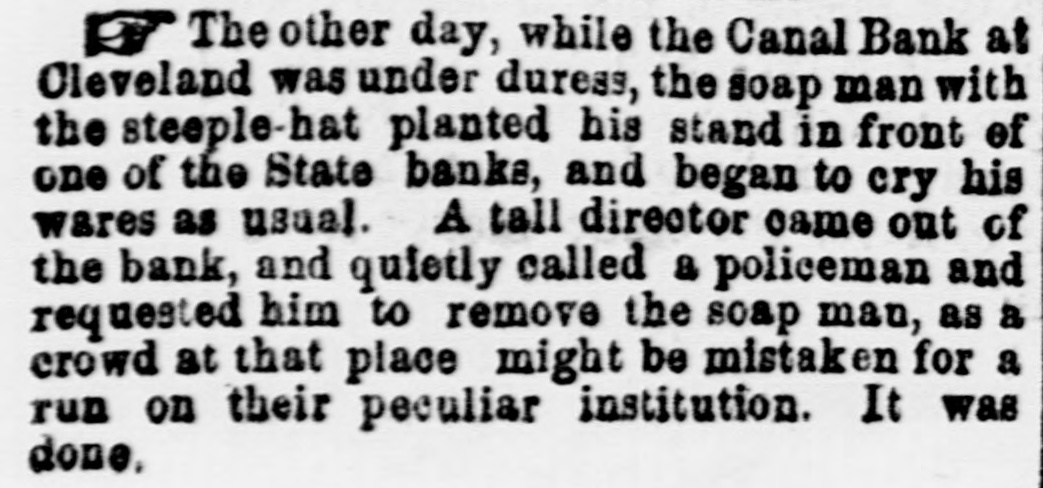
The other day, while the Canal Bank at Cleveland was under duress, the soap man with the steeple-hat planted his stand in front of one of the State banks, and began to cry his wares as usual. A tall director came out of the bank, and quietly called a policeman and requested him to remove the soap man, as a crowd at that place might be mistaken for a run on their peculiar institution. It was done.


Article from The Cadiz Democratic Sentinel, December 6, 1854

Click image to open full size in new tab

Article Text

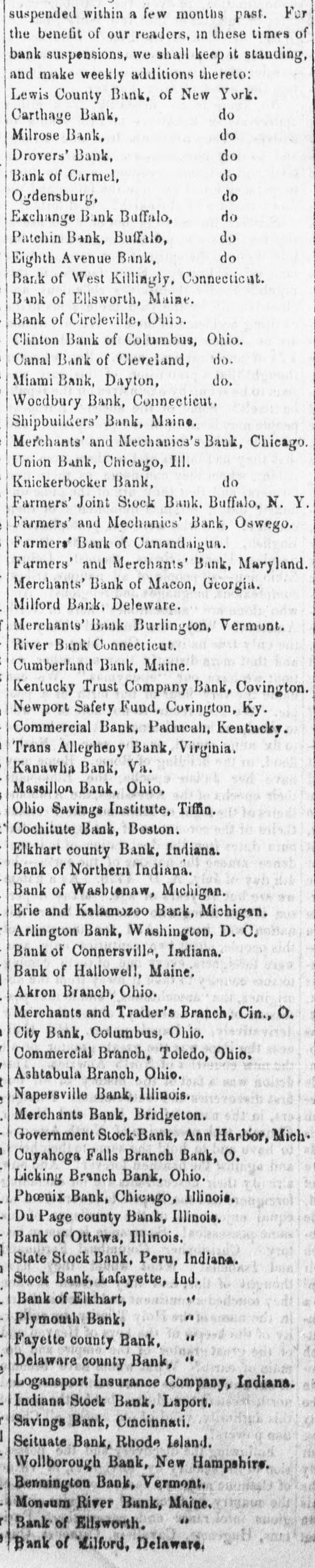
suspended within a few months past. For the benefit of our readers, in these times of bank suspensions, we shall keep it standing, and make weekly additions thereto: Lewis County Bank, of New York. Carthage Bank, do Milrose Bank, do Drovers' Bank, do Bank of Carmel, do Ogdensburg, do Exchange Bank Buffalo, do Patchin Bank, Buffalo, do Eighth Avenue Bank, do Bank of West Killingly, Connecticut. Bank of Ellsworth, Maine. Bank of Circleville, Ohio. Clinton Bank of Columbus, Ohio. Canal Bank of Cleveland, do. Miami Bank, Dayton, do. Woodbury Bank, Connecticut. Shipbuilders' Bank, Maine. Merchants' and Mechanics's Bank, Chicago. Union Bank, Chicago, Ill. Knickerbocker Bank, do Farmers' Joint Stock Bank, Buffalo, N. Y. Farmers' and Mechanics' Bank, Oswego. Farmers' Bank of Canandaigua. Farmers' and Merchants' Bank, Maryland. Merchants' Bank of Macon, Georgia. Milford Bank, Delaware. Merchants' Bank Burlington, Vermont. River Bank Connecticut. Cumberland Bank, Maine. Kentucky Trust Company Bank, Covington. Newport Safety Fund, Covington, Ky. Commercial Bank, Paducah, Kentucky. Trans Allegheny Bank, Virginia. Kanawha Bank, Va. Massillon Bank, Ohio. Ohio Savings Institute, Tiffin. Cochitute Bank, Boston. Elkhart county Bank, Indiana. Bank of Northern Indiana. Bank of Washtenaw, Michigan. Erie and Kalamazoo Bank, Michigan. Arlington Bank, Washington, D. C. Bank of Connersville, Indiana. Bank of Hallowell, Maine. Akron Branch, Ohio. Merchants and Trader's Branch, Cin., O. City Bank, Columbus, Ohio. Commercial Branch, Toledo, Ohio. Ashtabula Branch, Ohio. Napersville Bank, Illinois. Merchants Bank, Bridgeton. Government Stock Bank, Ann Harbor, Mich. Cuyahoga Falls Branch Bank, O. Licking Branch Bank, Ohio. Phoenix Bank, Chicago, Illinois. Du Page county Bank, Illinois. Bank of Ottawa, Illinois. State Stock Bank, Peru, Indiana. Stock Bank, Lafayette, Ind. Bank of Elkhart, Plymouth Bank, Fayette county Bank, Delaware county Bank, Logansport Insurance Company, Indiana. Indiana Stock Bank, Laport. Savings Bank, Cincinnati. Scituate Bank, Rhode Island. Wollborough Bank, New Hampshire. Bennington Bank, Vermont. Monsum River Bank, Maine. Bank of Ellsworth. Bank of Milford, Delaware.


Article from Fayetteville Observer, January 18, 1855

Click image to open full size in new tab

Article Text

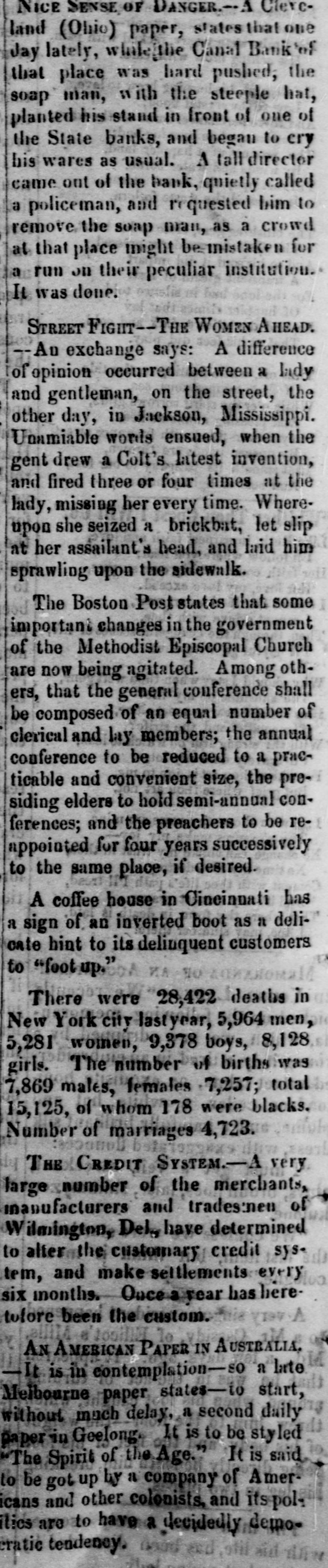
# NICE SENSE OF DANGER.--A Cleve-land land (Ohio) paper, states that one day lately, while the Canal Bank of that place was hard pushed, the soap man, with the steeple hat, planted his stand in front of one of the State banks, and began to cry his wares as usual. A tall director came out of the bank, quietly called a policeman, and requested him to remove the soap man, as a crowd at that place might be mistaken for a run on their peculiar institution. It was done. # STREET FIGHT--THE WOMEN A HEAD. --An exchange says: A difference of opinion occurred between a lady and gentleman, on the street, the other day, in Jackson, Mississippi. Unamiable words ensued, when the gent drew a Colt's latest invention, and fired three or four times at the lady, missing her every time. Where- upon she seized a brickbat, let slip at her assailant's head, and laid him sprawling upon the sidewalk. The Boston Post states that some important changes in the government of the Methodist Episcopal Church are now being agitated. Among oth- ers, that the general conference shall be composed of an equal number of clerical and lay members; the annual conference to be reduced to a prac- ticable and convenient size, the pre- siding elders to hold semi-annual con- ferences; and the preachers to be re- appointed for four years successively to the same place, if desired. A coffee house in Cincinnati has a sign of an inverted boot as a deli- cate hint to its delinquent customers to "foot up." There were 28,422 deaths in New York city last year, 5,964 men, 5,281 women, 9,378 boys, 8,128 girls. The number of births was 7,869 males, females 7,257; total 15,125, of whom 178 were blacks. Number of marriages 4,723. # THE CREDIT SYSTEM. -A very large number of the merchants, manufacturers and tradesmen of Wilmington, Del, have determined to alter the customary credit sys- tem, and make settlements every six months. Once a year has here- tofore been the custom. # AN AMERICAN PAPER IN AUSTRALIA. It is in contemplation-so a late Melbourne paper states-to start, without much delay, a second daily paper in Geelong. It is to be styled "The Spirit of the Age." It is said to be got up by a company of Amer- icans and other colonists, and its pol- itics are to have a decidedly demo- cratic tendency.


Article from Minnesota Weekly Times, March 13, 1855

Click image to open full size in new tab

Article Text

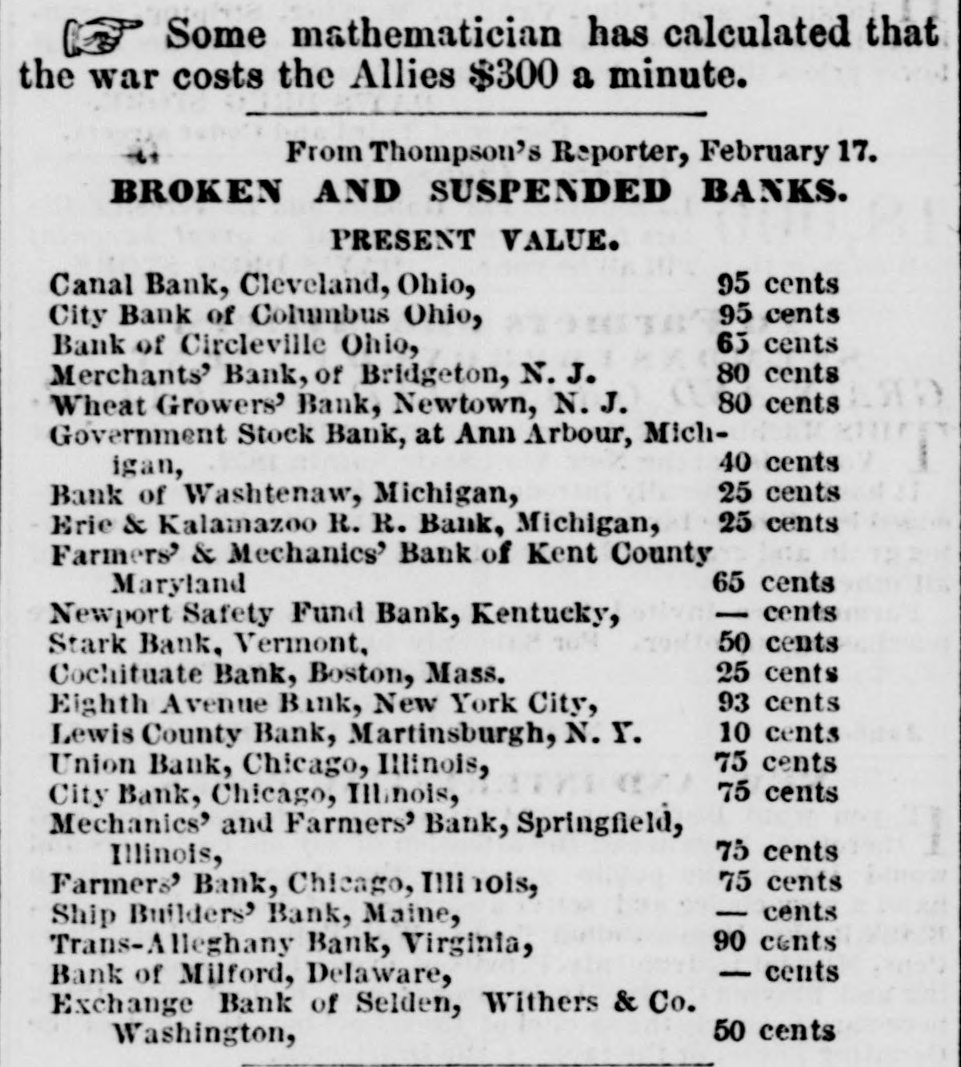
Some mathematician has calculated that the war costs the Allies $300 a minute. # BROKEN AND SUSPENDED BANKS. PRESENT VALUE. Canal Bank, Cleveland, Ohio, 95 cents City Bank of Columbus Ohio, 95 cents Bank of Circleville Ohio, 65 cents Merchants' Bank, of Bridgeton, N. J. 80 cents Wheat Growers' Bank, Newtown, N. J. 80 cents Government Stock Bank, at Ann Arbour, Mich-igan, 40 cents Bank of Washtenaw, Michigan, 25 cents Erie & Kalamazoo R. R. Bank, Michigan, 25 cents Farmers & Mechanics' Bank of Kent County Maryland 65 cents Newport Safety Fund Bank, Kentucky, — cents Stark Bank, Vernont, 50 cents Cochituate Bank, Boston, Mass. 25 cents Eighth Avenue Bank, New York City, 93 cents Lewis County Bank, Martinsburgh, N. Y. 10 cents Union Bank, Chicago, Illinois, 75 cents City Bank, Chicago, Illinois, 75 cents Mechanics' and Farmers' Bank, Springfield, Illinois, 75 cents Farmers' Bank, Chicago, Illinois, 75 cents Ship Builders' Bank, Maine, — cents Trans-Alleghany Bank, Virginia, 90 cents Bank of Milford, Delaware, — cents Exchange Bank of Selden, Withers & Co. Washington, 50 cents


Article from The Ashland Union, January 28, 1857

Click image to open full size in new tab

Article Text

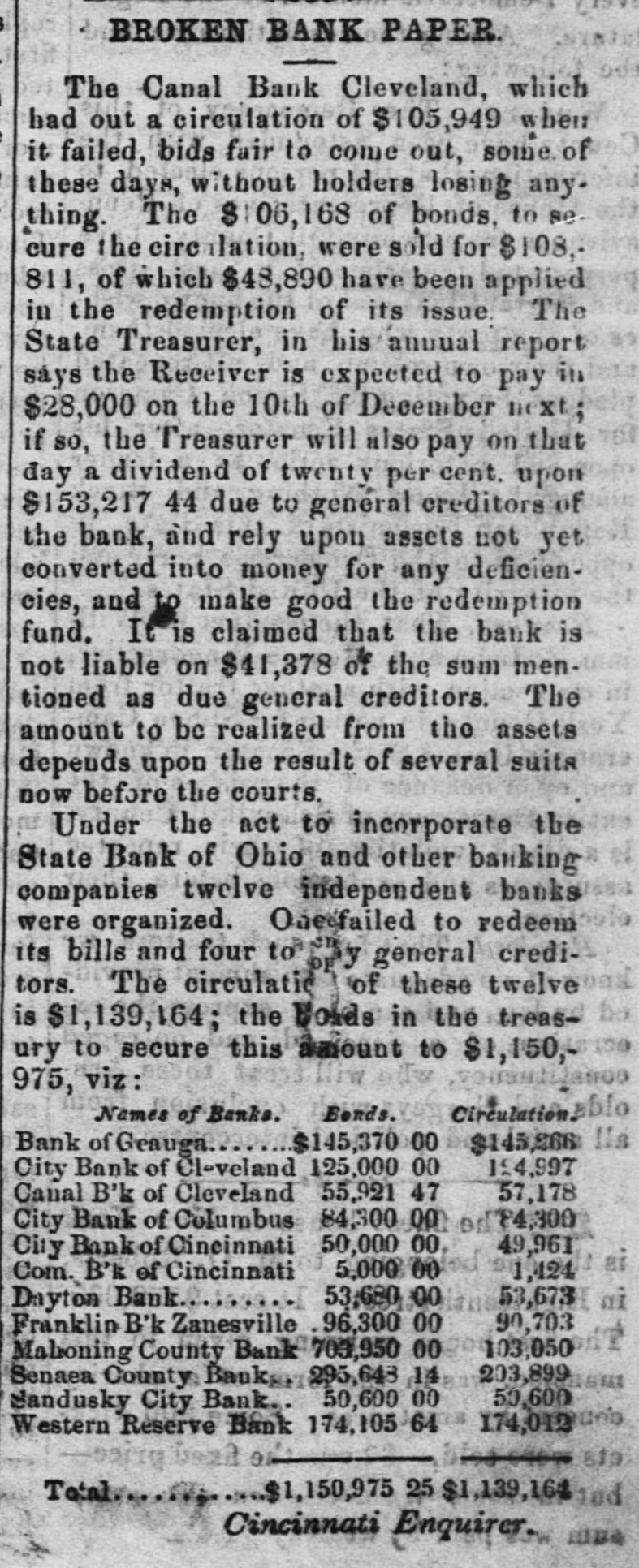
BROKEN BANK PAPER / The Canal Bank Cleveland, which had out a circulation of $105,949 when it failed, bids fair to come out, some. of these days, without holders losing any. thing. The $ 06,168 of bonds, to se cure the circ lation, were sold for $108, 811, of which $43,890 have been applied in the redemption of its issue. The State Treasurer, in his annual report says the Receiver is expected to pay in $28,000 on the 10th of December next; if so, the Treasurer will also pay on that day a dividend of twenty per cent. upon $153,217 44 due to general creditors of the bank, and rely upon assets not yet converted into money for any deficiencies, and to make good the redemption fund. It is claimed that the bank is not liable on $41,378 of the sum mentioned as due general creditors. The amount to be realized from the assets depends upon the result of several suits now before the courts. Under the act to incorporate the State Bank of Ohio and other banking companies twelve independent banks were organized. Onedfailed to redeem its bills and four to opy general creditors. The circulatic of these twelve is $1,139,164; the Folds in the treasury to secure this amount to $1,150, 975, viz: Circulation. Names of Banks. Bonds. $145,370.00 Bank of Geauga $145,866 154,997 City Bank of Cl-veland 125,000 00 47 55,921 Canal B'k of Cleveland 57,178 00 84,300 14,300 or City Bank of Columbus 00, 49,961 City Bank of Cincinnati 50,000 00 5,000 Com. B'k of Cincinnati 1,124 53,680.00 53,673 Dayton Bank 00 90,703 Franklin B'k Zanesville 96,300 00 103,050 703,950 Mahoning County Bank 203,899 14 295,643 Senaea County Bauk 00 50,600 50,600 Sandusky City Bank 174,012 Western Reserve Bank 174,105 64 Total $1,150,975 $1,139,164 Cincinnati Enquirer.


Article from The Ashland Union, February 17, 1858

Click image to open full size in new tab

Article Text

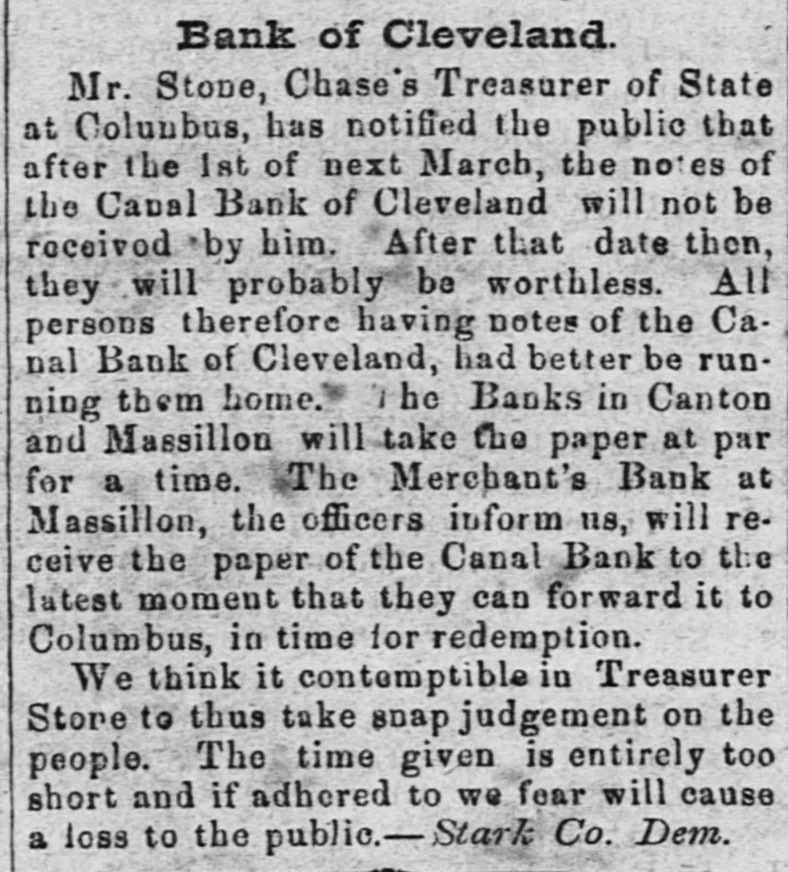
Bank of Cleveland. Mr. Stone, Chase's Treasurer of State at Colunbus, has notified the public that after the 1st of next March, the notes of the Capal Bank of Cleveland will not be received by him. After that date then, they will probably be worthless. All persons therefore having notes of the Canal Bank of Cleveland, had better be running them home. 7 he Banks in Canton and Massillon will take the paper at par for a time. The Merchant's Bank at Massillon, the officers inform us, will receive the paper of the Canal Bank to the latest moment that they can forward it to Columbus, in time for redemption. We think it contemptible in Treasurer Store to thus take snap judgement on the people. The time given is entirely too short and if adhered to we fear will cause a loss to the public.- Stark Co. Dem.


Article from Delaware Gazette, February 26, 1858

Click image to open full size in new tab

Article Text

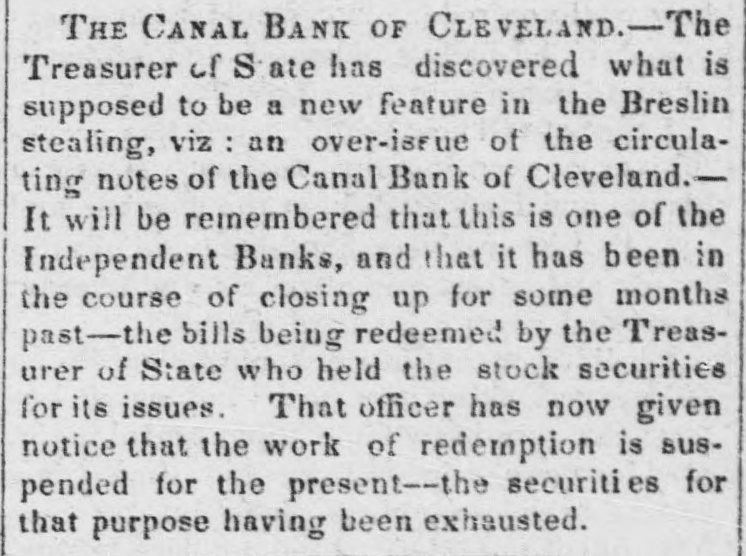
THE CANAL BANK OF CLEVELAND.-The Treasurer of S ate has discovered what is supposed to be a new feature in the Breslin stealing, viz : an over-issue of the circulating notes of the Canal Bank of Cleveland.It will be remembered that this is one of the Independent Banks, and that it has been in the course of closing up for some months past-the bills being redeemed by the Treasurer of State who held the stock securities for its issues. That officer has now given notice that the work of redemption is suspended for the present--the securities for that purpose having been exhausted.


Article from The Tiffin Tribune, January 14, 1859

Click image to open full size in new tab

Article Text

terest: CANAL BANK of CLEVELAND. has been is ered that there an. Since my last report it by $18,599 Anithere Bank of some hands after I continued redeeming to the last wasilegally surplus these in my outstanding notes, till remains. still unredeem dollar deem There I have granted ed, and 812,869. issue was visited exhausted. cates, for which over discovered, certifiWhen this the if possis M. Armstrong. in Canada, transaction to Receiver, Jearn, Mr. Mr. Brealin of this matter, as I J. ble, Brealin's the history version Armstrong, of the is this to the failure learn months MoMillen, from A Mr. low Bank, A Mr. pres jous in the of Akron, Bank, if he of the wan largely interested and asked Ohio came (Brealin) who into had the received Treasury account of $50,000 the informed Canal of Bank that State Stocks on and on being manifested of Clayeland, stooks had arrived, remarking at considerable no time, that surprise. they of Messrs. had bought Atwood same amount such of stocks their transferred. that & and had ordered office, immediately. Co., forwarded to this want of circulation, as they were in Mr. Brealin to He requested of notes signed and immediate. and amount great for delivery registered, have Breslin that so as to be ready the bonds, Mr. the notes. ly on receipt the Register of MciMillen to prepare led again, ordered next day, Mr bonds had arrived, reinquired if in the take the and The answered the to let him negative, and being numberquested which the bonds amount Mr notes Breslin $18,500. had that that been day; that sent certainly arrive probably Alwood & at Cleveland, ed and would Messrs. registered, the Bank Co. had as request in the honds direct to to the Treasury send them stead of that the Bank would Relying on this on him the bonds never books statement, but ed, immediately and the he gave arrival came. the circulation, of the Receiver thinks this statement. Bank The corroborate the in part Cashier depositor Mr. Sever to About this time. himself as a he charged amount, as he account shown a ance, circulation this credited $18,500. Had should discrepancy account have done, cred between cash it would his scirculation in circulation. have and else, without stock his Had he or some one that iting would have been over like a avoid desirous account Himself, put these difficulties, of covering amount very shrewd To book keeper. transaction, he credited wards a very dirty He after s amount and After as Hewitt, the Mt. Hewitt offset up charged Mr. himself to Bank, himself. President. edited the an claimed same the failure credit of the among others, and it was allow of this his bills payable, no suspicion him by the existed against ed this transaction Receiver, been having comm enced thisamount. against at the time. the President Suithas recover back it will be ample balance Should it over-issue, be recovered, and leave a meet for the the general creditors. SENECA COUNTY BANK. on the This Bank went last. to I protest have redeemed more, by day of March $100,879, being hands, $879, than still in my its circulation left should 82,121 have been outstanding protest There is to the Bank. On W. B. belonging immediately appointed who took Hon. possession Receiver, the Bank of the books and was Soon Thralf after. as Judge papers Thrall Treasury, of and appointed there. Comptroller of the position as Receivupon he resigned his appointed J T. Clay or. I thereupon the vacancy, who at once duties gave of bonds, and assets of any annexe poole to fill No entered upon the the value were post. will be seen by compiled of the Receiver, that on history found. the It Bank, by the carefully stock from its books of April. 1857, the assets the 25th day and divided all the the circula holders met, leaving stocks de among themselves, for by the Al to with the State tion posited be provided was Treasurer. wholly illethough this transaction provided for the general had gal, yet having wrong would have grown issue for, creditors, no there not been an over and un. out circulation of it still unprovided parties concerned in of to the of known. except What the amount but the the is, I am is $28,000. fraud given fraud. are that unable it to say. notice of probabilities The Reciver has the circula 838,887. the bilh holderé to resturn for the same to tion to him, giving saitagainst receipts the stock and williammente back the amount holdors to recover There is no doubt over of the liability them divided. for every dollar of this sue. while these suits are their panding, money the bill But, holders must seems wait to b for very giner's) boun The opinion in good faith, is not only this Bank the take State, up the over-issue of the of Canal Ban to but also the over This issue opinion is undoubt that of Cleveland founded on the rule of of law, his edly is bound by the acts for agen him NO far as he not have State principal frauds has could authority to of act existed, the These agent pos cept also equally true that from issuin It is by the acts the of Treasurer an the law tively forbids notes than there wer more circulating But, having consen b ed the bill. holders stocks to become deposited a kind of and stake the holder Banks,


Article from Cleveland Morning Leader, November 12, 1860

Click image to open full size in new tab

Article Text

ahoga Falls, plaintiff, against Isaac L. Hewitt, Ann L. Hewitt. Eber B. Ward, John G. Fay, S. E. Dewolf, Arthur J. Wenham, Calvin J. Comstock, Henry Newberry, O. E. Cory, William Melhinch, Dewey & Co., Stephen Buhrer, Eber Stark, Bank at Remington, Vermont, The Commercial Mutual Insurance Company of Cleveland, Charles T. Harvey, William J. Gordon, Samuel Ward, Mahlon T. Hewitt, Stephen Clement, John M. Armstrong, as Receiver of the Canal Bank of Cleveland, Bethany College, Ephraim J. Estep, David L. King, surviving Executor of Leicester King, deceased, George W. Girty, and Alenet Reed, defendants.


Article from Cleveland Morning Leader, November 16, 1860

Click image to open full size in new tab

Article Text

The Summit County Bank, Cuyahoga Falls, plaintiff, against Isaac L. Hewitt, Ann L. Hewitt, Eber B. Ward, John G. Fay, S. E. Dewolf, Arthur J. Wenham, Calvin J. Comstock, Henry Newberry, O. E. Cory, William Melhinch, Dewey & Co., Stephen Buhrer, Eber Stark, Bank at Remington, Vermont, The Commercial Mutual Insurance Company of Cleveland, Charles T. Harvey, William J. Gordon, Samuel Ward, Mahlon T. Hewitt, Stephen Clement, John M. Armstrong, as Receiver of the Canal Bank of Cleveland, Bethany College, Ephraim J. Estep, David L. King, surviving Executor of Leicester King, deceased, George W. Girty, and Alenet Reed, de- fendants.


Article from Cleveland Morning Leader, November 24, 1860

Click image to open full size in new tab

Article Text

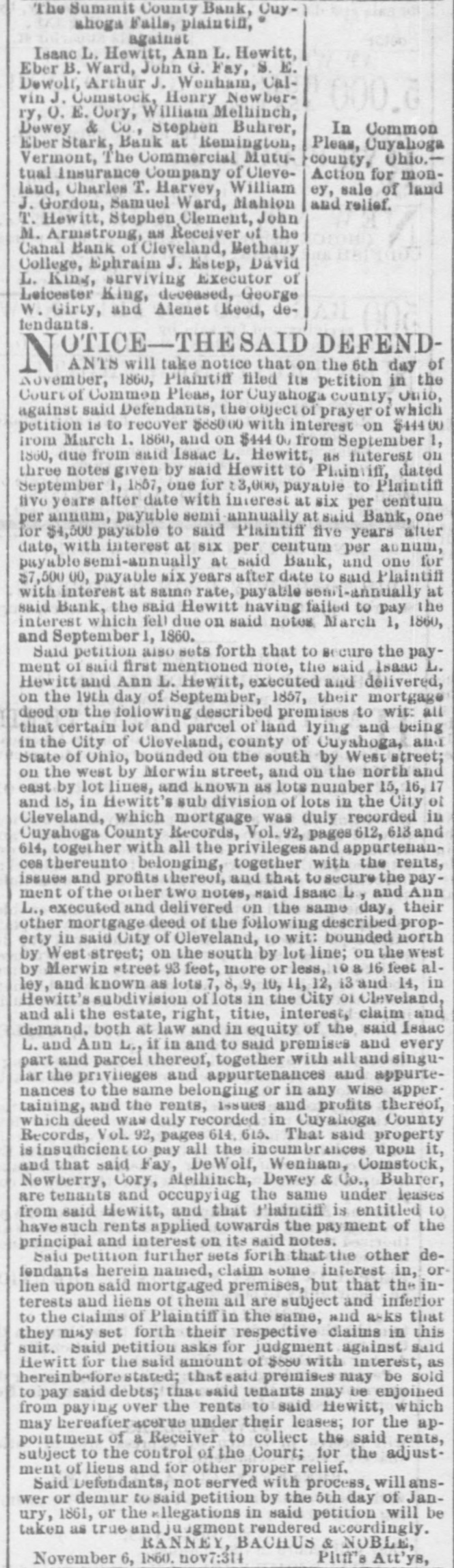
The Summit County Bank, Cuy- shoga Fails, plaintiff, against Isaac L. Hewitt, Ann L. Hewitt, Eber B. Ward, John G. Fay, S. E. Dowolt, Arthur J. Wenham, Cal- vin J. Comstock, Henry Newber- ry, O. E. Cory, William Melhinch, Dewey & Co., Stephen Buhrer, Eber Stark, Bank at Remington, Vermont, The Commercial Mutu- tual Insurance Company of Cleve- land, Charles T. Harvey, William J. Gordon, Samuel Ward, Mahion T. Hewitt, Stephen Clement, John M. Armstrong, as Receiver of the Canal Bank of Cleveland, Bethany College, Ephraim J. Estep, David L. King, surviving Executor of Leicester King, deceased, George W. Girty, and Alenet Keed, de- fendants. In Common Pleas, Cuyahoga county, Ohio.- Action for mon- ey, sale of land and relief. # NOTICE—THE SAID DEFEND- ANTS will take notice that on the 6th day of November, 1860, Plaintiff filed its petition in the Court of Common Pleas, for Cuyahoga county, Unio, against said Defendants, the object of prayer of which petition is to recover $88000 with interest on $444 00 irom March 1. 1860, and on $444 0 from September 1, 1860, due from said Isaac L. Hewitt, as interest on three notes given by said Hewitt to Plaintiff, dated September 1, 1807, one for 23,000, payable to Plaintifi livo years after date with interest at six per centum per annum, payuble semi-annually at said Bank, one for $4,500 payable to said Plaintiff five years alter date, with interest at six per centum per annum, payable semi-annually at said Bank, and one for $7,500 00, payable six years after date to said Plaintiff with interest at samo rate, payable semi-annually at said Bank, the said Hewitt having failed to pay the interest which fell due on said notes. March 1, 1860, and September 1, 1860. Said petition also sets forth that to secure the pay- ment of said first mentioned note, the said Isaac 4. Hewitt and Ann L. Hewitt, executed and delivered, on the 19th day of September, 1857, their mortgage deed on the following described premises to wit: all that certain lot and parcel of land lying and being in the City of Cleveland, county of Cuyahoga, and State of Ohio, bounded on the south by West street; on the west by Morwin street, and on the north and east by lot lines, and known as lots number 15, 16, 17 and is, in Hewitt's sub division of lots in the City of Cleveland, which mortgage was duly recorded in Cuyahoga County Records, Vol. 92, pages 612, 613 and 614, together with all the privileges and appurtenan- ces thereunto belonging, together with the rents, issues and profits thereof, and that to secure the pay- ment of the other two notes, said isaac L, and Ann L., executed and delivered on the same day, their other mortgage deed of the following described prop- erty in said City of Cleveland, to wit: bounded north by West street; on the south by lot line; on the west by Merwin street 93 feet, more or less, 10 & 16 feet al- ley, and known as lots 7, 8, 9, 10, 11, 12, 13 and 14, in Hewitt's subdivision of lots in the City of Cleveland, and ali the estate, right, title, interest, claim and demand, both at law and in equity of the said Isaac L. and Ann L., it in and to said premises and every part and parcel thereof, together with all and singu- lar the privileges and appurtenances and appurte- nances to the same belonging or in any wise apper- taining, and the rents, issues and profits thereof, which deed was duly recorded in Cuyahoga County Records, Vol. 92, pages 614, 615. That said property is insuthcient to pay all the incumbrances upon it, and that said Fay, DeWolf, Wenham, Comstock, Newberry, Cory, Melhinch, Dewey & Co., Buhrer, are tenants and occupying the same under leases from said Hewitt, and that Plaintiff is entitled to have such rents applied towards the payment of the principal and interest on its said notes. Said petition further sets forth that the other de- fendants herein named, claim some interest in, or- lien upon said mortgaged premises, but that the in- terests and liens of them ail are subject and inferior to the claims of Plaintiff in the same, and asks that they may set forth their respective claims in this suit. said petition asks for judgment against said Hewitt for the said amount of $580 with interest, as hereinb-forestated; that said premises may be sold to pay said debts; that said tenants may be enjoined from paying over the rents to said Hewitt, which may hereafter acerue under their leases; for the ap- pointment of a Receiver to collect the said rents, subject to the control of the Court; for the adjust- ment of liens and for other proper relief, Said Defendants, not served with process, will ans- wer or demur to said petition by the 5th day of Jan- ury, 1861, or the allegations in said petition will be taken as true and juugment rendered accordingly. KANNEY, BACHUS & NOBLE, Pitff's Att'ys, November 6, 1860. nov7:314


Article from Cleveland Morning Leader, December 1, 1860

Click image to open full size in new tab

Article Text

The Summit County Bank, Cuyahoga Falls, plaintiff, against Isaac L. Hewitt, Ann L. Hewitt, Eber B. Ward, John G. Fay, S. E. Dewolf, Arthur J. Wenham, Calvin J. Comstock, Henry Newberry, O. K. Cory, William Melhinch, Dewey & Co., Stephen Buhrer, Eber Stark, Bank at Remington, Vermont, The Commercial Mutual Insurance Company of Cleveland, Charles T. Harvey, William J. Gordon, Samuel Ward, Mahlon T. Hewitt, Stephen Clement, John M. Armstrong, as Receiver of the Canal Bank of Cleveland, Bethany College, Ephraim J. Estep, David L. King, surviving Executor of Leicester King, deceased, George W. Girty, and Alenet Reed, defendants.


Article from Cleveland Morning Leader, December 14, 1860

Click image to open full size in new tab

Article Text

The Summit County Bank, Cuyahoga Falls, plaintiff, against Isaac L. Hewitt, Ann L. Hewitt, Eber B. Ward, John G. Fay, S. E. Dewolf, Arthur J. Wenham, Calvin J. Comstock, Henry Newberry, O. E. Cory, William Melninch, Dewey & Co., Stephen Buhver, Eber Stark, Bank at Remington, Vermont, The Commercial Mutual insurance Company of Cleveland, Charles T. Harvey, William J. Gordon, Samuel Ward, Mahlon T. Hewitt, Stephen Clement, John M. Armstrong, as Receiver of the Canal Bank of Cleveland, Bethany College, Ephraim J. Estep, David L. King, surviving Executor of Leicester King, deceased, George W. Girty, and Alenet Reed, de- fendants.