14963. Metropolitan National Bank (Cincinnati, OH)

Bank Information

Episode Type
Run → Suspension → Reopening
Bank Type
national
Bank ID
2542
Charter Number
2542
Start Date
February 6, 1888
Location
Cincinnati, Ohio (39.103, -84.515)

Metadata

Model
gpt-5-mini
Short Digest
f50c750fd9f42a35

Response Measures

Accommodated withdrawals, Borrowed from banks or large institutions, Public signal of financial health, Full suspension, Books examined

Receivership Details

Depositor recovery rate
100.0%
Date receivership started
1888-02-10
Date receivership terminated
1888-06-27
OCC cause of failure
Losses
Share of assets assessed as good
64.6%
Share of assets assessed as doubtful
30.5%
Share of assets assessed as worthless
4.9%

Description

Multiple articles (Feb 4–19, 1888) describe heavy withdrawals/a short run, followed by directors' resolution to suspend (Feb 6–7), appointment of a receiver (Feb 10), payment of deposit claims in April, and the receiver turning the bank back to stockholders/directors in late May 1888. Cause of run/suspension is bank-specific adverse information (large unsecured/insufficient-collateral loans and misapplication by officers). No indication the run was caused by rumor/misinformation; random_run is false.

Events (7)

1. July 12, 1881 Chartered
Source
historical_nic
2. February 6, 1888 Run
Cause
Bank Specific Adverse Info
Cause Details
Heavy withdrawals driven by reports/examination showing large deficits from loans on insufficient collateral and speculation/loans to officers (Vice‑President DeCamp's reckless loans).
Measures
Eight banks lent $25,000 each and the associated banks agreed to re‑discount up to $200,000; paying‑teller desk stocked with currency; directors sought external aid.
Newspaper Excerpt
a heavy run was anticipated ... the paying-teller's desk was stacked with currency and coin to the amount of nearly $400,000; Saturday morning something of a run was inaugurated
Source
newspapers
3. February 7, 1888 Suspension
Cause
Bank Specific Adverse Info
Cause Details
Directors resolved to suspend after withdrawals and following the arrest of Vice‑President J. R. DeCamp on charges of certifying false statements and misapplication of funds; deficits from bad loans made suspension inevitable according to examiner Sanders.
Newspaper Excerpt
Later-The Metropolitan National bank directors passed resolutions to-night to suspend. The bank is now in the hands of the government.
Source
newspapers
4. February 10, 1888 Receivership
Source
historical_nic
5. February 10, 1888 Receivership
Newspaper Excerpt
The Controller of the Currency to day appointed James McConville ... to be receiver of the Metropolitan National Bank of Cincinnati, Ohio. He will take charge early next week (Feb. 10 dispatch).
Source
newspapers
6. April 16, 1888 Other
Newspaper Excerpt
Receiver McConville ... has received the checks upon the assistant United States treasurer to pay all claims of depositors ... Claims are paid in full with interest from the date of the bank's suspension. Each claimant receives a check for the amount of his claim. There are about 400 of these checks, aggregating $330,190.
Source
newspapers
7. May 24, 1888 Other
Newspaper Excerpt
The receiver reported: ... The receiver made his report and turned the bank over to the directors and stockholders. (stockholders' meeting May 24; receiver turned bank over).
Source
newspapers

Newspaper Articles (24)

Article from The Waco Daily Examiner, June 22, 1887

Click image to open full size in new tab

Article Text

agreeupon such a plan and were uns willing to take the risk of A RUN FOLLOWING the interference of the government. The outcome, however, was the anpointment of Mr. J. 11. Decamp. vice president of the Metropolitan National bank. receiver, and he was placed in charge of the banks affairs. Itis BOW stated that the Clearing house for the past few davs has shown su unusal drain on this banks resources. Besides this many banks have kept its checks out of the Clearing house AS A FAVOR. There are numerous rumors afloat concerning the cause of the action of the bank examiner. Vice President Harper, who has borne a heavy strain for the past week is much distressed this morning. He cells himself & ruined man, and 18 in shigh state of excitement. A conservative director says its his opinion depositors will get their money in full. THE IMMEDIATE RESULT. CINCINNATI, June 21.-E. L. Harper made an individual assignment to E. Zimmerman this afternoon and his firm, Harper & Co., dealers in iron and coal also assigned to Zimmerman. The failures is the direct result of the losing of the Fidelty bank. The assets are $2,000,000. The liabilities are not given. THE GOVERNMENT'S FINGER. WASHINGTON, The comptroller of currercy today received a telegram from Mr. Powell, the regular bank examiner for the western district of Ohio, saying that he had taken charge of the Fidelity National bank of Circinnati, Ohio, AS an insorvent institution. No particulars are given but it was subsequently 88certained that the liabilities of the bank, exclusive of capital stock, are about $5,500,000; individual deposits are about $2,000,000.


Article from New-York Tribune, February 5, 1888

Click image to open full size in new tab

Article Text

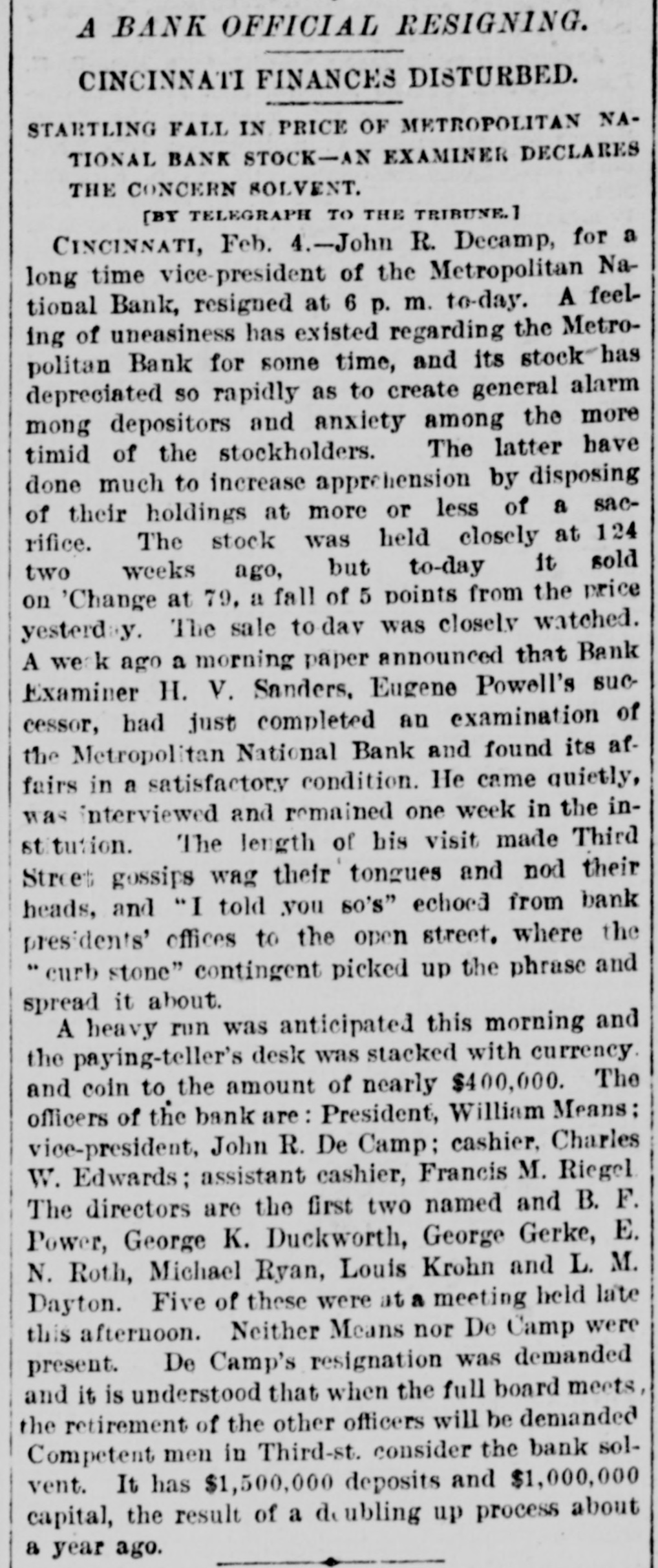
A BANK OFFICIAL RESIGNING. CINCINNATI FINANCES DISTURBED. STARTLING FALL IN PRICE OF METROPOLITAN NATIONAL BANK STOCK-AN EXAMINER DECLARES THE CONCERN SOLVENT. [BY TELEGRAPH TO THE TRIBUNE. CINCINNATI, Feb. 4.-John R. Decamp, for a long time vice-president of the Metropolitan National Bank, resigned at 6 p. m. to-day. A feeling of uneasiness has existed regarding the Metropolitan Bank for some time, and its stock has depreciated so rapidly as to create general alarm mong depositors and anxiety among the more timid of the stockholders. The latter have done much to increase apprehension by disposing of their holdings at more or less of a sacrifice. The stock was held closely at 124 two weeks ago, but to-day it sold on 'Change at 79, a fall of 5 points from the price yesterday. The sale to day was closely watched. A week ago a morning paper announced that Bank Examiner H. V. Sanders, Eugene Powell's successor, had just completed an examination of the Metropolitan National Bank and found its affairs in a satisfactory condition. He came quietly, was interviewed and remained one week in the institution. The length of his visit made Third Street gossips wag their tongues and nod their heads, and "I told you so's" echoed from bank presidents' offices to the open street. where the "curb stone" contingent picked up the phrase and spread it about. A heavy run was anticipated this morning and the paying-teller's desk was stacked with currency and coin to the amount of nearly $400,000. The officers of the bank are: President, William Means: vice-president, John R. De Camp; cashier, Charles W. Edwards: assistant cashier, Francis M. Riegel. The directors are the first two named and B. F. Power, George K. Duckworth, George Gerke, E. N. Roth, Michael Ryan, Louis Krohn and L. M. Dayton. Five of these were at a meeting held late this afternoon. Neither Means nor De Camp were present. De Camp's resignation was demanded and it is understood that when the full board meets, the retirement of the other officers will be demanded Competent men in Third-st. consider the bank solvent. It has $1,500,000 deposits and $1,000,000 capital, the result of a doubling up process about a year ago.


Article from Springfield Daily Republic, February 6, 1888

Click image to open full size in new tab

Article Text

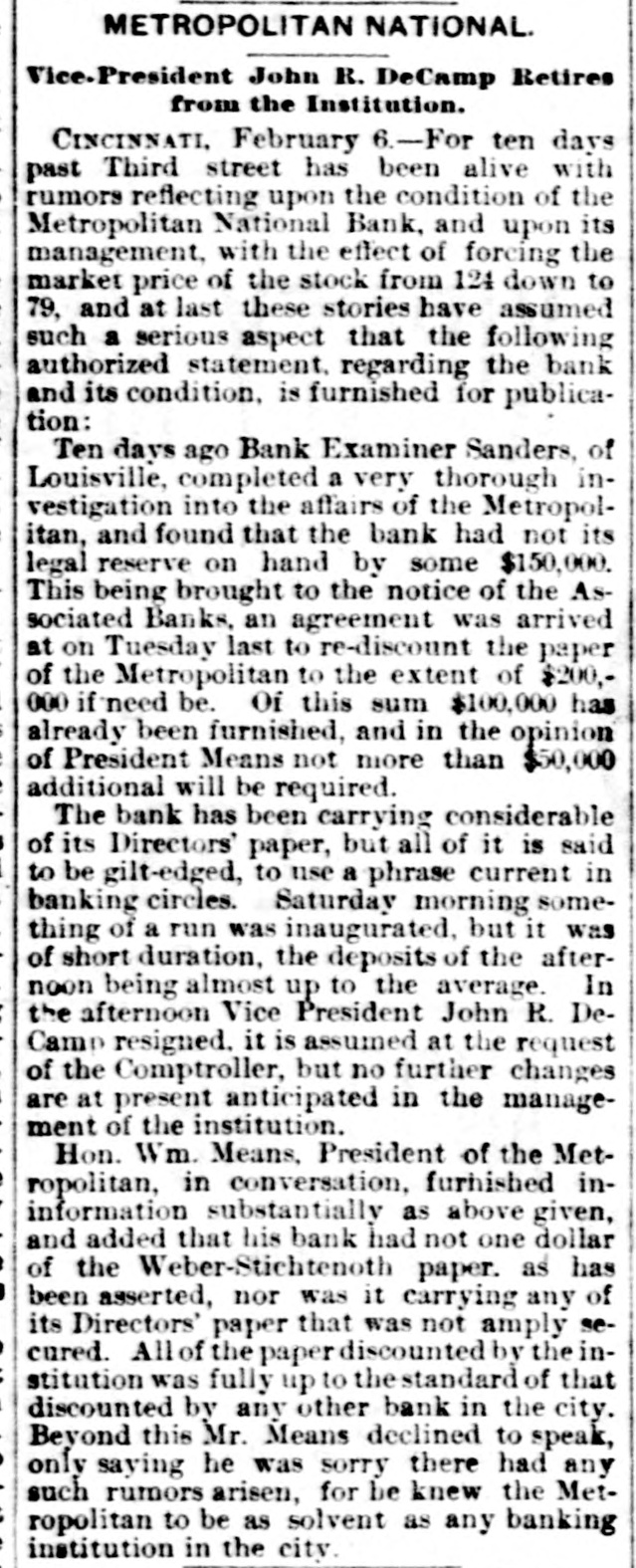
METROPOLITAN NATIONAL Vice.President John R. DeCamp Retires from the Institution. CINCINNATI. February 6.-For ten days past Third street has been alive with rumors reflecting upon the condition of the Metropolitan National Bank, and upon its management, with the effect of forcing the market price of the stock from 124 down to 79, and at last these stories have assumed such a serious aspect that the following authorized statement, regarding the bank and its condition. is furnished for publication: Ten days ago Bank Examiner Sanders, of Louisville, completed a very thorough investigation into the affairs of the Metropolitan, and found that the bank had not its legal reserve on hand by some $150,000. This being brought to the notice of the Associated Banks, an agreement was arrived at on Tuesday last to re-discount the paper of the Metropolitan to the extent of $200,000 if need be. Of this sum $100,000 has already been furnished, and in the opinion of President Means not more than $50,000 additional will be required. The bank has been carrying considerable of its Directors' paper, but all of it is said to be gilt-edged, to use a phrase current in banking circles. Saturday morning something of a run was inaugurated, but it was of short duration, the deposits of the afternoon being almost up to the average. In the afternoon Vice President John R. DeCamp resigned. it is assumed at the request of the Comptroller, but no further changes are at present anticipated in the management of the institution. Hon. Wm. Means, President of the Metropolitan, in conversation, furnished ininformation substantially as above given, and added that his bank had not one dollar of the Weber-Stichtenoth paper. as has been asserted, nor was it carrying any of its Directors' paper that was not amply secured. All of the paper discounted by the institution was fully up to the standard of that discounted by any other bank in the city. Beyond this Mr. Means declined to speak, only saying he was sorry there had any such rumors arisen, for be knew the Metropolitan to be as solvent as any banking institution in the city.


Article from New-York Tribune, February 7, 1888

Click image to open full size in new tab

Article Text

REPORT OF BANK EXAMINER SANDERS. WASHINGTON, Feb. 6.--The Controller of the Currency to-day received the reports of Bank Examiner Sanders in regard to the Metropolitan National Bank of Cincinnati. According to this report there has been no defaleation and the lesses have arisen entirely from loans upon insufficient security. During the examination Mr. Sanders succeeded in getting about $275,000 of additional collateral put up by parties to whom excessive loans had 1) oven made. he examiner says he thinks the losses will not exceed $350,000, even if the bank has to be wound UP. while If it goes on it good part of this may be saved. The books, he says, show at the credit of the surplus account and prefi and loss about $190,000, so that should the lesses reach the extreme limit of estimate, the capital of $1,000,000 would .. but little impaired. The Controller in speaking of the report said that the creditors cau lose nothing in any event. and should the bank survive the present run and pass under more prudent management, the stockholders may escape serious loss.


Article from Omaha Daily Bee, February 7, 1888

Click image to open full size in new tab

Article Text

National Capital Notes. WASHINGTON, Feb. 6.-The senate in secret session to-day confirmed C. M. Wherry as postmaster at North Platte, Neb. The senate to-day further considered the British extradition treaty, but took no action thereon. The comptroller of the currency to-day received the report of Bank Examiner Sanders in regard to the Metropolitan National bank, of Cincinnati. According to this report there has been no defalcation and the losses have arisen entirely from loans upon insufficient security. The comptroller said the creditors could lose nothing in any event and should the bank survive the present run and pass under more prudent management the stockholders may escape serious loss. M. Ackerman and Charles Mayer. of Lincoln are in town. The bill reported by Senator Dolph to-day to amend the act in relation to Dearborn park, Chicago, gives the consent of the United States to the erection of a public library building upon the south three-fourths of the park by the Chicago public library and the erection of a memorial hall building upon the northern one-fourth of the park by the soldiers home in Chicago. Senator Blackburn Better. WASHINGTON, Feb. 6.--Senator Blackburn, who is ill at his hotel, is said to be better this morning.


Article from Omaha Daily Bee, February 7, 1888

Click image to open full size in new tab

Article Text

THE METROPOLITAN'S TROUBLE. The Directors Meet and Accept VicePresident Camp's Resignation. CINCINNATI, Feb. 6.-The Metropolitan bank directors held a session this morning at 10 o'clock. Pending the meeting the payment of checks was suspended, and a long line of depositors gathered. In a few minutes, however, the payment of checks was resumed. The directors are still in session and what has been transacted is not yet known, except that Vice President De Camp's resignation has been accepted and Louis Krohn has been chosen in his place. Bank Examiner Sanders is at the bank, but says he IS too busy to say anything for the benefit of the public. President Means, referring to the stoppage of payments, says there was no order for it and that he did not know there was any suspension. He supposes the story must have arisen from some accidental delay at the payers' desk, as no order for suspension was given. There was more than the usual demand upon the Metropolitan bank all day, but at the closing hours it was only $10,000 behind. While bankers agree that the Metropolitan is solvent, the recognized fact is that it could not meet every possible demand during the day, so eight of the banks loaned $25.000 each. Other offers were declined. The objection made to Decamp, the retiring vice-president, was that he had been speculating too much in real estate. Later-The Metropolitan National bank directors passed resolutions to-night to suspend. The bank is now in the hands of the government. Vice-President J. R. Decamp has been arrested. At the close of business to day the directors felt confident of pulling through safely. The united banks had given them $200,000 during the day and voted $50,000 more to help them to-morrow. This evening, however, while the directors were in session, a United States deputy marshal stepped in and arrested the late vice president, J. R. DeCamp. The charges against him were certifying to false state ments of the December condition of the bank. This attracted the attention of the united banks and they at once withdrew the proposition to furnish $50,000, and said they would not help the Metropolitan any more. The directors immediately resolved to suspend and go into liquidation. The affairs of the bank were at once turned over to Government Examiner Sanders. # The next step will be the appointment of a receiver. The trouble is traced to the increase of stock from $500,000 to $1,000,000, the issue being to holders of stock at 20 per cent premium, which was utilized as a surplus fund. A large part of this increase was paid for in notes. The placing of stock in various banks gave rise to suspicion, and to sustain its market status the directors were compelled to buy in considerable quantities. The tight money market at the close of the year forced the bank to carry a load that was too heavy and the other troubles grow out of reports as to the speculation of some of the officers. It is said that other arrests will be made.


Article from Rock Island Daily Argus, February 7, 1888

Click image to open full size in new tab

Article Text

ANOTHER CINCINNATI BANK Forced to Suspend Because An Official Was Reckless. CINCINNATI, O., Feb. 7.-There has been trouble in the Metropolitan National bank of this city for some days. Last week Bank Examiner Sanders found that the reserve was much short of what it should be and so reported, the amount of deficit being about $350,000. This was caused by the carelessless of the vice president, John R. DeCamp, who permitted loans to be made on insufficient security. An attempt was made Monday to continue business, but the rush of depositors to draw their funds was too great and business had to be suspended. Later DeCamp was arrested on a charge of misapplication of funds and certifying to false statements. He was bound over in $20,000 bail. Earlier in the day he had been relieved of the bank office. It is believed the bank can pay all its liabilities.


Article from The Indianapolis Journal, February 7, 1888

Click image to open full size in new tab

Article Text

THE Metropolitan National Bank, of Cincinnati, has suspended. Cincinnati banking seems to be on the ragged edge. Yet it is noticeable that all the difficulty comes because of either criminal or negligent conduct on the part of bank managers. No business is safer than safe barking; none more unsafe than reckless banking


Article from The Big Sandy News, February 9, 1888

Click image to open full size in new tab

Article Text

Closed. The Metropolitan National Bank at Cincinnati suspended Tuesday. The President and Vice President were arrested for the violation of the National banking law. The President was William Means, brother to John Means, of Ashland.


Article from The Indianapolis Journal, February 9, 1888

Click image to open full size in new tab

Article Text

NATIONAL BANKING. The failure of the Metropolitan National Bank in Cincinnati is complete. It is not as bad a failure as that of the Fidelity, and does not present the same criminal features, but it is very bad and will probably wreck reputations as well as fortunes. Mr. William Means, president of the now defunct concern, was elected Mayor of the city in 1881 on the "reform" ticket, has been prominently connected with large local enterprises and was highly esteemed. He was president of the Duckworth Democratic Club, and an ardent supporter of the Queen City Club, an organization of much higher grade. These connections show his local standing. Vice-president De Camp was a good second to the highly esteemed president. Both men have stood above suspicion. Even now they have not lost the respect of the community, and universal sympathy is expressed for them, but they have wrecked the bank. And they have done it in the usual way-by a gross violation of the legitimate principles of banking involving, of course, violation of the national-bank law. Morally, the wreck of the Metropolitan does not present as bad a case as that of the Fidelity, but in respect of violating the principles of banking and the bank law, they are about on a par. Harper gutted the Fidelity to carry on his big wheat deal, while the officers of the Metropolitan swamped it by loaning money to themselves and the directors for real estate speculations. In both cases it was outside speculation that wrecked the bank. It generally works that way. Banking is not speculating. Cautious depositors will always do well to withdraw their money from a bank whose officers engage in any outside operations. The national-bank law contains very stringent provisions on this subject, in regard to making loans to directors, etc. These provisions are wise and should be strictly enforced. No doubt they are often violated without discovery, but never without risk. Most of the bank failures that occur are caused by outside speculations of the officers and large, unsecured loans to directors, one or both. The officers of the Metropolitan are surprised by the failure. Of course they are. Men who speculate with other people's money do not expect to lose, and it is always a painful surprise to them to discover that they have. It is often a still more painful surprise to depositors. But the national-bank law prohibits all such operations, and prescribes a penalty for its violation. The depositors in the Metropolitan will not lose anything, but if the government insists on a rigid enforcement of the law, it will take some very fine work to keep the able officers of the bank out of its clutches. It is not intended to say that they have been guilty of any intentional fraud or criminal misappropriation of funds, but of a plain violation of legitimate banking principles, and at least a technical violation of a very stringent law.


Article from Fort Worth Weekly Gazette, February 10, 1888

Click image to open full size in new tab

Article Text

PRECE SECOND Bank National Another Cincinnati for the by Closed Government the Law, Banking Violating Vice and The President President propriation Missppropri Charged of the With Bank's Funds. The Used Stock Bank's Collateral of the Loanst Speculain tion DECIDED The Feb. OHIO, have Bank directors CINCINNATIONAL to The suspend. the governARRESTED. passed bank ropolitan is Vice a resolution in President the hands J. R. of DeCamp has Another ment. been arresteer Feb. to the CINCINNATE THE OHIO, has been added It is presi- the sensational Bank William was issued manner. Metropolitan of the bank. Hon. The warrant was not served for Mr. in of arrest dent of this the morning, but Out of Bramet regard notified the issuance after arranged his the usual District O'clock Attorney of the Means to to the go office mind him writ Means, voluntarily and 12 with for Mr. bondsmen in 20'clock. relentless and With with compidenty volumissione cases fresh of the where the proof they the gave governmental transgre decided of the power of a plain causes & leading there has-been this arrest has held for a a numlaw Mr. Means men quite has been as vote, the gensation:mong position of years, served business a term by reputed party mayor ber and elected, not support To in by a procompliment when wealthy he a combir was mmination such to their prominence caused put a of is examinshave the peril man imprisonment There that fairly the and well papers au of the violation bank's of the with tion found teeli biatement thenticated gross books this V banking shows a to officers that such an in It is carried solvency. doing the may the that one law bank. loans have imperil possible been thought bank's to no other extent as time to it is made, not but of because this there speak with for & arrests At this will be certainty, thorough examhas can not been of the time bank's FIRST effairs. -The ARREST silence ination EFFECT OF OHIO, THE Feb. the Metro in the bank brown of CINCINNATICE the tomb morning. structure at locsted called occu- the new United half at The its this Western Banks' stone building outheast streets. and corner by wide ples the and Walnut by it and buildof Third is used eastern jointly half of the Bank. vestibule in Citizens' the National is open this neighbor course, from ing, vestibule, the the of door leading is closed that and plscarded the morning, This Metropolitan but Bank Comp acting into the with the hands of the through the bank of is the in Currency, United States clerks National can A few the door and of Mr. Examiner. glass in the door Bank through the lounges Small groups for geen single watchmsn of the vestibule president. and look of the the people room enter the vacated quarters the lesson power of moment in the read therein overnment. the would a great bank of and the national bank say government this the connected the have with happened arrest if the of the the ex arrest vicenot had not caused It is true to that withdraw their that president. the other banks but mercifully it may be in diof government moved of assistance, acted from the Metropoli- warrant the their money made in not the necessaverting for the charges arrest do possession tan, Mr. Decamp's may be serious in charges the for cover all that More statement of rily of the certifying government. to bank false may be brought condition than of of the the grand jury. the notice BOTH GIVE Feb. BOND. President at CINCINNATI , OHIO, this afternoon Commissioner Means of appeared United States bond for his The appear- charge Doragen office and gave of $20,000. is the misap- the the sum warrant of plication the bank ance against in him of in upwards the of Mr. $200,000 DeCamp also one funds gave bond of for $20,000. THE DIRECTORS 7 SAYS. M'chael WHAT ONE OF OHIO, Feb. of the Metro- the attributes CINCINNATI of the directors the failure to increase crease politan Ryan, Bank, influence of of the the $500,000 sold and debt capital weskening offered He said only was that used $20,000 collateral was of the bank for remainde was offered freely to loans, the thus as the stock thought it best it and again Moveover, sale, the directors value by buying of embaran keep for up its in market time W1B a source interhere rassment. paper publishes in which he bank's save An evening E. L Harper that the on with summer in view he knew last being used of as speculation collateral examstock was the purpose that & bank could estate. how to opinion loans real for knew He added then. examine country iner who that of the violaof of the to-day The have ine-tenths discovered put in prison bankers had been. for grand the could be the law, as jury he has been District distion United States the week to the W. missed for prepare against Mr. Attorney to indictment in the Fidelity bank, cases. The late director to-day. the as same H. Chatfield, WAS nolle that prossequee against Mr. Pogue.


Article from New-York Tribune, February 11, 1888

Click image to open full size in new tab

Article Text

RECEIVER OF THE METROPOLITAN BANK. WASHINGTON, Feb. 10.-The Controller of the Curreney to day appointed James McConville, of Steubenville, Otlo, to be receiver of the Metropolitan National Bank of Cincinnati, Ohio. He will take charge early next week


Article from Martinsburg Independent, February 11, 1888

Click image to open full size in new tab

Article Text

History of the Bank. CINCINNATI, Feb. 7. - The Metropolitan National bank was the outgrowth of the old private banking house of J. F. Larkin & Company. It was organized on January 15, 1881. J. F. Larkin was elected president and J. R. De Camp vice president. The capital stock was $500,000, and the bank was located in a modest apartment on the south side of Third street between Walnut and Vine streets. It is said the bank did a large business until the capital stock was increased. In February, 1882, Hon. William Means was elected president to succeed Larkin. A number of changes also took place in the directory. Of the original board of directors only two, E. N. Roth and J. R. De Camp, were in the bank at the time of the suspension. In July, 1886, the Metropolitan branched out into its new and elegant quarters in the United bank building, at Third and Walnut streets. No bank in the country has more handsome or convenient apartments. The building is very imposing from the outside, while within the work is of the finest description. The interior is of mahogany, while the wood work carving is very artistic. The bank fixtures are of the costliest and most modern patterns, and all the offices are admirably arranged. The vaults of the bank are the best in the west, both as to construction, safety and appearance. The lower vault is burglar-proof, and both vaults can withstand fire or attack of any kind. Both vaults are secured by Yale time-locks, and the bolt works are of the most massive character.


Article from St. Paul Daily Globe, February 11, 1888

Click image to open full size in new tab

Article Text

A Receiver Appointed. WASHINGTON, Feb. 10.-The comptroller of the currency to-day appointed James McConville, of Steubenville, O., to be receiver of the Metropolitan National bank, of Cincinnati, O. He will take charge early next week.


Article from Barbour County Index, February 15, 1888

Click image to open full size in new tab

Article Text

WASHINGTON NOTES. THE President has signed the act providing for printing the eulogies pronounced in Congress on the late John A. Logan. THE American Atlantic & Pacific Ship Canal Company has entered protest in the Senate against the passage of the bill to incorporate the Maritime Canal Company, of Nicaragua, claiming to have the exclusive right. A STATEMENT of internal revenue receipts, prepared by the Commissioner of Internal Revenue, shows that the total receipts for December, 1886, were $10,395,246, while the collections for December, 1887, were $10,580,351. PETITIONS for the retention of Statistician Dodge, of the Agricultural Bureau, have been received by Commissioner Coleman from members of the New York Cotton Exchange and others. THE President and Mrs. Cleveland gave a reception to the army and navy on the 9th. It was the last reception of the season at the White House and was largely attended. THE Treasury Department has decided that a Chinese merchant at Portland, Ore., can not bring his nephew from China to help him in his business. THE Comptroller of the Currency has appointed James McConnville, of Steubenville, O., to be receiver of the Metropolitan National Bank at Cincinnati. MRS. W. A. EMMONS, the erratic and yet talented woman who was the subject of an inquiry in lunacy some time ago, died in Washington on the night of the 12th quite unexpectedly. THE secret service division of the Treasury Department has discovered that a new counterfeit of the $5 silver certificate has been put in circulation. The bill IS about three-sixteenths of an inch too short. The general appearance is good and liable to deceive.


Article from The True Northerner, February 15, 1888

Click image to open full size in new tab

Article Text

THE WESTERN STATES. Two MEN were killed and four injured by the burst of a boiler at Barnesville, Ohio. THE Metropolitan National Bank of Cincinnati is a dead concern, and President Means has been arrested. A Cincinnati special says: The developments show that the bank has been in a very bad condition for some time. It was expected that there would be a run on the other banks of the city, but it was unusually quiet in business circles, the failure of the Metropolitan having been looked for a week ago. A sensation was caused by the arrest of William Means, President of the bank. It was known last night that his arrest was contemplated. Mr. Means understanding there was a warrant out for him, appeared at District Attorney Burnet's office shortly after noon and voluntarily gave himself up. It is understood that he is charged with signing the statement of Dec. 10, 1887, sent to the Controller, purporting to be a true statement of the condition of the affairs of the bank. Means is also charged with the misappropriation of $234,288 of the funds of the bank by loans to himself between Jan. 1. 1887, and Feb. 5, 1868. DAKOTA is getting very sensitive about her blizzard reputation. The Yankton Board of Trade is out in a circular reciting the history of the fearful storm of Jan. 12, and claiming that not over two hundred lives were lost in an area of 150,000 square miles, while not more than fifty head of live stock perished. FIRE in Cle Veland damaged J. L. Hudson's clothing store $75,000; insurance, $150,000. As A cable-car train at Kansas City was rounding the top of a steep grade the bar connecting the grip-lever with the cable broke and the cars dashed down the incline and collided with another train at the bottom. The cars were wrecked, three persons being fatally hurt and seven others badly injured. A FAMILY of five personsi Toledo are seriously and perhaps fatally ill of trichinosis from eating diseased pork. A DUBUQUE (Iowa) special says: "Judges Couch, Ney, and Linehan filed decisions in the Circuit Court, Thursday, granting permanent injunction against the proprietors of the five principal saloons in Dubuque. These are the first permanent injunctions granted in Dubuque County, notwithstanding there have been over two hundred cases pending for nearly four years. All of the Judges took the ground that the defendants, having in their answers admitted the sale of wine and beer, and the evidence having shown that they sold whisky. it was clearly the duty of the court, under the decisions of the Supreme Court of Iowa and of the United States, to grant the injunctions. Three of the defendants filed a supersedeas bond and notice of appeal to the Supreme Court. It is not likely that the saloons of the defendants will be closed until their cases are passed upon by the Supreme Court." HART was hanged for murder at Helena, Mout., on Friday. He was born in St. John, N. B., in 1863. Petitions had been presented to the Governor for clemency, but no active effort was made to save the murderer. Hart said that he had made a discovery for prolonging human life, and wanted to live to demonstrate its value. One of the ingredients, he said, was ashes, wh ch he had been eating for four months. MR. PINCKNEY, of Toledo, a well-shoo'er, and Harry Johnson, a workman, were literally blown to pieces by an explosion of nitroglycerine at Bellevue, Ohio.


Article from The News-Herald, February 16, 1888

Click image to open full size in new tab

Article Text

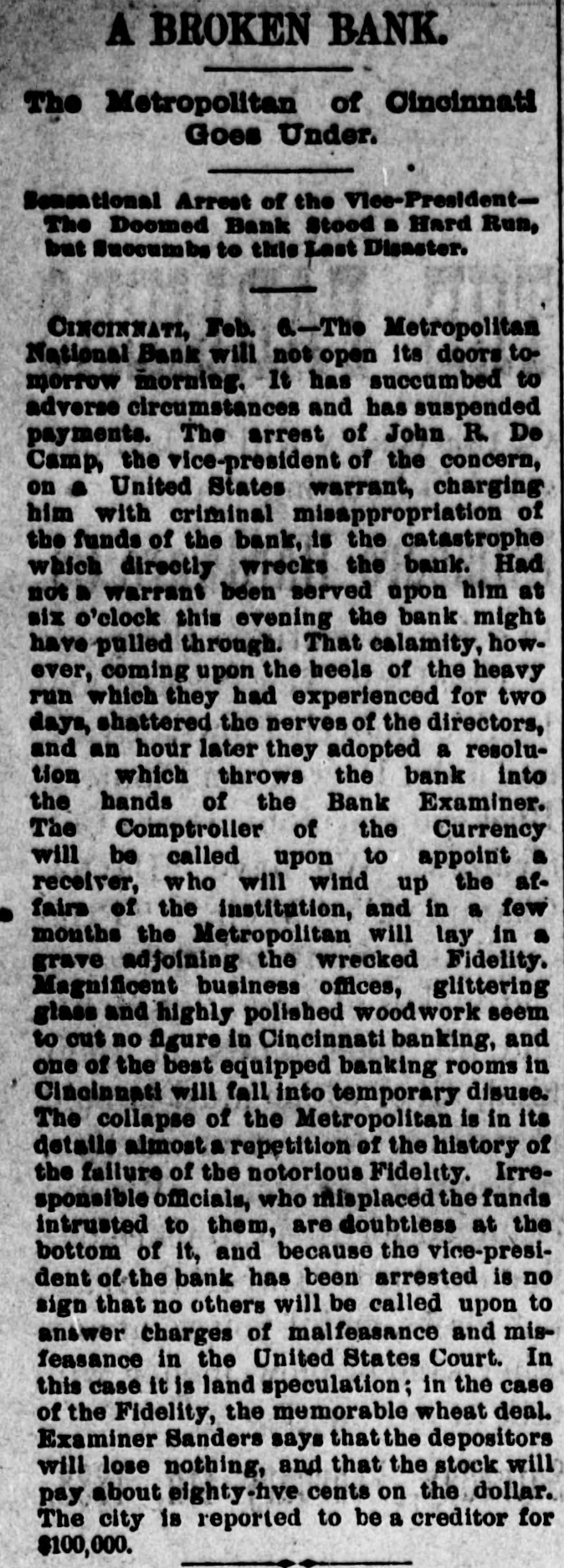
A BROKEN BANK. The Metropolitan of Cincinnati Goes Under. Semmational Arrest of the Vice-PresidentThe Doomed Bank Stood a Hard Run, but Succumbs to this Last Disaster. CINCINNATI, Feb. a-The Metropolitan National Bank will not open its doors to morrow morning. It has succumbed to adverse circumstances and has suspended payments. The arrest of John R. Do Camp, the vice-president of the concern, on a United States warrant, charging him with criminal misappropriation of the funds of the bank, is the catastrophe which directly wrecks the bank. Had not a warrant been served upon him at six o'clock this evening the bank might have pulled through. That calamity, however, coming upon the heels of the heavy run which they had experienced for two days, shattered the nerves of the directors, and an hour later they adopted a resolution which throws the bank into the hands of the Bank Examiner. The Comptroller of the Currency will be called upon to appoint a receiver, who will wind up the affairs of the institution, and in a few months the Metropolitan will lay in a grave adjoining the wrecked Fidelity. Magnificent business offices, glittering glass and highly polished wood work seem to out no figure in Cincinnati banking, and one of the best equipped banking rooms in Cincinnati will fall into temporary disuse. The collapse of the Metropolitan is in its details almost a repetition of the history of the failure of the notorious Fidelity. Irresponsible officials, who misplaced the funds intrusted to them, are doubtless at the bottom of it, and because the vice-president of the bank has been arrested is no sign that no others will be called upon to answer charges of malfeasance and misfeasance in the United States Court. In this case it is land speculation; in the case of the Fidelity, the memorable wheat deal. Examiner Sanders says that the depositors will lose nothing, and that the stock will pay about eighty.hve cents on the dollar. The city is reported to be a creditor for $100,000.


Article from Alma Record, February 17, 1888

Click image to open full size in new tab

Article Text

The failure of the Metropolitan National bank of Cincinnati, has led to considerable agitation of the subject by pub ic men in Washington. A prominent member of the house says "that enough care is not exercised in the selection of the men whose duty it is to examine and report upon the conditio n of the national tanks of the country. If these men were competent it does not seem possible that they would fail to discover the crooked condition of the banks. In the case of the Metropolitan bank the books show gross violation of the banking laws in the matter of loans advanced to officers of the bank and others. It is my of inion that something should be done by con gress in the way of curing the abuses which have grown up under our pres. ent national banking laws or else failures or consequent ru'n to the hundreds of innocent depositors will be more frequent in the future than they have been in the past."


Article from The Sun, February 19, 1888

Click image to open full size in new tab

Article Text

Cause of the Bix Bank Failure. CINCINNATI, Feb. 18.-Mr. Sanders, Government Bank Examiner. says the Metropolitan National Bank was ruined by its own policy of making loans upon insufficient collateral. and he verifies the statement that even if the arrest of Vice-President De Camp had not been made the bank would have been compelled to suspend. because the telegraphic orders received the day before the suspension were more than enough to swallow up all the money that could have been obtained.


Article from New-York Tribune, February 19, 1888

Click image to open full size in new tab

Article Text

BAD LOANS BY THEMETROPOLITAN BANK. CINCINNATI. Feb. 18.-Mr. Sanders, Government Bank Examiner, says that the Metropolitan National Bank was ruined by Its policy of making loans upon insufficient collateral, and he verifies the statement made some time ago in these dispatches that even If the arrest of De Camp had not been made the bank would have been compelled to suspend, because the telegraphic orders received the day before the suspension were more than enough to have swallowed up all the money that could have been obtained from the banks of Cincinnati. The examiner says that President Means has paid all his indebtedness which was pers nal. but there is still a large claim against him as trustee for money lent to a syndicate engaged in different enterprises. This has not been settled. Mr. Sanders does not consent to make a statement of the bank's condition, but says that the best paper of the bank was given to the Cincinnati banks for the loan made just before the suspension. and that, therefore, it cannot be told how much may be realIzed for the stockholders. George Gerke has taken up a p rtton of his paper. F. N. Roth is understood to be making arrangements to meet all his Indebtedness promptly. All this money is deposited by the receiver In the Sub-Treasury.


Article from The Memphis Appeal, April 17, 1888

Click image to open full size in new tab

Article Text

The Metropolitan Bank O. 16. CINCINNATI, O., April 16.-Receiver McConyille, of the Metropolitan National bank, has received the checks upon the assistant United States treasurer to pay all claims of depositors of the Metropolitan National bank whose claims were proved before April 5. Claims are paid in full with interest from the date of the bank's suspension. Each claimant receives a check for the amount of his claim. There are about 400 of these checks, aggregating $330,190. The largest is for $50,000, the smallest for 8 cents. This latter was a balance due on a deposit made by a guardian.


Article from Watertown Republican, May 30, 1888

Click image to open full size in new tab

Article Text

A Cincinnati Bank Reorganized. The stockholders of the Metropolitan National Bank, of Cincinnati, which, by order of the comptroller of the treasury. has been in the hands of a receiver for several months, met on the 24th. Receiver McConville made his report and turned the bank over to the directors and stockholders. Of the latter forty were represented in person or by proxy. The receiver reported: Good assets, $415,000; doubtful assets, $576,000; worth-


Article from Evening Capital, December 31, 1888

Click image to open full size in new tab

Article Text

PRICE ONE CENT sea: lost ia Thirteen killed at Flaverhill bridge over the Merrimac on Boston and Maine railroad. 12 Blizzard in the northwest Immense damage done: many frozen to death 17. E C. Walthall re-elected senator from Mississippi. 18. Norwegian bark Freidas sunk in collision with British steamer Toronto off Ireland; 13 drowned. Court Clerk Irion, of Birmingham, Ala., defaulted in $20,000. 19. Hatfield-McCoy row. 22. Fourteen burned to death at Tower, Mipn. 23. Charles O'Brien, cashier, and Elmer E. Morse, bookkeeper, Albany First National bank, defaulted in $200,000. 21. Colliery explosion at Wellington, B. C.:25 killed. 25. United States Senator Wilson, of Iowa, reelected. 25, 25 Great storm on the Atlantic coast. 27. Deficit of $350,000 alleged in the accounts of the late government of Manitoba. FEBRUARY. 1. Twenty two drowned in wreck of the British bark Absacom near mouth of the Columbia river. 5. White Cap outbreak in Indiana 7. Failure of the Metropolitan National bank, Cincinnati, President Means, Cashier Harper and others artested. 8. Murder of Amos J Snell, Chicago. (Tascott case). Henry Reece, cashier Continental hotel, Philadelphia, defaulter in $60,000. 11. James Albert won six-day go-as-you-please walking match New York, breaking world's record. 17 Two Americ . ships ordered to Tangiers, Morrocco, to Lettle row between the sultan and the United States consul. 19 Tornado a Mt. Vernon, Ills. 21 killed. of 2b Twenty-five killed by explosion of boiler steamer in the United States of Colombia. 29. Mackay and Flood quarrel over losses in wheat and dissolve partnership 27. Forty lost by explosion of a ferryboat at Val. lejo, Cal MARCH. 1. International railway connecting Mexican Central with Southern Pacific opened for business. 8. Discovery of graveyard insurance scheme, Charleston, S. C. 4. Erastus J. Jones, ex treasurer of Dauphin county, Pa., defaulter in $61,000. 11. 12,13. Famous blizzard along the Atlantic coast. Great damage done, railroads blocked, many frozen to death, many shipwrecks. 16. Gen. Adam Badeau brought suit against Mrs. Grant for compensation for assistance in preparing Gen. Grant's Memoirs. Settled late in the year. 17. 19 killed on Savannah, Florida and Western railroad, near Blakshear, Ga. 18. Confession by a member of the Missouri Bald Knobbers. 20. State Treasurer Tate, Ky defaulter in $250,000. 22. Blizzard in the northwest. 25. Tornado destroys town of Ninnescab, Kan. 27 Terrible floods in Germany and Hungary: floods in many parts of the United States: many lives lost and much damage done. President Close and Cashier White of the State National bank of Raleigh, N. C., defaulted in $73,000. 29. 30 miners killed by explosion at Rich Hill, Mo. Capt. Pau! Boyton adrift all day in the ice of Lake Michigan. APRIL. 1. Diss Debar Marsh spiritualistic sensation, New York, in full blast. Secretary Bayard expressed dissatisfaction with the conduct of Germany in Samoa. 5. Twelve killed in railroad accident at Newhamp ton, Ohio. 6. Gen George Crook nominated for major general in place of Gen. Terry. Col. John R. Brooks made brigadier general in Crook's place. 13. Failure of the American exchange in London; Henry F. Gillig general manager; liabilities, $4,000,000. 18. Eighteen burned to death at Celaya, Mex., by the burning of a stand for spectators of a bull fight. Senator Stanford's racing stables burned at Palo Alto, Cal. 23. Thos. Tunstall of Mobile, Ala., made United States consul to San Salvador. 24. John H. Murphy, confidential clerk of Dr. Daniel Gray of Holmesburg, Pa., defaulted in $27,000. 27. Gen. Joseph E. Johnston admitted to contributory membership by Gen. E. D. Baker Post, G. A.R. 29 Ship Smyrna sunk in collision with steamer Moto off Isle of Wight. Thirteen drowned. MAY. 1. Assistant Cashier De Baun, of the Park Na tional bank, New York, defaulted in $95,000. 2. Ten thousand dollars stolen from registered letters near Harrisburg, Pa. 3. Fifteen banks failed in Buenos Ayres. 6. Cloud burst near Maize, Kan., causing flood which swept the house and entire family to a watery death. Explosion of a carload of dynamite at Locust Gap, Pa. Eight killed. 12. Train robbery at Aguazarca, A. T. 13. High water along the Missouri and Red rivers. Several lives lost. 18. Methodist general conference created an order of deaconess for charitable work. 22. Rev. John H. Vincent and Rev. James M. Fitzgerald made bishops by the general Methodist conference. 23. Rev. J.C. Joyce made bishop by the general Methodist conference. Randall L. Gibson elected senator from Louisiana. 24. Dr. John T. Newman and Rev. Dr. Goodsell made bishops by the general Methodist conference. Corner stone of the now Roman Catholic university laid at Washington. 25. Rev. J. M. Thoburn elected bishop of India by the general Methodist conference. Exciting discussion of the negro question at the general assembly of the Preshyterian church in Philadelphia. 26. The southern assembly of the Presbyterian church decided against Dr. Woodrow and his evolution theory. 23 Destructive storms throughout the United States. Enormous losses. 29. General assembly of the southern Presby terian church decided against organic union. 30. E. D. White elected senator from Louisiana. JUNE. 3. White Cap outrages in Indiana. 4. Gen. William B. Francklyn named commissioner of the United States to the Paris exposition; Somerville B. Tuck, assistant commissioner. Eighteen killed in a railroad accident near Tampico, Mexico. Eleven burned to death at Rockdale, Tex. 6. E. L. Lichtenstein, Wilmington, Del., defaulted in $33,250. 8. Steam yacht Gleam run down in the Patapace river by steamer Joppa; M. T. Harrison Garrett, of Baltimore, drowned. Rev. Dr. Layton Coleman made Protestant bishop of Delaware 16. Train robbery at Muscogee, L T. 17. Train robbery near Junction City, M.T. 18. Mme. and Gen. Diss Debar sentenced to the penitentiary for six months. 22. Disastrous floods in Mexico. Many hundreds drowned. 21. Holbrook, A. T. nearly destroyed by fire.
Article from Baxter Springs News, June 28, 1890

Click image to open full size in new tab

Article Text

THE WEST. THE Park National Bank, of Chicago, has suspended. JOSIAH POTTS and Elizabeth Potts, man and wife, were both hanged together at Elko, Nev., for the murder of Miles Fawcett in January, 1888. Both died protesting their innocence. AN awful tornado visited Illinois on the afternoon of the 20th. In the vicinity of Earlville twenty-five lives were lost. Four were killed at the village of Sublette, south of Dixon. At Cornell much damage wasdone and four persons were fatally injured. THE golden jubilee of St. Navier's Jesuit College at Cincinnati closed on the 22d. At mass all the officiating clergy were graduates of this college. In the evening Archbishop Elder, assisted by visiting priests and bishops, celebrated pontificial mass. THE National Farmers' Alliance and Industrial Union will hold its next annual meeting in St. Louis in December. THE employes in the Union Pacific machine shops along the line from Pocotelo, Idaho, to Portland, Ore., have struck on account of a reduction in their wages. THE town marshal of Haughville, near Indianapolis, Ind., was recently fatally wounded by a turbulent negro. THE indictments against J. M. Means and J. R. De Camp, former officers of the Metropolitan National Bank, of Cincinnati, have been nolled in the United States Court upon motion of the United States district attorney. This ends all criminal proceedings against them growing out of the bank failure. MILLIE ALLMET, aged sixteen, was burned to death near Jeffersonville, Ind., while lighting a fire with coal oil. IT is stated on apparently good authority that thecensus returns show a population for Minneapolis of 210,000 and for St. Paul of 159,000 in round figures. THE entire business part of Cerrillos, N. M., fifty miles north of Albuquerque, was destroyed by fire. Loss, $100,000. FOREST fires are raging near Ward, in Boulder County, Col. Immense damage to forest and ranchmen has been done. The fire is beyond control and several mining properties are threatened with destruction. THE workmen in the stone quarries at Joliet, Ill., have renewed their strike. Four of them were arrested for refusing to disperse when ordered to do so by the sheriff. THE Bank of Hartford, Wis., has suspended. DES MOINES. Iowa, claims a population of 53,000; Dubuque, 40,000; Sioux City, 35,000; Cedar Rapids, 28,600; Davenport and Burlington, 30,000 each, and Marshalltown, 10,000. DETROIT is estimated at 197,000. MILWAUKEE'S population is 235,000. CLEVELAND, o., has 248,000 people. INDIANAPOLIS computes its population at 125,000. Two small boys were drowned in St. Louis bay, West Superior, Wis., while playing recently. THERE were six cases of sunstroke in Chicago on the 24th.