14940. Fidelity National Bank (Cincinnati, OH)

Bank Information

Episode Type
Suspension β†’ Closure
Bank Type
national
Bank ID
3461
Charter Number
3461
Start Date
June 21, 1887
Location
Cincinnati, Ohio (39.103, -84.515)

Metadata

Model
gpt-5-mini
Short Digest
2494278fa19f4539

Response Measures

None

Receivership Details

Depositor recovery rate
60.0%
Date receivership started
1887-06-27
Date receivership terminated
1909-10-30
OCC cause of failure
Fraud
Share of assets assessed as good
41.9%
Share of assets assessed as doubtful
15.6%
Share of assets assessed as worthless
42.5%

Description

The Fidelity National Bank of Cincinnati was closed by a government bank examiner on June 21, 1887; a receiver was appointed and the bank remained in receivership with subsequent lawsuits and arrests of officers. Contemporary dispatches describe runs/large withdrawals and clearinghouse drains, but the immediate documented action was a government-ordered closing and appointment of a receiver, followed by permanent winding up.

Events (6)

1. February 27, 1886 Chartered
Source
historical_nic
2. June 21, 1887 Receivership
Newspaper Excerpt
John R. Decamp ... has been appointed receiver and placed in charge of the bank's affairs. (later: Receiver Armstrong appears in subsequent litigation).
Source
newspapers
3. June 21, 1887 Run
Cause
Bank Specific Adverse Info
Cause Details
Alleged losses from a speculative Chicago wheat deal and suspected fraudulent or imprudent dealings by officers (Harper et al.) led to rumor, alarm and withdrawals by correspondent and country banks.
Measures
No explicit liquidity measures reported (some banks kept checks out of clearinghouse; but no temporary payment restrictions by the bank prior to closure mentioned).
Newspaper Excerpt
The sidewalks are lined with people... clearing-house settlements for the past few days have shown an unusual drain on the bank's resources.
Source
newspapers
4. June 21, 1887 Suspension
Cause
Government Action
Cause Details
Bank examiner Eugene Powell ordered the bank closed because of impairment of resources following heavy drains and suspected misconduct; directors were unable to reorganize and a receiver was placed in charge.
Newspaper Excerpt
The Fidelity National Bank was closed this morning by order of the Government through its representative, Eugene Powell.
Source
newspapers
5. June 23, 1887 Other
Newspaper Excerpt
Officers (E. L. Harper, Ammi Baldwin, Ben E. Hopkins) arrested and charged with conspiracy/issuing fraudulent drafts; suits and large liability figures reported ($5,500,000–$6,000,000).
Source
newspapers
6. June 27, 1887 Receivership
Source
historical_nic

Newspaper Articles (23)

Article from Los Angeles Daily Herald, June 22, 1887

Click image to open full size in new tab

Article Text

GENERAL NEWS. Collapse of the Fidelity National Bank. INTER-STATE COMMERCE LAW. The Railway Commission Overhauling the Affairs of the Union Pacific. Associated Press Dispatches to the HERALD. CINCINNATI, June 21.--The Fidelity National Bank closed this morning. bank the officials This is the of heavily which have been credited with being involved in the collapsed Chicago wheat deal. It is understood that the bank examiner has notified the directions that the speculative officials would have to leave. The investigation into the bank's was by one but when he est affairs stockholders, prompted of demanded the collater- larg sight of the securities and loan als two weeks ago, President Harper refused to let him see them. A govern- The ment investigation followed. police are guarding the door of the bank. A RECEIVER APPOINEED. bank examiner has announced bank's The owing to impairment of the take that, the government would resources, of the bank. John R. Decamp, Na. charge President of the Metropolitan receiver Vice Bank, has been appointed It is tional the business of the bank. settleto close stated up that clearing-house have shown now for the past few days resources. ments unusual drain on the bank's kept an this, many banks have a favor. their Besides checks out of the clearing-honee as THE BANK'S BOOKS. has been ascertained that the lia of the It of the bank, exclusive indibilities stock, are about $5,500,000 0.1 capital vidual deposits are about $2,500,00 SERIOUS CHARGES. Union National Bank of Gieve- in atThe afternoon brought suit land the Fidelity recover $67,331.44, had tachment this to against asserting National Bank the defendant corporation incurred the that fraudulently and which criminally suit has been 4 o'clock this affidavits drawn obligation brought. under At for by Attorney Assist- afternoon States District Howant sworn United to by Bank Examiner went to the and ell, a deputy Bank and marshall arrested Vice- Ammie Presi Fidelity L. Harper, Cashier Benjadent F. and Assistant Cashier taken be Baldwin, They were E. States their min United Hopkins. Commissioner bonds for Hoop- fuer, fore where they gave Mr. Harper's other bond two ture was fixed appearance. at $75,000, and the at each. The $10,000 affidavit against about Harper June charges 15th that he "did and on wilfully or misapply National funds unlawfully the Fidelity and credits of and did issue sentiti- of Bank Association deposit without the authority and cates directory of of said association one certifiwith and one the intent deferred, to wit: for $200,000. cate for against the date charge, a draft papers a The similar affidavit $300,000 fixing and Baldwin makes him for at June 13th Hopkins' and affidavit June charges 13th un$10,000. with having on on about draft or certifilawfully cate to wit: of deposit $400,000, issued association. a for certain with large intent sums These of of of defraud- money, affida- secfollow the States Statutes. 5209, described tion vits ing said United language therein for is Imprisonment The penalty in the years penitentiary nor more than not five action by the govern- having ten. authorities This bond is regarded as of eviment after the discovery and finds been taken sufficient to justify it, although it dence very general honored commendation, business transaction men that to that the wheat referred there appears is no to doubt relates to the recent deal in Chicago.


Article from The Palatka Daily News, June 22, 1887

Click image to open full size in new tab

Article Text

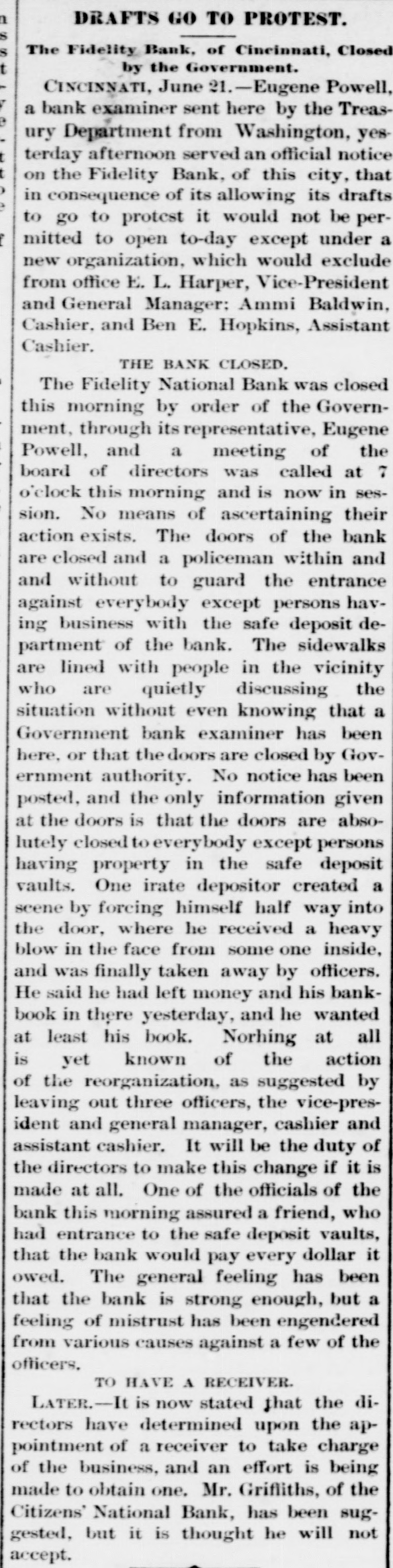
n DRAFTS GO TO PROTEST. The Fidelity Bank, of Cineinnati, Closed by the Government. CINCINNATI, June 21.-Eugene Powell, a bank examiner sent here by the Treasury Department from Washington, yes terday afternoon served an official notice on the Fidelity Bank, of this city, that in consequence of its allowing its drafts to go to protest it would not be perf mitted to open to-day except under a new organization, which would exclude from office E. L. Harper, Vice-President and General Manager: Ammi Baldwin, Cashier. and Ben E. Hopkins, Assistant Cashier. THE BANK CLOSED. The Fidelity National Bank was closed this morning by order of the Government, through its representative, Eugene Powell, and a meeting of the board of directors was called at 7 o'clock this morning and is now in session. No means of ascertaining their action exists. The doors of the bank are closed and a policeman within and and without to guard the entrance against everybody except persons having business with the safe deposit department of the bank. The sidewalks are lined with people in the vicinity who are quietly discussing the situation without even knowing that a Government bank examiner has been here. or that the doors are closed by Government authority. No notice has been posted. and the only information given at the doors is that the doors are absolutely closed to everybody except persons having property in the safe deposit vaults. One irate depositor created a scene by forcing himself half way into the door, where he received a heavy blow in the face from some one inside, and was finally taken away by officers. He said he had left money and his bankbook in there yesterday, and he wanted at least his book. Norhing at all is yet known of the action of the reorganization. as suggested by leaving out three officers, the vice-president and general manager, cashier and assistant cashier. It will be the duty of the directors to make this change if it is made at all. One of the officials of the bank this morning assured a friend, who had entrance to the safe deposit vaults, that the bank would pay every dollar it owed. The general feeling has been that the bank is strong enough, but a feeling of mistrust has been engendered from various causes against a few of the officers. TO HAVE A RECEIVER. LATER.-It is now stated that the directors have determined upon the appointment of a receiver to take charge of the business, and an effort is being made to obtain one. Mr. Grifliths, of the Citizens' National Bank, has been suggested, but it is thought he will not accept.


Article from The Morning News, June 22, 1887

Click image to open full size in new tab

Article Text

FIDELITY BANK CLOSED. Affected by the Wheat Deal and a Receiver is Appointed. CINCINNATI, O., June 21.-The Fidelity National Bank was closed this morning by an order of the government through its representative, Eugene Powell. A meeting of the board of directors was called at 7 o'clock this morning, and is now in session. No means of ascertaining their action exists. The doors of the bank are closed and the policemen within and without guard the entrance against everybody except persons having business with the safe deposit department of the bank. The sidewalks in the vicinity are lined with people who are quietly discussing the situation without even knowing that the government bank examiner has been here, or that the doors are closed by government authority. No notice has been posted and the only information given at the door is that the doors to are absolutely closed to everybody except persons having property in the safe deposit vaults. HIS BOOK AT LEAST. One irate depositor created a scene by forcing himself half way into the door where he received a heavy blow in the face from some one inside, and was finally taken away. He said he had left some money and his bank book in there yesterday, and he wanted at least his book. CLOSED DOORS TO ALL Nothing at all is known yet of the action of the reorganization as suggested, by leaving out three officers, the vice president and general manager, the cashier and assistant cashier. It will be the duty of the directors to make this change, if it is made at all. One of the officials of the bank this morning assured a friend, who had entrance to the safe deposit vaults, that the bank would pay every dollar it owed. The general feeling has been that the bank is strong enough, but a feeling of mistrust has become engendered, from various causes, against a few of the officers. SUGGESTION OF A RECEIVER. LATER. is now stated that the directors have determined upon the appointment of a receiver to take charge of the business, and an effort is being made to obtain one. Mr. Griffiths, of the Citizens' National, has been suggested, but it is thought he will not accept. At the meeting of the directors this morning Bank Examiner Powell announced that owing to the impairment of the bank's resources the government would take charge of it and would appoint a receiver to wind up the business. issaid unofficially that the alternative was given of continuing in business by a reorganization which would leave out Vice President Harper, Cashier Baldwin and the Assistant Cashier, Ben. E. Hopkins, but that the directors were unable to agree upon such plan, or were unwilling to take the risk of a run following the interference of the government. The outcome, however, was the appointment of John R. Deca np, Vice President of the Metropolitan National Bank, as Reeiver, and he was placed in charge of the bank's affairs. It is now stated that the clearing house settlements for the past few days have shown an unusual drain on their resources. Besides many of the banks have kept their checks out of the clearing house as a favor. There are numerous rumors afloat concernerning the cause of the action of the bank xaminer. Vice President Harper, who as borne the heavy strain for the past He week is much distressed this morning. tells himself a ruined man and is in a high tate of excitement. A conservative direcor says it is his opinion that the depositors will get their money in full. HARPER & co.'s CONDITION. E. L. Harper, Vice President of the Filelity National Bank, who is also senior member of the firm of E. L. Harper & Co., aas made an individual assignment. The firm of E.L. Harper & Co. also assigned, These failures are the result of the closing of the Fidelity Bank. Ten days ago Harper taid of the condition of his firm that it was worth over $2,000,000, most of it being his own property. He had then $500,000 Hock in the Fidelity National Bank and wwed 8 per cent. of the stock of Fidelity Safe and Deposit Company, besides owning controlling interest in Swift's Iron and iteel works and the Riverside rolling mill. Later in the day E. L. Harper made an astignment of his rolling mill in Newport, all Ky. An estimate of the liabilities in the interests of E. L. Harper is approachng $2,000,000, the assets, counting his bank tock at par, are about $2,000,000. THE BANKS LIABILITIES. WASHINGTON, June 27.-It is stated here hat the liabilities of the Fidelity National Bank of Cincinnati, exclusive of the capital tock, are about $5,500,000. The individual leposits amount to $2,500,000.


Article from The Palatka Daily News, June 22, 1887

Click image to open full size in new tab

Article Text

Erie Texas Pacific 396 324 East Tennessee 1314 l'enn Coal & Iron. 3814 Lake Shore Union Pacific 981/2 60% Louisville & Nash. 671/8 New Jersey Cen 804 Memphis & Char... 58 Missouri Pacific. 107 Mobile & Ohio 1396 Western nion. 7734 Cotton Seed Oil Tr.. 50 *Asked. +Bid. The renewal of panicky feeling in the Chicago market was supplemented to-day by closing the doors of the Fidelity Bank of Cincinnati. With these influences in their favor and the market lacking stimulus of moderate buy ing orders from London, usual of late, the bearish room traders hammered prices all around the room throughout almost the entire day Trading, which was dull and feverish. was more purely local than has been seen for some time. Late in the day advices were received that the Fidelity Bank would resume business shortly, and coal stocks, aided by the advance in price of coal in Philadelphia, led to a general recovery, buying of Reading being especially heavy in the last hour. Pacific Mail was special object of attack in the early morning, and did not recover the loss. Trading in the last hour was the heaviest of the day. and all the active stocks shared in the improvement, most of them being carried to the heaviest figures of the day. Specialties were unusually quiet and featureless. The opening was weak at declines from yes. terday final figures, ading to one-half per cent, and under the lead of Pacific Mail, which dropped 14 in the first fifteen minutes, further fractional declines were made in the general list. After the first half hour the market relapsed into extreme dullness, although a heavy tone continued until noon. After that time there was a change for the better in tone and speculation, although no feature was developed until the last hour, when decided strength was shown by the entire list, and Reading vanced 11/4 per cent. Total sales were 196,000 shares. Net result of the day's business is that prices are irregularly changed, although the differences are for fractional amounts only, except for Reading, which is up 11/2 per cent. Cotton. NEW YORK. June Greene & Co's report on cotton futures says "It has beena feverish market all day, and while cost on the old erop ranged to 10 points at times the advance was not maintained, and the early gain was due in great measure to manipulation on the part of the "bull" combination, through which local scalpers on the "short" side were induced to cover, but during the afternoon buy ers became scarce and there was a reactionary feeling. There was failure of a Cincinnati bank and the break here in wheat and coffee, coupled with the indifferent demand for spots, all appeared to earry more or less reflected influence. The erop was firm in the morning. but afterward eased somewhat under better weather reports. Afternoon report Cotton Net and gross reeipts, 3,035. Futuresclosed steadp; sales, 11 Jnue, 10 76@10 78 July 10 78 August, 10 83 @ 10 84; September, 10 45@10 46 October, 10 02 @10 03 November. 9 85@9 86 December, 9 84@9 85; January, 9 89@9 90 February, 9 96 @997; March, 1003@ 10 04; April 10 11@10 Cotton quiet; sales today 163 Middling Uplands, 11; Orleans 11 3-16; net receipts, 324; exports to Great Britain 669; to the Continent, 1,117; stock, 297,581. GALVESTON, June 21. Cotton nominal: middling, 10 9-16; net receipts, gross, -; sales, 67: stock, 5,739; exports coastwise, NORFOLK, June 31. Cotton quiet: middling. 11: net receipts, 3 gross receipts, 3: sales, stock, 3,048; exports coastwise, 38. BALTIMORE, June 21. Cotton firm mid dling, 11% net receipts, gross, sales, stock, 3,254; exports to Creat Britain, coastwise, BOSTON, June 21. Cotton quiet middling, 11Β½; net receipts, 86; gross receipts, 340 sales, none; stock, exports to Great Britain, WILMINGTON, June 21. Cotton firm middling, 11 net receipts, 2: gross receipts, : sales, none; stock, 1,603; exports coastwise PHILADELPHIA, June 21. Cotton quiet: middling, 11%; net receipts, gross receipts, stock, 13,875; exports to Great Britain, SAVANNAH, June 21. Cotton firm middling, 10% net receipts, 28; gross, 28 sales, : stock, 3,229; exports coastwise, NEW ORLEANS, June 21. Cotton dull middling, 10 11-16; net receipts 181; gross receipts, 181: sales, 750; stock, 89,030; exports to Great Britain, to the Continent, coastwise, none. MOBILE, June 21.- Cotton easy; middling, 1034: net receipts, 2: gross receipts, = sales, i stock, 382: exports coastwise, MEMPHIS, June 21. Cotton quiet middling, 104 net receipts, 63; gross receipts, 64; shipments, 125; stock,"8,190. AUGUSTA, June 21. Cotton quiet; middling, 10 15 16; net receipts, 10; gross receipts, sales, CHARLESTON. June 21. Cotton quiet but firm middling, 10%; net receipts, = gross receipts, 2: sales. stock, 724; exports coastwise, General Markets. CHICAGO, June 31.-An oppressively weak feeling prevailed in wheat at the opening, and traders were feeling decidedly blue July opened 3/4e lower at 69%, but some little effort was made to sustain the market, and a few minutes later July was selling at 69%c. The support was only temporary, however, and bank wheat being put on the market, July soon reacted to 69%, around which figure it held steady during the first hour of the session. At the end of that time "tailers" found they had sold themselves short, and began to cover, and July went up to 70% under this influence. Marketing bank wheat again caused July to ease back to 60% There was no let up in sales of wheat for account of banks to-day, and realizing continued straight up to the close of the session. The effect of the general selling was to break wheat from 6916 to 6834 for July, the latter figure being reacted about noon at bottom price. There were many good buying orders, and the reaction sent the price of July up to 69%, at which the morning session closed. Heavy exports from seaboard and covering by short interest made the afternoon market stronger. July sold up to 70% and closed at 20. Fluctuations in June were not very marked. It opened at 68% and 69. and closed at Corn was moderately active, with feeling somewhat unsettled. Prices were generally weak and lower. Trading was largely local and offerings were quite free, but the demand was very light. The weaker feeling which prevailed in the wheat market during the earlier hours of the session also had a depressing effect on corn. July opened at 36 and sold down to 351/4, but in ympathy with wheat during the afternoon session reactted, closing at 364 Oats were dull and weak. There was little speculative interest centered in the market; July opened 1/20 lower at 251/4, sold down to 25. and closed at the opening figure. Quite an active speculative business was transacted in the provision market, but the feeling was greatly unsettled. and prices ruled weak and lower. Offerings were quite liberal, while the demand was only fair and mainly from parties who covered outstanding contracts at a profit. Receipts of hogs were light, and prices ruled higher, but nervous feeling in grain markets had considerable effect on prov isions. July lard opened at $6 25, sold up to $6.30 and down to $6.25, closing at the opening figure. July spare ribs opened at $7.3216, sold up to $7.35 and down to 10, closing at $7.27% Cash quotations wereas follows: Flour ruled quiet, with prices steady at former quotations. No. 2 Spring W heat, 683/4e No. 3 Spring Wheat, No. 2 red. 74. No. 2 Corn. 35360 No. Oats, 24Β½. Mess Pork, $2. Lard, $6.200 $6.25 Short rib sides, loose, $7.20. Dry salted shoulders, boxed, $5.60@5.70. Short clear sides, boxed, $7,55@7.60. Whisky, $1.10. Leading futures closed as follows: Wheat June, 69 July, 70: August. 74%: Corn June, 35Β½; July, 361/4 August, 37% Oats, June, 2434; July, 44; August, 25% Mess Pork June, $150 Lard June, $6.25 : July $6.25; August, $6.35. Short Ribs June, $7.27%: July. $7.2736; August, $7.3714. NEW YORK, June 21.- Southern Flour dull and heavy common to fair extra. $3.40 good to choice do. $4 10@5. 10. Wheat No. : red, 88@924: June, 87@94; July, August, 3@85. Corn 1/4e lower No. = 4614; June, nominal: July, 4616@40%. Oats a shade lower No. = 33Β½: No. June, 33@33%: July 3440 32% Hops quiet and steady Coffee fair Rio nominal at 1814: No. Rio July, $16 75: Angust, $16.25@16.95; September, $16.50617.05. Sugar steady and quiet Molasses steady -one cargo 50 test, 1916. Rice firm. CottonSeed Oil, 240 for refined; crude nominal. Rosin dull at $1.234@1.274. Turpentine dull and weak at 34Β½. Hides quiet and steady wet salted New Orleans selected, 45 and 60 pounds, 9Β½ 10 Texas selected, and 60 pounds, 10. Wool


Article from The Indianapolis Journal, June 22, 1887

Click image to open full size in new tab

Article Text

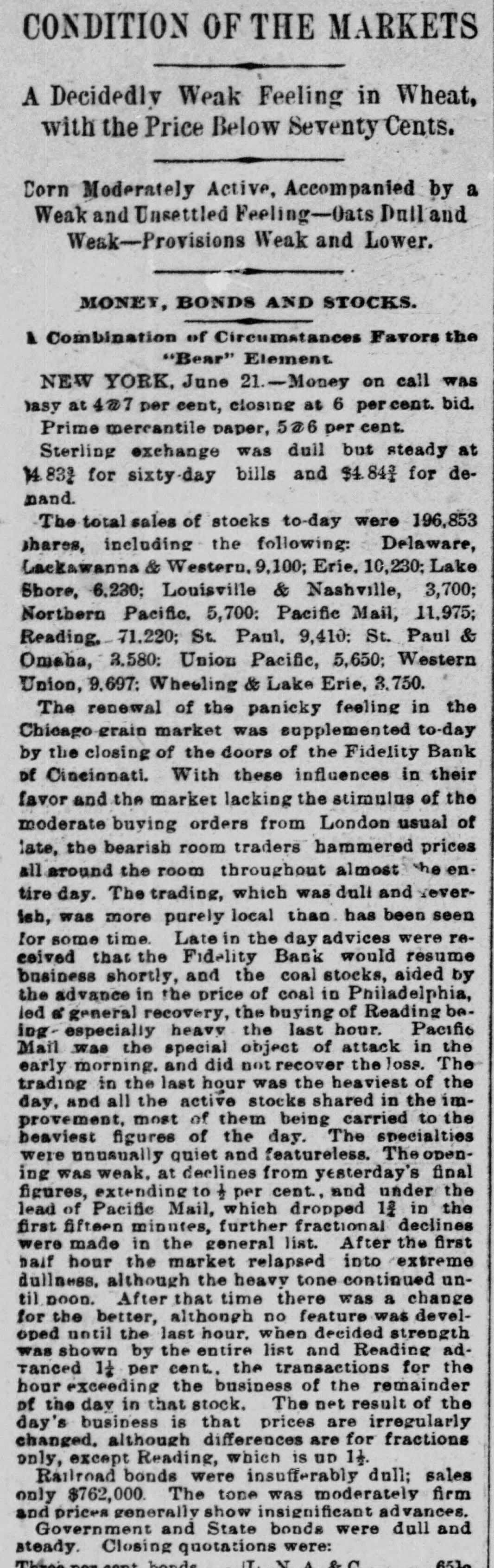
CONDITION OF THE MARKETS A Decidedly Weak Feeling in Wheat, with the Price Below Seventy Cents. Dorn Moderately Active, Accompanied by a Weak and Unsettled Feeling-Oats Dull and Weak-Provisions Weak and Lower. MONEY, BONDS AND STOCKS. a Combination of Circumstances Favors the "Bear" Element NEW YORK, June 21.-Money on call was asy at 4@7 per cent, closing at 6 percent. bid. Prime mercantile paper, 5a6 per cent. Sterling exchange was dull but steady at 14.83% for sixty-day bills and $4.843 for demand. The total sales of stocks to-day were 196,853 shares, including the following: Delaware, Lackawanna & Western. 9,100; Erie, 10,230; Lake Shore, 6,230; Louisville & Nashville, 3,700; Northern Pacific, 5,700: Pacific Mail, 11,975; Reading. 71.220; St. Paul, 9,410; St. Paul & Omaha, 3.580: Union Pacific, 5,650; Western Union, 9,697: Wheeling & Lake Erie, 3,750. The renewal of the panicky feeling in the Chicago grain market was supplemented to-day by the closing of the doors of the Fidelity Bank of Cincinnati. With these influences in their favor and the market lacking the stimulus of the moderate buying orders from London usual of late, the bearish room traders hammered prices all around the room throughout almost the entire day. The trading, which was duli and reverish, was more purely local than has been seen for some time. Late in the day advices were received that the Fidelity Bank would resume business shortly, and the coal stocks, aided by the advance in the price of coal in Philadelphia, led of general recovery, the buying of Reading being- especially heavy the last hour. Pacific Mail was the special object of attack in the early morning. and did not recover the loss. The trading in the last hour was the heaviest of the day, and all the active stocks shared in the improvement, most of them being carried to the beaviest figures of the day. The specialties were nusually quiet and featureless. The opening was weak. at declines from yesterday's final figures, extending to 1 per cent., and under the lead of Pacific Mail, which dropped 14 in the first fifteen minutes, further fractional declines were made in the general list. After the first half hour the market relansed into extreme dullness. although the heavy tone continued until noon. After that time there was a change for the better, although no feature was developed until the last hour. when decided strength was shown by the entire list and Reading advanced 11 per cent. the transactions for the hour exceeding the business of the remainder of the day in that stock. The net result of the day's business is that prices are irregularly changed. although differences are for fractions only, except Reading, which is up 11. Railroad bonds were insufferably dull; sales only $762,000. The tone was moderately firm and prices generally show insignificant advances. Government and State bonds were dull and steady. Closing quotations were: Three cent hands IT. V & C 651g


Article from St. Paul Daily Globe, June 22, 1887

Click image to open full size in new tab

Article Text

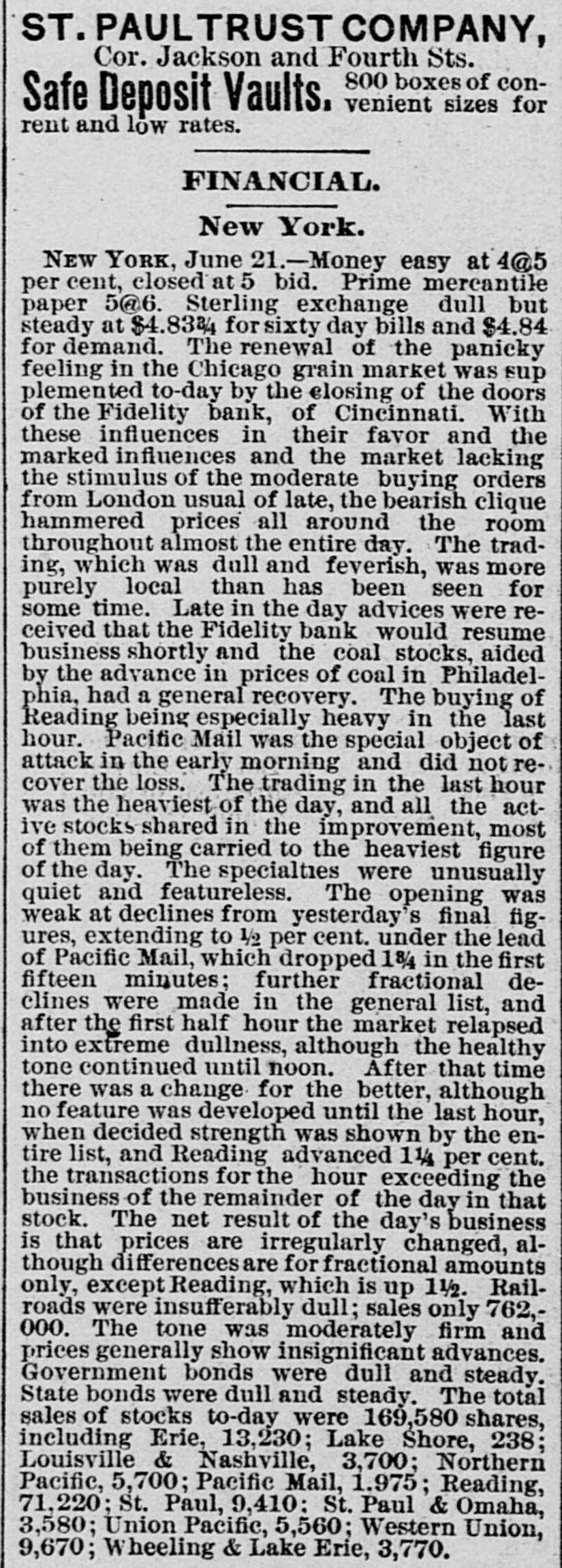
ST. PAULTRUST COMPANY, Cor. Jackson and Fourth Sts. 800 boxes of convenient sizes for Safe Deposit Vaults. rent and low rates. FINANCIAL. New York. NEW YORK, June 21.-Money easy at 4@5 per cent, closed at 5 bid. Prime mercantile paper 5@6. Sterling exchange dull but steady at $4.83% for sixty day bills and $4.84 for demand. The renewal of the panicky feeling in the Chicago grain market was sup plemented to-day by the closing of the doors of the Fidelity bank, of Cincinnati. With these influences in their favor and the marked influences and the market lacking the stimulus of the moderate buying orders from London usual of late, the bearish clique hammered prices all around the room throughout almost the entire day. The trading, which was dull and feverish, was more purely local than has been seen for some time. Late in the day advices were received that the Fidelity bank would resume business shortly and the coal stocks, aided by the advance in prices of coal in Philadelphia, had a general recovery. The buying of Reading being especially heavy in the last hour. Pacific Mail was the special object of attack in the early morning and did not recover the loss. The trading in the last hour was the heaviest of the day, and all the active stocks shared in the improvement, most of them being carried to the heaviest figure of the day. The specialties were unusually quiet and featureless. The opening was weak at declines from yesterday's final figures, extending to 1/2 per cent. under the lead of Pacific Mail, which dropped 18/4 in the first fifteen minutes; further fractional declines were made in the general list, and after the first half hour the market relapsed into extreme dullness, although the healthy tone continued until noon. After that time there was a change for the better, although no feature was developed until the last hour, when decided strength was shown by the entire list, and Reading advanced 11/4 per cent. the transactions for the hour exceeding the business of the remainder of the day in that stock. The net result of the day's business is that prices are irregularly changed, although differences are for fractional amounts only, except Reading, which is up 11/2. Railroads were insufferably dull; sales only 762,000. The tone was moderately firm and prices generally show insignificant advances. Government bonds were dull and steady. State bonds were dull and steady. The total sales of stocks to-day were 169,580 shares, including Erie, 13,230; Lake Shore, 238; Louisville & Nashville, 3,700; Northern Pacific, 5,700; Pacific Mail, 1.975; Reading, 71,220; St. Paul, 9,410: St. Paul & Omaha, 3,580; Union Pacific, 5,560; Western Union, 9,670; Wheeling & Lake Erie, 3,770.


Article from The Salt Lake Herald, June 22, 1887

Click image to open full size in new tab

Article Text

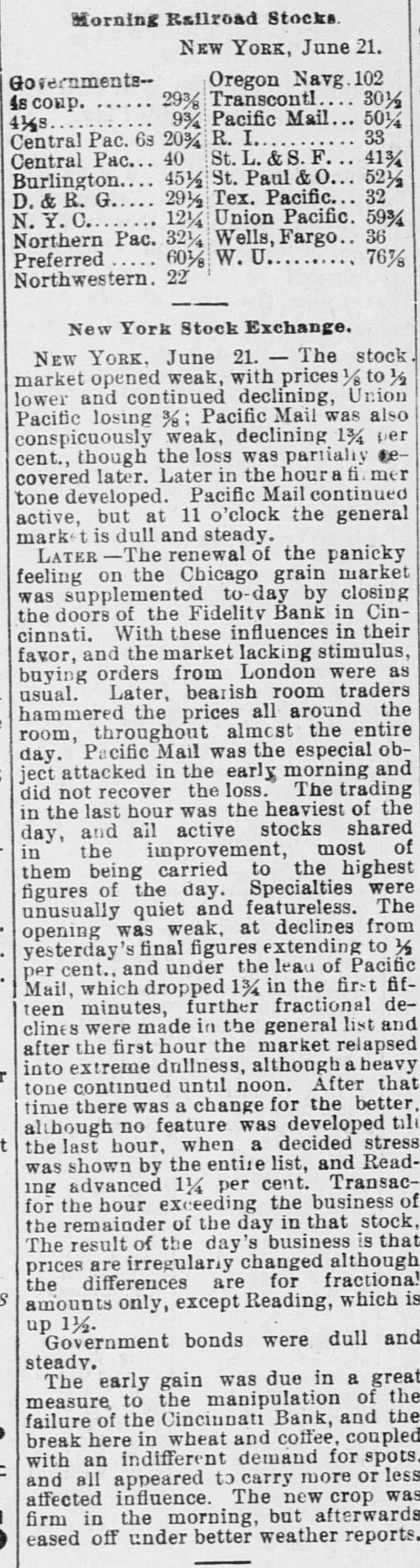
Morning Railroad Stocks. NEW YORK, June 21. Oregon Navg 102 Governments-Transcontl 30Β½ 293/8 4s соир. Pacific Mail 93/4 50Β½ 41/28 33 R.I. Central Pac. 6s 203/4 40 St. L. & S. F. 413/4 Central Pac St. Paul &O 52Β½ 45Β½ Burlington 32 Tex. Pacific 29Β½ D. & R. G Union Pacific. 593/4 12Β½ N.Y.C. Northern Pac. 32Β½ Wells, Fargo 36 W. U 60Β½ 76Β½ Preferred Northwestern. 22 New York Stock Exchange. NEW YORK, June 21. - The stock market opened weak, with prices 1/8 to Β½ lower and continued declining, Union Pacific losing 3/8; Pacific Mail was also conspicuously weak, declining 13/4 per cent., though the loss was partially cecovered later. Later in the hour a fi. mer tone developed. Pacific Mail continued active, but at 11 o'clock the general market is dull and steady. LATER - The renewal of the panicky feeling on the Chicago grain market was supplemented to-day by closing the doors of the Fidelity Bank in Cincinnati. With these influences in their favor, and the market lacking stimulus, buying orders from London were as usual. Later, bearish room traders hammered the prices all around the room, throughout almost the entire day. Pacific Mail was the especial object attacked in the early morning and did not recover the loss. The trading in the last hour was the heaviest of the day, and all active stocks shared in the improvement, most of them being carried to the highest figures of the day. Specialties were unusually quiet and featureless. The opening was weak, at declines from yesterday's final figures extending to Β½ per cent., and under the leau of Pacific Mail, which dropped 13/4 in the first fifteen minutes, further fractional declines were made in the general list and after the first hour the market relapsed into extreme dullness, although a heavy tone continued until noon. After that time there was a change for the better, although no feature was developed tili the last hour, when a decided stress was shown by the entire list, and Reading advanced 1Β½ per cent. Transacfor the hour exceeding the business of the remainder of the day in that stock, The result of the day's business is that prices are irregularly changed although the differences are for fractional amounts only, except Reading, which is up 1Β½. Government bonds were dull and steady. The early gain was due in a great measure to the manipulation of the failure of the Cincinnati Bank, and the break here in wheat and coffee, coupled with an indifferent demand for spots. and all appeared to carry more or less affected influence. The new crop was firm in the morning, but afterwards eased off under better weather reports.


Article from The Wheeling Daily Intelligencer, June 23, 1887

Click image to open full size in new tab

Article Text

METIOD: OF BUSINESS Pursued by the Bank-Country Correspondonts in Danger-Value of Stock. CINCINNATI, June 22.-The Enquirer says of the Fidelity bank: 'From the start the bank commenced to do 8 wonderful business; but it was a business which profited it nothing. Other banks paid for the deposits of country banks 2 per cent. This bank paid 21. Other banks charged for collections. This bank did not. Other banks sold exchange. This bank gave it away. This bank had no income whatever save from discounts, and it discounted comparatively little. It was deposits that it was after. It secured a vast deposit list. Mr. Harper WAS supposed to be our greatest financier. He WRS credited with having made a million in an ancient Chicago wheat deal. Money flowed in. The business was immenso, but it paid nothing. There have been questions since whether Mr. Harper made anything at all upon his ancient Chicago wheat deal. Suddenly, in the flush of its prosparity, it occurred to the Fidelity to enlarge its capital from $1,000,000 to $2,000,000. It 8 placed some of it round about by personal e solicitation. In many casea it sold its stock for n single-name, note, accepting the stock itself as collateral. This was an absolute violation of the National Banking law. It in more than doubtful if the notes can be collected. The great bulk of the stock was taken by Mr. E. L. Harper. He held, in his own name, 2,312 shares. In the name of one of his employes, Mr. Matthews, he held 1,709 shares. In the name of another employe, Mr. Gahr, he held 1,170 shares. He had, in addition, other holdings not quite 80 manifest upon the surface. It 18 matter of general knowledge that Mr. Harper was the bank, and that the bank was Mr. Harper." COUNTRY BANKS IN DANGER. The bank has been doing a very large business, and the detention of its mail may cause some serious embarramement to other banks, and the Comptroller of the Currency has been applied to to allow its immediate distribution. The deposits of country banks which kept accounts with the Fidelity, according to the last state. ment was over $3,000,000; just how much of this has been withdrawn can not be stated, as many banks which ordered the Fidelity to remit their balances to New York, and had received advices from Ammi Baldwin, cashier, that the money had been remitted as ordered and the same charged to their account, have found that when they began to check upon such balances in Now York no such balances were there, And that the funds had never been remitted by the Figelity as stated. e The far reaching effect of this action, or e rather inaction, will cripple many country banks no doubt, if it ia not the cause of failures. There is such an intimate connection among correspondent banks of 6 this kind that they bear the relation to each other as brick in a pile on edge-a slight push will send the entire row flat. But, as has been intimated, very many country banks have transfere red balances from the Fidelity to other local banks, and such as have done 60 are safo. On last Tuesday week y the entire local business community e was flooded with diepatches from Chicago, 0 New York and various other quarters eak ing if there was a run ou the Fidelity Na 8 tional Bank, and other such alarming ques tions. These dispatches, and other machinations of speculative persons appar o ently equally unscrupulous HS the Fidelity o trio have proved to be, created an alarm which amounted to quiet 8 run on the o Fidelity of its country bank correspon. denta. On lant Tuesday the Clearing house balance upon the Fidelity was $150,o 000, and of each succeeding day it WAS of about equal amount, until Friday it amounted to $100,000; in addition to this posted individuals checked out their BCs counts. This drain upon the bank's resources could not be stood forever. and the only wonder was that the bank withstood AO long without going under. STOCI


Article from Rock Island Daily Argus, June 23, 1887

Click image to open full size in new tab

Article Text

UNFAITHFUL FIDELITY. MATTERS GROW WORSE DAILY WITH THE CINCINNATI BANK And Also with the Officers Who Wrecked It-A Second Arrest of the Culprits and a Hard Time at Finding Bail-Another Arrest Ahead-A Loss of Six Millions Reported. CINCINNATI, June 23.-E. L. Harper, Vice president; Ammi Baldwin, cashier, and Ben. E. Hopkins, assistant cashier of the Fidelity National bank, were rearrested Wednesday, the two former at the bank and Hopkins at the office of Lawyer Rankin D. Jones. The charge upon which they were arrested this time is that they conspired to defraud in issuing large drafts to the amount of $600,000 for investments in the Chicago wheat deal, and in making false returns to the United States comptroller of the currency. The trio appeared before United States Commissioner Hooper, waived examination, and were bound over to the grand jury. Harper's bail under this arrest was fixed at $15,000, and that of Baldwin and Hopkins at $5,000 each. There was much difficulty in getting bondsmen, and at 5:45, over an hour after the arrest the three were still in custody. H. B. Morehead was the only bondsman offered, and he only went bail for Harper. It looked much as if the prisoners would have to be jailed. Joseph Josephs, a creditor of Harper to the extent of $19,000, has replevined Swift's Iron and Steel works, Newport, which were assigned by Harper. The arrested men finally secured bondsmen and were released. They are to be again arrested on charges similar to those already preferred. The more the affairs of the bank are looked into the worse they appear. It is now the comm on talk on the streets that the liabilities of the bank will reach the stupendous sum of $6,000,000, while the assets dwindle in proportion. It seems a foregone conclusion that depositors will get next to nothing. This is the general talk, but of course it is unofficial and can not be verified until the bank examiner completes his work and makes his report. It is stated that the memorandum which is the substitute for collaterals shows that Wilshire used $1,100,000 of the bank's money, and that collaterals for other loans were hypothecated in New York and elsewhere. It is the belief of some that Wilshire acted as the agent of Harper in conducting the wheat deal, and was not really a borrower. Mr. Eugene Powell, the bank examiner, is credited with saying that the condition of the bank is woful. He said it was singular how Harper had deceived everybody about the matter. When the wheat panic occurred in Chicago, and rumors were out of a run on the Fidelity bank, Mr. Harper stated repeatedly to parties asking for information that he did not know who was in the wheat deal, and he went SO far as to say that he did not believe that it was managed at all in Cincinnati. A statement was current here Wednesday morning that the American Exchange National bank of Chicago was a creditor to the Fidelity to the amount of $750,000. A telegram from Chicago, however, states that Vice President Dewey emphatically denies this in a statement issued to the directors of the American Exchange, in which he says that the interest of that bank in the Fidelity is limited to a draft of $100,000 drawn on the Chemical National of New York, and a balance of $198,367.10 on collection accounts, against which the American Exchange holds sundry collaterals. Mr. Dewey also says his private advices are to the effect that the Fidelity will pay in full.


Article from The Daily Times, June 24, 1887

Click image to open full size in new tab

Article Text

THE CINCINNATI BANK CRASH. Business Affected by it Three of the Officers Arrested on New Charges. As reported in Wednesday's dispatches it is now rumored in Cincinnati that the liabilities of the Fidelity National bank will reach $6,000,000. It seems a foregone conclusion that depositors will get next to nothing. This is the general talk, but of course it is unofficial and cannot be verified until the bank examiner completes his work and makes his report. It is stated that the memorandum, which is the substitute for collaterals, shows that Wilshire used $1,100,000 of the bank's money, and that collaterals for other loans were hypothecated in New York and elsewhere. It is the belief of some that Wilshire acted as the agent of Harper in conducting the wheat deal, and was not really a borrower. Messrs. Swift & Lyman, attorneys for the Exchange National Bank of Chicago, are in Cincinnati to push a claim against the Fidelity National for $198,000. Last Saturday Mr. Swift presented a certificate of deposit and demanded the money. He was told that the American Exchange did not have that sum to its credit. He then demanded the balance, whatever it might be, and was told that payment had been stopped In view of the apparent negligence of President Briggs, Swift, and the other directors, there is strong talk of causing their arrest. One who knows, but declines to give his name, says that ten days ago he, with President Swift, went over t e called loan account and found it all right. He says he is certain that Harper had done all his crooked work within the past ten days or two weeks While there is no effect upon the banks from this failure, there is a marked restriction of busine 8. Yesterday afternoon E. L. Harper vicepresident ; Ammie Baldwin, cashier, and Ben. E Hopkins, assistant cashier, of the Fidelity National Bank, were rearrested. The charge this t me is that they con spired to defraud in issuing large drafts to the amount of $600,000 for investment in the Chicago wheat deal, and in making false returns to the United States Comptroller of Currency. The trio appeared before United States Commissioner Hooper, waived examination, and were bound over to the grand jury. Joseph Josephs, a creditor of Harper's to the extent of $19,000, yesterday after noon replevined Swift's iron and steel works, Newport, which were assigned by E L. Harper.


Article from The Salt Lake Herald, June 24, 1887

Click image to open full size in new tab

Article Text

COMMERCIAL. Bullion. New YORK, June 23.-Bar ailver, 95% Money Market. NEW YORK, June 23. Money, 5 @ 6. LATER. Money on call loaned 6 @ 15; last loan, 6; closed, 12 bid. Prime mercantile paper-Unchanged. Exchange-Unchanged. Money is in demand to-day at 10 per cent., but there seems to be a great deal of hesitation by banks to replace the loans called yesterday. The weakness of the early morning has spread all through the list, but at present there are some signs supporting the orders being put in the market. To add to the depression, just as supporting orders were given, private dispatches were received from Chicago stating that one of the banks in Chicago needed assistance, but these dispatches were followed by denials from officials of the bank, and the break in stocks is generally believed to be the sequel to wheat panic in Chicago and bankers are of the belief that if rumors regarding weakness of banking firms in Boston and Chicago, resulting from the failure of the Fidelity Bank, Cincinnati, should prove unfounded, the course of prices would be upward at once.


Article from Wheeling Register, June 25, 1887

Click image to open full size in new tab

Article Text

Other Failures Caused by the Fidelity. SPRINGFIELD, O., June 24.-Yesterday the extensive firm of Whitely, Fassler & Kelly, manufacturers of Champion mowers and reapers, went into the hands of William N. Whitley as receiver. It being the largest firm in the city, and next to the largest makers of reapers and mowers in the country, the news in the community was like a clap of thunder. The direct cause of the assignment is the failure of the Fidelity bank at Cincinnati. Had the Fidelity failure come at any other time the firm would not have been at all embarrassed. This and next month are the months for the delivery of the work of the year and the time when the firm has to use large amounts of money. Six weeks from now the firm would have ample funds for all obligations. The firm does an annual business of $5,000,000. and this has been a most prosperous season. The condition of affairs is not considered in very bad shape and the embarrassment is only considered temporary. The firm employs over 2,000 hands.


Article from The Manitowoc Pilot, June 30, 1887

Click image to open full size in new tab

Article Text

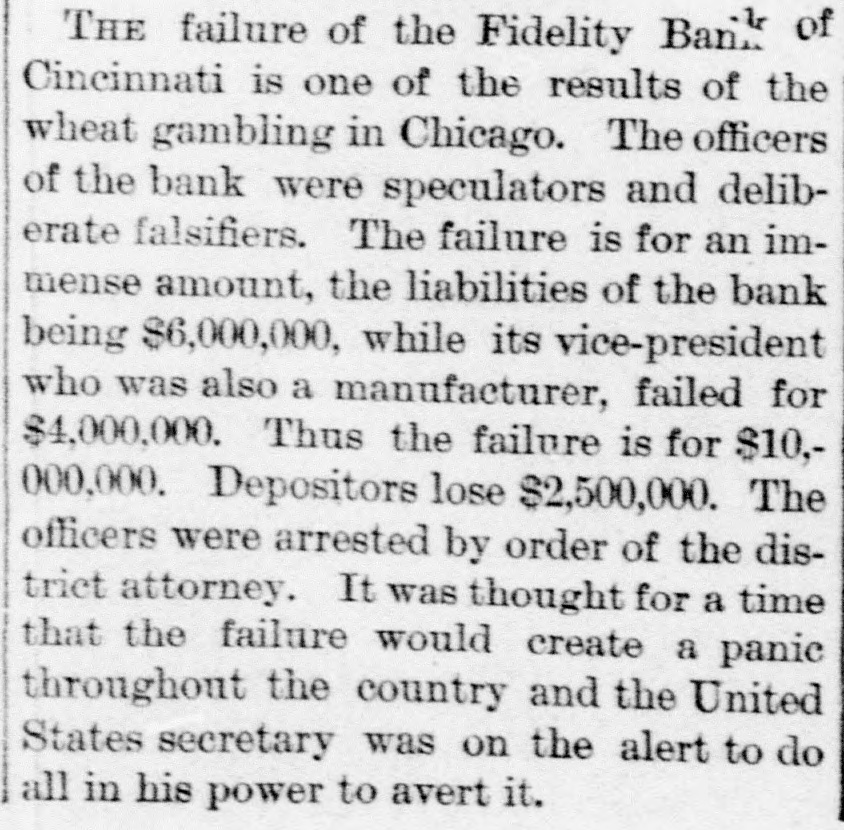
THE failure of the Fidelity Ban." of Cincinnati is one of the results of the wheat gambling in Chicago. The officers of the bank were speculators and deliberate falsifiers. The failure is for an immense amount, the liabilities of the bank being $6,000,000, while its vice-president who was also a manufacturer, failed for $4,000,000. Thus the failure is for $10,000,000. Depositors lose $2,500,000. The officers were arrested by order of the district attorney. It was thought for a time that the failure would create a panic throughout the country and the United States secretary was on the alert to do all in his power to avert it.


Article from The Superior Times, July 2, 1887

Click image to open full size in new tab

Article Text

NEWS NOTES. Fire among the buildings of the go Packing Company Stockyards stroved all the buildings vering acre and a half ground with their tents The loss is placed at $1 500.000 Among the property destroved was 000 barrels mess pork belonging to P Armour Murphy was killed by falling timbers Postmaster Carson of New Bruns wick, against the postmaster detained having ters addressed the depart him ames M took Webb the desperado the murder from Miss Brownsville, Charles E Mars. a veteran news man, committed suicide Buffalo by taking poison Sugland who nurdered Helen A Burt hanged himself in the Brattle boro. Vt.,jail The suspicion that the collapse the Fidelity National Bank Cincinnati would with it American Exchange Bank, of Chicago denied by the officers of the be $300 only nd some $6 000.000 officers surrendered by their bondsmen The Whitely Fos Springfield III., hands of the The wheat of a train, 23d. The fail the work on steep member of Par the of Parnellism Escanaba Mich in runaway His skull Ishpeming and two deaths from reported from Key H at died OF Blake has been appoint ed roundland New Orleans on the for in Texas commander of the M regular army H Conn Cora of Lee Mrs. Gra Mo disagreed had made 5,000, making $ 400 ch dren were and storm a during which demolished the an 22nd and drowned The of Joliet III has fixed at $1.000 An make it $ 000 John Rick Irondale, Rev. John F Maxwell morning of the 22d ewis which lding, a cigar as vanna Lottery 000 last draw at portions the Brooklyn fire quitted of the chase. govern Coloro murdered infants the in


Article from Morris Tribune, July 6, 1887

Click image to open full size in new tab

Article Text

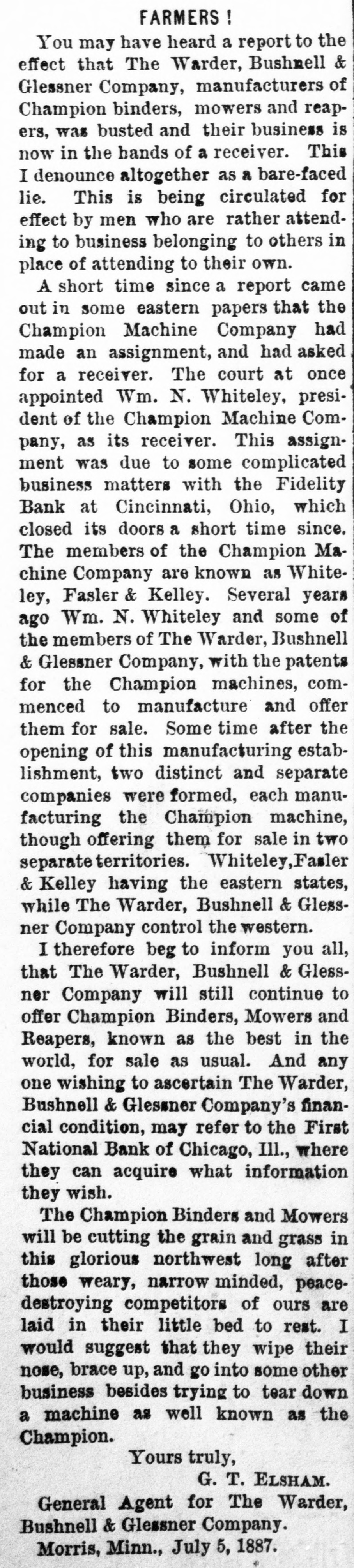
# FARMERS! You may have heard a report to the effect that The Warder, Bushnell & Glessner Company, manufacturers of Champion binders, mowers and reapers, was busted and their business is now in the hands of a receiver. This I denounce altogether as a bare-faced lie. This is being circulated for effect by men who are rather attending to business belonging to others in place of attending to their own. A short time since a report came out in some eastern papers that the Champion Machine Company had made an assignment, and had asked for a receiver. The court at once appointed Wm. N. Whiteley, president of the Champion Machine Company, as its receiver. This assignment was due to some complicated business matters with the Fidelity Bank at Cincinnati, Ohio, which closed its doors a short time since. The members of the Champion Machine Company are known as Whiteley, Fasler & Kelley. Several years ago Wm. N. Whiteley and some of the members of The Warder, Bushnell & Glessner Company, with the patents for the Champion machines, commenced to manufacture and offer them for sale. Some time after the opening of this manufacturing establishment, two distinct and separate companies were formed, each manufacturing the Champion machine, though offering them for sale in two separate territories. Whiteley, Fasler & Kelley having the eastern states, while The Warder, Bushnell & Glessner Company control the western. I therefore beg to inform you all, that The Warder, Bushnell & Glessner Company will still continue to offer Champion Binders, Mowers and Reapers, known as the best in the world, for sale as usual. And any one wishing to ascertain The Warder, Bushnell & Glessner Company's financial condition, may refer to the First National Bank of Chicago, Ill., where they can acquire what information they wish. The Champion Binders and Mowers will be cutting the grain and grass in this glorious northwest long after those weary, narrow minded, peace-destroying competitors of ours are laid in their little bed to rest. I would suggest that they wipe their nose, brace up, and go into some other business besides trying to tear down a machine as well known as the Champion. Yours truly, G. T. ELSHAM. General Agent for The Warder, Bushnell & Glessner Company. Morris, Minn., July 5, 1887.


Article from Wood County Reporter, July 14, 1887

Click image to open full size in new tab

Article Text

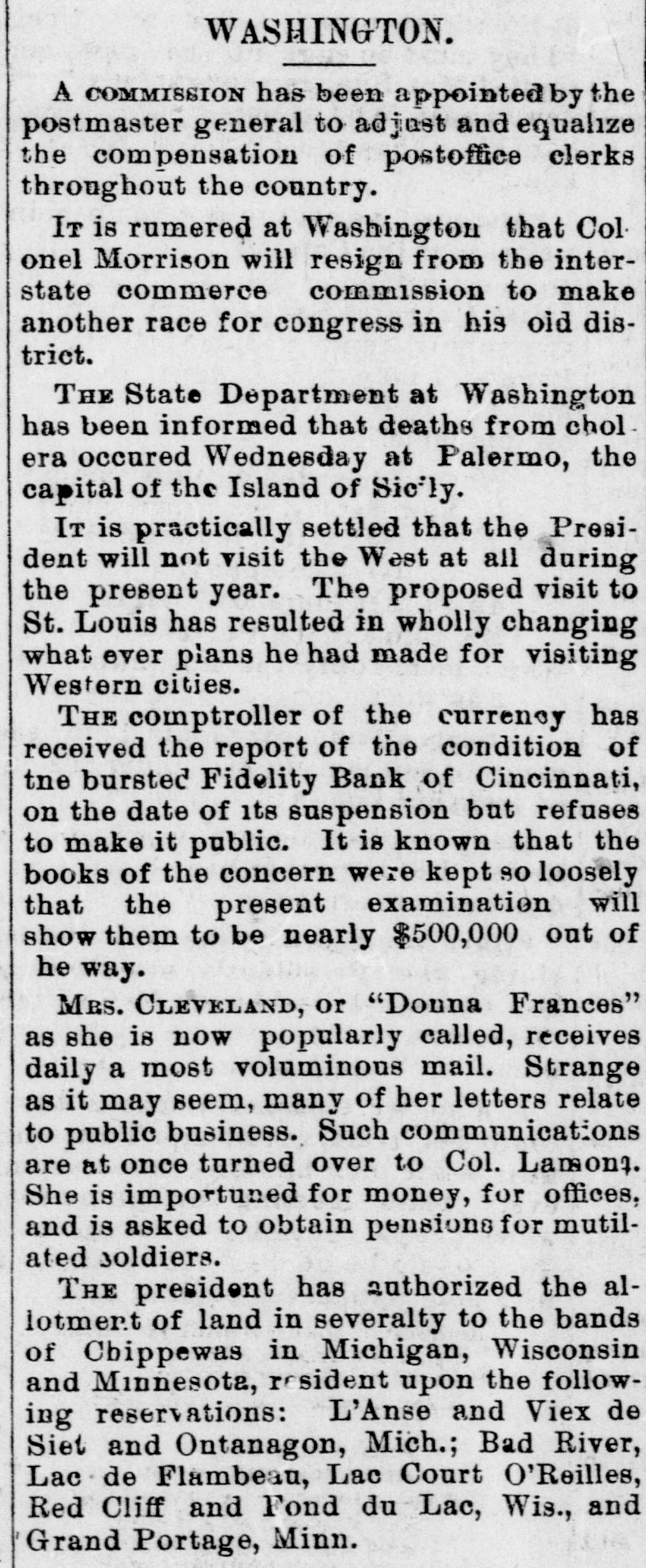
WASHINGTON. A COMMISSION has been appointed by the postmaster general to adjust and equalize the compensation of postoffice clerks throughout the country. IT is rumered at Washington that Colonel Morrison will resign from the interstate commerce commission to make another race for congress in his old district. THE State Department at Washington has been informed that deaths from cholera occured Wednesday at Palermo, the capital of the Island of Sicily. IT is practically settled that the President will not visit the West at all during the present year. The proposed visit to St. Louis has resulted in wholly changing what ever plans he had made for visiting Western cities. THE comptroller of the currency has received the report of the condition of the bursted Fidelity Bank of Cincinnati, on the date of its suspension but refuses to make it public. It is known that the books of the concern were kept so loosely that the present examination will show them to be nearly $500,000 out of he way. MRS. CLEVELAND, or "Donna Frances" as she is now popularly called, receives daily a most voluminous mail. Strange as it may seem, many of her letters relate to public business. Such communications are at once turned over to Col. Lansong. She is importuned for money, for offices, and is asked to obtain pensions for mutilated soldiers. THE president has authorized the allotment of land in severalty to the bands of Chippewas in Michigan, Wisconsin and Minnesota, resident upon the following reservations: L'Anse and Viex de Siet and Ontanagon, Mich.; Bad River, Lac de Flambeau, Lac Court O'Reilles, Red Cliff and Fond du Lac, Wis., and Grand Portage, Minn.


Article from Mineral Point Tribune, July 14, 1887

Click image to open full size in new tab

Article Text

# WASHINGTON. A COMMISSION has been appointed by the postmaster general to adjust and equalize the compensation of postoffice clerks throughout the country. IT is rumered at Washington that Colonel Morrison will resign from the interstate commerce commission to make another race for congress in his old district. THE State Department at Washington has been informed that deaths from cholera occured Wednesday at Palermo, the capital of the Island of Sic'ly. IT is practically settled that the President will not visit the West at all during the present year. The proposed visit to St. Louis has resulted in wholly changing what ever plans he had made for visiting Western cities. THE comptroller of the currency has received the report of the condition of the bursted Fidelity Bank of Cincinnati, on the date of its suspension but refuses to make it public. It is known that the books of the concern were kept so loosely that the present examination will show them to be nearly $500,000 out of he way. MRS. CLEVELAND, or "Donna Frances" as she is now popularly called, receives daily a most voluminous mail. Strange as it may seem, many of her letters relate to public business. Such communications are at once turned over to Col. Lamong. She is importuned for money, for offices, and is asked to obtain pensions for mutilated soldiers. THE president has authorized the allotment of land in severalty to the bands of Chippewas in Michigan, Wisconsin and Minnesota, resident upon the following reservations: L'Anse and Viex de Siet and Ontanagon, Mich.; Bad River, Lac de Flambeau, Lac Court O'Reilles, Red Cliff and Fond du Lac, Wis., and Grand Portage, Minn.


Article from New-York Tribune, September 21, 1887

Click image to open full size in new tab

Article Text

# DENYING REPORTS ABOUT A NATIONAL BANK. George G. Williams, president of the Chemical National Bank, denied yesterday the published dispatches that the bank was interested in any way in the failure of the Weber Brewing Company, of Cincinnati. He explained the only possible grounds for the statement in this way: The Fidelity Bank of Cincinnati applied for help when it was in distress and we made a loan to it. The bulk of the indebtedness has been paid and the balance will be met within about thirty days. Our security from the very first was am- ple and now we have collateral worth ten times probably the sum still due us. Among the securities there was some paper of the brewing company which we put into the hands of our Cincinnati lawyer for the simple purpose of avoiding re- sponsibility to the receiver of the Fidelity Bank. We should have turned the notes over to him, but the Bank of Montreal has laid an attachment on the surplus in our hands after our loan has been discharged. If it was not for this, we could soon give him a basketful of securities. The receiver could not bring suit on the notes, of course, and if we did not do so he might afterward hold us responsible for neglect. Our counsel advised us to avoid this possibility, but we have no interest in the failure of the brewing company.


Article from The Indiana State Sentinel, October 12, 1887

Click image to open full size in new tab

Article Text

The Fidelity Bank Cash. CINCINNATI, October 10.-It is understood that Ammi Baldwin, late cashier of the defunct Fidelity Bank, has made a statement of affairs in the institution, which gives an inside view. It begins with giving some news regarding the condition of the Third National Bank, in which Baldwin was cashier. In 1881, he says, Handy, Harper, and others were engaged in the big wheat deal at Chicago, and one night found the bank with only $1,600 in cash on hand. Some of the directors went to Chicago that night, and by 11 a. m. the next day had telegraphed $375,000 to the bank and saved it. The other directors never knew until now how near their bank was wrecked, Baldwin's brother, also in that bank, embezzled $18,000. Ammi covered it up for him, he says, with the help of Harper and others, and then got into Harper's hands. When the latter founded the Fidelity, he took Baldwin along with him. The Fidelity was run on wind and by the one-man power of Harper alone, who knew all the details of the business and kept all the secrets of the business, save such as he shared with Miss Josie Holmes, the exchange clerk. Harper was bound to keep the stock of the bank up, and at the premium boughteverybodys stock who wanted to sell. Baldwin was sick and absent for a few weeks, and on his return found Harper had assumed the duties of cashier, and continued to do so on the plea of relieving Baldwin of his work. Harper had balances of $100,000 or so on hand nearly all the time. The money seems now to have come mostly from hypothecating the banks stock and from the discounting of accommodation paper, yet so adroitly was it all done that Baldwin did not suspect the true state of affairs until the crash came. He had often heard Ben Hopkins the assistant cashier, say that Harper must be worth at least $5,000,000.


Article from St. Paul Daily Globe, October 29, 1887

Click image to open full size in new tab

Article Text

The Fidelity Swindle. CINCINNATI, Oct. 28.-The First National bank of Logansport, Ind., to-day brought suit in the United States court to recover from Receiver Armstrong $43,441, which, it is alleged, the late Fidelity National bank held for the plaintiffs. The petition says that the receiver has rejected the claim. The money was on deposit in the Fidelity bank, and Harper, at the request of the Logansport bank, loaned it for them, giving them notes of Matthews & Gahr, secured by Fidelity stock. When the notes became due the bank was in the hands of a receiver.


Article from The Salt Lake Herald, November 6, 1887

Click image to open full size in new tab

Article Text

# A Wheat Deal Relic. CINCINNATI, November 5. β€”The American Exchange National Bank of Chicago, this afternoon, brought suit in the United States Court, against Receiver Armstrong, of the Fidelity National Bank, for $400,000 This is a relic of the troubles during the famous wheat deal.


Article from The Indianapolis Journal, April 29, 1888

Click image to open full size in new tab

Article Text

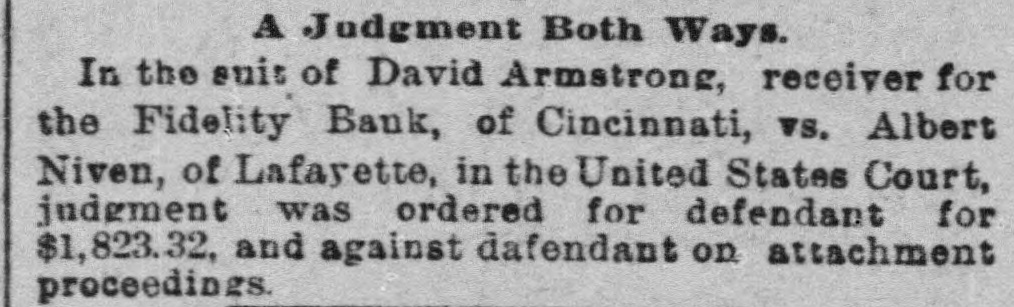
# A Judgment Both Ways. In the suit of David Armstrong, receiver for the Fidelity Bank, of Cincinnati, vs. Albert Niven, of Lafayette, in the United States Court, judgment was ordered for defendant for $1,823.32, and against defendant on attachment proceedings.


Article from Watertown Republican, June 6, 1888

Click image to open full size in new tab

Article Text

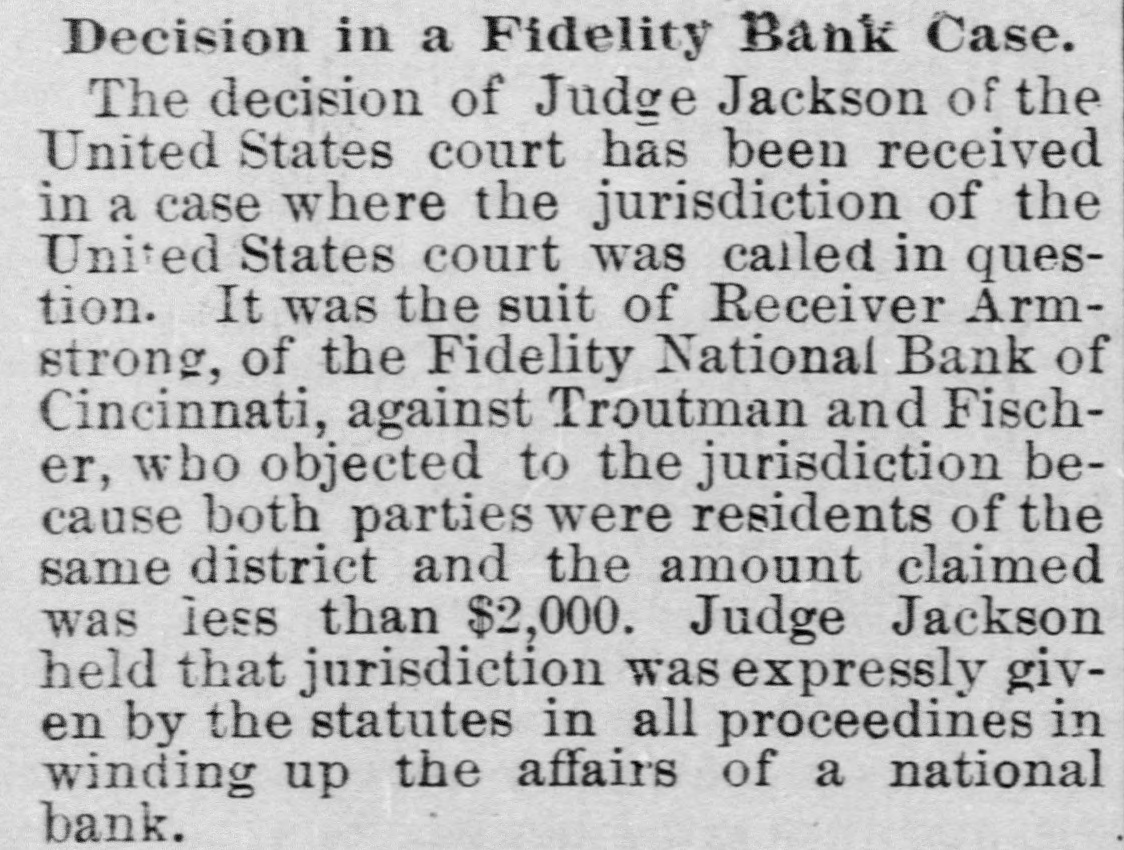
# Decision in a Fidelity Bank Case. The decision of Judge Jackson of the United States court has been received in a case where the jurisdiction of the United States court was called in question. It was the suit of Receiver Armstrong, of the Fidelity National Bank of Cincinnati, against Troutman and Fischer, who objected to the jurisdiction because both parties were residents of the same district and the amount claimed was less than $2,000. Judge Jackson held that jurisdiction was expressly given by the statutes in all proceedings in winding up the affairs of a national bank.