Article Text
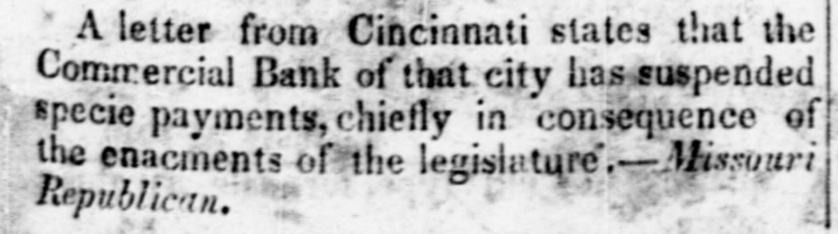
A letter from Cincinnati states that the Commercial Bank of that city has suspended specie payments, chiefly in consequence of the enacments of the legislature.-Masquari Republican.
375b8d217e38786cNone
Click image to open full size in new tab
A letter from Cincinnati states that the Commercial Bank of that city has suspended specie payments, chiefly in consequence of the enacments of the legislature.-Masquari Republican.
Click image to open full size in new tab
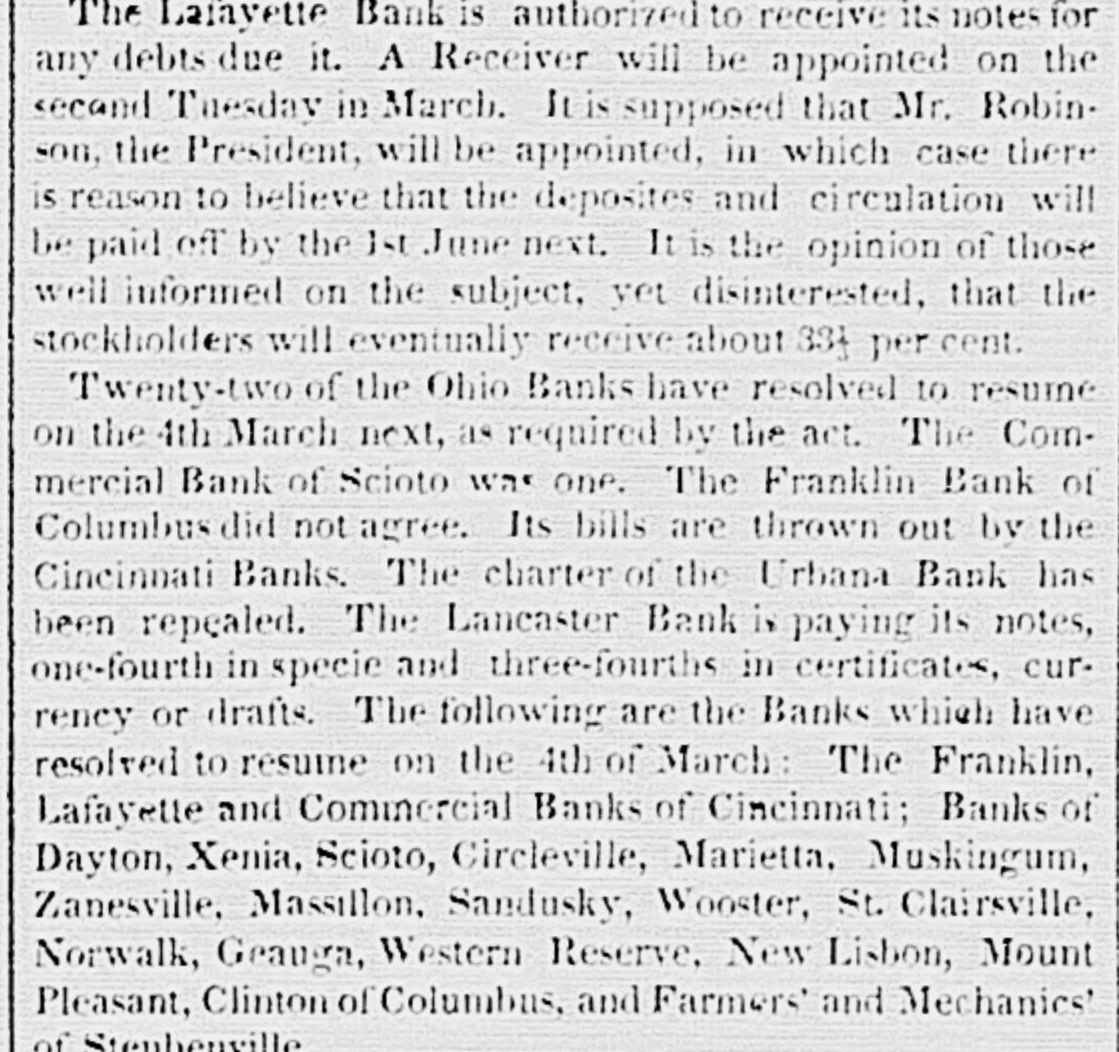
The Lajayette Bank is authorized to receive its notes for any debts due it. A Receiver will be appointed on the second Tuesday in March. It is supposed that Mr. Robinson, the President, will be appointed, in which case there is reason to believe that the deposites and circulation will be paid off by the 1st June next. It is the opinion of those well informed on the subject, yet disinterested, that the stockholders will eventually receive about 33j per cent. Twenty-two of the Ohio Banks have resolved to resume on the 4th March next, as required by the act. The Commercial Bank of Scioto was one. The Franklin Bank of Columbus did not agree. Its bills are thrown out by the Cincinnati Banks. The charter of the Urbana Bank has been repealed. The Lancaster Bank is paying its notes, one-fourth in specie and three-fourths in certificates, currency or drafts. The following are the Banks which have resolved to resuine on the 4th of March The Franklin, Lafayette and Commercial Banks of Cincinnati; Banks of Dayton, Xenia, Scioto, Circleville, Marietta, Muskingum, Zanesville, Massillon, Sandusky, Wooster, St. Clairsville, Norwalk, Geauga, Western Reserve. New Lisbon, Mount Pleasant, Clinton of Columbus, and Farmers' and Mechanics' of Stenhensille
Click image to open full size in new tab
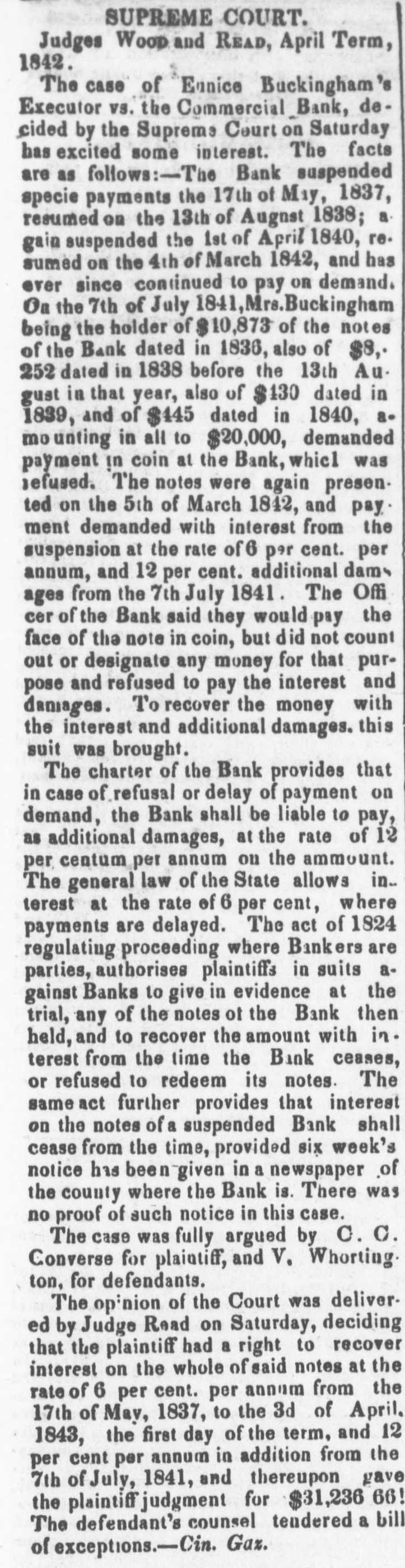
# SUPREME COURT. Judges Woop and READ, April Term, 1842. The case of Eunice Buckingham's Executor vs. the Commercial Bank, decided by the Supreme Court on Saturday has excited some interest. The facts are as follows:-The Bank suspended specie payments the 17th of May, 1837, resumed on the 13th of August 1838; again suspended the 1st of April 1840, resumed on the 4th of March 1842, and has ever since continued to pay on demand. On the 7th of July 1841, Mrs.Buckingham being the holder of $10,873 of the notes of the Bank dated in 1836, also of $8,252 dated in 1838 before the 13th August in that year, also of $130 dated in 1839, and of $445 dated in 1840, amounting in all to $20,000, demanded payment in coin at the Bank, which was refused. The notes were again presented on the 5th of March 1842, and payment demanded with interest from the suspension at the rate of 6 per cent. per annum, and 12 per cent. additional damages from the 7th July 1841. The Officer of the Bank said they would pay the face of the note in coin, but did not count out or designate any money for that purpose and refused to pay the interest and damages. To recover the money with the interest and additional damages. this suit was brought. The charter of the Bank provides that in case of refusal or delay of payment on demand, the Bank shall be liable to pay, as additional damages, at the rate of 12 per centum per annum on the ammount. The general law of the State allows in-terest at the rate of 6 per cent, where payments are delayed. The act of 1824 regulating proceeding where Bankers are parties, authorises plaintiffs in suits against Banks to give in evidence at the trial, any of the notes of the Bank then held, and to recover the amount with interest from the time the Bank ceases, or refused to redeem its notes. The same act further provides that interest on the notes of a suspended Bank shall cease from the time, provided six week's notice has been given in a newspaper of the county where the Bank is. There was no proof of such notice in this case. The case was fully argued by C. C. Converse for plaintiff, and V. Whortington, for defendants. The opinion of the Court was delivered by Judge Read on Saturday, deciding that the plaintiff had a right to recover interest on the whole of said notes at the rate of 6 per cent. per annum from the 17th of May, 1837, to the 3d of April, 1843, the first day of the term, and 12 per cent per annum in addition from the 7th of July, 1841, and thereupon gave the plaintiff judgment for $31,236 66! The defendant's counsel tendered a bill of exceptions. Cin. Gaz.