14887. Canton State Bank (Canton, OH)

Bank Information

Episode Type
Suspension β†’ Closure
Bank Type
state
Start Date
May 24, 1905
Location
Canton, Ohio (40.799, -81.378)

Metadata

Model
gpt-5-mini
Short Digest
ba3e323c64fb5e89

Response Measures

None

Description

The Canton State Bank closed/suspended on May 24, 1905 and was placed in the hands of receivers. The failure is attributed to heavy, improper loans (and alleged embezzlement) to W. L. Davis by cashier Corwin D. Bachtel. Multiple articles describe the bank suspending/closing and subsequent receivers' actions and indictments. No discrete run triggered by rumors or misinformation is described.

Events (3)

1. May 24, 1905 Receivership
Newspaper Excerpt
receivers of the Canton State bank (Henry A. Wise and James G. Barbour) were later appointed and filed reports; bank is in hands of receivers and being liquidated or wound up by receivership actions in subsequent months.
Source
newspapers
2. May 24, 1905 Suspension
Cause
Bank Specific Adverse Info
Cause Details
Heavy loans and alleged embezzlement: cashier Corwin B. Bachtelle (Bachtel) made large loans to vice president W. L. Davis without directors' consent; inadequate collateral and possible fraudulent entries led to insolvency.
Newspaper Excerpt
Canton, Ohio, May 24.-The Canton State Bank closed its doors today.
Source
newspapers
3. May 27, 1905 Other
Newspaper Excerpt
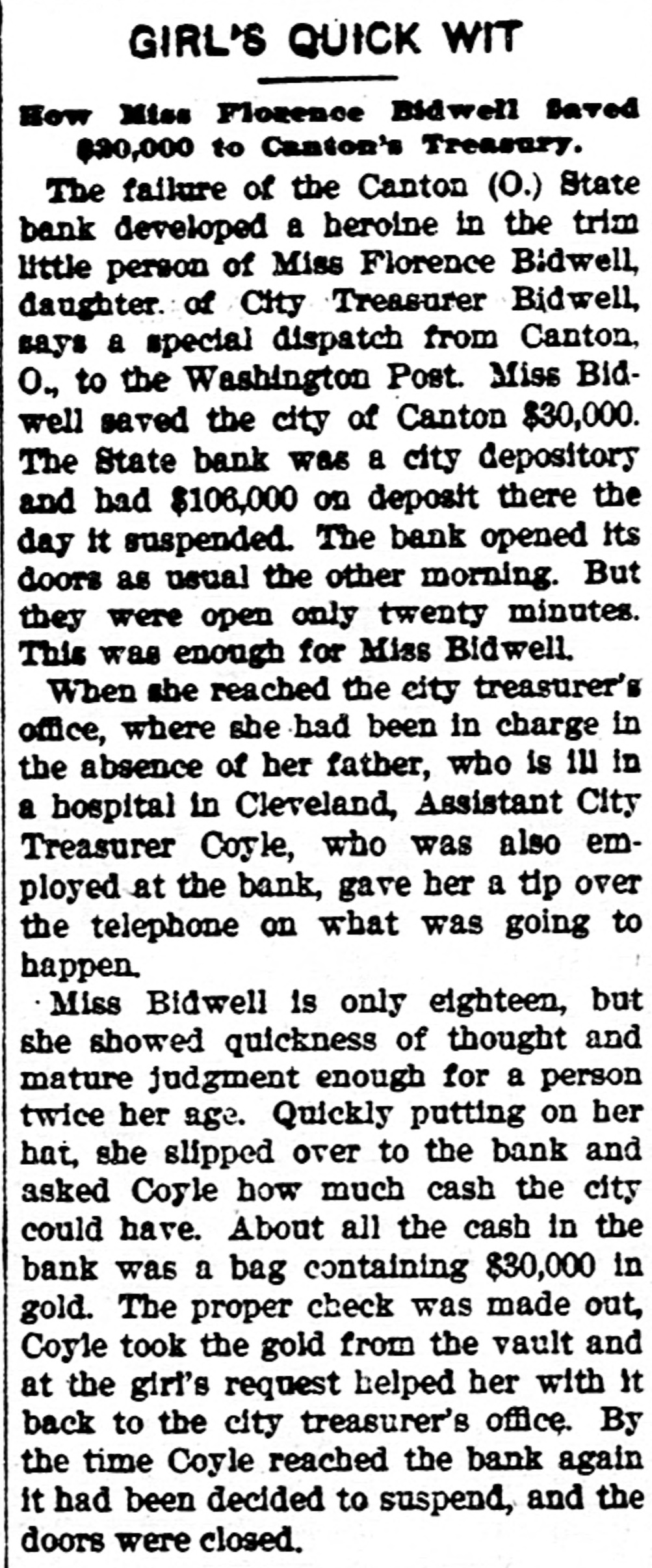
The State bank was a city depository and had $106,000 on deposit there the day it suspended; Miss Florence Bidwell removed $30,000 in gold for the city before the bank suspended.
Source
newspapers

Newspaper Articles (23)

Article from Santa Fe New Mexican, May 24, 1905

Click image to open full size in new tab

Article Text

TWO BANKS CLOSE. National Institutions In Ohio and Oklahoma Forced to Suspend Operations. Canton, Ohio, May 24.-The Canton State Bank closed its doors today. The cause of the failure is unknown. The report of the financial condition of the bank on March 6th, last, showed its resources were $839,552. First National of Lexington Fails. Washington, D. C., May 24.-The comptroller of the currency has been advised that the First National Bank of Lexington, Oklahoma, failed today.


Article from The Daily Morning Journal and Courier, May 25, 1905

Click image to open full size in new tab

Article Text

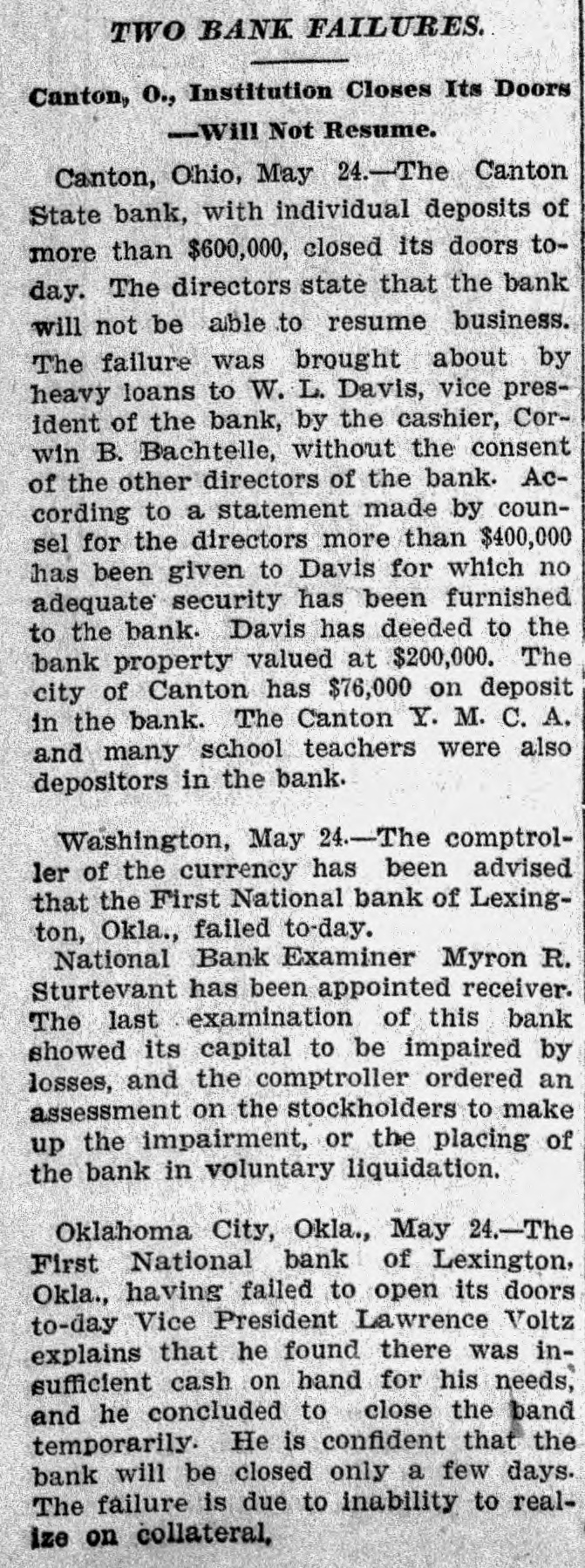
TWO BANK FAILURES. Canton, 0., Institution Closes Its Doors -Will Not Resume. Canton, Ohio, May 24.-The Canton State bank, with individual deposits of more than $600,000, closed its doors today. The directors state that the bank will not be able to resume business. The failure was brought about by heavy loans to W. L. Davis, vice president of the bank, by the cashier, Corwin B. Bachtelle, without the consent of the other directors of the bank. According to a statement made by counsel for the directors more than $400,000 has been given to Davis for which no adequate security has been furnished to the bank. Davis has deeded to the bank property valued at $200,000. The city of Canton has $76,000 on deposit in the bank. The Canton Y. M. C. A. and many school teachers were also depositors in the bank. Washington, May 24.-The comptroller of the currency has been advised that the First National bank of Lexington, Okla., failed to-day. National Bank Examiner Myron R. Sturtevant has been appointed receiver. The last examination of this bank showed its capital to be impaired by losses, and the comptroller ordered an assessment on the stockholders to make up the impairment, or the placing of the bank in voluntary liquidation. Oklahoma City, Okla., May 24.-The First National bank of Lexington, Okla., having failed to open its doors to-day Vice President Lawrence Voltz explains that he found there was insufficient cash on hand for his needs, and he concluded to close the band temporarily. He is confident that the bank will be closed only a few days. The failure is due to inability to realize on collateral,


Article from Los Angeles Herald, May 26, 1905

Click image to open full size in new tab

Article Text

Ohio Bank Closes By Associated Press. CANTON, Ohio, May 25.-The People's Deposit bank of Mineral City, Ohio, closed its doors today. The president of the institution says loans of about $50,000 have been made by the bank to W. L. Davis of Canton, whose heavy loans are said to have caused the suspension of the Canton State bank yesterday. Directors of the Mineral City say it may resume business in a day or two.


Article from The Cairo Bulletin, May 26, 1905

Click image to open full size in new tab

Article Text

ANOTHER OHIO BANK CLOSES Canton, Ohio, May 25.-The people's Deposit bank of Mineral City, Oh'o. closed today. The president of the institution says loans of $50,000 were made by the bank to W. L. Dav's of Canton. whose heavy loans are said to have caused a suspension of the Canton state bank yesterday,


Article from The Madison Daily Leader, May 26, 1905

Click image to open full size in new tab

Article Text

WEALTHY MAN ENDS LIFE MURDER INQUIRY LEADS TO SUICIDE OF LEADING CITIZEN OF SAVANNAH, ILL. Savannah, III., May 26.-Rothwell Pulford, reputed to be the wealthiest citizen of Savannah, committed suicide during the day, a few minutes after being questioned regarding the whereabouts of a revolver with which he was suspected of having slain Attorney Daniel S. Berry, former leading member of the Illinois legislature. Pulford has denied any knowledge of the killing of Berry, but became agitated when questioned concerning the revolver. The story has been widely circulated that Berry was killed as a result of attentions paid by him to a married woman. Pulford, on arriving at his store in the morning, found a newspaper man waiting for him with queries as to the revolver. As soon as the interviewer had left Pulford hurried home and, going to the hayloft of his barn, shot himself dead. When Daniel Berry was killed in Pulford's Opera House last Monday and the authorities began to question Pulford it was evident to those who knew him best that Pulford's mind was giving away. "He is not mentally sound," said Chief of Police C.S. Barker two days ago. "I am afraid he will kill himself." Similar fear was felt by Mrs. Pulford. Pulford's death ends the life of a man who rose from a poor boy to the position of one of the wealthiest men in this section of Illinois. A tireless worker he accumulated money fast and besides owning much of the most valuable real estate of Savannah he was the president of the Commercial bank and the owner of the electric light system. 3. Another Ohio Bank Fails. Canton, O., May 26.-The People's Deposit bank of Mineral City, O., closed its doors during the day. The president of the institution says loans of about $50,000 have been made by the bank to W. L. Davis of Canton, whose heavy loans are said to have caused the suspension of the Canton State bank Wednesday.


Article from New-York Tribune, May 26, 1905

Click image to open full size in new tab

Article Text

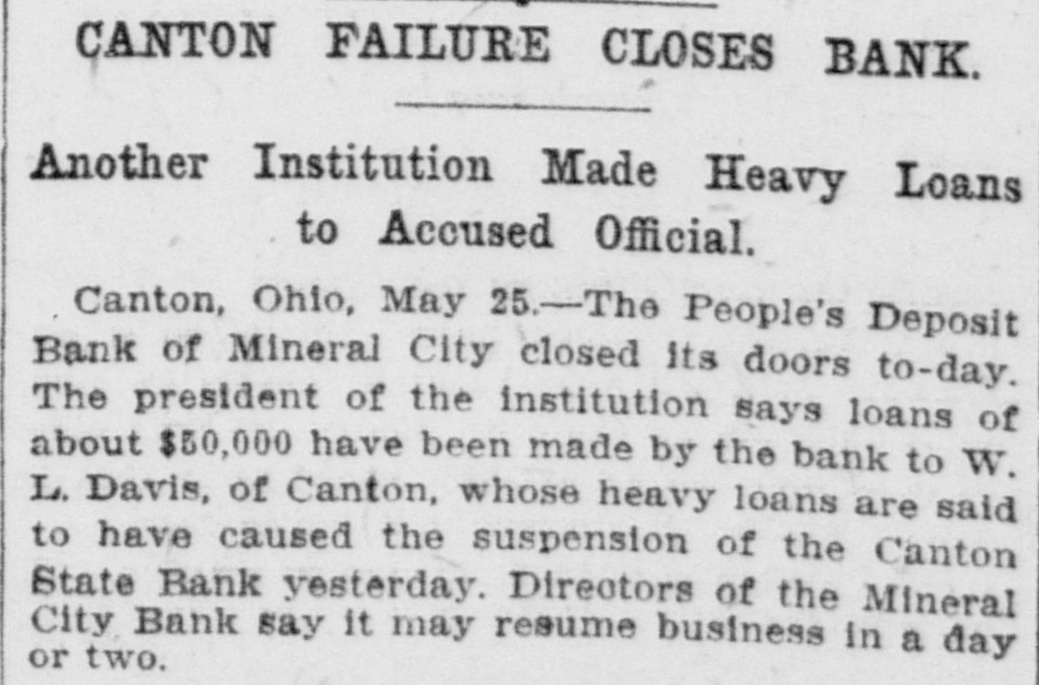
CANTON FAILURE CLOSES BANK. Another Institution Made Heavy Loans to Accused Official. Canton, Ohio, May 25.-The People's Deposit Bank of Mineral City closed its doors to-day. The president of the institution says loans of about $50,000 have been made by the bank to W. L. Davis, of Canton, whose heavy loans are said to have caused the suspension of the Canton State Bank yesterday. Directors of the Mineral City Bank say it may resume business in a day or two.


Article from Evening Star, May 26, 1905

Click image to open full size in new tab

Article Text

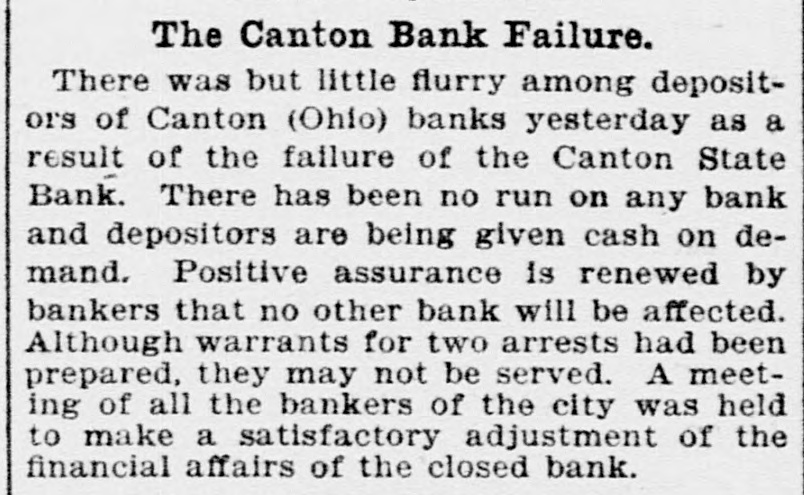
The Canton Bank Failure. There was but little flurry among depositors of Canton (Ohio) banks yesterday as a result of the failure of the Canton State Bank. There has been no run on any bank and depositors are being given cash on demand. Positive assurance is renewed by bankers that no other bank will be affected. Although warrants for two arrests had been prepared, they may not be served. A meeting of all the bankers of the city was held to make a satisfactory adjustment of the financial affairs of the closed bank.


Article from The Sun, May 28, 1905

Click image to open full size in new tab

Article Text

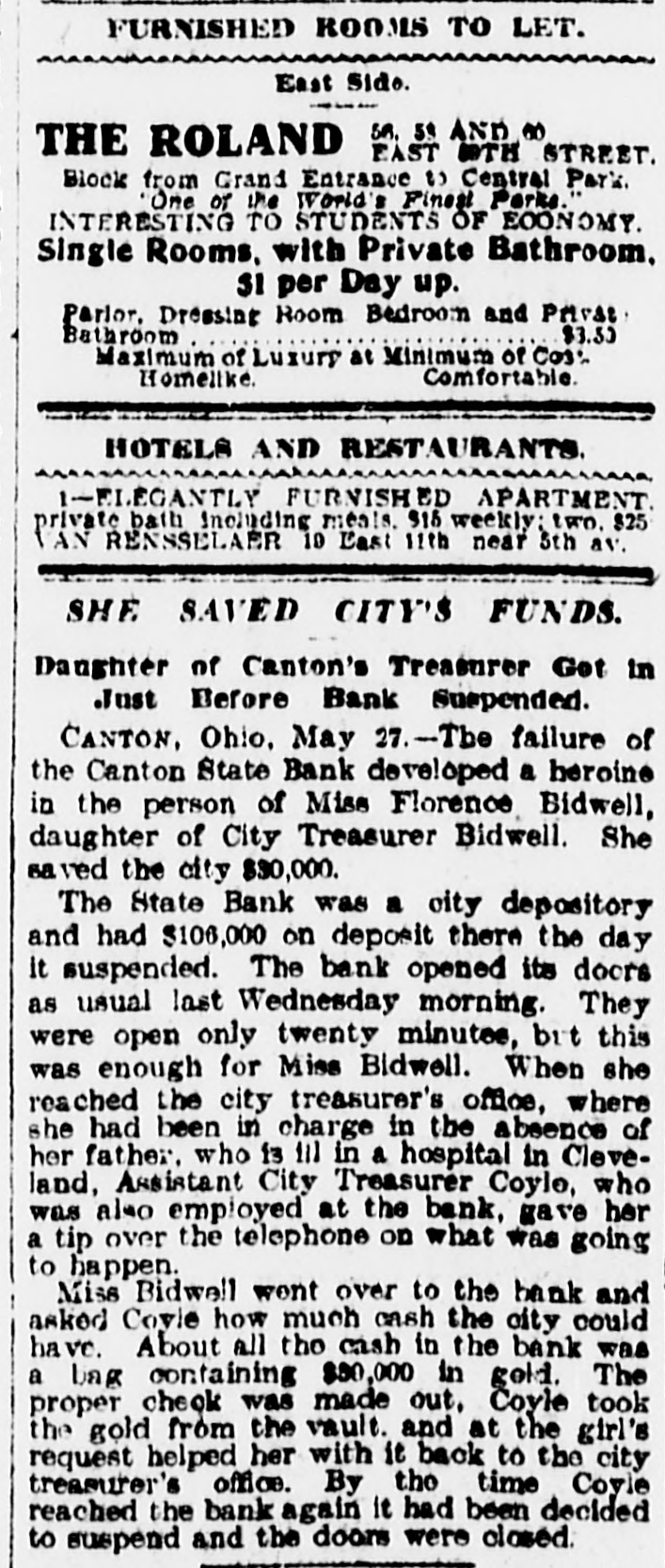
FURNISHED ROOMS TO LET. East Side. THE ROLAND 58, 59 AND 60 EAST OTH STREET. Block from Grand Entrance to Central Park. One or the World's Finest Parks." INTERESTING TO STUDENTS OF ECONOMY. Single Rooms, with Private Bathroom, $1 per Day up. Parior, Dressing Room Bedroom and Privat. $3.50 Bathroom Maximum of Luxury at Minimum of Cos:Comfortable. Homelike. HOTELS AND RESTAURANTS. 1-ELEGANTLY FURNISHED APARTMENT private bath including meals. 315 weekly: two. $25 VAN RENSSELAER 10 East 11th near 5th av. SHE SAVED CITY'S FUNDS. Daughter of Canton's Treasurer Get in Just Before Bank Suspended. CANTON, Ohio, May 27.-The failure of the Canton State Bank developed a heroine in the person of Miss Florence Bidwell, daughter of City Treasurer Bidwell. She saved the city $30,000. The State Bank was a city depository and had $106,000 on deposit there the day it suspended. The bank opened its doors as usual last Wednesday morning. They were open only twenty minutes, bit this was enough for Miss Bidwell. When she reached the city treasurer's office, where she had been in charge in the absence of her father. who is 111 in a hospital in Cleveland, Assistant City Treasurer Coyle, who was also employed at the bank, gave her a tip over the telephone on what was going to happen. Miss Bidwell went over to the bank and asked Covie how much cash the city could have. About all the cash in the bank was a bag containing $50,000 in gold. The proper check was made out, Coyle took the gold from the vault. and at the girl's request helped her with it back to the city treasurer's office. By the time Coyle reached the bank again it had been decided to suspend and the doors were closed.


Article from The Stark County Democrat, May 30, 1905

Click image to open full size in new tab

Article Text

of the doors of the Canton State bank has subsided, and the feeling of the depositors, stockholders and creditors is that the only thing now to do is to turn the affairs over to competent parties who can be trusted and liquidate ffairs as economicaly and quickly as possible. The plans of the stockholders and creditors for the continuing of the business of the bank had to be given up when it was discovered that W. L. Davis had large obligations outside of bis indebtedness to the bank, and that these outside creditors will, of course, share in the property that was turned over to the bank some days ago. It is thought that Davis' indebtedness aside from that of some of the companies In which he is interested will reach between $600,000 and $700,000. The great majority of the stockholders seem to be willing to do all that they can to protect the depositors, and it is expected that the greater number will promptly pay the 40 per cent on their shares of stock, thus bringing quite a sum to the relief of the bank. It is not expected, however, that anything can be realized upon the stock of Davis and Bachtel. The former is the heaviest stockholder, having 805 shares, while Bachtel has 490. MINERAL CITY FAILURE. The Mineral City bank, in which Davis was a heavy stockholder, closed its doors Thursday morning to prevent a run. Its condition IS being investigated and no definite news as to its solvency can be secured until the inspection is completed. The bank was started by Alfred Davis, now deceased, the father of W. L. Davis. The bank has a capital stock of $25,000 and it is said that Davis has borrowed sums aggregating $50,000, to secure which there are some collaterals, the real value of which cannot be ascertained. The depositors are quite numerous, and there is a great deal of excitement ( in the village. ( THE CITY IS SAFE. The city of Canton will not lose TO anything at the hands of the State F bank. Treasurer Bidwell, who is ill in a Cleveland hospital, will be at home E Sunday, it is thought. The city is proE tected by a bond of $200,000 given by M the Bankers' Surety Co. of Cleveland, C and the records show that the council L had not at any time created a deposA itory for the city funds, but on the N other hand the Surety company had M given its consent to Treasurer Bidwell I to deposit money with the State bank, G and also seven other banks of Canton. J The State bank held the largest G amount. L The directors of the State bank had M a meeting last evening and decided to M submit a proposition to the creditors. J J It is thought that the affairs of the institution can be better subserved by ΠΈ H the appointment of competent persons M to close up the affairs, rather than go M through the expense of bankruptcy. A W resolution was adopted which will be K submitted to all interested parties for M approval. E The stockholders of the Canton State A bank include many of the substantial G citizens of this city. From the recB ords at the auditor's office the News A has secured the complete list of stockM holders, with the amount of stock, Je which is published below. There are in all 6,000 shares, each share having a face value of $50, upon which $30 has been paid. The list follows: Shares 5 John L. Allman, Canton


Article from Waterbury Evening Democrat, June 5, 1905

Click image to open full size in new tab

Article Text

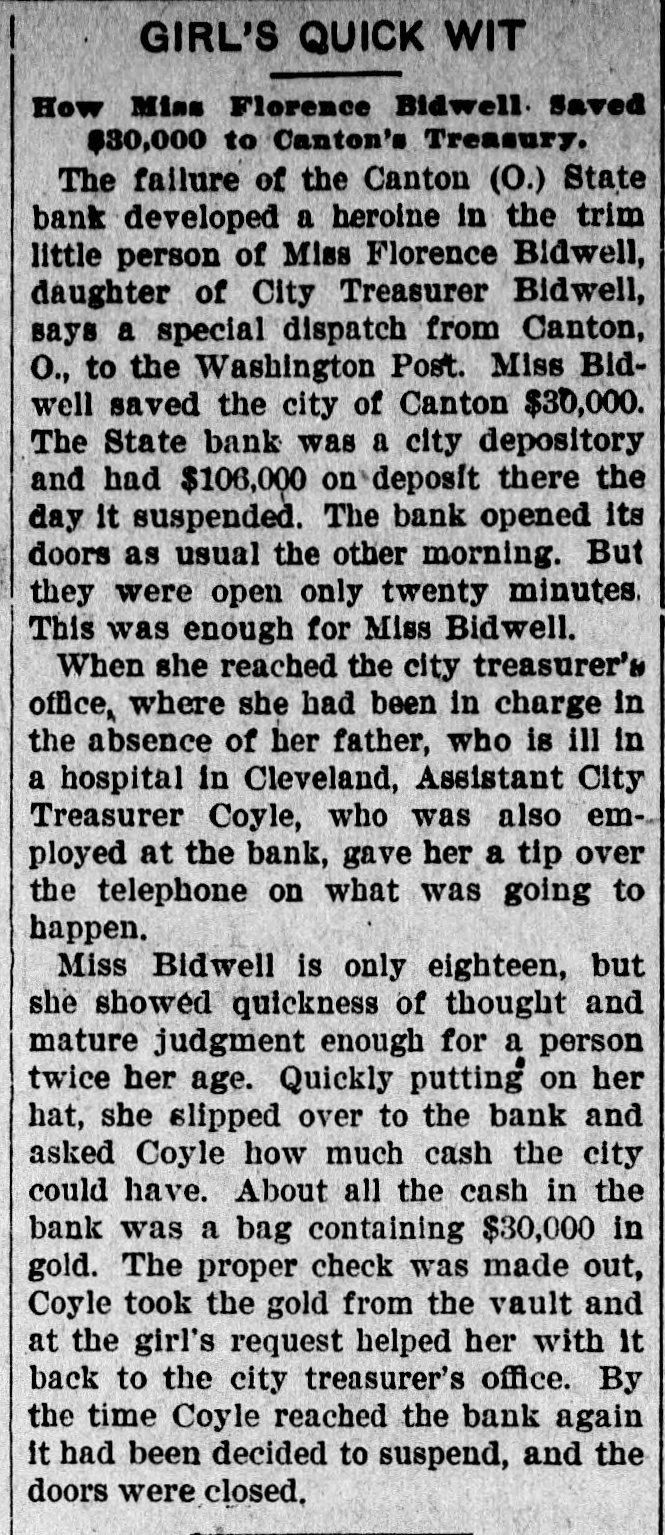
GIRL'S QUICK WIT How Mins Florence Bidwell. Saved $30,000 to Canton's Treasury. The failure of the Canton (O.) State bank developed a heroine in the trim little person of Miss Florence Bidwell, daughter of City Treasurer Bidwell, says a special dispatch from Canton, O., to the Washington Post. Miss Bldwell saved the city of Canton $30,000. The State bank was a city depository and had $106,000 on deposit there the day It suspended. The bank opened its doors as usual the other morning. But they were open only twenty minutes. This was enough for Miss Bidwell. When she reached the city treasurer's office, where she had been in charge in the absence of her father, who is ill in a hospital in Cleveland, Assistant City Treasurer Coyle, who was also employed at the bank, gave her a tip over the telephone on what was going to happen. Miss Bidwell is only eighteen, but she showed quickness of thought and mature judgment enough for a person twice her age. Quickly putting on her hat, she slipped over to the bank and asked Coyle how much cash the city could have. About all the cash in the bank was a bag containing $30,000 in gold. The proper check was made out, Coyle took the gold from the vault and at the girl's request helped her with It back to the city treasurer's office. By the time Coyle reached the bank again it had been decided to suspend, and the doors were closed.


Article from The Bamberg Herald, July 20, 1905

Click image to open full size in new tab

Article Text

GIRL'S QUICK WIT How Miss Florence Bidwell Saved $20,000 to Canton's Treasury. The failure of the Canton (0.) State bank developed a heroine in the trim little person of Miss Florence Bidwell, daughter. of City Treasurer Bidwell, says a special dispatch from Canton, On to the Washington Post. Miss Bidwell saved the city of Canton $30,000. The State bank was a city depository and had $106,000 on deposit there the day it suspended. The bank opened its doors as usual the other morning. But they were open only twenty minutes. This was enough for Miss Bidwell. When she reached the city treasurer's office, where she had been in charge in the absence of her father, who is ill in a hospital in Cleveland, Assistant City Treasurer Coyle, who was also employed at the bank, gave her a tip over the telephone on what was going to happen. Miss Bidwell is only eighteen, but she showed quickness of thought and mature judgment enough for a person twice her age. Quickly putting on her hat, she slipped over to the bank and asked Coyle how much cash the city could have. About all the cash in the bank was a bag containing $30,000 in gold. The proper check was made out, Coyle took the gold from the vault and at the girl's request helped her with It back to the city treasurer's office. By the time Coyle reached the bank again it had been decided to suspend, and the doors were closed.


Article from The Stark County Democrat, August 11, 1905

Click image to open full size in new tab

Article Text

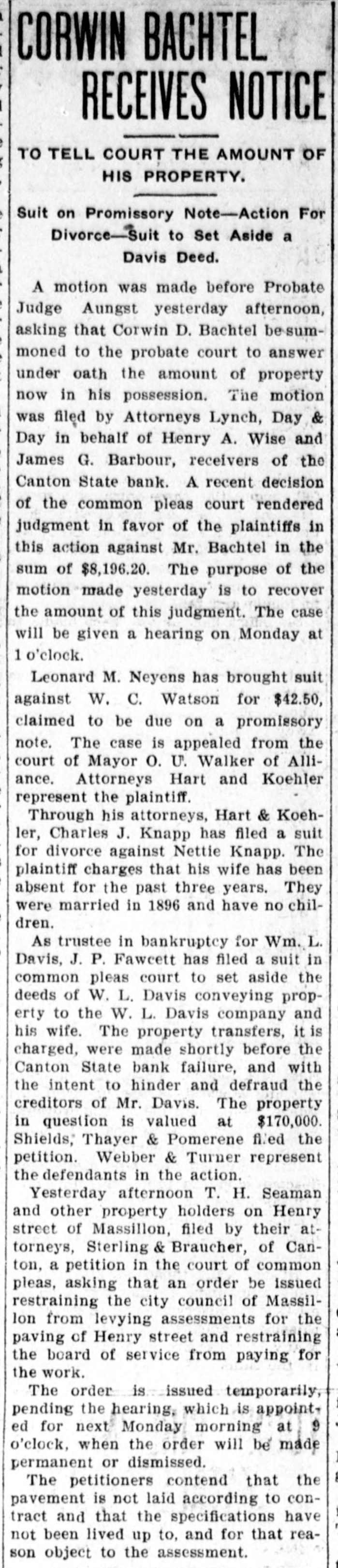
# CORWIN BACHTEL RECEIVES NOTICE TO TELL COURT THE AMOUNT OF HIS PROPERTY. Suit on Promissory Note-Action For Divorce-Suit to Set Aside a Davis Deed. A motion was made before Probate Judge Aungst yesterday afternoon, asking that Corwin D. Bachtel be summoned to the probate court to answer under oath the amount of property now in his possession. The motion was filed by Attorneys Lynch, Day & Day in behalf of Henry A. Wise and James G. Barbour, receivers of the Canton State bank. A recent decision of the common pleas court rendered judgment in favor of the plaintiffs in this action against Mr. Bachtel in the sum of $8,196.20. The purpose of the motion made yesterday is to recover the amount of this judgment. The case will be given a hearing on Monday at 1 o'clock. Leonard M. Neyens has brought suit against W. C. Watson for $42.50, claimed to be due on a promissory note. The case is appealed from the court of Mayor O. U. Walker of Alliance. Attorneys Hart and Koehler represent the plaintiff. Through his attorneys, Hart & Koehler, Charles J. Knapp has filed a suit for divorce against Nettie Knapp. The plaintiff charges that his wife has been absent for the past three years. They were married in 1896 and have no children. As trustee in bankruptcy for Wm. L. Davis, J. P. Fawcett has filed a suit in common pleas court to set aside the deeds of W. L. Davis conveying property to the W. L. Davis company and his wife. The property transfers, it is charged, were made shortly before the Canton State bank failure, and with the intent to hinder and defraud the creditors of Mr. Davis. The property in question is valued at $170,000. Shields, Thayer & Pomerene filed the petition. Webber & Turner represent the defendants in the action. Yesterday afternoon T. H. Seaman and other property holders on Henry street of Massillon, filed by their attorneys, Sterling & Braucher, of Canton, a petition in the court of common pleas, asking that an order be issued restraining the city council of Massillon from levying assessments for the paving of Henry street and restraining the board of service from paying for the work. The order is issued temporarily, pending the hearing, which is appointed for next Monday morning at 9 o'clock, when the order will be made permanent or dismissed. The petitioners contend that the pavement is not laid according to contract and that the specifications have not been lived up to, and for that reason object to the assessment.


Article from The Stark County Democrat, August 18, 1905

Click image to open full size in new tab

Article Text

DAVIS CASE HEARD BY JUDGE AMBLER SUIT TO SET ASIDE TRANSFER OF PROPERTY. Bachtel Examination Indefinitely Postponed-Massillon Temporarily Enjoined-Mrs. Williamson Brings Damage Suit. The case of Judge J. P. Fawcett, trustee in bankruptcy for William L. Davis, against William L. Davis, Louisa Davis, the W. L. Davis company, James G. Barbour and Henry A. Wise, receivers of the Canton State bank, was given a hearing before Judge Ambler yesterday afternoon. Judge Fawcett was upon the witness stand from 1 o'clock until 5. with the exception of an hour in the middle of the afternoon. Through Attorney Shields, the trustee for William L. Davis, he is seeking to set aside the transfer of property from Mr. Davis to the Canton State bank. The action of the trustee is being opposed by the receivers of the bank through their attorneys, Wm. A. Lynch and Austin Lynch. The attorneys on both sides questioned the witness very closely, but the hearing was not completed. The case will be continued on Wednesday morning at 9 o'clock. Yesterday afternoon a number of attorneys representing persons who are not parties to the suit were in the court room. Among them were Peter J. Collins, C. P. Meyer and J. L. Robb. BACHTEL CASE POSTPONED. The examination into the affairs of Corwin D. Bachtel was postponed indefinitely yesterday noon by Judge Ambler. This action was taken as the result of a motion filed by Attorneys Lynch, Day & Day. TEMPORARY INJUNCTION. A temporary injunction was issued yesterday by Common Pleas, Judge Ambler, restraining the city of Massillon from passing an ordinance for fixing assessments on the paving of a portion of Henry street in that city. The case will be tried later upon its merits. SUIT FOR DAMAGES Through her attorney, Peter J. Collins, Lilly L. Williamson has begun suit in common pleas court against Lena Witter. The plaintiff alleges that on the evening cf Aug. 5, 1905, Mrs. Witter was arrested on the charge of stealing a piece of meat from Killian's stall at the market house, and that in giving her name at the police station she registered as Mrs. Willlamson and gave the latter's address. Through newspaper publicity and by other means, the plaintiff claims that her name was damaged to the extent of $2,500 and sues in that amount. TRANSCRIPT FILED. A transcript from the civil docket of Justice Barrick was filed in common pleas court yesterday afternoon. The suit is filed by Eugene Jeanrenaud against the Woodford Distilling Co., and in the amount of $26.62. Craine & Snyder represent the plaintiff and Clark & Clark the defendant company. TO SETTLE ACCOUNT. To settle an account outstanding since 1889, J. A. Braucher has sued Sarah A. Krider, administratrix of the estate of Charles Krider. It is claimed by the plaintiff that before the death of Mr. Krider the latter owed Braucher on a contract for farming on shares a considerable sum of money. The estate has collected some claims of the deceased man, and for this money co!lected the plaintiff is suing. Attorneys R. A. Pinn and Charles Krichbaum represent Braucher.


Article from The Stark County Democrat, September 15, 1905

Click image to open full size in new tab

Article Text

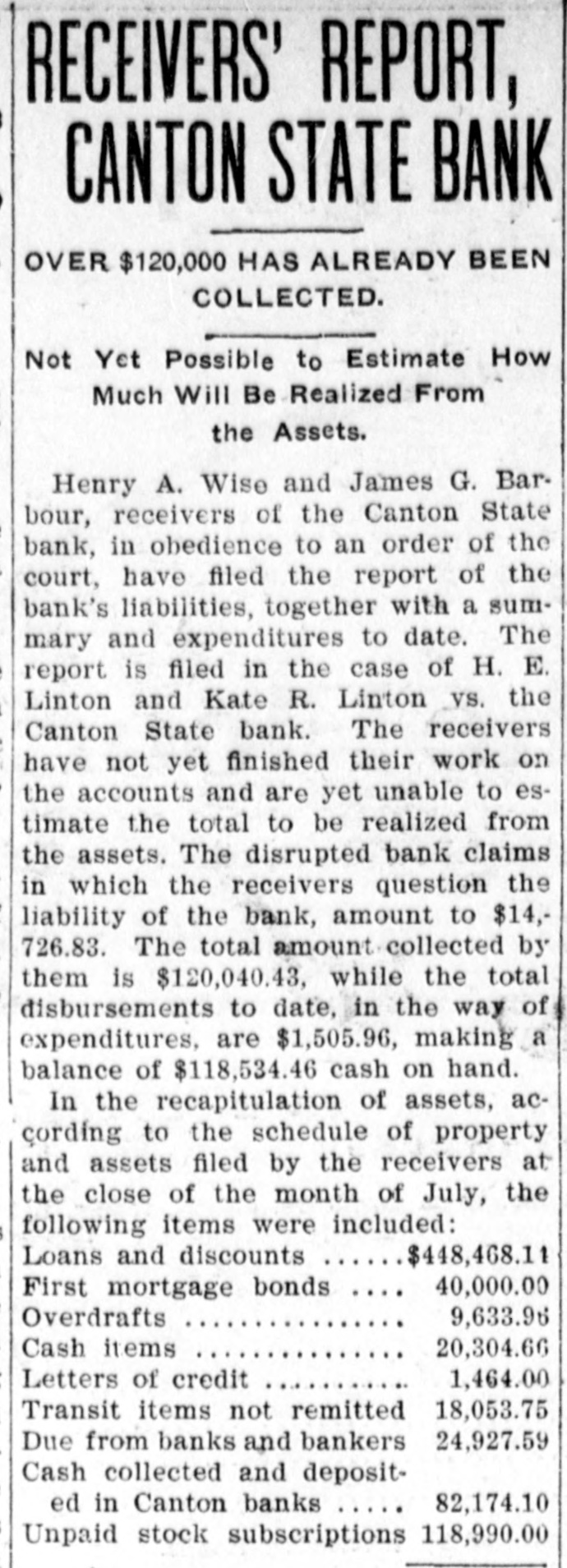
RECEIVERS' REPORT, CANTON STATE BANK OVER $120,000 HAS ALREADY BEEN COLLECTED. Not Yet Possible to Estimate How Much Will Be Realized From the Assets. Henry A. Wise and James G. Barbour, receivers of the Canton State bank, in obedience to an order of the court, have filed the report of the bank's liabilities, together with a summary and expenditures to date. The report is filed in the case of H. E. Linton and Kate R. Linton vs. the Canton State bank. The receivers have not yet finished their work on the accounts and are yet unable to estimate the total to be realized from the assets. The disrupted bank claims in which the receivers question the liability of the bank, amount to $14,726.83. The total amount collected by them is $120,040.43, while the total disbursements to date, in the way of expenditures, are $1,505.96, making a balance of $118,534.46 cash on hand. In the recapitulation of assets, according to the schedule of property and assets filed by the receivers at the close of the month of July, the following items were included: Loans and discounts $448,468.11 40,000.00 First mortgage bonds Overdrafts 9,633.96 Cash items 20,304.66 Letters of credit 1,464.00 Transit items not remitted 18,053.75 24,927.59 Due from banks and bankers Cash collected and deposited in Canton banks 82,174.10 Unpaid stock subscriptions 118,990.00


Article from The Stark County Democrat, September 15, 1905

Click image to open full size in new tab

Article Text

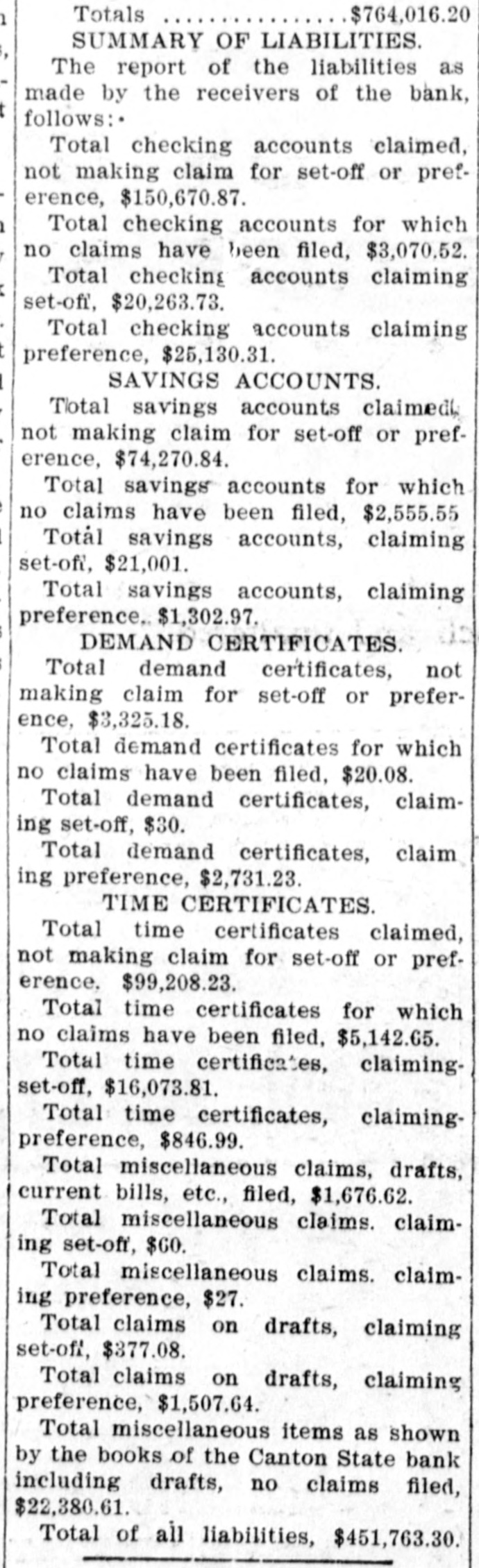
Totals $764,016.20 # SUMMARY OF LIABILITIES. The report of the liabilities as made by the receivers of the bank, follows:. Total checking accounts claimed, not making claim for set-off or pref-erence, $150,670.87. Total checking accounts for which no claims have been filed, $3,070,52. Total checking accounts claiming set-off, $20,263.73. Total checking accounts claiming preference, $25,130.31. # SAVINGS ACCOUNTS. Total savings accounts claimedl not making claim for set-off or pref-erence, $74,270.84. Total savings accounts for which no claims have been filed, $2,555.55 Total savings accounts, claiming set-ofi, $21,001. Total savings accounts, claiming preference. $1,302.97. # DEMAND CERTIFICATES. Total demand certificates, not making claim for set-off or prefer-ence, $3,325.18. Total demand certificates for which no claims have been filed, $20.08. Total demand certificates, claim-ing set-off, $30. Total demand certificates, claim ing preference, $2,731.23. # TIME CERTIFICATES. Total time certificates claimed, not making claim for set-off or pref-erence, $99,208.23. Total time certificates for which no claims have been filed, $5,142.65. Total time certificates, claiming-set-off, $16,073.81. Total time certificates, claiming-preference, $846.99. Total miscellaneous claims, drafts, current bills, etc., filed, $1,676.62. Total miscellaneous claims. claim-ing set-off, $60. Total miscellaneous claims. claim-ing preference, $27. Total claims on drafts, claiming set-off, $377.08. Total claims on drafts, claiming preference, $1,507.64. Total miscellaneous items as shown by the books of the Canton State bank including drafts, no claims filed, $22,380.61. Total of all liabilities, $451,763.30.

Article from The Star, October 11, 1905

Click image to open full size in new tab

Article Text

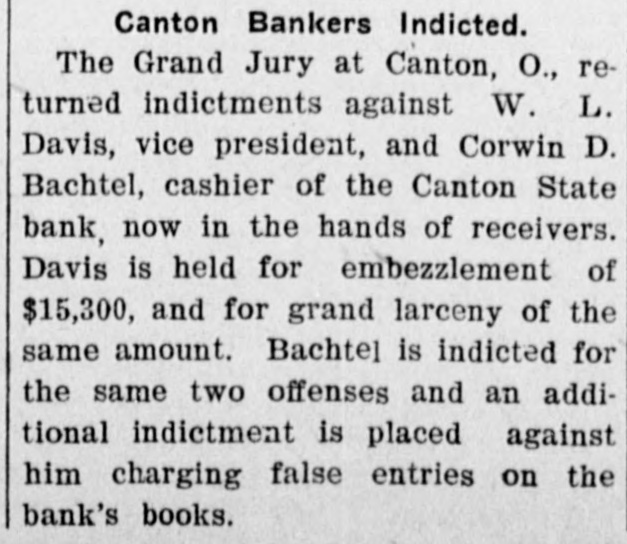
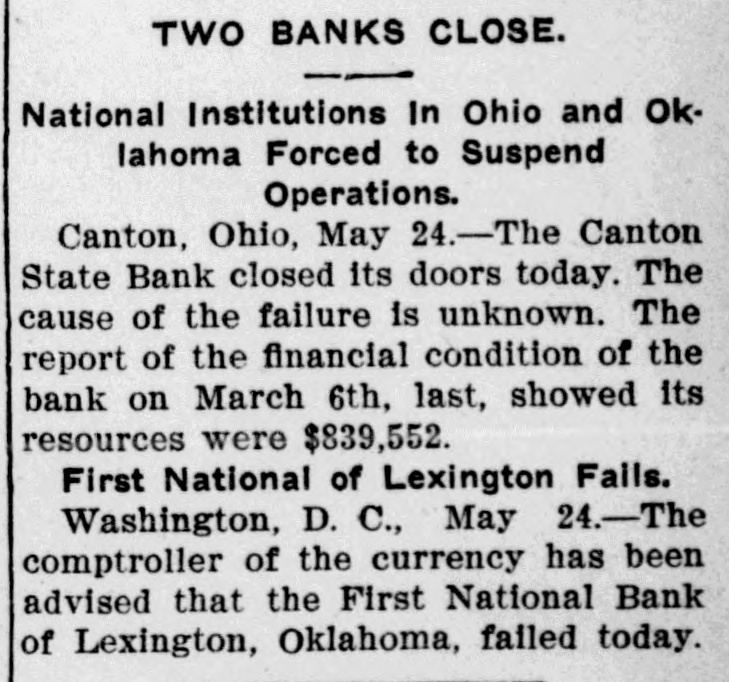
Canton Bankers Indicted. The Grand Jury at Canton, O., returned indictments against W. L. Davis, vice president, and Corwin D. Bachtel, cashier of the Canton State bank, now in the hands of receivers. Davis is held for embezzlement of $15,300, and for grand larceny of the same amount. Bachte1 is indicted for the same two offenses and an additional indictment is placed against him charging false entries on the bank's books.


Article from The Stark County Democrat, October 20, 1905

Click image to open full size in new tab

Article Text

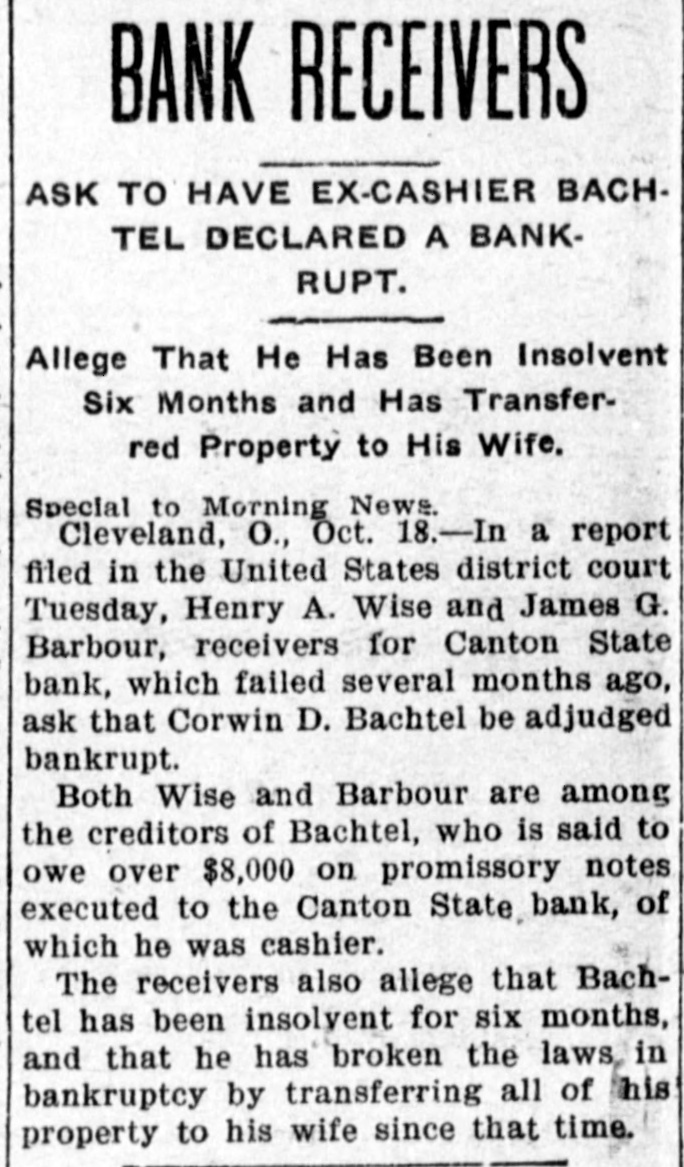
BANK RECEIVERS ASK TO HAVE EX-CASHIER BACHTEL DECLARED A BANKRUPT. Allege That He Has Been Insolvent Six Months and Has Transferred Property to His Wife. Special to Morning News. Cleveland, O., Oct. 18.-In a report filed in the United States district court Tuesday, Henry A. Wise and James G. Barbour, receivers for Canton State bank, which failed several months ago, ask that Corwin D. Bachtel be adjudged bankrupt. Both Wise and Barbour are among the creditors of Bachtel, who is said to owe over $8,000 on promissory notes executed to the Canton State bank, of which he was cashier. The receivers also allege that Bachtel has been insolvent for six months, and that he has broken the laws, in bankruptcy by transferring all of his property to his wife since that time.


Article from Perrysburg Journal, January 26, 1906

Click image to open full size in new tab

Article Text

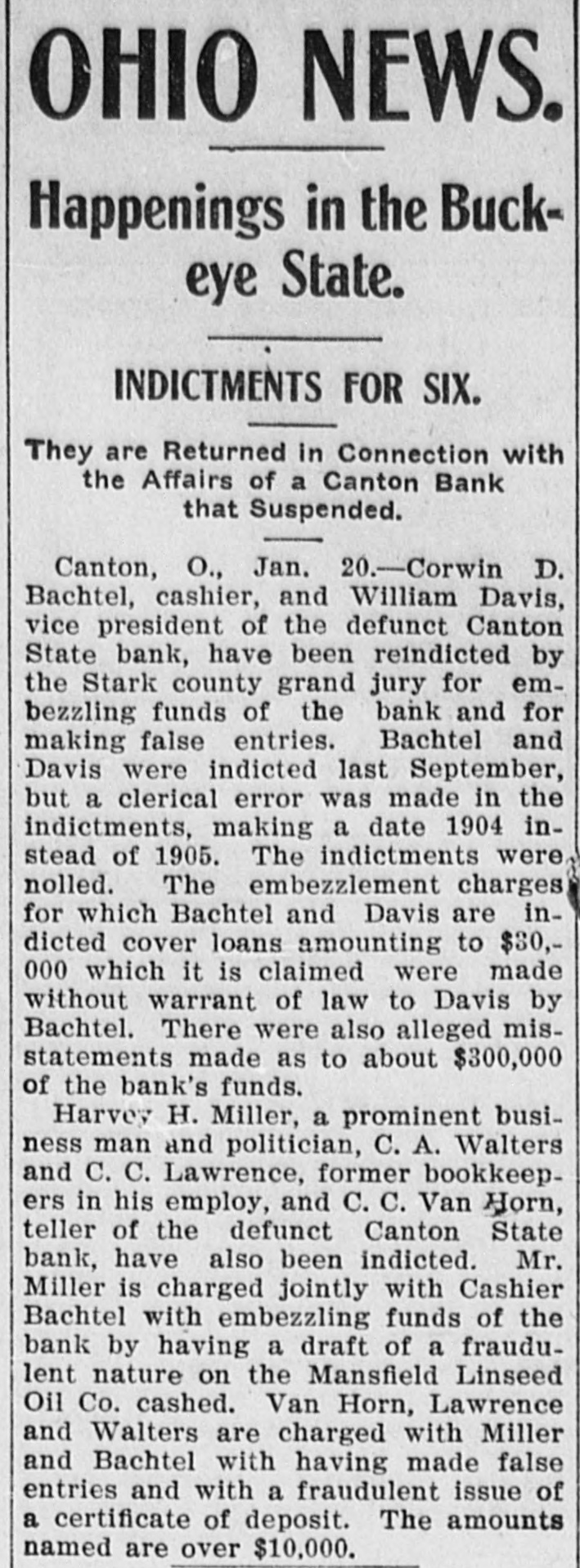
OHIO NEWS. Happenings in the Buckeye State. INDICTMENTS FOR SIX. They are Returned in Connection with the Affairs of a Canton Bank that Suspended. Canton, O., Jan. 20.-Corwin D. Bachtel, cashier, and William Davis, vice president of the defunct Canton State bank, have been reindicted by the Stark county grand jury for embezzling funds of the bank and for making false entries. Bachtel and Davis were indicted last September, but a clerical error was made in the indictments, making a date 1904 instead of 1905. The indictments were nolled. The embezzlement charges for which Bachtel and Davis are indicted cover loans amounting to $30,000 which it is claimed were made without warrant of law to Davis by Bachtel. There were also alleged misstatements made as to about $300,000 of the bank's funds. Harvey H. Miller, a prominent business man and politician, C. A. Walters and C. C. Lawrence, former bookkeep. ers in his employ, and C.C. Van Horn, teller of the defunct Canton State bank, have also been indicted. Mr. Miller is charged jointly with Cashier Bachtel with embezzling funds of the bank by having a draft of a fraudulent nature on the Mansfield Linseed Oil Co. cashed. Van Horn, Lawrence and Walters are charged with Miller and Bachtel with having made false entries and with a fraudulent issue of a certificate of deposit. The amounts named are over $10,000.


Article from The Stark County Democrat, January 26, 1906

Click image to open full size in new tab

Article Text

RESTRAINING ORDER. Judge Harter Thursday morning is- sued a restraining order preventing E. D. Hester, of Alliance, from erect- in a stairway in the home which he now occupies and which is owned by Isauore and Joseph Kock. It is claim- ed that Hester's building plans would result in irreparable damage to the home. Attorney Hart and Koehler represented the plaintiffs. TO FORECLOSE MORTGAGE. Attorney William H. Smith, in be- half of the Dime Savings bank com- pany was filed a suit in common pleas court against William H. Burgener, as guard an of J. 1. Holden, to recover the payment of an alleged $1,000 prom- sory note, with interest from July 6, 1904. The plaintiff asks that a mort- gage security be foreclosed and the prcceeds applied to payment. DIVORCE SUIT. Elda L. Whitacre filed a petition in common pleas court Thursday af- terncon against Albert W. Whitacre asking for a divorce and the restora- tion of her maiden name, Summer. Cruelty is the charge made. A re- straining order is also asked prevent- ing the defendant from disposing of their property. Attorney J. J. Grant represents the plaintiff. DIVORCE GRANTED. Judge Harter granted a divorce to Catnerine Bucher from Martin W. Bucher Thursday afternoon. Welty and Albaugh were attorneys for the plaintiff. The divorce case of Eliza- beth Neidlinger, of Massillon against Valentine Neidlinger was started be- fore Harter late Thursday afternoon. The charges are cruelty. The case will be continued this morning. Willison and Day are attorneys for the plain- tiff and Prosecutor Upham represents the defendant. COURT ASSIGNMENT. Deputy Clerk of Courts Agler has completed next week's court assign- ment. As Judge Ambler will be in Carrollton court will only be held in Judge Harter's room. On Monday the arraignments of prisoners, with the exception of those involved in the Canton State bank cases, will be held. The assignment of cases is as fol- lows: Tuesday, Jan. 30. Shumaker vs. Ir- win et al; Stark I. and M. Co., vs. Em- merman bros. Co.; Oliver vs. Dorrance et al; Edney vs. Reeves; Shufelt vs. Shufelt's adm'r. Wednesday, Jan. 31-Moore vs. News- Dem. Pub. Co.; Clark vs. Ducomb et al; Clark vs. W. & L. E. R. R.; Con- rer vs C. A. R'y Co.; Weaver vs. Sny- der et al; Deibel vs. Hoberdier et al. Thursday, Feb. 1.-Loutzenheiser vs. Kreibrill et al; Kaltenbach vs. Pocock Coal Co.; Graham vs. Ins. Co.; Graham vs. Ins. Co.; Neyens VS. Walters; Dennis & Dickey vs. Penna Co. Friday, Feb. 2.-Little's Adm'r. vs. C. T. & V. R. R.; Carnahan S. E. Co. vs. Canton Hollow Block Co.; Cris- well vs. Canton City; H. Middleton Co. vs. Diamond Metal Lath Co.; Harlan vs. Canton City; Schuff et al vs. Al- liance City. PETIT JURY DRAWN. The pet't jury for the January term of common plea court will convene before Judge Harter on Tuesday morn- ing. The following is the jury as drawn: Levi Bates, Washington; Jacob W. Smith, Canton; David Bates, Paris; Milton Shaeffer, Canton; H. Budd Pounds, Canton; Frank Baird, Can- ton; H. R. Bennett, Bethlehem; John Teeples, Lake; Jacob Schilling, Tus- carawas; Marion Ake, Osnaburg; Wil- liam Martin, Massilion; George W. Young, Lake; Henry, Margo, Canton; Abraham D. Coldren, Canton; Louis Ruch, Lawrence; William S. Ring- genberg, Canton; Samuel Holibaugh, Nimishillen. JUDGE HOLE TO PRESIDE. The attorneys for those indicted by the last grand jury in connection with the Investigation of the Canton State bank trouble met in the attorney's room in the court house yesterday and decided that Judge W. W. Hole, of Columbiana county would be a suitable selection to preside over the trials.


Article from The Stark County Democrat, March 30, 1906

Click image to open full size in new tab

Article Text

was competent, and admitted it. Then Attorney Craine read the resolution of the directors passed on May 5, 1900, appointing a teller at a salary of $65 a month. Leroy Coyle was also named as a bookkeeper at that time The appointments were for one year. Mr. Wagner's evidence was important as showing Van Horn to be a regular employe of the bank. He was not cross-examined. ### W. H. HOOVED CALLED. W. H. Hoover, of New Berlin, was next called. He said he was about the bank during the last two years. He saw Van Horn there acting as both teller and bookkeeper. Bachtel, the witness said, was cashier. Hoover was not cross-examined. ### HARVEY P. PACKER. Harvey P. Packer, a bookkeeper for W. L. Davis, vice president of the Canton State bank, was called and said he was employed by Davis for 13 years. He was shown a check which he identified. This he deposited in the Canton State bank. It was the one which figures in the Indictment. On a note attached to this was the word "hold." Packer made out the check to himself and endorsed it in the absence of Davis, supposed to be the real maker, and took it to the bank, together with the deposit check. The witness was shown the stub on the check book. The defense objected strenuously to the reading of the stub which was allowed under objection. The word "hold" was written by the witness an hour or two after the deposit was made. He went to the bank and asked an employe to pin the slip marked "hold" upon it after the bank had closed. The witness could not remember when he saw the check the second time, so a second check, a duplicate of the first, was shown him. This was made May 1, 1905, to replace the original. Packer said he went to the bank with the second check to take up the first one. The first check, made Dec. 22, 1904, the deposit slip and the check made May 1, 1905, were offered in evidence, together with the slip marked "hold." All except the second check were admitted under exceptions, which were sustained in the case of the second check. ### AFTERNOON SESSION. When court reconvened at 1 o'clock Tuesday afternoon Packer was put on the stand again and cross-examined by Attorney Siddall. He was questioned at length as to the notations on one of the check-book stubs. Witness could not tell where Davis was when he (Packer) drew the check on Dec. 22, 1904. The checks, he said, were left blank and signed by him. Attorney Siddall persisted in declaring that Packer did not appear positive as to anything, but had merely used his best recollection. To this side remark Attorney Craine objected, and the court sustained this objection. Davis, it appeared, drew up a check on a stone company for the purpose, he admitted on redirect examination, to give credit to Davis' personal account and not the account of the stone company. ### RECEIVER BARBOUR ON STAND. James G. Barbour, one of the receivers of the Canton State bank, was next called to explain about the bookkeeping system in vogue at the bank. He described the various books and records, which be brought along. He was asked to produce a daily ledger and brought up a book. He said it was the daily ledger. He turned to an entry of Dec. 22, 1904. He said Van Horn made the entries on page 286. Attorney Craine offered the book and entry as evidence. This was strenuously objected to by the defense, which sought to interrupt the direct examination so as to cross-examine. The court ruled against Attorney William A. Lynch, and declined to admit the entry at the present time. Barbour was shown another book, the journal, and identified an entry made there by Van Horn corresponding with the entry in the daily ledger. It was soon after this that the question of admitting this in evidence was brought up. This precipitated the above move on the part of the defense to knockout the indictment.


Article from The Richmond Palladium, January 8, 1907

Click image to open full size in new tab

Article Text

A Number of Rulings Made by Highest Tribunal in the Land Yesterday. MOODY'S FIRST DECISION NEY YORK'S STOCK TRANSFER CASE DECLARED VALID-OHIO BANK CASES WERE DISMISSED FROM DOCKET. [Publishers' Press.] Washington, Jan. 7.-In an opinion by Justice Brewer the supreme court dismissed the so-called Canton bank wrecking cases dealing with questions involved in the failure last spring of the Canton (Ohio) State bank. There were five of the Canton cases before the court, representing 25 indictments, and of the five two were against Corwin D. Bachtel, cashier of the bank, and one each against William L. Davis, a vice president and director; Charles H. Van Horn, teller, and Har- and H. Miller, a customer. These vey other indictments were returned 19 the grand jury of Stark county Ohio last May, by under what is known as the free banking law of the state, which provides for imprisonment from -one of to ten years.of any officer or agent to a bank who in any way attempts deceive or defraud. The indicted men made an immediate effort to secure release by means of writs of habeas corpus, and failing in the state courts, brought their suits to the supreme court. As that court refused to take cognizance of the case, they met with no better success. They relied entirely on establishing the unconsti- the tutionality of the law under which' proceeding against them was brought, contending that as the punishment provided for was made only to banks there incorporated under that statute, was discrimination such as to prevent in equal treatment before the law that provision was intended to apply some members of a class of persons, to and not to the class as a whole. order The effect of the supreme court will be to leave the cases in the state courts, at least for the present. The supreme court of the United g States announced its decision in the t stubbornly fought contest over street privileges in Cleveland, Ohio. The by opinion car of the court was presented deJustice Peckham and affirmed the 0 cision of the United States circuit i court for the northern district of II b Ohio. The suit involved the right to opera street car line on Central aveCleveland, for which both the and old t company, iue, the Cleveland Electric the new, the Forest City, contended, the former under a franchise, it urged, and S perpetual, or good until 1913, 5 was the latter under an ordinance passed of I 1904, granting to it a "renewal Central 00 the right to operate a line on for venue." The old company asked N njunction against the city, and the by company, which was granted the Judge new Taylor, who also held that ranchise of the old company expired h March 22, 1905. The city was prohibA ted from putting the Forest City V company in possession of the the ordinance other


Article from The Stark County Democrat, March 22, 1907

Click image to open full size in new tab

Article Text

# HE MADE GOOD (Continued from Page One.) tificates was the best and most tangible way. The books were produced and Bachtel testified that they had been so entered and that the handwriting was his. # BACHTEL'S REPORT. The making up of the report of October 12, 1904, to State Auditor Guilbert was next gone over. Bachtel stated that the blanks for the report to the state auditor do not contain sub-divisions of individual deposits. He swore that the only possible way to enter the $19,000 certificates of deposits was by putting it under the general item of individual deposits. A lengthy reproduction of the report to the state auditor was placed on an easel directly in front of the jury. Attorney Welty pointed out plainly each amount in question. H. H. Miller was the originator of the idea. # MORNING SESSION. At 9:15 Prosecuting Upham informed the court that the state had finished. Attorney Welty addressed the court stating that he wished to further cross examine several of the state's witnesses. Receiver James E. Barbour was called and asked if he had received several large pocket-books among the effects of the bank at the time he took charge as receiver. He answered in the affirmative. Leroy Coyle on cross examination was asked where the certificates of deposit were kept. The counsel for state and defense argued for some lime as to permissability of such cross examination. The court stated that the question was no doubt competent but that he was doubtful of the advisability of allowing the defense to go into such cross examination since the state had closed their rase. Judge Hole ruled that the defense had opened their case and that the form of examination was not in order although the particular question was competent. Attorney Welty for the defense filed a lengthy exception and Coyle was excused. # ASKED FOR ACQUITTAL. The defense then interposed a motion to have the court direct the jury to bring in a verdict of not guilty. The defense's contention on this score was that the state had not introduced sufficient evidence to substantiate the Indictment. Bachtel, they said, had been charged with having made a false report in the sum of $179,982, while the state had only accounted for $19,000. # OVERRULED The court overruled the motion and instructed the defense to proceed with their case. Upon the call of Upham for a separation of witnesses, the defense instructed W. L. Davis and Expert Accountant Blythe to leave. Blythe is in the employ of the defense. The above two and Coyle and Bachtel will testify for the defense. Coyle was questioned closely on his knowledge of the certificates of deposit in question. Welty did his best to have Coyle testify that he knew to whom the certificates of deposit belonged. Each query to Coyle was objected to by the state and he left the stand without having answered the desired question. W. L. Davis, a director and the first vice president of the Canton State bank, was called next. His examination was conducted by Turner. # DAVIS' TESTIMONY. Davis testified that the board of directors took action at their meeting of June 4, 1904, to have Bachtel continue in carrying the Schucker re-discounts as individual deposits. He said that Bachtel had suggested at this meeting that the Schucker re-discounts which had been carried for some time as individual deposits should be shifted to their proper place under re-discounts. The board, however, Davis testified, instructed Bachtel to continue carrying them as individual deposits and that he should reduce them as rapidly as possible. In the cross examination Attorney Craine went directly into the question of the impending indictments against Davis. This was done to question his credibility. The defense objected and a recess of ten minutes was allowed to argue the question. # OVERRULED AGAIN. After a recess of ten imnutes and the study of authorities the court overruled the defense's objections. Davis said there were a number of indictments against him but did not know how many. He added that he thought he could meet them. Craine retaliated and said: "You will not have any choice but will have to meet them." "You are indebted to the bank in the sum of $415,000, are you not?" Defense's objection sustained. "You are quite a warm friend of Bachtel's?" "Yes." "You were in conference with Bachtel's attorneys last night were you not?" "Yes, I was." "You talked over testimony, did


Article from The Stark County Democrat, August 27, 1908

Click image to open full size in new tab

Article Text

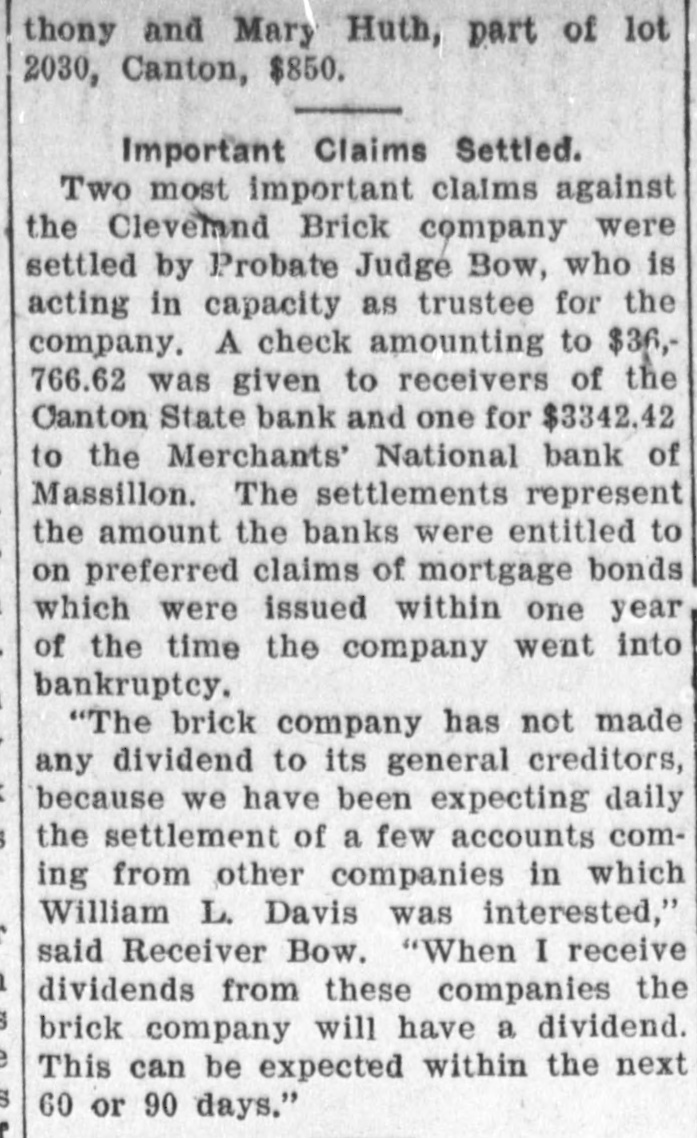
# Important Claims Settled. Two most important claims against the Cleveland Brick company were settled by Probate Judge Bow, who is acting in capacity as trustee for the company. A check amounting to $36,766.62 was given to receivers of the Canton State bank and one for $3342.42 to the Merchants' National bank of Massillon. The settlements represent the amount the banks were entitled to on preferred claims of mortgage bonds which were issued within one year of the time the company went into bankruptcy. "The brick company has not made any dividend to its general creditors, because we have been expecting daily the settlement of a few accounts coming from other companies in which William L. Davis was interested," said Receiver Bow. "When I receive dividends from these companies the brick company will have a dividend. This can be expected within the next 60 or 90 days."