Articles (June 1904) report the Commercial Bank of Cambridge (Guernsey County), a private institution, closed and a receiver (R. V. Orme/Orue) appointed after discovery of large defalcations by Cashier P. C. Patterson and Vice President H. O. (Herbert) Barber. No article describes a depositor run; failure follows discovery of embezzlement and receivership.
Events (2)
1.June 16, 1904Receivership
Newspaper Excerpt
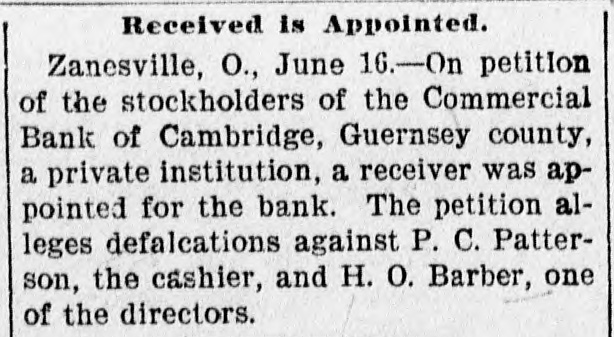
On petition of the stockholders of the Commercial Bank of Cambridge, Guernsey county, a private institution, a receiver was appointed for the bank. The petition alleges defalcations against P. C. Patterson, the cashier, and H. O. Barber, one of the directors.
Source
newspapers
2.June 16, 1904Suspension
Cause
Bank Specific Adverse Info
Cause Details
Stockholders petitioned after discovery of large defalcations/embezzlements by Cashier P. C. Patterson and Vice President H. O. Barber (shortage ~ $100,000).
Newspaper Excerpt
On petition of the stockholders of the Commercial Bank of Cambridge, a private institution, a receiver was appointed for the bank to-day.
Source
newspapers
Newspaper Articles (10)
1.June 16, 1904The San Francisco CallSan Francisco, CA
Click image to open full size in new tab
Article Text
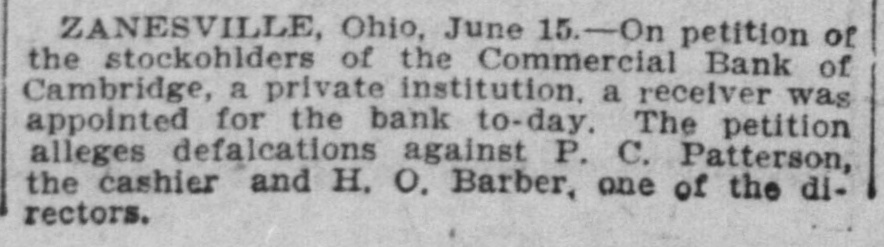
ZANESVILLE, Ohio, June 15.-On petition of the stockohlders of the Commercial Bank of Cambridge, a private institution. a receiver was appointed for the bank to-day. The petition alleges defalcations against P. C. Patterson, the cashier and H. O. Barber, one of the directors.
2.June 18, 1904The Cairo BulletinCairo, IL
Click image to open full size in new tab
Article Text
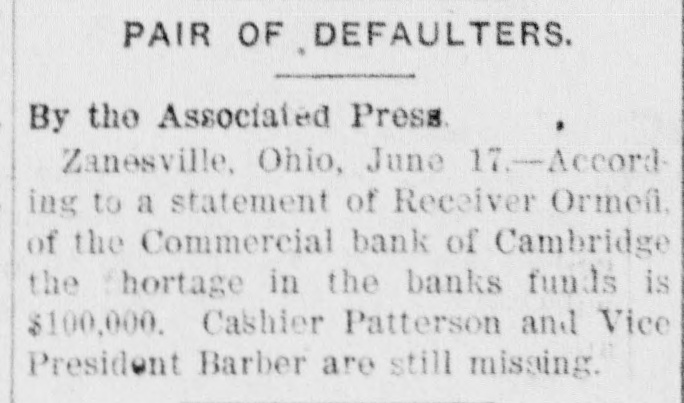
PAIR OF DEFAULTERS. . By the Associated Press. Zanesville, Ohio, June 17.-Accord ing to a statement of Receiver Ormeñ. of the Commercial bank of Cambridge the hortage in the banks funds is $100,000. Cashier Patterson and Vice President Barber are still missing.
3.June 21, 1904The Stark County DemocratCanton, OH
Click image to open full size in new tab
Article Text
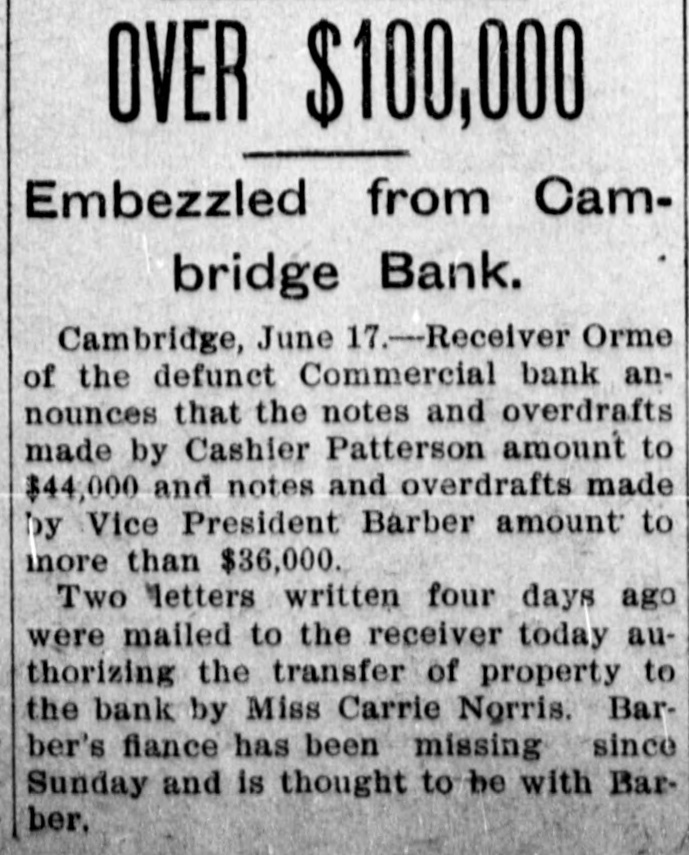
OVER $100,000 Embezzled from Cambridge Bank. Cambridge, June 17.-Receiver Orme of the defunct Commercial bank announces that the notes and overdrafts made by Cashier Patterson amount to $44,000 and notes and overdrafts made by Vice President Barber amount to inore than $36,000. Two Metters written four days ago were mailed to the receiver today authorizing the transfer of property to the bank by Miss Carrie Norris. Barber's fiance has been missing since Sunday and is thought to be with Barber.
4.June 23, 1904The Manitowoc PilotManitowoc, WI
Click image to open full size in new tab
Article Text
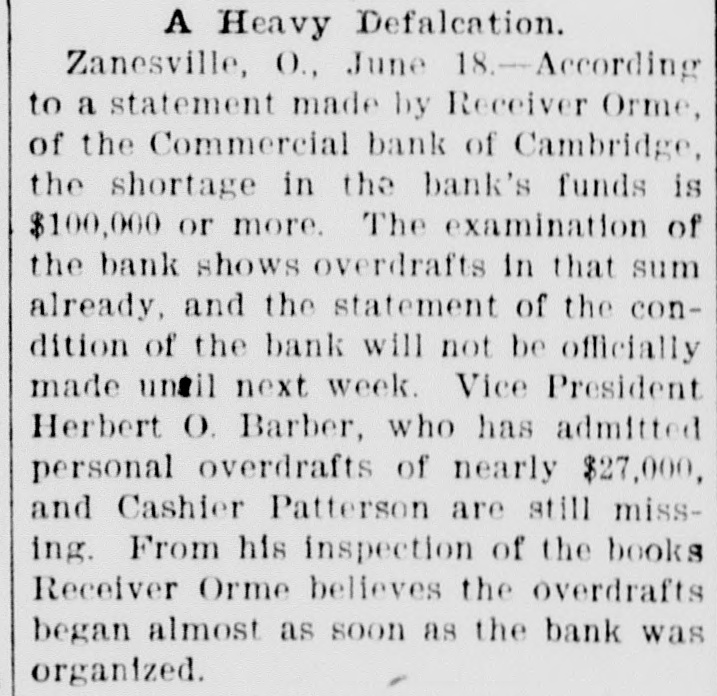
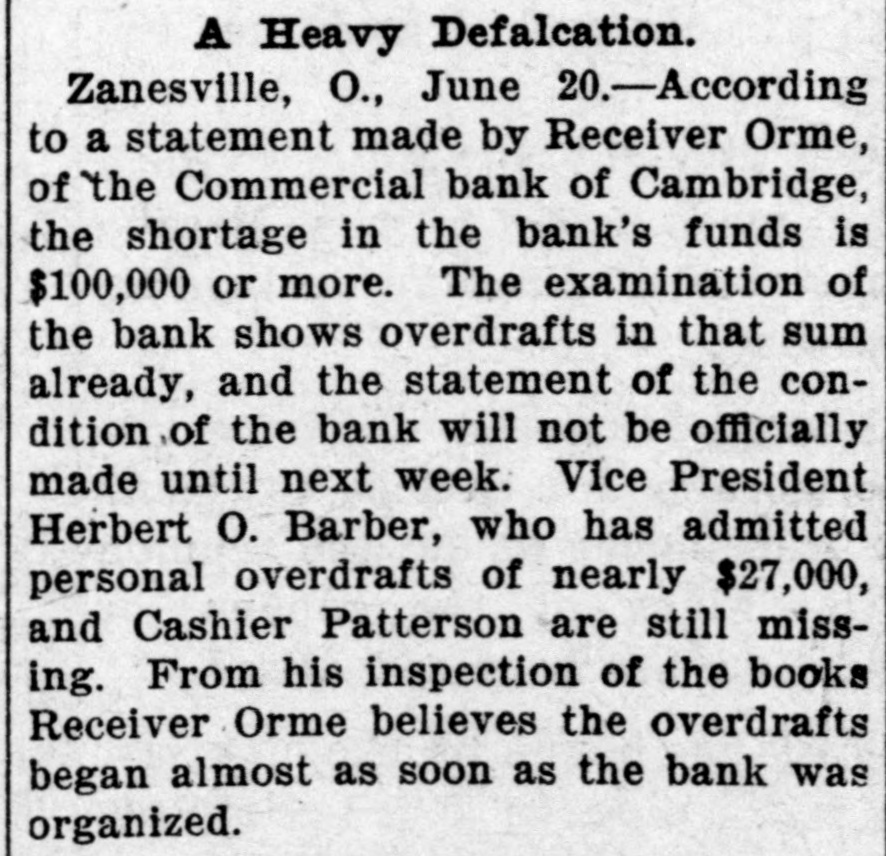
A Heavy Defalcation. Zanesville, O., June 18.-According to a statement made by Receiver Orme, of the Commercial bank of Cambridge, the shortage in the bank's funds is $100,000 or more. The examination of the bank shows overdrafts in that sum already, and the statement of the condition of the bank will not be officially made until next week. Vice President Herbert O. Barber, who has admitted personal overdrafts of nearly $27,000, and Cashier Patterson are still missing. From his inspection of the books Receiver Orme believes the overdrafts began almost as soon as the bank was organized.
5.June 23, 1904Iron County RegisterIronton, MO
Click image to open full size in new tab
Article Text
Received is Appointed. Zanesville, O., June 16.-On petition of the stockholders of the Commercial Bank of Cambridge, Guernsey county, a private institution, a receiver was appointed for the bank. The petition alleges defalcations against P. C. Patterson, the cashier, and H. O. Barber, one of the directors.
6.June 24, 1904Perrysburg JournalPerrysburg, OH
Click image to open full size in new tab
Article Text
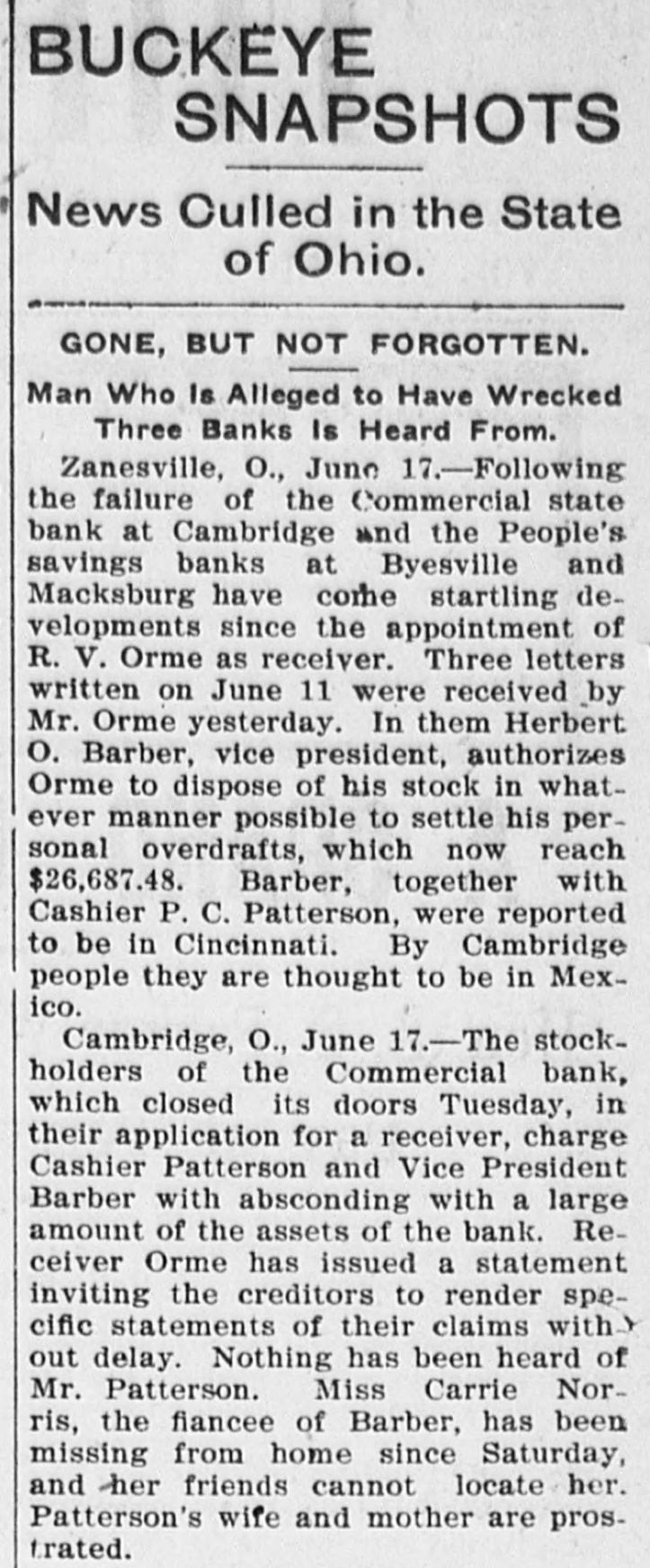
BUCKEYE SNAPSHOTS News Culled in the State of Ohio. GONE, BUT NOT FORGOTTEN. Man Who Is Alleged to Have Wrecked Three Banks Is Heard From. Zanesville, O., June 17.-Following the failure of the Commercial state bank at Cambridge and the People's savings banks at Byesville and Macksburg have come startling developments since the appointment of R. V. Orme as receiver. Three letters written on June 11 were received by Mr. Orme yesterday. In them Herbert O. Barber, vice president, authorizes Orme to dispose of his stock in whatever manner possible to settle his personal overdrafts, which now reach $26,687.48. Barber, together with Cashier P. C. Patterson, were reported to be in Cincinnati. By Cambridge people they are thought to be in Mexico. Cambridge, O., June 17.-The stockholders of the Commercial bank, which closed its doors Tuesday, in their application for a receiver, charge Cashier Patterson and Vice President Barber with absconding with a large amount of the assets of the bank. Receiver Orme has issued a statement inviting the creditors to render specific statements of their claims with out delay. Nothing has been heard of Mr. Patterson. Miss Carrie Norris, the fiancee of Barber, has been missing from home since Saturday, and her friends cannot locate her. Patterson's wife and mother are prostrated.
7.June 24, 1904The Jasper Weekly CourierJasper, IN
Click image to open full size in new tab
Article Text
Received is Appointed. Zanesville, O., June 16.-On petition of the stockholders of the Commercial Bank of Cambridge, Guernsey county, a private institution, a receiver was appointed for the bank. The petition alleges defalcations against P. C. Patterson, the cashier, and H. O. Barber, one of the directors.
8.June 24, 1904The Ely MinerEly, MN
Click image to open full size in new tab
Article Text
A Heavy Defalcation. Zanesville, O., June 20.-According to a statement made by Receiver Orme, of the Commercial bank of Cambridge, the shortage in the bank's funds is $100,000 or more. The examination of the bank shows overdrafts in that sum already, and the statement of the condition of the bank will not be officially made until next week. Vice President Herbert O. Barber, who has admitted personal overdrafts of nearly $27,000, and Cashier Patterson are still missing. From his inspection of the books Receiver Orme believes the overdrafts began almost as soon as the bank was organized.
9.June 25, 1904Chicago EagleChicago, IL
Click image to open full size in new tab
Article Text
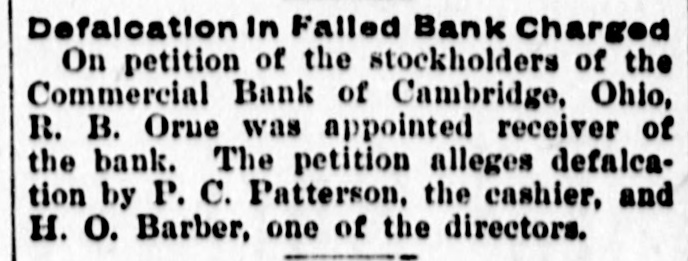
Defalcation In Falled Bank Charged On petition of the stockholders of the Commercial Bank of Cambridge, Ohio, R. B. Orue was appointed receiver of the bank. The petition alleges defalcation by P. C. Patterson. the cashier, and H. O. Barber, one of the directors.
10.March 28, 1905Wausau PilotWausau, WI
Click image to open full size in new tab
Article Text
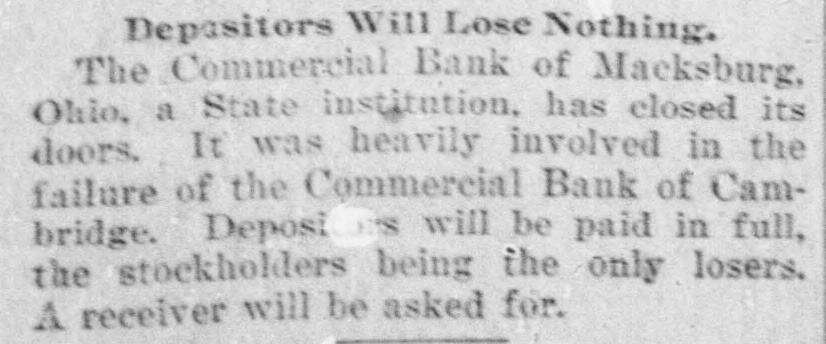
Depositors Will Lose Nothing. The Commercial Bank of Macksburg, Ohio, a State institution, has closed its doors. It was heavily involved in the failure of the Commercial Bank of Cambridge. Deposi its will be paid in full, the stockholders being the only losers. A receiver will be asked for.